

Images of Revolution

Why Images Matter
One of my favorite parts of learning about the American Revolution is its images – the fascinating backstories and the surprising lives of the artists behind them.
Discover Hidden Stories
As we prepared to launch Analyzing American Revolution, it occurred to us that most people don’t know the rich stories behind these images—the personal stories and political angles they reveal.
Resources & Links
We’ll highlight these images from time to time and list them here for your convenience:
Traditions & Memories

Why Myths and Traditions Matter
On the homepage of this website, we state that myths are important—even sacred. This applies to traditions as well.
Exploring Revolutionary Traditions
In our program, we explore the myths and traditions of the American Revolution from many angles, uncovering how these stories shaped collective memory and cultural identity.
Resources & Links
Here are a few highlights from our coverage:
- 3 Reasons Why Yankee Doodle Embodies the American Revolution
- How do we Americans remember the American Revolution? And how have our traditions and memories changed over the centuries? Dr. Michael D. Hattem has written extensively on this topic, including The Memory of ’76 and Past and Prologue: Politics and Memory in the American Revolution, books that we discuss with him in detail. That interview will be linked here when it publishes.
- Christmas in the Revolutionary Era: Traditions, War, Nation-Building
Revolution's Intellectual Foundations

The Cross-Atlantic Dialogue
The cross-Atlantic discourse among the great minds of Great Britain, France, the Netherlands, and the American colonies formed the intellectual underpinnings not just of the American Revolution, but also of revolutions in the Netherlands, France, and Ireland.
The Wider Impact
The ideas and ideals of that era—the Age of Enlightenment (also known as the Age of Revolution)—touched the Habsburg, Ottoman, and Russian Empires as well.
Resources & Links
We explore the Revolution’s intellectual foundations from several angles:
- Dr. Sophia Rosenfeld takes us through the Age of Enlightenment and its impact on the American Revolution—and vice versa.
- In a two-part interview, Prof. Harvey Kaye dissects Thomas Paine’s turbulent and tragic life and explains his intellectual radicalization that led to the publication of Common Sense. He also shows how this 47-page pamphlet shifted the colonies away from the King and toward independence.
- Dr. Peter Van Cleave reveals a facet of the American Revolution that I suspect most of you have never heard about: the intellectual contributions of the Dutch to the Revolution. That interview will be linked here when it publishes.
- Dr. Ivan Kurilla explains how an enlightened queen—Empress Catherine the Great of Russia—reacted when the American Declaration of Independence was printed in Russian newspapers.
Seeds of Revolution

An Unlikely Or An Inevitable Revolution
It’s fair to say that the American colonies changed after 1763. But perhaps this focus misses a point fundamentally more important: the British Empire itself underwent an internal transformation after the Seven Years’ War.
The American colonists’ reactions to new British policies ultimately set the stage for revolution — a process shaped as much by imperial reforms as by colonial grievances.
Resources & Links
In our program, guest scholars uncover the undercurrents that brought the American Revolution to the surface, including:
- Dr. Steven Pincus, author of 1688: The First Modern Revolution and The Heart of the Declaration: The Founders’ Case for an Activist Government, answers this question: when do revolutions happen? Surprise: revolutions don’t occur when the populace is most desperate for change — they occur when governments modernize their systems and institutions, as the British did in the 1760s and 1770s.
- Dr. Michael D. Hattem, author of The Memory of ’76 and Past and Prologue: Politics and Memory in the American Revolution, explains how the American colonists sense of history and identity shifted after 1763. That interview will be linked here when it publishes.
- Dr. Serena Zabin, author of The Boston Massacre: A Family History, explores the complex intermix of British soldiers and their families with American colonists in Boston — confusing not just to historians today, but even at the time. She also highlights the huge emotional and propaganda impact of Paul Revere’s engraving (shown above), and details an event the impact of which arguably doesn’t need confirmation: that the Boston Massacre changed the colonies’ relationship with the British Empire. That interview will be linked here when it publishes.
- Dr. Robert A Gross, author of The Minutemen and Their World, describes the economic, societal, generational, and religious transformations in British policies that shaped events in Concord and other parts of western Massachusetts. That interview will be linked here when it publishes.
- Dr. Dael A. Norwood, author of Trading Freedom: How Trade with China Defined Early America, tells us what the Qing Dynasty thought of the American Revolution and later Americans (to the extent that it mattered to them at all), and, more importantly, details how the trade with China was so important in the consciousness of the American colonists.
Organizing The Revolution

Why Committees Mattered
Committees are one of the most understudied areas of the early Revolutionary years. Just ask yourself this: did you learn about the various committees of the American Revolution in your K-12 years? Probably not—or maybe just a little.
Yet without these committees, the American Revolution might never have launched, let alone succeeded!
Resources & Links
Our program devotes many articles and interviews to colonial committees. For your convenience, here are some key resources:
The Revolutionary War

A Complex War Fought on Many Fronts
We all learned in school about the heroics of the Revolutionary War — George Washington’s crossing of the Delaware, for example. While those dramatic moments and determinative battles, like the Siege of Yorktown, are important, so much more defines the American war effort and deserves attention.
Resources & Links
Our program highlights the lesser-known aspects of the American Revolutionary War, including:
- How Committees of Safety supported the war effort by enforcing colonial policies and policing Loyalists.
- Dr. Ricardo Herrera, author of For Liberty and the Republic: The American Citizen as Soldier, 1775-1861, and Feeding Washington’s Army: Surviving the Valley Forge Winter of 1778, explores creating and maintaining the Continental Army, the experiences of soldiers and officers, pivotal battles, and more.
- Dr. Paul Douglas Lockhart, author of The Drillmaster of Valley Forge: The Baron de Steuben and the Making of the American Army, explains why Valley Forge was selected for the winter camp, how foreign officers contributed to the Revolutionary War, the contrast between Steuben and Lafayette, and the life and real contributions of Baron von Steuben. I also ask him: did we ever compensate Steuben?
- Dr. Robert A Gross, author of The Minutemen and Their World, describes the transformations in Concord and other parts of western Massachusetts that led to “the shot heard ’round the world” on April 19, 1775.
- Dr. Rebecca Brannon, author of Loyalists and The American Revolution and From Revolution to Reunion: The Reintegration of the South Carolina Loyalists, tells us about Loyalists — who they were, why they opposed the Revolution — and answers this question: was the American Revolution in essence a civil war?
- Dr. John G. McCurdy, author of Quarters: The Accommodation of the British Army and the Coming of the American Revolution, explains that, despite our collective historical memory of the American Revolution, Britain’s Quartering Acts did not force British soldiers into the private homes of American colonists. If that is the case, then why did the Founders include the Third Amendment in the Bill of Rights?
- Dr. Farley Grubb, author of The Continental Dollar: How the American Revolution was Financed with Paper Money, upends our common belief that the Continental Congress merely printed worthless money to finance the American Revolution. That interview will be linked here when it publishes.
The Continental Perspective
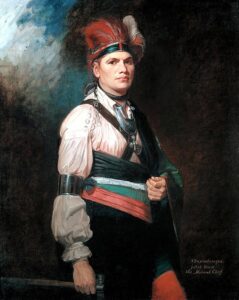
Joseph Brant (1743-1807) was a Mohawk military and political leader who fought for the British during the American Revolution. I selected his portrait because it gives us a glimpse into the tragic dilemma of North America’s indigenous peoples.
The Curcible of the American Revolution
Was the American Revolution a civil war? Were the British fighting only American rebels on the Continent? And were the American Patriots really fighting only the British within the Thirteen Colonies?
A closer look at the American Continent during the Revolutionary War points to a clear answer: it was a crucible—one whose complexity upends what we learned in school. In the process, it reveals the American Revolution as a far more layered and colorful conflict than we often imagine.
Resources & Links
We explore the Continental perspective from several angles, including the following:
- Dr. David Silverman, author of many books about Native America, Colonial and Revolutionary America, including The Chosen and the Damned: Native Americans and the Making of Race in the United States (forthcoming), explains the existential dilemma the Revolution forced on Native Americans (aka Indians), and how it tore apart their communities and alliances.
- Dr. Rebecca Brannon, author of Loyalists and The American Revolution and From Revolution to Reunion: The Reintegration of the South Carolina Loyalists, tells us about Loyalists — who they were, why they opposed the Revolution — and answers this question: was the American Revolution in essence a civil war?
- Dr. Gonzalo Quintero, author of Bernardo de Gálvez: Spanish Hero of the American Revolution and Spain and the American Revolution: New Approaches and Perspectives (The Revolutionary Age), brings to the fore part of the Revolutionary War that most of us Americans know little about—Spain fought the British on the American Continent. That interview will be linked here when it publishes.
The French Alliance

Understanding the French Gamble on America
After its humiliating loss to Britain in the French and Indian War (aka the Seven Years’ War), Louis XV was consumed with plotting revenge. However, his grandson, Louis XVI, initially resolved to honor France’s peace terms with Britain.
So, how did the King’s steadfast determination come undone? And how did France ultimately contribute to the American cause? There is much here that we didn’t learn in school, and I submit you will experience many wow moments.
Resources & Links
We explore the French alliance from several angles, including the following:
- Dr. Rafe Blaufarb, author of books on the French Revolution, Napoleon and the French Army, as well as The Revolutionary Atlantic: Republican Visions, 1760-1830, explains how the Kingdom of France transformed an intra-empire British rebellion into a world war. He elaborates on French realpolitik and doesn’t shy away from asserting that Americans betrayed the French during the Paris peace negotiations with Britain.
- Prof. Joel Richard Paul, author of Unlikely Allies: How a Merchant, a Playwright, and a Spy Saved the American Revolution, takes us through the unbelievable world of internal French and American politics — scheming, assassination plots, cross-dressing spies, blackmail, backstabbing, American family feuds, polarized colonial politics (yes, even before we had formed a country), and secret night-time supply routes that saved the Revolution. Prepare for many wow moments.
- Dr. Eliga Gould, author of Peace and Independence: The Turbulent History of the United States’ Founding Treaty (forthcoming), details the history of the negotiations culminating in the Treaty of Paris, signed on September 3, 1783. Although this treaty formally ended the Revolutionary War, it cleared many hurdles for the founding of a great new nation. That interview will be linked here when it publishes.
The British Perspective

How Britain Confronted Rebellion
Did Cornwallis leave America dishonored and disgraced? Did King George III contemplate abdicating his throne? Did ordinary Britons sympathize with the American cause—and if so, when and why did their opinions change? And why didn’t the pro-American faction of Parliament prevail?
Exploring the American Revolution from the British perspective complicates familiar narratives and forces us to rethink how the conflict was understood in London, Parliament, and British society at large.
Resources & Links
We explore the British perspective from several angles, including the following:
- Dr. Richard Bell, author of The American Revolution and the Fate of the World, joins our program to address these questions and more. Among them: How did King George III react when he read the American Declaration of Independence? That interview will be linked here when it publishes.
- Prof. Carlton F.W. Larson, author of The Trials of Allegiance: Treason, Juries, and the American Revolution, examines the legal and political meaning of “treason” during the Revolution. In doing so, he reflects on the King’s reference to “traitorous correspondence” in the proclamation shown above. That interview will be linked here when it publishes.
- Prof. Harvey Kaye, author of Thomas Paine and the Promise of America, analyzes Thomas Paine’s tumultuous life before his journey to America and widens the lens on British society and politics.
- Dr. Steven Pincus, author of 1688: The First Modern Revolution and The Heart of the Declaration: The Founders’ Case for an Activist Government, answers this question: when do revolutions happen? Surprise: revolutions don’t occur when the populace is most desperate for change — they occur when governments modernize their systems and institutions, as the British did in the 1760s and 1770s.
The Global Perspective

A World Event
A salient feature of the American Revolution is its global nature—undoubtedly because Britain was a global power. Consequently, a significant upheaval within the British imperial system engulfed and enticed others to get involved.
So, in our program, we examine the American Revolution from many global perspectives—not for the sake of inclusivity, but to better understand the world of the Revolutionary Era.
Resources & Links
Here are some of the global perspectives our guest scholars explore:
- Dr. David Silverman, author of many books about Native America, Colonial and Revolutionary America, including The Chosen and the Damned: Native Americans and the Making of Race in the United States (forthcoming), explains the existential dilemma the Revolution forced on Native Americans (aka Indians), and how it tore apart their communities and alliances.
- Dr. Jeffers Lennox, author of North of America: Revolution, British Provinces, and Creating the United States, 1774-1815 (forthcoming), describes British Canada’s interactions with the American Revolution. That interview will be linked here when it publishes.
- Dr. Gonzalo Quintero, author of Bernardo de Gálvez: Spanish Hero of the American Revolution and Spain and the American Revolution: New Approaches and Perspectives (The Revolutionary Age), brings to the fore part of the Revolutionary War that most of us Americans know little about—Spain’s support, influence and perspective on the American Revolution. That interview will be linked here when it publishes.
- Dr. Peter Van Cleave, author of A Shadow of Liberty: Religion, Politics, and the Dutch in the Early American Republic (forthcoming), explains how the Dutch influenced the intellectual foundation of the American Revolution, how they directly supported it, and how that support led them to war with the British Empire. That interview will be linked here when it publishes.
- Dr. Jonathan Singerton, author of The American Revolution and the Habsburg Monarchy, explains Austria’s perspective on the American Revolution. That interview will be linked here when it publishes.
- Dr. Daniel Krebs, author of A Generous and Merciful Enemy: Life for German Prisoners of War during the American Revolution, describes how the German states got involved in the American Revolution and how Hessian POWs fared in the American colonies. That interview will be linked here when it publishes.
- Dr. Friederike Baer, author of Hessians: German Soldiers in the American Revolutionary War, examines the role and impact of Hessian forces in the American colonies by exploring battles and other aspects of the Revolutionary War. That interview will be linked here when it publishes.
- Dr. Ivan Kurilla, co-author of Distant Friends and Intimate Enemies: A History of American–Russian Relations, tells us how Catherine the Great assessed the American Revolution, why she refused to assist the British, and how her subjects reacted to the American Revolution – for instance when they read the American Declaration of Independence in their newspapers!
- Dr. Dael A. Norwood, author of Trading Freedom: How Trade with China Defined Early America, tells us what the Qing Dynasty thought of the American Revolution and later Americans (to the extent that it mattered to them at all), and, more importantly, details how the trade with China was so important in the consciousness of the American colonists.
Other Key Themes

Stories That Compose the Revolution’s Narrative
One of the challenges of studying the American Revolution is its vast scope. Upon closer inspection, many lesser-known subthemes prove to be integral to understanding the Revolution.
My interest in taverns illustrates this point: popular movies, documentaries, and other narratives rarely highlight their importance. Yet, as the image above suggests, many pivotal decisions were made in taverns.
Resources & Links
Here are themes our guest scholars explore to reveal the depth and complexity of the American Revolution:
- Dr. Vaughn Scribner, author of Inn Civility: Urban Taverns and Early American Civil Society, describes tavern culture in early America and their influence on the American Revolution.
- Dr. Kathleen M. Brown, author of Good Wives, Nasty Wenches, and Anxious Patriarchs: Gender, Race, and Power in Colonial Virginia, explains how women were involved in the American Revolution and its impact on women.
- Dr. Aaron Fogleman, author of Hopeful Journeys: German Immigration, Settlement, and Political Culture in Colonial America, 1717-1775, describes immigration to America before the American Revolution, and how immigrants affected the Revolution.
- Dr. John G. McCurdy, author of Vicious and Immoral: Homosexuality, the American Revolution, and the Trials of Robert Newburgh and Citizen Bachelors: Manhood and the Creation of the United States, explores gender and LGBTQ+ facets of the American Revolution.
- Dr. Katherine Carté, author of Religion and the American Revolution: An Imperial History and Religion and Profit: Moravians in Early America, explains the role of religion in the American Revolution. That interview will be linked here when it publishes
- Dr. Christopher P. Magra, author of The Fisherman’s Cause: Atlantic Commerce and Maritime Dimensions of the American Revolution, connects the highly lucrative commercial fishing industry in North America, predominantly dried, salted cod – the most lucrative export in New England, to the American Revolution. That interview will be linked here when it publishes.
- Dr. Nathan Perl-Rosenthal, author of Citizen Sailors: Becoming American in the Age of Revolution, tells the history of how sailors arguably fought harder than others to establish their American identity, and how they created the first racially inclusive example of citizenship in this new nation. That interview will be linked here when it publishes.
- Dr. Rachel Herrmann, author of Waging War and Fighting Hunger in the American Revolution, examines food, feast and famine in the American Revolution – its importance in diplomacy and war. That interview will be linked here when it publishes.
Your Revolutionary Themes

Have a Suggestion?
We welcome your ideas for new topics or fresh takes on the fascinating history of the American Revolution. If you know of scholars whose work we should explore, feel free to share that as well.
Email your suggestions to info@HistoryBehindNews.com.
Thank you,
Adel Aali

