Updated: May 31, 2026
Introduction
In this interview: “Homosexuality infects the nation. It threatens the empire. It upsets the natural order. If men can have sex with men, everything’s topsy-turvy. There is no natural order anymore.”
Watch this segment in the video below (20:22)
Why would Revolutionary Americans reduce penalties for sodomy… while Britain was intensifying prosecutions?
Why was homosexuality viewed differently in parts of colonial America than in England?
Why were single men taxed… but denied the vote?
Why did some colonies believe unmarried men should not live alone?
Why did Benjamin Franklin call single men “half men”?
And why did a secret homosexuality trial unfold inside the British Army… just before the American Revolution?
In this interview, Dr. John G. McCurdy examines homosexuality, bachelorhood, masculinity, military service, and citizenship during the Revolutionary Era. The conversation explores a hidden British Army trial involving accusations of sodomy, colonial fears surrounding unmarried men, and the ways the American Revolution transformed ideas about manhood, political rights, and social order in early America.
Video
Watch the full interview with Dr. McCurdy (timestamped outline below)
Key Themes
- Homosexuality and Social Order
- Single Men and Citizenship
- Rumor, Reputation, and Law
- Masculinity and Revolutionary America
- Sexuality and the British Empire

Central Question
This conversation raises a central question:
Did the American Revolution merely inherit British attitudes toward homosexuality and bachelorhood — or did it begin redefining citizenship, masculinity, and private life in ways that quietly separated the United States from the British Empire?
How to Use This Post
Use this post as reference guide to the American Revolution through the lens of this interview and the broader Analyzing American Revolution program (AARevolution). Navigate using the interactive table of contents above and the timestamps below (in gray) to discover how this interview deepens the story of the Revolution—and to explore how the program unfolds: its key themes, insights, image gallery, scholars list, history quizzes, and related interviews across the series.
Homosexuality Was Illegal — But Colonial America Did Not Always View It the Same Way as Britain
In the 18th century, the term “homosexuality” did not yet exist. As Dr. McCurdy explains, colonial Americans and Britons did not think primarily in terms of sexual identity or orientation, but instead focused on specific acts such as “sodomy” or “buggery.” English law treated sodomy as a capital crime, and all thirteen American colonies formally criminalized it as well. Yet enforcement was uneven, difficult, and often shaped by social standing, local attitudes, and practical realities.
Under 18th-century English law, convicting someone of sodomy required evidence that was often almost impossible to obtain and an extraordinarily high legal bar to prove. As a result, many accusations relied heavily on rumor, reputation, gossip, and suspicions about behavior, appearance, or personal relationships rather than direct evidence. Men considered overly effeminate or socially unconventional often attracted suspicion even when no formal charges could be proven.
Dr. McCurdy argues that an important divide was emerging between Britain and parts of colonial America by the eve of the Revolution. In Britain, prosecutions for sodomy intensified during the 18th century as authorities increasingly associated homosexuality with moral disorder, political decline, and imperial weakness. In parts of colonial America, however, attitudes were often more pragmatic. Unless authorities believed behavior threatened public order or disrupted community life, many preferred to look the other way.
That tension became especially visible in the case of Robert Newburgh, an Irish chaplain in the British Army accused of improper relations with a male servant. Although military officers struggled to prove any criminal act, rumors alone were enough to trigger investigations, damage reputations, divide officers within the regiment, and eventually produce a secret court-martial in British-occupied New York shortly before the outbreak of the American Revolution.
About My 217th Guest: Dr. John G. McCurdy
Dr. John G. McCurdy is a Professor and Graduate Coordinator at the Department of History and Philosophy of Eastern Michigan University. He specializes in colonial and Revolutionary America, gender, and LGBTQ+ history, and his research explores the cultural history of the eighteenth-century Anglo Atlantic.
Dr. McCurdy has published extensively on these subjects, including the following books:
- Vicious and Immoral: Homosexuality, the American Revolution, and the Trials of Robert Newburgh
- Citizen Bachelors: Manhood and the Creation of the United States
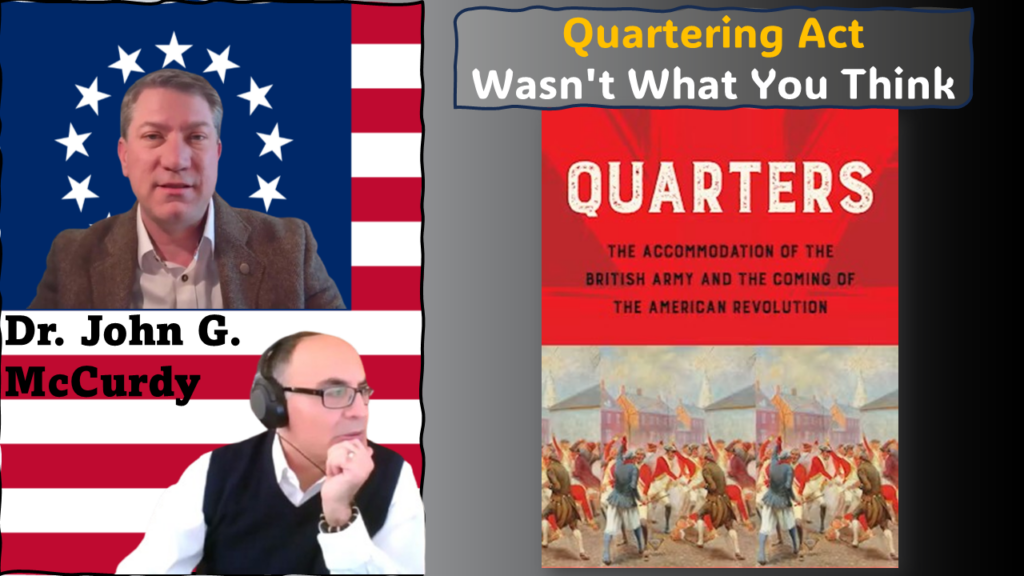
- Quarters: The Accommodation of the British Army and the Coming of the American Revolution (discussed in Part II of this interview)
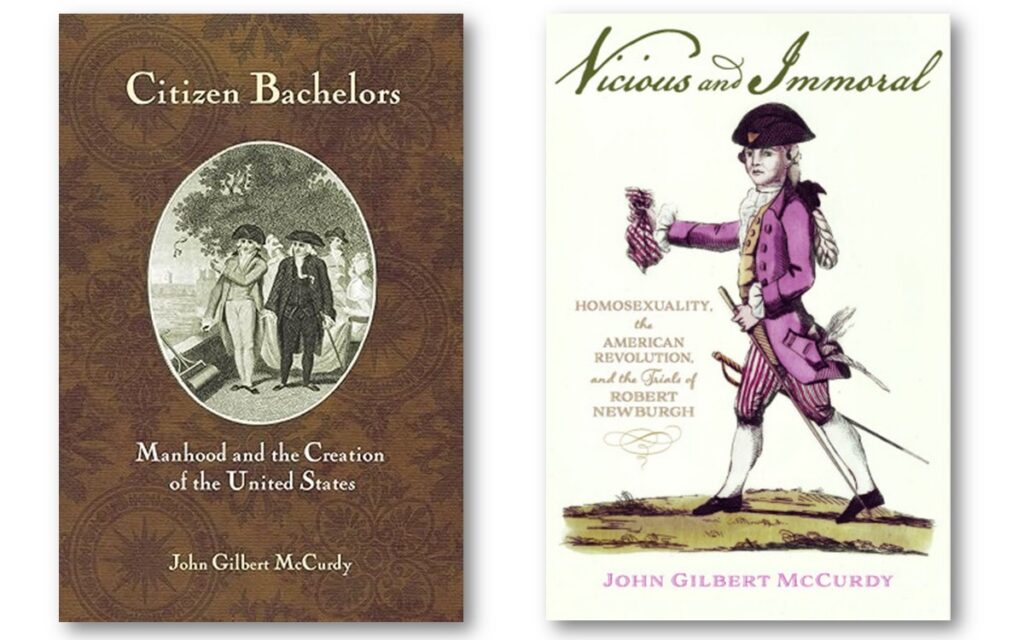 Dr. McCurdy’s books that we discuss in this interview
About Featured Image
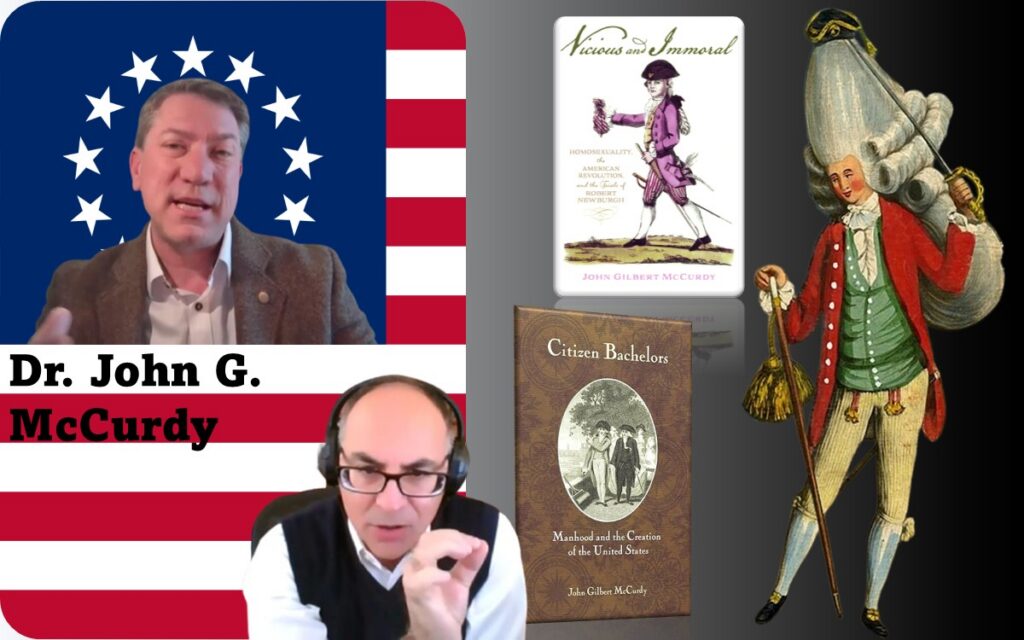
Image of Adel Aali (program host) and his guest, Prof. Joel Richard Paul, superimposed on the Betsy Ross flag, along with images of a man dressed as a macaroni with huge wig topped by a small tricorn hat, and carrying a tasseled cane and sword. This image is a satire of fashion in the 18th century, and the man is also referred to as a “fop”. Also in this image are covers of two books by Dr. John G. McCurdy, our program guest: “Vicious and Immoral: Homosexuality, the American Revolution, and the Trials of Robert Newburgh”, and “Citizen Bachelors: Manhood and the Creation of the United States”.
Unless otherwise indicated, all images in AAR—including those in this post—are in the public domain.
AAR Essential Insights
Although the full video and transcript of my conversation with Dr. McCurdy are included in this post, I’ve selected and summarized several insights that I found particularly revealing and worth emphasizing. These moments — some surprising, others that challenge familiar assumptions — help us see homosexuality, bachelorhood and the American Revolution in a different light.
By the way, these insights are my own takes and interpretations from the interview. For Dr. McCurdy perspective and exact framing, please watch the interview above and view the transcript below in the corresponding sections.
Law, Status, and Sodomy in Colonial America
In some ways, one of the most revealing points in this interview appears in the opening minutes: the word “homosexual” did not even exist during the American Revolution. That alone forces us to slow down and reconsider how we project modern categories backward onto the 18th century. Colonial Americans were not primarily thinking in terms of sexual identity, orientation, or even private desire. They were thinking about acts. About conduct. About whether behavior disrupted religious, legal, or social order.
That distinction matters. A great deal. Because it changes how we interpret both the law and the society surrounding it. Sodomy was technically a capital crime throughout the colonies, yet convictions were extraordinarily difficult to secure. Rumor, reputation, mannerisms, and social standing often mattered more than hard evidence. And once we begin looking closely at these cases, another reality emerges: colonial governments were not always equally interested in prosecuting everyone. Status mattered. Property mattered. Community standing mattered.
I found particularly striking Dr. McCurdy’s point that accusations alone could linger socially even when legal proof was almost impossible to obtain. In smaller colonial communities, suspicion itself could become a form of punishment. Yet at the same time, authorities often hesitated to aggressively prosecute elite men because doing so could destabilize entire local networks of property, labor, and influence. The law existed. Enforcement was another matter entirely.
And perhaps this is where the interview begins opening a much larger historical question: not simply how homosexuality was viewed in early America, but how societies decide which laws they truly intend to enforce — and against whom.
Watch this segment in the video above (02:59)
Why Robert Newburgh Forced A Homosexuality Trial
What I found especially striking here is how little of this case actually revolves around proof in the modern legal sense. Robert Newburgh arrives in British America carrying rumors from Ireland — rumors that he slept with a male servant. But even within the interview, we quickly realize something important: men sharing beds in the 18th century was not inherently unusual. Travelers did it. Soldiers did it. Political figures did it. Benjamin Franklin himself famously shared beds while traveling. So the issue was not simply physical proximity. It was suspicion layered onto ordinary behavior until ordinary behavior no longer looked ordinary.
And once suspicion attached itself to a person, almost every aspect of his life could be reinterpreted through that lens. Newburgh was described as “sickly.” He was a chaplain rather than a combat officer. His role involved comforting wounded and dying soldiers — what some contemporaries considered a more “feminine” social role inside a military environment. Even personality traits and mannerisms began to matter. The trial increasingly became less about whether specific acts could be proven and more about whether his overall character fit emerging assumptions about what a “sodomite” supposedly looked like.
That transition feels historically important. Earlier in the interview, Dr. McCurdy explains that the 18th century still lacked a modern concept of sexual identity. Yet here we begin seeing hints of something changing. British officers were not simply policing acts anymore. They were beginning to police perceived types of people. The accusation itself starts reshaping how the accused is socially interpreted.
I also found Newburgh’s response fascinating. The British Army wanted the problem to disappear quietly. Leave the regiment. Return to Ireland. Let the rumors fade. Instead, Newburgh forced a trial because his reputation was tied to money, office, and status. He had purchased his military commission for hundreds of pounds sterling. In other words, this was not merely a private moral accusation. It was also a struggle over livelihood, credibility, rank, and belonging within imperial society.
Watch this segment in the video above (10:41)
Homosexuality: British Empire vs. American Colonies
Continue watching at 19:55 in the video above
Did the Revolution Change Attitudes Toward Homosexuality?
One of the most surprising arguments in this interview is that the American Revolution may have reflected an emerging divide between Britain and what would become the United States not only politically, but culturally and morally as well. And not over taxation or Parliament, but over how society responded to homosexuality.
Dr. McCurdy is careful here. He does not argue that Revolutionary America suddenly became tolerant in any modern sense. Sodomy remained illegal. Punishments remained severe. Yet the interview repeatedly points to an important contrast. By the late 18th century, Britain was intensifying prosecutions for sodomy and increasingly linking homosexuality to moral disorder, national decline, and threats against the empire itself. The fear was not simply private behavior. It was social contamination. Political instability. A collapse of “natural order.”
At the very same moment, some Americans appear to have been moving in a different direction — not toward equality, but toward selective indifference. If private behavior did not disrupt the broader social order, many preferred not to turn it into a public crusade. That distinction becomes especially striking in Pennsylvania. As Dr. McCurdy notes, one of the first acts Pennsylvania took after independence was removing sodomy from the category of capital crimes. Not legalization. Not acceptance. But still a meaningful departure from British policy.
I also found fascinating the human dimension inside the British Army itself. Some officers viewed Newburgh as a danger to the empire. Others defended him, testified for him, and eventually became committed Americans after the Revolution. The ideological divide inside that regiment almost feels like a small cultural preview of a much larger imperial rupture already beginning to form beneath the surface.
And perhaps this is one of the larger reminders running through the interview: revolutions are not only arguments over constitutions, taxation, or armies. They also reshape assumptions about morality, authority, citizenship, and private life — sometimes in ways barely visible at the time.
Watch this segment in the video above (18:33)
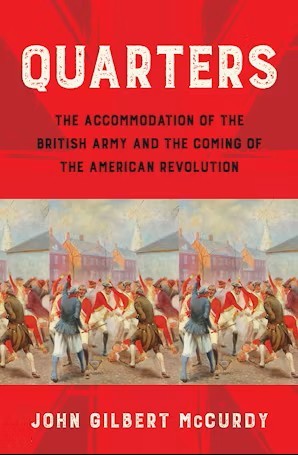 Dr. McCurdy’s book that we discuss in Part II of our interview
Why Single Men Alarmed Colonial Society
One of the more overlooked realities of colonial America is how deeply society revolved around the household. Not simply the family emotionally, but the family as a governing structure. A household was an economic unit, a labor unit, a social unit, and in many ways a political unit as well. Which helps explain why large numbers of unattached men created anxiety in ways that modern readers may not immediately recognize.
I found especially striking Dr. McCurdy’s point that some colonies literally expected single men to place themselves “under family government.” In parts of New England, unmarried men were discouraged from living alone or even living together independently. Instead, they were often expected to attach themselves to an established household. That detail alone reveals how different early American assumptions about adulthood and citizenship really were. Independence was not automatically viewed as stability. In some contexts, too much independence itself could appear socially disruptive.
And yet the story becomes even more interesting once economics and politics enter the picture. Colonial governments repeatedly treated single men as both necessary and expendable. They were taxed differently. Drafted differently. In Pennsylvania, unmarried men without property could be taxed while simultaneously being denied the vote because they lacked property qualifications. Married men without property, meanwhile, could avoid both burdens. So even if lawmakers did not explicitly frame this as “discrimination,” the practical consequences often worked that way.
There is also a broader tension here that feels very modern in a strange way. Colonial America celebrated liberty, self-government, and independence, yet remained deeply uncomfortable with unattached men operating outside traditional household structures. The bachelor could be economically useful, militarily useful, even politically useful — but still socially suspect.
And then there is Benjamin Franklin calling single men “half men.” A revealing statement from a founder who publicly promoted family stability while privately living a far more complicated personal life himself.
Watch this segment in the video above (25:04)
When Bachelors Became Citizens
One of the tensions running quietly beneath the American Revolution is that many of the people fighting for “home” and “family” did not actually possess either. Revolutionary rhetoric constantly invoked property, wives, households, and domestic independence. Defend your home. Defend your family. Defend your liberty. Yet as Dr. McCurdy points out, many soldiers entering the Continental forces were single men without property and sometimes without clear social standing. For many, military service was not simply ideological. It was also economic survival. A paycheck. Food. Mobility. Opportunity.
And that creates a fascinating contradiction inside the Revolutionary story itself. Colonial society often treated unattached men with suspicion before the Revolution. Single men could be specially taxed, drafted more aggressively, or pressured into living under established household authority. In some respects, they were viewed as socially incomplete. Yet the Revolution suddenly required enormous numbers of exactly these men to fight, labor, mobilize, and sustain the war effort.
I found especially interesting Dr. McCurdy’s observation that colonial governments were often less concerned about sex between men than about sex between unmarried men and women. Why? Because illegitimate children created financial obligations and social instability. The state’s fear was not simply morality in the abstract. It was dependency. Fatherless children. Poor relief. Economic burden. That shifts the conversation away from modern assumptions and back toward the practical concerns of 18th-century governance.
And then comes one of the interview’s most important transitions: the Revolution gradually changes the political meaning of bachelorhood itself. Pennsylvania’s post-independence constitution expanded voting rights to taxpayers, which suddenly enfranchised large numbers of previously excluded single men. By the early republic, older legal distinctions targeting bachelors began fading away. The unmarried man who had once been viewed as socially incomplete increasingly became recognized as an individual citizen in his own right.
That may sound subtle, but it represents a major shift in how Americans understood adulthood, independence, and political participation. The Revolution did not simply challenge monarchy. It also began redefining who counted as a full member of society.
Watch this segment in the video above (31:33)
The Interview (S1E20): Adel Aali and John G. McCurdy
In our conversation, Dr. McCurdy addressed important topics relating to homosexuality, single men and the American Revolution. Below, is the outline of our conversation followed by the interview’s full transcript.
Podcast
Watch the full interview on this page with the outline and transcript below, or take the conversation with you on the go through our Spotify podcast.
Outline
Watch the full interview on this page with the outline and transcript below, or take the conversation with you on the go through our Spotify podcast.
Click for Timestamped Outline
- Selected Highlights (00:00)
- Guest Introduction (01:25 )
- Homosexuality Before “Homosexuality” Existed (02:59)
- Why 18th-Century Society Focused on Acts Rather Than Identity (03:39)
- Sodomy, Buggery, and Capital Punishment in Colonial America (05:01)
- Rumor, Reputation, and the Problem of Proof (06:10)
- How Accusations of Sodomy Emerged in Colonial Communities (06:40)
- Elite Men, Status, and Unequal Justice (10:06) – Turning Point (10:31)
- Robert Newburgh and the British Army (10:41)
- The Irish Chaplain Accused of Sleeping with His Servant (11:05)
- Why the British Army Wanted the Scandal to Disappear (11:54)
- Men Sharing Beds in Colonial America (12:52)
- Why Bed Sharing Was Common in the 18th Century (13:06) – Key Moment (13:32)
- How Ordinary Behavior Became Evidence of Suspicion (13:50)
- Why Robert Newburgh Forced a Homosexuality Trial (14:42)
- How Newburgh Manufactured a Formal Accusation (14:59)
- Reputation, Money, and Military Rank in the British Empire (15:37)
- Character, Masculinity, and the British Army (16:26)
- Why the Trial Became a Question of Character (16:53)
- Chaplains, Compassion, and “Feminine” Roles in the Military (17:45)
- Did the American Revolution Change Attitudes Toward Homosexuality? (18:33)
- The Secret Trial Hidden Inside British Army Barracks (18:52)
- Britain’s “Sex Panic” and Colonial American Pragmatism (20:22) – Turning Point (21:26)
- Homosexuality, Tolerance, and Revolutionary America (22:12)
- Why Some Americans Preferred to “Look the Other Way” (22:12)
- Pennsylvania Removes Sodomy as a Capital Crime (24:07) – Key Moment (24:30)
- Why Single Men Alarmed Colonial Society (25:04)
- Why Colonial America Expected Men to Live Under “Family Government” (26:33)
- Benjamin Franklin and the Idea that Bachelors Were “Half Men” (27:33)
- Single Men, Citizenship, and the American Revolution (29:10)
- Why Bachelors Were Taxed, Drafted, and More “Expendable” (29:23)
- Expanding Political Rights for Single Men (35:33) – Turning Point (35:51)
- Just One Point (36:31)
Transcript
Note: This transcript was generated automatically and may contain minor errors. It is provided for reference and accessibility only.
Click to View Transcript
Adel:
Dr. McCurdy, it’s a pleasure to have you in our program’s special series. Thank you for taking the time for this conversation with me about the American Revolution. So let’s start with your book, which is titled Vicious and Immoral, Homosexuality, the American Revolution, and the Trials of Robert Neuberg.
And I’ll begin our discussion with several specific questions, if I may. And this one is really basic, Dr. McCurdy, but I felt compelled to ask it. Was homosexual a term that was used in Britain or British America back then?
Dr. McCurdy:
No.
Adel:
No. Okay. So what did they say?
Was it even referenced in any way?
Dr. McCurdy:
No, the term homosexual doesn’t exist in the 18th century. It’s invented in the 19th century. It’s coined in the 1860s by an Austrian sexologist who’s trying to understand desire.
This is the same man who also comes up with the term heterosexual and heterosexuality. So, and I think that reveals something. So in the 19th century, in the middle of the 19th century, they’re starting to think about desire and what people want to do in their hearts and in their sort of bodies.
Whereas the 18th century is less concerned with what people have a desire to do and are more focused on the acts themselves. So the terms in the 18th century would be sodomy, buggery. I mean, there are sort of terms that connect to that, that are described people who engage in those acts, such as sodomite, buggerer, but even katamite.
And, but we don’t yet in the 18th century have a fully formed notion of sexual identity like we do today.
Adel:
So was homosexuality, and I appreciate it wasn’t called that back then, was it illegal in Great Britain and the American colonies? Yes. And it is.
So, so, okay. If you say yes, were there laws on the books about it?
Dr. McCurdy:
So again, going to the, I guess the earlier point that it’s, you know, we’re not described, they’re not illegalizing people or desire. It’s about acts, right? Because it’s difficult to prosecute somebody’s feelings.
But sodomy is against the law in England and has been for since at least the 1200s. In 1533, Parliament passes a law and it’s an act against buggery, which is sex between men or sex between a man and an animal. And that law will mandate a capital punishment for a person convicted of sodomy.
All of the, all 13 colonies established in North America will also make sodomy a capital crime. I would add a caveat here, which is it’s very difficult to prove sodomy as a crime because it’s a capital crime, which means you need two witnesses to prove a capital crime, even more so under English law on the 18th century. And they changed this later.
But you need both penetration and admission for it to qualify as sodomy. So there’s a lot, there’s a very high legal bar for it to prove sodomy in order to put someone to death.
Adel:
You just answered a question that I was going to ask. How would you even, well, how would you even know it’s different than how would you prove it? One, how would you even know?
Is this where, how would people be accused of this? Did people stand out for being quote unquote homosexual? And I put that in quotes because that’s our term.
That’s not right. Yeah. How would this even come about?
Dr. McCurdy:
Well, there’s a story that I like it. So it’s written, recorded in the Journal of John Winthrop, who’s the first governor of Massachusetts. He writes in his journal about a man named Plain, William Plain, who lives in the New Haven colony.
And he talks about that there were reports that this man has committed sodomy in England before he comes over to the colonies. And that further reports are that he’s taught the youth of the town in which he lived to masturbate. And so the governor goes to him, the town leaders go to this man and say, what are you doing?
Don’t you know what you’re doing is wrong? It’s against the law of God. And this man’s response is, who says there is a God, right?
Which is not the thing you want to say in colonial New England. And it’s for that reason that he will be put to death. And that’s the only record we have of this man’s trial is in the Journal of John Winthrop.
But I think that’s sort of suggestive. So a lot of it’s about rumor stories. There is investigation when rumors emerge.
And it’s not usually just one rumor. You usually need multiple rumors to attract attention. And the state will investigate.
And yeah, sort of what is the person’s response to something like that? Most of the time, it’s not death. It is not what is meted out if there’s an accusation of sodomy.
Adel:
So let’s say I’m belaboring this because I’m trying to understand the setting at that time. So let’s say someone is accused of something. Their response is acceptable.
You know, they don’t say, oh, if there’s a God or something crazy like that in New England. Or let’s say there’s a trial and they just can’t prove it, right? Is that person exonerated legally and socially?
Or is that person discriminated against, continuing to be persecuted in society? And by society, I appreciate that we’re not talking about, you know, 6 million, 9 million people in New York City. These are like little towns.
So how does that work out?
Dr. McCurdy:
So, I mean, I think there’s still rumors seem to be very strong, right? There are suspicions. And some of this would be familiar to us today.
So men who are deemed to be overly effeminate, especially in the 18th century, there are suspicions raised about them. Men who live a certain way, who dress a certain way, there are suspicions that are raised usually about this. And historians who’ve looked at this have said, you know, we have one very few cases in colonial America.
Most of the time, if somebody’s accused of sodomy, it’s either they’ll be prosecuted for sodomitical practices, which means they can’t prove sodomy. They can’t put this person to death. So the person will mostly be whipped.
And the idea is usually these are young men. And so the idea is, well, they’ve gone astray. They’ve done wrong, partly because they didn’t know better.
So they’re whipped. And the idea is that they’re being corrected so that they won’t do this again. And most of the time, this seems to work.
At least these people don’t show up in the records. The bigger issue becomes someone who’s accused of sodomy, but who’s a leading man in the town, an older man who has property, who has a family, who has a number of servants, maybe even slaves working on his property. And that person’s accused of sodomy.
It’s a lot harder for the state to prosecute that person because to prosecute that person and possibly either deprive him of life or liberty is going to disrupt the entire community. And so we see this in Connecticut in the 17th century. There’s a man who’s accused of sodomy repeatedly.
It’s not just one accusation. It’s repeatedly over a period of many years. And the state really drags its feet to prosecute this man.
And historians have looked at this and said, this obviously has to do with his status. He’s such a high status man. It’s difficult to prosecute someone like that.
Adel:
That’s not Robert Newberg, right? No, no. No.
So let’s get into that. I want to repeat the title of your book and then we’ll talk about it. Just as I repeated, the title of your book once more is Vicious and Immoral Homosexuality, the American Revolution, and the Trials and Plural of Robert Newberg.
So who was he?
Dr. McCurdy:
So Robert Newberg’s an Irishman. He’s a Protestant Irishman. He’s a priest in the Church of Ireland, which is the Irish branch of the Church of England or the Anglican Church.
And he comes to America in 1773 as a chaplain in the British Army, specifically in the 18th Regiment, which is at that point stationed in Philadelphia. When he arrives to join his unit to become a chaplain, rumors follow him that when he was back in Ireland years before, he was accused of sleeping with his servant, his male servant. And there’s several people who will testify to this, of seeing him sleeping with his servant and reporting that their interactions were inappropriate.
This all happens before Newberg joins the army. And so there’s a great deal of sort of, they don’t know exactly how to proceed because this isn’t an act they can prove, nor did it happen while he was in the army. And so trying to deal with these rumors, the army mostly wants this to go away.
Several people in the army, federal officers in his regiment will tell him, leave, this is not the place for you. If these are mere rumors, go back to Ireland, clear them up there, and then maybe you can rejoin the unit. Other people just want him expelled from the army altogether.
They think his character is such that he’s going to pollute the army. They’re worried about him. And the interesting piece for me becomes sort of, we talk about, as I was talking about earlier, about acts and identities.
So I think here we get a little closer. In 1773, we’re getting a little closer to the notion that you can tell who a sodomite is by what they look like. So Newberg arrives with these rumors.
Adel:
May I interrupt you for one second, please? I just want to make sure that I follow something. Specifically, he said he was sleeping with his servant.
That part alone, sleeping with another man, didn’t that happen all the time? For example, delegates to the Continental Congress, they would go, there’s a tavern, there’s not enough room. Like Benjamin Franklin has slept in the same bed with other people.
So that in and of itself for that time was not unusual. You’re traveling, that part, okay. There was more happening.
There was more gossiped about, right? Right, right.
Dr. McCurdy:
So that’s, yeah, you’re right. In the 18th century, in the 17th century, men share beds all the time, right? Politics makes strange bedfellows, right, is the phrase, right?
This sort of thing. So no, but they are trying to look to prove, right, he has done something. And that’s the most proof they can come up with, is while he was in Ireland, he goes traveling, he rents a room, it’s actually in Sligo, and the landlady puts a bed in the room for his servant who comes with him.
The servant doesn’t sleep in that bed, he sleeps with Newburgh. And he’s asked about this and Newburgh said, yes, he did sleep with me in the same bed, to your point, this is usual. And Newburgh then goes on and says, well, I’ve actually known this man my whole life.
We grew up together. He was a servant in my parents’ house. And he’s often slept with me because I’ve been so sick.
He was, I’m a sickly person, which doesn’t sort of absolve the issue here because there are theories that it’s a nervous condition is connected to male-male desire. So by admitting that he’s a sickly person and that he has a servant sleeping with him, doesn’t allay anybody’s fears.
Adel:
So how does it come that he has a trial now? The army says, hey, you know, it’s better off for everyone, for you to leave, some people want him expelled. The British army doesn’t want to make a huge deal out of this.
So how do we get to the trial?
Dr. McCurdy:
There’s only a trial because Newburgh demands one. And it takes him a long time to get one. Because he has, various people start rumors about him in Philadelphia.
All right. And so he starts by suing the people who talk about him in civil court. He demands a court-martial for various members of his regiment.
Finally, he convinces an enlisted man in the regiment to go to his commanding officer and say, I will not work with this chaplain. I will not work with this man because he has been accused of buggery. And now there’s a formal accusation of buggery and the army has to act.
It can’t simply ignore this charge. And so Newburgh basically forces the trial because he doesn’t want to just leave. Because to become a chaplain in the army in the 18th century, he’s purchased his commission.
He spent hundreds of pounds sterling to buy this commission. And if he leaves or is pushed out of the army, he’s going to lose that investment. And so this is not just protecting his reputation, it’s about protecting his investment.
Adel:
And I know from your other talks, you had mentioned Baron von Steuben. If there is some sort of rumor from your past, it carries with you. In fact, it carries to 2026.
You’re talking about Steuben right now. So here he is, Newburgh wants to clean that up. Go ahead, please.
Dr. McCurdy:
No, I was going to say it’s very difficult. Yeah, if it’s difficult to prove that someone has had sex with a man, it’s even more difficult to disprove that you’ve had sex with a man, right? And so it becomes the trial.
There’s a three week long trial, court martial trial in New York in August of 17th. Oh, not Philly, in New York. They go to New York because that’s where the headquarters of the British army is.
And it’s a long trial. And that trial turns into a question about character. Since they can’t prove acts, the trial basically becomes what is this man’s character?
And is he doing things such as disobeying superior officers, encouraging enlisted men to be disobedient to their commanding officers? All these things, are they related to Newburgh’s sexual acts? And Newburgh tries to push back and says, no, I have an exemplary character.
You can’t prove that I’ve done anything. I have a good character. And brings forth character witnesses to say, this is a great man.
He does his job just fine.
Adel:
Does he stand out in the community? Does he get any benefit of the doubts because he’s a chaplain?
Dr. McCurdy:
Yeah, I think so. And I think being a chaplain, of course, is complicated, right? Because a chaplain is sort of a strange position in a military, in an army, because this is a non-fighting person whose job is in many ways to provide compassion to sick men, to men who are dying, to really act in what in the 18th century would be understood as a very feminine role.
And so there’s already sort of suspicions around a man who was a chaplain anyway. And I think that doesn’t help Newburgh’s case.
Adel:
I had not, from my perspective, growing up in the 20th century and 21st century, I had not thought of it that way to think of a chaplain in like a feminine role. That’s interesting. Did, hmm, did homosexuality or Newburgh’s trial, you said 1773, this is just a year and a half to two years before Lexington and Concord, right?
April, 1775. Did it have any imprint on the revolution?
Dr. McCurdy:
So, you know, two answers, of course, yes and no. So the no is easier to explain. So this is a trial that’s held by the British army in New York.
This is not open to the public. In fact, when John Adams is attending the First Continental Congress, he’s making his way from Boston down to Philadelphia, will pass by New York, reports going by the barracks where the soldiers lived. Doesn’t know there’s a trial going on inside the barracks when he’s there in New York, right?
Because it’s completely sealed off to civilians. So there’s no reporting of this in American newspapers. This case doesn’t show up in any of the sort of traditional gay histories of the revolution or of American history.
I only found it because I stumbled upon it in some papers at the Clements Library over at the University of Michigan, is where I found it about the story.
Adel:
What a great find. So, which means that this trial is also not like a sensational development. Right.
Not in the tabloids. Right. So, okay, that’s the no answer.
But you said yes and no. So what’s the yes answer?
Dr. McCurdy:
Yeah, so the thing I find interesting is, so the members of the unit, of the regiment, the officers in the unit really fall down into, do you support Newberg and you think he’s an okay guy? Or do you want him out of the army? And those who want him out of the army are a series of captains in the regiment who are very loyal to the British army.
They remain loyal to the British army, will fight in the American Revolution, some at Lexington and Concord, to defend the disintegration of the British empire. And they’re very much, I believe, following an 18th century British vision of homosexuality, which is homosexuality infects the nation. It threatens the empire.
It upsets the natural order. If men can have sex with men, everything’s topsy-turvy. There is no natural order anymore.
And so you see this in England, that the prosecution of men for sodomy begins to increase over the course of the 18th century and really picks up around this time, really going into the Napoleonic Wars about 20 years later. So Britain is becoming very determined to prosecute sodomites, obviously leading ultimately up to the Oscar Wilde trial in the end of the century. The flip side of that is Robert Newbert also has a series of friends in the regiment, a lieutenant and an ensign who were very close to him.
And they stand up for him. They testify for him in his trial. And they say, basically, we don’t care what the stories are about him.
They don’t like homosexuality. They don’t like sodomites. But they’re willing to overlook it.
And I think this very much matches an American view, which was, I think, we see in the colonial era, which is sort of a laissez-faire. Unless this act is disrupting the social order, we can ignore it. It happens in private.
We can kind of look the other way. And it’s interesting. These two allies of these two friends of Newbert who go on to defend him, they will leave the British army and become American citizens.
One goes and becomes a merchant in Pittsburgh. One becomes a planter out in Louisiana. And they become very devout Americans.
One runs for Congress under Thomas Jefferson’s Democratic Republican Party. Another, he has a wife who’s even more devout American than he is. And she’s buried in an unmarked grave at Monticello today.
So it’s very reflective, I think, of this sort of divide that’s emerging between Britain and England, or England and America at this time, about is homosexuality a big deal that we need to be concerned about and bring a lot of public attention to? Or is it a private matter that we can kind of ignore?
Adel:
So the lieutenant and the ensign who are siding in the 18th regiment of the British army that are siding with Robert Newberg, they become American citizens and they’re also more progressive than the other people in their regiment.
Dr. McCurdy:
Right. And I think progressive is a relative term. So I don’t know if I’d use that.
But from our position, I think from our standpoint, sure. They are much more progressive.
Adel:
Yeah.
Dr. McCurdy:
Yeah.
Adel:
I’m speaking in 20th, 21st century sort of language. I’ll turn that question upside down now because before I asked you what impact homosexuality or Newberg’s trial had on the American revolution, I’ll flip it now. Did the revolution, did the American revolution have any impact on homosexuality?
And you gave a little clue to it. Look the other way, if it’s not disrupting the social fabric of society, you said something to that effect.
Dr. McCurdy:
Right. Well, I think two things. I mean, one is coming through this research and working on this book, I did conclude in the 18th century, I think people’s ideas about homosexuality then are very similar to our ideas now that there’s a diversity of opinions that some people think homosexuals should be put to death.
Some think they’re an object of humor. Some want to look the other way and some wonder if society might not be more tolerant. Right.
So there’s a range of opinions then as now. The other point I would make is sodomy is illegal. It’s a capital crime in all 13 colonies.
But one colony in particular, Pennsylvania, didn’t want this. Pennsylvania, which is founded by Quakers or members of the Society of Friends, doesn’t have a lot of capital crimes. It doesn’t want to put people to death for a series of crimes.
And sodomy is one of these. And it’s only at the demands of the British, of Great Britain, of the Privy Council, that they have to make sodomy a capital crime in 1718. When the revolution gets going and Pennsylvania declares its independence, one of the first acts Pennsylvania will do is to remove sodomy from being a capital crime.
I mean, it still is a corporal crime, right? You can still be castrated or fined or imprisoned. I mean, it’s still pretty cruel by our standards.
But there’s a move away. And I think this is indicative that what becomes the United States is not terribly interested in having sort of the same sex panic that England was having at the same time when it came to issues of sexuality, especially homosexuality.
Adel:
Interesting. I want to move on and talk about another book. You’ve written that.
The subject is just really fascinating. And it’s titled Citizen Bachelors, Manhood, and the Creation of the United States. I’ll start with this.
Were there a lot of single men in the American colonies?
Dr. McCurdy:
It’s hard to know. We don’t have good, you know, there are no censuses taken for the whole colonies. And traditionally, the historians have argued that there are very few single men in early America because, you know, why would you need to be single?
I think that in my research, that sort of idea sort of misses a few points. One, of course, you have a number of men who have not yet married, right? So if the average age is mid-20s is when men are getting married, you have a range of men who aren’t married.
I think we’d also want to remember that there’s a great deal of people who are unfree laborers in early America, both indentured servants or African slaves. And those men are not legally allowed to marry either. They may have relationships, but we would legally count those along with being single men.
So I think that we don’t have a good number, but I think it’s more than a handful. It’s a larger number than we might expect.
Adel:
Was it an issue to have single men around?
Dr. McCurdy:
I think not necessarily. I mean, the single men aren’t necessarily deemed to be a problem. It’s understood as being part of society, but the society in the colonial era is much more family focused.
The family is an independent unit. It’s really a unit of government in many ways. And so there’s a sense that single people don’t really fit in that arrangement.
So single men in colonial New England, for example, are, there’s a law on the books that they are to place themselves under family government. They are to go live with a family. Single men are not supposed to live alone or live with other single men because at least to disorder.
Adel:
So I think there’s also a concerns about- Or just find a family, rent a room from them.
Dr. McCurdy:
Yeah, probably. It could be either. I mean, they would be providing, they would be necessary labor.
So these are rural societies, rural communities. So most of these men are going to be engaged in farming or livestock of some sort.
Adel:
Is it true, and this question follows what you were saying, I was just trying to figure out, I’m trying to figure out whether or not this is an issue. Did Ben Franklin really say that single men are just half men?
Dr. McCurdy:
Yes.
Adel:
I was able to find that quote somewhere.
Dr. McCurdy:
I think it’s on my book jacket. So it must be something he truly said. You would never lie on a book jacket.
Adel:
So what does that mean?
Dr. McCurdy:
I think it’s, on the one hand, I think he’s saying something that we’d be finding very familiar, which is a man without a wife, a man without a partner really is only half who he should be, that we’re incomplete without a partner. I think that’s one of the things he’s saying. The thing I would add to that, of course, is Benjamin Franklin is himself a curious person.
One, he’s writing, a lot of his writing is humorous. A lot of his writing is poking the bear, as it were. He’s trying to get a reaction out of people.
There’s a lot of dry humor with Ben Franklin. Ben Franklin in his serious writing is very pro-family, very pro-population growth, wants people to have large families. He wants America to become a very healthy, large country.
Of course, Benjamin Franklin is probably not the best father or husband for anyone to look to. He’s a man with an illegitimate son. This is a man who abandons his wife to go live in England for the last 20 years of her life.
He probably doesn’t, he doesn’t necessarily practice what he preaches.
Adel:
And he himself didn’t have a large family.
Dr. McCurdy:
Yeah, a couple daughters. Yeah.
Adel:
So you said, for example, in New England, there were laws that single men should live with a family. Were single men discriminated otherwise?
Dr. McCurdy:
So in my research, I found that in there, in 11 of the 13 colonies or later states, there are laws specifically named single men or bachelors. And most of these laws, the idea is they’re trying to focus on, they’re trying to carve out exceptions for married men. And they’re trying to sort of place larger burdens on single men.
I think an example of this would be military service. So many of the colonies during the Seven Years’ War and then during the Revolution will have a draft. And we’ll say, if you’re a single man, you’re subject to the draft.
And they’re doing this because you don’t want to send a married man off to war. Because if he dies, then the state is responsible for paying for his family. A single man is more expendable in that way.
And so discrimination, I think, isn’t, I’m not sure it’s quite the right question or quite the right phrase. But things happen that I think are ways of framing this. So going back to Pennsylvania for an example.
So Pennsylvania, as early as 1700, has a tax on single men. It’s a poll tax, it’s a head tax. Single men who own no property.
And the idea is they’re out working, they’re probably working for another man, living with someone else. They’re making pretty good money. The wages are pretty high in colonial America.
But they’re getting off scot-free because most of the taxes are derived from property, property owners. And so the idea is if you’re a single man, but you don’t own property, but you’re working, you pay a tax. However, in order to vote in colonial Pennsylvania and later the state of Pennsylvania, you have to be a property-owning man.
So that means if you’re a married man who owns no property, you can’t vote, but you also don’t have to pay the tax. Or pay any taxes. If you’re a single man, you have to pay a tax, but you cannot vote because you don’t own property.
Adel:
That’s interesting. Yeah, yeah.
Dr. McCurdy:
So I think that’s one way to think about it.
Adel:
In a way, that becomes discriminatory, right? Right. Even if the law is intended as something, just logically administrative, it may make sense, but still the consequence is discriminatory.
What roles did single men have in the American Revolution? I appreciate that that’s a broad question, but I’m going to narrow it down. Let’s start with that.
Dr. McCurdy:
So I think soldiers would be something, right? Military service is key. And this is sort of interesting because when the revolution begins, there’s a lot of appeals to men should be fighting for their families and their property, right?
Defend your home, defend your family. This is why you’re going off to war. However, we know that many of the men who go off to war have no families, have no property.
They’re fighting because it’s a paycheck. And we assume they also have a desire for liberty and love of the country, but they’re not fighting for wives and property. Single men are also throughout the Republic.
I think this is another piece. We’re also talking about class and age are really key to understanding a single man’s status. For example, Cesar Rodney, who showed up on the quarter of the Delaware quarter a number of years ago, sort of as a famous founding father of Delaware.
He makes this late night ride to Philadelphia in the summer of 1776 so he can cast the decisive vote so Delaware will vote for independence. He’s a single man. He never marries.
He goes on to become governor of Delaware. And he’s not unusual in the sense of if you’re a high ranking man, if you have property, concerns about your marital status is less of an issue, at least less of an issue for lawmakers. So the difference is it’s really about, yeah, again, how old you are and whether you have property or not.
Adel:
That’s interesting. And there’s no stories about him. This is actually not a good thing to conclude just because you’re single that he was homosexual, but nothing like that ever came out about him, right?
Dr. McCurdy:
Right, well, and this was something else I found. So I started working on The Bachelors as my dissertation. This is now more than 20 years ago.
And that’s what I started the project for is I was sort of interested in kind of, is this about homosexuality or thinking about bachelors? Would this get us into understanding what we would call gay men? And what I found is that the colonial governments in particular are much less concerned that men are having sex with men and are much more concerned that single men are having sex with women because having sex with women leads to all these illegitimate children.
And the state’s great concern, of course, is that there are children without fathers, right? This concern doesn’t go away. And so there’s very little discussion about men having sex with men.
It’s mostly about men having sex with women. That’s a much bigger concern.
Adel:
Okay, so all the conversation that we had earlier in the context of your first book, Homosexuality, I mean, that was something that’s important. But really what the colonial administrations are concerned with is sort of uncared for, fatherless children running around and becoming a burden for the state. Right, right.
Oh, that is very interesting. So did the status of single men change after the American Revolution?
Dr. McCurdy:
So I think there are some significant changes that happened with the revolution. Some have already been, are sort of already going on culturally, but they’re sort of escalated because of the revolution. And there are also legal changes.
So to start with the legal changes, we do see an end to these specific laws that identify bachelors is what goes on. And by 1800, most of the laws that have identified single men for special treatment have gone away, partly because the country is increasingly moving to a concept of sort of simplifying what a citizen is, that there should be one set of laws for all people. And it’ll take another 100 years or so, if not longer, to really work that out.
But that’s ultimately sort of the goal of a Republican state. But in the meantime, it’s really interesting. So Pennsylvania, as I mentioned before, which has this tax, which if you’re a single man without property, you have to pay, but you can’t vote because you don’t own any property.
And when Pennsylvania writes its first constitution in 1776, it includes a provision that says all men who pay taxes have the right to vote. And it doesn’t, there’s not a lot of discussion about this, but what this does is this is enfranchising all of these single men who have previously been taxed and without the vote. And of course this will include, there’s some married men who are out working, who are making some money, but this is the largest beneficiary of this change in the constitution will be single men.
So they are able to gain rights at this moment.
Adel:
Do other states pick this up from Pennsylvania? I know in Pennsylvania, yeah, they do. That’s very interesting.
Dr. McCurdy:
Because that’s sort of the, a lot of states will move to taxpayer suffrage and then eventually we’ll just go to universal manhood suffrage just by virtue of being a man you can vote.
Adel:
If you wanted our audience to remember just one point about single men during the American revolution, what would that be?
Dr. McCurdy:
I think it’s that single men, they’re ever present throughout this period, but it’s at the revolution that they become men in many ways. That legally and socially, they’re able to be seen as not sort of half a man in Ben Franklin’s phrase, but become much more full citizens and begin to even beyond the law make demands. We see this in literature.
Some single men will claim they have a right to sexual freedom or personal freedom. After the revolution, some single men will start saying being a bachelor is a really good thing. I really like not being attached and tied down to a family.
So there’s a change in how Americans think about marital status and the rights that an individual has, regardless of whether they’re married or not, that really connects back to the revolution.
Adel:
I want to ask just one follow-up question, and this has nothing to do with the revolution. I know that in the, gosh, 1840s, 1850s and in the second half of the 19th century, a lot of men married very late or just didn’t marry. For example, Andrew Carnegie marries when he’s 50 years old or something like that.
Did what you just share with us, the literature that’s saying there’s nothing wrong with being bachelor, did that sort of set the stage for that? Or is that a whole different, that’s an entirely different development, has nothing to do with this.
Dr. McCurdy:
Yeah, that’s hard to say. Because I mean, even when I looked at the, even in the colonial era, you have men who get married for the first time, very late in life. And I think that’s the thing, right?
It’s sort of easy to deal with a group, but it’s always difficult to deal with individual decisions, right? Why someone gets married or doesn’t get married is all being a very personal decision that usually has multiple causes.
Adel:
Yeah, yeah.
Dr. McCurdy:
So I don’t want to point fingers at that.
Adel:
No, no, that’s fine. It’s just something interesting that I thought about. Let’s take a break here.
In the next segment, I’ll ask Dr. McCurdy about quartering soldiers during the American Revolution and the Third Amendment to our Constitution that came later. We’ll be right back.
Related Interviews and Essays
Quartering Acts
►Part II of my with Dr. McCurdy: “The American Revolution Myth We Learned Wrong”
 The Quartering Act Did Not Force Soldiers Into Private Homes
Women & Enslaved People
►My interview with Dr. Kathleen Brown: “The Freedom Fought For Was Denied to Women”
Dr. Brown’s major works include:
- Undoing Slavery: Bodies, Race, and Rights in the Age of Abolition
- Foul Bodies: Cleanliness in Early America
- Good Wives, Nasty Wenches, and Anxious Patriarchs, which we discuss in this interview
 The American Revolution Didn’t Free Women—It Strengthened Slavery
Three Men (or 2 Men and a Woman) Who Armed the American Revolution
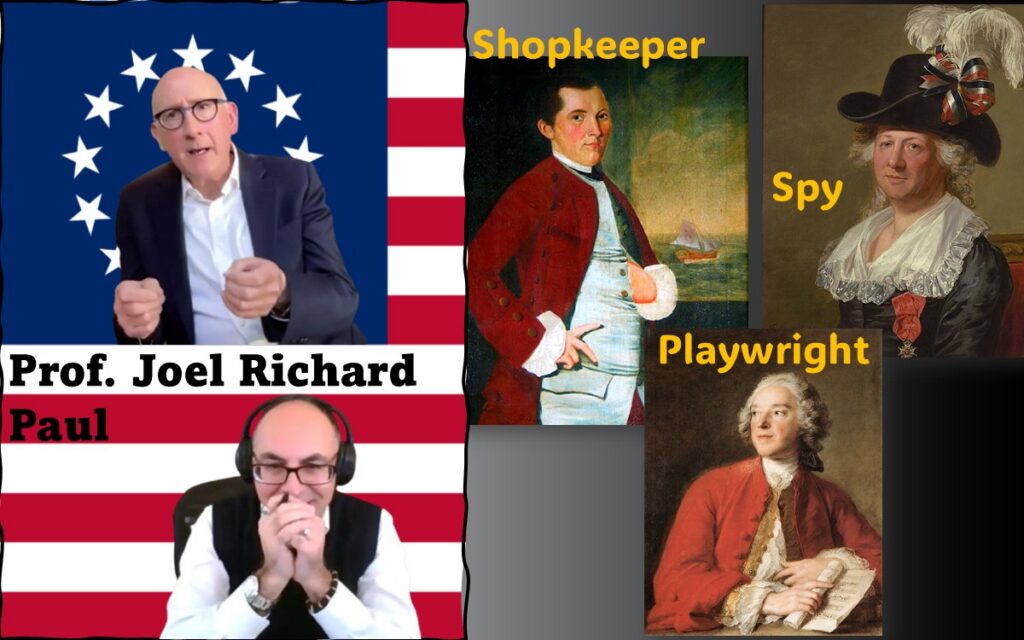
Would it sound crazy to you that a bisexual playwright and a spy whose sex became a high-profile political, legal, and financial scandal in France and Great Britain were part of the effort to arm the Americans in time for the Battle of Saratoga? This is one of the most unbelievable and unimaginable stories of the American Revolution, and one that Prof. Joel Richard Paul shares in our program. During the interview, you’ll hear me exclaim: “You can’t make this up!”
►My interview with Prof. Paul: “The Bizarre Plot That Armed the American Revolution”
Prof. Paul major works include the following books:
- Without Precedent: Chief Justice John Marshall and His Times,
- Indivisible: Daniel Webster and the Birth of American Nationalism, and
- Unlikely Allies: How a Merchant, a Playwright, and a Spy Saved the American Revolution.
 Extraordinary Men (and a Woman?) Behind a Ludicrous Scheme That Worked Against All Odds
About This Program
Analyzing American Revolution (AAR) is a special series podcast production of the History Behind News program. In this series, 33 professors (and counting) analyze the American Revolution from 33 different angles through in-depth interviews with host Adel Aali.
Meet Our Guest Scholars
A structured body of thought on the American Revolution—where leading scholars advancing distinct interpretations that give this program its depth.

Thematic Collection
Tap below for a closer look at the Revolutionary Era themes we examine—and to meet our guest scholars.

Library
- Interview Transcript Highlights
- Interview Image and Artist Highlights
- Quiz Answers and Backstories

Image Gallery
Explore the backstories and artist bios behind images of our Founding—before and after the American Revolution. These visuals shape how we remember—and reimagine—the Revolutionary Era.

Support AAR
AAR is an independent program built on sustained research, preparation, and production. Your support helps continue this series and expand our program.

Experienced Analysis of History
About HbN Program
The History Behind News program (HbN) is committed to making in-depth history researched and written by scholars enjoyable and accessible to everyone. Our motto is bridging scholarly works to everyday news.
The histories we’ve uncovered encompass an impressively wide range of subjects from ancient history to U.S. politics and economy to race, women’s rights, immigration, climate, science, military, war, China, Europe, Middle East, Russia & Ukraine, Africa and the Americas to many other issues in the news. We also receive advanced copies of scholarly books and discuss them in our program (in the context of current news).

Adel Aali, host. Snapshot from his introductory video to AAR podcast.
232 Scholars & Counting
Our guests are scholars at leading institutions. They are highly recognized, having received prestigious grants and fellowships as well as notable awards, including the Pulitzer Prize. They include celebrated documentary producers, former White House advisors and other high-ranking government officials, and current and former senior reporters of major national and international newspapers. Many have testified in Congressional hearings, and others frequently contribute to major media outlets and widely read publications.
Think You Know the American Revolution?