Updated: August 6, 2026
Discover Continental view images of the American Revolution behind our videos and posts. These visuals shape how we remember — and reimagine — the Revolutionary Era. Each image tells its own story, highlighting a key figure, event, or idea, with context about the artist and historical significance. Explore these Revolutionary Era visuals to dig even deeper into history.
Explore the Images of the American Revolution – A Continental View
One of my favorite aspects of the American Revolution is its wonderful images. Images of the Continental view that inform us about the American Revolution complement our videos and posts, where there is often limited space to share more about the images themselves, their artists, and their backstories. Yet we believe you should know them — at least to some extent — because they add depth to how we Americans perceive and picture the Revolution and, equally important, how our collective memory of the Revolutionary Era has been shaped and reshaped over the centuries.
Almost all of the images we use in our program, as well as the music, are in the Public Domain. For those that aren’t, we’ve included links, licenses, and attributions. If you use any of these images, please provide proper credit and include links when required.
This post features Continental view images of the American Revolution, each presented individually with its historical significance and the artist’s background. These posts are designed for exploration — enjoy browsing, learning, and linking to related history posts. Explore these Revolutionary Era visuals to dig even deeper into history.

The Grand Union Flag
On January 1, 1776, the Grand Union Flag — also called the Continental Union Flag or Continental Colors — was raised on Prospect Hill, overlooking British-occupied Boston (they would leave on March 17). Today, it flies atop the Prospect Hill Monument (pictured below).
George Washington’s Two Messages:
1) America is distinct from Britain – The 13 stripes represented the colonies, while the Union Jack in the canton showed Americans still saw themselves as part of the British Empire.
2) Independence was not yet the goal – Despite battles at Lexington, Concord, and Bunker Hill, Washington and his officers continued to recognize King George III as sovereign.
As the push for independence grew, the flag changed. On June 14, 1777, the Second Continental Congress adopted the Stars and Stripes, replacing the British Union in the canton with 13 stars.
Fun Facts:
⚓ The Grand Union Flag first appeared on the USS Alfred on December 3, 1775, along the Delaware River in Philadelphia.
🏴 The British Union in the canton represented Scotland & England. It changed in 1801 when Northern Ireland joined the union.
Image credits:
• Grand Union Flag by Hoshie, Public Domain.
• Prospect Hill Monument by Daderot, CC0 (dedicated to Public Domain).

The “Betsy Ross” Flag
The “Betsy Ross” flag – with its 13 stars and stripes, was used from June 14, 1777, to May 1, 1795.
On June 14, 1777, the Second Continental Congress passed the Flag Act of 1777, officially adopting the “Betsy Ross” flag. According to legend, George Washington asked Betsy Ross to sew this first American flag. While Betsy Ross was an upholsterer and a prominent flag maker, there is no historical evidence that she made the first official U.S. flag. Some historians credit Francis Hopkins for this flag design.

This flag fell out of official use after Kentucky and Vermont were admitted as states. Hence, the next flag was the 15-star, 15-stripe-flag. I should note that after 1818 U.S. flags reverted to 13 stripes, even though the number of their stars continued to increase until July 4, 1960, when Hawaii was admitted as the 50th state.
This image is in the Public Domain.
Tory Refugees
Was the American Revolution, in essence, a civil war?
Rebecca Brannon certainly makes the case for it. The American Revolution was, in part, a civil war between the Patriots and the Loyalists. The Revolutionary Era was also a time of vigilante policing and suppression of Loyalists. Dr. Brannon is author of From Revolution to Reunion: The Reintegration of the South Carolina Loyalists and many other works on Loyalists, including The Consequences of Loyalism: Essays in Honor of Robert M. Calhoon.
In my opinion, the story of the Loyalists and what happened to them after British defeat is one of the most complicated aspects of the Revolutionary War. I say this because shifting alliances tend to blur this history. In a nutshell, it could be, and continues to be, hard to identify Loyalists during the American Revolution.

The complexity of their plight continued after the American Revolution. Unlike what we learn in popular history, they were not particularly taken care of by the British. Moreover, many of the exiled Loyalists returned to America and some even received pensions for fighting on the American side, which illustrates their shifting allegiances.
This work is titled Tory Refugees on the Way to Canada and appeared in Harper’s Monthly in December 1901. It is by Howard Pyle (1853-1911), an American artist and author, mostly of books for the young. His works include The Battle of Bunker Hill (1897- year of the painting, not the battle), which depicted the second British advance up Breed’s Hill (it failed – their third advance was a success because Americans ran out of ammunition).
Pyle’s 1891 novel, Men of Iron, was adapted into a 1954 movie: The Black Shield of Falworth.
This work is in the Public Domain.
Since we did not specifically display an image about Canada in our introductory video, I feel compelled to assert the following here: Canada is paramount to the story of the American Revolution. Even before we decided to produce Analyzing American Revolution podcast series, we covered the history of U.S.-Canadian relations in a podcast conversation with Patrick James in our sister program, History Behind News. Dr. James is a Canadian-American scholar who has published many works on the history of Canada, including the Handbook of Canadian Foreign Policy.
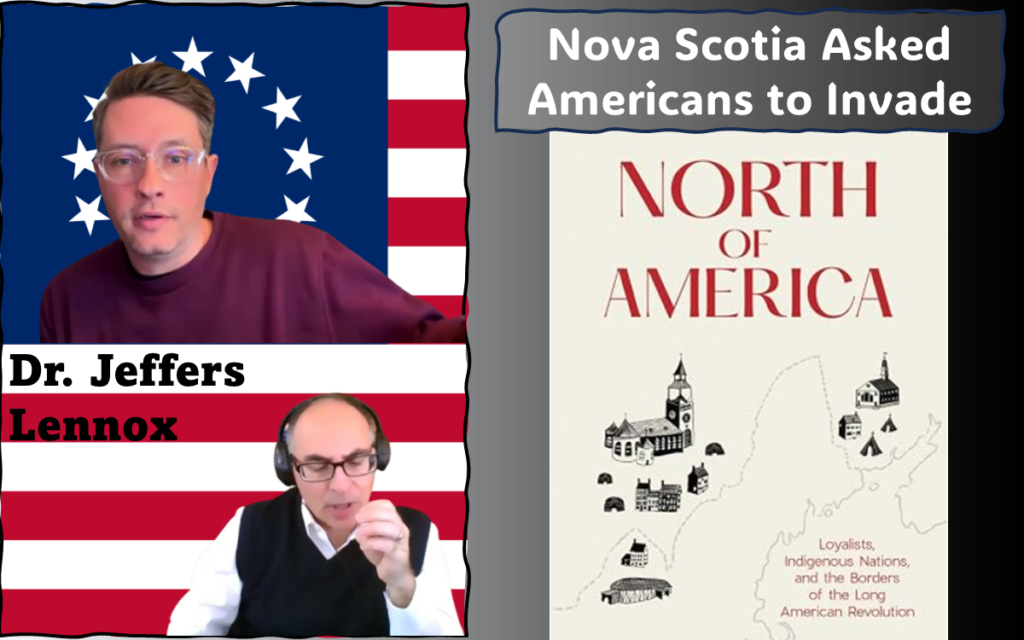
For the Revolutionary Era, in this program Jeffers Lennox explores the history of British Canada and its contact and conflict with the American colonies. Dr. Lennox has published extensively about this history and received many awards, including the Canadian Historical Association, Clio Award, Atlantic History (2018). His forthcoming book is North of America: Revolution, British Provinces, and Creating the United States, 1774-1815. I will post a link to my interview with him when it publishes in 2026.
Joseph Brant
George Romney painted this portrait in 1776 during Brant’s first visit to London (1775-75). His second visit was in 1785-86.
Joseph Brant (1743-1807) was a Mohawk military and political leader who fought for the British during the American Revolution. Along with his sister, Molly Brant, he was one of the best known Indigenous people of North America during and after the Revolutionary War. He met some of the most notable figures of American Revolution during his lifetime, including President George Washington (1792) and King George III (Nov. 1775).
In addition to the portrait of Joseph Brant, Romney’s work includes Thomas Paine’s portrait, which is discussed above. This image is in the Public Domain.

I selected Joseph Brant’s portrait for our introductory video because it gives us a glimpse into the tragic dilemma of North America’s indigenous peoples. Who should they support: the British or
the American colonies?
In the video below, David Silverman shares with us how the American Revolution extinguished the flame of Native American union that had been burning for centuries. Dr. Silverman is a scholar of Colonial and Revolutionary America and Native America and has written extensively on these subjects including Thundersticks: Firearms and the Violent Transformation of Native America and Colonial America: Essays on Politics and Social Development.
Dr. Silverman has also guest participated in our sister program, History Behind News, where we explored the Real History of Thanksgiving, a popular interview that has become an annual Thanksgiving tradition for us.
Tap for more vidoes about the American Revolution.
About This Program
Analyzing American Revolution (AAR) is a special series podcast production of the History Behind News program. In this series, 33 professors (and counting) analyze the American Revolution from 33 different angles through in-depth interviews with host Adel Aali.
Themes of the Revolution
Tap below for a closer look at the Revolutionary Era themes we examine—and to meet our guest scholars.

Visit our Revolutionary Era Blog page for
- Interview Transcript Highlights
- Interview Image and Artist Highlights
- Quiz Answers and Backstories

Visual Index of the American Revolution
Explore the backstories and artist bios behind images of our Founding—before and after the American Revolution. These visuals shape how we remember—and reimagine—the Revolutionary Era.

Experienced Analysis of History
About HbN Program:
The History Behind News program (HbN) is committed to making in-depth history researched and written by scholars enjoyable and accessible to everyone. Our motto is bridging scholarly works to everyday news.
The histories we’ve uncovered encompass an impressively wide range of subjects from ancient history to U.S. politics and economy to race, women’s rights, immigration, climate, science, military, war, China, Europe, Middle East, Russia & Ukraine, Africa and the Americas to many other issues in the news. We also receive advanced copies of scholarly books and discuss them in our program (in the context of current news).

232 Scholars & Counting:
Our guests are scholars in prestigious institutions, such as Oxford, Yale, Caltech, Harvard, MIT, Stanford, the Hoover Institution, the American Enterprise Institute, Quincy Institute for Responsible Statecraft, King’s College London, Princeton University, Notre Dame, Dartmouth College, Columbia University, the Atlantic Council, Duke, Amherst College, University of Michigan, Rhodes College, Emory University, Northwestern Law, Vanderbilt University, US Naval War College, Air Command and Staff College, Marine Corp University, US Army War College, UVA, Johns Hopkins, Cornell, NYU, Rice, University of Chicago, White House Historical Association, Baylor University, USC, UC Berkeley, UCSF, UCI, UCSD, UC Davis, UCR, Tel Aviv University, Hebrew University of Jerusalem, the Israel Democracy Institute, University of Aberdeen, Universidad Complutense de Madrid, University of Navarra, University of Seville, Helsinki University, Diego Portales University (Chile), Lund University (Sweden), University of Edinburgh, Near East University (Türkiye), Cardiff University, the Free University of Berlin and many others.
They include Pulitzer Prize winners, renowned documentary producers, former White House advisors and other high-ranking government officials, and current and former senior reporters at The Wall Street Journal and New York Times Magazine. Many have testified in Congressional hearings and others frequently contribute to major media outlets and widely read publications, ranging from the BBC, NPR, PBS and MSNBC to The Wall Street Journal and The New York Times.
Think You Know the American Revolution?