Updated: August 16, 2026
Introduction
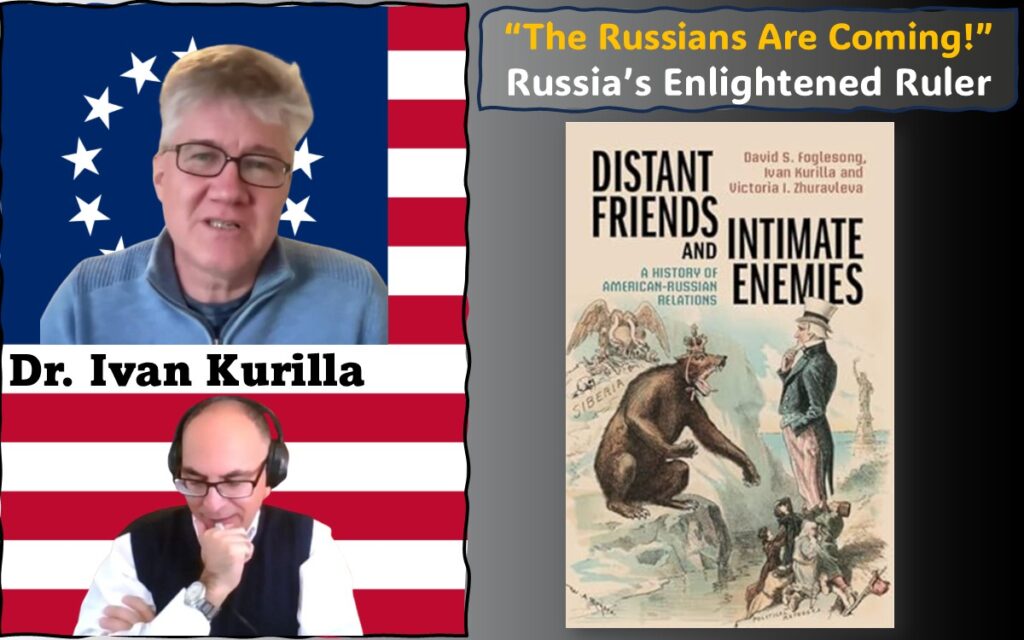
In this interview: “King George III asked Catherine to send her troops or Cossacks to North America to help suppress American uprising. And by the way, British propaganda already used the promise of coming Cossacks, you know, use this propaganda against colonists saying, you know, soon the Russians [are coming] and will suppress you.”
Watch this segment in the video below (00:26:02).
“The Russians are coming. The Russians are coming!”
No American Patriot ever shouted those words—but it’s not as far-fetched as it sounds.
Imperial Russia and the American Revolution are rarely mentioned together. Yet one of Europe’s most powerful empires could not ignore a conflict that reshaped the Atlantic world.
In this interview, we explore how the American Revolution challenged Russia ideologically and strategically—and how the Russian Empire, indirectly and perhaps unintentionally, helped the American cause.

How to Use This Post
Use this post as reference guide to the American Revolution through the lens of this interview and the broader Analyzing American Revolution program (AARevolution). Navigate using the interactive table of contents above and the timestamps below (in gray) to discover how this interview deepens the story of the Revolution—and to explore how the program unfolds: its key themes, insights, image gallery, scholars list, history quizzes, and related interviews across the series.
Video
Watch the full interview (timestamps below)
Imperial Russia and the American Revolution: Ideas vs. Empire
From the very beginning, Russia’s relationship with the United States was defined by a tension that emerged during the American Revolution itself.
On the one hand, the Russian Empire did not fear thirteen distant colonies rebelling against Britain. On the other, it feared something far more dangerous—the spread of revolutionary ideas. Liberty, republicanism, and even the global popularity of Benjamin Franklin signaled that Enlightenment thought was no longer theoretical. It was actionable.
This tension is especially striking under Catherine the Great. She cultivated the image of an enlightened ruler—corresponding with leading thinkers and even describing herself as a “republican,” a term that carried a different meaning in her time. Yet in practice, she remained an absolute autocrat. Russians who circulated the Declaration of Independence or wrote about liberty, human rights, and the injustices of serfdom faced censorship, exile, or worse.
As my guest explains, this contradiction shaped Russia’s response to the American Revolution. While resisting its ideas at home, the Russian Empire would, in two important ways, indirectly—and perhaps unintentionally—support the American cause.
Central Question
This conversation raises a central question:
If the American Revolution simultaneously inspired Russian reformers as a model of liberty and alarmed the imperial state as a source of ideological subversion, how did these two competing traditions—imitation and suppression—shape Russia’s enduring relationship with the United States from its very inception?
About My 206th Guest: Dr. Ivan Kurilla
Dr. Ivan Kurilla is a historian of U.S.-Russian relations. In addition to many appointments at U.S. universities, he previously taught at Volgograd State University and the European University at St. Petersburg. However, in 2024 he left Russia after being dismissed for opposing the war in Ukraine and is now based in the United States as a visiting scholar in the Department of History at The Ohio State University.
Dr. Kurilla’s scholarship also focuses on the history of U.S. and American foreign relations, the international dimensions of the American Civil War, issues of historical memory, the misuse of history, and the role of historians in contemporary Russia. He has published extensively on these subjects, including the following books:
- Russian/Soviet Studies in the United States, Amerikanistika in Russia: Mutual Representations in Academic Projects,
- Distant Friends and Intimate Enemies: A History of American-Russian Relations,
- Echoes of the American Civil War Abroad: Perceptions, Identities, and Historical Memory – 2026, his most recent work,
- Trailing the Bolsheviki: Twelve Thousand Miles with the Allies in Siberia, and
- Amerikancy i vse ostalnye: Istoki i smysl vneshnej politiki SSHA (Americans and All the Rest: Origin and Meaning of U.S. Foreign Policy, 2024), which won the Enlightener (Prosvetitel) Prize in the Humanities as the year’s best Russian-language nonfiction book.
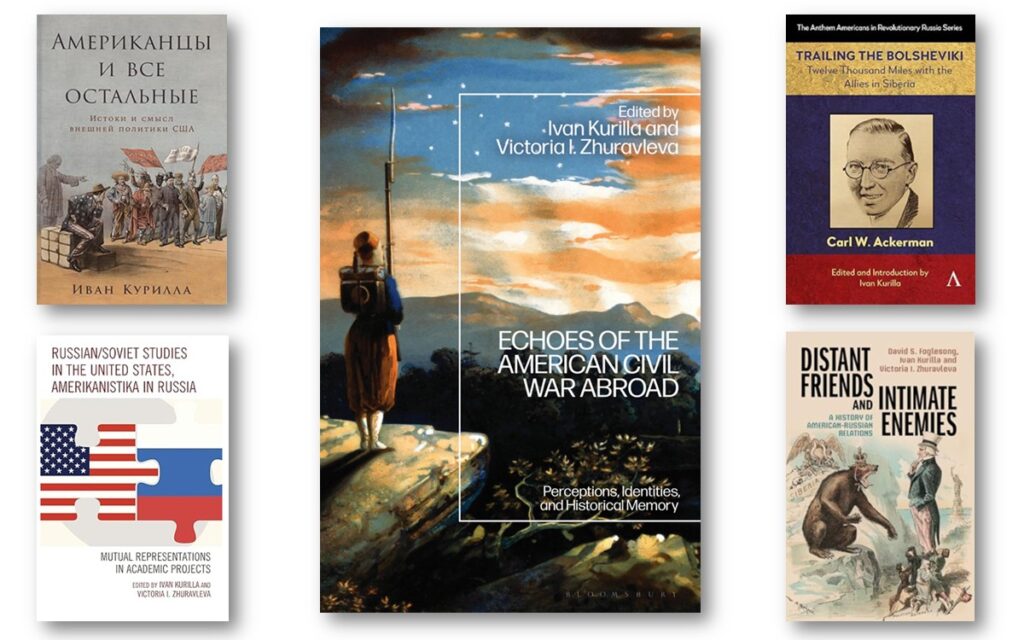 books by Dr. Kurilla
About This Post’s Featured Image
The featured image brings together images of Dr. Ivan Kurilla and Adel Aali from the interview, superimposed on the Betsy Ross flag, alongside a portrait of Catherine the Great – Empress of Russia.
Unless otherwise indicated, all images in AAR—including those in this post—are in the public domain.
AAR Essential Insights
Although the full video and transcript of my conversation with Dr. Kurilla are included in this post, I’ve selected and summarized several insights that I found particularly revealing and worth emphasizing. These moments — some surprising, others that challenge familiar assumptions — help us see the Russian Empire and the American Revolution in a different light.
Catherine the Great: Enlightenment vs. Autocracy
Catherine the Great (r. 1762–96) wanted to be seen as an enlightened ruler. She corresponded with leading thinkers of the Enlightenment, including Voltaire, and embraced the language of reform—even calling herself a “republican,” a term that carried a different meaning at the time.
Yet in practice, she remained an absolute autocrat. Her rule included the brutal suppression of the Pugachev Rebellion (1773–75), a massive peasant uprising that exposed the fragility of her empire.
Why does this matter to the American Revolution?
Because the Revolution posed not a military threat to Russia, but an ideological one. Catherine did not fear thirteen distant colonies. She feared the ideas they represented. The American Revolution demonstrated that Enlightenment principles could be put into action—and that made them dangerous.
News of the Revolution and the Declaration of Independence spread throughout the empire (although the text of the Declaration was censored for decades). Figures like Nikolay Novikov published American developments widely, while Alexander Radishchev celebrated the Revolution’s promise of liberty—only to face exile for his writings.
Watch this section in the video above (00:10:51).
Ideas vs. Rebellion: Radishchev and Pugachev
For Catherine, Pugachev could be crushed. His rebellion, though massive, was a physical threat—one that could be defeated.
Radishchev was different. He changed minds. And that made him far more dangerous. For his writings on liberty and his criticism of serfdom, he was exiled to Siberia.
In Catherine’s own view, this made him “worse than Pugachev.”
Watch this section in the video above (00:14:54).
Catherine Predicted American Independence
Catherine did not like Lord North and criticized his government. And before the American Revolution, she “wrote to her German relative that she expects that British made so many mistakes in dealing with American colonies that she will be not surprised to see colonies independent within her lifetime”.
The fact that her prediction had come true was not at welcome news for the Empress. In fact, it was a sea change in the world. As discussed above, it meant that Enlightenment ideas can affect real change – liberate peoples and topple governments.
Watch this section in the video above (00:12:44).
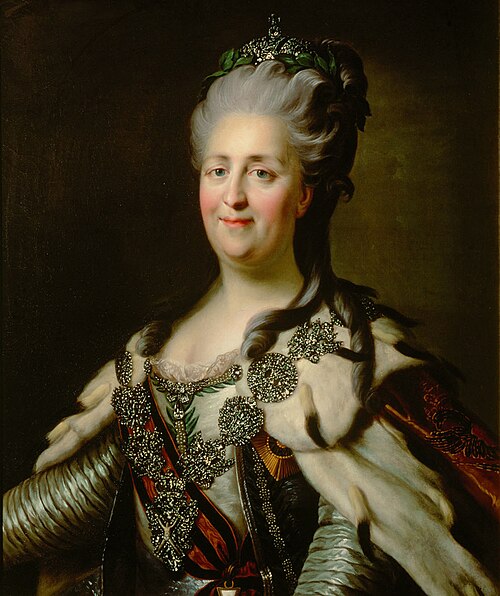 Catherine the Great (r. July 1762–November 1796), 1780s portrait.
Two Russian Traditions Toward America
Catherine was not surprised by the American bid for independence. In private correspondence, she criticized British leadership and remarked that the colonies might well become independent within her lifetime.
When that prediction came true, it marked more than a geopolitical shift—it confirmed that Enlightenment ideas could overturn established power.
For an autocratic empire, that was a deeply unsettling realization.
Watch this section in the video above (00:20:38).
Neutrality That Helped the American Cause
The American Revolution is bookended by the Russo-Turkish Wars of 1768–1774 and 1787–1792, during which Russia expanded its influence in the South at the expense of the Ottoman Empire. For example, the Crimean Peninsula was formally annexed by Russia in 1783.
At the same time, Russia participated in the partitioning of Poland with Austria and Prussia—a process that began with the First Partition in 1772 and ended with the complete disappearance of the Polish-Lithuanian Commonwealth by 1795. These geopolitical priorities left Russia with little interest in directly intervening in the American Revolution.
Still, Russia’s policy of neutrality had significant consequences—and arguably provided strategic advantages to the American cause.
First, Britain requested Russian military assistance twice, asking for troops or Cossacks to suppress the rebellion. British propaganda had already invoked the fearsome image of Cossacks against the colonists, yet Russia never sent a single soldier. Catherine the Great refused King George III both times.
Her reasons were practical: Russia was poised to reengage the Ottomans and needed its forces at home. Financial incentives didn’t sway her either. Unlike the German states, which rented out their soldiers to Britain (the infamous Hessians), Russia had no urgent need for money. Britain reportedly even offered Russia a Mediterranean island—believed to be Menorca—in exchange for troops. But with Russia newly established on the Black Sea and on track to dominate the Ottoman Empire, Catherine likely saw little value in a distant island when the Mediterranean could soon be within her reach.
French propagandists capitalized on this refusal, portraying Russia as a distant but sympathetic power “on the side” of the American colonists, boosting revolutionary morale.
Second, as the war expanded into a global conflict, Catherine issued the Declaration of Armed Neutrality in 1780 — which, in effect, supported the American colonies. It established three key rules:
- Neutral ships could freely access ports of warring powers.
- Goods from belligerent nations on neutral ships could pass unhindered, except for war contraband.
- Only ports actually blocked by naval forces counted as blockaded.
Most European nations accepted these terms, but Britain rejected them, as the rules undercut their blockade of American ports—a cornerstone of their military strategy. While Russia’s navy was far smaller than Britain’s, the declaration rallied other European nations into a league of armed neutrality, indirectly benefiting the American colonies by complicating Britain’s naval operations.
Watch this section in the video above (00:32:51).
Russia’s Quiet Expansion into North America
This is an interesting point that we often overlook. During the American Revolution, in addition to Britain, France and Spain, Russia also had vast interests in the Americas.
Russia’s Great Norther Expedition (1733–1743) opened up North America to the Russians. By the 1780s, Russia had permanent settlements in North America. And by 1799, at the end of the Catherine’s rule, the Russian-American Company was established as a permanent, semi-governmental body to rule Russian America.
Watch this section in the video above (00:08:01).
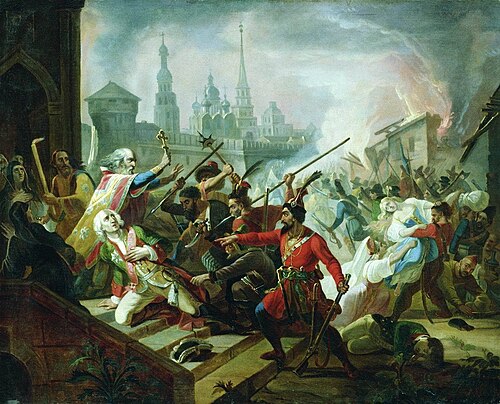 Assault on Kazan during Pugachev’s Rebellion (July 1774).
This was a major event in Russian history, during which large parts of Kazan were destroyed
and Empress Catherine’s rule faced a serious regional challenge.
Why Benjamin Franklin Captivated Russia
Benjamin Franklin was already famous in France, but he became the most celebrated American in Russia as well. His unique appeal there came from the combination of his political skill and scientific achievements. Russia had many accomplished scientists, but few who were also politicians. As Nikolay Novikov noted in praising Franklin, this rare blend made him especially valuable—not just as a scientist, but as someone whose contributions could benefit humankind more broadly.
Watch this section in the video above (00:18:04).
Censorship in Russia: When Foreign News Becomes Domestic Critique
This is one of the most interesting points—and it likely still resonates for autocratic governments today. While the Russian government tightly controlled news and commentary about domestic affairs, newspapers and citizens were free to discuss events outside the empire. Over time, however, these discussions often carried subtle innuendos or critiques that reflected on Russia’s own policies and reforms, using foreign events as a mirror for domestic concerns.
Watch this section in the video above (00:23:22).
Imperial Russia’s Fear of American Revolution
Continue watching at 20:38 in the video above.
America’s Uninvited Diplomacy in Russia
“Militia diplomacy” describes when a nation—or a people—sends an emissary to another country without an invitation. The American colonies were masters of this, dispatching missions to France, Spain, the Netherlands, the Habsburgs, and Russia without official requests. Unsurprisingly, this breach of protocol irritated host nations, suddenly forced to take sides in America’s War of Independence.
This is exactly what happened with Russia. The Second Continental Congress sent Francis Dana to the Russian Empire. Although he spent three years there, he was never able to establish formal relations with the Russian court or gain official recognition.
A side note: Dana brought along John Adams’s son, John Quincy Adams, as his personal secretary. Years later, John Quincy would become America’s first ambassador to Russia, closing the circle on this early experiment in uninvited diplomacy.
Watch this section in the video above (00:38:10).
The Interview (S1E11): Adel Aali and Ivan Kurilla
In our conversation, Dr. Kurilla addresses key questions about the Russian Empire, Catherine the Great and the American Revolution. Below is a structured outline to help you navigate the discussion, followed by the full transcript.
Podcast
Watch the full interview on this page with the outline and transcript below, or take the conversation with you on the go through our Spotify podcast.

Outlline
Use the in-depth outline below to follow the discussion and navigate key moments in the interview.
Click for Timestamped Outline
- Selected Highlights (00:00)
- Guest Introduction (01:58)
- Russia During the American Revolution (03:56)
- Catherine the Great and “Enlightened Rule” (04:18)
- The Pugachev Rebellion and Russian Autocracy (05:10)
- Russian Expansion and North America (06:18)
- Crimea, the Ottoman Empire, and the Partition of Poland (06:29)
- Russian Settlements in Alaska and North America (08:30)
- Catherine the Great and the American Revolution (10:54)
- Why Catherine the Great Expected American Independence (12:44)
- The “Republican” Empress and Enlightenment Politics (11:29)
- Russian Intellectuals Discover America (14:18)
- Nikolai Novikov and American News in Russia (14:59)
- Enlightenment Ideas Become Politically Real – Key Moment (14:31)
- Alexander Radishchev and the Promise of Liberty (16:06)
- Ode to Liberty and Admiration for America (16:24)
- Slavery, the Constitution, and Disappointment With America – Turning Point (18:04)
- Benjamin Franklin and Revolutionary Fear in Russia (18:40)
- Why Benjamin Franklin Became Famous in Russia (18:46)
- “A Rebel Worse Than Pugachev” and Siberian Exile – Key Moment (20:16)
- America, Censorship, and Russian Political Debate (22:35)
- The American Revolution and Russian Censorship (23:22)
- Why Catherine the Great Feared Revolutionary Ideas (21:24)
- Britain, Russia, and the War for American Independence (24:50)
- King George III Requests Russian Troops (26:56)
- “The Russians Are Coming” and British Propaganda (27:18)
- The Declaration of Armed Neutrality (32:55)
- How Russia Undercut the British Blockade – Turning Point (33:24)
- The League of Armed Neutrality and European Powers (34:03)
- Francis Dana and American “Militia Diplomacy” (34:38)
- Why Francis Dana Failed in St. Petersburg (35:50)
- John Quincy Adams’s First Encounter With Russia (38:39)
- Russian Reformers and the American Model (41:58)
- The Decembrists and the American Constitution (42:00)
- Railroads, American Engineers, and James McNeill Whistler (46:20)
- Just One Point (49:49)
- John Paul Jones and the Russian Navy (52:10)
Transcript
Note: This transcript was generated automatically and may contain minor errors. It is provided for reference and accessibility only.
Click to View Transcript
Adel:
Dr. Kurilla, it’s a pleasure to have you in our program’s special series. Thank you for taking the time for this conversation with me about the American Revolution. So, Dr. Kurilla, please set the stage for our audience. At the time of the American Revolution, let’s set it from like 1775, even a year before the Declaration of Independence. You have Lexington and Concord and Bunker Hill. From then to 1783, what was happening in the Russian Empire? Was it going through major developments or, I don’t know, transformations?
Dr. Kurilla:
Well, yeah, first of all, thank you for inviting me to speak about these topics. And yes, Russia at that time was a period, you know, lived through the period of so-called Enlightenment rule of Empress Catherine the Great or Catherine the Second.
Adel:
Enlightened rule?
Dr. Kurilla:
Yes, it was how it’s called in Russian history, historiography. Because she befriended people, you know, like Voltaire, and she exchanged correspondence with some leading French and Swiss philosophers. So, she wanted to appear to, you know, to make an image of herself as a person who is sharing this Enlightenment ideas.But at the same time, she was an autocratic ruler. Just at the year of the beginning of American War for Independence or Movement for Independence, in 1774, the huge Russian peasant uprising was suppressed. It’s also called Pugachev, Emilian Pugachev was the head of the uprising.
Adel:
Oh, Pugachev, yeah.
Dr. Kurilla:
And that was a huge, big, you know, uprising, which covered a big portion of European part of Russia, all the Volga river basin was covered with this uprising. And it was very cruelly suppressed. So, Catherine the Great wanted to look like an Enlightenment person when she communicated with the West.But at the same time, she was pretty old style autocratic monarch.
Adel:
That’s interesting. Yeah, yeah, yeah. So, at home, she continued to be whatever, an autocrat, but the external image was different.Okay. Did, at that time, Russia have any geopolitical ambitions?
Dr. Kurilla:
Well, yes, sure. Russia was in the middle of several, I would say, South and Western directions. In the South, Russia continued a series of wars against the Ottoman Empire.
And that was exactly, you know, that was a period when Russia, well, acquired the territories, which we know now as the Southern Russia and Southern Ukraine. That was a period of acquisition of big territories, which belong to the Ottoman Empire. And then the West…
Adel:
Like the Crimea?
Dr. Kurilla:
And the Crimea, exactly. Crimea was annexed in 1783. And that will be, actually, I do think that we will get back to this conversation.
Adel:
Okay.
Dr. Kurilla:
Because it has a direct connection with something in the Russian-American relations.
Adel:
Great.
Dr. Kurilla:
And then, also, Russia, you know, in concert in the agreement with Russia and Austria divided Poland. And that was also the period of division of Poland between three, like, Eastern and Central European empires. So, that was a big of external expansion, the peak of external expansion of Russia.
And that was an important part of imperial development. And that’s what happened.
Adel:
So, carving out the Northern influence, if not the territory of the Ottoman Empire, and then the Great Partition of Poland happens during Catherine the Great. Those are huge. How about eastward expansion for Russia?
Dr. Kurilla:
Yeah, that was, you know, by that time, by the time of Catherine, Russia mostly established control over Siberia, not the Far East, which will be later, but the Siberia. And Russian explorers and Russian merchants came to the territory of North America, you know, that Russian America started. Well, the first expedition took place before Catherine the Great in 1730s.
That was so-called Great Northern Expedition by Berenkin and Chirikov, which actually gave Russia the footage on the North America. But the first permanent Russian settlements in the North America took place in 1780s also. And by the end of Catherine rule, and actually with her son, Paul, in 1799, the Russian American Company was established like a permanent semi-governmental, semi-private body to rule Russian America.
That was also the period of eastward expansion. But that eastward expansion will continue in the 19th century as well. So, that was just one of the steps.
Adel:
One of the steps. Was Russia’s expansion to Alaska, and by the way, I’ve actually seen Russian churches, I’ve been to the Kenai Peninsula, seen some of the early Russian settlements in southern Alaska, but was that expansion to Alaska and over the decades all the way down to northern area of San Francisco, was that early expansion sort of coincidental, or was there also a sudden vacuum and opportunity because the British Empire was busy fighting this global war, including the American Revolution?
Dr. Kurilla:
I would say that it’s more or less coincidental. Okay, that was already some type of a rivalry, but well, it was still pretty far away from both, from St. Petersburg and London, but it was closer, I would say, to some extent closer to the Russian exploration in the Kamchatka in this eastern Siberia. So, I do not see any, you know, vacuum at that point.
When British came here, well, that was expedition of Cook, the famous British expedition.
Adel:
Captain Cook, yeah.
Dr. Kurilla:
Captain Cook, yeah, who reached the northern part of the Pacific, but it was already after Russians came there, so he met Russian settlement there, so that was not a vacuum, just Russian came first.
Adel:
Russian came first, I see. So, you mentioned, we opened this conversation by you telling us that Catherine the Great wanted to be perceived as an enlightened ruler, and this was the age of enlightenment here, she is interacting with Voltaire. I think she even wrote letters to Montesquieu?
Dr. Kurilla:
Well, she wrote letters to many people. Well, we know about Voltaire, not sure about Montesquieu, but she definitely knew his writings. She called herself Republican, by the way, you know, Catherine the Great wanted that people called her Republican.
Well, the meaning of Republican was not exactly as we understand it, but that was her, you know, her wish at some point.
Adel:
Wait, so a Republican didn’t mean a nation without a monarch?
Dr. Kurilla:
Yes, it means something different.
Adel:
Oh, that is wild. Okay, so this Republican, quote-unquote, Queen of Russia, Empress of Russia, in the middle of her reign, we have the US Declaration of Independence, and it’s shipped over to Britain, and I’m sure it starts making the rounds in Europe. How is this received in Russia, America’s Declaration of Independence?
Dr. Kurilla:
Well, we should probably distinguish between Catherine the Great and her government on the one hand, and the educated public, which, well, it was a pretty narrow layer of educated public who read the European and American news, but still, there were people. And, well, Catherine the Great, we know from her private correspondence, which was published later, that she expected that Americans will get their independence pretty early. That is interesting.
She wrote to her German relative that she expects that British made so many mistakes in dealing with American colonies that she will be not surprised to see colonies independent within her lifetime. So, that was one of her first reactions. So, she criticized more or less, you know, Catherine did not like Lord North and this government in Britain.
So, she found these mistakes of this specific government of British, and she did not like what they were doing. So, that was her first, you know, prediction, which proved to be true, finally.
Adel:
What does she think of King George III?
Dr. Kurilla:
Well, she did not criticize King George III. She criticized, she had very polite correspondence with him, as we know, but she did not, well, the Northern colonies. While the educated public, on their side, were pretty much, you know, shaken by the news.
It was a huge change of the, well, you know, for the first time, the Enlightenment ideas became truth, and it became, like, good, the real meat.
Adel:
Yeah, yeah.
Dr. Kurilla:
That was the first reaction by educated people.
Adel:
It became politically actionable.
Dr. Kurilla:
Yes. And so, those people who, before that, for several decades, read this French, British, Scottish authors, finally see, okay, those people attempted to build on those ideas. They built real, you know, community, real state on that.
And that was a big, you know, the biggest news, probably, on the late second half of the 70s and during the whole 80s of the 18th century. You know, Nikolai Novikov was one of the, you know, publisher, very influential person in Russia at the time. He was a publisher of the Moscow Vedomosti, Moscow News, a major newspaper in Moscow.
And he published news from America, almost in every issue. It was, like, biweekly newspaper at the time, and every issue devoted its pages to American news. And that was, and Novikov was definitely, you know, he definitely adored those news, because for them, it was a, like, big, you know, discovery that such things can happen, would happen.
Adel:
So, Novikov loves this news, because it’s his discovery, or Russian-educated published discovery that this talk of enlightenment can actually come to fruition. This can be real.
Dr. Kurilla:
Yes, and also, you know, for some other people, and we probably will speak more about another guy whose name is Alexander Radishchev. I know it’s hard for American to pronounce, but it’s famous person for Russian history. Alexander Radishchev, well, at that time, by the way, he was a customs officer in St. Petersburg. So, he received all the news immediately from the merchants who arrived to St. Petersburg. And he wrote an ode, like a big lyrics, ode with the title to, you know, on freedom, or on liberty, probably, because its translation from Russian can be different. And that was exact appeal to America.
As I say, America is a country of freedom, country of liberty, and he’s, you know, glorified this liberty as an idea. You know, Radishchev was very critical to Russian, I would say, unfreedom, to Russian suppression. He later wrote another book criticizing the serfdom in Russia.
So, for him, the Declaration of Independence was also a call for freedom, call to liberty, that he wanted to spread among his fellow Russians. So, that was his first impression. And by the way, the same Radishchev later, like a few years by the end of the 80s, he wrote this other book, The Travel from Petersburg to Moscow, that was the title of it, which is very critical, that was very critical towards Russian serfdom.
But at that time, he criticized America as well. It looks like Radishchev was, you know, was excited when he read Declaration of Independence, because he saw in it the promise of universal liberty and universal freedom. But when he read American Constitution, and he found that the slavery was still there, he got disappointed.
So, in his second book, we see how he turned to say that, you know, the universality of slavery, he said, here in Russia, and those people in America also failed this promise of freedom. So, that was his change of mind. But still here, in his second book here, actually, his big book, he still praised America in some way.
He praised Franklin, for instance, Benjamin Franklin was probably the most famous American among Russians. And he praised Franklin saying that that person, and by the way, Nabokov also praised him saying that Franklin was both the scientist and the political person. And that’s why he is more, you know, more useful for the humankind than just scientists, as you know, we had a lot of scientists here in Russia, like Lomonosov, but no, none of them was also, you know, the politician, and Franklin was a politician.
And that’s in turn, to finish this history of Radishchev and Catherine the Great, led Radishchev to Siberian exile. Catherine the Great first sentenced him to death, and then changes the death penalty to an exile, exactly.
Adel:
Is that exile like a gulag or just exile?
Dr. Kurilla:
It was, well, before the gulag, of course, gulag was a Soviet- No, no, I appreciate that. But was it like- But Siberia was already the place for penal work or for imprisonment of enemies of- So it was like a prison, it wasn’t just residents in the Siberia, it was, you have to go and force labor, okay. That was already the tradition of sending criminals to Siberia.
And again, we know Catherine’s comment to her private secretary, who again, who published it later or not, actually, he has published it later. And Catherine the Great remarked that Radishchev was a rebel worse than Pugachev was. And he praises Franklin, and he wants, he praises Franklin, and he dreamed himself to be similar.
So that was a reason for him to be sent to Siberia. So that’s how, you know, that’s exactly from that time, the two traditions, two Russian traditions of dealing with America emerged at once. You know, for Russian revolutionaries or Russian reformists, the United States provided, from the very beginning, provided the model to, you know, to orient themselves to build their plans for Russia and for autocratic governments, being Catherine the Great or later, you know, Bolsheviks, or, you know, Putin probably now.
For later Russian governments, that exactly became the challenge, you know, that not the United States in the 18th century was a threat. Of course, Catherine was not afraid of the United States as a power. But she was afraid already by the by the thoughts, which Russian revolutionaries tried to imitate.
So that was the beginning.
Adel:
That is fascinating. In her mind, when you have a huge rebellion at home by Pugachev, he’s going around killing landlords and all of that. I can suppress that, I can deal with that.
But someone like a Radishchev that changes people’s minds, that’s harder to deal with.
Dr. Kurilla:
That is worse than Pugachev.
Adel:
Yeah, that’s worse than Pugachev. I have two follow up questions, Dr. Karula, about what we just talked about, Catherine and the educated public. You said that the educated public was shaken by the news of the Declaration of Independence.
Did you use the word shaken to mean as in they were excited or they feared because this happened? Which one? Or is it both?
Because I asked, let me ask a follow up question, were the educated public also the nobility that had vested interest in the government?
Dr. Kurilla:
Well, I would say that more excited, but we just less know about those who were afraid. You know, we see that Catherine has a great reaction. And we can see that not only Catherine personally, but maybe some nobility also looked at that with, well, if not with fear, but with suspicion.
But what we can read only like educated journalists, thinkers, and most of them were excited. And, you know, that excitement continued at least the beginning of the French Revolution, you know, since the French Revolution, the public turned their view, turned their, you know, intention to Europe, to French news. But before, so between middle of the 1770s until 1789, the American news was a major source of political discussion in Russia.
Any political discussion in Russia should be a discussion about the foreign affairs, because you could not discuss domestic policy, it was censored. But you can discuss foreign affairs. And that’s why American discussion was a very important part of important way to hint the dissatisfaction of something back at home or whatever.
Adel:
Oh, wow. You’re free to comment about what’s happening outside. And by sometimes by commenting on the developments, you’re also having like sending little innuendos about how domestic policies and policy should be.
That is fascinating. And you also said that Catherine, Empress Catherine was not surprised at the fact that the 13 colonies were in open revolt against the British Empire. And he, she disliked and disagreed with some of the policies of King George III, but most, more importantly, the Prime Minister, Lord North.
Did she flag out anything in particular? Was there like two or three important stuff that she sort of thought?
Dr. Kurilla:
We don’t know exactly. Well, we can, of course, we can try to guess, but there is no direct remarks that we would know. But well, she did not like, well, what she said, the Whiggish politics, she did not like.
Adel:
Whiggish politics, I see.
Dr. Kurilla:
Well, and she, well, at that time, also, we can say that you asked the question about geopolitics. And by that time, Russia was attempting to establish so-called Northern Alliance in Europe. And Russia and the United, sorry, Russia and the United Kingdom, well, not yet United Kingdom, Great Britain, England, still they use the word England in Russian.
So Russia and England attempted to build the alliance together. And that was a question who will be the major power in that alliance. So that was a competition.
It was like friendly competition. It was still as the same alliance, but well, Russia competed with England for primacy in this alliance. And the rebellion in American colonies, like objectively played on the Russian interest because, well, that makes British Empire weaker.
And that made Russia more leveraged in this consultations, diplomatic intrigues in the building this Northern Alliance.
Adel:
So since we’re on the subject of geopolitics, I’ll go to this sort of events that occur a couple of times in between the British Empire and the Russian Empire. As I understand that Britain twice asks for help from Catherine the Great. Why don’t you share that story with us?
What happens? What did they ask for and how did Catherine the Great respond?
Dr. Kurilla:
Well, yes. King George III asked Catherine to send her troops or Cossacks to North America to help suppress American uprising. And by the way, British propaganda already used the promise of coming Cossacks, you know, use this propaganda against colonists saying, you know, soon the Russians came and will suppress you.
Adel:
Oh, really? Even though they had no promise of it yet?
Dr. Kurilla:
Yeah, there was no promise, but it was already propaganda in the Northern colonies that Russians will come and will. So Russians probably had some, I don’t know, some image of invincible or brutal, I don’t know, but something that can scare the colonists to death. But Catherine refused.
Catherine refused to do it. She refused it in a polite term. She said, well, her response was, well, I need my troops because of the lot of troubles, you know, that the troops, first of all, they need to have a rest after another war with Ottoman Empire.
And I need my troops in Poland because of recent partition. So I do not have free people to send to you. But, you know, that was her polite answer.
While we know that in private conversations she just refused to help King George. What is interesting, you know, in the United States, well, already in the United States, in the late 70s, the colonists learned this exchange from the mouth of a French ambassador, what was his name, Rinaldi, and who delivered a speech in the Continental Congress. And he told the story.
And in his interpretation, the story was that Catherine the Great refused to send troops because she supported colonists, because she said they are fighting for a just cause. Nothing like that, because she never mentioned that it was a just cause. She never actually speaks this type of this language.
But French ambassador, you know, told the colonists that that was a support of their cause. And that was part of already propaganda to support morale, support the feelings of colonists that, you know, the Russia, you know, faraway empire on our side.
Adel:
I’m sure he gave him a boost. Now, we don’t have, I know that the British Empire, the second time, or I think it was the second time, comes back and makes this request again, and they’re rejected again. And they even offer an island to Russia in the Mediterranean.
Is that true?
Dr. Kurilla:
There is a like a widespread story. We know that this conversation probably did happen. We didn’t see any real like hard promises.
So, but probably that was some of conversation reported by some diplomat, but nothing in a like hard way, negotiations about that.
Adel:
So, they weren’t like recorded?
Dr. Kurilla:
Yes, they were recorded. But I know that it’s here, we know that it was widely circulated later that the British did support, they did suggest to Russia this Menorca.
Adel:
Menorca, yeah. And to just cap this off, this story, we don’t know why Catherine rejected the British, do we?
Dr. Kurilla:
Well, I think it’s pretty clear, well, we know her reasoning, which was definitely a polite way to refuse. And we know this, but objectively, why should Catherine send the troops? Well, we know that then Hessian Germans did send the troops, but because they like make money out of that.
Catherine did not need money so badly as German princes did. So, why she would send her troops far away from home, while at the same time, she just suppressed this big peasant uprising. She can be unsure that any new uprising will follow.
So, she needed troops at home and she needed to keep, well, she needed troops at home in case anything new like Pugachev emerged again. So, for any objective reasons, she had no, I mean, no reason to support, to help. Yes.
Adel:
Her reasons may have been very practical and security-based. Sounds good. Let’s take a break here.
In the next segment, I’ll ask Dr. Kurilla, how the Russian empire impacted the American revolution. We kind of talked about that. So, we’ll be right back to talk about it more.
Dr. Kurilla, what was the purpose of Francis Dehna’s mission to Russia? He was representing the American colonies that were not a nation, but he spent almost three years there.
Dr. Kurilla:
Well, we should probably, I know that you probably have another part of the story about the Russian neutrality, but it’s connected directly, there is a link to that.
Adel:
No, please go ahead. We can get into the background if you wish.
Dr. Kurilla:
Yeah, first of all, that was another, like, second major decision by Cassius the Great, which supported American colonies. In the early 1780s, Russian government issued so-called Declaration of Armed Neutrality. And that neutrality was in fact the support of British colonies.
Because the essence of the armed neutrality was the claim that Russian ships and any neutral ships should be able to trade with American colonies. And that was a breaking of British blockade, because Britain announced that all the ports of North America are blockaded and no European vessel should enter these ports. While there is a response to that, Catherine issued this Declaration of Armed Neutrality, which included that only those ports, which has like British fleet, British Navy nearby, can be considered blockaded, but not in any other port.
So that was, and while of course, the British Navy was much bigger and stronger than Russian one, but Declaration of Armed Neutrality immediately was followed by the joining of smaller countries of Europe, who actually united against British blockade. So it was very soon, it became a league of armed neutrality, which helped Americans to break British blockade. So that was a big step towards…
Adel:
Huge step. That undercut the British blockade.
Dr. Kurilla:
Yes, British blockade. And that was a neutrality. And the decision to send Francis Dehner to Russia was partially responded by Continental Congress on that news.
It’s like, okay, Catherine is so friendly to us. She helps us. We should establish a diplomatic connection.
And that was, of course, the Continental Congress engaged with what we call militia diplomacy. They did not follow the rules, while the first diplomatic recognition, then the agreement of sending the diplomat, and only after that, the country should send representative to another country. Instead of that, they just send the representative who should attempt to get a diplomatic recognition already on the spot.
So Francis Dehner was sent to St. Petersburg with this idea. He should came to St. Petersburg and request or ask for diplomatic recognition and sign the treaties on trade, commerce, and probably another treaty on neutrality or whatever. But he failed.
He failed, first of all, because it was against the diplomatic rules, but also because some of the moods, some of the policies of Russian government has changed since by the time he arrived. That was not about American colonies or about war for independence, but it was about European affairs. In the same year, 1780, the Austrian Empress Maria Theresia died.
And that was a big change of European policy. Her son Joseph expressed ideas, inclinations to ally with Russia. And that changes the whole geopolitics in the southern part of Russian Empire, because that provided a good opportunity to renew the war against Ottoman Empire.
Austrian Empire and Russian Empire was two major European countries bordering. And that was a good chance, a good opportunity to restart the war against Ottoman Empire. And Russia, in fact, did start the war.
And I’ve mentioned earlier that Russia annexed Crimea in 1783 as a result of that war.
Adel:
Oh, that’s what you said we’re going to come back to. The Russian Empire is now allied with the Austrian Empire, and it’s an opportunity for to take Ottomans.
Dr. Kurilla:
But to do, but to start another war against Ottoman Empire, Russia needed at least neutrality from Britain and from France. So she needed better relations with Britain. She needed better relations with other countries of Europe because, well, by sending troops to against Ottoman Empire, she became vulnerable on other fronts.
So she needed better relations. And the new government in Russia, actually, it was a great change of the minister, Count Panin, who was in charge for earlier relations, was changed to Count Osterman. And that was became a different foreign policy with a new government of Catherine the Great.
And that new government was less inclined to, less friendly to America, less inclined to support British colonies. And that’s why Francis Dehna did met many people in St. Petersburg, top nobility, even some of the minister, but he never met Catherine the Great. And the Russian government never officially recognized his mission.
So that was a fruitless mission. Well, we can say that there was at least one longer consequence of that, because you know that Francis Dehna brought with him as a secretary of the mission, a young teenager boy, John Quincy Adams.
Adel:
I love that story.
Dr. Kurilla:
20 years later, John Quincy Adams would become the first American minister to Russia, when finally the diplomatic relations will be established in the early 19th century. So that was his first acquaintance with Russian court, with St. Petersburg, with Russia. And that was at least kind of a byproduct of the byproduct.
Adel:
Let me just review what you just shared with us about Francis Dehna’s visit, well, long visit to Russia, three years worth of staying there. Instead of being sort of recognized and hence invited, you know, send us an embassy or send us at least a consulate of some sort. That doesn’t happen.
Instead, you use the word militia diplomacy, that phrase. Instead, the 13 colonies send Francis Dehna to Russia to establish this. And so this is not similar to what happens in the diplomacy of the time.
And at the same time, Russia’s own geopolitical interests with the death of Empress Maria Theresa of the Austrian Empire changes. So Dehna is there, but he doesn’t accomplish much.
Dr. Kurilla:
Yeah, correct. Yeah.
Adel:
During these years, I think it’s 1780 to 83 that Dehna is there, the declaration of armed neutrality. That doesn’t change. That stays in place, right?
Dr. Kurilla:
Yeah, that stays in place. And that was, yeah, that was, I mean, you know, that will be, you know, the future generations, I would say, of American diplomats will refer to this declaration of neutral rights and will continue pushing Russian court to sign some kind of a treaty on the rights of neutral powers. And Russia would continue to refuse to sign such an agreement until the Crimean War in 1850s.
During the Crimean War in 1850s, Russia would no more be concerned about British reaction. She was already in war against Britain. Russia and the United States finally signed this convention of the neutral rights, but it will be like eight years later than after this, 70 years later after this declaration of armed neutrality.
Adel:
That is interesting. Russia constantly, Russia’s interactions with the United States in the late 18th century and up to 1850s, the 19th century, and perhaps a little bit beyond, is really based on her geopolitical interests, shifting interests in continental Europe and also with Britain, right?
Dr. Kurilla:
Well, later, if you speak about the 19th century, it started to change, you know. Well, on the one hand, the continuation of this dichotomy of Russian revolutionaries who followed American example, you know, Russian, the biggest Russian rebellion against authoritarian regime in 1825, so-called Decembrist rebellion. Decembrists did follow, did copy American constitution.
They translated American constitution and made the Russian, you know, blueprint for Russian constitution, the draft Russian constitution based on American example. So that will continue. And of course, the Russian rulers, Russian tsars, were scary, afraid of such a development.
But the new, I would say, new dimension of these relations came from the late 30s, 1830s, 1840s, when Russian tsar Nicholas I, the grandson of Catherine the Great, decided to build, well, actually, he started the economic industrial rearmament of the Russian empire. He started it with a construction of first big Russian railroad between Moscow and St. Petersburg, two major cities, and he invited Americans. He invited Americans.
The first big Russian railroad was built by American engineers with American technologies, design, and, you know, and American engineers were invited to St. Petersburg to build a rolling stock, you know, engines and cars for the first railroad. So that was a beginning of another tradition, I would say, that any time that Russian ruler wants to reform Russia, wants not to make a revolution, but to increase productivity, improve economic, you know, economic figures, or to rearm Russian industry, any Russian ruler turns to American example, and vice versa. So Nicholas I was the first, and then, you know, Bolsheviks did it even, you know, in the 1920s.
You know, Nikita Khrushchev, Mikhail Gorbachev, all the reformists invited Americans to Russia to help them to boost Russian economy. You know, the latest example of this kind was Dmitry Medvedev. Do you remember that was a Russian?
Adel:
Yeah, Medvedev was the prime minister of Putin.
Dr. Kurilla:
Yeah, between Putin and Putin, yeah, that was exactly. And he said, you know, he mentioned that he wants the modernization of Russia. And as soon as he mentioned the word modernization, what he did, he traveled to the Silicon Valley, he met people there, you know, Steve Jobs was still alive, he met people there, he brought back an iPhone.
So he just repeated the same political decision that all of the reforms before him did. If he, if Russian government wants to improve Russian economy, he needs an American model or American advice. And that’s, that’s repeated again and again.
Adel:
And that is fascinating. You know, I get how and why the Russian Empire and later the Soviets may reach out to the United States of America for inspiration for economic and industrial and technological reform. I get that.
I’m not talking about ideological and political sort of enlightenment stuff. But going back to what you shared with me about Nicholas I, and this is in the 1830s and 40s, and he wants to create this railroad between Moscow and St. Petersburg and do other stuff. This is in the 1830s and 40s.
Why would he bring engineers from the United States and not Germany or Britain? They were, at that time, they were arguably more advanced than America. I mean, it was a toss up.
It’s not like America, in the 1830s, America was not what it was in the 1890s, right?
Dr. Kurilla:
I would say, you know, this is exactly, that’s actually one of my books and my bigger book about, I read the reports of Russian engineers, Pavel Melnikov and Nikolai Kraft. Those two Russian engineers were sent in the late 30s. They were sent across Europe and to the United States to study railroads.
And their goal was to find which railroad construction will be most fit to Russian conditions. And they studied, they studied German, Austria, Dutch railroads, and they studied British railroads. And then they get to the United States and their advice was to turn to America.
So they said, well, that American, well, European continental Europe was still not, the railroad construction was still not well developed. Americans were already ahead of Europeans of continental Europe in the late 30s. In England, the railroads were better than American ones.
They were better, they were, you know, smoother, it was safer, they were, you know, straight. But the problem was they were too expensive. And the advice was, you know, the British variant of railroad construction does not fit Russian environment because England is relatively small country with relatively big money.
Russia has vast, vast spaces and less money in the budget. So we need to rely on American because America is also the vast country with a huge spaces and they had less money than British ones. So they managed to build railroads with less money for a longer distance.
That’s something we need to follow. They need to borrow from them.
Adel:
That’s a great story.
Dr. Kurilla:
That was their advice. And they finally, they invited people, you know, one of the results, well, unpredicted results of this invitation, you know, the engineer who was, who became the main, major, the chief advisor engineer for this construction, George Washington Whistler, who before that build Baltimore High Railroad, he was, he had a real accomplishment back in his portfolio. And he brought with him his family.
And among his family was a teenage boy who wanted to paint. So his father sent him to study in the Imperial Academy of Fine Arts. And that’s how America got his, their first great painter, James McNeill Whistler, who, you know, that was a son, you know, James McNeill Whistler, you know, great American painter, was a son of that engineer who built Moscow St. Petersburg Railroad. And he started studying painting in Russia. So that’s, that’s one of them.
Adel:
That’s a great story, Dr. Kirillov. So if you wanted our audience to remember just one point about Imperial Russia and the American Revolution, just one point after everything we’ve talked about, what would that be?
Dr. Kurilla:
I would say, among European countries, Russia had less, probably less stakes in American development, not like Britain or France. And Russia could, Russian government was able to, you know, to make decisions based not on the immediate interest, but by some long, by their vision of the long consequences.
Adel:
Yeah.
Dr. Kurilla:
And that’s one. And that’s why Russian government, like objectively, not because Russia did like Russian government, I guess it was agreed, like the ideas of liberty, but because Russian government, well, consider it American Republic as a, well, as a way to weaken the rival Great Britain or whatever, but still they, it was friendly. And the Russian, for the Russian public, for the Russian educated public, the American Revolution was, of course, the beginning of a new era.
Because since that, and until, until now, I would say the American model plays an important role in any domestic debates, any domestic political debates involved in American model, you know, it started with Novikov and Radishchev. And that continual now, because people in Russia still compare, well, they still very attentive to what is going on in American politics. They wanted to know, to explain to themselves what is going on because they see American model as an important part of the domestic conversation about the future of Russia.
So it all started with American Revolution.
Adel:
So it’s, it goes back to the bi-weekly newspaper back in the 17, late 70s, 70s of, yeah, wow, that’s fascinating. Dr. Kurilla, thank you so much for educating me and our audience about the American Revolution. And to our audience, if you know of any history that could provide more perspective about the American Revolution, please share it with us and tell us what’s your perspective.
Thank you so very much, Dr. Kurilla. This was wonderful.
Dr. Kurilla:
Thank you very much. Thank you.
I just recollected one story, which, but yeah, it’s not- Do you want to share it?
Adel:
Yeah, please go ahead.
Dr. Kurilla:
You know, John Paul Jones, the founder of American Navy.
John Paul Jones, the founder of American Navy, after his victories over British Navy, British fleet, he emigrated to Russian Empire and he became an admiral on the Catherine the Great service. He participated in that war in Crimea, actually, that’s actually- He participated in that war, which led to the Russian annexation of Crimea.
But then he was dismissed from the Russian service and returned first to France. (And then actually he died in France finally. But for several years, he was an admiral of the Russian Navy after- Wow, an admiral of the Russian Navy.
Independence. So that’s a part of the story of Russian connection, Russian bridges to American Revolution.
Adel:
That’s a great part.
Related Interviews and Essays
If you’re interested in the broader intellectual world of the Enlightenment — the context in which Thomas Paine wrote Common Sense — see my interview with Dr. Sophia Rosenfeld: The Enlightenment, Common Sense, and the American Revolution.
Intellectual Foundations of the American Revolution
Dr. Rosenfeld’s major works include:
- The Age of Choice: A History of Freedom in the Modern World
- Common Sense: A Political History
- A Revolution in Language: The Problem of Signs in Late Eighteenth-Century France
- Democracy and Truth: A Short History
 Why “Enlightenment” Is So Hard to Define?
Exploring the Age of Enlightenment, the Age of Reason, the Age of Revolutions,
and Thomas Paine’s place in and contributions to this transformative era.
Habsburg Monarchy and the American Revolution
In this interview, Jonathan Singerton, author of The American Revolution and the Habsburg Monarchy, explains why the American cause gained popularity in Austria—and how its enlightened ruler, Joseph II, ordered his government to break with established protocol and initiate negotiations with the Americans to establish relations. What followed is a remarkable—and little-known—story of how one of America’s foremost Founding Fathers deliberately scuttled relations with one of Europe’s major powers.
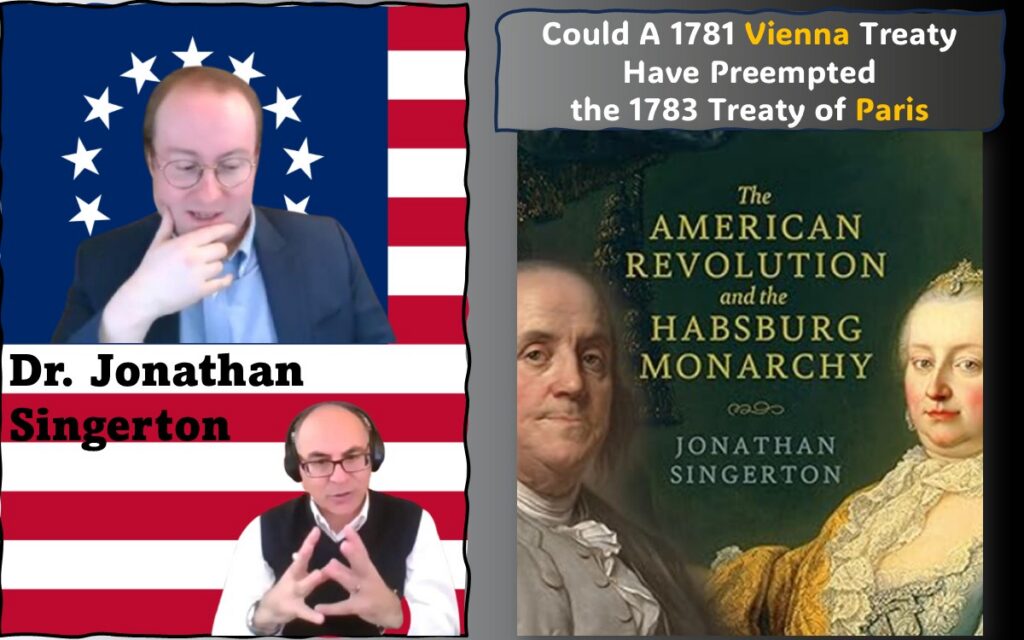 Why the Habsburg Monarchy Mattered to the American Revolution
About This Program
Analyzing American Revolution (AAR) is a special series podcast production of the History Behind News program. In this series, 33 professors (and counting) analyze the American Revolution from 33 different angles through in-depth interviews with host Adel Aali.
Meet Our Guest Scholars
A structured body of thought on the American Revolution—where leading scholars advancing distinct interpretations that give this program its depth.

Thematic Collection
Tap below for a closer look at the Revolutionary Era themes we examine—and to meet our guest scholars.

Library
- Interview Transcript Highlights
- Interview Image and Artist Highlights
- Quiz Answers and Backstories

Image Gallery
Explore the backstories and artist bios behind images of our Founding—before and after the American Revolution. These visuals shape how we remember—and reimagine—the Revolutionary Era.

Support AAR
AAR is an independent program built on sustained research, preparation, and production. Your support helps continue this series and expand our program.

Experienced Analysis of History
About HbN Program
The History Behind News program (HbN) is committed to making in-depth history researched and written by scholars enjoyable and accessible to everyone. Our motto is bridging scholarly works to everyday news.
The histories we’ve uncovered encompass an impressively wide range of subjects from ancient history to U.S. politics and economy to race, women’s rights, immigration, climate, science, military, war, China, Europe, Middle East, Russia & Ukraine, Africa and the Americas to many other issues in the news. We also receive advanced copies of scholarly books and discuss them in our program (in the context of current news).

Adel Aali, host. Snapshot from his introductory video to AAR podcast.
232 Scholars & Counting
Our guests are scholars at leading institutions. They are highly recognized, having received prestigious grants and fellowships as well as notable awards, including the Pulitzer Prize. They include celebrated documentary producers, former White House advisors and other high-ranking government officials, and current and former senior reporters of major national and international newspapers. Many have testified in Congressional hearings, and others frequently contribute to major media outlets and widely read publications.
Think You Know the American Revolution?