Updated: August 16, 2026
Introduction
In this interview: “No immigrants, no America.”
Watch this segment in the video below (00:58:42)
Wait… what?
Wasn’t the American Revolution mainly an English colonial story? If not, then what role did immigrants actually play? And how many immigrants were even living in the colonies by 1775?
Why were Germans taking loyalty oaths to the British crown? Why did thousands of German soldiers fighting for Britain stay in America after the war?
Also, why were some Catholics hiding their religion?
Isn’t it interesting that even before independence, colonists were already arguing about immigrants, their hunger for land, and their participation in colonial politics—issues and tensions that continue into our time.
The more we analyze the history of immigration in colonial America, the harder it becomes to separate immigration from the story of the American Revolution itself.
In this interview, Dr. Aaron Fogleman explains how immigrants and their descendants shaped colonial society, westward expansion, political life, religious conflict, and the Revolutionary War. The conversation examines German immigration, indentured servitude, anti-Catholic restrictions, citizenship, land pressure, Hessian soldiers, and the enormous demographic impact immigrants had on Revolutionary America.
Video
Watch the full interview with Dr. Fogleman (timestamped outline below)
Key Themes
- Forced and Free Migration
- Land, Opportunity, and Expansion
- Immigration, Citizenship, and Property
- Ethnic Identity and Political Participation
- Immigrants in the American Revolution
Central Question
This conversation raises a central question:
Was the American Revolution fundamentally shaped by immigrants and their descendants rather than by a purely English colonial population, and how did immigration, land hunger, ethnic politics, religion, and imperial expansion transform the social and political tensions that led to revolution?

How to Use This Post
Use this post as reference guide to the American Revolution through the lens of this interview and the broader Analyzing American Revolution program (AARevolution). Navigate using the interactive table of contents above and the timestamps below (in gray) to discover how this interview deepens the story of the Revolution—and to explore how the program unfolds: its key themes, insights, image gallery, scholars list, history quizzes, and related interviews across the series.
Immigrants and Their Descendants Made Up Nearly Half of Revolutionary America
By 1775, immigrants and their descendants made up nearly half of the population of Britain’s mainland American colonies. That included free migrants from across Europe, indentured servants, convicts, and enslaved Africans forcibly brought across the Atlantic. My guest, Dr. Fogleman, emphasizes that immigration to colonial America was not a marginal phenomenon or a side story to the American Revolution. It was one of the central demographic realities shaping colonial society before independence.
The largest group of forced migrants were enslaved Africans, who accounted for nearly half of all immigrants entering British North America during parts of the colonial period. Alongside them were convicts transported from Britain and Ireland, indentured servants working off the cost of passage, and free migrants searching for land, economic opportunity, or social stability. Many immigrants arrived during periods of upheaval in Europe, while others responded to recruitment campaigns, letters from relatives already living in the colonies, or imperial settlement schemes designed to strengthen Britain’s hold over North America.
The scale of this migration had major political and social consequences. Immigrants settled new lands, formed ethnic communities, published newspapers in their own languages, participated in colonial politics, and eventually fought on both sides of the American Revolution. Germans in Pennsylvania, for example, became heavily involved in petitions, protests, militias, constitutional debates, and ratification politics during and after the Revolution.
 Dr. Fogleman’s book discussed in this interview.
About My 216th Guest: Dr. Aaron Fogleman
Dr. Aaron Fogleman is a Distinguished Research Professor at Northern Illinois University. His work focuses on (1) the Atlantic World, (2) transatlantic migration, and (3) the intersection of religion and culture in early America. He has published extensively about these subjects, including the following books:
- Two Troubled Souls: An Eighteenth-Century Couple’s Spiritual Journey in the Atlantic World,
- Jesus Is Female: Moravians and Radical Religion in Early America,
- Five Hundred African Voices, and
- Hopeful Journeys: German Immigration, Settlement, and Political Culture in Colonial America, 1717-1775.
Dr. Fogleman is also working on “Immigrant Voices: European and African Stories of Freedom, Unfreedom, and Identity through Four Centuries of Transatlantic Migrations to the Americas,” a project that is supported by a Guggenheim Foundation fellowship.
 Other major works by Dr. Fogleman
About Featured Image
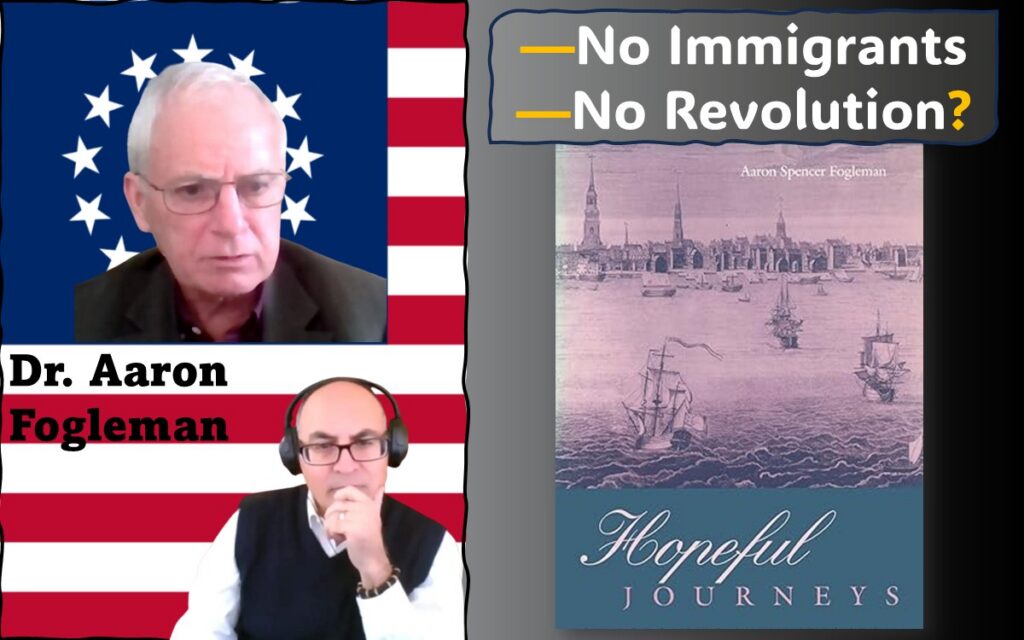
Image of Adel Aali (program host) and his guest, Dr. Aaron Fogleman, superimposed on the Betsy Ross flag, along with the cover image of Dr. Fogleman’s book “Hopeful Journeys: German Immigration, Settlement, and Political Culture in Colonial America, 1717-1775”, which we discuss in this interview.
Unless otherwise indicated, all images in AAR—including those in this post—are in the public domain.
AAR Essential Insights
Although the full video and transcript of my conversation with Dr. Fogleman are included in this post, I’ve selected and summarized several insights that I found particularly revealing and worth emphasizing. These moments — some surprising, others that challenge familiar assumptions — help us see immigration and the American Revolution in a different light.
By the way, these insights are my own takes and interpretations from the interview. For Fogleman’s perspective and exact framing, please watch the interview above and view the transcript below in the corresponding sections.
Who Were the Immigrants to Colonial America?
One of the most important points that Dr. Fogleman makes early in this interview is that colonial immigration was not mainly a story of free settlers seeking opportunity. That image is far too simple.
Dr. Fogleman reframes immigration around a different question: what was a migrant’s legal status when they stepped off the ship? Once you look at it that way, colonial America appears very different. Nearly half of all immigrants into British North America were enslaved Africans brought through force and violence. Add convicts transported from Britain and Ireland, along with indentured servants working years to repay their passage, and the colonial world starts looking much harsher and more coercive than the popular image many of us inherited.
Even “free migration” becomes more complicated under closer examination. Many Europeans came voluntarily, but often under economic pressure, debt, or social upheaval at home. In other words, freedom and desperation frequently existed together.
I was also struck by the discussion of indentured servitude. Some migrants arrived already tied to labor contracts that could last nearly a decade if they lacked money or useful skills. That alone changes how we should think about opportunity in colonial America before the Revolution.
And throughout all of this hovered the constant reality of imperial war. As Dr. Fogleman notes, wars in Europe almost always spilled into the colonies, shaping immigration patterns across the Atlantic world.
Watch this segment in the video above (03:24)
Why Europeans Immigrated to the American Colonies
One of the things I found especially interesting in this part of the interview is how immigration to colonial America was not simply spontaneous migration. It was actively encouraged, promoted, and at times engineered.
Dr. Fogleman explains that many Europeans were facing economic pressure and social upheaval at home. Large numbers of people felt they could no longer continue living as they had before. At the same time, stories coming back from the colonies described something many Europeans desperately lacked: land. To villagers in the German states or elsewhere in Europe, America represented space, opportunity, and escape.
But this was not just word-of-mouth migration between families and villages. Colonial expansion itself became a project. Governments, speculators, entrepreneurs, and imperial planners actively recruited settlers for strategic and economic reasons. The colonies needed population growth, labor, and loyal settlers to expand Britain’s imperial presence.
I was particularly struck by the New York example Dr. Fogleman discusses. Thousands of Germans were recruited to settle the upper Hudson Valley and help support imperial economic projects tied to the British Navy. On paper, the scheme sounded organized and ambitious. In reality, it became chaotic and poorly managed. And in a way, that failure says something important about colonial America itself: imperial planners could move populations across the Atlantic, but once migrants arrived, they often reshaped events for themselves.
The interview also quietly challenges the modern tendency to separate immigration from empire. In the 18th century, migration, economics, land hunger, and imperial expansion were deeply connected parts of the same story.
Watch this segment in the video above (09:27)
How Were Immigrants Recruited to America?
One of the points that stood out to me in this discussion is how organized immigration to colonial America actually was. We often imagine immigration as isolated families simply deciding to leave Europe and somehow ending up in the colonies. But Dr. Fogleman shows that there was an entire network helping direct and encourage that movement.
Potential migrants needed information. Where should they go? Pennsylvania? New York? The Carolinas? In an era when crossing the Atlantic was effectively a one-way journey for most people, these were life-changing decisions. That created demand for recruitment networks.
Some of that information came through private letters from earlier immigrants. But there were also pamphlets, broadsides, and organized colonial projects actively promoting migration. What I found especially interesting is that these efforts were often driven by entrepreneurs, speculators, and colonial promoters, while imperial authorities quietly supported them because expanding the colonies required people.
The New Bern example in North Carolina shows how ambitious some of these projects became. Recruiters targeted German-speaking Swiss populations and tried to move entire communities across the Atlantic to strengthen Britain’s imperial position in North America.
Immigration, in other words, was deeply connected to imperial expansion, economics, and settlement strategy.
Watch this segment in the video above (24:07)
Why Citizenship Mattered in Colonial America
What I found especially interesting in this discussion is how practical citizenship was in colonial America. Before the American Revolution, becoming a British subject could determine whether your family kept its property after your death.
As Dr. Fogleman explains, immigrants who were not naturalized faced real legal disadvantages. In a proprietary colony like Pennsylvania, there were circumstances in which the proprietor could claim an immigrant’s land after death if that immigrant was not legally a citizen. Naturalization was therefore tied directly to inheritance, stability, and protecting a family’s future.
Religion also shaped the process. Immigrants had to swear oaths, pay fees, and demonstrate Protestant conformity. For Catholics, that created obvious complications, which helps explain why some concealed aspects of their religious background.
In the decades before the Revolution, citizenship also opened the door to political participation. German immigrants and their descendants voted, petitioned, protested, and even served in local government, often while maintaining a strong German cultural identity.
That last point matters because it reminds us that hyphenated identities in America are not new. Long before later immigrant waves transformed the United States, Germans in colonial America were already participating actively in political life while still maintaining a strong German identity.
Watch this segment in the video above (33:35)
Was the Revolutionary War Fought by Immigrants?
One of the most striking arguments Dr. Fogleman makes in this interview is that immigrants and their descendants were not peripheral to the American Revolution. They were central to it.
Nearly half of the population in 1775 was either born outside British North America or descended from people who had arrived after 1700. As Dr. Fogleman points out, the colonies on the eve of the Revolution had a higher proportion of recent immigrants and their descendants than the United States would experience even during the great immigration waves of the 19th century.
And these immigrants were everywhere in the Revolution. Patriots. Loyalists. Militias. Continental forces. Even Hessian mercenaries who later became immigrants.
What also stood out to me is how deeply immigrants participated politically, not just militarily. German-language newspapers discussed revolutionary events. German Americans petitioned, protested British policies, fought in the war, and later participated in constitution writing and ratification debates. In places with large German populations, they became an important part of revolutionary political culture itself.
The interview ultimately challenges the familiar image of the Revolution as a struggle led primarily by English-descended colonists. The society that went through the Revolution was already extraordinarily international, multilingual, and shaped by migration from across the Atlantic world.
And that is what makes Dr. Fogleman’s closing line so powerful: “No immigrants, no America.”
Watch this segment in the video above (49:00)
No Immigrants, No Revolution?
Continue watching at 58:42 in the video above
The Interview (S1E18): Adel Aali and Aaron Fogleman
In our conversation, Dr. Fogleman addresses key questions about immigration and the American Revolution. The detailed outline and full transcript below supplement the video above.
Podcast
Watch the full interview on this page with the outline and transcript below, or take the conversation with you on the go through our Spotify podcast.

Outline
Use the in-depth outline below, with its key moments and turning points, to follow the discussion and navigate the interview.
Click for Timestamped Outline
- Selected Highlights (00:00)
- Guest Introduction (01:33)
- Forced and Free Migration to Colonial America (03:34)
- Enslaved Africans, Convicts, and Indentured Servants (04:01) – Key Moment (4:30)
- Paying for Passage Through Indentured Labor (06:21)
- Immigration Growth and Wartime Disruptions (08:13)
- Why European Wars Reduced Migration (08:38)
- Land, Opportunity, and Economic Upheaval in Europe (10:12) – Turning Point (10:37)
- Colonial Recruitment and Imperial Expansion (11:20)
- The German Settlement Project in New York (12:03)
- Imperial Schemes, Speculators, and Population Transfers (13:22)
- Hopeful Journeys and German Immigration (14:30)
- Why Dr. Fogleman Studied German Emigration (16:16)
- Religion, Migration, and Forbidden Catholics (18:44)
- Germans, Swiss, and the Meaning of Identity (20:18)
- German and Irish Immigration Compared (20:55)
- Why Swiss Immigrants Often Called Themselves “German” (22:08)
- Recruitment Networks and the Decision to Leave Europe (23:37)
- Pamphlets, Flyers, and Private Letters (25:01)
- Colonial Entrepreneurs and the Settlement of North Carolina (26:53) – Key Moment (27:22)
- Oaths, Citizenship, and Becoming British Subjects (30:06)
- Immigration Processing and Loyalty Oaths (31:43)
- Naturalization, Property Rights, and Anti-Catholic Restrictions (33:23)
- Germans in Colonial Politics and Public Life (35:16)
- Voting, Petitions, and Ethnic Political Communities (39:25)
- Hyphenated Identities in Colonial America (40:36)
- Immigration, Land Hunger, and Imperial Conflict (42:00)
- Immigration Backlash and Competition for Land (44:19)
- The Proclamation of 1763 and Westward Expansion (45:59) – Turning Point (47:14)
- Immigrants and the American Revolution (49:00)
- German Regiments, Hessians, and Loyalist Highlanders (52:46)
- German Newspapers, Protest Movements, and Constitution Making (56:24) – Key Moment (58:09)
- Just One Point (59:00)
Transcript
Note: This transcript was generated automatically and may contain minor errors. It is provided for reference and accessibility only.
Click to View Transcript
Adel:
Dr. Fogelman, it’s a pleasure to have you in our program special series. Thank you for taking the time for this conversation with me about the American Revolution. So, who were the emigrants to the American colonies in the 18th century?
Dr. Fogleman:
There’s a number of ways to answer that. Who are our people? How do you describe them?
The way I do it, I think it explains a lot, is to consider where they came from and how they got here and their legal status when they were taken off the ship or got off the ship. Close to half of them were enslaved Africans, born free somewhere in West Central Africa, in some cases, Southeastern Africa, captured in warfare or through several other matters, put on a slave ship, taken to the Americas, and some of them, nearly half of all immigrants into British North America. Had this background.
So, they’re forced migrants, I think, in terms of forced and free migrants. And the forced are nearly half. They’re also convicts, mostly from England, Scotland, and Ireland, and they’re forced immigrants as well.
Not nearly as many as the Africans, but not an insignificant number. And then European immigrants who came by choice, some as close to half of those as indentured servants. So, they were in servitude when they got off the ship, but still, it was a voluntary migration and it was temporary for a few years.
And then there were the free passengers, people who could afford to go and got off the ship and were legally free anyway to go wherever they wanted. There are other issues. It’s not that easy.
So, that’s how I present them, forced and free migrants. Enslaved, convicts, indentured servants, free passengers.
Adel:
Before I go on further and ask more detailed questions about this, I just wanted to confirm something. And I know a little bit about this. Indentured servants, essentially, most of them became indentured because, essentially, their service later was to pay for the passage.
Is that how it worked to America?
Dr. Fogleman:
Yes. It was very expensive to emigrate. People didn’t have a lot of money.
Most of them were in some sort of trouble. That’s why they wanted to leave and make a go of it in North America. And there were various ways and strategies involved with doing this.
But this is common. People did this in other contexts, not just in immigration in the 17th, 18th centuries. But you sign a contract, an indenture, and the people who ship you agree to pay for your upkeep, ship you to wherever you’re going, and then they will sell you when you get to the colonies.
And then you have another area of service there for some amount of years. It might be one or two years if you’re not too old and healthy and you have a valuable skill. Then your contract will be shorter.
But if you don’t, if you’re, say, 17 or 18 and you don’t have any skills that are helpful in the colonies, you might have to serve for eight or nine years.
Adel:
Wow. Wow. That’s a long while.
So let’s go back to my question about the 18th century. How do the composition and numbers of immigration to the American colonies change? I know that’s a big question.
You’ve got a hundred years, but is there like a trend?
Dr. Fogleman:
The overall trend is that it keeps growing from the 17th into the 18th century. It’s an important part of the overall colonial population growth, the immigrants and their descendants in the 18th century. In times of war, the immigration tends to go down.
It’s dangerous. It’s expensive. So it usually isn’t entirely shut off, but it goes down.
Adel:
So there are ups and downs, but the general path- You mean war in Europe or in the American colonies? Yes. Yes, both.
Okay. Yeah. Yeah.
Dr. Fogleman:
If there’s war in Europe, there’s going to be war in the colonies.
Adel:
Yeah. The French, the British and all that. Yeah.
Dr. Fogleman:
There are local wars in the colonies that wouldn’t have so much impact on transatlantic immigration. But in the 18th century, well, 17th too, you just can’t go very many years before there’s another large outbreak of warfare in Europe.
Adel:
Yeah. Yeah. Yeah.
I’ve noticed that in that context. So let’s go back to the different categories of immigrants that we identified. There were the forced migrants and the slave Africans made the overwhelming majority of that.
Then there were also convicts. And then on the free side, there were the indentured servants, and then there was the free, free, those that chose to come. In that last category, the free, what I call free, free, what were the reasons and motivations for those immigrants for coming to the colonies?
Dr. Fogleman:
For the majority, you might sum it up as social economic reasons and pressures, transformations in the homelands that were leading to upheavals and changes. People had to make a move. They just could not continue to live the way they had been.
Large segments of the society. And they started making a move. That combined with what people perceived as increasing opportunities in the colonies, land.
There’s just a perception that there’s just a great deal of land to be obtained there and people can get it. You have to take it from first from the people who already lived there, but from a European perspective in the villages, they’re just not worried about that. They’re just hearing about land.
Yeah. And immigrants who went before them, right back and say, yes, this works. You want to come.
So encouragement from people, family and villagers who went before them, encouraging them to come. That is probably the most compelling account of America that might encourage people to come. There were also colonial projects and schemers and speculators who recruited people to come and they were often unscrupulous and just lie.
Adel:
Give me an example of a colonial project. What is this? Build the canal or build new colonies or what was it?
Dr. Fogleman:
There was a project, for example, involving Germans in New York in the early 18th century. They wanted thousands of people to come and settle in the upper Hudson Valley for a number of reasons. One, they wanted white European immigrants who would be loyal to settle the area to contribute to colonial expansion.
They wanted them to develop the naval stores, potential and industry there to help the growing English British Navy. So they were supposed to do that. They didn’t end up doing that.
They did other things. But so the idea was there were people on the continent and in Britain, they see the colonies are working. By the late 17th century, it’s clear that they passed the crisis point of early Jamestown and Massachusetts Bay.
This is going to work. They’re going to survive. It’s working.
Now what can we do? And people had big ideas for imperial colonial economic expansion and it involved moving populations from one point to the other. That was a naval stores project.
There were a lot of other things. Was that a scheme or was that well intended and it just failed? That was an imperial backed project and it, they got more people there than they could really handle.
And it just wasn’t managed very well because it seemed like a good idea on paper, but how to actually deal with many, many thousands of people to get them there, to take care of them initially when they had nothing to get all the startup funds and equipment and things they needed. It was, it was pretty much a disaster and, and the immigrants realized that at midstream and they just started doing what they wanted to do. Yeah.
And just like other immigrants.
Adel:
I want to talk about one of your books. The title suggests that at least in the case of German immigrants, and you just mentioned them, they had very high hopes for America. I’ll read the title for our audience.
Hopeful Journeys, German Immigration Settlement and Political Culture in Colonial America, 1717 to 1775, which is literally when the American revolution starts in 1775. Yeah. I’d love to hear about this book.
You, you focus on German immigrants, right?
Dr. Fogleman:
Yes. There’s a, in the introduction, that’s a long introduction. There’s an overview of all these things I’ve just been talking about.
Immigration of all groups to British North America, forced and free to give you context. And there’s some estimates in there and I just address larger issues of immigration and a colonial, expanding colonial imperial society. And then the book itself, the chapters focuses on German.
The first half is of the book is about the people and conditions in the German territories in the 18th century that were leading people to leave. And then the second half of the book is about what happens to them in the colonies and how they settle and engage with American society and political culture.
Adel:
Did you focus on German immigrants because they made up a huge number of free immigrants or is this just something that you were interested in?
Dr. Fogleman:
Well, I started working on German immigrants. Actually, I was an undergraduate.
Adel:
Oh, wow.
Dr. Fogleman:
So 1980, yeah, it was my senior thesis. And it was a long time ago. And yeah, I was just somebody looking for a topic and I was interested and I was interested in the American revolution.
I wrote this paper that got published in a student journal. I won a $50 prize for it. I came in second place in some undergraduate competition.
And I remember calling up my advisor and telling them, hey, I got something and they’re going to publish it in their journal. And he said, congratulations, and you even get paid for this one. And I didn’t know what that meant.
I understood later what that meant.
Adel:
Well, $50 in 1980 or whenever that was, was a lot more money than it is these days.
Dr. Fogleman:
But let me just add that I studied in Germany later. I got a master’s degree and wrote a master’s thesis on German emigration from the Southwest in the 18th century. I didn’t follow them to wherever they went, but just why were people leaving?
But I just got interested in it. And the more I studied it, the more I realized that it just hadn’t been studied very much scholarly perspectives, using the language and the perspective of going deep into the homelands where people came from to get a sense of who they were and what was motivating them and the issues of their culture, religion. I do a lot with religion, its impact on migration.
That just hadn’t been done very much. And it was needed because there was just growing interest among scholars in early America and immigration and European and later African backgrounds. And so I just kept going because the more I worked on it, the more I could see people needed it, liked it, wanted it.
And so I just kept going.
Adel:
When you say religion, did Catholic Germans come over as well?
Dr. Fogleman:
A very small number. Catholics were actually forbidden by the British to immigrate. They did it anyway, Irish as well as Germans.
But the percentage of Irish that was Catholic, it was a minority, but it was a significant minority. I don’t know, it might’ve been like 30, 35% of all of them, something like that. For Germans, it was much smaller, but they were there.
So you just, I think most people knew it was forbidden. So you just don’t tell them you’re Catholic. And once you get settled and you’re in whatever colony and you’re starting to getting your land, you’re in a village settlement, then you can start finding other Catholics and try to have some kind of religious life, which they did.
Adel:
Which they did. Did they open Catholic churches through and through or was it more private and not conspicuous?
Dr. Fogleman:
They had churches and a sense of a congregation, people coming together.
Adel:
Yeah.
Dr. Fogleman:
Trying to think when was the first church building built?
Adel:
You mean Catholic church building?
Dr. Fogleman:
I think there was something by before independence in Pennsylvania, but I couldn’t tell you the exact date.
Adel:
Were there more German immigrants than let’s say Irish or Scottish immigrants?
Dr. Fogleman:
If you look at the Irish, all of them, from Ulster, from everywhere else, from Protestants, Catholics, they were about the same, a little over a hundred thousand from 1700 to 1775, the eve of the revolution, about the same. Germans may have been a little more. There’s an old traditional way of looking at the Irish is dividing them between Scots-Irish and just Irish or whatever, and seeing them as two different peoples.
It’s a little complicated. People don’t do that as much as they used to. But if you just say, look, they’re from Ireland, and even if they immigrated from Scotland 10 years before, that’s tough.
Are they Scottish? Are they Irish? They’re probably Scots.
If you take out some of them, then Germans are definitely higher. The German is complicated as because this is well before unity, obviously, in 1871. But a lot of them are from Switzerland.
They’re German-speaking people from Switzerland. But the thing is, whether they’re from Switzerland or anywhere else, they often refer to themselves in the colonies as Germans.
Adel:
You said, okay, so even if they were from Switzerland, they call themselves Germans in the American colonies.
Dr. Fogleman:
In all contexts. In certain contexts, somebody would say, I’m Swiss, or the Swiss this or that. In other contexts, they would say the Germans, and sometimes even the German nation.
Adel:
So you said, if they came from German states or they came from Switzerland, but you didn’t identify any Germans from the Habsburg sort of realm, the Austrian Empire. Did Germans come from there too?
Dr. Fogleman:
Not very much.
Adel:
Not very much.
Dr. Fogleman:
Most of the people who emigrated from the German territories, and they were heavily concentrated in the Southwestern territories, they went to Eastern Europe. Probably 80, 90% of them went to Eastern Europe, not to North America in the 18th century. A lot of those were from Habsburg lands, because the Habsburg had territories in Eastern Europe, and some of them went from a German territory in the Southwest to what is now Romania.
And a lot of them went to Russia as well, what is now, they went to the Russian Empire.
Adel:
Interesting. You said in your study, especially in your master’s, that you studied in Germany, you looked at religion and several other aspects. One of the things that you looked at, homeland, did you mean deep into German homelands?
Is that what you meant? Yeah. You’re shaking your head in affirmation.
In studying this, was there a certain, I don’t know, recruitment of Germans? I don’t want to say offices, that sounds silly. You said, please tell me about that.
I’m interested. Who was recruiting? How was this happening?
Dr. Fogleman:
Sorry, I’ve got to remember to speak and not nod my head.
Adel:
That’s okay.
Dr. Fogleman:
The audience can see it, but go ahead. Recruitment was very important for all this immigration, whether they went to Eastern Europe or North America or anywhere else in the Americas. You have to know where you’re going.
There’s a couple of things happening. One, you realize I have to make a move. Now, the question is, where do I go?
Do I go to the next village? Do I go to the next territory? Am I going to go East to Transylvania or Romania or Eastern Prussia?
Or am I going to go West to North America? If I go to North America, most people went to Pennsylvania, but am I going to go to New York or North or South Carolina or Maryland? There are other possibilities.
You need information on this. You need encouragement because in this era, there’s pretty much no going back. You’re making a life-altering decision.
There were other things you could do. You had to make a move, but you didn’t necessarily have to immigrate. You didn’t have to immigrate far.
It’s a big decision. It’s a big choice. There were printed pamphlets, some very well-known booklets that were intended to recruit immigrants.
There were some smaller pamphlets and sometimes just a broadside, a single sheet. Like a flyer? Yes.
The private letters were really important.
Adel:
I get the private letters, Dr. Fogelman. I’ve actually read about those. The thing that I’ve been fascinated by, I’ve only read one or two instances of this, is the recruitment side.
Are these, I don’t know, companies, are these British agents, are these colonial agents coming from the US, not US, from the American colonies? Who is doing this recruiting? Who is printing these booklets or pamphlets?
Who’s distributing them in the German states?
Dr. Fogleman:
That’s a good question. It’s really complicated. There are a number of possibilities.
There are big projects and colonial schemes. I mentioned New York. There was another one for North Carolina in the early 18th century around what is now New Bern, North Carolina.
They recruited heavily in the Swiss territories, German-speaking Swiss territories. They being colonial Americans that went back to Germany? These were a Swiss proprietor.
Oh, I’m forgetting his name. They were entrepreneurs, speculators, and people who lobbied the imperial government, the British government, royal officials to get permission and support to do this. The British welcomed it.
It was in their interest because they needed people there. They didn’t want to have to manage all this themselves. They welcomed this if people could put together a good project.
It’s not unlike the early colonial projects themselves. For example, William Penn in Pennsylvania, he lobbied the English government to get a charter to start the new colony of Pennsylvania. Every new colony did that, all of them, the royal colonies, the charter colonies, the proprietary colonies.
You have to get together people, money, you come up with a plan for a colonial project, and you get the backing of the royal government. Whether it’s going to be a royal colony or not, you can’t do this without some kind of royal sanction. That’s just how the colonies work.
Within that, there are these smaller projects to develop the colonies, to develop the empire.
Adel:
And for that, you needed people.
Dr. Fogleman:
Yes. Entrepreneurs, adventurers, schemers, people like this are doing this in all kinds of ways. In all of the empires, not just in settlement projects, but in financial projects, just money-making schemes, that sort of thing.
That’s so interesting.
Adel:
Let’s go back to something you said earlier. Remember, I asked you if Catholics, German Catholics, were coming, and you said very little numbers. Then you said this.
You said, you just don’t tell them you’re a Catholic. That small percentage that came, and then once they got to the colonies, they formed their own congregations, and they went down their merry way from a religious perspective anyway. You said, don’t tell them you’re Catholic.
Don’t tell who. My question here is this, the reason I ask it. How were these immigrants processed?
If I want to be a little bit silly here and say, put it in 21st century or 20th century, what? Do they go to the local consulate or embassy, get a visa? They’re going to another country.
Britain is a different empire, and these Germans are foreigners to the empire. I know that the concept of nationality was different. The notion was different back then, but still, they need a visa something to get there.
Dr. Fogleman:
How does this happen? From the British perspective, there were a couple of things that happened, and this was pretty haphazard in the early period. As you move through the 18th century, it becomes more sophisticated and enforced, but still, nothing like what you see in the 19th or 20th centuries.
You have to get on a ship, and the ships have manifests, and they tell what are they carrying? Immigrants, and how many? A lot of those are anonymous.
They don’t actually keep names, but some do, some don’t. In 1728 or 1729, there were so many Germans coming into the colonies, especially Philadelphia, that they made it a requirement for all males 16 years and older disembarking from the ships to take an oath of allegiance to the British crown. Those are immigrants coming outside of the realm, the British empire, only for them, and that’s primarily, overwhelmingly, the Germans.
They didn’t even do this with the Irish, for example.
Adel:
Yeah, even though it was not…
Dr. Fogleman:
And there were a small number of Germans who came from Hanover, which was part of the British empire then, the king.
Adel:
Hanover and all that, yeah.
Dr. Fogleman:
They didn’t have to do this, but there weren’t very many, this period, there weren’t very many immigrants. They signed their names, and those lists are still available. Immigration historians use them in all kinds of ways to study them.
That was one way, and you had to swear an oath of allegiance, and that’s when you would want to make sure that no one knows you’re Catholic. I don’t believe they ask you to state your religion. I don’t think so, but it was forbidden to come if you were Catholic, so you just don’t say anything.
The other time is during naturalization that became an issue. It was always there, but in the mid-18th century, that became increasingly an issue. I wrote about this at length in Hopeful Journeys.
If you wanted to vote legally and ensure that you could bequeath your property to your children, you needed to get naturalized.
Adel:
Naturalized into a British citizen? Yes. Okay, okay, okay.
Yes.
Dr. Fogleman:
You had to prove that you’d taken the Lord’s Supper within three months, and you signed another oath, and you paid a fee, and then you were naturalized. So, you wouldn’t want to say that you took communion at whatever Catholic church in Redding, Pennsylvania. That would not have been a good idea.
Yeah. To know that you went to that Catholic church.
Adel:
Yeah. Did a lot of Germans or a lot of, well, this doesn’t apply to Scots or even Irish, but did a lot of Germans become citizens?
Dr. Fogleman:
There were several thousand. I would say by the late 1760s, by 1770, a large percentage of German immigrant families in the Delaware Valley area had the head of family naturalized. I think I tried to figure that out once.
A rough estimate, I don’t know, 40 to 50 percent, something like that.
Adel:
40 to 50 percent.
Dr. Fogleman:
That’s just in the Delaware Valley. There are lots of Germans in the southern colonies and the people in New York and elsewhere.
Adel:
And to just go back, you mentioned property, and there were practical advantages of becoming a citizen? Yes.
Dr. Fogleman:
Yes. If you’re in Pennsylvania, for example, which is where most Germans were, it still was a proprietary colony. That meant that the Penn family, by this time Thomas Penn, was literally the owner, the legal owner of the entire colony.
Even though you might buy property there, you own it in the sense that you bought it, you’re not renting it, there is still a sense of ownership that the proprietor has. And you had to pay, you were required to pay a quit rent, just a fee. It’s something like a tax, except the reason you’re paying it is not to pay for a government, you pay for government services, you’re paying it because you’re supposed to pay it to the proprietor, the owner.
Adel:
Wow.
Dr. Fogleman:
So one of the proprietary rights, it’s a legal right of escheat. And when you die, the proprietor has the right to your property if you are an immigrant. Because you are not a citizen, you came from outside the realm.
Yes, you can buy land, you can work it, it’s yours, make sure you pay the quit rent every year. Now, whether or not all these things were enforced is a different issue, but this is the law, this is how it worked. So you die, the proprietor gets your land, if you’re not a citizen.
Adel:
So you have every incentive to become a citizen so that your sons or daughters had a different journey, but your children could benefit from your life’s toil.
Dr. Fogleman:
The question is, is the proprietor in a position to actually enforce this, or to even know if you’re an immigrant? Because there were so many people in so many languages. I mean, you could just lie and say, no, I was born in Reading.
I’m from Ole, I’m from Lancaster, I’m from Philadelphia.
Adel:
And it’s okay that you have an accent.
Dr. Fogleman:
Because we all speak German. I’m not from Germany, so you just lie. And so enforcement was difficult, but actually in the 1760s, enforcement was increasing.
Adel:
Yeah.
Dr. Fogleman:
There was a crackdown and it was working. And the Penn family was making a lot of money off of this.
Adel:
You mentioned vote. Another benefit of becoming a citizen is that you could participate, at least in your community, in your regional or your township, by voting. What was the impact, this is before the revolution even, of German political participation?
Were they a relevant force or was it very small and irrelevant?
Dr. Fogleman:
They were quite relevant. Wherever there were numbers, they were relevant. They voted.
They were involved in politics in other ways. Petitions, protests.
Adel:
Protests, okay.
Dr. Fogleman:
Lobbying government, getting elected to government, serving as officials.
Adel:
When you say getting elected to government, these were immigrants who had become citizens. So they were born somewhere in the German states or Switzerland. They immigrated, they became citizens, and then they started serving local governments.
Dr. Fogleman:
But you also need to be aware that this was, in places where there were a lot of Germans, there was a strong ethnic culture there. So you have children, second, third generation people, speaking German, going to German-reformed and Lutheran churches and some of the smaller, more radical groups, participating heavily in public life as Germans, referring to themselves in German. And as Germans, even though they were really born there.
You have what immigration historians sometimes refer to as a dual or hyphenated identity. I’m American and I’m German. Or I’m Irish and I’m American.
And later, I’m Italian and I’m American. And, but they were ethnic blocs in how they lived, how they worshipped and political activity.
Adel:
You mentioned Irish, then you also discussed Scott Irish. Did they also have their own communities? Oh, yes.
Yeah. And did they, their communities separate from other colonists, right?
Dr. Fogleman:
Well, yes and no. What happened in the 18th century regarding this is instructive for any other later period in American history or immigrant history to this very day. You have people who immigrate here, especially if they’re large numbers.
And some of them don’t pursue this separate ethnic dual hyphenated identity.
Adel:
So it just melts into…
Dr. Fogleman:
They don’t care about the homeland. It’s just not me. I’m here.
I’m American now. It’s it for me. And they changed their names.
They changed their religions. They just don’t get into it. And others do.
And that was true in the 18th century as well.
Adel:
Hmm.
Dr. Fogleman:
And it was true in every generation. It’s true today. People coming from anywhere in the world today, they might live in ethnic communities, try to preserve the language, the religion, make a major effort to teach their kids the language and culture of the homeland to preserve it.
Knowing that they’re going to learn English in American ways anyway. But they want to preserve the older and there are others that just don’t do that.
Adel:
Did… We talked about citizenship earlier. Did Scots and Irish need to become citizens in order to participate in local government vote?
Dr. Fogleman:
Well, they were already considered citizens of the British Empire, from the empire.
Adel:
Yeah.
Dr. Fogleman:
There are other issues regarding, you know, voting on that. You need to be male. You need to have property.
Those issues are there.
Adel:
But those also apply to English.
Dr. Fogleman:
Yeah, there’s no prejudice to people who aren’t English that I know of in the colonies. On these issues.
Adel:
And was there any backlash? Because there were so many immigrants coming. I’m particularly interested in German Americans, German immigrants, because they spoke an entirely different language.
Dr. Fogleman:
Yeah. There’s some issues that are developing. If you read the letters and commentaries, you see a lot of responses just to the volume.
There are so many people coming in. It’s getting harder to get land. Land is getting more expensive as it becomes more scarce.
Adel:
Hmm.
Dr. Fogleman:
There are issues of the massive influxes of immigrants into the port areas. They don’t all stay there, but a lot of them do. And yes, that depressed wages.
Adel:
And there’s more labor available. Yeah.
Dr. Fogleman:
There’s a sense, a growing sense, especially after this huge wave of Germans and especially others in the late 1740s and early 50s, that we’re just running out of land. Even though they had so much more land than they were coming from in Europe. But there’s just a sense that they’re running out of land.
It’s part of this mentality that sets in among Americans and not just in the United States and not just in North America, Europeans, that there is a lot more land here than in the homelands and we need a lot more land. We just have to keep expanding, which means conquering, conquest, the people who already lived there. We just have to have that to do what we do.
This is why we came. This is who we are. This is how we live.
And so if it starts getting crowded, then people start complaining and they start pressuring to move west.
Adel:
And I forget when this was. I think it must have been late 1760s or early 1770s when the British tell the colonies that you can’t just push into native territories. It must have ticked off a lot of immigrants who wanted more land then.
Dr. Fogleman:
Well, immigrants and their descendants and others. It’s the proclamation of 1763 after the French and Indian War. And the British just expand their empire dramatically after this huge victory.
They get all of Canada, all of North America to the Mississippi River, and they get Florida. They’ve got it all. They’ve got to figure out what to do with it.
That wasn’t really the plan. And from a British imperial perspective, it’s just not that easy. For one, they get it.
They see how land hungry the colonists are because of the heavy immigration and just the pressures there. But a lot of people living there were their allies in the war. And they just can’t let the colonists trample all over them.
Adel:
By that, you mean native people.
Dr. Fogleman:
Yeah, help them beat the French. They call it the French and Indian War. But there were Indians that were on the side of the British as well.
And they’re your allies. So the empire came first, but they were trying to show them some consideration. And they’re also just worried about how to manage all this.
Worried about colonists expanding into new and different and dangerous places. Whenever they do that, it has ramifications for the entire empire. The reason why the beginnings of the entire Seven Years War in Europe, 1756 to 63, actually began with George Washington and his unit, Virginia Militia on the Virginia frontier.
They were some place where they shouldn’t have been clashing with the French. That just snowballed into the Seven Years War. Now, it didn’t cause it or start it because there are all these other factors.
But from a British imperial perspective, that’s what they’re worried about. They don’t want these guys going to places where they shouldn’t be doing things they shouldn’t be doing that will erupt into another imperial war for the whole empire. And that and protecting their Native American allies is why they did that.
Adel:
Let’s take a break here. In the next segment, I asked Dr. Fogelman about emigrants and the American Revolution. We’ll be right back.
Dr. Fogelman, what role did emigrants play in the American Revolution?
Dr. Fogleman:
It was a huge role. Because there were so many of them. Emigrants and their descendants on the eve of the Revolution.
If you think of the population that went through the Revolution, that fought the Revolution, if you will. So many of them were emigrants or descended from recent emigrants. They were involved in everything.
And the period up to the Revolution, you have the highest percentage of recent emigrants and their descendants in all of American history to this day, by far. Oh, wow. Yes.
Wow. Nearly half of the population in 1775 was either born elsewhere, Europe or Africa, or were descended from people who came after 1700, came or were brought. So your parents or your grandparents, it’s almost half.
We’ve never even come close to reaching those levels in later periods. In the 19th century, which is famous for so many millions of European emigrants coming in, their impact, their numbers, their proportions of the population that was already there. If you look at emigrants, recent emigrants and their descendants didn’t come close to reaching the levels that they did in 1776.
Adel:
Half is a huge percentage.
Dr. Fogleman:
Yes. So they’re involved in everything. They’re on all sides, patriot, loyalists.
They’re in the military, both sides, loyalist militia, patriot militia, Continental Army. So they fought in battles as regulars and irregular troops on both sides. There were British and especially their German allies that fought with them, commonly called the Hessians.
Many of them deserted and became immigrants. Sometimes immigration is a process. You get stationed overseas as a soldier to go fight in a war.
You’re not an immigrant, you’re a soldier. But if you desert and stay there, you become an immigrant. And about 5,000 of the German emigrants that fought with the British did exactly that.
That’s a big chunk. Yes. But they were so much of the revolution was just about life and survival and supporting one side or the other.
And everybody was involved with that. Choosing sides and immigrants and their descendants were recent descendants. Descendants of recent immigrants were all involved.
Adel:
Were there any German special regiments or anything, German-dominated regiments in the Continental Army or anything?
Dr. Fogleman:
Yes, there were. Oh, there were? Yes.
I want to say two battalions. One of them were from Maryland, but also Pennsylvania. And they were in the Continental Army.
German officers spoke. All the commands were in German.
Adel:
Wow.
Dr. Fogleman:
And there are other immigrants as well. A lot of Irish immigrants fought in the Continental Army, including officers. Highlanders in North Carolina fought in the famous Battle of Moores Creek Bridge.
They were loyalists. They were kilts in that battle, but they were actual immigrants. Scots in North Carolina.
Adel:
I’ve read that Scots were more likely to be loyal to the British Empire than other immigrants.
Dr. Fogleman:
It’s a mixed.
Adel:
It’s a mixed, yeah, mixed bag.
Dr. Fogleman:
North Carolina, yes, they were heavily loyalists.
Adel:
Heavily loyalists in North Carolina. The fact that Hessians were serving the British and the colonists knew this, and there was a lot of propaganda. There was a lot of discussion of this, that the Hessians were there.
Did that create a backlash against existing German immigrants in the colonies?
Dr. Fogleman:
I haven’t seen that so much. I mean, there was a tremendous hatred of Hessians themselves. If people thought you were a Hessian or you were with the Hessians, and the Patriots are controlling the area, then you’re in trouble.
I don’t see the Patriot militia, not familiar with them, going after German communities because they thought they were disloyal because they associated them with the hated Hessians. I mean, it is common in 18th century armies, and later, and earlier, to have foreign troops involved, so it’s not… The question is ordinary people in the colonies, how aware of this were they, but certainly in Europe, it’s common.
The French army marches through your village and you see a lot of people there who aren’t French, or same with the British, or the Germans, or the Russians, and their armies. That was common. Navies too.
Adel:
Yeah. With respect to Germans and the Irish who were fighting for the colonies, did they know what they were fighting for? My question is very specific to Aquafogelman.
Up through 1775, for example, before Thomas Paine’s pamphlet and before the Declaration of Independence, people were fighting for their rights as British subjects to secure their rights. Then it became rights turned into revolution and independence. I get all of that, but was this narrative also being discussed among German Americans and Irish immigrants, or were they fighting for local communities?
Was there something different that we should know or no? Just sort of applied to the same story.
Dr. Fogleman:
Well, they are a part of the larger narrative. You either don’t like British policy, you might get out and protest it or not. Germans did that, Irish did that.
They had a long background, both groups, Irish and Germans, protesting British or colonial policy violently at times. That’s just what you do, so they’re involved. They were involved with petitioning leading up to the revolution.
There were German newspapers that put out all the news of these developments. People read those pamphlets as well. And Germans in Pennsylvania, especially when the revolution began turning radical, when the protest movement becomes war, and then they start talking independence and writing and rewriting constitutions, Germans were heavily involved with that.
Fought in regular and irregular forces, and they were involved in the writing of constitutions at the state level and then at the US Constitution. So they were part of the- Ratification of it, especially ratification of it, they’re heavily involved in that.
Adel:
Germans were heavily involved in the ratification of the constitution in 1789 and all of that.
Dr. Fogleman:
Wherever there you see a lot of numbers of Germans, you see heavy involvement there.
Adel:
That’s wonderful. If you want our audience to remember just one point about immigration and its impact on the American Revolution, what would that be?
Dr. Fogleman:
Immigration was so big numerically, as I said before, if you look in terms of immigrants and their recent immigrants and their descendants, they have the largest proportion of the American population ever to this day. And they were so involved in all aspects of the revolution, good or bad, what you might like, what you might not like on all sides. You just couldn’t have had a revolution the way it was without them.
No immigrants, no America.
Adel:
Wow. Dr. Fogelman, thank you so much for educating me and our audience about the American Revolution. And to our audience, if you know of any history that could provide more perspective about the American Revolution, please share it with us and tell us what’s your perspective.
Related Interviews and Essays
Religion
Religion was an important aspect of the political alliances that supported the American Revolution. In this interview, Dr. Fogleman highlights the religions of immigrants to America, including Catholic Germans and Irish immigrants. In addition, he has published extensively about religion, including Two Troubled Souls and Jesus Is Female, two books identified in his bio above.
In our program, we have dedicated an entire episode to religion and the American Revolution in my interview with Dr. Kate Carté, Professor of History at Southern Methodist University.
Hessians
In this interview, Dr. Fogleman also discusses the Hessians in the broader context of immigration, the American Revolution, and how German-speaking peoples participated on both sides of the conflict.
In our program, the following scholars discuss the history of Hessians in America and their stories back in the German states:
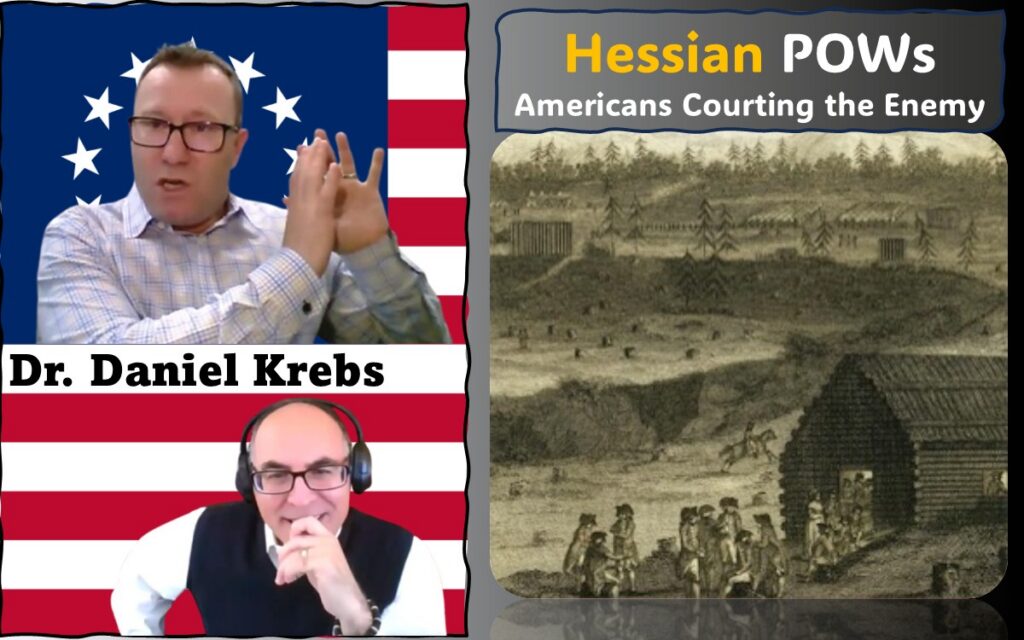
- Dr. Daniel Krebs (U.S. Army War College), author of A Generous and Merciful Enemy: Life for German Prisoners of War during the American Revolution
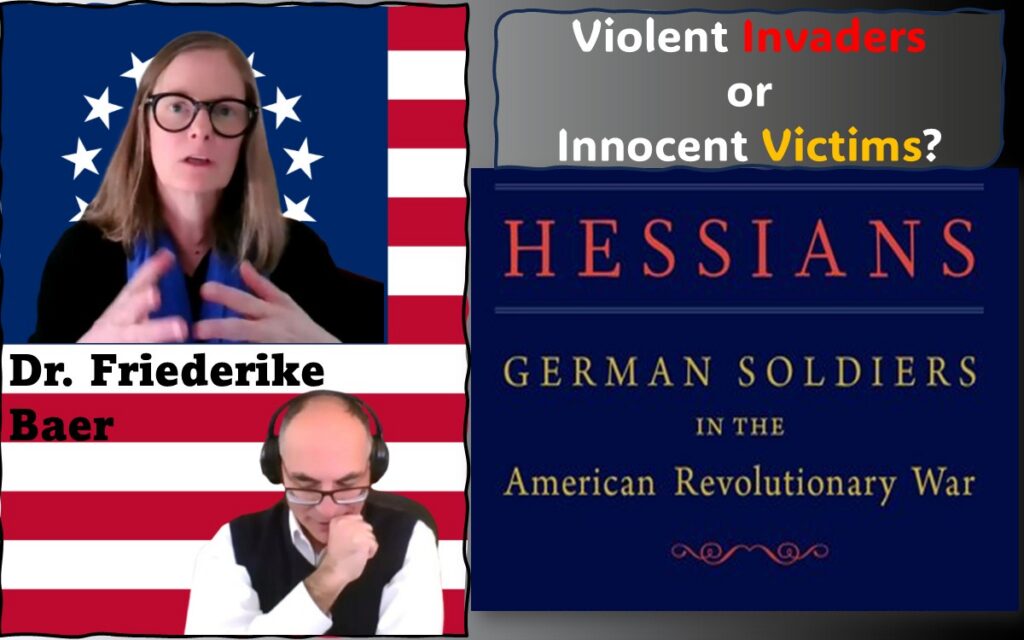
- Dr. Friederike Baer (Penn State Abington College), author of Hessians: German Soldiers in the American Revolutionary War
These interviews will be linkd here when they publish.
About This Program
Analyzing American Revolution (AAR) is a special series podcast production of the History Behind News program. In this series, 33 professors (and counting) analyze the American Revolution from 33 different angles through in-depth interviews with host Adel Aali.
Meet Our Guest Scholars
A structured body of thought on the American Revolution—where leading scholars advancing distinct interpretations that give this program its depth.

Thematic Collection
Tap below for a closer look at the Revolutionary Era themes we examine—and to meet our guest scholars.

Library
- Interview Transcript Highlights
- Interview Image and Artist Highlights
- Quiz Answers and Backstories

Image Gallery
Explore the backstories and artist bios behind images of our Founding—before and after the American Revolution. These visuals shape how we remember—and reimagine—the Revolutionary Era.

Support AAR
AAR is an independent program built on sustained research, preparation, and production. Your support helps continue this series and expand our program.

Experienced Analysis of History
About HbN Program
The History Behind News program (HbN) is committed to making in-depth history researched and written by scholars enjoyable and accessible to everyone. Our motto is bridging scholarly works to everyday news.
The histories we’ve uncovered encompass an impressively wide range of subjects from ancient history to U.S. politics and economy to race, women’s rights, immigration, climate, science, military, war, China, Europe, Middle East, Russia & Ukraine, Africa and the Americas to many other issues in the news. We also receive advanced copies of scholarly books and discuss them in our program (in the context of current news).

Adel Aali, host. Snapshot from his introductory video to AAR podcast.
232 Scholars & Counting
Our guests are scholars at leading institutions. They are highly recognized, having received prestigious grants and fellowships as well as notable awards, including the Pulitzer Prize. They include celebrated documentary producers, former White House advisors and other high-ranking government officials, and current and former senior reporters of major national and international newspapers. Many have testified in Congressional hearings, and others frequently contribute to major media outlets and widely read publications.
Think You Know the American Revolution?