Updated: August 1, 2026
Introduction
In this interview: “What he doesn’t realize is that Bancroft is getting two salaries… one from Deane… and one from the British.”
Watch this segment in the video below (00:24:59)
Why did Benjamin Franklin send a Connecticut shopkeeper who spoke no French and had hardly traveled outside of Connecticut to France?
How and why was a playwright secretly smuggling weapons to the American colonies?
Why were people in London gambling fortunes on whether a French war hero was a man or a woman? And how does this relate to the American Revolution?
In this interview, Prof. Joel Richard Paul examines the hidden international struggle behind the American Revolution and the unlikely network that helped arm the colonies before the Franco-American alliance officially existed. Through the stories of Silas Deane, Pierre-Augustin Caron de Beaumarchais, and the Chevalier d’Eon, this conversation explores espionage, diplomacy, political sabotage, and the desperate effort to secure the weapons and supplies that saved the American Revolution.
We also discuss this: how polarized politics inside the Continental Congress nearly destroy America’s diplomatic efforts in France.
Video
Watch the full interview with Prof. Paul (timestamped outline below)
Key Themes
- Franco-British Rivalry After the Seven Years’ War
- Unlikely Allies on an Improbable Mission
- Secret Arms and Revolutionary Survival
- Gender Controversy and International Intrigue
- Political Rivalry in the Continental Congress
- Lost Heroes, Hidden Spies, and Discovered Records
Central Question
This conversation raises a central question:
How did a shopkeeper who spoke no French and had no international experience, a playwright, and a war hero at the center of one of Europe’s strangest gender scandals become part of the bizarre international plot that helped keep the American Revolution alive?

How to Use This Post
Use this post as reference guide to the American Revolution through the lens of this interview and the broader Analyzing American Revolution program (AARevolution). Navigate using the interactive table of contents above and the timestamps below (in gray) to discover how this interview deepens the story of the Revolution—and to explore how the program unfolds: its key themes, insights, image gallery, scholars list, history quizzes, and related interviews across the series.
Extraordinary Men (and a Woman?) Behind a Ludicrous Scheme That Worked Against All Odds
Here is a stark and, candidly, shocking fact the gravity of which we often fail to appreciate: the American rebels simply had no real means of fighting the mighty British Empire. How mighty? Throughout the Revolutionary War, Britain fought in India and the Indian Ocean, Europe, the Atlantic Ocean, the Mediterranean, the Caribbean, and across North America. Not only did Britain survive this global war, but the British Empire continued to expand afterwards.
Against the might of the British Empire, the American rebels virtually had no arms. But it was more than that. They also lacked the means of manufacturing arms on the scale required to sustain a major war.
As many historians have emphasized in our program, it is one thing to declare independence. Winning it is a whole different matter.
By 1776, it was obvious that passions and proclamations alone would not secure independence. So even before the colonies formally declared independence, (1) Silas Deane — a shopkeeper turned successful merchant turned delegate to the Continental Congress — was sent to France to secure arms for the American Revolution. But he spoke no French and had no diplomatic contacts or experience.
Upon arriving in France, Deane’s mission became even less probable.
He had no money, at least not money the French considered real currency. Continental dollars were essentially worthless in France. While in France, he received no instructions from Congress. He was utterly alone in a foreign country. And to boot, from the moment he landed in France, British spies followed him.
Yet Benjamin Franklin had selected Deane for this improbable mission precisely because his role as a diplomat seemed so unlikely that the British would never suspect him. So how did British intelligence know almost immediately?
History is filled with unbelievable stories. Stories so improbable that they sound fictional except for the incredible fact that they actually happened. Among them, the story of how Silas Deane secured arms for the American Revolution ranks near the very top. This is one of those twisted plots of history that Hollywood probably could not invent convincingly.
In this story — and it genuinely does read like one — two other figures play essential roles:
(2) Pierre-Augustin Caron de Beaumarchais, the French playwright who helped organize covert arms shipments to the colonies; and
(3) the Chevalier d’Eon, a celebrated French diplomat and military officer whose personal life became one of the great controversies of eighteenth-century Europe.
Two other aspects make this story remarkable. First, the global and history-altering scale of what was at stake. Second, how fragile these efforts truly were. At many moments, the entire operation appears on the verge of collapse. Yet through fortunate coincidences and even outright misfortunes, the scheme somehow staggered toward success.
And according to Prof. Joel Richard Paul, these covert efforts helped sustain the American war effort long enough for the victory at Saratoga to transform the Revolution into an international war.
 Prof. Paul’s book discussed in this interview.
About My Guest: Prof. Joel Richard Paul
Joel Richard Paul is Professor Emeritus of international law at UC Law San Francisco, where he taught and wrote about constitutional law, international business and trade, and foreign relations and national security law.
Prof. Paul was the first openly gay man hired on a U.S. law faculty. He drafted federal trade legislation, advised the Clinton presidential campaign on trade policy, challenged the military’s exclusion of gay service members, brought First Amendment cases before the U.S. Supreme Court, testified before Congress, managed political campaigns, and worked on affordable housing policies. In 1991, Prof. Paul corroborated the testimony of Prof. Anita Hill before the Senate Judiciary Committee hearings on the nomination of Clarence Thomas.
In addition to his legal career, and especially relevant to our program, Prof. Paul is also a historian and author of the following books:
- Without Precedent: Chief Justice John Marshall and His Times,
- Indivisible: Daniel Webster and the Birth of American Nationalism, a book we discussed in the History Behind News program, and
- Unlikely Allies: How a Merchant, a Playwright, and a Spy Saved the American Revolution, which is the subject of this interview.
Prof. Paul is also a repeat guest in the History Behind News program, where he discussed with us the history of the Republican and Democratic Parties in the context of his book Indivisible: Daniel Webster and the Birth of American Nationalism.
You can learn more about Prof. Paul below:
Academic Homepage
Personal Website
 Other major works by Prof. Paul
About Featured Image
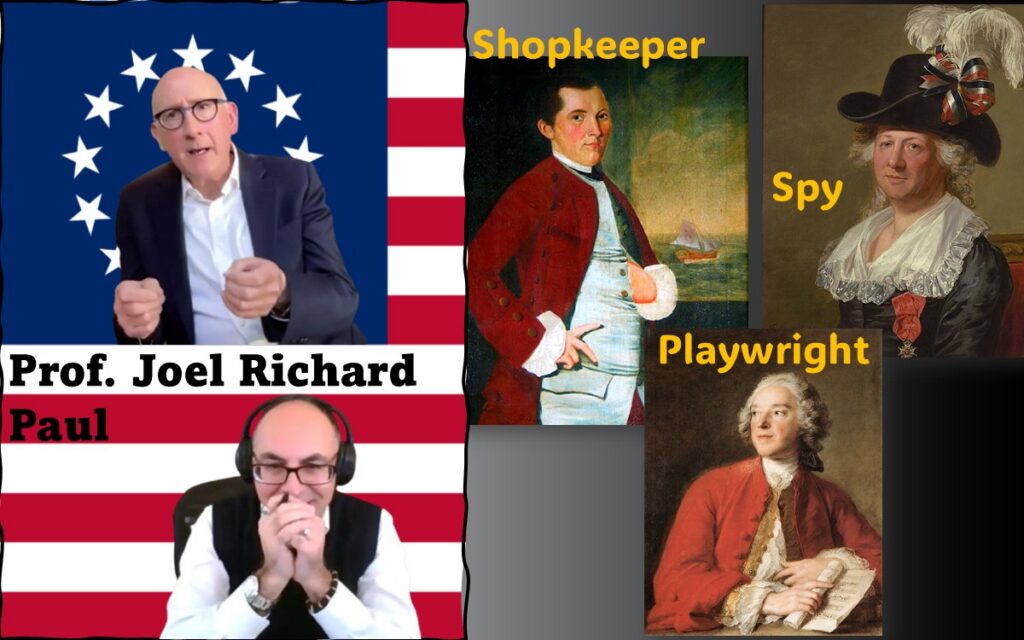
Image of Adel Aali (program host) and his guest, Prof. Joel Richard Paul, superimposed on the Betsy Ross flag, along with images of Silas Deane (the shopkeeper), Pierre-Augustin de Beaumarchais (the playwright), and Chevalière d’Éon (the spy).
Unless otherwise indicated, all images in AAR—including those in this post—are in the public domain.
AAR Essential Insights
Although the full video and transcript of my conversation with Prof. Paul are included in this post, I’ve selected and summarized several insights that I found particularly revealing and worth emphasizing. These moments — some surprising, others that challenge familiar assumptions — help us see how the war for America’s was initially armed and supplied.
By the way, these insights are my own takes and interpretations from the interview. For Prof. Paul’s perspective and exact framing, please watch the interview above and view the transcript below in the corresponding sections.
Declaring Independence Meant Nothing Without the Arms to Win It
One aspect of the American Revolution that I think we modern Americans fail to appreciate is just how militarily absurd the entire enterprise looked in 1776. We often imagine the colonies as weak compared to Britain. But “weak” almost understates the situation. According to Prof. Paul, the colonies lacked not merely an army capable of defeating Britain, but the industrial capacity to sustain a major war at all.
No meaningful arms industry. No gunpowder production. Very limited manufacturing. Few cannons. Even firearms in colonial America largely came from Europe. The Americans were preparing to challenge what was arguably the most powerful empire on earth while lacking many of the basic tools necessary to wage war against it. The image that stayed with me from this segment was Prof. Paul’s remark that the colonies even tried making gunpowder from bird droppings. That detail alone captures the desperation of the situation.
And this is where the interview begins overturning one of the more familiar stories many Americans learned growing up. The traditional version usually centers Benjamin Franklin charming France into supporting the Revolution. But Prof. Paul argues that much of the critical work of obtaining arms and supplies had already happened before Franklin even arrived in France. That is a major historical shift in perspective. It redirects attention away from the polished diplomatic mythology surrounding Franklin and toward the far messier, riskier, and more improbable international operation already underway.
There is also a broader point here. Declaring independence and winning independence are not the same thing. Revolutionary rhetoric alone could not supply muskets, gunpowder, uniforms, cannons, and ships. Someone had to secure them. And according to this interview, that hidden story may be far stranger than the familiar founding narrative many of us inherited.
Watch this segment in the video above (00:04:34)
The Three Guys Who Armed the American Revolution
Continue watching at 11:28 in the video above
The Shopkeeper: America’s Most Improbable Diplomat – 1 of 3
One of the aspects of Silas Deane’s story that fascinated me most is that nothing about him screams “international diplomat.” Quite the opposite. He was the son of a blacksmith. A schoolteacher. A modest Connecticut merchant. Yes, he was intelligent, educated at Yale, active in his community, and eventually a delegate to the Continental Congress. But France? Versailles? Negotiations involving Louis XVI and the future of the American Revolution? On paper, the whole thing sounds absurd.
And yet that absurdity was precisely the point. According to Prof. Paul, Benjamin Franklin believed Deane was so improbable a diplomatic figure that British intelligence would never suspect him. In retrospect, there is something almost modern about that logic. The perfect secret agent is the man no one would ever imagine sending on such a mission.
The problem, of course, is that the mission itself bordered on madness. Deane represented a country that technically did not yet exist. He spoke no French. He had no diplomatic experience, few meaningful contacts, and no real money. Congress essentially sent him to France carrying paper currency that European banks considered worthless.
But there is another overlooked point here. Before France, Deane had already played a role in one of the Revolution’s early turning points. He helped finance Benedict Arnold and Ethan Allen’s seizure of Fort Ticonderoga, which gave the Americans access to the cannons later used against the British in Boston. In other words, before Deane was trying to secure arms from France, he was already helping secure arms inside North America itself. So his role in arming the Revolution did not begin in Paris.
What makes the story increasingly tense is how isolated Deane becomes once he reaches France. No instructions from Congress. British spies follow him almost immediately as he lands in France. French officials are reluctant to help. And then, in one of the interview’s more unbelievable twists, Deane unknowingly recruits a British spy into his own inner circle. At multiple points in this story, the American mission appears doomed before it even properly begins.
Watch this segment in the video above (00:14:46)

Portrait of Silan Deane. Drawn from life by Pierre Eugene du Simitiere in Philadelphia; and engraved by Benoît-Louis Prévost in Paris. Click for iconic images of the American Revolution.
The Playwright: France’s Most Unlikely Arms Dealer — 2 of 3
One of the points that becomes increasingly clear in this interview is that eighteenth-century Europe operated through relationships, patronage, reputation, and personal access as much as formal institutions. And few people embodied that world better than Pierre-Augustin Caron de Beaumarchais. On paper, he sounds almost fictional. A clockmaker who invented the wristwatch. A playwright. A musician. A social climber. A man connected to wealthy patrons, royal politics, arms dealing, and eventually the American Revolution itself.
What also struck me during this segment is how dangerous satire could be in pre-Revolutionary France. Today, “The Marriage of Figaro” and “The Barber of Seville” are often remembered through opera and comedy. But as Prof. Paul explains, Beaumarchais was mocking the aristocracy and offending powerful people in a society where public criticism of elites could destroy careers, fortunes, or worse. This was not merely entertainment. These plays emerged from a French political culture already simmering with tensions that would later explode during the French Revolution.
And then the story becomes even stranger. Legal troubles. Political maneuvering. Secret meetings with the French foreign minister. A mysterious diplomatic mission to London. A war hero at the center of one of Europe’s great gender controversies. One almost forgets that the fate of the American Revolution is tied up in all of this. Yet that is precisely the point Prof. Paul is making. The struggle for American independence became entangled with personal rivalries, court politics, espionage, scandal, and elite networks stretching across Europe.
What also makes Beaumarchais remarkable is how improbable his role in the American Revolution really was. This was not a military officer, diplomat, or statesman. He was a playwright and celebrity who had spent years navigating aristocratic patronage, legal scandals, and court politics within the world of Versailles. Yet those very experiences — his charm, connections, wealth, and ability to maneuver through elite society — ultimately helped place him at the center of the covert effort to arm the American colonies.
Watch this segment in the video above (00:25:51, 00:32:20)
 Bronze monument to Beaumarchais in Paris by Louis Clausade, 1895.
The Spy: Europe Bet Millions on One Question — Man or Woman? — 3 of 3
By this point in the interview, the story has moved so far beyond conventional Revolutionary War history that it almost feels disconnected from the American colonies altogether. And yet, somehow, all roads somehow continue leading back to the American Revolution. At the center of this segment is the Chevalier d’Eon — a decorated war hero, diplomat, intelligence operative, and former French ambassador to London whose life became one of the great scandals of eighteenth-century Europe.
What fascinated me most here is how personal instability, court intrigue, espionage, and international politics all collapse into one another. The Chevalier was not merely a diplomat. According to Prof. Paul, d’Eon was secretly involved in plans connected to a possible French invasion of Britain. When the Chevalier later threatened to release sensitive correspondence tied to Louis XV, the French monarchy panicked. Suddenly, recovering these letters became a matter of state security. And somehow, the man chosen to manage this explosive situation was Beaumarchais — a playwright tied to aristocratic scandals and covert arms deals.
But perhaps the most astonishing aspect of this story is how public the controversy surrounding the Chevalier became. Londoners were openly gambling on whether the former French ambassador was a man or a woman. Newspapers, aristocrats, and stockbrokers became consumed with the question. Meanwhile, beneath this spectacle sat an increasingly dangerous political crisis involving blackmail, espionage, royal embarrassment, and fears of renewed war between Britain and France.
And then the story somehow becomes stranger still. Assassination attempts. Explosives planted inside a London home to deter assassins. A house the French government deliberately tried to make seem haunted. Emotional collapse. Paranoia. At multiple moments in this interview, one almost forgets that all of this chaos eventually intersects with efforts to arm the American Revolution. But that is precisely what makes this history so remarkable. The fate of the Revolution became entangled with human dramas so bizarre they almost defy belief, volatile personalities, and fragile political calculations unfolding thousands of miles away from the battlefields of North America.
Watch this segment in the video above (00:29:03, 00:35:39)
 Caricature of d’Éon dressed half in women’s clothes, half in men’s clothes.
Title: “Mademoiselle de Beaumont or The Chevalier D’Eon”
The Interview (S1E19): Adel Aali and Joel Richard Paul
In our conversation, Prof. Paul addresses key questions about unlikely story of three unlikely allies to save the American Revolution. The detailed outline and full transcript below supplement the video above.
Podcast
Watch the full interview on this page with the outline and transcript below, or take the conversation with you on the go through our Spotify podcast.

Outline
Use the in-depth outline below, with its key moments and turning points, to follow the discussion and navigate the interview.
Click for Timestamped Outline
- Selected Highlights (00:00:00)
- Guest Introduction (00:02:41)
- A Historian’s Unexpected Discovery (00:04:34)
- How an International Law Project Became a Revolutionary War Story (00:04:34)
- Forgotten Letters Found in the Basement of the Connecticut Historical Society (00:07:12) – Key Moment (00:07:38)
- America’s Impossible Military Problem (00:08:06)
- Fighting the British Empire Without Arms or Gunpowder (00:08:25)
- Why the American Revolution Needed France (00:09:14)
- The Shopkeeper, the Playwright, and the Spy (00:11:05)
- Silas Deane’s Improbable Mission to France (00:11:20)
- Pierre-Augustin Caron de Beaumarchais and the Chevalier d’Eon (00:11:50)
- Silas Deane: America’s Unlikely Diplomat (00:14:54)
- From Connecticut Merchant to Continental Congress Delegate (00:15:21)
- Benedict Arnold, Fort Ticonderoga, and the Cannons of Boston (00:16:21) – Turning Point (00:17:12)
- Alone in France and Surrounded by Spies (00:18:40)
- Worthless Continental Currency and a Diplomatic Mission in Chaos (00:19:29)
- Edward Bancroft: The Spy Inside America’s Mission (00:24:00) – Key Moment (00:24:59)
- Pierre-Augustin Caron de Beaumarchais and the Secret Arms Network (00:25:51)
- The Playwright Behind The Marriage of Figaro and The Barber of Seville (00:26:12)
- Smuggling Arms to the American Colonies Through British Lines (00:33:48)
- The Chevalier d’Eon and Europe’s Most Bizarre Scandal (00:29:03)
- A French War Hero, Diplomat, and Secret Agent (00:30:02)
- Gambling Fortunes on Whether the Chevalier Was a Man or a Woman (00:34:12) – Key Moment (00:34:20)
- The Secret Deal That Armed the American Revolution (00:38:16)
- Marriage, Blackmail, and French Support for the Colonies (00:44:28) – Turning Point (00:44:52)
- Why France Secretly Backed the American Cause (00:47:03)
- Saratoga, Franklin, and the Franco-American Alliance (01:02:57)
- How Secret French Arms Helped Change the War (01:03:20) – Turning Point (01:04:19)
- Why Prof. Paul Challenges the Traditional Benjamin Franklin Story (01:05:05)
- Political Rivalries and the Destruction of Silas Deane (01:06:14)
- Arthur Lee, Congressional Infighting, and Charges of Corruption (01:09:14)
- Financial Ruin, Isolation, and the Collapse of America’s Diplomat (01:12:01)
- Just One Point (01:24:21)
Transcript
Note: This transcript was generated automatically and may contain minor errors. It is provided for reference and accessibility only.
Click to View Transcript
Adel:
Professor Paul, it’s a pleasure to have you on our program’s special series. Thank you for taking the time for this conversation with me about the American Revolution. I read your entire book, it sits right behind me, and as I shared with you before we started, I had many wow moments.
But I want to start our interview with your initial wow moment. And the reason I describe it as a wow moment is because of two lines on page 347 of your book. And it reads as such, this is not the book I intended to write.
I was writing a different book about the history of international law in the United States when, go ahead and finish that story, when what, how did you go to this book from international law?
Prof. Paul:
Well, I’ve written a lot about law and economics, which is my field. And my sister said to me, why don’t you write something I want to read for a change? And so that was really the moment at which I took that as a challenge.
I thought, well, okay, I’m going to write this book about the beginnings of international law in US courts, and I’m going to write it in a way that it’s going to be a popular bestseller, which of course is absurd. But I was too foolish to realize that at the time. So I wanted to start with a little vignette which captured the idea that at the beginning of our republic, we started with a tabula rasa.
We didn’t know how to engage in international diplomacy at all. And I wanted to figure out who was the first real diplomat. And I came across a small reference in Barbara Tuchman’s book, The First Salute, to this guy, Silas Dean, who was a shopkeeper in Connecticut and was sent on this improbable mission as our first emissary to France to try to persuade the French to give us all of the arms and the ammunition and the supplies we needed to win the war.
And I tried to figure out how we did this, how we accomplished this. And there was really nothing written that explained this at all. In fact, most books talking about Silas Dean talk about him as either a thief, a traitor, or an idiot.
And I thought, well, that can’t be right if he succeeded in what he did. So I called a friend of mine who was, I used to teach in Connecticut. One of my friends was the head of the Connecticut Historical Society.
Where Silas Dean is from? Where Silas Dean is from, he’s from Spiel, Connecticut. And I called David and said, I’m not a trained historian.
I don’t know where to find letters or diaries of people from the 18th century. Can you help me? And David said, well, who are you looking for?
I said, well, there’s this guy, Silas Dean. I don’t know if you’ve heard of him or not. And David said, well, actually I own all of his letters.
Adel:
Oh my God, serendipity here.
Prof. Paul:
And it turned out that the Connecticut Historical Society doesn’t keep documents, but they had two weeks before I called David. They’ve been cleaning out the basement of the Connecticut Historical Society and they found boxes, just old beat up dress boxes that were filled with letters to and from Benjamin Franklin, George Washington, John Adams, Louis XVI.
Wow, wow. With Silas Dean’s name on them. So I flew back to Connecticut and that was the beginning of the story.
That is wonderful.
Adel:
Okay, before we talk more about the story, can you couch this for us? Why is even this important, Silas Dean in France? What is happening in the bigger history of the American colonies at this moment?
Why do we care about the Silas Dean story?
Prof. Paul:
Sure, well, I mean, to give you a sense of what it meant for the colonies to declare independence in 1776, imagine a country like, oh, let’s say Greenland declaring its independence from the United States in the improbable likelihood that we were to acquire Greenland through some means. I mean, the Greenlanders are probably more unified than we are. Obviously our population in 1776 was much larger than the Greenland population.
But the point is they have no arms, they have nothing to fight the greatest superpower in existence. And that’s what the colonists faced in 1776. There were no- That bad?
Industries, there was, we had a few scattered foundries in America that produced some guns. Mostly they were to repair guns, but virtually all of the firearms that existed in the Americas during that time came from Europe. We had almost, we had no saltpeter, we couldn’t produce gunpowder.
We tried to produce gunpowder from bird droppings.
Adel:
Wow.
Prof. Paul:
We didn’t have cannons, we didn’t have any means with which to fight the greatest power ever to exist at that point in time. That’s what this book is about. How we managed to get the arms, the ammunition, the supplies that we needed to beat the British.
Adel:
Okay, a couple of follow-ups. We haven’t even gotten to your book. We’re just talking about how important this story is.
First, we’re about to talk about Silas Dean, but as I’ve understood this story and I’ve read quite a bit about this segment of the story, this was all Ben Franklin. You’re about to talk about Silas Dean.
Prof. Paul:
Right, well, that is the common understanding and certainly was mine, was that Ben Franklin went to France, he charmed the French and managed to forge the Franco-American alliance. That story is false. Now, that Ben Franklin had very little to do with obtaining the arms and the ammunition and the supplies that we needed to win the American Revolution.
All of that happened before Ben Franklin even got to France. Ben Franklin, it was true, was very charming and he did manage to charm the ladies in France, but that had very little to do with winning the revolution.
Adel:
Okay, there’s a lot there to unpack and let’s do that by getting into your book, which is called The Unlikely Allies. I think to help the audience to follow along with us before getting too deep, why don’t you just introduce the three main characters with like a one-liner or two-liner of who they are, then we’ll get into the characters and what they did.
Prof. Paul:
So this is my book, Unlikely Allies, is about three guys who were extraordinary in different ways. First, there was Silas Dean, this shopkeeper from Wethersfield, Connecticut, who never left Connecticut in his life, can’t speak a word of French, knows nothing about international diplomacy. And so Ben Franklin thinks he’s the perfect guy to send on a secret mission to persuade Louis XVI to arm the Americans against the British because Franklin says he’s so improbable, the British will never suspect him.
That’s the first guy. The second guy who makes this all possible is the French comic playwright, Caron de Beaumarchais. Beaumarchais was, I think, one of the most extraordinary men of the 18th century.
He was the guy who at age 19 invents the wristwatch. He built the Paris water system with the Perrier brothers. He ran a timber, a logging company.
He also was a famous musician. He designed the modern harp. And on the side, he was an arms dealer.
And he manages with Dean to provide all the arms, the ammunition that the Americans need and smuggle it out of France through the British lines to the Americans in time for the critical battle of Saratoga. And the third man who makes this possible is the French ambassador to London, the Chevalier D’Eon. Chevalier D’Eon was one of the great war heroes of the Seven Years’ War with Britain.
He was famed for his valor in battle. He was wounded many times. He was also an accomplished diplomat.
He was responsible for the entente between France and Russia that really shifted the balance of power in continental Europe. He negotiated the peace between Britain and France, and then he was appointed the French ambassador to London.
Adel:
Wow, what a superstar.
Prof. Paul:
Right, and what makes him especially interesting was, it turns out, he was a woman. Oh, boy. Years of her life, pretending to be a man, accomplishing all these things, until she meets Caron de Beaumarchais and falls in love and decides that she’s gonna marry him.
And that is the catalyst that I posit, that persuaded Louis XVI to arm the Americans against the British and win the American Revolution, and it’s all true.
Adel:
And we’re gonna get to that in a moment. I just wanted to add, having read your book, the following two accomplishments to Beaumarchais, and I’m familiar with both. He wrote the plays, The Marriage of Figaro and The Barber of Seville.
I haven’t read the plays, but I’ve seen the operas. So there you go. Much more accomplished than I’ve been in life.
That’s for sure, with everything he’s done. These characters are really extraordinary. Why don’t you tell us a little bit more about Silas Dean, please?
Because he touched on it. It’s just, the more I read about him, a merchant in Connecticut, and he was a happening guy in his own small community. Then he ventures out really big and goes to the Continental Congress.
That was in Philadelphia back then? Yeah, there you go. So that was his big adventure.
How does his background prep him for this?
Prof. Paul:
To go to France? Not at all, no. I mean, he was the son of a blacksmith.
He was a guy who was a school teacher in Connecticut. He’d studied law. He’s a very intelligent guy.
He went to Yale. He was well-educated, got a scholarship. And he had the good sense of marrying the richest woman in Wethersfield, Connecticut.
And she set him up in this dry goods business. He was a shopkeeper there. And he was very successful by the standards of his time, but he was a very modest shopkeeper.
He was chosen to go to the Continental Congress because, among other things, he was just sort of a leader of the community. He was just really a leader of the community. And he went to the Continental Congress.
Probably his greatest accomplishment up to this point before he goes to France is that he and one of his neighbors, a guy by the name of Benedict Arnold, who you may have heard of. Benedict Arnold and Silas Dean are the guys who plotted the seizure of Fort Ticonderoga with the help of Ethan Allen before he was a furniture store. And Ethan Allen and Benedict Arnold managed to seize the Fort Ticonderoga.
It wasn’t that hard. They didn’t fire a single shot. The British were kind of asleep.
They didn’t know what hit them. And the fort was kind of falling apart. But Ticonderoga was a big psychological victory early on in the revolution.
And it meant that they got access to a bunch of cannons. And then those cannons were used to force the evacuation of the British from Boston.
Adel:
What role did Dean play in that?
Prof. Paul:
Did he help finance Benedict Arnold’s journey? I’m sorry, that’s right. So Dean was the secretary, was the treasurer rather of Connecticut at the time, which is a minor role.
And he, let’s say, lent the money to Benedict Arnold and Ethan Allen to recruit the people and arm them to go capture the fort. So Dean financed the capture of Ticonderoga and plotted it with those men.
Adel:
I see.
Prof. Paul:
They did not fight. So, okay. But he was otherwise, I mean, he had absolutely no experience that would have possibly prepared him for this negotiation with Louis XVI.
This was just complete nonsense that they sent him.
Adel:
I chuckle here because, Professor Paul, as I’m thumbing through the pages of your book and it gets to the point that they’re about to send him to France, you explain this and I’m going to ask you about it, but this is apparent to me as I’m going through this journey in your book that he’s about to go to France. Instead of me inserting this, I’m going to ask you. Credentials.
He’s not representing a country. US is not even a country. It’s not like he has contacts that much in France.
How is this being put together? What money? I mean.
Prof. Paul:
So basically, the whole idea was that Franklin thought, because he’s a dry goods salesman, we can send him to France with the, with the pretext that he is just acquiring stuff for his own business. And basically, he’ll go there and he’ll buy ladies’ garments and shoes and other things that would be imported from France. And on the side, he’ll buy a few guns and barrels of gunpowder.
And the way he was going to pay for this, I mean, understand that at the time of the American Revolution, we were a very primitive barter economy. We had no currency of our own. British currency was extremely rare in the American colonies at the time.
So unless you had gold or silver coins, you couldn’t pocket that many gold and silver coins and take them with you to France. So the Continental Congress just printed their own money and they sent him to France with, you know, suitcases full of Continental currency, which of course was completely worthless. No one in their right mind was gonna take this paper junk from the Continentals at a time when they were still, you know, subjects of the British crown, at least as far as the British were concerned.
The French banks refused the currency and Dean had nothing other than his own financial resources, which were relatively modest to finance a war. And so he needed the help of the French government, but the French government did not wanna get involved at all because they were in no position at the time to risk war with the British. The French wanted to avoid war with the British.
Adel:
And so the- Because of their humiliating defeat back that ended in 1763, the Seven Years’ War, or as we call it, the French-Indian War here in the US.
Prof. Paul:
Right, right. So I think most Americans don’t appreciate the fact that the French-Indian War is really, that’s our local name for it, but it was the Seven Years’ War was the first world war. It was all over the world between France and Britain.
And it was a humiliating defeat for the French. They were forced out of North America pretty much everywhere except for the Sugar Islands and the Caribbean. And they really had, their entire Navy was destroyed.
They had no Navy at that point. They were effectively disarmed. But- Wow, wow.
And they were just in the process of beginning to rebuild when Silestine arrives in France and says, hey, how about helping us out? And the French were also, they were teetering on the brink of insolvency. The French treasury did not have a lot of extra cash to spend either.
So there was a great deal of reluctance to get involved with these Americans. And it was really Beaumarchais who made that possible.
Adel:
And we’re going to get to Beaumarchais because he plays such a key role in arming the Americans, especially the Fort of Babel, so thanks in part to Silestine and everything that he’s put in motion. The thing that started to worry me as I was reading your book, and I do really mean the word worry, is that Dean was like alone. He was literally alone in France, like this guy just walking around, bobbing around, trying to make things happen.
And to boot, there was no communication from the colonies. How does this play out?
Prof. Paul:
I mean, I’m- He was, he wasn’t entirely alone because he was followed everywhere by British spies. Although he’d been sent there on the premise that he would be a secret agent because he was such an improbable agent, the British knew the moment he stepped off the boat that they followed him from the dock and they followed him everywhere he went in France. And he went to Versailles, he spoke with Virgin, the French foreign minister.
He was turned to shut out of Versailles. He had no access to the French government. He didn’t know what to do.
He couldn’t speak a word of French. He was counting on instructions coming from Congress. They’d promised his any instructions.
He never received any instructions. He doesn’t even find out that they had declared independence until the French foreign minister tells him. Oh, by the way- Wow.
You’ve received independence. What he does do is he writes to an old pupil of his, a guy named Bancroft, who was living in London at the time. He was a physician in London.
Bancroft was also a friend of Franklin’s. And Bancroft had indicated to Franklin that he was a friend of the American revolution. And so Dean invites Bancroft to come to France.
Edward Bancroft speaks French. Edward Bancroft is fully acculturated into European society. He understands European society.
And Bancroft agrees to serve as Dean’s private secretary. And so Bancroft helps to facilitate Dean’s access to people in France. What he doesn’t realize is that Bancroft is getting two salaries, one from Dean.
Dean is paying him money. And he’s getting paid also by the British, for whom he’s working as a counter-spy. So Bancroft is the sort of the spy in Dean’s nest, who is keeping track of everything Dean does and sending copies of all of Dean’s correspondence to Congress to the British ambassador in France, which he deposits under a tree in the Tuileries.
Adel:
That’s just such a rich story. And by the way, based on what I read in your book, we don’t find out, we Americans, like historians don’t find out that Bancroft was a spy till decades and decades later, right? To the 1900s, yeah.
Wow. So- Spy, but we’ll get to that later. We’ll get to that later, yeah.
Beaumarchais, you and I could have two podcasts on him alone. We should.
Prof. Paul:
But how does he get involved in all of this? So Beaumarchais is, if I were casting this, I would cast Jonathan Bailey as Beaumarchais. Beaumarchais is this incredibly charming, a delightful, witty, smart person who just sweeps everybody off their feet.
And he is probably bisexual. I say probably bisexual because he has what I would have to describe as a homoerotic relationship with his patron, who’s the richest man in France, Paris Duvalier. And Paris Duvalier is a man who made his fortune as an arms dealer in the French, in the Seven Years’ War.
So, Beaumarchais has this relationship with Paris Duvalier. Paris Duvalier completely funds Beaumarchais. He takes this young man who is a time, literally is a clockmaker who invented the wristwatch.
And he buys him a title, he buys him a mansion. He gives him the equivalent of $6 million over the course of his lifetime. And makes him a wealthy, successful man who’s accepted into the court in Versailles.
Adel:
Beaumarchais- This older man does that to Beaumarchais. Okay.
Prof. Paul:
And Beaumarchais gets himself into a lot of trouble because Beaumarchais is writing these comedies, which, you know, we read now in the, and if you read the Marriage of Figaro or the Barber of Seville, you’d think, well, it’s a fairly mild kind of comedy. But at the time, he was poking fun at the aristocracy in France, which was not something one did for one’s own benefit. It was for one’s health.
And he offended the king greatly, as well as a lot of the aristocrats. And for reasons that we don’t have to go into all the details, he gets himself into a lot of trouble when Paris Duvernay is much older. Paris Duvernay is 50 years older than he is.
And Paris Duvernay is unmarried and childless. And his nephew, who’s going to inherit his fortune, decides that he has to get rid of Beaumarchais. So his nephew basically trumps up these charges against Beaumarchais.
Beaumarchais gets indicted and convicted and is sentenced to go to prison. Wow.
Adel:
Okay.
Prof. Paul:
When that happens, and I know this is a complicated story, so bear with me. When that happens, Beaumarchais goes to Paris Duvernay and says, help me, what can you do? And Paris Duvernay agrees to set up a private meeting between him and the French foreign minister, Vergene, who’s a, Comte de Vergene is a very powerful figure in the cabinet at that point of Louis XVI.
And Vergene says, well, you know, we’d like you to do us a favor. And if you do us a favor, we’ll do you a favor. So we’ll wipe the slate clean, we’ll pardon you from all of your crimes, alleged crimes, and restore you as a playwright and allow your place to be produced if you agree to go to London and get some, retrieve some letters sent by Louis XV, the grandfather of Louis XVI, to the Chevalier d’Eon.
Adel:
One of the three characters that we talked about, Chevalier, the war hero from the Seven Years’ War.
Prof. Paul:
Okay. It was at this point, the ex-ambassador to London. The Chevalier d’Eon has been fired and his position as ambassador to London.
Why? Because basically he had a great fondness for wine and he spent so much money on wine that it was threatening the French treasury. And the French foreign minister was sort of writing him letters, telling him, could you cut back a little bit on your French wine?
Because he was not just buying wine for himself, he was buying literally hundreds and hundreds of bottles of the best wine and just distributing them widely to everybody in London. Wow.
Adel:
Wow, occurring famous.
Prof. Paul:
And the French foreign minister tells him to cut back and the Chevalier d’Eon, who’s not used to taking orders from anyone, writes back these brilliant temperate letters that just offends the French foreign minister. It also turns out that the Chevalier d’Eon is not just the French ambassador to London, he’s also working as a spy. But he’s working as a spy for Louis XVI, the former king.
Louis XV. Louis, I’m sorry, Louis XV, right? The former king.
Louis XV hires the Chevalier d’Eon to plot a plan to invade London at a time when the French don’t have a navy to cross the Channel. So it’s not a perfect plan. Wow, wow.
Chevalier is planning this invasion of London and the king and the Chevalier have these letters going back and forth about this. Well, obviously, when he gets fired from his job as ambassador, he’s pissed off and he wants some sort of restoration of his title or he wants a pension or something. He blackmails Louis XVI by threatening to publish the letters of his grandfather, Louis XV, plotting an invasion of London.
Now, why does Louis XVI care? Because if the British get wind of the fact that the French were planning to invade London, if they’re gonna have a pretext for another fight against France, then France is not gonna win. So the Chevalier has been demanding that the French pay him for these letters.
Beaumarchais is sent to London to get the letters back from the Chevalier. Why is Beaumarchais chosen for this mission? He’s nothing to do with, he’s never met the Chevalier.
He doesn’t know anything about this blackmail scheme. He’s completely out of the loop. We don’t know exactly why he was chosen, but possibly it was because Beaumarchais had a reputation as being very charming to both men and women, and as someone who could be very persuasive with both of them.
And Virgin says to Beaumarchais, well, this guy, the Chevalier, he may have, he may be a little bit like your friend, Paris Duvernay. And Beaumarchais, what do you mean he might be like Paris Duvernay? Well, he has what Virgin refers to as Italian tastes, meaning that one might not be gay.
We’re not exactly sure. So Beaumarchais goes to London and meets the Chevalier. And that’s where the Chevalier enters the story.
The Chevalier, it does have this sort of like strange personality because he’s very handsome as a man, but he’s also got looks that are kind of androgynous. And there’s a rumor circulating London that the Chevalier is actually a woman in disguise. And this rumor has taken off so that people are betting in what was then the London Stock Exchange on the question whether the French ambassador is a man or a woman.
Needless to say, this does not make the Chevalier all that happy that his gender is being questioned and that people are betting literally tens of thousands of pounds on this question of whether he’s a man or a woman. First of all, do you appreciate that you can’t make this up?
Adel:
I mean, you’re telling me, I’ve read the book as I was reading your book, I’m like, this is unreal.
Prof. Paul:
Well, you can imagine how I felt and discovering the story and thinking, why has nobody found this out before? It’s just so incredible. The Chevalier, I mean, to give you a sense of whether the Chevalier’s personality is like, the Chevalier is very emotional and impulsive.
And he goes to the London Stock Exchange and challenges all the stockbrokers to a duel because he’s so insulted by the fact that they’re betting on the question whether he’s male or female. He also tangles with the then French ambassador who he insists is a false ambassador, that he insists he is still the ambassador and that he refuses to leave the French embassy. So Beaumarchais gets there and he meets the Chevalier and the Chevalier is clearly in an emotionally strained state.
At this point, Louis XVI has done everything he could possibly do to stop the Chevalier, including sending assassins to London to try to kill the Chevalier. Poison him, they tried to shoot him, they tried to kidnap him and the Chevalier is becoming extremely paranoid. Paranoid to the point where he has literally planted explosives in his house to detonate the house if anyone breaks into his home and hires people to stand outside to guard him in London.
And so Beaumarchais gets there and the Chevalier meets Beaumarchais and falls apart and tells him, Je suis une femme, I am a woman. And it turns out that the Chevalier persuades Beaumarchais that she is in fact a woman who has been disguised as man for 40 years and Beaumarchais begins to see his opportunity. Because he knows he’s pretty good with the women and he can charm her and hopefully get the letters back that the king wants.
Okay, I wanna fast forward. Apologies for being long-winded.
Adel:
No, no, no, you’re actually abbreviating so much that is happening here, including, I don’t know, chimney sweepers going up on the roof and I don’t know, doing things that Chevalier thinks there are ghosts in the house or what have you. I mean, there’s so much more to this story. I wanna go back, ask a question about Beaumarchais.
I hope I’m pronouncing his name correctly. Did Beaumarchais expect to be repaid by America or by the French government for his Herculean task of getting arms from way out east in France and through land and going at night to get to the ports? And it’s like a huge task, huge undertaking.
Are we gonna pay him?
Prof. Paul:
Was France gonna pay him? Right, right. So I should explain Beaumarchais’ motivation in the arms deal.
Just so people can keep this straight. So there’s really two things going on here. There’s really two deals.
On the one hand, Beaumarchais is trying to get the letters back from France. On the other hand, Beaumarchais and Dean are plotting to smuggle all these arms and ammunition and supplies to the Americans. What is Beaumarchais’ motivation for doing that?
Well, Parthite Duvernay is a committed French loyalist and royalist and he says to Beaumarchais, I want you to do something that will help me to defeat the British. That somehow Duvernay wants to find a way to avenge the humiliation of France. And he says, I may not live long enough, but that’s one thing you can do for me.
And the love and the gratitude that Beaumarchais felt for Parthite Duvernay explains one of his motivations for trying to help the Americans. The other part of this is that basically there was money to be made in this because he expected that in exchange for the arms, Dean was going to arrange for the export of the finest Virginia tobacco to Europe and that Beaumarchais would then become the principal import exporter of arms and tobacco. Tobacco at the time was extremely highly valued in Europe.
And to get a hold of this Virginia tobacco and be able to distribute it, Beaumarchais says, well, look, I’ll sell the tobacco and then I’ll have more money to buy more arms and I’ll sell more arms to you and then you’ll sell me more tobacco. This is what kind of creates a virtuous cycle. And so the American- I was good in theory.
Yeah, right. And of course, there’s a certain appropriateness that the birth of America owes itself to this relationship between guns and tobacco. But it’s no wonder that guns found their way into our constitution.
So that was his motivation in engaging in the acquisition of these arms.
Adel:
Does he ever get paid?
Prof. Paul:
He never gets paid. Wow, okay. He never gets paid because, without getting into a whole other sub topic, he doesn’t get paid because there’s a conspiracy afoot in Congress to undermine Silas Dean, even at the risk of undermining the revolution itself.
The Dean has made enemies in Congress and those enemies are determined to paint Dean as a thief who is trying to somehow profit from the sale of these arms. Their proposition is that, well, Dean has all this money to buy these arms. Why does he need this tobacco?
What happens with the money? Well, of course, the money was worthless at the Continental Congress game. But they wanted to have a way of undermining Dean.
And so Dean is painted as a scoundrel and the tobacco never arrives and Beaumarchais is financially ruined.
Adel:
Let me go to another unfinished conversation that we had. And that is about Chevalier. So he, I’m sorry, she, he, she comes back to France.
There are some conditions. She’s supposed to give up many of her uniforms and medals, except one uniform and one major, I think it’s a cross or something, one major- Croix de Saint-Louis.
Prof. Paul:
I’m sorry, say that again. It’s the Croix de Saint-Louis, which is like the equivalent of our Purple Heart. Oh, there you go.
So she keeps that.
Adel:
And she comes to France and the condition, help me out with this, the condition that Louis XVI imposes on Chevalier is you have to wear your gender’s clothes, that is a woman’s clothes, right? Right, right, right. And then he gets to France and then Marie Antoinette, the queen actually funds clothing and jewelry for her?
Prof. Paul:
Yeah, so what happens was, so that’s, yeah. So here’s what happens. What happens is that the original deal between Beaumarchais and Virgin, remember, was that if Beaumarchais succeeded in bringing these letters back, that he’d be restored.
His position would be restored. He wouldn’t have to go to jail. He wouldn’t have to pay a fine.
He could write more plays. But Dean sees that there’s a problem here. The problem is that, let’s say that the Chevalier gives up these letters.
So what? The Chevalier still knows in her head what happened, what Louis XVI, what Louis XV, rather, was doing. She still knows that there was this plot to invade London.
So she can still blackmail the king. How do you shut her down permanently? And so Dean realizes the only way to shut her out- Dean or Louis XVI?
Dean and, both Dean and Virgin. Okay, okay. That the only way to really shut her down, to really prevent her from, I’m sorry, I said Dean, I meant Beaumarchais.
So Beaumarchais and Virgin realize that the way to quiet her once and for all is to force her to acknowledge her gender, to make her come out as a woman. Because if she comes out as a woman, she has no credibility, right? She’s lost her credibility.
She’s been pretending to be a man all these years. And now she admits that she’s a woman. And so no one will believe her anymore.
So Beaumarchais persuades her that he’s going to marry her. And he’ll bring her back to France as a woman, as his wife, and she will be safe in France. What she doesn’t know is that Beaumarchais has also bet 100,000 pounds on the question, whether she’s male or female.
And when she finds that out, and she finds out that he has been boasting to people that she’s going to be his wife, she calls the whole engagement off. Wow. But she wants to go back to France now to tell the king that this SOB did these things to me, and you should can him, and I wanna go back and fight, fight for the Americans, the American Revolution.
I wanna go fight for them. She goes back to France as a man, dressed in her uniform, her military uniform. And Derjean says, basically he’s putting her under house arrest, and she’s going to have to learn to be a woman because she cannot appear in France as a man any longer.
Adel:
Wow.
Prof. Paul:
She’s taken by Derjean’s assistant, and Marie Antoinette’s dressmaker agrees to provide her with a complete wardrobe. And so the same person who dresses Marie Antoinette is now dressing the chevalier in clothing and so forth, so that she is presentable enough to be able to go to Louis XVI and present her complaints to the king.
Adel:
And very important to our story, French surgeons check her organs and confirm that she is indeed a woman.
Prof. Paul:
We’re sort of jumping ahead here, so let me just hold that question for a moment. So the significance here of her becoming a woman and Beaumarchais agreeing to marry her is that Beaumarchais says to Derjean, hey, look, I’m not really in the business of marrying a military soldier, but if I’m going to marry her, I’m going to want something from you. And what I want from you is I want credit so that I can purchase the arms and the ammunition and the supplies for the Americans.
And Derjean is like, what the hell do you care about these Americans? I mean, why are you getting involved with the Americans now? And Beaumarchais sort of says, well, this is sort of my way of serving France and also I’m doing something for a friend of mine.
And so he says, we don’t have to actually win the American Revolution. All we have to do is bleed the British a little. If we give the Americans arms, and I’ll do it as a private import exporter so that no one’s going to suspect that the French government is behind this.
The British don’t have to know about the French government’s role. You guys can throw me under the bus. He didn’t say bus at the time.
You can throw me under the bus if the British find out. You can just say, this is just this crazy playwright, but I’m going to do this to help the Americans. And if you give me the credit to buy the arms, I’ll marry her.
And that was the deal.
Adel:
But it got called off. It gets called off, but let’s just go back to the question that I asked because I want to set the stage for the next segment. Right.
Prof. Paul:
Do you want me to reveal the reveal here?
Adel:
No, do not reveal anything. This is all I want. And for the audience to pay attention to this question.
At some point in these months, when Chevalier is back in Paris and Marie Antoinette has, through her beneficence, is given her clothes and her tailor and all of that, they check, French surgeons check, and they confirm that she’s a woman. Yes? You’re shaking your head.
You’re affirming that that’s a yes.
Prof. Paul:
That’s correct. But not only that, I mean, before that even happens, but actually, I’m trying to remember now, I think contemporaneous about the time that that happened, there’s a lawsuit brought in London, because remember, there’s, at this point, hundreds of thousands of pounds that have been bet on this question. Gambling on her sex, about her sex.
And the British love to bet on anything. Yeah. So there’s a lawsuit brought as to try to determine what her actual gender is.
And no less than Lord Mansfield, who is probably considered the greatest jurist of maybe in English history, here’s this case. And Lord Mansfield issues this ruling that she is, in fact, a woman. So- It goes that high up in the British legal system?
Yes, yes. Yeah, yeah. I mean, this is a lot of money.
Wow. Okay. Chevalier, a woman, a French surgeon.
You know, people have made money. People have lost money on this question. All of that because of Lord Mansfield’s decision on the question.
And then I think after that, the French surgeons confirmed her gender.
Adel:
Let’s take a break here. In the next segment, I asked Professor Paul about a big lie, a potential conspiracy. I don’t know if I’m reading too much into it.
Or, yeah, I should just take it at face value. Otherwise, we’ll get into it. I think it’s a huge cover-up.
We’ll be right back. Professor Paul, as we were closing the last segment, you told us that Lord Mansfield concludes, holds in a major lawsuit that Chevalier is a man. And to boot, French, I’m sorry?
He concludes that Chevalier is a woman. Oh, I apologize. I apologize.
That was a slip that Chevalier is a woman. Lord Mansfield holds that in a case, in a major case. And then to boot, French doctors confirm that Chevalier is a woman.
Got it. Okay. And I read that in your book.
And for another couple of hundred pages, there’s just so much more stories in the book that I’m reading your book. And I get to the last pages of your book. Chevalier dies in 1810.
Ms. Cole, the lady who took care of her, is preparing Chevalier’s body for burial. But then something absolutely astounding happens. Please take it away.
Prof. Paul:
Well, Mrs. Cole discovers that the Chevalier is in fact a man. Wow. A man.
And she calls over the priest and the priest confirms that it looks like a man’s body. And you can imagine my surprise when I was sitting in the reading room of the British library, and I found her death certificate, which was signed by eight different people, confirming that in fact, the Chevalier was a man.
Adel:
And then I think in your book you say other important people in that town come to also confirm this, right?
Prof. Paul:
Well, there was a priest and there was a doctor and there were some other folks who were all signing on to this death certificate. And that raises a question. Yeah.
Voltaire famously said that the Chevalier d’Eon was a nice problem for history. Because how are we to understand that? I mean, there’s a number of possibilities here.
I mean, one possibility, which I can’t completely reject is that maybe the people who signed the death certificate were paid off to say that she was a man. I don’t think that that’s likely. They weren’t people who knew each other.
They didn’t seem like it was part of a conspiracy. I just think it’s improbable that Mrs. Cole would want to acknowledge that she had been living for years with a man in her home. So I don’t think that that’s true.
What about the French doctors? Maybe they were paid off to confirm that she was a woman. Was she intersex?
I don’t think so. But that’s also a possibility. Do we then think that she was transgender?
Well, I don’t like that idea for two reasons. One is because there’s no conception of transgender at the time. So it’s ahistorical to sort of refer to her, to label her as transgender.
And second of all, one of the things that the trans movement has taught us is that people have a right to identify themselves. And she didn’t identify herself as being transgender. She identified herself as being female.
She wrote a memoir, actually she wrote several, talking about herself where she describes her female body. I mean, she talks about her breast. Maybe this was a kind of body dysmorphia.
You know, I’m not a doctor. Maybe we would understand this as some kind of emotional kind of confusion that she had about what her body looked like. She seemed convinced that she was in fact female.
It’s also possible that she was lying, that she knew she wasn’t female, but that she liked to cross dress or maybe she thought that, or he thought that the one way he could find security was in pretending to be female. So, you know, remember he would, he had been threatened by assassins. He was in a state of paranoia when he met Beaumarchais.
Maybe he thought, well, by dressing as a woman, by coming out as a female, he could save himself. But, you know, he went to live, just to understand how significant this was, his commitment to being female, he went to live in a nunnery. He lived in a convent with other nuns for years and only left there because of the French Revolution and wrote these tracts talking about his sort of, how he had purified himself by coming out as a woman, that he saw being female as a kind of spiritual sort of purification.
So I don’t know the answer to the question. I don’t know if he was in fact really male or really female, but certainly he was a nice problem for history.
Adel:
He certainly was and continues to be based on the conversation we were having during the break. This is something that is actually being debated still, right?
Prof. Paul:
Yeah, there’s a whole network of legal scholars and historians who discuss and debate the different ideas about her. And I just think that it would be presumptuous for me or any historian to try to slap a label on it.
Adel:
Yeah, yeah. In your book, and I wanna make sure my memory is correct, in your book, I think you also mentioned that when he was a spy for France and he was sent to, this is before the war, going to Britain, he was sent to the Russian Empire to become Empress Elizabeth’s tutor. He dressed as a woman.
Prof. Paul:
Did I get that right? Right, right. So during this period of time prior to that, the Russian court was closed to French diplomats.
The Russians and the French had no diplomatic relations. French had tried to send diplomats to Russia. The Russians refused to hear them or see them.
They even arrested one of them. So Louis XV came up with this scheme, which was to send the Chevalier d’Eon, who was not then the Chevalier, she was just d’Eon, d’Eon de Beaumont, to send her, to send him, he was then a man or a boy anyway, he was a young man, to dress him up as a woman and to send him as a French maid to sort of to tutor Empress Elizabeth in French because, as you may know, in the French, in the Russian court, they often spoke French.
Yeah, yeah. But French is being more sophisticated than Russian. So she goes to France as a woman.
She befriends the Empress. She then reveals herself, apparently, and this is all according to her own writings. We don’t know this to be historically accurate, but according to her writings, she befriended the Empress, she revealed herself to the Empress.
The Empress thought this was delightful and the Empress agrees to reestablish diplomatic relations with France. And that has tremendous implications on the continent, shifting the relationship between France, Prussia and Russia.
Adel:
What I like about your book, in addition to all the tantalizing stories, some of which we’ve talked about, is the grandness of what’s happening and their involvement. For example, Chevalier himself slash herself is involved in huge geopolitical developments and transactions, as is Boumarché and as is Silestin. These are not little stories.
These are actually world-changing, transformative developments that these three people are playing a small part that actually sort of, I don’t know, blossoms into much bigger stories. And in that respect, I wanna go back to one of the three characters that we talked about, who maybe because I’m American, I’m just biased, is Silestin. Perhaps because I felt so sorry for him for what’s happened later and I wanna talk to you about that.
Dean, after everything he’s done and Ben Franklin comes to Paris, I think it’s December, 1776. He’s with Dean for some time. Franklin actually really likes him and they get along and then comes Arthur Lee, I think from Britain.
Franklin is not that much enamored by Arthur Lee and there’s a whole story in that. Now, Dean is recalled? I mean, he’s the man that made it happen.
He’s the man that opened, you know, kept on needling the French to send arms to America and he’s recalled in 1777, somewhere thereabouts?
Prof. Paul:
Yeah, so I mean, to appreciate just how unfair this is, Dean has gotten all the arms, all the ammunition, all the uniforms for an army of 30,000 men. He and Beaumarchais have smuggled these arms out of France through the British lines to the Americans, to Portsmouth, New Hampshire, where the supplies are rushed to the Americans who at this point are surrounded. They’re surrounded in Saratoga by the forces, the North American forces of coming down from the British.
General Burgoyne, is that it? A gentleman, Johnny Burgoyne.
Adel:
Yeah.
Prof. Paul:
And General Burgoyne basically is going to wipe out the American army. That’s what everyone thinks is gonna happen. And that would have happened had it not been for the arrival of these arms and these arms made it possible for the Americans to win the Battle of Saratoga, which is the turning point of the American Revolution.
That is the point at which the American Revolution is really won, because at that point, the British are vanquished in North America. The entire British army in New England from the North, Northern Command, including a general, a gentleman, Johnny Burgoyne are captured by the forces of the Americans. They captured the entire British army.
Nothing like this has ever happened before. Yeah, yeah. And this is all possible because Dean has provided the arms and because of the victory at Saratoga.
At this point, Franklin has arrived in France, but Franklin has done nothing other than enjoy himself with the ladies and have a little tête-à-tête with the British ambassador, Lord Stormont, which we can talk about if you’d like. And at this point in time, Louis XVI invites the Americans, Franklin, Dean, and Arthur Lee, to come to Versailles and to establish the Franco-American alliance. The alliance is created because of the victory at Saratoga made possible by Dean’s efforts.
And immediately following that, Dean is recalled by Congress because of the false accusations leveled against him by Arthur Lee and Arthur Lee’s brothers in Congress, that Dean has somehow stolen money that wasn’t there to begin with, and that Dean is a traitor to the American cause.
Adel:
This is not a point that we need to discuss. I just want to capture it because I learned it by reading your book. Arthur Lee and his brothers are actually very powerful in Virginia.
Okay. And hence, in the Continental Congress.
Prof. Paul:
Yeah, the Lee family is like the first family of Virginia. They’re related to everybody. And they have a huge plantation.
They have lots and lots of tobacco. And his brother is the person who Richard Lee is the person who introduces the motion for the Declaration of Independence. Richard Lee was a leading patriot in Congress that led to the Declaration of Independence.
The Declaration of Independence would not have been possible without the support of the Lee brothers.
Adel:
So Dean, in the Lee family, he has very powerful enemies back home. And Arthur Lee, that’s a whole different podcast. I mean, he has all sorts of insecurities, all sorts of grudges against many people, and somehow the spearhead of all that buildup, grudge, and resentment is pointed towards Silas Dean.
It’s reading your book, it’s really hard not to dislike Arthur Lee. This is what I wanna ask. I could ask so many questions, but this is what I wanna ask.
In making life difficult for Silas Dean, and also Franklin, and everything else he does, does Arthur Lee at some point unwittingly, at least unwittingly, betray the American Revolution? Absolutely, yeah.
Prof. Paul:
Why do you say that? Just to understand Arthur Lee for a moment, and to kind of put him in the best possible light, I suspect that many people know someone like this. Arthur Lee has the great misfortune of coming from a storied family, the story passed, and being the youngest brother, his two older brothers are members of Congress.
Under the laws of inheritance, the oldest brother, Richard, is going to inherit all of the property, all the land. Arthur Lee has nothing. Arthur Lee is an intelligent, well-educated man.
He’s sent to London. He learns, first he learns to be a doctor. He studies medicine, actually, in Scotland.
And then he goes to London, and gets a law degree in London. He’s an intelligent guy. He has some prospects.
He really enjoys life in London. He’s sort of an Anglophile. He’s trying to make a name for himself.
And he’s good pals with the British mayor. Is that Wilkes? John Wilkes, John Wilkes, who is also a little crazy.
John Wilkes and Chevalier D’Eon and Arthur Lee are kind of pals. They’re sort of in the same circle, socially. And it’s Arthur Lee who came up with the original plan to trade tobacco for arms.
Why? Well, who owns the tobacco? His brothers, his family.
So Arthur Lee figured, I can make a profit on this deal too. And Beaumarchais steals Arthur Lee’s idea and takes that idea, and he and Dean work the same deal. And so Arthur Lee feels that somehow he’s not getting credit for what was his plan.
So he feeds the false idea to his brothers that the arms are a gift, a gift from the French government, and that Dean is holding onto all this money that Congress gave him. And that he’s trying to get the tobacco as well. And we shouldn’t send him the tobacco.
He should be indicted for having stolen money. And it’s all a lie. And in doing so, Arthur Lee has put at risk the entire American nation.
Because if the French government doesn’t get paid off, it’s not clear that the aid is gonna continue. And the Americans may be without a paddle.
Adel:
Okay, so Arthur Lee is a major thorn in Dean’s life and a major catalyst of Dean’s recall and later just unhappiness and downfall. Dean is taken, goes back to Congress in 1777. I think I got the year right.
And then testifies, however, that worked in the Continental Congress, that, look, my accounts are fine. I mixed my personal and sort of the country’s business because you wanted me not to show explicitly that I was dealing in arms. So I mixed it up so no one would find out.
I get all of that. Is Dean ever compensated for all his…
Prof. Paul:
No, Dean is basically bankrupted. Wow. He never gets to see his family.
His wife dies while he’s gone. He never sees his son again. He goes back to England at that point because he’s…
I’m sorry, back to France at that point because he’s left all of his things in France and he’s hoping to somehow… I mean, I guess he’s hoping that maybe he can do some business in France that will sort of save him financially. He’s broke.
He’s been using all of his own money during this two-year period to stay alive in France and to buy whatever supplies he could afford to buy the Americans. He’s ruined. And so is Beaumarchais ruined because of the Lees.
Adel:
And then a couple of things happen in the closing years of Dean’s life that I think is just really tragic. One is…
Prof. Paul:
You know, I should point one other thing out. Sure. Which is that it’s not just that Dean and Beaumarchais are financially ruined.
The French government ultimately is better.
Adel:
Which ultimately leads to the French Revolution.
Prof. Paul:
Which leads to the French Revolution, yeah.
Adel:
Okay. A couple of things happened in Dean’s life in the closing years of his life. One is this letter that he writes.
I forget the title now. It’s almost as if he’s gone crazy. I had the letter somewhere here.
I was so interested in it.
Prof. Paul:
Actually, it was a series of letters. It wasn’t one letter. It was actually a whole set of letters.
Adel:
One of it was called… I wrote it, so I want to read it for you and the audience. An address to the free and virtuous citizens of America or something.
This was in 78. Maybe I have it wrong. But anyway, he essentially wants to exonerate himself.
But tell us what happens. That backfires and it becomes a disaster? Yeah, well.
It’s actually really sad how this plays out.
Prof. Paul:
Right, so I mean, Dean has lost everything. He’s lost his position. He’s lost his money.
He’s lost his family. His reputation is destroyed.
Adel:
Also, if I may add, I apologize for interjecting. As I’m reading the pages of your book, psychologically, he’s in the gutter. He’s just not doing well, right?
Prof. Paul:
Right, right, right. So he’s, and he’s losing faith.
Adel:
Yeah.
Prof. Paul:
I mean, after this experience, how much faith could he have in the Continental Congress? Yeah. The ability of the Americans to successfully prosecute the war effort because it feels like this is just totally corrupted.
That folks like Arthur Lee are totally corrupting the American Revolution and Dean is just disgusted. And he writes, he does two things. He has this public proclamation he writes to the Americans, which just does him no good because it sounds disloyal.
But even more damaging to Dean, he writes a number of letters, personal private letters home to his brothers in Connecticut, basically just venting. He’s venting, you know, these people are jerks. They don’t know what they’re doing.
They’re ruining the whole thing. The American Congress is corrupt. We never should have declared independence.
Oh, wow. And he goes on and on and on like this. What he doesn’t know, I mean, these are private personal letters.
What he doesn’t know is that his secretary, I remember Edward Bancroft, is a spy. And Bancroft is taking copies of these letters and giving them to the British ambassador by depositing them in a bottle underneath a tree in the Tuileries where the British ambassador goes at night to pick up these letters. The whole thing is remarkable.
Adel:
But- And he’s pretending that he’s writing love letters. I mean, one of the pages you say this, Bancroft was not having an affair with anyone. Between the lines of his love letters, he had inscribed secret messages in invisible ink.
Prof. Paul:
That’s right, that’s right.
Adel:
Yeah.
Prof. Paul:
And so, which was also something that was not unusual at the time, to use invisible ink for these kinds of correspondence. So the British ambassador now has leverage over Dean and goes to Dean and basically says, hey, you know, you got two choices. Either I publish these letters and your reputation is ruined, or you come to work for us.
Oh, wow. And if the British ambassador, if Dean doesn’t come to work for the British, he’s gonna be destroyed. If he does come to work for the British, the British offer him a large pension.
And the ambassador holds out the possibility that Dean might become a royal governor when the British reestablish rule over the colonies. And to Dean’s credit, despite what he wrote, he refuses to go to work for the British. And therefore his letters are published and he is completely, utterly ruined.
And this is the reason why I could not find a single kind word written about Silas Dean. Because Silas Dean was considered a traitor, a man who stole money and an idiot. And none of those things were true.
Adel:
Yeah, it truly is an unfortunate ending for someone. As your telling goes, that’s so much for the American Revolution. Let me ask this.
Dean, at the end, decides to come back to America. There are some people that help him financially to pay for this journey. And we don’t need to get into details.
At some point, even Arnold, Benedict Arnold comes to visit him and he says, don’t come back to me. Like, I’m not a traitor, don’t come here. And he says, I’m gonna go back to America.
And he has all these ventures. And all of a sudden, under Thames River, he collapses into the arms of the captain of the ship, right there on the ship. Something that I think, I hope I got that story right.
But, and you can correct me, but my question, you’re shaking your head, maybe I didn’t get all that. But my question is this, did Bancroft kill him?
Prof. Paul:
Most probably, yes. Most probably, he was, here’s what happened. And long after the revolution has been settled, we have the first constitution, the president, George Washington is elected.
And George Washington writes a personal letter to Dean, inviting Dean to come back. To him, he’s saying, all is forgiven. Washington and Dean had been good friends before this all happened.
They met in the Continental Congress. And Dean borrows the money from his brother, because he’s in poverty, basically, at the time. He is living, at this point, he’s taking refuge in London, because the French, once the letters are published, the French have expelled him from France.
So he’s now living in London, having fought the British. He’s living in London, and he’s being cared for by his good friend, Edward Bancroft. No one that has been spying on him.
It’s not clear whether he realizes that Edward Bancroft is the spy who exposed him. He may not have any choice, because he had no other friends. So Bancroft is supporting him and caring for him in some little hovel in London.
Washington invites him to come back. Bancroft tells him, no, no, you’re too sick. You can’t go, you should go back there.
But Dean decides he’s gonna go back to America anyway, because he wants to see his family. And Dean has been taking laudanum, which is an opiate that’s prescribed for him by Dr. Bancroft. Dr. Bancroft, it turns out, is also an expert in the subject of poison. He actually wrote a book about the flora and fauna of Ghana, in which he talks about the use of poisons and how in Ghana, the native population would befriend someone that they wanted to poison. And then they would gradually give them poisons that would eventually make them sick so that no one would suspect who the killer was. And since the laudanum was being provided by Bancroft to Dean, Dean gets on this ship, and he is heading home, and he collapses and dies.
And, you know, maybe it was just a coincidence that he collapsed and died on the ship. You know, after all, we all have a shelf life. It seems suspicious.
People suggested that it was suicide. Well, that doesn’t make any sense. Why would you buy a ticket and spend all this money and borrow money to go home and to die?
It doesn’t make sense.
Adel:
Plus he had plans for ventures, business ventures.
Prof. Paul:
He had all kinds of ambitious ideas about things he could do when he got back to the States. It’s clear to at least some historians, and I am one of them, who believe that Edward Bancroft was most likely the guy who killed him, and killed him for a very good reason. Bancroft, for almost two centuries, Bancroft was regarded as a hero of the American Revolution.
But Dean got no credit. Arthur Lee and Bancroft were considered heroes of the American Revolution for having facilitated this Franco-American alliance. Bancroft doesn’t want Dean going back to America and exposing what Bancroft maybe suspects Dean knows, that Bancroft is in fact a spy who worked for the British, not for the Americans during the American Revolution.
And so we have to wait 150 years later for someone, a historian to discover that in fact there was evidence that Bancroft poisoned him.
Adel:
And you have a play that you’re working on for all of this, right? Tell us about the play, play of this book.
Prof. Paul:
Right, I’ve been sort of playing with a play for many years and I’m hoping that it’s going to be ready for the public sometime in the next year.
Adel:
Wonderful, wonderful. And when it does, please tell us about it and we’ll put it up in our program. If you wanted our audience to remember just one point about how these three unlikely allies saved the American Revolution, what would it be?
Prof. Paul:
I think there’s really two points that I wanted to make in the book. I mean, the first point is the importance of our alliances. Unfortunately, we’re living at a time when some people have not given up their faith or given sufficient attention to our alliances.
And I think people maybe don’t appreciate the fact that we would never have won the American Revolution without the French. And that we became a world power, not on our own but because of our alliances, that we won two world wars because of our alliances. We could not have won the second world war without those alliances.
And this is a book about the importance of allies. And I hope that that’s one point that people get in the book. The other point about the book is a broader point about the nature of history.
We’re all accustomed to the idea that history is shaped by great men like George Washington, or that it’s shaped by great movements of people, you know, the populist movement or the enlightenment or something like that. It’s shaped by intellectual movements. It’s shaped by demographics.
That all of these things are certainly important in understanding history. But just as important is the fact that history is often shaped by accident. That this was really an accidental relationship that these three men formed.
That they were the most unlikeliest of allies. That they had, they were all ill-chosen for their respective roles. You know, you wouldn’t choose Silas Dean today to negotiate that deal.
You wouldn’t expect the French to rely on a comic playwright to rescue the King’s reputation. And it was this sort of strange confluence of personalities and opportunities that created the Franco-American alliance that won the American Revolution. And there’s a quote in the beginning of my book from Teotihuacan, where he writes, perhaps chance is God’s pseudonym when he doesn’t wish to sign his name.
And I think that that’s very true about history. That we sometimes forget that a lot depends on not just great figures like George Washington or Alexander Abraham Lincoln. Kind of ordinary folks.
And Silas Dean was about as ordinary as you can get. Who do extraordinary things. And I hope, particularly in the times that we’re living through right now, that that gives people some optimism about how they might be able to make a difference.
Adel:
That’s a great point. And it’s a great closing. Professor Paul, thank you so much for educating me and our audience about the American Revolution.
And to our audience, if you know of any history that could provide more perspective about the American Revolution, please share it with us and tell us what’s your perspective. Thank you so very much.
Prof. Paul:
Thank you very much. It’s always a pleasure to talk with you, Adele.
Adel:
Same here.
Related Interviews and Essays
Revenge! Revenge! Revenge!
►My interview with Dr. Rafe Blaufarb, author of The Revolutionary Atlantic: Republican Visions, 1760-1830, among other works
 Why France Backed the American Revolution (And Got Nothing in Return)
Spain and Beaumarchais
Why was Spain helping Beaumarchais send aid to the American colonies even before Lexington and Concord?
►Interview with Dr. Gonzalo Quintero: Spain’s Forgotten Role in the American Revolution
Dr. Quintero’s major works include the following:
- Bernardo de Gálvez: Spanish Hero of the American Revolution, which received the Distinguished Book Award from the Society for Military History
- Spain and the American Revolution: New Approaches and Perspectives (The Revolutionary Age)
- His forthcoming book’s working title: Spain and the Global Struggle for U.S. Independence
 Spain and the American Revolution
Homosexuality: British Empire vs. American Colonies
►Interview with Dr. John G. McCurdy: “Homosexuality, Single Men and the American Revolution“.
Dr. McCurdy has published extensively on these subjects, including the following books:
- Vicious and Immoral: Homosexuality, the American Revolution, and the Trials of Robert Newburgh
- Citizen Bachelors: Manhood and the Creation of the United States
- Quarters: The Accommodation of the British Army and the Coming of the American Revolution
 Homosexuality Was Illegal —
But Colonial America Did Not Always View It the Same Way as Britain
About This Program
Analyzing American Revolution (AAR) is a special series podcast production of the History Behind News program. In this series, 33 professors (and counting) analyze the American Revolution from 33 different angles through in-depth interviews with host Adel Aali.
Meet Our Guest Scholars
A structured body of thought on the American Revolution—where leading scholars advancing distinct interpretations that give this program its depth.

Thematic Collection
Tap below for a closer look at the Revolutionary Era themes we examine—and to meet our guest scholars.

Library
- Interview Transcript Highlights
- Interview Image and Artist Highlights
- Quiz Answers and Backstories

Image Gallery
Explore the backstories and artist bios behind images of our Founding—before and after the American Revolution. These visuals shape how we remember—and reimagine—the Revolutionary Era.

Support AAR
AAR is an independent program built on sustained research, preparation, and production. Your support helps continue this series and expand our program.

Experienced Analysis of History
About HbN Program
The History Behind News program (HbN) is committed to making in-depth history researched and written by scholars enjoyable and accessible to everyone. Our motto is bridging scholarly works to everyday news.
The histories we’ve uncovered encompass an impressively wide range of subjects from ancient history to U.S. politics and economy to race, women’s rights, immigration, climate, science, military, war, China, Europe, Middle East, Russia & Ukraine, Africa and the Americas to many other issues in the news. We also receive advanced copies of scholarly books and discuss them in our program (in the context of current news).

Adel Aali, host. Snapshot from his introductory video to AAR podcast.
232 Scholars & Counting
Our guests are scholars at leading institutions. They are highly recognized, having received prestigious grants and fellowships as well as notable awards, including the Pulitzer Prize. They include celebrated documentary producers, former White House advisors and other high-ranking government officials, and current and former senior reporters of major national and international newspapers. Many have testified in Congressional hearings, and others frequently contribute to major media outlets and widely read publications.
Think You Know the American Revolution?