Updated: August 9, 2026
Introduction
In this interview: “And they hold a muster and they don’t get enough people.”
Watch this section in the video below (00:11:45).
Concord, Massachusetts, on the eve of the American Revolution, was far from a small simple farming town. Beneath its seemingly quiet rural setting lay a community in social, political, generational and economic flux.
Amidst these tensions, the Minutemen emerged—not as spontaneous heroes, but as a carefully organized response to impending conflict, which came with the British Imperial government taking away Concord’s “last vestiges of self-control and autonomy”.
Concord’s story illustrates how local dynamics shaped the larger revolutionary movement, revealing that the American Revolution was not merely about taxes or ideology, but about communities grappling with change and the defense of their way of life.

How to Use This Post
Use this post as reference guide to the American Revolution through the lens of this interview and the broader Analyzing American Revolution program (AARevolution). Navigate using the interactive table of contents above and the timestamps below (in gray) to discover how this interview deepens the story of the Revolution—and to explore how the program unfolds: its key themes, insights, image gallery, scholars list, history quizzes, and related interviews across the series.
Video
Watch the full interview (timestamps below)
Concord Before the Revolution: The Minutemen and a Town in Crisis
In 1775, Concord was not a quiet rural town waiting for history to arrive. It was an important Massachusetts community already under strain—shaped by class divisions, religious tensions, and an eighteenth-century “affordability crisis” that had been building for years before the “shot heard ’round the world”.
Concord managed to sustain a remarkable tension between its highly organized civic society and the possibility of open rebellion. That balance collapsed after the Massachusetts Government Act, which became the last straw pushing this community-in-crisis toward revolution. The British had finally made clear that the people of Concord would always remain second-class subjects of the Empire. For Concord’s elite and others, this was “a rude awakening” indeed!
This is the story of Concord’s Minutemen and militiamen—not as symbols, but as members of a deeply structured institution shaped by internal conflict, frayed loyalties, and generational divisions. Their experience shows how a town struggling to govern itself became part of the “spontaneous conflagration” that turned local resistance into revolution.
The Minutemen were a select group within Massachusetts militias, trained to respond at a minute’s notice. They embodied both the town’s commitment to defense and its complex social fabric. Concord residents, long accustomed to self-governance, found their traditions under assault when the Massachusetts Government Act limited town meetings and local autonomy. These external pressures compounded existing conflicts over church membership, inheritance, and land distribution. By the time British authority imposed further restrictions, the town had reached a tipping point. What might have seemed like spontaneous rebellion was, in fact, the culmination of years of social, political, and economic pressures that primed Concord and other Massachusetts towns for the American Revolution.
 Books by my guest, Dr. Robert Gross.
Click to explore images from Concord’s history and the stories behind them.
These images are featured in my interview with Dr. Gross.
Central Question
This conversation raises a central question:
How did a town already fractured by internal conflict, generational strain, and a failing ability to reproduce its inherited way of life become the site where British interference turned crisis into organized rebellion?
About My 202nd Guest Scholar: Dr. Robert Gross
Dr. Robert A. Gross is Professor Emeritus of American History at the University of Connecticut (UConn). His scholarship focuses on U.S. social and cultural history from 1750 to 1850, with particular attention to the American Revolution, Transcendentalism, and New England history.
Dr. Gross is the recipient of various national awards, including fellowships from the Guggenheim, Howard, and Rockefeller Foundations, the National Endowment for the Humanities, and the American Antiquarian Society. He is the author of several influential works, including:
- The Minutemen and Their World
- Transcendentalists and Their World
Dr. Gross joins us from Concord, Massachusetts—the central setting of this interview—which examines the town’s social and political tensions before the Revolution, as well as events in Lexington and western Massachusetts on the eve of April 19, 1775.
About Featured Image
The featured image brings together images of Dr. Robert A. Gross and Adel Aali from the interview, superimposed on the Betsy Ross flag, alongside picture of “The Minute Man”, by Daniel Chester French (1875), Concord — commonly known as the “Concord Minute Man.”
Unless otherwise indicated, all images in AAR—including those in this post—are in the public domain.
AAR Essential Insights
Although the full video and transcript of my conversation with Dr. Gross are included in this post, I’ve selected several insights that I found particularly revealing and worth emphasizing. These moments — some surprising, others that challenge familiar assumptions — help us see Concord, Massachusetts, the Battles of Lexington and Concord, and the American Revolution in a different light.
The Myth of Spontaneity in Concord
I’ve always thought this is one of the most overlooked aspects of Lexington and Concord. Yes, the fighting itself comes fast—almost sudden, almost chaotic. But the preparation? That had been building for years. Through networks like the Committees of Correspondence, through local organizing, through habits of self-governance. This wasn’t a crowd improvising in the moment. It was a society getting ready—whether it fully realized it or not.
And that’s exactly what comes through in my exchange with Dr. Gross. My initial reaction was simple: this is incredibly organized. Not the image we tend to carry around. Not the romantic version where Paul Revere is racing through the countryside, shouting warnings, and farmers just grab their muskets and run. That story feels immediate… almost cinematic. But it misses something deeper.
What Dr. Gross points out is far more interesting. Revere wasn’t improvising—he was operating as a courier under instructions from the Massachusetts Provincial Congress. There were thresholds. Plans. Conditions under which militias were to mobilize—and even then, with orders not to fire unless fired upon. That’s not chaos. That’s structure.
And yet—here’s the tension I keep coming back to—it still becomes a “spontaneous conflagration.” How does that happen? How does something so carefully organized still explode in the moment? That’s the story of Concord. You don’t get April 19, 1775 without preparation… but you also don’t get it without that sudden ignition. Both are true at the same time.
Watch this section in the video above (00:07:44).
 Side-by-side images of the Lexington Minutemen (right) and the Concord Minute Man (left). Public domain images.
Even in Concord, Minutemen Ranks Were Not Immediately Filled
Would it surprise you if I told you that in Concord—of all places—they actually struggled to get enough men to sign up for Minutemen? It surprised me.
We tend to associate Concord with automatic patriotism, almost as if the entire town was ready and eager from the start. But that’s not what Dr. Gross found.
What struck me in this part of the conversation is how deliberate—and frankly difficult—the recruitment process was. The Minutemen weren’t some elite corps in the way we might imagine today. Not wealthy, not socially elevated—just “select,” as Dr. Gross puts it. And even then, they had to be recruited through formal musters. Called out. Persuaded. Sometimes more than once.
And here’s where it really gets interesting. Why weren’t people volunteering? That question just hangs there. Was it hesitation about resisting British authority? Fear of risking their lives? Or something more practical—like pay? Because yes, they were paid. And Concord, despite everything we associate with it, wasn’t exactly generous. The town held the line on wages. No increases. Which meant—believe it or not—they had to hold more than one muster just to fill the ranks.
That really changes how we see Concord, particularly before the Revolution. This isn’t a town unified in a rush to arms. It’s a town negotiating, hesitating, weighing costs—until, eventually, it commits.
Watch this section in the video above (00:10:38).
The Myth of a Fully Mobilized Concord
This is one of those moments that really forces you to pause and rethink everything you thought you knew about Concord.
We tend to picture Concord as fully mobilized—everyone aligned, everyone ready, everyone “up in arms.” That’s the image. That’s the story. But as Dr. Gross walks through the evidence… that picture starts to fall apart.
When I asked whether Concord was a sleepy town or a hive of activity, I wasn’t expecting this answer. Because what he essentially says is: if you assume everyone was ready to resist—you’re wrong. And not just slightly wrong. Fundamentally wrong.
What really got me here is how he discovered this. He went into the town records expecting to find fiery resolutions, bold statements, clear signs of resistance. Instead? Silence. Delays. Even actions that cut the other way. Concord re-electing someone seen as sympathetic to the Stamp Act. Not fully participating in boycotts. Waiting… and waiting… before even discussing major events like the Boston Tea Party.
And then there are moments that almost feel jarring. You have figures like James Barrett—a key Patriot figure—negotiating to supply British troops. That alone should make us stop and think. What exactly was going on in this town?
So what do we do with all this? Were people indifferent? Distracted by local concerns? Or was there active resistance to resistance—people deliberately slowing things down, keeping radical measures off the agenda? However you read it, one thing becomes clear: Concord was divided, cautious, and far more complex than the story we usually tell.
And honestly, that makes the events of April 1775 even more remarkable.
Watch this section in the video above (00:16:48).
The Truth About Concord Will Surprise You
Continue watching at 17:25 in the video above.
An “Affordability Crisis” Before the Revolution
“Affordability crisis.” That sounds like something out of today’s headlines, not 18th-century Massachusetts. And yet, that’s exactly how Dr. Gross frames what was happening in Concord—and once you hear it, you can’t unsee it.
What he describes is a slow but powerful squeeze. Land—the foundation of life in a place like Concord—was no longer stretching far enough. Families couldn’t keep dividing farms without making them too small to survive. So what happens? Sons and daughters start leaving. Not because they want to, necessarily, but because they have to. Heading west. North. Anywhere there’s opportunity.
And this is where it gets really interesting to me. This isn’t just an economic story—it’s a generational one. The entire system of life in New England depended on passing land down, on waiting your turn, on building a future where your parents built theirs. But now that system is breaking down. Young people can’t wait. Or maybe they won’t wait.
You start to see it in unexpected ways. Earlier marriages. Rising premarital conceptions. Subtle signs that something is shifting beneath the surface. A kind of quiet pressure building. Almost like a generational impatience—people pushing against limits that no longer make sense for their reality.
And I have to say, when Dr. Gross brought in Luke Skywalker, it actually clicked. That feeling of being stuck… of being told “just one more season”… and realizing that if you don’t leave now, you may never leave at all. That’s not just a modern feeling. It’s there, right on the eve of the American Revolution.
And here’s the twist: they’re not trying to break away to create something new. They’re trying to preserve the old way of life—the very system that’s no longer working for them. That tension… that pressure… it’s hard not to see how something bigger would eventually come out of it.
Watch this section in the video above (00:40:02).
The Final Spark: When Crisis Turned Into Rebellion
By this point in the conversation, something becomes clear to me—and I think it’s worth pausing on.
Crises alone don’t cause revolutions. Societies can live with tension, even deep dysfunction, for long periods of time. This reluctance to rebel and rarity of revolutions is an important, and often overlooked, point that Dr. Sophia Rosenfeld, another scholar in our program, emphasizes in her explanation of the intellectual foundations of the American Revolution.
So the question becomes: what actually pushes a place like Concord over the edge?
As Dr. Gross lays it out, Concord is already under serious strain. Families are divided. The church is fractured. Economic pressures are pushing people out. Others are drifting from town to town, unable to establish themselves. There’s this underlying sense that control—over community, over tradition, over the future—is slipping away.
And then Britain steps in.
With the Massachusetts Government Act, it’s not just another policy or tax. It goes straight at the heart of local self-rule. Town meetings—something these communities relied on, something almost second nature to them—are suddenly restricted. One meeting a year. Anything more requires approval. Approval that can simply be denied.
Think about what that means in practice. You can’t gather. You can’t organize. You can’t even formally protest. For a place like Concord, that’s not just inconvenient—that’s existential.
And this is where it clicks for me. It’s not that the Act creates the crisis. The crisis is already there. What it does is collide with it. It takes a town already on edge and removes the very mechanisms it depends on to manage that tension.
That’s the tipping point. That’s the moment where pressure turns into action.
And honestly, it completely reshapes how we think about the Revolution. This isn’t simply a reaction to British policies. It’s the intersection of imperial pressure with a society already struggling to hold itself together. By the time we get here, Concord isn’t just reacting—it’s ready.
Watch this section in the video above (00:48:39).
 The second image in a four-print series created in 1775 by engraver Amos Doolittle, illustrating British forces as they moved into Concord.
Public domain image. Click for image backstory.
Failing to Pass the Past: Concord Confronts Its Heritage
It hit me while Dr. Gross was explaining this: Concord isn’t just a town at odds with Britain. It’s a town at odds with itself, wrestling with its own history and traditions.
I mean, think about it—these families, these towns, they’ve inherited a way of life, a sense of religious liberty, a claim to land and local authority. But the next generation? They can’t inherit it fully. The farms are too small. Opportunities are limited. They’re failing to pass the past. And that phrase—failing to pass the past—isn’t just 18th-century New England poetry; it resonates today in ways we all recognize. Parents watch their children navigate a world they once knew but can’t quite hand down.
And here’s the kicker: the radicals are fretting about duty to ancestors, about honoring their heritage. Meanwhile, so many others—enslaved Africans, for example—have had that heritage violently stolen, a reminder that the “past” isn’t evenly distributed. But for Concord’s townspeople, their worry is real, tangible: the inability to secure land, to transmit their way of life, to protect the social and civil liberties they’ve cherished.
Then Britain steps in. And the Massachusetts government doesn’t just make life inconvenient; it rips away the last vestiges of self-control, the final threads that let Concord govern itself, organize its militias, or even meet freely. And when that happens, the internal divisions start to fade. Suddenly, the town that couldn’t fully unite behind its own past is rallying together against a common external threat.
Dr. Gross makes this clear: the ministers, the veterans, the church members—they reach back to everyone who’s been sidelined, conciliate former dissenters, and mobilize for resistance. Even the older generation, in their 50s and 60s, come forward to lead committees and guide the effort.
So in a way, the Revolution in Concord isn’t just young men rushing to arms. It’s a society reclaiming the possibility of passing on its past, even as the old order collapses around them. The Revolution becomes, in a very literal sense, a project of preserving heritage while preparing to fight for a future.
Watch this section in the video above (01:04:44).
The Interview (S1E4): Adel Aali and Robert Gross
In our conversation, Dr. Gross addressed important topics about Concord’s road to Revolution. The detailed outline and transcript below supplement the video above.
Podcast
Watch the full interview on this page with the outline and transcript below, or take the conversation with you on the go through our Spotify podcast.

Outlline
Use the in-depth outline below, with its key moments and turning points, to follow the discussion and navigate the interview.
Click for Timestamped Outline
- Minutemen Basics (03:25)
- Who Were the Minutemen? (03:49)
- Select Companies Within the Militia (04:12)
- Training, Pay, and Recruitment Challenges (07:53)
- Minutemen vs. Militia Roles (15:20)
- Organization vs. Spontaneity in April 19, 1775 (08:26)
- Paul Revere and the Alarm System (08:35)
- Massachusetts Provincial Congress and Pre-Planning (09:13)
- Massachusetts vs. Virginia Militia Systems (13:49)
- Hierarchy and Pay Differences in Virginia (13:54)
- New England’s Military Tradition (14:30)
- Concord and Lexington on April 19, 1775 (15:13)
- Mixed Forces: Militia and Minutemen (15:20)
- Combat Organization and Coordination (16:18)
- Who Were the Minutemen? (03:49)
- Concord Before the Revolution (17:10)
- Concord: Myth vs. Reality (17:25) – Key Moment: Concord Was Not Initially Radical
- Myth Breaks: Concord Was Not Initially Radical (17:40)
- Limited Early Resistance to British Policies (19:20)
- Local Politics and Resistance Before 1775 (19:54)
- Stamp Act Silence and Re-election of Loyal Figures (19:33)
- Delayed Responses to Tea Act and Boycotts (21:47)
- Role of Local Elites and Conservatives (22:57)
- Concord as a Community (25:26)
- Farming Town and Commercial Center (25:34)
- County Courts and Regional Importance (26:23)
- Comparison with Lexington (26:42)
- Population Growth and Internal Divisions (27:56)
- Town Fragmentation and New Settlements (28:02)
- Tax Burdens and Local Conflicts (29:54)
- Religion and the Great Awakening (31:19)
- Church Membership and Community Tension (32:28)
- George Whitefield and Revivalism (34:14)
- Conflict over Dr. Joseph Lee (35:20)
- William Emerson and Factional Division (36:16)
- Concord: Myth vs. Reality (17:25) – Key Moment: Concord Was Not Initially Radical
- “No concord in Concord” (37:13)
- Family, Land, and Economic Pressure (38:10)
- Land Scarcity and the “Affordability Crisis” (39:59)
- Out-Migration and Expansion (40:25)
- Generational Tension and Delayed Independence (41:31)
- Youth, Mobility, and Social Change (41:50)
- Rising Premarital Conception Rates (43:41)
- “Rebellion of the Young” (45:19)
- Political Culture: Consensus vs. Conflict (46:14)
- Ideal of Unanimity in Town Meetings (46:25)
- Reality of Division and Disagreement (47:55)
- Crisis of Traditional Life (48:41) – Key Moment: Internal Crisis Before Imperial Crisis
- Social, Religious, and Economic Breakdown (48:41)
- Loss of Control Over Community Structure (49:21)
- Family, Land, and Economic Pressure (38:10)
- Changing British Policies Affect Concord
- British Intervention and the Breaking Point (49:25) – Turning Point: British Policies Force a Crisis of Allegiance to Empire
- Massachusetts Government Act (49:25)
- Limits on Town Meetings and Local Autonomy (50:13)
- “Last Straw” in a Crisis Society (51:23)
- Loyalists, Elites, and Empire Connections (52:57)
- Patronage and Royal Appointments (53:06)
- Slaveholding and Imperial Identity (54:29)
- Ideology: Conservative vs. Radical Resistance (56:58)
- Constitutional and Economic Arguments (57:53)
- Radical Appeals to Ancestry and Duty (58:47)
- “No Taxation Without Representation” (57:19)
- British Intervention and the Breaking Point (49:25) – Turning Point: British Policies Force a Crisis of Allegiance to Empire
- A Rude Awakening! (1:04:44)
- From Division to Unity (1:07:56) – Turning Point: United Resistance
- Reconciliation Within the Town (1:08:24)
- Return of Older Leadership (1:09:46)
- Committees and Mobilization (1:09:36)
- Illegal Resistance and British Response (1:10:28)
- Thomas Gage and Enforcement (1:10:28)
- Limits of British Authority (1:11:27)
- British Strategy and the March to Concord (1:12:16)
- Seizing Arms and Supplies (1:12:16)
- “Search and Destroy” Objective (1:12:55)
- From Division to Unity (1:07:56) – Turning Point: United Resistance
- Rebellion or Revolution (1:13:58)
- Rebellion vs. Independence (1:13:47)
- Defense of Charter Rights (1:14:07)
- Transition Toward Independence (1:14:44)
- Rebellion vs. Independence (1:13:47)
- Intellectual Capital of the New Nation (1:15:29)
- Concord’s Intellectual Legacy (1:15:33)
- Transcendentalism (1:15:36)
- Ralph Waldo Emerson, Henry David Thoreau, Margaret Fuller (1:15:40)
- Universalism vs. Revolutionary Ideals (1:16:52)
- Concord’s Intellectual Legacy (1:15:33)
- Just One Point (1:13:39)
Transcript
Note: This transcript was generated automatically and may contain minor errors. It is provided for reference and accessibility only.
Click to View Transcript
Adel:
Dr. Gross, it’s a pleasure to have you on our program, it’s a special series. Thank you for taking the time for this conversation with me about the American Revolution. So let’s start with a basic question or some basic questions that may turn out not to be so basic after all.Who were the Minutemen?
Dr. Gross:
Well, the Minutemen were a group of soldiers who were detached from the regular militia in which they were obliged to serve, and they agreed to train additionally beyond what the militia would do, and to respond at a minute’s notice to an alarm. So they were a pick group of volunteers, some readily volunteering, others, when the militia companies went out for a muster, maybe leaned on by the officers and said, hey, you’re volunteering. But they were enlisted in Massachusetts in the fall of 1774 and winter of 1775 to prepare for what people feared would be a clash with the British regular troops stationed in Boston.Minutemen companies had been raised in earlier wars, for example, in the late 17th century, in King Philip’s War, there was an institution designed for emergencies, that is the Minutemen companies. The militia itself was an institution carried over from Britain to New England. And it was a defense force in which all men between 16 and 60 were obligated to serve.
Adel:
16 and 60? Wow. Okay.
Dr. Gross:
And there were exemptions. College students and Harvard faculty were exempt from training. Public officials were exempt from training.
And black men and Native American men were barred from serving.
Adel:
Barred from serving, okay.
Dr. Gross:
Clergymen were exempt from serving. So, but that was for the regular militia training. If there was a general alarm, if there was an invasion of the town, which is in effect, how people viewed the British troops coming out on April 19th, if there was an invasion, then every man, including the exempts, was obligated to turn out and defend the community.
So, you could say it’s community self-defense, but there’s one other thing you need to know, which is while every town had a militia company or two, depending on population, while every town had a company, the companies themselves were grouped into county-wide regiments. And the county regiments general officers were appointed by the royal governor. And then later, when the revolution takes place, elected by the officers of the companies, and the officers of the companies were elected by the men.
So, the reason to emphasize this is twofold. One, the companies in the town coordinated with one another through the regiments. And two, the obligation to serve in counties meant that this was a popular defense force based on the people.
Adel:
My first impression, as you described this, Dr. Gross, is this. This is so organized.
Dr. Gross:
This is so highly organized. And why would that be surprising?
Adel:
No, it’s not surprising. It just emphasizes something that I think sometimes when we think of this history, and by us, I don’t mean not historians like you, just general population, you sort of feel like there’s this call to arms, everyone runs, there’s a scramble to get going. But the way you’re describing all of this, this is highly organized.
Dr. Gross:
Yes. And what you’re really evoking, which is neatly done, is the general impression is somehow it was spontaneous.
Adel:
Yeah, yeah, yeah.
Dr. Gross:
Paul Revere was on his horse. And the popular lore is, it’s as if he’s shouting as he’s riding. And the regulars are coming, the regulars are coming out.
And every farmer hears it. The town bells are ringing, the farmers hear it. And suddenly, everyone grabs his musket and turns out.
Adel:
And you’re suggesting it wasn’t like that.
Dr. Gross:
Paul Revere was acting as a courier appointed by the leaders of the Massachusetts Provincial Congress. We can get into what that was.
Adel:
OK.
Dr. Gross:
Planted to carry the alarm whenever, said the Provincial Congress, whenever the British regulars, as I recall now, it’s more than 500 or 700, march into the countryside with their baggage and arms. Then Revere should ride along the countryside. And the militias should turn out, but with strict order, not to start a war, not to fire unless they were fired upon.
So you’re right. You have this remarkable tension between overall organization and what will become, nonetheless, spontaneous conflagration.
Adel:
I see.
Dr. Gross:
You can’t have, the way to put it is, you can’t have April 19, 1775 if the towns aren’t ready and on the alert. And you can’t have them ready and on the alert unless you have a Provincial Congress.
Adel:
Wow. Which goes to sort of my emphasis on the organization, on my fascination by it. A couple of points that I just want to go back and sort of confirm and ask about is this.
So based on what you described about the Minutemen, they were sort of the elite core of the regular militia. Is that a fair way of describing that? I wouldn’t call them elite.
You would not?
Dr. Gross:
OK. I would just say select.
Adel:
Select.
Dr. Gross:
They volunteered in part because elite has too much of a connotation of wealth, social status.
Adel:
Yeah.
Dr. Gross:
OK. And remember also, just as the towns did not rise spontaneously to answer the alarm, so people didn’t sign up spontaneously to become Minutemen. When Congress has town meeting votes to raise mini companies, the militia officers are ordered to call out the men at a muster and recruit.
And they hold a muster and they don’t get enough people. And apparently, what I found in my research is, so why are people not volunteering? Well, you can imagine reasons like, well, they’re not all that excited about resisting British taxes and imperial measures.
Or maybe it’s because they didn’t want to risk their lives. Or maybe it turned out they didn’t like what the town was paying. Remember, this is another thing often forgotten.
They were paid for their military service. When they enlisted, they agreed to a particular rate of pay. And the town of Concord, which you might think, since it’s the place where the battle happened, town of Concord said, we’re not negotiating, we’re not raising the pay.
So they had to have one or two more musters to get everybody to sign up. And then you can see, long after the battle, in the Massachusetts State Archives and the Concord Town Archives, there are the invoices for police and receipts for their pay. Even though they’re voluntary soldiers and not professional military, they gave, they risked their lives and gave their time, but they were paid.
Adel:
Is this payment, is the payment that you’re referring to for the entire militia or just the Minutemen?
Dr. Gross:
I think it’s just the Minutemen Company.
Adel:
Okay.
Dr. Gross:
Good question.
Adel:
The second question I have about the Minutemen is, were they just in Massachusetts or did other colonies have them too?
Dr. Gross:
Virginia later appointed companies of Minutemen. But that was really interesting because in Virginia, much more hierarchical colonies. In Virginia, the officers who were paid much, much more than the enlisted men.
And it’s a county organization. There was not a long tradition of militia service in Virginia itself.
Adel:
As opposed to Massachusetts that had a long tradition.
Dr. Gross:
And that’s one of the things, if you’re thinking about Massachusetts today, you know, a blue state, deeply blue and resistant to military adventurism. You would not realize how strong the military tradition Massachusetts had as a 17th and 18th century, first quasi-independent colony, and then later a province of the British Empire.
Adel:
Oh, wow. That’s, that’s fascinating. So, on April 19, 1775, the battles of Lexington and Concord, and specifically, we’re talking about Concord right now.
Was it all just the Minutemen or did the regular militia also accompany them?
Dr. Gross:
So, when Revere alarms the countryside, bells are tolling and everywhere through the countryside, everybody knows what the warning is for. Militia companies turn out, as in Lexington, which didn’t have a Minutemen company, and Minutemen companies turn out. So, in Concord, you had two militia companies, two Minutemen companies, that gets you about over 200 men.
But sometimes militia, sometimes Minutemen, some occasions both.
Adel:
Did the Minutemen, you said that Lexington didn’t have a Minutemen company. So, did the Minutemen in Concord, one company of Minutemen and two companies of regular militia, which makes it about, you said, 200 people. I think that’s what you said.
Did the Minutemen fight along the regular militia or did they have a special role or some other tactic?
Dr. Gross:
No. They seem to have been arrayed for combat without all that much sharp distinction between the two.
Adel:
I see.
Dr. Gross:
Good question, because they did train the militia companies and the Minutemen companies. It would have trained separately.
Adel:
Yeah, yeah.
Dr. Gross:
And so, it may well be that there was some organization by unit.
Adel:
You know, we’ve mentioned Concord several times, and this is what I’m wondering. And before you and I started, I told you that I’ve traveled through Massachusetts, not as far west as Concord, but I’m familiar with some of the sort of upper state in Massachusetts. So, my question is this, Dr. Gross, was Concord, Massachusetts in April of 1775, sort of a sleepy New England town or was it a hive of activity back then?
What was it like?
Dr. Gross:
Well, one way we could approach this is, let’s take a wide lens and then a microscopic one. Okay. The wide lens is this.
You can think about Concord and Lexington as the starting points of the Revolutionary War. When you think of them that way, you’re likely to assume that everybody was militant, that they were all up in arms, to be literal about the metaphor. They’re all up in arms to resist British taxes, and then the measures to enforce them.
And when you think that, you’re wrong. Okay. And I say that because when I first conceived of the Minutemen in their world, way back around 1973, 1974, as the bicentennial was approaching.
Adel:
Yeah, in 1976.
Dr. Gross:
And I thought it would be a quickie book in which what I would bring to it that was new was social history. Who were the people in the community and what were their lives like? But I assume that all the previous scholars and general writers who described Concord as a town full of embattled farmers, Emerson’s phrase, I guess they were right.
So I went to the book with the Minutes of the Town Meetings to go look for the resolutions that would breathe fire and show the readiness to fight. And what I found was that the town resolution on the Stamp Act, which the town meeting had directed the clerk to put in the town book, wasn’t there. And then I found that in 1766, when the town voted for a representative to the House of Representatives of Massachusetts, their sitting delegate was denounced in the press as a friend of the Stamp Act.
And Concord re-elected him. And then I found when there were boycotts against British goods to protest the towns and duties, Concord never actually got involved. And then…
Adel:
Wait a second, this is not how I know… Please continue. I’m just really fascinated.
This is counter to what we Americans know about this story.
Dr. Gross:
It’s what I thought would be the case. And then I found in 1768, when the government in London shipped British regulars to Boston to occupy the city and make sure that crown customs officials were not intimidated, there was a convention. And Concord sent a delegate to the convention.
And it was Colonel James Barrett, then a captain, James Barrett. And as it turned out, they adopted modern resolutions. And Barrett stayed over in Boston after the convention broke up.
And he negotiated a contract to feed the British army with rye and oats from his farm. And so on. And what I discovered was, when they were simply silent, that was one way of showing either indifference or opposition to radical measures.
In other cases, what they would do, like discuss the Tea Act or other measures, is they wouldn’t hold a meeting to discuss the matter until just before the law went into effect. Or in the case of after Boston dumped the Mohawk Sons of Liberty, dumped the tea into Boston Harbor, they didn’t even meet to discuss the Tea Party and to consider endorsing it until a couple months after. Now, if you want to kill something, you get on a committee and you don’t give a report.
And so it turns out that all the silences and all the delays might be seen either as the reflection of a community too caught up in its own local affairs to notice what’s happening more widely. Which is kind of what I say in the first version of the Minutemen in the World. Or it might mean that conservatives who opposed radical resistance to Britain were able to keep things off the agenda of town meeting.
And when they did so, they were in effect signing with the royal government. This was very much the case in Western Massachusetts. And Western was not unlike Concord.
Adel:
Oh, so well, I gotta ask this now, Dr. Gross. So how do we get from that either two possibilities? One in that Concord is caught up in its own local community affairs or that conservatives are sort of silencing the agenda, putting a cap on it, putting the lid on it, if you will.
How do we get from that to April 19, 1775?
Dr. Gross:
I am setting you up as my straight man. How? Wow.
That is indeed, I would say both things are true.
Adel:
Both things are true.
Dr. Gross:
And let’s start to think this through. First place, when all of scholars and general writers and journalists described Captain Isaac Davis and Captain David Brown and John Parker of Lexington, and imagine that they were all in battle form, they did so in the conviction that, of course, they were. But they forgot that communities have ongoing lives, feuds, conflicts, issues they long faced, issues they’ve long ignored.
It’s a living, breathing place. And the previous scholars who focused on, oh, they’re just radical and that’s the, and they tended to assume we know what farmers are, we know what merchants are. We know what congregationalists and born-again Christians are.
And so none of those groups really had history. They weren’t located in time and context. They were names who occupied roles but didn’t have an ongoing place in the community.
So let’s start with the community. Concord is a farming town but also a mercantile center and a seat of government. Founded in 1635, it was now in its third, fourth, and fifth generation of English settlement.
And it has about 1,500 or 50 or so people. Lexington nearby is a small town with about 750 people. Agriculture in both places is a mainstay of the economy.
But Lexington is off the main roads and has no retail store. Concord is a center for trade. It’s a place where the county courts meet as well as town meeting.
It’s a staging ground for military expeditions. And so it has a history as an important place on the Massachusetts landscape, a product in part of its being a node on the transportation network.
Adel:
I see.
Dr. Gross:
On the whole, Lexington lacked those advantages. So and Concord, when it was first chartered as a town, was the first inland settlement beyond Tidewater. If your mic just picked up the sound of a train in the background, that’s the train that Emerson and Thoreau regularly took from Concord into Boston.
So Concord not only later got the train and was a node on the rail transportation network. In the 18th century, it’s a significant place. It was chartered, but it’s a large tract of land that is the first inland settlement beyond Tidewater, beyond the sight and smell of the sea.
And from it will be detached the future towns of Bedford, Lincoln, Acton. And so in Concord over the 18th century is dealing with the consequences of population growth. 17th century growth is relatively small.
But by the second decade of the 18th century, people have been filtering now for a good while away from the town center into the outlying districts and creating farming neighborhoods that in time have enough people who say, why do we have to go into the town center every Sabbath to the meeting house? Why can’t we hire our own preacher and hold our worship services on our own? And why do our children always have to go into the town center for schooling?
Why can’t we have a school teacher go from section to section to section of town and hold lesson? There are people in what will be the town of Bedford petitioned and said, please, please lift the taxes on us, let us hire our own teaching. It is so burdensome to have to go to the center and travel several or six, seven, eight miles for Sabbath worship that we begin to say, behold, the Sabbath, what a weariness it is.
Now, ministers have fixed salaries when they’re hired and there’s cost to the meeting house and it’s upkeep. If the people in Concord are to lose a third of the taxpayers, what’s that going to mean for the tax burden on everybody who stays behind?
Adel:
Because as you said, the ministers have fixed salaries that still needs to be paid, albeit with less smaller tax base.
Dr. Gross:
Yes. So taxes are going up for you if you let the people on the outskirts go worship on their own. So one group after another, including what we call the district of Carlisle, keep petitioning town meeting to let us hire our own preaching.
When Concord keeps saying no, they appeal to the legislature and they say, would you please incorporate us as a separate town? You could put it this way. On the eve of the American Revolution, there’s one section left, what had been briefly in the district of Carlisle that’s agitating to be made a town of its own.
Concord has lost a lot of land and people. And when that happened, Concord, facing the revolution, the eve of the revolution, Concord, the mother country, refused to let its own little colonies go. So that’s one.
Then the church. The ideal is one town, one church. All the people get together and worship together on the Sabbath.
Think of Granchester on PBS. You’ve got a vicar and a parish and people come together in community every Sabbath to listen to two sermons a day after having heard a lecture on Thursday and worshiping together on fast days and Thanksgiving. Now the ideal of their gathering and community together is the ideal Christian vision.
But in fact, in Congregationalist practice, you have to demonstrate your worthiness to the church members to be admitted to join them.
Adel:
And you have to sort of prove your worthiness. Worthiness, huh?
Dr. Gross:
So you have to show you’re an ethical person.
Adel:
OK.
Dr. Gross:
If you are in a congregation that is evangelical, that believes that you have to be born again and show it, as most Congregationalists believed in the 18th century, you have to demonstrate that you know the doctrine, you know the ritual, you’re an ethical person, and you in one way or another have felt Christ, the Holy Ghost within your soul. And the people who are the existing members actually get to vote on whether you have really proven. How would you like your neighbors to look into your soul?
Adel:
And this is happening in the 17th?
Dr. Gross:
All over a 17th and 18th century New England. Now many a town has lifted the demands for really inspecting you. And if you’re kind of moral and you seem to be a good person, or put it this way, you’re rich, you obey the law, and nobody’s found out that you didn’t break any laws, they might let you join.
Actually, 7 out of 10 members in Concord’s church, maybe sometimes 75, are women.
Adel:
7 out of 10.
Dr. Gross:
Yeah. But in any case, there’s a rift in Concord over what we call the Great Awakening. And the then minister of Concord, Daniel Bliss, is a follower of George Whitefield, the English evangelist, and he is eager to bring souls to Christ.
And people view his preaching as bellowing and shouting and not very genteel. And a good number of people withdraw from his congregation, but don’t actually get incorporated as a church of their own. That’s one thing.
By the 1760s, some of that conflict has eased, but resentments linger. And Dr. Joseph Lee, one of the richest men in Concord, applies to be accepted as a member of the Congregational Church, and people discuss among themselves whether they should admit him, and word starts to spread through gossip. You know, when he’s been appointed to be the executor and administrator of people’s estates by the county court of probate, and he’s been known to oppress the widows and orphans by charging too much for his services.
Adel:
And many of these—I’m sorry, if I may just go back—7 out of 10 members of these churches, congregations, are women.
Dr. Gross:
And they get—I believe in Concord they were voting, but we don’t have detailed records of that. But they certainly were telling the men. And so Joseph Lee can’t get in, and it roils the congregation and the town.
And when that happens, it’s on the watch of the new minister of Concord, William Emerson. William Emerson ends up marrying the daughter, Phoebe Bliss, of his predecessor. And he not only gets his predecessor’s daughter, but he gets all the enemies and friends from the ongoing conflict.
And in this setting, Emerson gets identified with one faction of town and not the other. And Dr. Joseph Lee runs for town representative against Captain James Barrett, who I mentioned before. So what you have is a breakdown in the harmony of the community.
There’s no Concord in Concord. And one of the members of the congregation who comments on this says, where there is discord, there is every evil work. So now you’ve got contests at town meeting over which section of town can control the select pool.
You’ve got conflict within the church that makes it impossible for them to hold communion services when there’s an outstanding conflict. Now, let’s look at the one other thing. All families and community are in contention.
Why are all families in contention? Because we’re now in our fourth generation of settlement. The land that was once abundant and given out to first settlers has been divided up one generation after another into farms to provide for the young.
You know, the Lord says in the Old Testament, the people of Israel be fruitful and multiply. And the people of Concord heard that and indeed multiply. So it’s not true that they had, you know, it’s so many children because they married young.
They actually men married about 24, 25. Women 21, 20, 21, 22. But they were healthier than they were in the old world.
And typically, a family might have five or six children reach adulthood. So by the 1720s and 30s, you begin to see that a good number of farms can’t be subdivided without, as they called it, spoiling the whole. The typical farm was about 60 acres.
And within the agricultural technology of the day, that could feed a family and take care of them. But once your farm was at 60 acres, you couldn’t break it up for new kids. So your children had to move away.
What you had was what we might call the 18th century affordability crisis. So sons and daughters in a place like Concord could no longer afford to live in the place where their parents raised. So they begin to move out to unsettled territories, settled by native people, but unsettled by English people.
First heading west and then into south into Worcester County, and then north into Middlesex and up into New Hampshire, some down east to Maine. And that out migration accelerates. And from the 1720s to the 50s to the 70s, you have growing numbers of people leaving in order to regulate the agricultural economy and not make the farms too small to support anyone.
But of course, humans can’t control everything. And so some farms do become too small. Some places, people lose their farm, kids go on the road, and they search for new possibilities.
Now here’s the rub. The way you raise children in 18th century New England was tied up with the agricultural economy on the passage of land from fathers to sons, and daughters to daughters. Okay, what happens is, as well, the agricultural economy and the passage of land is tied to how a generation comes in age.
When young men are growing up there, after a while, by the time they’re 1012, they’re old enough to provide useful labor on the farm. That’s great. But when they’re in their early 20s or later, they’re already an adult with desires and drives of their own.
But in the 17th and early 18th century, they put off their sexual lives, desire to marry until they’re 24, 25, or sometimes older. Why do they do that?
Adel:
Well, because of the affordability crisis that you were talking about?
Dr. Gross:
Yeah, when they can expect to inherit land on their own and start farms on their own, they will stay. But when the land starts to run out, and you need to get going to start someplace else, you want to get to the unsettled lands in New Hampshire, or Worcester County or Western Massachusetts, or before others. You don’t want to be hanging around your father’s farm, losing your place in the line.
Adel:
Yeah.
Dr. Gross:
And how do we know this is the case? Well, in the 17th century, early 18th century, very few illegitimate births occur. And a tiny percentage of births come within nine months of the wedding.
But starting in the 1740s and 50s, you begin to see a rise in premarital conception. Between 1765 and 1774, about 40% of all first person conquered had been conceived out of wedlock, but born into married couples. In effect, what you’re seeing is the young people coming of age are pressing against the regulations and limitations of the parents to get to have farms of their own or become independent and go off.
So geographical mobility increases, economic mobility is challenged, and generations of young men and women break from their family. Think about, I used to present this to my students back in the mid 70s. Remember Luke Skywalker on that godforsaken planet being overseen by his uncle, wanting to go and be a Jedi fighter pilot?
And what does his uncle say? One more season, Luke. Stay one more season.
But one season blends into the next season. And the next thing you know, you’re going to have children who break away. And hence, you have then a kind of rebellion of the young against the old, on the eve of the revolution.
But there’s one catch. Young people want to press ahead against their parents, not to be different, but to be like them and carry on the same way of life. They’re not looking for something new.
They want to carry out the old.
Adel:
Um, okay. The first thing I have to say about all of this, and we’re not nearly done, Dr. Gross, is that you have painted such a complex background, like a just a complex canvas to conquer in the American Revolution. When you tell this, I’m using the word story just literally.
Yeah.
Dr. Gross:
Yeah.
Adel:
When you tell this to people, whether it be your students decades ago or your colleagues later, are they sort of left in awe? Did they scratch their heads saying the story of Concord as we know it, as we learned in high school or middle school? This is so much more complex.
This is…
Dr. Gross:
Well, I think they love learning.
Adel:
Yeah, yeah, of course.
Dr. Gross:
That these are people, human like us, but different from us.
Adel:
Yeah.
Dr. Gross:
But the more we probe the difference, the more we can find the similarity.
Adel:
Yeah.
Dr. Gross:
And so here’s the kicker.
Adel:
Okay.
Dr. Gross:
What I have just described to you, let me add one other thing. They have a political culture that favors unanimity, consensus. When they go to town meeting, the town clerk likes nothing better than to record a vote that says the town ordered, the town voted.
They rarely took roll call votes because roll call votes would reveal disagreement, conflict, dissent. The problem is that they strove for unanimity and consensus in a world where there were, as always with people, differences and disagreements. How do you conduct politics when you need to want to argue for your own group’s interest or challenge another group’s initiatives, but you have to pretend to be speaking in the name of the whole?
One of the passages in the Bible they always quoted when they were scoffing is a house divided against itself cannot stand.
Adel:
Doesn’t Lincoln also say that?
Dr. Gross:
Yup, exactly so. So they, in effect, have a set of values, ideal. They’re utopian, but they have a group of people who are normal people.
Adel:
Yeah.
Dr. Gross:
So what I have just described to you is they are losing control of their traditional life. The church divided, the town splintered, families in conflict, and change, social change is occurring everywhere through out-migration, through the poor who couldn’t get farms, wandering from town to town and being warned of. In that setting, they’re losing control of their traditional life.
And what do the British do, the British government? They pass the Massachusetts Government Act, which invades the town and takes away the local autonomy the towns are accustomed to exercise. The Massachusetts Government Act punishes Massachusetts for the Tea Party and seeks to limit popular self-rule as governors have been advising Britain to do for quite a long time.
Massachusetts Government Act says from now on, you can’t have any town meetings but once a year to elect your local officials. And if you need, want to have any other meetings, you can’t do it without the governor seeing your warrant, that is your list of town, your agenda of business, and without the governor seeing in advance and approving. These are legalistic people who aren’t going to hold town meetings without warrants and agendas and official sanctions.
So if the governor says you can’t ever meet, as the law says, that you can’t meet without the governor’s approval, and he says sorry, no, then you can’t get together to condemn British imperial policies. You can’t get together to raise mini-companies. You can’t get together to organize protests.
In effect, what I’m saying to you is that the invasion of the town by the Massachusetts Government Act is the last straw in a town in Massachusetts landscape where people are losing control of their traditional life. It’s in crisis and Britain brings it to a fury. So back to your question, how do people respond?
Does this sound similar to the present? Social change, unsettling people, maybe we should make New England great again?
Adel:
Yeah.
Dr. Gross:
Make Massachusetts great again?
Adel:
Yeah. This, okay, Dr. Gross, this is not simply or just sort of smoothly the story of British taxes and all sorts of different stuff that the British did and Americans begin to despise that start and begin to resisting it. This is so much more complex.
This really, by the time you get to the passage of the Massachusetts Government Act, Concord is almost at a boiling point for the things that were happening within Concord itself, even before the added pressure of British laws.
Dr. Gross:
No, we have one other thing we haven’t left out until now.
Adel:
Oh, okay.
Dr. Gross:
Concord was an important town. It was on the landscape.
Adel:
Yeah, you told it. So Concord was one of the more important towns on the inland side in Massachusetts.
Dr. Gross:
Right. And one of the things that’s crucial here is that it had a number of justices of the peace appointed by the Royal Governor. The courts met here.
Militia officers were appointed by the Royal Governor. Well, the Governor had a lot of patronage to reward his friends. They were called friends of government.
Just as the king in Parliament across the sea had all kinds of patronage to create majorities in the House of Commons, so the Governor tried to do the same. And the people who held positions that tied them to royal government, you could see as cosmopolitan people whose way, whose perspective was translocal, not just the town. And so Concord had such men who were intermediaries between the locality and the province and the British Empire.
These were people who were also disproportionately in Concord, the slave owners, the men who held two to three dozen people of African descent in bondage. So these friends of the government took great pride in their membership in the British Empire, one aspect of which was slaveholding. This is not a point widely recognized.
It’s common to say that elites, rich people, top officeholders, clergymen, disproportionately held slaves. But most rich people didn’t own slaves. So you’ve got to ask which ones did and which ones didn’t.
And what I discovered was people who held high positions from the governor were the most likely. And when you view it that way, you begin to see that maybe people who really identified with the British Empire were the most likely to be the faction within the town that pushed for conservative measures, that sought to reconcile the dispute with Britain and opposed the kind of measures that were the sign of radicalism in Massachusetts. What were those measures?
One was appointing committees of correspondence.
Adel:
Well, yeah, that was a big deal in the Civil War. I’m sorry, in the American Revolutionary War. That’s what I meant to say.
Dr. Gross:
And well, you’re starting, I can see that maybe there was a civil war within Massachusetts.
Adel:
Yeah.
Dr. Gross:
Revolution. So let me lay out now on the level of rhetoric and ideology how maybe the differences between the cosmopolitan elite and the farmers and craftsmen and laborers plays out.
Adel:
This is within Concord still. We’re still sticking to Concord.
Dr. Gross:
This is broadly in Massachusetts.
Adel:
Okay. Broadly in Massachusetts. Okay.
Dr. Gross:
Okay. So everybody has to learn Britain taxes the colony with colonies without their participation in an agreement, no taxation without representation. And then they continue to oppose other measures and you end up with crowd actions and popular violence and so on.
The problem is in politics, it’s not just what you do and say, it’s how you do and say it. So yeah, there are many ways you can oppose British policies. One is to say they’re unconstitutional.
English people have the right to consent through election of their representatives to the taxes that are levied upon them. That’s a legal constitutional argument. Or you could be a merchant and you could say, you know, that stamp actor that tells you they’re a killer on trade.
They’re going to hurt the economy. They’re a burden. You can make either argument and be a pretty conservative person.
In fact, a lot of people who made those arguments, who opposed British taxes, became loyalists. There was a third argument that was a measure of popular radicalism. And that was an appeal to a theme deep in New England, Massachusetts, and Puritan history, which said, our forefathers fled the tyranny of Charles I and Archbishop Law, and at great risk and danger themselves, managed to get on vessels to cross the Atlantic and get to the New World, where in Massachusetts, they would go through the howling wilderness and form towns like Concord, sometimes with the cooperation of Native people, often in conflict, and nonetheless, carve out at great cost of treasure and blood, civil and religious liberty for themselves, and to provide a legacy of freedom to their posterity.
It is our duty as their heirs to preserve that legacy intact and pass it on to the next generation. That’s an appeal to identity, to ancestry, to being part of a familial chain. And that appeal, that rhetoric, was the measure of popular radicalism in the Revolution.
Lexington, Massachusetts was saying that as early as 1765. Concord didn’t get around to saying it until 1774.
Adel:
Nine years after Lexington.
Dr. Gross:
Yeah.
Adel:
I want to, if I may, I just want to repeat what you just shared with us. I think it’s really important to make sure that I have it correctly. So, if you’re living in Massachusetts, and you’re upset at the British, and you couch your claim on constitutionality, or that it causes economic burden, you’re still having issues.
You’re still ticked off at the British. But that puts you in the bucket of being conservative, and perhaps loyalist even, right?
Dr. Gross:
Right. And it’s also that you can, you not only, if you care about constitutionality, you would also point out that nowhere in the Massachusetts Charter or the British Constitution is there a provision for towns to elect committees of correspondence in concert with one another about measures of protest. After all, your town by charter can elect a representative to the assembly.
And at that assembly, you could instruct your representative to make, to raise concerns about British policy. And then your legislature as a whole could come and vote a humble petition to the crown. Nowhere will you authorize to get in touch with Virginia and the other colonies and say, hey, let’s get in touch.
So, if you are opposed to British taxes, but concerned about constitutionality, you can be even more concerned about popular radicalism violating constitutional procedure than you are by the British. Okay, what makes you a radical? And if you’re concerned, you can have, crucially, revolutions are about authority and the unsettling and overturning of authority.
And so, you can oppose British measures that are unconstitutional or drag on the economy. But you may consider the breakdown of authority far more serious matter than paying the tax. Remember, most people, you didn’t have to buy tea, then you wouldn’t pay the tax.
So, people who are conservative, but end up staying with the patriots, like the justices of the peace and the judges and the people of cosmopolitan connection, they may be really feeling the tension between, on the one hand, being devoted to the local community, but on the other, having identified with the British Empire. I said, besides owning slaves, a lot of these people are big speculators in land in the western townships of Massachusetts and New Hampshire and Vermont. You’re not going to be investing in new towns and settlements and developing them and selling them off unless you’re optimistic about the future.
So, people who are, in fact, speculating your land, using their political influence, getting whole townships to develop, owning slaves, importing elite British goods, those people have a rude awakening when Britain retaliates against the colonies. And they come to realize that they are going to always be treated as second-class subjects of the British Empire. So now, you guys decide which is more important, the challenge to authority that may come from a revolution, a rebellion, or you need to uphold law and you’re worried about what the British regulars might do.
Meanwhile, the popular radicals, people who are upset at British measures, mm-hmm, say, what about our duty to the ancestors? That’s not going to matter much to African, people of African descent, whose ancestors were stolen from West Africa, sold across the ocean into a bondage far worse than anything the English people will feel. But nonetheless, most of the towns are seeking charter rights to live up to the promises of the British crown.
And here was the combination I was going to give you before my computer decided to have its own life. I mentioned here that what is bothering them deeply is their inability to pass on heritage of religious and civil liberty to the posterity. What have I described in the society of Concord, but a town whose inhabitants are failing to pass on the past, are unable to give everybody land, are unable to transmit the way of life that they’ve inherited and idealized intact to future generations.
In that setting where they’re losing control of their traditional life, what do the British do? They seek to take away the last vestiges of self-control and autonomy, collective self-control and autonomy. In effect, British Massachusetts government is the last straw in the assault on the way of life to which people are clinging, in which in significant ways they will lose in the course of the war.
Adel:
Wow. In a way, well, let me reach this conclusion for myself based on what you’ve said. And you tell me whether or not this is correct based on your research.
In a way, this town, Concord and maybe representative of other towns in Massachusetts, that is conflicted within itself. There’s no harmony here. Does it create a united front once the British take away that last vestige of self-control?
Is that what happens? Yes.
Dr. Gross:
Because we have a culture that’s not like our own.
Adel:
A culture that’s not or is like our own.
Dr. Gross:
It’s not like our own. They seek unanimity and consensus. So what do they do?
In the revolutionary crisis, the minister and the church members invite back in everyone who’s ever been unhappy.
Adel:
Oh, wow. Including those that were not- Yeah, but not Dr. Lee.
Dr. Gross:
Dr. Lee turns out to be a royalist, almost loyalist. And he races into Cambridge, Boston to tell the officials about what’s happening in Congress.
Adel:
Okay. So Dr. Joseph Lee is not part of that.
Dr. Gross:
So Lee’s friends say, maybe we don’t want to be his good friend anymore. The town votes to allow the section that will become later the town of Carlisle to hire their own preacher and worship on their own. They conciliate.
They have to appoint a whole bunch of special committees to mobilize for the resistance. We think of revolutions as led by young men. No, they go back to the veterans of office who are in their 50s and 60s.
People who experienced but have stepped aside for middle-aged men, and now they’re being brought in. So the old are in fact being brought back.
Adel:
The old are not doing the fighting. They’re putting the committees together, such as Committee of Correspondence, which is illegal, by the way. And all these committees that you’re mentioning that they’re forming, and all this organization that we talked about, especially at the top of our interview when we started about how to organize the Minutemen and other militia, all of this activity is illegal.
Dr. Gross:
Well, yeah, holding town meeting without the governor’s consent, the Violence in Massachusetts Government Act, and Governor Thomas Gage, general commander of British forces in Massachusetts, as well as now the appointed governor of Massachusetts, he issues a proclamation saying this is treasonable. He issues another one saying if you sign a boycott of British goods, you’re violating the law. You can’t have town meetings without the governor’s consent.
So people who engage in this activity do so knowing that the governor has declared their acts tyranny, rebellion, and there’s only one good thing about his proclamations.
Adel:
What?
Dr. Gross:
They’re unenforceable.
Adel:
As far as you mean, militarily unenforceable or constitutional?
Dr. Gross:
He’s not going to send the British regulars out into every town to try to enforce them. He’s going to start a war and he doesn’t want to start a war. He wants to, and we probably, you know, in a few minutes, you want to close, but the key is when the governor decides to send troops out to Concord, he does so because over the previous month, he has been trying to break the back of the resistance by seizing the weaponry that the provincials are amassing and maybe arrest the ringleaders of the rebellion.
But crucially, the Provincial Congress is overseeing the gathering of supplies, you know, muskets and gunpowder and food supplies, and crucially, cannon for potential conflict with the British Army. Cannon. Are the weapons of mass destruction of the 18th century.
So he’s sending his troops out here to seize the cannon and destroy the military hardware and food supplies that are being stored. And he hopes that he’s tried this in other places with mixed success. And he thinks when he sends them out to Concord, he’s doing so on direct orders from London, we’re waiting too long, you haven’t enforced our laws, get some results.
So he sends out his detachments. He thinks it’s going to be a lightning strike. It is akin to Vietnam War search and destroy missions.
Adel:
Search and destroy Vietnam War. Two questions before we close. Actually, that’s not true.
I have many questions, but I’m going to limit it to Dr. Gross. One is, I want to confirm this, Dr. Gross. At this point, right, April 1775, are the people of Concord, the militia and the Minutemen, are they thinking resistance and rebellion?
Or are they thinking revolution and independence?
Dr. Gross:
They are thinking about rebellion. They wouldn’t call it that. Rebellion is a technical term in British law.
And they hang you for that, when they don’t do worse. So they are thinking, we just want our charter rights, give us our charter back. And that is really important because those charter rights are not the same as the universal rights that Jefferson writes into the preamble of the Declaration of Independence.
And one of the biggest questions you can ask about New England is, how do you go from April of 75 to July of 1776, from charter rights to universal rights?
Adel:
Are you going to answer that question?
Dr. Gross:
No. Because you wanted to talk about Concord.
Adel:
Yeah, I know. That would be a podcast or two. And the other question I wanted to ask and sort of bring attention to is this.
As I understand it, Concord in the following decades and century sort of becomes an, if you will, intellectual capital of the new nation. Am I saying that correctly?
Dr. Gross:
Absolutely. The epicenter of the Transcendentalist movement, it’s a generator of one reform after another in a wider, greater Boston and Massachusetts, New England. Perfectionist move.
And that Transcendentalism embodied and preached by Ralph Waldo Emerson, Henry David Thoreau, Margaret Fuller, the Allcuts, that has at its core the universal vision that every child born, every human being on this earth partakes of a divinity that’s within us all. And that means that the task of child rearing, the task of education, is not to stand in the way but to facilitate each person’s realization of a potential for perfection. And that means, Emerson says, the moment you believe that every man, every person, every woman has a God-given soul, all hierarchies topple.
Slavery is at an end. You believe that and you believe that you can achieve for every person the ideal that’s built within. That is not the universalism of the American Revolution.
This is a rejection of the weight of tradition and duty, the heritage of institutions. What matters most is to get them out of the way of the perfection of the individual.
Adel:
That is beautiful and profound.
Dr. Gross:
For that, you have to read the Transcendentalists in their work.
Adel:
Yeah. Dr. Gross, I can talk to you about this topic for another six podcasts, but I value your time. Dr. Gross, thank you so much for educating me and our audience about the American Revolution and to our audience. If you know of any history that could provide more perspective about the past and about the American Revolution, please share it with us and tell us what’s your perspective. Thank you so very much.
Dr. Gross:
Great.
Adel:
Thank you.
 Did the British Empire Cause the American Revolution?
The King, the Parliament, the British people and Cornwallis’s Second Act
This is my interview with Dr. Richard Bell, a historian at the University of Maryland, explains “The Missing—and Misunderstood—British Side of the American Revolution”.
Dr. Bell has published extensively, including the following major works
- The American Revolution and the Fate of the World – his most recent book, which is the subject of this interview,
- Stolen: Five Free Boys Kidnapped Into Slavery and Their Astonishing Odyssey Home,
- We Shall Be No More: Suicide and Self-Government in the Newly United States, and
- Buried Lives: Incarcerated in Early America.
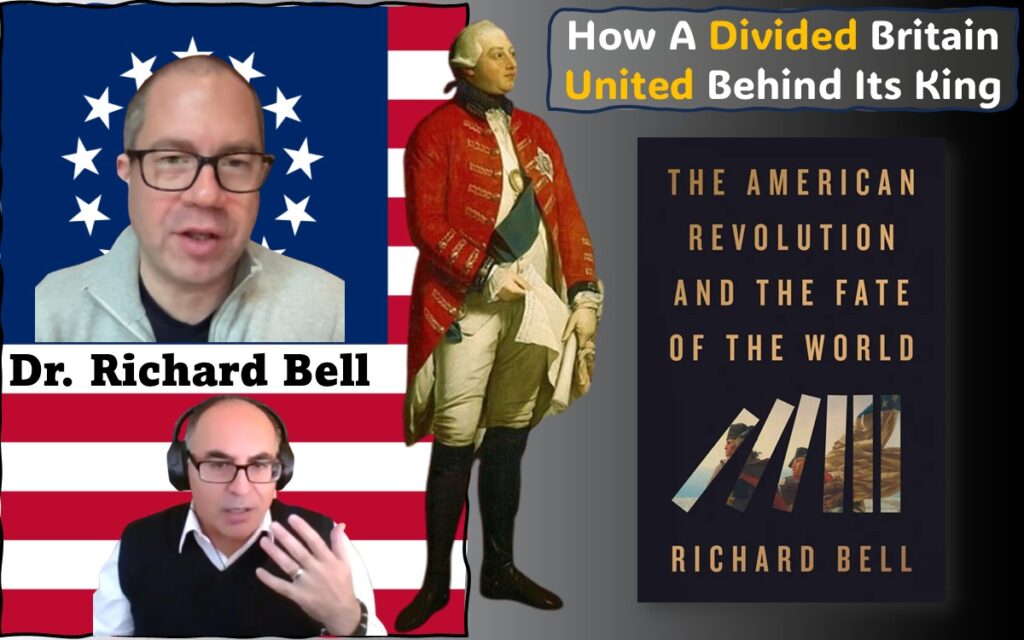 Rethinking King George III: the American Revolution From the British Perspective
About This Program
Analyzing American Revolution (AAR) is a special series podcast production of the History Behind News program. In this series, 33 professors (and counting) analyze the American Revolution from 33 different angles through in-depth interviews with host Adel Aali.
Meet Our Guest Scholars
A structured body of thought on the American Revolution—where leading scholars advancing distinct interpretations that give this program its depth.

Thematic Collection
Tap below for a closer look at the Revolutionary Era themes we examine—and to meet our guest scholars.

Library
- Interview Transcript Highlights
- Interview Image and Artist Highlights
- Quiz Answers and Backstories

Image Gallery
Explore the backstories and artist bios behind images of our Founding—before and after the American Revolution. These visuals shape how we remember—and reimagine—the Revolutionary Era.

Support AAR
AAR is an independent program built on sustained research, preparation, and production. Your support helps continue this series and expand our program.

Experienced Analysis of History
About HbN Program
The History Behind News program (HbN) is committed to making in-depth history researched and written by scholars enjoyable and accessible to everyone. Our motto is bridging scholarly works to everyday news.
The histories we’ve uncovered encompass an impressively wide range of subjects from ancient history to U.S. politics and economy to race, women’s rights, immigration, climate, science, military, war, China, Europe, Middle East, Russia & Ukraine, Africa and the Americas to many other issues in the news. We also receive advanced copies of scholarly books and discuss them in our program (in the context of current news).

Adel Aali, host. Snapshot from his introductory video to AAR podcast.
233 Scholars & Counting
Our guests are scholars at leading institutions. They are highly recognized, having received prestigious grants and fellowships as well as notable awards, including the Pulitzer Prize. They include celebrated documentary producers, former White House advisors and other high-ranking government officials, and current and former senior reporters of major national and international newspapers. Many have testified in Congressional hearings, and others frequently contribute to major media outlets and widely read publications.
Think You Know the American Revolution?