Updated: August 6, 2026
Introduction
“Neutrality is emerging out of that. And in fact… what the Dutch want more than anything is to trade with the British and trade with the Americans.”
Watch this segment in the video below (47:24)
The Dutch claimed to be neutral. But were they really?
Could a country claim neutrality while smuggling tea, gunpowder, and war materials to American rebels?
Was Dutch neutrality a principle? A strategy? A cover?
Or the product of deep divisions within the Dutch Republic itself?
And what happens when Dutch trade becomes so essential to the Revolution that Britain starts treating neutrality as betrayal?
In this interview, Dr. Peter Van Cleave explains how the Dutch Republic became one of the American Revolution’s most important—and most overlooked—international enablers: not through battlefield heroics, but through trade, loans, smuggling, diplomacy, ideological kinship, and a dangerous balancing act that eventually pulled the Dutch into war with Britain.
Video
Watch the full interview with Dr. Van Cleave (timestamped outline below)
Key Themes
- Dutch Neutrality and the Dilemma of Supporting the American Revolution
- Dutch Decline and Fading Atlantic Influence
- Dutch Republican Ideals Across the Atlantic
- Dutch Patriot Revolt and Political Division
- Forgotten Dutch Contributions to American Independence
Central Question
If the Dutch Republic claimed neutrality while its merchants, bankers, ports, and Patriots helped sustain the American Revolution, should we understand Dutch involvement as cautious neutrality, covert collaboration, or a fractured republic turning Atlantic commerce into revolutionary power?

How to Use This Post
Use this post as reference guide to the American Revolution through the lens of this interview and the broader Analyzing American Revolution program (AARevolution). Navigate using the interactive table of contents above and the timestamps below (in gray) to discover how this interview deepens the story of the Revolution—and to explore how the program unfolds: its key themes, insights, image gallery, scholars list, history quizzes, and related interviews across the series.
Neutrality or Collaboration? The Dutch Dilemma in the American Revolution
The Dutch dilemma began with the structure of the Dutch Republic itself. Unlike France or Britain, the Netherlands did not have a single powerful monarch or centralized executive who could dictate foreign policy. Power was divided among provinces, the States General, and the Stadtholder, William V, whose pro-British sympathies did not give him enough authority to control Dutch policy. That fragmentation made neutrality both attractive and unstable. The Dutch wanted to preserve trade with Britain while also profiting from American demand for goods, weapons, tea, and credit. In practice, that meant neutrality became less a clean position than a contested space—one where pro-British Orangeists, pro-American Patriots, merchants, bankers, smugglers, and diplomats all fought over what the Dutch Republic should do.
About My 211th Guest: Dr. Peter Van Cleave
Dr. Peter Van Cleave is a Clinical Professor of History and Director of Online Programs in the School of Historical, Philosophical and Religious Studies at Arizona State University. His work focuses on the Atlantic World, the Dutch-American Atlantic, the Age of Revolutions, and the American Revolution. His publications include:
►the connections between the Netherlands and the United States during the Age of Revolutions
►Thomas Jefferson and the “Notes on the State of Virginia”
►religious tolerance and religious freedom in the Second Great Awakening
►the relationship between the Dutch Patriot Revolt and the American Revolution
►the legacy of New Netherland and the Dutch in American history
►John Adams and Atlantic politics, including his essay “The Dutch Origins of the Quasi War: John Adams, the Netherlands, and Atlantic Politics in the 1790s”
About Featured Image
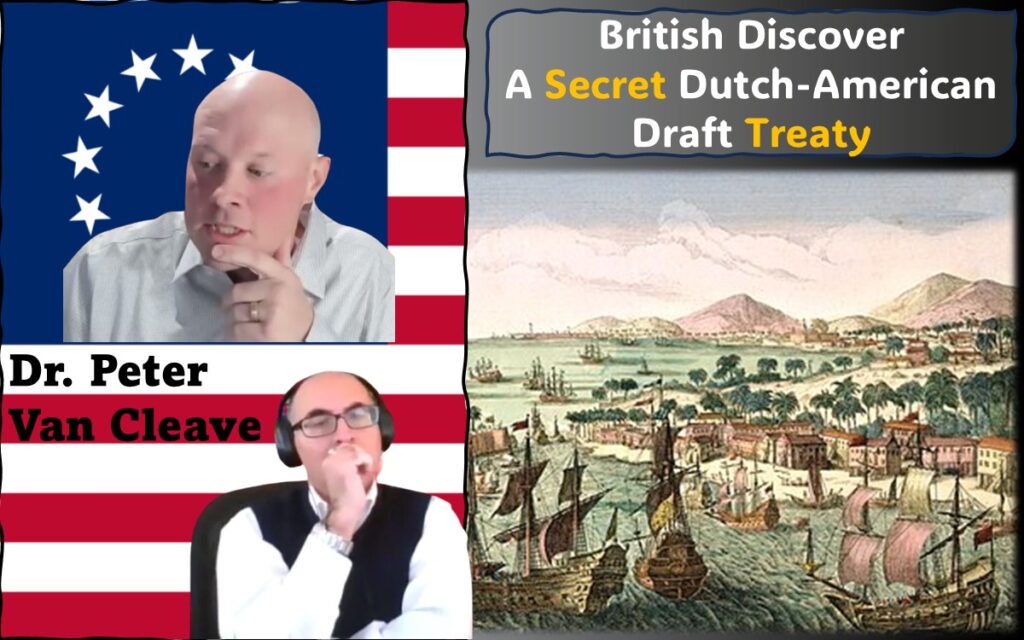
The featured image brings together images of Dr. Peter Van Cleave and Adel Aali from the interview, superimposed on the Betsy Ross flag, alongside an engraving of the capture of St. Eustatius, By Gestochen von Johann Baptist Bergmüller.
Unless otherwise indicated, all images in AAR—including those in this post—are in the public domain.
AAR Essential Insights
Although the full video and transcript of my conversation with Dr. Van Cleave are included in this post, I’ve selected and summarized several insights that I found particularly revealing and worth emphasizing. These moments — some surprising, others that challenge familiar assumptions — help us see the Netherlands and the American Revolution in a different light.
By the way, these insights are my own takes and interpretations from the interview. For Dr. Van Cleave’s perspective and exact framing, please watch the interview above and view the transcript below in the corresponding sections.
Structure of the Dutch Government and Its Effect on the American Revolution
To understand the Dutch role in the American Revolution, we have to start with structure—not intention. The Dutch Republic is not a centralized state; it’s a federation of provinces, each guarding its own authority, with a national body—the States General—that requires unanimity on major decisions .
That sounds manageable in theory. In practice, it slows everything down.
Add to that a Stadtholder—William V of Orange—who carries influence but not decisive power, and you get a system where no single faction can set policy. Provinces pull in different directions, the Stadtholder cannot impose a course, and consensus becomes the only path forward—if it can be reached at all.
This is not just background—it explains the Dutch response to the American Revolution.
Neutrality isn’t simply a choice. It’s the default outcome of a system that cannot act quickly, cannot unify easily, and cannot commit without agreement across competing interests. So while individuals and factions move—trading, lending, sympathizing—the Republic itself hesitates.
And that hesitation shapes everything that follows.
Watch this segment in the video above (00:16:02)
 William V (1748-1806), Prince of Orange (Oct. 1751 – Apr. 1806) and the last Stadtholder (Oct. 1751 – Feb. 1795) of the Dutch Republic. Following a French invasion and the collapse of his government, he fled into exile in England on Jan. 18, 1795.
This public domain image was painted by Henry Bone.
From Constraint to Collapse: The Fourth Anglo-Dutch War
The structural limits of the Dutch Republic don’t just slow decision-making—they leave it exposed, and the Fourth Anglo-Dutch War makes that unmistakably clear. Under William V of Orange, a divided and hesitant system meets British force, and the result is humiliation, captured ships, and a visible decline in Dutch power. Out of that weakness, however, emerges something new—a Patriot movement that sees in the American Revolution not just an event abroad, but a model at home.
Watch this segment in the video above (00:22:01)
From Neutrality to Recognition of American Independence
The same structural hesitation that kept the Dutch neutral begins to give way under pressure—war, decline, and shifting public sentiment start to align. As John Adams works the Dutch political landscape and events like Yorktown change the strategic picture, neutrality becomes harder to sustain. By April 19, 1782, the Dutch move from ambiguity to action—formally recognizing the United States and Adams as its ambassador.
Watch this segment in the video above (00:26:02)
The Dutch Dilemma
We tend to think in clean lines—Britain versus America, France steps in, sides are chosen. The Dutch don’t fit that model.
But as early as 1774-1775, they are already helping the Americans—but quietly, indirectly, covertly and without formal commitment. Not out of hesitation, but because they can’t act decisively even if they wanted to. No single authority in the Dutch Republic can set foreign policy. So support happens in fragments—merchants, towns, networks—not as a unified national strategy.
At the same time, neutrality isn’t some abstract principle. It’s economic. The Dutch want access to both British and American markets. War threatens that. So they try to maintain trade in all directions—even when that trade edges into smuggling, which had been happening for years.
By the time we get to the Revolution, Dutch goods are already embedded in the colonial economy. Parliament’s response—the Tea Act—isn’t just about taxation. It’s an attempt to compete with Dutch trade that is undercutting British control.
So the dilemma isn’t whether to help the Americans. The Dutch already are.
The real question is how long they can continue doing it… without being dragged into the war.
Watch this segment in the video above (00:45:32)
A Republic Divided: The John Paul Jones Affair
This is where the broader dilemma becomes real: when John Paul Jones enters a Dutch port as both hero and liability, neutrality stops being theoretical. William V of Orange and his supporters want him expelled or handed to the British, while others argue that any move against him would violate the very neutrality the Dutch are trying to preserve. So the Republic does what its structure almost guarantees—repair his ships, deny him arms, and move him along.
Watch this segment in the video above (00:53:08)
A Secret Treaty… That Led to War?
The Dutch dilemma doesn’t stay quiet for long—it surfaces in the form of a document that was never supposed to be seen. When Henry Laurens is captured at sea, the British recover papers he tried—and failed—to sink, including a draft treaty negotiated between Dutch officials and American agents .
Draft or not, it looks like the real thing.
And that’s enough. To the British, this is proof that the Dutch are not neutral—they are negotiating, collaborating, and positioning themselves alongside the American cause well before any official recognition. The result is immediate and consequential: the document becomes part of the justification for war, pushing Britain into direct conflict with the Dutch.
So the question isn’t whether the Dutch were involved.
It’s whether they could keep that involvement hidden.
Watch this segment in the video above (00:58:18)
 Henry Laurens (1724-1792). A Founding Father, delegate to and president of the Second Continental Congress, and a signatory of the Articles of Confederation. He was captured at sea by the British on September 3, 1780, and imprisoned in the Tower of London for roughly 15 months on charges of high treason (based on papers revealing a draft treaty between the American states and the Netherlands – see video at 1:00:28). He was released in exchange for British General Lord Cornwallis on December 31, 1781. Laurens is the only American ever to be formally imprisoned in the Tower.
This is a public domain image by Lemuel Francis Abbott.
From the Caribbean to Yorktown: An Unexpected Chain of Events
St. Eustatius isn’t just a trading hub—it becomes a strategic obsession. By the time of the Fourth Anglo-Dutch War, the British see it as a center of smuggling, communication, and even symbolic defiance, dating back to the earliest salute of American independence.
So Admiral George Rodney moves decisively—he sacks the island, shuts down its networks, and focuses his attention there.
And that’s where the story turns. Because while Rodney is consumed with destroying St. Eustatius, a French fleet under François Joseph Paul de Grasse sails past unchallenged, reaches the Chesapeake, and blocks Cornwallis’ escape at Yorktown. The connection isn’t direct in a simple sense—but it’s real: British focus in the Caribbean creates space on the American coast.
History doesn’t always turn on the obvious battlefield.
Sometimes it turns on where attention—and force—is not applied.
Watch this segment in the video above (01:04:37)
The First Salute to American Independence
Continue watching at 1:04:52 in the full interview above.
Rethinking the Pilgrims and the Mayflower: A Dutch Twist
This is one of those moments that makes you rethink what we learned in school—and it’s worth telling, even though it falls outside the history of the American Revolution.
We tend to tell a clean story about the Pilgrims—leaving England in search of religious freedom, sailing on the Mayflower, and founding a new life in America. But that story skips a crucial stop.
Before they ever crossed the Atlantic, these English settlers lived in the Netherlands—and they already had the religious freedom we assume they were seeking.
That’s the twist.
In the Dutch Republic, they were free to practice their faith. What troubled them wasn’t persecution—it was assimilation. Their children were becoming Dutch—speaking the language, adopting the customs—and that raised a different concern: not how to preserve their religion, but how to preserve their identity. There’s more.
The Dutch even offered to help them establish a colony in North America. The Pilgrims declined, choosing instead an English-backed venture—likely in part to protect land claims and ties back home. So the familiar story shifts.
Not a flight from oppression. But a decision shaped by culture, identity, and long-term security.
And in the background of all this sits a Dutch legacy that carries forward—religious tolerance, however imperfect, becoming part of the broader Atlantic world the Pilgrims helped enter.
Watch this segment in the video above (00:38:21)
The Interview (S1E15): Adel Aali and Peter Van Cleave
In our conversation, Dr. Van Cleave addresses important topics relating to the Netherlands and the American Revolution. The detailed outline and full transcript below supplement the video above.
Podcast
Watch the full interview on this page with the outline and transcript below, or take the conversation with you on the go through our Spotify podcast.

Outline
Use the in-depth outline below to follow the discussion and navigate key moments in the interview.
Click for Timestamped Outline
- Selected Highlights (00:00)
- Guest Introduction (01:50)
- The Dutch & 17th Century America:
- Dutch Colonies and the “Dutch Moment” in the Atlantic World (04:00)
- Henry Hudson and New Netherland (04:29)
- Wim Klooster and the “Dutch Moment” (04:47)
- The Eighty Years’ War and the Act of Abjuration (05:38)
- St. Eustatius and Dutch Trade with the American Colonies (06:52)
- The Fall of New Netherland and Dutch Atlantic Priorities (08:20)
- Dutch Brazil vs. New Netherland (09:08)
- Dutch Influence in British North America (10:55)
- Dutch Identity After 1674 (12:16)
- Dutch Language, Religion, and Law (13:34)
- Dutch Families: Livingston, Van Rensselaer, Roosevelt, Martin Van Buren (15:02)
- Francis Adrian Vanderkamp and Alexander Hamilton (14:29)
- Dutch Colonies and the “Dutch Moment” in the Atlantic World (04:00)
- The Dutch Republic:
- Structure of Government (16:18)
- States General and Provincial Power (17:46)
- Stadtholder and the House of Orange (18:27)
- William III and the Glorious Revolution (18:46)
- William V and Limits of Authority (20:35)
- The Fourth Anglo-Dutch War and Dutch Decline (22:01)
- William V and Pro-British Policy (22:59)
- Dutch Patriot Revolt (1781–1788) (24:50)
- John Adams and the Patriots (24:58)
- Structure of Government (16:18)
- The Dutch & the American Revolution:
- From Neutrality to Recognition of the United States (26:22)
- John Adams in the Netherlands (26:49)
- Dutch Recognition of the United States (April 19, 1782) (27:41)
- Dutch Intellectual and Ideological Influence (29:07)
- Hugo Grotius and “Free Seas” (29:46)
- Baruch Spinoza and Religious Tolerance (31:07)
- Jonathan Israel on the Enlightenment (31:32)
- Thomas Jefferson and the Act of Abjuration (33:25)
- Religion and Liberty in the Dutch Republic (37:00)
- Reformed Church and Liberty of Conscience (37:47)
- The Pilgrims and the Netherlands (38:33)
- Religious Freedom and Cultural Tensions (39:21)
- Petrus Stuyvesant and Religious Conflict (41:25)
- From Neutrality to Recognition of the United States (26:22)
- Dutch Direct Support:
- Dutch Loans and Financial Support (42:26)
- John Adams and Dutch Loans (43:46)
- Holland Land Company (45:08)
- Dutch Loans and Financial Support (42:26)
- The Dutch Dilemma:
- Neutrality and Trade (45:32)
- George III and the Scots Brigade (48:47)
- Johan Dirk van der Kappelen (50:17)
- Orangeists vs. Patriots (50:56)
- John Paul Jones in the Dutch Republic (53:08)
- The Serapis and Texel (54:08)
- Neutrality Tested (54:40)
- Henry Laurens, John Adams, and the Secret Treaty (58:18)
- Capture of Henry Laurens (1:00:28)
- Engelbert van Berkel (1:01:16)
- Charles Dumas and Secret Correspondence (1:01:53)
- Jean de Neufville (1:02:28)
- St. Eustatius, George Rodney, and Yorktown (1:03:58)
- Andrew Doria and Johannes de Graaff (1:04:39)
- Admiral George Rodney (1:04:16)
- Admiral de Grasse (1:05:00)
- Cornwallis and Yorktown (1:05:09)
- Neutrality and Trade (45:32)
- Why Dutch Contributions Are Overlooked (1:10:00)
- My Guest’s Research
- how Dr. Van Cleave became interested in Dutch-American relations (1:18:14)
- Just One Point (1:21:16)
Transcript
Note: This transcript was generated automatically and may contain minor errors. It is provided for reference and accessibility only.
Click to View Transcript
Adel:
Dr. Van Cleave, it’s a pleasure to have you in our program’s special series. Thank you for taking the time for this conversation with me about the American Revolution. So our interview is about how the Dutch helped the American cause during the American Revolution.
That’s why I invited you to our program. But before we go there, let’s start with this, Dr. Van Cleave, if you don’t mind. Did the Dutch have their own colonies in North America?
Dr. Van Cleave:
Yes, yes. So in fact, the Dutch have colonies throughout the world during this period.
Adel:
And by this period, are we talking about 18th century or 17th century at this point?
Dr. Van Cleave:
So largely beginning in the 17th century, yeah. So in fact, right, so Jamestown is founded as the first permanent English colony in 1607. The Dutch and Henry Hudson are exploring what would become New York in 1609.
Adel:
Oh, wow, that early.
Dr. Van Cleave:
That early, yeah. So Plymouth is another example founded in the 1620s. New Netherland, which will be the main Dutch colony in North America, is founded in 1624.
So the Dutch are right there in the midst of all of this colonization. And in fact, in this period, particularly the 17th century, this is what historian Wim Klooster calls the Dutch moment. The Dutch moment.
Yeah. So it has a book by the same name. And essentially what Klooster argues is that there is a period in the 17th century in which the Dutch are the primary movers in the Atlantic world.
And a lot of this is coming against the Spanish. So, of course, the Spanish are colonizing the Americas, you know, a full century before other European powers are setting up permanent settlements. And the Dutch in particular, actually, I’m guessing a lot of people don’t know this, are fighting their own independence battle against the Spanish in the Netherlands.
So this is what largely becomes known as the 80 Years War. But it is an independence movement in the Netherlands in the mid 1500s to the Dutch declare their own independence in 1579 with the Union of Utrecht. They actually have a document that’s called the Plakat van Vertellingen, which is translated to an act of abjuration in which they declare that they are no longer under the auspices of the Spanish king.
They say that the Spanish king no longer serves their interest. So in 1581, they declared that they are themselves independent and they’re going to operate as an independent nation.
Adel:
That’s impressive from 1581 going forward by 1624 to have colonies, New Amsterdam and the Americas. Yeah. Wow.
So what happens to these colonies? They’re like, you know, we’re going to talk about the American Revolution. Surely there are no more Dutch colonies in America by then.
Dr. Van Cleave:
Not in North America, but certainly the Americas. Yes.
Adel:
So like the Caribbean and all that. Yes.
Dr. Van Cleave:
Yeah. The Caribbean in particular, there are a series of Dutch islands, the most prominent of which that we’ll talk about in this conversation is St. Eustatius. St. Eustatius emerges as the Dutch entrepot in the Caribbean, but also becomes really the greatest facilitator of goods running through the Netherlands to the United States. In fact, more so than the French, more so than the Spanish, more so than any other country. The Dutch are directly supplying the Americans with gunpowder, with war material in exchange, of course, for goods. Right.
So the Dutch are getting heaps of goods from what is now the United States. So much so, I mean, there are stories that I’ve read in sources about, you know, tobacco rotting on docks because there’s so much of it. They can’t move it quickly enough.
Adel:
Tobacco from the 13 colonies like Virginia shipped to St. Eustatius.
Dr. Van Cleave:
Exactly. Tobacco, rice, indigo, all of these are rolling through St. Eustatius on their way, typically to places like Amsterdam, but also other ports in the Netherlands.
Adel:
That is so awesome. I can’t wait to dig deeper into that. But let’s go back again to 1624 moving forward.
New Netherlands, and there’s also New Amsterdam that we know in New York, but they don’t exist anymore by the time of the American Revolution. What happens to them? That’s correct.
Dr. Van Cleave:
So in 1664, the English take over New Netherland, the entire colony. So New Netherland has as many settlements, but the two largest settlements are New Amsterdam, which becomes New York, and then Beverwijk, which eventually becomes Albany. So you have kind of two stations, you know, largely set up on the Hudson River.
And that represents the kind of central points of the New Netherland colony. And in 1664, the English, largely without any kind of war or anything like that, take that over. So this is the Dutch are in some ways pulling back from their what was called the grand design.
And this is also coming on the heels of a large protracted battle over Dutch Brazil. So if we think and pull back and look at the Dutch Atlantic, Brazil was far more important to the Dutch than was New Netherland. New Netherland, not to say that it wasn’t important.
But if you look in the grand scheme of what the Dutch are concerned with, Brazil is the crown jewel of the Dutch.
Adel:
You’re saying you’re not saying Portuguese Brazil, you’re saying Dutch Brazil.
Dr. Van Cleave:
Right. So the Dutch take it over from the Portuguese.
Adel:
Oh, wow.
Dr. Van Cleave:
But then they lose it in 1654.
Adel:
So can one say the quote unquote, the Dutch moment is gone? Yeah.
Dr. Van Cleave:
Yeah, absolutely. After certainly 1664. Yeah.
Leading into the 1700s, you know, 1700 in general. We can we can argue that that the Dutch have permanently transformed the Atlantic world, that the shape that the Atlantic world takes is because of the Dutch, because of their training connections, because of the wars that they they wage. Against the Spanish, the Portuguese, also the English.
At this point, you actually have three Anglo Dutch wars in. I think I think all of them are in the 17th century. There’s there’s another one that we’ll talk about.
The fourth Anglo Dutch war takes place and starts in 1780. But that’s directly connected with the revolution. But during the 17th century, the English and the Dutch are constantly at odds with one another and they’re constantly also at war.
Adel:
OK, so the English take over. New Netherlands, which includes Albany and New York, present day New York in 1664. So let’s move forward now in the 17th century and we’re in the 18th century.
But just because. The English take over, it’s not like the Dutch or their influence vanish, it’s not like a binary thing that’s on or off. What are Dutch still there is like the Dutch culture influence sort of just kind of like seep into the 18th century.
Dr. Van Cleave:
Yeah, absolutely. So the there is actually some some back and forth. So in in realistic purposes, the New Netherlands is lost by 1664.
The Dutch do take it back in 1673. But then the Treaty of Westminster in 1674, New Netherlands is permanently now in the hands of the English. New Amsterdam becomes New York, named after the Duke of York who oversees the colonies.
But in in the negotiations about the capitulation of the Dutch to the English and about the transfer of New Netherland to New York, the Dutch residents are given pretty wide berth in terms of holding on to their customs, holding on to their culture, their churches, for example, such that there there’s an argument amongst historians, at least when it comes to New Netherlands, the sensibility of being Dutch, of having a Dutch culture, of identifying as Dutch doesn’t really come about until after 1674. Prior to that, you know, one of the hallmarks of the Dutch colony was its heterogeneity. In fact, there’s only I think it’s barely a majority of residents of the colony are from the Netherlands.
You know, it’s a lot of other travelers coming in. Of course, enslaved peoples are also a significant population in the Netherlands. But because of all of these different settlers, there isn’t really a kind of sensibility of being Dutch.
Right. There’s nothing that’s really kind of truly defining as being Dutch. And it’s only kind of truly after the English takeover that this Dutch community begins to recognize its own uniqueness.
And this largely comes through language. It comes through religion. And it does also come through jurisprudence.
There’s a lot of, you know, kind of vestiges of the Dutch that exist not only in the 18th century, but well into the 19th century as well.
Adel:
19th century. That is fascinating. So, well, I think, well, I may have a I may be able to answer this question myself.
By the time of the American Revolution, let’s say Battle of Lexington and Concord, we’re talking in April 1775. There must be Dutch speaking people in North America then in the colonies.
Dr. Van Cleave:
Oh, absolutely. Yeah, absolutely.
Adel:
Yeah.
Dr. Van Cleave:
Particularly in upstate New York. But as a little example, one of the figures that I study, his name is Francis Adrian Vanderkamp. He’s a Dutch preacher who gets involved in the revolution, is arrested and then exiled, makes his way to the United States in 1788.
He is met at the docks in New York City by none other than Alexander Hamilton, who greets him speaking Dutch.
Adel:
Hamilton spoke Dutch or maybe just for limited for this purpose, maybe.
Dr. Van Cleave:
Conversationally, at least. Wow, that’s the account that Vanderkamp gives of his arrival. But but there are prominent Dutch families.
So the Livingtons, the Van Rensselaers, the Roosevelts, obviously Martin Van Buren is also of Dutch descent. So particularly when it comes to New York, there is a lot of Dutch residents, families who have direct lineage to Dutch settlers. And so, yeah, there’s still a lot of Dutch culture and Dutch customs that exist in New York at this time.
Adel:
And by Martin Van Buren, you’re referring to the future president that comes after Andrew Jackson. That’s correct. Yeah.
Our seventh president. OK, coolio. Since we’re at the time of the American Revolution, let’s just talk about it.
What was you told us about? The Dutch. Independence movement from Spain, the 80 Years War by 1581, they gained independence.
So by the. 1770s, what is what is Netherlands? Is it is it an empire?
Is it a kingdom? Is it well, if it’s a kingdom, it’s a monarchy or is it a republic?
Dr. Van Cleave:
Right. Yes. So the Dutch organized back in the 16th century as a federated republic.
So this is the United Providence provinces of the Netherlands. And this is seven provinces that make up the Netherlands. And they essentially each act rather independently.
I think probably the best comparison we can make is what the United States was under the Articles of Confederation. In fact, the Articles of Confederation were in part inspired by the Netherlands and the organization of the Dutch Republic, which, if you if you fast forward, also becomes an example that James Madison uses to say that this doesn’t work. Yeah, that we need a new, stronger constitution because this type of federated system isn’t efficient.
Adel:
Which means that at that time, the Federated Republic of the Netherlands doesn’t have a super powerful president or administrator. It’s more akin to the Articles of Confederation, where there’s a lot of consensus and a lot of sort of just things are moving like molasses. You know, it’s am I am I am I on the mark there?
Dr. Van Cleave:
Yeah. So the Dutch it’s a really kind of confusing setup as well. In fact, maybe even more confusing than what the United States was under under the articles.
So it does largely or governance does largely happen at the provincial level. Provinces make kind of most of their own decisions at that level. But there is a national body that is known as the states general.
And so provinces can actually send as many delegates as they like to represent themselves at the states general. But each province only gets one vote. And when it comes to critical matters of state, there has to be a unanimous vote in order to move forward on any any big decision.
Now, what what makes this confusing is that there is also a ceremonial and kind of hereditary position that’s known as a Stadtholder. And the Stadtholder is typically held by a member of the Orange Nassau family. So this is the family of Orange.
This is why the Dutch are always recognized as being orange. Right. Have you ever seen this?
Adel:
Does this relate to William the Orange King of England? Oh, wow. Oh, wow.
Dr. Van Cleave:
Yeah, right. Yeah.
Adel:
So the Glorious Revolution. All that’s right. Yes.
Dr. Van Cleave:
1688.
Adel:
Wow. OK.
Dr. Van Cleave:
We could we could interpret the Glorious Revolution as a Dutch invasion of England. Right. So this is William the third William and Mary.
William is Dutch. Yeah.
Adel:
Yeah. Yeah. Yeah.
Dr. Van Cleave:
So there are. So importantly, right. There are deep abiding connections between the Netherlands and the British Empire from 1688 on.
Both familial, but also, you know, kind of in the 17th century, a lot of commercial exchange between these groups. But that that Stadtholder position kind of ebbs and floats in terms of power and authority. There are times in which there are really powerful Stadtholders who do kind of operate in a monarchical fashion.
The Orange family provides a lot of the military assistance to the Netherlands. They provide a lot of monetary assistance and they’re able to use that to leverage power against the provinces. But the provinces are all always in kind of constant jockeying with the Stadtholder about where does ultimate power and authority lie.
So you have periods with incredibly powerful Stadtholders. You have periods without Stadtholders. So there are Stadtholder list periods of time as we get into the revolutionary era.
There is a Stadtholder. So initially it’s William the fourth, but he he dies in the mid 18th century. His son, I think, is only like five years old when he dies.
And so he can’t take over by that time. And so there’s a regent that’s appointed in his stead. But by the time we get to the revolution, this is William the fifth.
He has emerged as a Stadtholder and he does he doesn’t have unilateral power. Right. And this is it is critical to understanding the role of the Dutch in the American Revolution, is that no one faction within the Netherlands has enough power to dictate to the other.
So the Dutch are broadly committed to neutrality and then they’re broadly committed to neutrality. In most cases, they try their best to stay out of the Seven Years War. They try their best to stay out of a lot of the European wars.
You know, war of Spanish succession, things of that nature, claiming a strong commitment to neutrality. This is also because of that tension about where power lies. The Stadtholder doesn’t have enough power to say, hey, we’re going to do this.
Right. Or this is the path that we’re going to take.
Adel:
And that has an impact on the American Revolution. And we’ll get to that in a moment, because I’m now curious about this. William V is not as powerful as William IV in the Netherlands.
I get that. Does that open up space for some sort of revolution in the Netherlands itself? I guess I can let me ask you this.
Do the Dutch have their own revolution at the time of the American Revolution suddenly?
Dr. Van Cleave:
Yes. So there is. And this comes in large part due to William V’s weaknesses.
There is also very particular things that happen in the lead up. I don’t know if we want to jump into this now in terms of the outbreak of what is called the Fourth Anglo-Dutch War. This takes place from 1780 to 1784.
It is an utter disaster for the Netherlands. It largely takes place in the Caribbean. So this is in direct consequence of all of the trading and smuggling that is happening through St. Eustatius. So the Caribbean is the focal point of this war. I think there’s one stat that I read that in the first month of the war, the British capture something like 200 Dutch ships. And the consequence of this is that the Dutch are humiliated by the British.
And so William V, who, of course, has a family connection to the British monarchy, or at least a kind of not an ancestral connection, not a family connection, because it’s the Hanoverans right now. Right. So George III is there.
But there is political, but also kind of diplomatic connections that William V has with the British monarchy. And so he’s pro-British this entire time. He is always angling to support the British.
He doesn’t want to provide any kind of support from the Netherlands to the Americans. And the fourth Anglo-Dutch war both embarrasses him. It exposes to many within the Netherlands how weak that they’ve become, you know, in kind of a real politic way.
The Dutch have always prided themselves on their influence. They’ve always prided themselves on their ability to kind of shape Atlantic commerce. And what we see in 1780 by the end, certainly by the end of 1784, is that the Dutch are in an absolute decline.
That the Dutch are nowhere near. And I think it’s probably safe to say that most people in the Netherlands knew that they were no longer at the height of where they were in the 17th century. There isn’t, I don’t think they’re trying, dreaming of getting back to that.
But the kind of disrepair of the Dutch Navy, the disrepair of the ability of Dutch resistance inspires a kind of similar movement within the Netherlands that we see happening in the United States. It precedes this moment. There is a contingent of kind of a Dutch group that is known as the Patriots.
And they’re deeply aligned with the American Revolution. They see the revolutionaries as kind of kindred spirits. This is the group that John Adams, once he arrives in the Netherlands, this is who he embeds himself with.
And what the Fourth Anglo-Dutch War inspires then is a more kind of movement across the provinces. And so what you have in 1781 that lasts until 1788 is what’s known as the Dutch Patriot Revolt.
Adel:
1788. 1788, correct. When you say movement across the provinces, let me just go to the top of this segment.
Because of William V’s weakness, there’s no one faction in the Netherlands that sets the agenda, particularly in the subject that we’re here to talk about, what’s happening in the American Revolution in North America. But when the Dutch are humiliated, that process starts in 1780, it’s the Fourth Anglo-Dutch War. Does this sort of, when you say movement across, does that also unify sort of the Dutch in their engagement with the American colonies?
Is that a fair description?
Dr. Van Cleave:
Yeah, that’s a good question. So, I mean, it solidifies more public and kind of republic-wide support of the United States. So I think to think about the timeline itself, the Dutch-Anglo War begins on December 20, 1780.
That’s when Britain declares war on the Netherlands. In 1780, John Adams has arrived in the Netherlands. He’s already working with the Patriots.
He’s trying to get access to the States General, but he’s being rebuffed. He’s being denied. They won’t even accept his credentials at this point because it’s still, you know, neutrality still sits at the heart of the Dutch response.
And that’s still their official position. But by 1781, you have Yorktown, right? So you kind of see the beginning of the end of the revolution.
You know, the Netherlands are seeing the kind of fall of the Dutch, both in the Caribbean, but also in the larger Atlantic, such that then you have a much more concerted support for the Americans, for John Adams. And on April 19, 1782, the Dutch officially recognize the United States as an independent country. They officially recognize John Adams as Minister Plenipotentiary.
And he’s the official ambassador from the United States to the Netherlands. And so the fourth Anglo-Dutch war and kind of this embarrassment does directly lead into kind of official Dutch recognition of the United States.
Adel:
I want to take a moment and ask the following questions in the context of your forthcoming book, which is titled A Shadow of Liberty, Religion, Politics and the Dutch in the Early American Republic. One, based on what you just shared with us, it’s fair to say that Netherlands, the Dutch and their revolutionaries were in contact with the American revolutionaries. We sort of established that, right?
I’m interested in the Dutch influence. And it’s obvious that you’re going to talk about that because we’re talking about the title of your book, Religion, Politics and all of that. And you also mentioned how their articles of confederation, whatever that’s called, their version of it influenced ours.
So what are the we’ll get to war and actual war assistance and loans in a moment. But are there like other influences from the Dutch religion and all of that? And I ask that question, Dr. Van Cleve, from the perspective of an American who’s learned about the Enlightenment era, you know, like Adam Smith or David Hume, that those sort of, you know, or let’s say Montesquieu and all of that Voltaire.
Dr. Van Cleave:
Yeah.
Adel:
Are there are there influences from the Dutch that we sort of haven’t learned in school?
Dr. Van Cleave:
Oh, probably.
Adel:
Yeah.
Dr. Van Cleave:
So I would say, you know, in in that kind of catalog of thinkers, probably the two most prominent Dutch thinkers in this moment. I mean, these these are contemporaries of Montesquieu, contemporaries of Locke and Hobbes are Hugo Grotius and then Baruch Spinoza are the two that we should probably include in that conversation. Grotius is probably best known for his treatises and his thinking about international law.
So Grotius has a pretty famous book that it’s roughly translated to the free sea. And he articulates an idea that the ocean belongs to no one, that the ocean is a free, independent and open space that independent nations should be able to move through. And this kind of gets at the heart of what becomes a Dutch axiom, which is free ships equal free goods.
In the Seven Years War, the American Revolution, the French Revolution, all of these kind of 17, 18th century conflicts, the Dutch maintain that because they’re not at war with any of these belligerents, that they have the right to engage in trade with anyone, that their trade should not be restricted by anyone because they are not officially at war. And so a lot of these ideas are coming from Grotius. Spinoza is a more radical Enlightenment thinker.
He certainly writes about governance, writes about religion. So if we think about really kind of radical approaches to religion, seeing religious tolerance as a key Dutch ideology, a lot of that is coming out of Spinoza. There’s in fact one historian, Jonathan Israel, who places Spinoza at the center of the Enlightenment.
Maybe arguing too aggressively, but arguing that, you know, in terms of both neglected figures, but also critical figures, Spinoza is the person we should be paying attention to. So I think, one, there are literal Dutch thinkers that are a part of these conversations that are influencing and shaping what Locke is thinking and writing about. Locke is reading these people, Montesquieu is reading these individuals.
But I think another facet of this is that the Dutch are also reading all of the things that Americans are reading. Right. So there’s a lot of literature out there, you know, certainly starting with Bernard Bailyn, by Carolyn Robbin, right.
Thinking about this kind of Commonwealth, little R Republican ideology. And in this kind of Commonwealth ideology becomes the ideological premise that Americans use to justify and move toward independence ideologically. The Dutch are reading these same individuals, right.
The Dutch are part of this conversation, such that it’s not just an American context. It’s not just an American conversation, but it really is an Atlantic conversation. And the Dutch and the Americans are also in dialogue about this.
I think something that’s really interesting, you know, you talk about contact. One of the things that’s happening both in the Netherlands, but in the United States, is things are being translated. So the Dutch are translating documents from the colonies about their grievances against the United States.
Adel:
The Declaration of Independence.
Dr. Van Cleave:
And in fact, there’s some speculation. There hasn’t been anything definitive that I’ve seen. But the 1581 Act of Abjuration certainly was read by Jefferson.
Jefferson had that as part of his repertoire in thinking about how do you justify independence? How do you justify throwing off a monarch? The Dutch had already done this, right?
The Dutch had done this back in the 16th century. And while, you know, there isn’t, there’s not a lot of concrete evidence. You know, there isn’t a letter where Jefferson’s like, I just read the Dutch Act of Abjuration.
I’m going to include it in this section of the Declaration of Independence. But there’s certainly parallel thinking, right? And I think one of the things that does come out of this is that the Dutch recognize the kind of shared values that exist between their idea of a republic and the American idea of a republic.
They see their fight. And so confusingly, this is also known as the Dutch Revolt. So this is the 16th century revolt that is known as the Dutch Revolt.
The 18th century is designated as the Dutch Patriot Revolt. But they see themselves as kind of continuing this very Dutch tradition that now the Americans are also participating in. Right.
So Americans see themselves as a vanguard. The Dutch, at least the Dutch patriots, see the Americans joining the cause for republican governance, for this kind of ideology. So there’s there’s a lot of intellectual exchange that is going on between the Dutch Republic and in this new kind of American republic.
Adel:
I’m now curious, is the 1581 Act of Abjuration by the Netherlands to sort of gain independence from Spain, the Spanish Empire? Is it sort of structured like our Declaration of Independence, where you have a preamble and sort of a list of grievances? That doesn’t sound like that.
Dr. Van Cleave:
So it’s certainly a list of grievances and an articulation of a kind of, you know, a duty to revolt when the monarch no longer represents the interest of the people. There is kind of directly shared ideology between those. Right.
I think the disagreements amongst historians is about kind of literal usage. Right. Like, does Jefferson kind of use this as a model, you know, both in terms of form and content?
I think there’s there’s less to suggest that kind of direct usage. But I think, you know, one of the things about the declaration is that Jefferson’s also just vacuuming up all the ideas that that are present at that time.
Adel:
Yeah.
Dr. Van Cleave:
And these Dutch ideas are a part of that bundle.
Adel:
And to add to that, Dr. Van Cleve, by the time Jefferson actually writes the Declaration of Independence, our sort of national declaration of independence, there were other declarations of some sort within the colonies themselves. So it wasn’t whole cloth. He just go to your phrase that he was vacuuming this sort of corpus of knowledge about how he could compose this along with his team of John Adams and Ben Franklin.
I think there were two others. Just just quickly before we go to the next segment. We mentioned religions many, many times, even going back to the 17th century.
What is the religion of the Netherlands at that time? Yeah.
Dr. Van Cleave:
Yeah. So again, we kind of fall back on the complexity of the Dutch situation. So the Dutch have what they call a public church and the public church for them is the Reformed Church.
So this is a Calvinist based faith. The Dutch, you know, much like many areas and countries in the Protestant Reformation are caught up in that. Much of the revolt against the Spanish is a deeply seated Protestant versus Catholic fight.
And the Dutch emerge out of this kind of committed to the Calvinist faith, which through their church is known as the Reformed Church. However, in the Union of Utrecht from 1579. And so this largely acts as the governing document for the Dutch Republic.
There is an article in there that commits the Dutch to the liberty of conscience that a crucial Dutch value is, is the liberty of conscience and kind of a certainly at this time, a widespread sense of religious liberty. There are constant tensions between the Reformed Church and its kind of public status. So, for example, in order to hold office, you have to be a member of the Reformed faith or as the Dutch commonly do, pretend that you’re a member.
Adel:
Remember, you and I could have a whole podcast just on this topic. This is really fascinating. And I hope I hope I don’t embarrass myself in front of you and our audience.
Did the Mayflower go to the Netherlands before a set sail for the Americas? And there were some religious sort of people that got on the ship.
Dr. Van Cleave:
Is that what the scurvy Puritans who we largely know as the pilgrims. Right. So the pilgrims is that first contingent of English settlers, in fact, did not come from England, but they came from light.
Yeah, that’s fascinating. You know, one of the great ironies, right, is that while we largely at times attribute a sense of religious freedom to these pilgrims that they were seeking out religious freedom. The reality was, is they had religious freedom in the Netherlands.
They were free to practice the faith. In fact, they were they were Calvinist. Right.
They were welcome to practice their faith. It’s actually more the case that, well, there were two large things that were happening for the pilgrims. The first of which is that their children were becoming Dutch.
Their children were speaking Dutch. They were adopting Dutch customs. And as good English subjects, they couldn’t abide that.
Right. Religious freedom wasn’t the interest. They didn’t want their children being so Dutch.
And then there was also, as I understand it, some kind of concern over losing land claims back in England. That because the Netherlands actually approached this group and said, hey, if you want to immigrate to North America, we can provide that. We can set you up in a colony.
We can we can do this for you. And the pilgrims rejected that offer, in fact, took the English offer. And there is some speculation that they did this in order to secure familial land claims back in England, because they were threatened that if they went with the Netherlands and set up this Dutch colony for for the West India Company, that they would in fact lose claims back back in England.
So it wasn’t about religious freedom that the pilgrims were seeking settlements in the New World. But we kind of invoke our earlier conversation when we talk about Dutch customs and liberties. This sense of religious freedom, this sense of the liberty of conscience and kind of anchoring that as a dedicated principle, is also another legacy that New Netherland bequeaths to New York.
It’s a really complicated story and we shouldn’t see it as a linear story. There were many instances within New Netherland of governors trying to suppress dissident faiths. In fact, probably the most prominent governor of New Netherland, Petrus Stuyvesant, was a rabid Calvinist and did everything he could to suppress the practice of non-Calvinist faiths in the colony.
But there were so many disparate faiths, so many disparate peoples, he was never able to exert enough control. And he didn’t have support from the states general and he didn’t have support from the West India Company Board of Advisors, who kind of pushed him to allow for kind of freer in public expressions of faith.
Adel:
And you’re sharing that with us to sort of make sure we recognize that this story of religious liberty in the Netherlands is more complex. And this is an example of a governor who actually didn’t believe in this philosophy of liberty. I get that.
Let’s take a break here. In the next segment, I will speak with Dr. Van Cleave way more about the American Revolution. We’ll be right back.
Dr. Van Cleave, in the last segment, you told us that, what was the date? I think you said April 19, 1781 or 1782? 1782.
1782. There you go. The Dutch recognize the American colonies as a new country.
And then they also recognize John Adams as an ambassador, an outright ambassador in official capacity. Got that. But.
Correct me if I’m wrong, I thought that John Adams actually secured loans from the Dutch by 1779.
Dr. Van Cleave:
So there are some loans that are coming in from private individuals. There isn’t anything official and there isn’t anything major that’s coming in from particularly Dutch banks. Right.
So one of the consequences of Adams becoming the official minister plenipotentiary is that it gives him standing to negotiate kind of official loans with the Dutch Republic and the banks that are involved with the states general. So that by the end of 1782, Adams has secured a loan of five million guilders.
Adel:
Is that a big amount, five million guilders?
Dr. Van Cleave:
It’s a pretty, pretty sizable amount in terms of support. And, you know, one of the other things that that also secures loans, I guess it secures a kind of constant stream of Dutch involvement in American commercial affairs. So the Dutch offer loans in 1784.
They offer loans again in 1787. They offer loans in 1788. And then the between 1790 and 1794, Congress actually gets loans of about 23 million guilders from from the Netherlands.
It is, you know, it isn’t too much to say that the Americans are largely subsidized by Dutch money during the Articles period. And then even even into the constitutional period, and that I should note is only kind of formal exchanges, you know, with the US government and these Dutch banks. There’s also less formal exchanges and investment that the Dutch were making.
So we’re getting a little beyond the revolutionary period. But there is an organization that is formed in the 1800s that’s called the Holland Land Company. And they end up purchasing about five million acres of land in upstate New York and western Pennsylvania.
If you think about the Erie Canal route, that was all Dutch owned land and managed by this Holland Land Company.
Adel:
Okay, we’re going to get to that for a moment. I’m amazed by this, what you just shared with us. But let me clarify something regarding the American, the period of the American Revolution.
So we’re still 1781, 1782, that period. The Paris Peace Treaty or the Treaty of Paris happens in 1783. Okay.
I’m curious about this, Dr. Van Cleave. Before you told me in the last segment that there was no faction powerful enough in the Netherlands to set agenda, foreign policy agenda vis-à-vis the Americans. So things are happening.
The Dutch are helping the Americans, if not officially, at least families, whatever, towns, smaller portions. Are the Dutch suddenly in a bind? Does this cause a dilemma that, holy moly, we’re going to get in a war with Britain, who’s all powerful at this time?
Because France was fearing this, that by helping the Americans, it may go into a war that it was not yet ready for.
Dr. Van Cleave:
Right. Yeah. So there’s a similar situation in the Netherlands in terms of kind of fear and tension about how much do you help the Americans?
You know, how much do you stay, you know, in collaboration with Britain? There is also a kind of genuine commitment to neutrality. Now, it’s also a selfish commitment because what the Dutch want more than anything is to trade with the British and trade with the Americans.
Right. So neutrality is emerging out of that. And in fact, to take a small step back, you know, something that we should highlight is that the Dutch have been smuggling in goods to the colonies for decades.
Right. So, you know, if we think about the kind of standard march up to the revolution, you know, one of the things that we normally highlight is the Tea Act of 1773. Right.
This inspires the Boston Tea Party, all of these things. The reason that the British create the Tea Act. So ironically, the Tea Act actually lowers the prices of tea in the colonies.
It gave a monopoly to the East India Company to sell tea into the colonies. But the hope of the British was actually that they wanted to lower the price so that Americans would stop buying Dutch tea. There is so much Dutch tea that is just flooding the colonies.
American colonists are ravenous for this. And so you have kind of official top line British policy that is all in an effort to lower its own prices so it can compete with the price of Dutch smuggled tea. So the Dutch are embedded in all of these conversations kind of from the beginning.
It reaches kind of an official status in 1775. So in 1775, George III can kind of see the writing on the wall. He’s starting to prepare the British Army.
He’s starting to gather troops, right, you know, paying for some troops, gathering what other troops he has. And there is a contingent of troops within the Netherlands. It’s known as the Scots Brigade.
And this is a unit that is garrisoned in the Netherlands. It’s kind of presumably there to prevent border entry largely from France. But it’s a unit that has been sent to England from the Netherlands a handful of times, actually.
And so in 1775, George III puts a formal request in for the Scots Brigade. Right. It’s a pretty small garrison, but every little bit helps.
And so he’s reaching to all these different places, one of which is the Netherlands. William V is perfectly fine sending the Scots Brigade. But again, to your point, he doesn’t have the power to unilaterally do so.
So what does he have to do? He has to go to the states general and he has to request that they agree to send the Scots Brigade. And this becomes one of the first kind of public sticking points with the Netherlands and their engagement in the kind of formal processes of the American Revolution.
There is a particular nobleman, he’s a regent from over ISIL. His name is Johan Dirk van der Kappelen. Van der Kappelen makes a kind of big public show of his opposition to sending the Scots Brigade against the Americans.
He frames it as a protection of Dutch neutrality. He also publicly submits this testimony, which is kind of against the decorum of what the states general does. This is largely internal business that they’re supposed to be discussing.
This actually leads him to be removed from his seat eventually. He’s brought back in with kind of public support. But critically, one, it shows the negotiation that is happening in the Dutch Republic between those kind of pro-British supporters, people like William V and his supporters, which we can broadly label Orangeists.
This is what they’re called in the Netherlands, people that support William of Orange. With this kind of growing body of what we would call patriots that are led by this nobleman, van der Kappelen. And van der Kappelen’s speech kind of makes waves.
It creates enough problems for William V. And essentially what the Dutch do is they put so many stipulations on sending the Scots Brigade. They have to do this.
They have to do that. They have to do this other thing that George III is like, forget about it. We won’t even use them.
Right.
Adel:
But clarify this for me, please. Why would George III, the king of Great Britain, need Dutch permission to call his own troops from continental Europe? They’re British troops.
They’re Scots Brigade.
Dr. Van Cleave:
Right. But they’re garrisoned in and under the authority of the Netherlands.
Adel:
Under the authority of the Netherlands. OK.
Dr. Van Cleave:
Yeah. So he has to request that they be sent, which the Dutch have done. They did it in 1715 and 1745.
And this is largely the Jacobite rebellion. So this was a kind of alignment of Protestant interests against Catholic uprisings. And so there was a shared agreement kind of across the Netherlands about sending the Scots Brigade.
But but in this moment, George III has to request that because they’re in the Netherlands. Right. And they would be crossing through Dutch territory, across Dutch borders in order to get that.
And so George III and also William V need the permission of the states general to send those troops.
Adel:
And the Jacobite rebellion occurs in Scotland and we all know Battle of Clawdon and all of that. There’s a wonderful story about John Paul Jones. We know him.
Is it fair to call him a privateer or should we call him an American sailor? How should we categorize him?
Dr. Van Cleave:
He is a naval commander. Right. I think he is commissioned back in 1775.
So I mean, he does.
Adel:
I was mistaken. Member of the Continental Navy. OK.
Dr. Van Cleave:
Right. I believe so. And there are.
But he’s certainly operating in many times as a privateer. Right. Exactly.
They call him a pirate.
Adel:
Right.
Dr. Van Cleave:
And yes. So in the summer of 1779, Jones is commanding an American ship called the Bornholm Richard. He engages British ships off the coast of Scotland.
The British ship is the Serapis. The Serapis actually sinks John Paul Jones’s ship. But Jones is able to board the Serapis and overtake it.
Adel:
Wow. Go Jones!
Dr. Van Cleave:
The Serapis has taken quite a bit of damage. Jones still has some of his other fleet. So there’s five ships in total.
The four ships that were with Jones and then the Serapis. And they make their way to the Netherlands. They set course for the Dutch Republic and they dock in the port of Texel.
And so this is another flashpoint for the Dutch in terms of a test of their neutrality. It is an example of the kind of tension between the pro-British factions that are forming in the Netherlands and the pro-American factions that are forming in the Netherlands. Because kind of quite awkwardly, Jones enters the Netherlands as a hero.
There are songs sung to his honor. There are celebrations when he reaches the dock. He is welcomed as a hero.
By 1779, you’re talking at least four plus years of not official but overt support that the Dutch have for the Americans. And so there is a growing pro-American sentiment that is occurring throughout the Netherlands. And so Jones arrives in Texel.
And the question is, what do we do with him? Or what do the Dutch do? What do the Dutch do with him?
William V wants him gone. William V wants him turned over to the British. At best, at worst, he wants him just out of the Netherlands.
The other Dutch, the kind of pro-American Dutch, are arguing that any kind of action would in fact violate Dutch neutrality. That there isn’t anything that they can do to Jones. Jones is there as, I think in this case, he is under the auspices of a privateer.
He is under the auspices of a merchant.
Adel:
Tense my question whether or not he was a privateer or not. Right.
Dr. Van Cleave:
And so the Dutch don’t feel that they’re in the position to make determinations about who’s a rebel and who’s not. Because if they confiscate the ship, if they punish Jones, they’re more or less declaring that he is in rebellion against the British. It puts them on the side of the British.
However, if they arm him, if they repair his ships for him, this can now be interpreted as support of the Americans in violation of Dutch neutrality. So what ends up ultimately happening is the Dutch say there are very limited things we can do. He can’t receive ammunition.
We can’t arm him. That’s a violation of neutrality. This is a ship that is in our docks.
He can be provided assistance. His ships can be repaired. Right.
We can provide some of those efforts. And so Jones is able to repair his ships and he’s able to kind of leave the port largely without issue there. There is certainly some intrigue that is happening again.
You know, we’re talking three years after the declaration, four years after the incident with the Scots Brigade. There’s a lot of maneuvering that is happening. But ultimately what happens is that Jones is able to leave.
He’s given very minimal support and the Dutch are clinging on to what neutrality that they have.
Adel:
Wow. This is. But so this this sort of demonstrates the infighting within the Netherlands about how to deal with the American Revolution.
I asked you about John Adams, how in 1779 he started securing loans. You explained that those were sort of a smattering of loans and they were not sizable until years later, starting in 1782. Before that, in our prior communications, you sort of beacon for me that, hey, Henry Laurens was in the Netherlands before John Adams.
Dr. Van Cleave:
What is what is his story? Yes. So Henry Laurens was, in fact, the first envoy to the Dutch Republic.
The Continental Congress in October of 1779 names Henry Laurens. So Henry Laurens is of South Carolina. I think it was actually the head of the Congress at one point.
They named him to be an envoy to the Netherlands with two main goals. You know, official recognition from the Dutch Republic and then loans. Right.
That is what Henry Laurens is designed to do. Laurens doesn’t actually take off until August of 1780. So he doesn’t leave 1780.
1780. Yeah. And by this time, actually, Adams is already on his way to the Netherlands.
So both of them are kind of making their way where they’re from. So Adams at this point, it was in France. So Adams was part of a diplomatic contingent that was headed up by Benjamin Franklin, also joined by by Richard Henry Lee.
Adams, the diplomatic way to say it is he was frustrated with Franklin’s approach to diplomacy as well as French response. And so he became rather impatient, became incredibly frustrated, and he didn’t see a path forward for him in France. And I think it’s probably also safe to say that Franklin didn’t see a path forward with Adams there in France.
And so it’s kind of agreed upon that Adams will, because he’s in France, he has quicker access. He will make his way to the Netherlands and kind of start laying the groundwork for Lawrence’s arrival. So so we can kind of picture Adams is on his way.
Lawrence is on his way across the Atlantic. The thing is, Lawrence never makes it to the Netherlands. His boat is caught off of Newfoundland, so he barely makes it out of the United States.
He’s captured by a British ship in the process of being captured. Henry Lawrence tries to add some weights and throws a bunch of papers into the ocean, except that he didn’t put enough weight into it. And those papers easily float up to the surface.
They’re scooped up by the British sailors. Amongst those documents is, in fact, a secret treaty that had been negotiated between Dutch officials and American official that dates back to 1778. So this is.
Wow. Wow. OK.
Yeah. So it’s we should we should we should say it’s a draft treaty. So, you know, no one actually had official capacity to do anything.
But what happened was in 1778, Engelbert van Berkel, who is the Grand Prince of Amsterdam. So he’s basically like the treasurer of Amsterdam, which is an incredibly prominent position in the province of Holland. Holland being the most powerful province in the Dutch Republic, Amsterdam being the most powerful city.
So this is not no one. Right. This is not a nobody, but it’s a pretty prominent Dutch official.
I mean, he is in an official capacity, but he is negotiating with two American agents in the Netherlands. So there is an American agent named Charles Dumas, who was actually set up in 1775. The Committee of Secret Correspondence, which is headed by Ben Franklin, sets up Charles Dumas in the Netherlands as an American secret agent.
And unsurprisingly, you know, kind of tellingly, all of Dumas’ correspondents go through St. Eustatius and then go to the Continental Congress.
Adel:
Wow.
Dr. Van Cleave:
That’s really interesting. St. Eustatius is always present in these conversations. So Van Engelbert is negotiating with Dumas.
He is also negotiating with Dutch financier, Jean de Nunaf. And they meet in a German city, Aachen. And in Aachen, they draft essentially a treaty that says if the United States is recognized, you know, if these things happen, we will formally enter agreement and we will begin to provide loans.
It’s again, it’s a draft, but it looks like a treaty. Like if you read this document, it has all the trappings of being a formal treaty. And so the British in 1780 now have evidence that the Dutch have been negotiating.
They’ve been collaborating, conspiring, forming secret treaties with American officials all the way back to 1778. And this actually imparts the capture of Lorenz, the capture of the secret treaty. It is enough evidence that this directly leads to that declaration of war that we talked about that kicks off.
Adel:
Oh, wow. Poor Lorenz, sort of no good deed goes unpunished. He goes out there to get loans and he inadvertently starts a war.
And in all likelihood, the Brits would have probably plunged into war based on, you know, different excuses and circumstances. That’s a great that’s great history. We talked about St. Eustatius several times. You’ve also highlighted for me another really fascinating twist in history that has to do with Admiral George Rodney. Right. And his obsession with this sort of distribution center for the Dutch.
Could you share that with us, please? And what sort of impact does it have on the American Revolution?
Dr. Van Cleave:
Right. Yeah. So.
So, in fact, I think I’ll approach this with a kind of prologue in the story of Rodney, which which highlights, again, the kind of central node that St. Eustatius finds. I’m not sure if I shared this with you, but one of the kind of prominent stories that comes out about the Netherlands, about St. Eustatius during the American Revolution, is that in November of 1776, there is an American ship called the Andrew Doria that is making its way into St. Eustatius. As the Doria approaches, it’s it’s flying the new flag of this now declared independent United States.
The commander of St. Eustatius, this is Johan de Graaf, he fires a signal to this ship recognizing the American flag, acknowledging the kind of independence of the U.S. way back in 1776. This is widely known as the first international recognition of the independence of the United States. Wow.
And so de Graaf, of course, is in trouble. Right. Like the British are like, what are you doing?
You can’t do this. You can’t recognize this independent country. These are our colonies.
And de Graaf is like, listen, that wasn’t it. There’s an error. You’re confused.
We signal merchant ships with I think it’s like six shots. We recognize independent nations with eight shots. We fired six shots for these guys.
This was an official recognition. The British, of course, aren’t buying it all.
Adel:
Right.
Dr. Van Cleave:
It becomes a kind of cause célèbre. De Graaf ends up going back to the Netherlands to have to testify in front of the West India Company.
Adel:
Big deal.
Dr. Van Cleave:
Yeah. And so, you know, it points to to St. Eustatius. Right.
So not only did the British know that the Dutch are smuggling loads of ammunition, loads of goods through St. Eustatius. St. Eustatius is the site of this first salute of the independence of the United States. And of course, kind of Dutch denial and commitment to neutrality.
You know, St. Eustatius is also the pathway now that they know that all of these secret correspondents are running through. And so St. Eustatius emerges as the thorn in the side of the British Empire. Right.
And so when the fourth Anglo Dutch war kicks off, it kicks off in the Caribbean. And St. Eustatius is the centerpiece of British aggression in the Caribbean. And in fact, George Rodney, who you mentioned, completely sacks St. Eustatius. He overruns the colony, arrests many of the residents there. He kind of sets up English shipping in St. Eustatius. The Dutch smuggling and shipping in St. Eustatius largely comes to a stop. He is so focused on destroying and sacking St. Eustatius. This is his primary goal. What happens, though, is he is so focused on St. Eustatius that a French fleet led by Admiral de Grasse sails right past him, St. Eustatius. And where does de Grasse end up in 1781, but off the coast of Virginia, blocking Cornwallis’ retreat from Yorktown. Cornwallis wanted to retreat to the sea. Right.
He wanted to escape, maintain his garrisons, maintain his army. But he can’t because de Grasse and the French fleet have hemmed him in. This leads directly to the surrender at Yorktown, all because Rodney and his fleet are so busy attacking the Dutch and sacking St. Eustatius that he does nothing to stop de Grasse from making his way to Yorktown.
Adel:
Oh, wow. This is fascinating. Had Rodney let up a little bit in St. Eustatius, the American war for independence may have gone on for some, I don’t know, some months or years longer.
Dr. Van Cleave:
Certainly. And I mean, yeah, we know, like the war itself certainly goes on after the surrender of Yorktown.
Adel:
Yeah.
Dr. Van Cleave:
You know, there is some, you know, I think, you know, if if we do some some speculation, I think maybe the safest one is to say, does the end of the war, you know, execute in the way that it does? Do the Americans have the bargaining power that they do going into those negotiations in Paris? Right.
Where the British are essentially like, take take the rest of North America all the way to the Mississippi.
Adel:
Right.
Dr. Van Cleave:
If Yorktown doesn’t happen, if there’s still, you know, that large army that Cornwallis has, are our negotiations different? Right. You know, is do they continue to fight toward a stalemate with with the Americans?
Right. That’s kind of a famous British cartoon of a snake coiling around British garrisons. And then the first mark is Saratoga.
The middle mark is Yorktown. And then the third mark is a board with a big question mark. Right.
So the British are basically like, where are we going to lose next? Right. What’s the next major defeat after Yorktown?
But if there is no defeat at Yorktown, you know, it’s unclear. How does the British Republic respond? How does the British Army respond if Cornwallis is able to escape to the ocean?
We just don’t know.
Adel:
Yeah. Dr. Van Cleve, you and I just been talking for over an hour about this fascinating history. Which leads me to this question, like I didn’t learn any of this in school about the Dutch, did you?
No, I actually I didn’t.
Dr. Van Cleave:
Yeah.
Adel:
I mean, so how how are the Dutch contributions so overlooked? I mean, yes. In the HBO series about John Adams, you see it.
I’ve read his biography. So I know from that aspect, I learned later just because I love history. But this is not something we as Americans kind of know.
Right.
Dr. Van Cleave:
Right. Yeah. Well, even in that Adam series.
Right. Like most of the scenes of Adams in the Netherlands. So he falls severely ill.
Adel:
It’s about him being sick.
Dr. Van Cleave:
Yeah. And like that’s basically what you see. Right.
Like you see really dour, you know, Dutch officials looking down on Adams and he’s like shivering. And that’s basically it. Right.
We’re done with the Netherlands. We’re done with the Dutch. So I think, you know, part part of the answer is that.
Many of the international contributions are slow coming to our understanding of the American Revolution. Right. Even the most prominent ones.
You know, the full commitment of France. Right. Or the full engagement of France is not something we readily learn about in terms of the American Revolution.
Right. One of the like my favorite fact toys that I like to present to students when we talk about the revolution is that at Yorktown, speaking of French troops outnumbered American troops two to one.
Adel:
Right.
Dr. Van Cleave:
So if we talk about who’s winning the actual American Revolution. Right. The French have to be there.
But when we think about the Dutch, you know, there is no Dutch commander that is in the United States. Right. There isn’t kind of a counterpoint to George Washington.
There isn’t, you know, kind of a Marquis de Lafayette. There isn’t Baron von Schreuben. Right.
These kind of international figures that come and give direct public contributions in the United States itself. Right. And all of the Dutch commitment is coming through their secret channels or indirect channels or something that actually happens.
A lot is Dutch contributions are awarded to other countries. Right. So there’s actually, you know, a lot of the Dutch guns and ammunition and war material is moving through French ports on their way to the United States.
But the French are being given credit for that. Right. But this is actually Dutch material, Dutch goods, Dutch trade that that is offering that.
So I think one of one of which is because the contribution is so indirect, we don’t we don’t readily recognize what it is.
Adel:
And you said there’s no commanders and there are no battles. So there’s there are like no sexy moments, no dramatic moments to make a movie about.
Dr. Van Cleave:
Right. Yeah. There’s there’s quick vignettes.
You know, you know, the the first salute of the Andrew Doria is an interesting moment. John Paul Jones is a fascinating story.
Adel:
Yeah.
Dr. Van Cleave:
Henry Lawrence, right, is really great. Even even Adams. Right.
Adams is struggles with and against the states general, his navigation of Dutch politics. You know, a lot of that is left. If you read many Adams biographies or Adams accounts, you wouldn’t know that.
I mean, he widely considered his time in the Netherlands as one of the most important things that he did in his life. He to to his death that was in exchange. So I mentioned the figure of Vanderkamp, Francis Vanderkamp, who is a Dutch preacher, a Dutch patriot, fights, you know, leads actually a garrison during the Dutch Patriot Revolt in New York.
Adel:
Yeah.
Dr. Van Cleave:
Yeah. And then eventually emigrates to New York. And, you know, he strikes up a correspondence with Adams in the Netherlands.
So they meet in 1781, you know, and they write until Adams’s death in 1824. In fact, John Quincy Adams is writing to Vanderkamp after Adams’s death in 1824. And there’s a there’s a great line that John Quincy sends to Vanderkamp that is basically I’m paraphrasing here from memory.
But it’s like, you know, my dad told me that if I didn’t appreciate the value of what the Dutch offered during the American Revolution, I don’t have the right to call myself an Adams.
Adel:
Oh, wow. That is a wonderful line. I’m glad you shared it with us.
Let me you know, we talked about the Dutch and the American Revolution for for for so long. If you don’t mind, I’m going to ask you a question about you. So.
Van Cleve sounds like a Dutch name and I’m not sure if that’s the reason, but I want to know, how did you get interested in this?
Dr. Van Cleave:
Yeah, it was I mean, it was certainly, you know, being of Dutch descent. So, I mean, people have done genealogy in my family and like they found someone that traces back to the New Netherland colony and all that kind of thing. And so I had I had an interest in the Netherlands.
I was also, you know, at that time in my scholarly career, I was getting into the Atlantic world, kind of studying Atlantic history. And that was also a moment in which the Dutch were becoming a more prominent topic. I wouldn’t say that they are a prominent topic.
And so I started doing some some reading, started doing some interesting things. And what I found is that there’s kind of essentially two main periods when you think about Dutch involvement in the United States. I’m an Americanist, while I’m an Atlanticist, you know, most of my anchoring is in the United States in the early Republic, you know, the kind of that late colonial period.
So I knew I wanted to think about Dutch involvement in the United States. Right. And there’s essentially kind of two main bodies of scholarship.
There’s the New Netherland colony. Right. So early 1600s to 1674.
And there’s a lot of tremendous work done. So there’s a great group, the New Netherland Institute, that is out of the New York State Department in Albany. They do fantastic work.
So this was largely started as a translation project by a guy named Charles Goering, because they have all of the records of the New Netherland colony. Kind of ironically, there was a fire in Albany in the early 20th century. It burned all of the English translations of the Dutch colony.
But because they were sitting on top of the Dutch original documents, those documents were spared. So beginning, I think it was in the 70s, Charlie and a team began translating those documents. And it’s been a massive project.
And it’s led to some really great work in that. So that’s kind of one one note. The other one is Dutch immigration in the kind of late 19th, early 20th century.
Right. And that’s where a lot of this is why if you’ve ever been in the upper Midwest, you have places like Holland, Michigan. Right.
Or there are two festivals that happened through these upper Midwest states. And it’s because of this this immigration. But what I noticed, it was that there wasn’t a lot talking about the American Revolution.
You know, I got surveys of kind of Dutch Americans or the Dutch in America or various books. And then there just wasn’t very much about Dutch involvement or kind of a Dutch interaction. And so that led me to reading about it.
And that’s kind of settled on a central figure to try and tell that story. So I largely explore the life of van der Kamp, both his time in the Netherlands, his participation in the Dutch Patriot Revolt, his connection with John Adams. But then also, as I say, you know, as an American, as I’m also deeply interested when he gets to the United States.
So this is a guy who finds his way to New York. He founds a church in a place that’s called Barneveld, New York. It was originally titled Oldenbarneveld, which, you know, in Dutch history, Johan Oldenbarneveld was one of the great martyrs of the religious tensions.
He was executed for being a dissenter from the reformed faith. So van der Kamp as a preacher, as kind of a more radical theologian names, you know, helps name this town Oldenbarneveld. The church actually still practices, still has services to this day.
It’s a Unitarian church now, but it was founded in the early 1800s by van der Kamp. I mean, there’s this kind of group of Dutch settlers. And so that’s that’s largely kind of where my projects and my interest lie is in figuring out, you know, how how are the Dutch involved in things like the American Revolution?
What support do they give? You know, I do some research into the Patriot Revolt itself. You know, it’s ultimately a failure.
But, you know, it’s interesting in that this is the first kind of revolutionary response to the to the American Revolution. Right. It’s not the French Revolution.
People want to draw a straight line from the American Revolution to the French Revolution. But the Dutch launched a revolution well before we think about having a revolution. But then also the kind of Dutch Dutch involvement in the United States, as I mentioned, you have the Holland Land Company, which owns five million acres of land.
You have different officials from from the Netherlands. Actually, van der Kamp’s son becomes one of the top ranking officials of the Holland Land Company and is negotiating from Philadelphia is kind of where he settles. Van der Kamp is exchanging letters with George Washington, Thomas Jefferson, John Adams, Alexander Hamilton.
And this was a guy I never even heard of. Right. And he’s barely mentioned in even the books that you have on the Netherlands, on the American Revolution.
So that’s that’s largely where my interest in my my intrigue about this topic is fascinating.
Adel:
Just just I want to repeat what you told us at the top of this segment, which is loans began small portions from the Dutch to the Americans in 1779. They continue in 1782. They come much bigger after the Netherlands recognizes the American colonies.
Then again in 1784, then again in 1787, then again in 1788. And then when we are the United States of America, then again in 1790 to 94, more loans come. And then the Dutch and the Holland Company America.
That’s that is fascinating. Dr. Van Cleve, if you wanted our audience to remember just one point about the Dutch and the American Revolution after everything we’ve talked about, what would that one point be?
Dr. Van Cleave:
I think the one point would be is that the Dutch were a critical part of a contingent of international forces that are contributing to the success of the American Revolution. Then and that without those without Dutch involvement and, you know, kind of larger French involvement, Spanish involvement, the Americans are unlikely to be successful in in the American Revolution. And maybe even now I’m going far more than one point, but I think even more than the French, I would argue the Dutch see themselves in the United States.
Right. The French are doing this for convenience. Right.
The French want to take the British down a peg. They want to reconstitute portions of the French Empire.
Adel:
Revenge for the Seven Years War, which we call the French Indian War here.
Dr. Van Cleave:
Yeah, yeah, exactly. Whereas the Dutch. See, the United States is part of a larger revolutionary movement that their central members of and they continue to try to do this during the Dutch Patriot Revolt.
There’s actually another revolution that occurs in the Netherlands in 1795. This is known as the Batavian Revolution. Also, it is also short lived because Napoleon and the French, you know, as they kind of stretch their tentacles outward, they end up actually first incorporating the Dutch as a satellite republic.
But then they essentially overtake it entirely and fold it into the French Empire. What is truly ironic is that in 1814, when the Dutch gained their independence, they do not reconstitute as the Dutch Republic. The Dutch Republic ends in 1795.
The Batavian Republic ends at about 1797. In 1814, the Dutch emerge as the kingdom of the Netherlands and they were a kingdom to this day.
Adel:
Wow.
Dr. Van Cleave:
So one of the most powerful republics that existed in the Atlantic world, something that was certainly an inspiration, you know, very least an inspiration to the United States Republic. You know, during the revolution, you have these groups that on kind of republican values, these kind of shared ideologies of republicanism are assisting American rebels. They eventually become a kingdom in the aftermath of the French Revolution and all of the European warfare.
Adel:
That is both interesting and a bit of irony there, right? Yeah, yeah. Dr. Van Cleve, thank you so much for educating me and our audience about the American Revolution. And to our audience, if you know of any history that could provide more perspective about the American Revolution, please share it with us and tell us what’s your perspective. This was wonderful. Thank you so much.
Related Interviews and Essays
If you’re interested in other perspectives on the American Revolution, the Revolutionary War and their global perspective, see interviews with the following guest scholars in the program:
The Enlightenment
►My interview with Dr. Sophia Rosenfeld:
 The Enlightenment and Intellectual Foundations of the American Revolution
Committee of Secret Correspondence vs. Secret Committee
►My own essay on this subject:
 American Revolution Secret Committees – Three Reasons For Secrecy
About This Program
Analyzing American Revolution (AAR) is a special series podcast production of the History Behind News program. In this series, 33 professors (and counting) analyze the American Revolution from 33 different angles through in-depth interviews with host Adel Aali.
Meet Our Guest Scholars
A structured body of thought on the American Revolution—where leading scholars advancing distinct interpretations that give this program its depth.

Thematic Collection
Tap below for a closer look at the Revolutionary Era themes we examine—and to meet our guest scholars.

Library
- Interview Transcript Highlights
- Interview Image and Artist Highlights
- Quiz Answers and Backstories

Image Gallery
Explore the backstories and artist bios behind images of our Founding—before and after the American Revolution. These visuals shape how we remember—and reimagine—the Revolutionary Era.

Support AAR
AAR is an independent program built on sustained research, preparation, and production. Your support helps continue this series and expand our program.

Experienced Analysis of History
About HbN Program
The History Behind News program (HbN) is committed to making in-depth history researched and written by scholars enjoyable and accessible to everyone. Our motto is bridging scholarly works to everyday news.
The histories we’ve uncovered encompass an impressively wide range of subjects from ancient history to U.S. politics and economy to race, women’s rights, immigration, climate, science, military, war, China, Europe, Middle East, Russia & Ukraine, Africa and the Americas to many other issues in the news. We also receive advanced copies of scholarly books and discuss them in our program (in the context of current news).

Adel Aali, host. Snapshot from his introductory video to AAR podcast.
233 Scholars & Counting
Our guests are scholars at leading institutions. They are highly recognized, having received prestigious grants and fellowships as well as notable awards, including the Pulitzer Prize. They include celebrated documentary producers, former White House advisors and other high-ranking government officials, and current and former senior reporters of major national and international newspapers. Many have testified in Congressional hearings, and others frequently contribute to major media outlets and widely read publications.
Think You Know the American Revolution?