Updated: August 16, 2026
Discover Revolutionary War images behind our videos and posts about the American Revolution. These visuals shape how we remember — and reimagine — the Revolutionary Era. Each image tells its own story, highlighting a key figure, event, or idea, with context about the artist and historical significance. Explore these Revolutionary Era visuals to dig even deeper into history.
Explore the Images of the American Revolution – The Revolutionary War
One of my favorite aspects of the American Revolution is its wonderful images. These Revolutionary War images complement our videos and posts about the American Revolution, where there is often little space to share more about the images themselves, their artists, and their backstories. Yet we believe you should know them — at least to some extent — because they add depth to how we Americans perceive and picture the Revolution and, equally important, how our collective memory of the Revolutionary Era has been shaped and reshaped over the centuries.
Almost all of the images we use in our program, as well as the music, are in the Public Domain. For those that aren’t, we’ve included links, licenses, and attributions. If you use any of these images, please provide proper credit and include links when required.
This post features the American Revolution’s Revolutionary War images presented individually, each with its historical significance and the artist’s background. These posts are designed for exploration — enjoy browsing, learning, and linking to related history posts. Explore these Revolutionary Era visuals to dig even deeper into history.

Battles of Lexington and Concord
On April 19, 1775, British Regulars from Boston marched to Concord with the intention of seizing colonial military cache. Along the way, they were confronted by Minutemen – initially in Lexington (below left) and then again at the North Bridge in Concord (below right). These marked the first open military confrontations of the Revolutionary War. And the Battle of Bunker Hill followed two months later (see above).

The “shot heard ’round the world” entered our culture and history from Ralph Waldo Emerson, who lived in Concord for the majority of his life until his death. Apparently there is some debate among historians regarding the first shot – did the colonials shoot first in Lexington or in Concord?
In this program, Robert A. Gross, a renowned scholar of 18th-century Concord, discusses the social, economic and religious forces that transformed Concord into its battle-ready stance against the British. Dr. Gross is the author of many works on this subject, including The Minutemen and Their World, which won the Bancroft Prize in American History. I will provide a link to our interview here when it publishes in 2026.
The First Fight for Independence, Lexington Common, April 19, 1775, is by William Barnes Wollen (1857-1936), an English painter known for his battle scenes. He is famous for his battle scene paintings, including those from the Second Boer War, WWI and Afghanistan in 1842. This image is in the Public Domain.
North Bridge, Concord, Massachusetts, April 19, 1775 is a 1909 work by Frank T. Merrill. His drawings for the illustrated edition of Little Women, a novel by Louisa May Alcott, are his best-known works. This image is in the Public Domain.
Battle of Bunker Hill
This a photomechanical print (not a painting) of the Battle of Bunker Hill. The original print was made by Edward Percy Moran in 1909. This image is in the Public Domain.

Moran (1862-1935) was an American artist who is well-known for his works on American history, including scenes titled Signing the Mayflower Compact, George Washington’s Farewell Address and Battle of New Orleans.
Returning to this print, did you know that the Battle of Bunker Hill (June 17, 1775) was actually fought on Breed’s Hill? Did you know that in 1843, a 221-foot tall obelisk was erected on Breed’s Hill to commemorate the Battle of Bunker Hill?
So why the confusion?
Because even though Col. William Prescott—an American officer in the Revolutionary War—was ordered to fortify Bunker Hill, he chose to fortify Breed’s Hill instead – and that’s where the main battle took place. The confusion is due to the mislabeling of the two hills (Bunker Hill and Breed’s Hill) on the map and, of course, the original order to fortify Bunker Hill.
Battle Of Princeton – James Peale (1782)
This 1782 painting by James Peale depicts the Battle of Princeton, fought on January 3, 1777. It is one of the images that stands out to me most from the Revolutionary War.
What immediately draws my attention is George Washington’s headquarters flag, shown with 13 white, six-pointed stars on a blue field. It is a small but striking detail—an early visual language of union, authority, and command during the war.
James Peale (1749–1831) was part of one of the most prominent American artistic families of the Revolutionary era. His brother, Charles Willson Peale, painted George Washington numerous times, as did his nephew, Rembrandt Peale. This image is in the public domain.

By now, many readers will be familiar with the Battle of Princeton. Rather than retelling the full narrative, here are four aspects of the battle that especially interest me:
1. A Lesser-Told Victory
Although popular memory often centers on the Battle of Trenton and Washington’s dramatic crossing of the Delaware (December 25–26, 1776), many historians consider Princeton just as important—if not more so. Together, Trenton and Princeton shattered the illusion of British invincibility, disrupted British communications, and renewed Patriot confidence at a critical moment in the war.
2. Washington’s Deception
At Princeton, Washington once again demonstrated his ability to outmaneuver the British through intelligence, timing, and deception. Similar to his earlier success at Dorchester Heights overlooking Boston on March 4, 1776, when he positioned Henry Knox’s artillery there, and his daring crossing of the Delaware River on December 25–26, 1776 to surprise the Hessian garrison at Trenton, Washington relied on stratagem rather than brute force.
As he quietly withdrew his army to strike at Princeton, Washington left approximately 500 men behind to keep campfires burning and camp activity visible, convincing British forces that the Continental Army remained in place. This calculated deception bought him the time and freedom of movement needed to surprise the enemy—an example of Washington’s growing mastery of operational maneuver during the Revolutionary War.
3. The Death of Hugh Mercer
Continental Army Brigadier General Hugh Mercer was overrun by British troops and mistaken for George Washington. When ordered to surrender, Mercer refused and continued to fight. What surprises me is that after bayonetting him multiple times, the British left him for dead, rather than taking his body as a prize.
4. Nassau Hall and Revolutionary Memory
According to an apocryphal but enduring story, American artillery fire—often attributed to orders by Alexander Hamilton—struck Nassau Hall, where British troops had taken refuge. One cannonball reportedly passed through a portrait of King George III, which was later replaced with a portrait of George Washington.
In Analyzing American Revolution, Dr. Ricardo Herrera, an award-winning historian of military history at the U.S. Army War College, explores the Battle of Princeton in greater depth. A link to that discussion will be added here when it publishes.
Painting by James Peale, 1782. Public Domain.
Valley Forge & Baron von Steuben
Was the 1777-1778 winter in Valley Forge the coldest of the American Revolution?
The answer is no.
Paul Douglas Lockhart is the author of The Drillmaster of Valley Forge: The Baron de Steuben and the Making of the American Army. He explains why the Continental Army selected Valley Forge, despite the fact that the British had raided the Patriots’ supply magazine there just months earlier – in Sept. 18, 1777.
Dr. Lockhart (see video below) also explains why the Continental Army stayed at Valley Forge for so long – from December 19, 1777, to June 19, 1778.
There are two explanations for this.

The first is that for the armies of this period spring campaigning was difficult because of icy and muddy road conditions.
The second reason is that the Continental Army was simply not ready to take on the British.
And that’s where Baron von Steuben comes into the story.
In his role as the Inspector General of the Army, he reformed the Continental Army into a disciplined and professional fighting force, a task that continued well after Valley Forge.
In 1781, the Baron commanded one of the three divisions of Washington’s troops at the final battle of Yorktown.
In 1783, he helped Gen. Washington demobilize the Army and devise plans for defending the nation in the future. That same year, he presided over the founding of the Society of the Cincinnati.
In this painting, titled The Camp of the American Army at Valley Forge, February 1778, the Baron is pointing toward the militia. Edwin Austin Abbey (1852-1911) began this project in 1902 but could not finish it before his death in 1911. His assistants completed the painting after his death. Abbey was an American artist whose mural The Quest and Achievement of the Holy Grail now adorns the Boston Library’s Abbey Room.
This image is in the Public Domain.
Tap for more vidoes about the American Revolution.
Battle of Yorktown
The painting below is titled Surrender of Lord Cornwallis. It was painted by John Trumbull in 1820, and depicts the surrender of British forces after the siege of Yorktown (September 28 – October 19, 1781).
It should be noted that Cornwallis himself is not in this painting. But why?
I think you know the answer – it’s because Charles Cornwallis (commander of British forces in Yorktown) refused to personally surrender to the American rebels!
Well, the story is actually a bit more involved than that. Cornwallis claimed he was ill. But in all likelihood, he refused to attend the surrender ceremony due to (1) profound humiliation, and (2) his pique that Gen. Washington did not grant the defeated British the “honors of war”. This meant that the British could not march out playing their tune and flying their colors. The reason Washington rejected the British these traditional honors in surrender is that the British had rejected these very honors to the Americans when they surrendered in Charleston on May 12, 1780 – a year prior.
A Note About Cornwallis
If Cornwallis (1738-1805) was humiliated in Yorktown, then did he return to England in disgrace and dishonor – with his career in ruins?
No! Far from it.
In our program, Dr. Richard Bell describes how Cornwallis “arrived back in London after his surrender with his head held high, widely perceived to have been a victim of circumstances.” This is a quote from page 292 of The American Revolution and the Fate of the World, a fabulous book by Dr. Bell that we discuss in our interview, which is scheduled to publish in 2026. I will update this post then with a link to the interview.
And Cornwallis’s fate improves with time as his career flourishes. In 1786 he was made a Knight Companion of the Most Noble Order of the Garter. Also in 1786, he was appointed Governor-General and commander-in-chief of British India, where his reforms, diplomacy and war consolidated and secured British rule over India. Then, in 1798, he was appointed the Lord Lieutenant of Ireland and Commander-in-Chief in Ireland, where he successfully crushed the Irish Rebellion of 1798.

Surrender of Lord Cornwallis
This painting was commissioned by the U.S. government in 1817 and it now exhibited in the Capitol Rotunda. It depicts the French on the left and the Americans on the right. Gen. Washington and French Gen. Count Rochambeau are in the back of their respective columns – both astride their horses. At the center is the American Gen. Benjamin Lincoln atop his horse. If you look closely, you will note that Gen. Lincoln is gesturing his right hand down toward the sword carried by Gen. Charles O’Hara – the surrendering British officer on foot.
Trumbull (1756-1843) is called the “Painter of the Revolution”. He was an American military officer and has painted historical scenes such as The Declaration of Independence (painted 1819), Surrender of General Burgoyne (1821), General George Washington Resigning His Commission (1824), and The Capture of the Hessians at Trenton, December 26, 1776 (1786–1828, this is not a typo, the work on this painting took 42 years), among others.
During the American Revolution, Trumbull was Gen. Washington’s second aide-de-camp. He resigned from the Army in 1777 (due to a dispute about his commission and promotion). This is when he decided to make a living as a professional artist. He journeyed to London, where Benjamin Franklin made introductions for him. While there, he painted many images of the Revolutionary War, including Washington’s portraits from memory.
On September 23, 1780, he was arrested in Britain in retaliation for the Continental Army’s hanging of John André, a British spy. Trumbull spent seven months in a London prison.
This painting is in the Public Domain.
Russian Infantry
This image depicts a Russian grenadier private (left) and an “Ober-officer” (right), wearing the Russian infantry uniforms from the period of 1756-62.
An “Ober-officer” in the 18th-century Russian military was a commissioned officer of higher rank, distinct from non-commissioned officers (“unter-officery”) and generals. The term literally translates to “higher-officer” and encompassed ranks such as Captain, Major, and Lieutenant Colonel, who held command and leadership positions within the armed forces.

To me, this image seems out of sorts because the grenadier private, who was significantly lower in rank than the ober-officer, seems much more relaxed than the latter!
By the way, historically, a grenadier was a soldier who threw grenades. However, over time, the definition of this term has evolved to mean an elite infantryman.
This lithograph (type of print that can be recreated into identical images) is displayed at the State Russian Museum in St. Petersburg. Its artist in unknown.
So, why have I included a portrait of Russian infantry in this blog about the American Revolution?
Yes, we do use this image in the introductory video to our program. That’s why it is included in this post. But we use this image because, in order to crush the American rebels, George III and his government requested troops from Empress Catherine of Russia. In fact, Britain implored Russia for help on two occasions. And twice Russia rejected Britain.
The geopolitical posture of Imperial Russia in this period is a fascinating history that Dr. Ivan Kurilla tells in detail. He also explains that in the early stages of the American Revolution, the British were spreading rumors in the American colonies that the Russian are Coming!
This image is in the Public Domain.
Hessians
During the American Revolution, the term Hessian referred to all German soldiers hired by the British. Prior to the Revolutionary War, the British had hired Hessian troops during the Seven Years’ War. And based on research, the British had a long history of incorporating Hessians as auxiliary troops even prior to this.
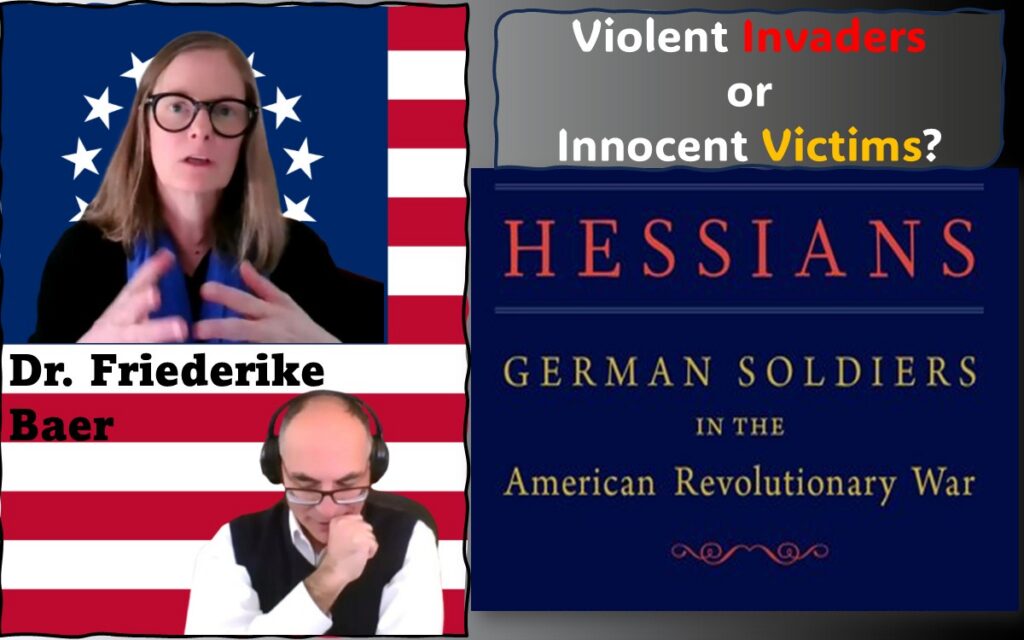
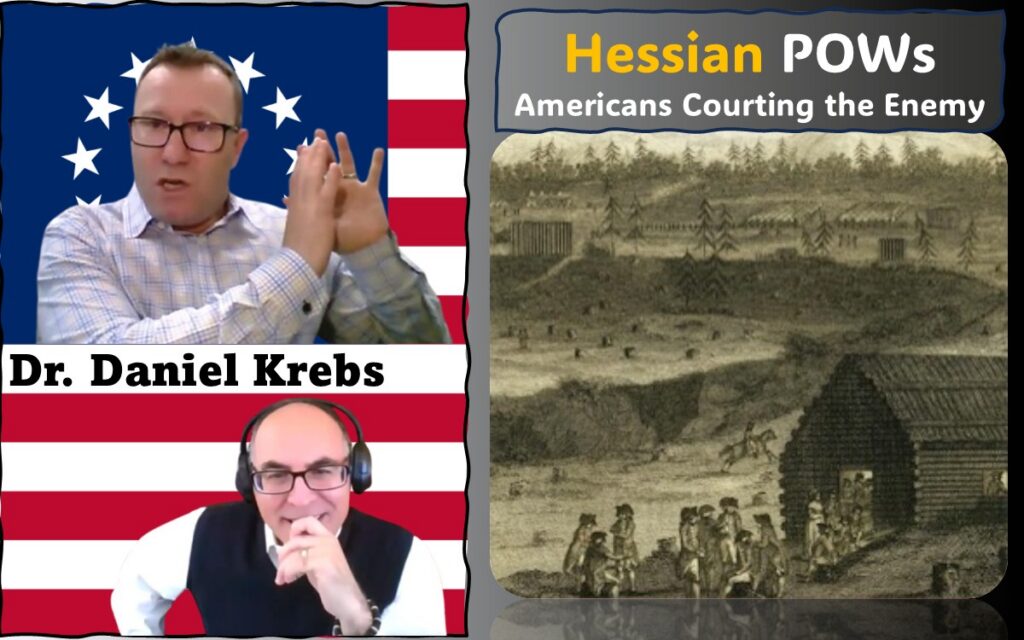
But for reasons that Friederike Baer explains in an upcoming interview in our program, the British use of Hessian troops for purposes of crushing the American rebels was so controversial in the German states that they never again rented out their soldiers! Dr. Baer is the author of Hessians: German Soldiers in the American Revolutionary War, a fabulous book that we discuss in detail. I will post a link to that interview when it publishes in 2026.

In the American Revolution, Hessian troops comprised about 25% of all British forces (not counting the British Navy), and 65% of them came from two German states: Hesse-Kassel and Hesse-Hanau, both Holy Roman Empire states that are now in the state of Hessen in modern Germany.
The image to the left is of two Hessian grenadiers. It is by Charles MacKubin Lefferts (1873-1923), who was an American soldier (New York National Guard and then the federal army) and artist. He is known for his meticulous study and detailed illustrations of uniforms during the American Revolution. After his death, the New York Historical Society, of which he had become a member in 1909, published his works in a book titled Uniforms of the Armies in the War of the American Revolution, 1775–1783.
This image is in the Public Domain.
The other image is, based on our research, a 1799 portrait of Hessian Hussars during the American Revolution. The origin of the term hussar goes back to 15th-century Hungarian light cavalry with their flamboyant uniforms, who were highly skilled in scouting and raiding. In later centuries, many European states adopted the term and its function for their own militaries. For example, Hessian Hussars were also light cavalry units skillful in scouting and raiding.
We were not able to determine the artist who created this work. The image is in the Public Domain.
George Washington
As of this writing, I have not invited any scholars to our program for the subject of George Washington – his life and contributions to the American Revolution. This is partly because we already know so much about him.
However, as I interview more scholars (30 so far) and dig deeper into different fascinating angles of the Revolutionary Era, as evidenced by the variety of topics in this post, I am beginning to realize that even Washington’s life and contributions can and should be examined from fresh perspectives that most of us may not have appreciated before. So if we do schedule a scholar interview on Washington, I will update this post with a link to that conversation.

For the purposes of this post, I think you will be interested in a brief discussion of Washington’s image by Rembrandt Peale (1778-1860).
This “porthole portrait” seems to have been created by Peale in 1824, which is 24 years after Washington’s death (Dec. 14, 1799). But Peale first painted Washington in 1795 – when Washington was the President of the United States and Peale was only 17 years old. So how did a mere teenager manage to gain access to such an important person as Pres. Washington?
The answer: his father arranged the 1795 sitting and even worked alongside Rembrandt to keep him calm.
Rembrandt hails from an illustrious line of American painters. His father, Charles Willson Peale, painted Washington more than once – one example is the famous painting Washington at Princeton (1779). The senior Peale also painted William Clark (1810), Meriwether Lewis (1807), Robert Morris (1763, known as the financier of the American Revolution), Henry Knox (1784), Nathanael Greene (1783), Joseph Brant (1797) and Baron von Steuben (1780).
Rembrandt’s uncle, James Peale – his father’s younger brother, was also an American painter and he also painted George Washington (1782).
Rembrandt’s siblings—Raphaelle, Rubens, and Titian Peale—were also artists.
Rembrandt painted many portraits of Washington. He also painted Martha Washington (1796), Thomas Jefferson (1800), William Henry Harrison (1814, decades before he became president), and John C. Calhoun (1834).
This image of George Washington is in the Public Domain.
Continental Army
Why do we celebrate the U.S. Army Birthdays on June 14?
Because on June 14, 1775, the Second Continental Congress (May 1775 to Mar. 1781) in Philadelphia passed a resolution to form the Continental Army. It appointed George Washington as its commander-in-chief, a position he maintained until the War’s end.
The Continental Army was formed less than two months after the Battles of Lexington and Concord (April 19) and just three days before the Battle of Bunker Hill (June 17). Notably, Gen. Washington was not present at the Battle of Bunker Hill. The primary commander then was Col. William Prescott.

Throughout the Revolutionary War, 231,000 Americans and foreigners served in the Continental Army. At its peak, the Continental Army was 48,000 strong. In comparison, at their peak the British forces in North America (not just the American colonies) totaled about 50,000. This number included British Regulars, the Loyalists and the Hessians.
Militias and volunteer troops supplemented the Continental Army, which Gen. Washington disbanded in 1783 after the Treaty of Paris with the help of Baron von Steuben (see above). Only two detachments of the Continental Army remained. One to guard West Point and the other to guard Fort Pitt (now in Pittsburgh, Pennsylvania).
This image is by Charles Lefferts, whom we discussed above for his portrait of Hessian grenadiers.
This image is in the Public Domain.
About This Program
Analyzing American Revolution (AAR) is a special series podcast production of the History Behind News program. In this series, 33 professors (and counting) analyze the American Revolution from 33 different angles through in-depth interviews with host Adel Aali.
Themes of the Revolution
Tap below for a closer look at the Revolutionary Era themes we examine—and to meet our guest scholars.

Visit our Revolutionary Era Blog page for
- Interview Transcript Highlights
- Interview Image and Artist Highlights
- Quiz Answers and Backstories

Visual Index of the American Revolution
Explore the backstories and artist bios behind images of our Founding—before and after the American Revolution. These visuals shape how we remember—and reimagine—the Revolutionary Era.

Experienced Analysis of History
About HbN Program:
The History Behind News program (HbN) is committed to making in-depth history researched and written by scholars enjoyable and accessible to everyone. Our motto is bridging scholarly works to everyday news.
The histories we’ve uncovered encompass an impressively wide range of subjects from ancient history to U.S. politics and economy to race, women’s rights, immigration, climate, science, military, war, China, Europe, Middle East, Russia & Ukraine, Africa and the Americas to many other issues in the news. We also receive advanced copies of scholarly books and discuss them in our program (in the context of current news).

233 Scholars & Counting:
Our guests are scholars in prestigious institutions, such as Oxford, Yale, Caltech, Harvard, MIT, Stanford, the Hoover Institution, the American Enterprise Institute, Quincy Institute for Responsible Statecraft, King’s College London, Princeton University, Notre Dame, Dartmouth College, Columbia University, the Atlantic Council, Duke, Amherst College, University of Michigan, Rhodes College, Emory University, Northwestern Law, Vanderbilt University, US Naval War College, Air Command and Staff College, Marine Corp University, US Army War College, UVA, Johns Hopkins, Cornell, NYU, Rice, University of Chicago, White House Historical Association, Baylor University, USC, UC Berkeley, UCSF, UCI, UCSD, UC Davis, UCR, Tel Aviv University, Hebrew University of Jerusalem, the Israel Democracy Institute, University of Aberdeen, Universidad Complutense de Madrid, University of Navarra, University of Seville, Helsinki University, Diego Portales University (Chile), Lund University (Sweden), University of Edinburgh, Near East University (Türkiye), Cardiff University, the Free University of Berlin and many others.
They include Pulitzer Prize winners, renowned documentary producers, former White House advisors and other high-ranking government officials, and current and former senior reporters at The Wall Street Journal and New York Times Magazine. Many have testified in Congressional hearings and others frequently contribute to major media outlets and widely read publications, ranging from the BBC, NPR, PBS and MSNBC to The Wall Street Journal and The New York Times.
Think You Know the American Revolution?