Updated: August 9, 2026
Introduction
In this interview: “Americans, of course, think of the Revolution and they think of the Declaration of Independence. But let me make it clear. During the Revolutionary War, people thought of Common Sense as the document of independence.”
Watch this section in the video below (00:44:46)
Thomas Paine arrived in America in late 1774 a relative unknown and in poor health, yet within months his words would resound across the colonies. In this episode of Analyzing American Revolution, Professor Harvey J. Kaye traces Paine’s remarkable transformation from an English artisan’s son into an influential political writer whose pamphlet Common Sense shaped the emerging revolutionary movement. Paine’s unique blend of personal experience, radical ideas, and dramatic articulation of democratic possibility helped turn a colonial rebellion into a revolution that defined a new nation.

How to Use This Post
Use this post as reference guide to the American Revolution through the lens of this interview and the broader Analyzing American Revolution program (AARevolution). Navigate using the interactive table of contents above and the timestamps below (in gray) to discover how this interview deepens the story of the Revolution—and to explore how the program unfolds: its key themes, insights, image gallery, scholars list, history quizzes, and related interviews across the series.
Here’s how I’ve structured this post:
- Part I (this post): “Thomas Paine’s Life Journey to Becoming the Voice of the Revolution”
- Part II: “How “Common Sense” Transformed the American Colonies”
Video
Watch the full interview (timestamps below)
From Corset Maker to Revolutionary Voice: Paine’s Journey
Paine’s life before arriving in the American colonies was far from linear. Born into a working‑class family in England with a Quaker father and Anglican mother, he left school at thirteen and was apprenticed to his father — only to abandon that life for the unpredictable world of privateering and self‑education. Despite setbacks that included business failure, personal loss, and dismissal from official posts, Paine’s thirst for understanding and expression endured. His autodidactic pursuit of knowledge in London’s artisan communities and his lived experiences of religious tension, class inequality, and political exclusion informed his radical worldview. When he finally reached Philadelphia, already abuzz with resistance to British authority, Paine found fertile ground for his ideas — and soon, Common Sense became the pamphlet that crystallized a widespread yearning for independence and democratic self‑government.
Central Question
This conversation raises a central question:
Did Thomas Paine actually create a revolutionary ideology that transformed colonial resistance into a democratic revolution, or did he simply articulate—at the decisive moment—what Americans were already doing but had not yet fully recognized?
About My 203rd Guest Scholar: Dr. Harvey Kaye
Dr. Harvey Kaye is Professor Emeritus of Democracy and Justice Studies at the University of Wisconsin—Green Bay. His area of interest and expertise is American Democracy: History, Memory, Politics, Radicals, and Ideas.
Prof. Kaye is a nationally recognized historian and an award-winning author of many books, including the following:
- The Powers of the Past: Reflections on the Crisis and the Promise of History,
- Why Do Ruling Classes Fear History?,
- Are We Good Citizens? Affairs Political, Literary, and Academic,
- The Fight for the Four Freedoms: What Made FDR and the Greatest Generation Truly Great,
- Thomas Paine: Firebrand of the Revolution, and
- Thomas Paine and the Promise of America.
 Prof. Kaye’s book is central to our two-part conversation.
About Featured Image
The featured image brings together images of Prof. Harvey Kaye and Adel Aali from the interview, superimposed on the Betsy Ross flag, alongside the cover image of his book Thomas Paine and the Promise of America.
Unless otherwise indicated, all images in AAR—including those in this post—are in the public domain.
AAR Essential Insights
Although the full video and transcript of my conversation with Dr. Kaye are included in this post, I’ve selected and summarized several insights that I found particularly revealing and worth emphasizing. These moments — some surprising, others that challenge familiar assumptions — help us see Thomas Paine and the American Revolution in a different light.
How Thomas Paine Became Thomas Paine: The Origins of Common Sense
When Thomas Paine arrived in Philadelphia in late 1774, he was not yet the revolutionary voice history remembers. He was a struggling English immigrant in poor health, carrying little more than experience, conviction, and a restless intellect. Yet within just over a year, his words would ignite the colonies. In this episode of Analyzing American Revolution, Professor Harvey J. Kaye explores how Paine’s early life, personal struggles, and radical imagination helped transform a colonial rebellion into a democratic revolution through his landmark pamphlet Common Sense.
From Artisan Origins to Revolutionary Pen
Thomas Paine’s story begins far from the centers of power. Born in 1737 in Thetford, England, to a Quaker father and Anglican mother, Paine grew up in modest circumstances and left school at thirteen. Apprenticed to his father’s trade, he soon abandoned that path, drawn instead to adventure, ideas, and self-education. He briefly went to sea, later worked as a tax officer, and endured repeated setbacks — including business failure, dismissal from government service, and personal tragedy.
Yet Paine never stopped learning. Living among London’s artisan communities, he absorbed the language of dissent, religious tolerance, and political reform. He became a self-taught thinker shaped not by elite institutions but by self-education and lived experience — inequality, exclusion, and the limitations imposed by monarchy and class. These experiences forged the intellectual and moral foundations that would later define his revolutionary voice.
Arrival in America and the Power of Timing
Paine arrived in Philadelphia in November 1774. It was a moment of rising tension between the American colonies and Britain. Colonial resistance was growing, but the idea of full independence had not yet taken hold among the broader population or even America’s revolutionary elite. Paine quickly immersed himself in the political and intellectual life of the colonies, writing for the Pennsylvania Magazine and sharpening his arguments about liberty, equality, and the rights of ordinary people.
What distinguished Paine was not simply his ideas, but his ability to communicate them in clear, direct, and emotionally compelling language. He wrote not for elites, but for common people — artisans, farmers, laborers, and citizens who would ultimately determine the fate of the revolutionary movement.
The Birth of Common Sense
In January 1776, Paine published Common Sense, a pamphlet that fundamentally changed the political conversation in America. Rather than cautiously debating reform within the British Empire, Paine made a bold and uncompromising case for complete independence. He attacked monarchy as irrational and unjust, argued that America had a historic opportunity to create a new democratic order, and presented independence not as a radical gamble but as simple common sense.
The effect was immediate and profound. Common Sense spread rapidly across the colonies, reaching audiences far beyond traditional political circles. It gave voice to sentiments many colonists already felt but had not yet fully articulated. More importantly, it reframed the struggle — from resistance against British policies to a revolutionary movement for self-government and democratic possibility.
 Other books by Prof. Kaye
From Rebellion to Revolution
Prof. Kaye emphasizes that Paine did more than argue for independence — he helped redefine the meaning of the American cause. His writings transformed the political imagination of the colonies. Independence was no longer merely a defensive necessity; it became a moral and democratic project rooted in the rights and power of ordinary people.
Paine’s influence extended beyond 1776. His words continued to inspire soldiers, citizens, and future generations, reinforcing the idea that democracy was not a gift from elites but a creation of the people themselves. In this way, Paine helped turn a colonial rebellion into a revolutionary movement with global implications.
Paine’s Enduring Legacy
Thomas Paine remains one of the most important democratic voices of the Revolutionary Era. He demonstrated that ideas — clearly expressed and widely shared — can change the course of history. His life also illustrates that revolutionary leadership does not always emerge from privilege or power, but often from struggle, self-education, and conviction.
As Prof. Kaye argues, understanding Paine is essential to understanding the deeper democratic promise of the American Revolution — a promise that continues to shape political debates and aspirations today.
Interview Transcript (S1E5): Adel Aali and Harvey Kaye
As you will see in the transcript (and in the video above), this conversation with Dr. Kaye explores the life, ideas, and revolutionary transformation of Thomas Paine in the years leading to American independence. Paine did not arrive in America as a famous revolutionary figure, but through experience, struggle, and conviction he developed a powerful democratic voice that helped reshape colonial resistance into a movement for independence — most notably through his influential pamphlet Common Sense. The detailed outline and transcript below supplement the video above.
Podcast
Watch the full interview on this page with the outline and transcript below, or take the conversation with you on the go through our Spotify podcast.

Outlline
Use the in-depth outline below to follow the discussion and navigate key moments in the interview.
Click for Timestamped Outline
- Selected Highlights (00:00)
- Guest Introduction (02:00)
- Why Thomas Paine Matters (03:17)
- Paine’s Radical Voice in 1776 (04:52)
- Writing for Ordinary People (06:10)
- Common Sense – Key Moment: Its Impact on Colonial Opinion (08:03)
- From Resistance to Revolution (09:28)
- Popularizing Independence (10:41)
- Paine’s Background (13:12)
- Arrival in America (14:30)
- Connections with Benjamin Franklin (15:22)
- Common Sense Language
- Democracy and Equality (18:07)
- Attacking Monarchy and Hereditary Rule (19:33)
- Expanding Political Imagination (21:05)
- Rebellion to Revolution
- From Loyalty to Empire to Independence – Turning Point (24:11)
- Shifting Public Sentiment (25:44)
- The Role of Print Culture (27:02)
- Paine and the American People (30:18)
- Speaking to Artisans and Laborers (31:40)
- Mobilizing a Broad Audience (33:12)
- From Loyalty to Empire to Independence – Turning Point (24:11)
- The Crisis of War
- The American Crisis Papers (36:29)
- “These are the times that try men’s souls” (37:58)
- Boosting Morale During the War (39:20)
- The American Crisis Papers (36:29)
- Commitment to Revolution – Key Moment (42:05)
- George Washington and the Army (43:33)
- Perseverance in Dark Times (45:10)
- Beyond Independence
- Paine’s Vision for America (48:22)
- Republicanism and Democratic Ideals (49:51)
- Equality and Social Reform (51:06)
- From Revolutionary Writer to Political Thinker – Turning Point (54:18)
- Broader Atlantic Influence (55:42)
- Connections to the French Revolution (57:03)
- Paine’s Vision for America (48:22)
- Paine’s Later Years and Controversies (1:00:21)
- Religion and The Age of Reason (1:01:50)
- Reputation in America and Abroad (1:03:18)
- Legacy of Thomas Paine (1:06:37)
- Memory and Marginalization (1:08:02)
- Influence on Democratic Thought (1:09:40)
- How Paine Has Been Remembered (1:11:12)
- From Hero to Outsider – Turning Point (1:12:30)
- Just One Point (1:13:21)
Transcript
Note: This transcript was generated automatically and may contain minor errors. It is provided for reference and accessibility only.
Click to View Transcript
Adel:
Dr. Kaye, it’s a pleasure to have you on our program’s special series. Thank you for taking the time for this conversation with me about the American Revolution. So, we’re here to talk about a person who played an important role in the American Revolution, and that’s Thomas Paine.
So, who was he?
Prof. Kaye:
Well, for a start, I’ll just lay out a sort of frame or image. He was the greatest radical of a radical age.
Adel:
Greatest radical of a radical age? Yes.
Prof. Kaye:
And probably one of the most incredible of writers, political writers, in the modern age.
Adel:
When you say incredible, you mean his penmanship quality of writing, his prose?
Prof. Kaye:
Well, his writing was the way in which he wrote, but also the fact, and this is partly why he was such an effective writer, is that he came from what we would call a working class background. He was not educated beyond the age of 13 in schools. His father was an artisan, in fact, a corset maker in England, which was very, very difficult, not just in terms of the skill required, but it also, by the time of Paine’s life in the 18th century, was a very difficult way of making a living.
Okay? Anyhow, so the fact is that here’s a man who doesn’t even come to America until his late 30s, late 30s. And America by that time is already in a state of rebellion.
Adel:
Yeah, yeah, yeah.
Prof. Kaye:
He leaves England because basically what happened, it would take us the whole hour, perhaps, to just discuss why.
Adel::
I appreciate that, yeah.
Prof. Kaye:
Well, the fact is that he had a very trying set of careers. He apprenticed to his father, but his parents couldn’t afford to keep him in school any longer. An aunt had basically paid for the fees.
They pulled him out of school and they made him an apprentice to his father to learn corset making. His father, and this is critical, was a Quaker. And in England in the 18th century, unless you were an Anglican, whatever faith you practiced, was tolerated.
In modern terms, you were not a full citizen if you were Catholic or a Quaker or any of the Protestant groupings or Jewish. There was a Toleration Act that had been passed, which said, yeah, these people could live here, but the fact is that they would not have the right to vote. They would not have the ability to go to one of the two major universities.
I mean, none of that was available. But it’s also crucial that his father was a Quaker because the Quakers had developed in the course of England’s 17th century, a very revolutionary period in English history. It was the revolution often called by many the Puritan Revolution, but actually it really was more of a social revolution.
Adel:
Are you referring to the beheading of Charles I?
Prof. Kaye:
Exactly. As I often told my students, the English taught the French how to take off the head of a king.
Adel:
Which the French adopted 140 years later.
Prof. Kaye:
Exactly. So the thing is that, but Paine’s father married an Anglican, which meant that, and the Quakers basically expelled him from their community, but he never ceased to think of himself as a Quaker. And he passed on Quaker ideas and ideals to Thomas Paine.
Meanwhile, Paine’s mother, the Anglican, she was a serious Anglican. She insisted that Paine learn the Bible and the Anglican catechism. Anglicanism in America is Episcopalianism.
That was the original term for it. But after the revolution, it ceased to be called Anglicanism and became the Episcopal church.
Adel:
Oh, I thought it was Presbyterian, but I’m wrong.
Prof. Kaye:
No, the Presbyterians essentially were Scottish originally and definitely not Anglicans.
Adel:
Yeah, yeah, yeah. My mistake. Okay.
Prof. Kaye:
Okay. So Paine really was, I mean, he actually practically memorized the Bible because of his mother’s insistence.
Adel:
Wow.
Prof. Kaye:
One thing he became aware of is, first of all, the ideas and ideals of the Quakers. But at the same time, he was very well aware of the tension that prevailed, not only in his home regarding the question of religion, but also in England generally. I mean, Anglicans scorned the Quakers.
So he was very much aware of that. And the other thing is that even as a boy, he recounts that in reading the Bible, he kept saying, how could God be so cruel? So eventually Paine himself, for the record, will become what’s known as a deist, which says it’s a belief in God.
But as Paine would argue, if God’s creation was perfect, then he wouldn’t need to interfere in it, that kind of thing. But then Paine also hypothesized, maybe he read works that influenced him, hypothesized, and that meant God was out further creating the universe. Further.
Adel:
So this is a continued process by God.
Prof. Kaye:
Yeah. At least as Paine understood it. But Paine wasn’t a theologian.
But anyway, so he grew up in this working class home, an artisan home, not laborers home, but an artisan, a skilled worker. But at 13, he becomes an apprentice to his father. He was not keen on corset-making, Paine, but he endured it for several years.
But there came a time where he said, I got to get out of it. I’m paraphrasing, obviously, I don’t know what you said to himself, is that he decided he had to get out. So he ran away, basically, from his apprenticeship and enlisted or joined the company of privateers.
Privateering, as I, again, often told my students, is like licensed piracy. So wars between England and France and other countries. And basically, a privateer was a ship commissioned by the crown to go out and prey upon enemy shipping.
Adel:
This is kind of like Sir Francis Drake at the time of Elizabeth I.
Prof. Kaye:
Yeah, the privateers, right. So Paine spends a year aboard a privateer, which was an important lesson for him in many ways. Not only taught him about seamanship, it also had taught, originally, we don’t know what motivated it other than to get away.
Was it patriotism that led him to do it? Was it adventure that led him to do it? Was it possibly the profit that was possible if you survived and didn’t get killed in the course of sailing?
It also taught him about comradeship. Plus, and this is not unimportant, but I think it’s crucial, these ships were often multinational in character. I mean, English, Welsh, Scottish, Irish, as well as quite possibly, in many cases, multiracial.
So he learned, if you like, about the solidarity in diversity. And after a year on board the ship, he also learned how to fight. That’s pretty critical.
Learned how to wield a sword when necessary, or in any case, to fight. The main task he had on the ship was, since he had been trained as a corset maker, he was then on the ship, often called upon to repair the sails.
Adel:
Yeah, yeah.
Prof. Kaye:
Okay. But after a year, he’d had enough between, as I used to say, between the devil and the deep blue sea. And he decided he took the money that he made, because the way that worked is if a privateer was successful in its raiding and preying upon these enemy ships, then the deal was that they would take the ships, if possible, in tow and move as quickly as they could towards an English port.
And in essence, the contents would then become the means by which you would reward the crew. So he could put money in his pocket from that. And he basically had enough money, he decided, because Paine liked poetry, he liked science, he liked school.
But pulled out at the age of 13, he yearned for more. So he took what he had and what he had gained, and he went to London. And he basically, I mean, crudely put, or put in a silly way, he financed a year in London, living in the artisan communities of London.
And the reason that was great is, for a start, there were only two universities in England, Oxford and Cambridge. All they taught at the time, you could only get degrees in classics and theology at that time, at the universities. To get into the universities, you had to be an Anglican.
Of course, you had to be a male, you had to be an Anglican. And you had basically, you had to come from a fairly prominent family. They didn’t have, to my knowledge, they didn’t have what you would call student loans and scholarships.
But the artisan class was very keen on learning and education. So they basically became a sort of class of autodidacts. They would host outstanding figures from science and astronomy, and even within their own fields of cabinet making, carpentry, and they would stage lectures in cafes and pubs.
So Paine basically learned about science all the more by attending these lectures.
Adel:
Oh, that’s kind of like becoming educated without a formal degree.
Prof. Kaye:
Right. Autodidactic.
Adel:
Yeah. Wow. Okay.
Prof. Kaye:
After a year, however, he was out of money and he decided he would have to resort to becoming a corset maker. So he moved a little, he moved to some distance outside of London. Today, it wouldn’t be so terribly far, but in those days it was a distance out.
And he set himself up as a corset maker. In the town that he moved to, he also fell in love, which people say the woman whom he married was probably a household maid of somebody he had befriended. They married.
The tragedy is that his business wasn’t doing very well and she died in childbirth, as did the baby. Okay. So I mean, it’s probably devastated.
Men in the time rarely talked about their emotions. So we don’t know the impact, but we can imagine. Her father was or had been an excise officer, which is a customs officer.
And they had talked about the fact that if the business really didn’t, you know, didn’t survive, that Payne should study for the excise commission, meaning to gain a position, an officership in the excise commission. He moved home to his parents’ place and threw himself into studying and he passed- I mean, he moved to his in-laws? No, he moved actually to his own parents.
Adel:
Oh, his own parents.
Prof. Kaye:
Okay. His own parents’ place, which was, by the way, up in Norfolk in England, if anyone knows the map of Norfolk, it’s Thetford, not that far from Cambridge, to the northeast of London.
Adel:
Yeah.
Prof. Kaye:
So what happens? He passes, he gets the commission and he’s sent off to the British, the northeast coast of England. The job of an excise officer, especially at first, is you ride the coast.
So you have a horse, all of which you have to buy yourself and afford yourself, and you patrol the coast. Why do you patrol the coast? Because not just simply smuggling might be taking place, but also some of these villages along the way, their livelihoods often depended on ships wrecking.
Yeah, yeah. I think if I’m not mistaken, in the TV series Poldark, which was on public TV for some time- I watched that, yeah, PBS. I do think there are episodes of that exactly happening.
It was illegal, that kind of collecting from the wrecks. Anyhow, so the job was not only arduous and not very well paid, it was also dangerous, because you can imagine a village being very unhappy if the excise officer shows up just when they’ve got a great cargo they’re trying to haul in from the sea.
Adel:
And he’s showing up by himself. It’s not like he’s God.
Prof. Kaye:
Right, it’s just him. Just him on the horse. Oh, wow.
Adel:
Okay.
Prof. Kaye:
So anyhow, to make matters worse, he’s accused of something called stamping. That is, of failing to inspect the cargos of ships that would arrive in his territory. Though there was one biographer who makes a very good case that he was set up, that he was framed, that his superior had set him up to be the fall guy if it was ever exposed, that things weren’t properly inspected.
And I’ll tell you why it’s a good reason to believe that. He’s sacked, as the English would say. He’s let go from the excise commission, and he moves back to London.
But he immediately begins to petition the excise commission to reinstate him. Now, it takes a few years. And in the meantime, he’s got him- A few years?
Oh, yeah. Because things didn’t move quickly. So he’s living in London, and he’s trying to make a living by scraping things together, but by tutoring the children of middle class people, who may not have been able themselves to afford sending their kids to school.
Schools were not public in those days. The public school in England was, of course, extremely high. It was a private school, the term public school.
Adel:
And if I may just interrupt you, Professor Kay, even though he had not gone to Harvard or Oxford, or he didn’t have- We would call it high school. High school. There you go.
He was still qualified to become a tutor.
Prof. Kaye:
Well, they didn’t have qualifications. He was literate. In other words, he was literate.
He was well-read, very well-read. And he had all the makings of a tutor. This was not a high-priced tutorship that he would pick up.
He was scraping by on this stuff. But apparently the other thing he did is that he would go to Methodist meetings on Sunday, especially outdoor meetings that were being held. Methodists were essentially Anglicans who were sort of dissenting from the mainstream of Anglicanism and eventually became a separate church.
And at those events, he would occasionally preach. I don’t know what he preached, but he preached. And why would he do that?
Well, if you’re preaching, you get a free meal. Plus he would meet people. It gave him a community, so to speak.
Eventually, and luckily, because he really was scraping by, he did get reinstated. The fact that the excise commission reinstated him implies that there was evidence that he had been framed to begin with. And they now then sent him to the south coast of England.
Adel:
So not to the northeast anymore.
Prof. Kaye:
No, no. They sent him to the south coast to a really nice little town called Lewis, L-E-W-E-S. And in Lewis, he resides with a man named Samuel Olive, I think was the name.
And he himself was a tobacconist who had a shop. And Samuel Olive really took a liking to pain and brought him along to something called the Headstrong Club.
Adel:
Headstrong Club?
Prof. Kaye:
Headstrong, you know, headstrong.
Adel:
Yeah, yeah.
Prof. Kaye:
And this was a gathering that met a couple of times a week, at least once a week, a couple The White Hart Tavern is still in Lewis, and they have a plaque outside the White Hart Tavern, commemorating the fact that Thomas Paine met with the Headstrong Club there at the White Hart Tavern. Though the plaque, I think, exaggerates something. They say that’s where he learned his radical ideas.
I don’t know if he learned radical ideas there, but he definitely learned how to speak more effectively, perhaps. He also learned how to, he was able to use his skill with a pen, which previously was, you know, hardly what his, it wasn’t his talent, and he probably rarely did so. But in the Headstrong Club, they would meet and they would talk about politics.
And they would, and basically, some would write poetry, and he wrote poetry on occasion for the club. And it’s very interesting. So each week, they would then vote on who had offered the best words of the week.
And that person got to take home for the, until the next week, the Headstrong book, which was like a record book, a diary kept by the group. And he became very well-liked. He also became well-known, this is totally irrelevant to our subject, but I’ll point it out.
He became known as the Commodore, not simply the Commodore, not because so much he had been a privateer, but that he was so good as an ice skater. Yes.
Adel:
Okay.
Prof. Kaye:
He became so well-liked, and his ability with words became fairly well-known. And the excise officers of that part of England became aware of all this, and they met. They didn’t meet simply to meet Thomas Hayden.
They met because their wages and their expenses were high and their wages were low. And they gathered to figure out what could we do to improve our situation? It was like an early version of a labor gathering is the best way to put it.
And what they did is they decided they were going to petition the excise commission and lobby parliament to raise the wages of their occupation, which by the way, was illegal. It was illegal to petition and lobby parliament on behalf of working people.
Adel:
Wow.
Prof. Kaye:
Okay.
Adel:
Which is really interesting that actually that language, the right to petition is in our first amendment. I mean, we digress, but that is fascinating. Okay.
Prof. Kaye:
And since Hayden is so good with words, they get him to write the petition, which is called the case of the excise officers or case of the officers of excise. And he is then commissioned himself to go to London, which by the way, probably appealed to him because he loved living in London when he did, except for when he ran out of money. And he went to deliver the petition and lobby prominent people and members of parliament if he could reach them.
Now, keep in mind, doing so was illegal. And in any case, he was abandoning his post.
Adel:
Yeah. Income. What happens to that?
Prof. Kaye:
Well, the income presumably he was receiving, it was being sent to Lewis where he was living. So, and he spends quite a while there, maybe months at a time, months he was up there, but a really important thing happens while he’s in London, even though he’s going to eventually lose the job again. Okay.
And that is apparently the first time he lived in London, he met Benjamin Franklin. Franklin spent more time in London than he ever did probably in PhilAdel:phia. Okay.
And he was very much a member of this artisan class, right? And the taverns and the pubs, these were places where artisans met to talk about politics and ideas. And keep in mind, working class people in England could not vote.
They could talk, but they could not vote. The way in which artisan class and laboring class expressed their political views was in street actions, crowd actions, protests, sometimes violent protests. Anyhow, so Paine is back in London.
He’s probably witness to what were known as the Wilkes and Liberty crowds. It would take me too far afield from our discussion, but Wilkes was a political figure who the crown viewed as a scoundrel and maybe he even was, but the point is he became sort of a hero of the artisan class. More importantly, he meets Franklin.
Adel:
A second time. This is the second time he meets him.
Prof. Kaye:
The second time. He meets him once again and they become friendly. Now, here’s the thing.
He is sacked again and he goes back to Lewis to collect his things. Basically, he’s going to move up to London. I should also point out he did marry Samuel Olive’s daughter, but a marriage was annulled.
Okay. The marriage was annulled. They separated.
Adel:
Up to this point, he’s had such a tumultuous life.
Prof. Kaye:
Right. Exactly. Exactly.
That’ll come into play as I’ll pose it in a little while. He goes back to London and he seeks the advice of Benjamin Franklin. What do you think I should do?
Adel:
As far as for my career?
Prof. Kaye:
For my life. I mean, he’s now, keep in mind, this is probably 1774. He was born in 1737.
What is he like? He’s 37 years old, which by the way, longevity was not part of the 18th century life for working people. He asked Franklin, what do I do?
He may not have known, but Franklin was already recruiting key people to go to America. Because as I’ll point out in a little while, America is already in a state of rebellion.
Adel:
1774, this is a year before Bunker Hill, two years before the Declaration of Independence.
Prof. Kaye:
Well, yes. Basically, a year before Lexington and Concord.
Adel:
That’s right. That’s right. Yeah, yeah, yeah.
Prof. Kaye:
I’m going to come back to all of that, obviously.
Adel:
Okay. Okay. Okay.
Prof. Kaye:
So then Franklin says to him, and I don’t know if Paine was aware of why he was doing it, but Franklin probably thought, this guy is something. He can maybe serve the cause in some way, but we don’t know for a fact. But he urges him to go to PhilAdel:phia and gives him a letter of recommendation and tells him to make sure to see Richard Bache.
That’s his son-in-law. His son-in-law. Franklin had a son of his own who, ironically enough, was the governor, the royal governor of New Jersey.
Adel:
Yeah.
Prof. Kaye:
And you can imagine the relationship between Franklin and his son was not going to be a very good one.
Adel:
Yeah, father and son.
Prof. Kaye:
By the way, later in time, they remained very close, Franklin and Paine, in America. And Franklin would call Paine his adopted political son. Wow.
Yeah. Okay. So Paine boards a ship, I think it was in September, October.
He arrives in PhilAdel:phia at the very end of November, but he is in terrible physical shape, or at least he’s arriving before the New Year and Christmas. But these ships were terribly unhealthy places. And he wasn’t as bad off as those who were like indentured servants, who were probably down in the hold, not unlike the slaves were being in the holds of the ships coming across the Atlantic in the slave trade.
But he develops typhus. He develops, he comes down with, he’s terribly ill. And when he arrives in PhilAdel:phia, he is carried off the ship on a, what do you call it?
On a- Kearney of some sort. On a stretcher.
Adel:
Yeah.
Prof. Kaye:
And they deliver him to a boarding house, and he has enough money so he can afford to stay there. And it takes a couple of weeks or more for him to recover. So now we’re in January of 1775.
This is important. I’ll get to Paine’s life as it continues in a moment. Most Americans don’t realize that after the Boston Tea Party of December 1773, the British imposed another set of acts upon the American colonies.
Well, it was imposed specifically on Massachusetts, but it might as well have been colonial wide. It was, they came to be known as the coercive acts or intolerable acts. And it really did antagonize not simply the Massachusetts and Bostonian folk, but the entire East, well, all the colonies were antagonized with this.
And it led basically to intercolonial cooperation. And essentially this is what most Americans don’t realize, the colonists North and South threw out British authorities, or at least denied them any authority. They would not defer to British authorities, the royal governors and so on.
And they created committees to run their own affairs in the towns and cities. So Paine arrives in the midst of all of this. And I can tell you, he gets out into PhilAdel:phia.
PhilAdel:phia at this time was one square mile with a population of about 30,000 people, but it was essentially the capital of the colonies. Essentially.
Adel:
30,000 people.
Prof. Kaye:
Yes. But you also had New York and Boston and down South, I guess it would have been Charleston’s and you had other cities, but this was the key city of the British empire, of the North American colonies. And he marvels at PhilAdel:phia.
First of all, it’s not just ethnically diverse. Okay. People from, you know, there were Englishmen, Scots, Welsh, Irish, Germans, French, people from Africa, some slaves, some not, from all over what would have been his known world, you might say, as well as Native Americans who were now perhaps living in the area, or even had some who had come in to live in PhilAdel:phia.
And he’s impressed by this. The second thing is, this impresses him terribly. I mean, I’d really get in a very positive way, I should say.
Since his parents had this religious problem, we’ll call it. In PhilAdel:phia, the religious diversity, he had never experienced it. So you had, number one, it was a Quaker colony, you may recall PhilAdel:phia, Pennsylvania.
Okay. Quaker, number one. Two, there were, of course, Anglicans and there were Presbyterians and there were Methodists and there were Moravians and Lutherans and Jews and Catholics.
And there were no aristocrats, by the way, to speak of, or to bow down to. There were aristocrats, of course, but they never had the role that aristocrats in Europe had. There was terrible class inequality in the Americas, in the American colonies.
But it wasn’t the divide between aristocrats and common people. It was the property versus the working class. That was the divide.
And then, of course, you also had slavery on a large scale in the South, but also in an evident way in the North. So Paine is marveling at the diversity. The one thing that shocked him, however, was the slave market in PhilAdel:phia.
He couldn’t believe that these colonists who were talking so much about liberty and their struggle against England at that point was to secure the rights that they felt they were entitled to, the rights of freeborn Englishmen. And he said, how can people who are talking liberty possibly tolerate slavery in their midst? So anyhow.
Adel:
He said that publicly or are you I’m coming to it.
Prof. Kaye:
So as he explores PhilAdel:phia, within the first few days, he has the good fortune. He loved books, as I said, and he would visit the printer shops, which were often also bookstores. And in one of them, the owner noticed that he was coming every day, but he hadn’t bought anything.
And he went over and approached him and said, can I help you? And they ended up in a conversation. And Paine showed this printer the letter of introduction from Franklin.
And he’d also by this time, I assume, gone to meet Richard Bache, who was a very prominent figure. The name Bache, of course, becomes very prominent in finance in PhilAdel:phia.
Adel:
Okay.
Prof. Kaye:
So this man, the printer says, guess what? I’m paraphrasing all of this. I’m starting up a new magazine.
The Pennsylvania Magazine. And he actually offers Paine the role of editor. So here’s a guy who’s had this terribly fragmented and really fracturous kind of career beforehand.
And he arrives in PhilAdel:phia and within a week, he’s now the editor of a new magazine.
Adel:
Wow. Talk about luck at this point in his life.
Prof. Kaye:
Yeah. He fell in love with America. So in those days, an editor of magazine, first of all, most of the pieces that would appear in any of these colonial magazines, they were written under pseudonyms.
You would write under a pseudonym.
Adel:
Yeah.
Prof. Kaye:
Not use your own name. And he had his own, but that’s beside the fact, right? What’s important is he immediately begins to write, not just edit, but to write articles for the magazine on everything that intrigues him.
And especially he celebrates what he feels America is about. He’s literally fallen in love with America. How could he not?
It’s literally in his life, at least, a new world for him.
Adel:
If I may just ask you a couple of things about this turn of event in his career. First of all, when you say editor and you say he’s writing, so is he receiving other people’s pieces and incorporating?
Prof. Kaye:
Absolutely.
Adel:
And in addition, he’s writing as well.
Prof. Kaye:
Yes. Oh yes, of course.
Adel:
Absolutely. Is this a weekly journal, a monthly journal?
Prof. Kaye:
I wish I could remember exactly. Right now, I can’t remember that.
Adel:
That’s okay. And when you say magazine, are you really saying pamphlet? Is that what you mean?
Prof. Kaye:
It might look like a pamphlet in its day, but it’s a magazine. So it’s a pamphlet, but it’s more than just a single article. It’s numerous articles.
And it becomes, under his editorship, the most popular magazine in the American colonies.
Adel:
Oh, wow. And it’s not a newspaper, you’re using the word magazine.
Prof. Kaye:
No, it’s not a newspaper. A newspaper would be a daily item probably.
Adel:
Exactly. Oh, wow. Most popular.
Prof. Kaye:
Later, by the way, some major figures have said that Paine is the man who published Phyllis Wheatley, the black slave out of Boston, that he was the one who published her. She became a phenomenal figure, having lived her life as a slave. And even Washington marveled at her work apparently.
But I don’t know if he was going to still be at the magazine when her stuff appears in it. So I’m not going to say he published Phyllis Wheatley. Okay.
Even though I’m blanking on the Harvard professor’s name and Gates, Henry Louis Gates in his work claims that it was Paine who published her, but I don’t know if that’s true. Okay. Here’s the story.
Along the way, he actually publishes a piece on African slavery in America. Essentially an abolitionist argument. He doesn’t sign his name to it though.
Okay. Nobody ever signed their names to these things at that time. But his call for abolition isn’t just to say, okay, you have to bring an end to slavery and then we have to send them back to Africa, which was the attitude of all too many folks.
No, what he said is, and we owe them something. We need to provide an opportunity. Basically, he wanted to provide them with land towards the West and also an education before they’re sent off.
This is a very humanistic kind of call for abolition that he published.
Adel:
And also radical at that time.
Prof. Kaye:
Decidedly radical, which will cost him later, but that’s beside the fact at the moment. The Second Continental Congress is now in PhilAdel:phia. And in the wake of Lexington and Concord, I believe in the wake of Lexington and Concord, radical things will begin to happen.
Lexington and Concord is April 19th, 1775. Now I have to go back to England and say something about what’s going on in England. Edmund Burke, known as the father of modern conservatism, he’s Anglo-Irish, he’s in parliament.
And it’s often said that Burke was a friend of the American Revolution. He was not a friend of the American Revolution. He was a friend of the American rebellion.
And what does that mean? He feared that the American rebellion might actually become a revolution. And he writes a speech, which he takes into parliament.
Here’s what he says. He says, the Americans do not realize it, but they have essentially staged a revolution by basically ignoring and refusing to defer to British authorities in America. And look, they’ve created these committees to govern themselves.
And they have yet to call their activities a revolution. And they definitely have yet, they have not called for independence. They want to be recognized as full freeborn Englishmen, those same rights.
In other words, everyone hears, oh, no taxation without representation. No, it was no legislation, period, without representation.
Adel:
So basically- Wait, that’s way more than just no taxation without representation.
Prof. Kaye:
Oh yeah, no. Well, taxation, of course, refers to legislation, but more than that, I mean, it was all the other acts that were imposed upon them. Now, this is key.
Burke says to parliament, this is incredibly dangerous. This is before Lexington and Concord, by the way. This is in March of 1775.
And what Burke says basically is, this is dangerous because if we try to impose our authority too forcefully, they will stage a revolution. But then hold on, the second thing is even more important in many ways. And if they stage a revolution, we have to worry about revolutions arising here in Europe.
The world order as we know it could literally be undone if these Americans realize what they’re doing and are pushed to turn the rebellion into a revolution. Now, I don’t know any American history texts that do it. And I’ve got the speech nearby.
I came across it in a collection of speeches around the time of the revolution, but I’m not even sure it was on the revolution or on the colonial period.
Adel:
Well, most of us know Edmund Burke because he wrote the book Reflections on the French Revolution. Yeah, this is fascinating.
Prof. Kaye:
Which we won’t have time. I’m already looking. We won’t have time within the context of this hour.
Adel:
Yeah, I appreciate that.
Prof. Kaye:
We can get to any other time you want.
Adel:
Okay.
Prof. Kaye:
So, Paine himself is critical of British imperialism. But he himself at this point has not called for any kind of revolution. No one has really.
Lexington and Concord. Lexington and Concord turns Paine into a radical. Now, what happens?
One of the members of the Continental Congress named Benjamin Rush, a young PhilAdel:phia doctor who was educated over in Scotland. He, maybe a year or two before 1775, had written an article calling for an end of slavery, which had basically angered a hell of a lot of people. And he was worried even about his medical practice and what it might cost him for having done that.
Adel:
Okay.
Prof. Kaye:
Now, I’m not telling you the majority of PhilAdel:phians or Pennsylvanians believed in slavery, but prominent figures who might have owned slaves who are not keen on talking about the end of slavery. Anyhow, Rush is a part of the radical group within the Continental Congress. You know, the group that included the likes of Adams and others.
And Rush wants to meet the author of the piece calling for the abolition of slavery. So he goes to the magazine. And in the course of inquiring, he meets Paine and is now aware of the fact that this is the man who was able to write that, who wrote that piece.
And in the course of whatever number of weeks ensue, we don’t know exactly how this ensues time-wise, but it’s in the course of weeks ensuing, they become friendly. And at one point, and this is an interesting question, did Rush think of this on his own, or did the group that he’s a part of in Congress say to him, well, why don’t you ask this Paine if he’d like to take on this job? Anyhow, Rush, and this, we know the conversation that occurs because Rush put it in his own diary.
And what the conversation is, they’re meeting over coffee or whatever. And he suggests that Paine write an article or a pamphlet, likely a pamphlet, calling for independence. However, Rush says this, this is the bizarre part of the conversation.
Rush says to Paine, but there are two words you shouldn’t use. One is separation. And the other word is republic.
I mean, he’s warning him not to use certain words. Now- Why is that? It’s curious.
It’s curious because how could you possibly talk about independence without using the word separation? I mean, I don’t fathom it either. To this day, I don’t fathom it.
However, you have to imagine what’s in Paine’s mind.
Adel:
You mean what’s in Rush’s mind or Paine’s mind?
Prof. Kaye:
When he hears this idea, he’s already probably inclined that would have led Rush to say to him, why don’t you write this? Why don’t you write this pamphlet?
Adel:
He was hot to trot. He was like, Paine would have done it. Yeah.
Prof. Kaye:
And Rush says to him, and this is Rush’s own words, says to him, I have too much at stake to do that. In other words, it’s treason if you do that. And I have too much at stake.
And you can imagine Paine saying to him, one more of these rich SOBs or something like that. Okay. So anyhow, but he likes the idea.
And by the end of the summer, he has left the magazine and taken on the task. And he’s collecting materials to properly inform himself as to where he wants to go. And he is in touch with prominent members of Congress and Benjamin Franklin, who himself has returned to the colonies, I’m pretty sure.
And in the autumn, Paine apparently is not a fast writer. He really wants to polish it. So in the autumn, he spends his time working up this pamphlet.
By the way, Rush suggested to Paine that he titled the pamphlet Common Sense. No, sorry, sorry. Not true.
Rush wanted him to title it Plain Truth.
Adel:
Plain Truth.
Prof. Kaye:
Plain Truth. I don’t know where Paine actually did get the title, but it comes out in January 1776 as Common Sense, which was, by the way, and this is incredible to imagine. Americans, of course, think of the revolution and they think of the Declaration of Independence.
But let me make it clear. During the Revolutionary War, people thought of Common Sense as the document of independence.
Adel:
Wait, say that again. So you’re saying that the Common Sense as a document?
Prof. Kaye:
No doubt, the statement of it, the call, the proclamation that Americans will be independent is the Declaration.
Adel:
Yeah, yeah. Okay.
Prof. Kaye:
But if you, based on what one encounters regarding Common Sense and its history, it was not unusual for soldiers in the field and other folks to toast Common Sense before the Declaration.
Adel:
Fascinating. Wow.
Prof. Kaye:
I’m not the only one to make this argument. There’s another, I’m forgetting his name, there’s another historian who’s written in innumerable volumes on the revolution, who in one of the more recent volumes says Common Sense was the document of the revolution that people most readily had in mind.
Adel:
Associated with, sort of viscerally, sort of held on to, yeah.
Prof. Kaye:
No, it was printed. He found a printer to do it and it came out January 9th or 10th, depending on how you look at the calendar, I guess. I think I regularly refer to it.
I can’t remember if it’s 9th or 10th in my head. The most important thing is, I think they published like a thousand copies, 2,000 copies of the pamphlet. It was a pamphlet of under 50 pages.
Adel:
Yeah.
Prof. Kaye:
And within the course of like a week or two, it’s sold out. Sold out. And to make it, it basically, it launches a whole series of new edition, not new editions, of new printings.
Now, Paine had made it clear he was not looking for royalties. That if any money was to be had, it should go to buy mittens for Washington’s troops. There’s already a, if you like, rebellion underway and the troops are in the field under Washington’s command.
But keep in mind, Washington, whenever he had dinner with his officers, even in the course of January of 1776, the first thing at the dinner with the officers was they would toast the King of England. They didn’t see themselves as revolutionaries. They were trying to secure the rights of Englishmen.
Adel:
So even as late as 1776, early 1776, Washington and his officers were toasting the King.
Prof. Kaye:
Yes. Okay. Wow.
Wait. So then it’s coming out. It’s all of a sudden newspapers all across the, up and down, not all across, up and down the colonies are reprinting pieces of common sense in their pages.
There was a film, and I’m not happy to recommend it because I’m not at all a fan of Bill Gibson. I find him abhorrent. But the film, which before I knew it was abhorrent, I did see was the, I just blanked on the title of it.
It was, it’s, he plays a planter in South Carolina. And one good thing about this film is when the mail arrives at the plantation, at the estate, his son, who’s played by Heath Ledger, he grabs the mail because he wants to see if a letter from his girlfriend is there. Whereas Mel Gibson, the planter reaches for the newspaper that’s included in the packet and he opens it up- You’re talking about the Patriot.
Thank you. The Patriot.
Adel:
Yeah.
Prof. Kaye:
Exactly. The camera zooms in on the newspaper and there on the page of the newspaper is excerpt from Common Sense.
Adel:
Wow.
Prof. Kaye:
I mean, at least that author and, or screenwriter got it, got it right.
Adel:
So- I have two questions to ask and just super brief. In Common Sense, I have read it, I don’t remember, are the words, do the words separation and republic show up in Common Sense?
Prof. Kaye:
No. No.
Adel:
So he takes, he takes Russia’s sort of- Oh, wait, wait.
Prof. Kaye:
He makes the argument for independence, but I don’t believe he ever uses, does he actually say independency? I can’t promise you he didn’t. He might well.
Adel:
Okay. Yeah.
Prof. Kaye:
I know this thing. I used to know this thing by heart. And now I wonder, did he actually do that?
And the second question- He calls for independence and he also calls for a democratic constitution, but let’s leave that aside for a moment.
Adel:
Okay.
Prof. Kaye:
My second question- It fell, oh wait, this is important to get the facts out. Please. When in that few months that ensued 120,000 copies.
Wow. And that entire population of the colonies, I believe, even with the slaves included, might be two and a half to 3 million. Moreover, if you did it in terms of contemporary publishing, it would be as if it was like the bestseller for length.
I mean, it really was a huge bestseller to put it in even better terms. Imagine that Oprah Winfrey had said, go out and buy this book. And it went like crazy, the sales.
In the course of the revolution, it’s estimated a half a million copies might’ve been printed and distributed.
Adel:
Wow. The other question, and just sort of a small question, did the second continental Congress commission Paine or did he just go- It was proposed to him by Rush, but the continental Congress did not.
Prof. Kaye:
No one in the continental Congress ever called for independence before the appearance of common sense. Now, let me tell you, in fact, I’ll give you- We can talk probably by the way to like 10 after 11 or so, okay? John Adams bought three copies of the pamphlet.
Three copies? Three copies. Keep in mind that Adams himself did not believe in democracy.
He believed in a republic. Well, the idea that there would be an elite that would basically run the republic. So wait, so he gets the pamphlet.
Yes, he gets it. He sends two copies to Abigail up in Quincy, wherever they are. And she receives them, okay?
And he doesn’t hear right away from her. She reads it. She gives the other copy to Mercy Otis Warren, who herself would later be well known for writing a history of the revolution.
Adams writes her a letter, letters crossed at that time. And he said, I’m waiting to hear what you think of the pamphlet. She imagines, no one’s heard of Thomas Paine.
She imagines that maybe it was John Adams who wrote it. Okay. Maybe.
And she writes, she’s inspired by the pamphlet. She writes to him and says, I am charmed by the sentiments, which by the way is a sexy thing to say in the 1770s. And then she said, it’s also leads her to write these famous lines.
And note, every women’s history of America, every history of the United States now includes this, that Abigail responds to events and writes, don’t forget the ladies.
Adel:
Yeah.
Prof. Kaye:
Because if you do, we will come down to PhilAdel:phia and make a revolution of our own. Wow. Wow.
John reads this and sends her another letter. And he says, not you too. We are hearing slaves are rebelling in the Carolinas.
Students are rebelling at their colleges. In other words, all apprentices are rebelling against their masters. It’s evidence of the degree to which the content of Congress is hearing the turmoil that this has unleashed, this pamphlet.
Moreover, towns North and South begin to write their own petitions and send it to the continental Congress, calling for action, separation, independence. And that drives these otherwise very hesitant continental congressmen to commission a committee to write a declaration of independence, which is mostly written by Jefferson. And I will tell you, I will tell you after the revolution, many years after the revolution, amongst the correspondence that Jefferson always received piles of letters was one that said to him, Mr. Jefferson, who was the great writer of the revolution?
Because the assumption is that Jefferson was a great writer. Everyone knew it. Even when he was saying things we wouldn’t want to be associated with, it was as part of work that was considered well-written.
The fact is that he said pain.
Adel:
Wow.
Prof. Kaye:
Yes. So anyhow, the revolution, the declaration of independence, the revolution begins. Pain enlists in a Pennsylvania militia.
I won’t go through the whole rest of his life story, but this is now the revolution is this. Pain has turned a colonial rebellion into a world historic revolution, not simply for independence, but if you look, if you read common sense as you have, he is arguing for the creation of making of a democratic Republic, which is why the elite of the continental Congress shook. They were shaken by the arguments that, I mean, believe me, they would not have declared for independence themselves if they had not been pushed by the folks inspired by common sense.
They were hesitant. Democracy was not on the agenda for these people. Maybe and decide, I mean, that was the revelation.
The declaration is a decidedly democratic document undeniably, but keep in mind, they’re pushed. Members of the continental Congress started telling each other, we better take charge of this struggle or it’s going to take charge of us.
Adel:
You can undo the class that the continental Congress. Professor Kay, I had this question lined up to ask you and you just, you answered it already. I was going to ask, did common sense touch off the revolution?
Prof. Kaye:
I think that- Keep in mind, what Pain did, this is the key thing to remember. He didn’t come up with the idea of revolution. He came to America and was so impressed by how Americans were governing themselves already that he could readily imagine that these people just for some reason are not taking the next step that history is calling to them.
I like to tell people, you have to imagine that common sense is like a mirror and in this mirror, what does he do with it? He holds it up and says to Americans, look in this mirror, consider what you are already doing. That’s what that pamphlet is really doing.
He actually says in common sense, perhaps our reservations for doing what we’re talking about is we don’t have a plan. That’s when he starts laying out the basis of an American, he calls it a charter, but it’s really in a constitution in which he calls for, this is crucial, his ability to rally people with every step of the way. He says, first of all, we need a charter, a constitution.
The next thing is we should have in this constitution, this charter, what you and I would come to call a bill of rights. He calls for freedoms to be specified. Says one of them should be the freedom to hold and own your property and two, he basically calls for separation of church and state.
By the way, he does so as many as five times in common sense. This really did matter to him. In fact, he goes a step further in it, he actually bluntly says the only role for government in religion is to make sure that everyone gets to practice it as they please.
That is the most radical way of putting separation of church and state. He’s not calling for toleration. He will not accept the idea of toleration.
He’s saying government has no role in religion other than to guarantee your right to practice it as you please, meaning all faiths would stand equal in the new America. That is a really, truly radical document common sense. I’ll even go a step further.
Let’s not forget in the course of the next printing that he commissions, there’s an appendix, which is just a few weeks after. He actually says in that appendix, what might well be the most radical statement in modern history. We have it in our power to begin the world over again.
Adel:
We have it in our power to begin the world over again.
Prof. Kaye:
He begins, he says, a birthday of a new world is at hand. We have it in our power to begin the world over again. This really resonated, not it resonated at the time, but I discovered after I published the book, Thomas Paine and the Promise of America, I discovered that Martin Luther King Jr., when he would go, if there were times where he would become despondent about the state of the movement, or for example, when there was that kind of black power movement at first, which was not pushing for integration and civil rights and stuff, he would turn to Paine’s writing and he would remind himself of the line, we have it in our power to begin the world over again.
It’s in at least one of his books that he says this.
Adel:
Wow. This is fascinating, Professor Kay. Let me, in the interest of time, ask this question and then we can end it.
Should you and I, or should you have the availability, I’d love to have you on the program again to continue this.
Prof. Kaye:
I’ve literally only covered so much.
Adel:
I know. I wholeheartedly agree with you. Let me just ask this final question and then we’ll segue to a closing.
If you wanted our audience to remember just one point out of everything we talked about, about Thomas Paine and the American Revolution, what would that one point be?
Prof. Kaye:
Okay. This is going to sound like more than one point, but I have to preface that answer. The key thing about Paine is his life taught him that working people did not need to be ruled, they could govern themselves.
Democracy was possible. They didn’t need kings, they didn’t need aristocrats, they didn’t need the powerful and wealthy governing them. It’s always like democracy, equal rights.
Adel:
And that was revolutionary at the time, that way of thinking.
Prof. Kaye:
Of course. You’ve talked about like that anywhere else, they’d have strung you up or whatever, I mean, or they would have jailed you if they didn’t want to do physical harm to you. But I think it’s imperative, especially that if we had time, I would have given you quotes of Paine about why the monarchy was so oppressive and utterly ridiculous.
I mean, it’s rich stuff, truly rich stuff. But the main thing is, I guess, that you read Common Sense, which I think is like reading a letter from an old friend if you allow yourself the time to do it. And you realize that what he’s doing is he’s laying out a vision of the modern world, which says, the people shall govern.
We, the people. The resonation right through the Declaration and elsewhere. Some said maybe he wrote the Declaration and handed it to Jefferson.
I don’t believe that for a fact. Because as radical as the Jefferson Declaration was, it would have been even more radical if Paine had.
Adel:
Exactly. Yeah, yeah, yeah.
Prof. Kaye:
But it really was the case that, nope, as there was this guy during the period of time, he was an aide to Washington. He became a diplomat. He said, it wasn’t John Adams who said this.
Some people mistakenly think that. I’m forgetting the name of the writer. He said, without the pen of Paine, Washington’s sword would have been wielded in vain.
Adel:
Wow. Wow.
Prof. Kaye:
Yeah.
Adel:
Professor Kay, thank you so much for educating me and our audience about the American Revolution. And to our audience, if you know of any history that could provide more perspective about the American Revolution, please share it with us and tell us what’s your perspective. Thank you so much.
Prof. Kaye:
A pleasure, always.
Part II: Discover more about Thomas Paine’s “Common Sense”
From “Common Sense” to the “Crisis” papers, Thomas Paine challenged power and inequality. His writings were revolutionary not just in political thought, but in their practical logic, expressed in language ordinary people could understand. There’s no getting around it: Paine’s pen transformed a colonial rebellion for rights into a revolutionary war for independence. Yet, after the Revolution, the political class tried to suppress his memory, casting him in the harshest light—but even so, his influence never truly disappeared, echoing across generations all the way to our own time.
 How Common Sense Transformed
Rebellion to Revolution
Related Interviews and Essays
If you’re interested in the broader intellectual world of the Enlightenment — the context in which Thomas Paine wrote Common Sense — see my interview with Dr. Sophia Rosenfeld: The Enlightenment, Common Sense, and the American Revolution.
Intellectual Foundations of the American Revolution
Dr. Rosenfeld’s major works include:
- The Age of Choice: A History of Freedom in the Modern World
- Common Sense: A Political History
- A Revolution in Language: The Problem of Signs in Late Eighteenth-Century France
- Democracy and Truth: A Short History
 Why “Enlightenment” Is So Hard to Define?
Exploring the Age of Enlightenment, the Age of Reason, the Age of Revolutions,
and Thomas Paine’s place in and contributions to this transformative era.
Thomas Paine Urges Independence
In Common Sense, Thomas Paine wrote, “We have it in our power to begin the world over again” to urge American colonists to break from British rule and create a new, independent, and democratic republic. Click the image below for a deeper dive into this story.
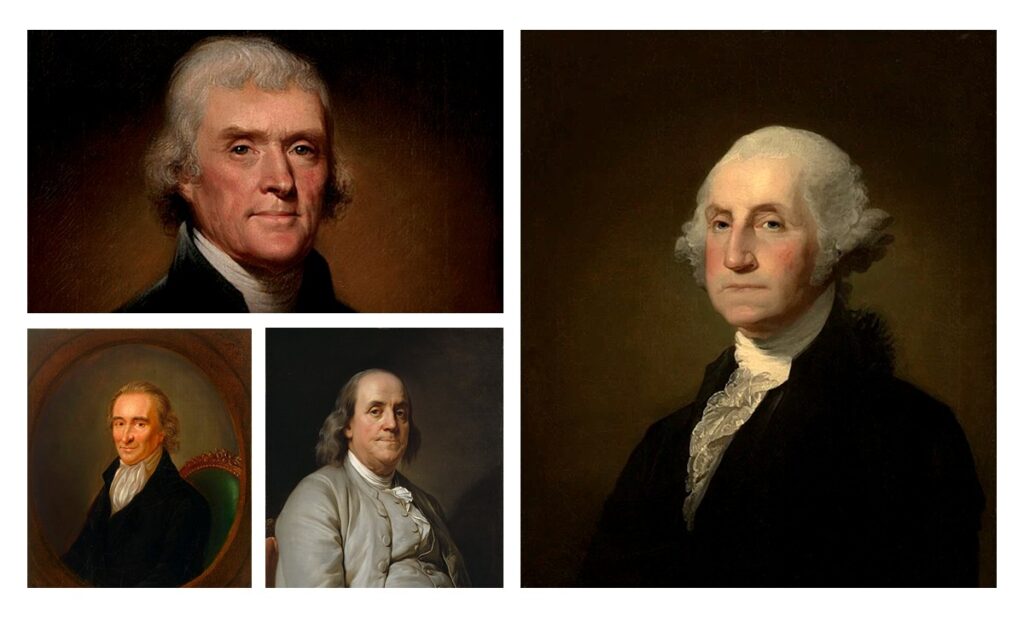 From rebellion for British liberties to revolution for liberation from Britain
About This Program
Analyzing American Revolution (AAR) is a special series podcast production of the History Behind News program. In this series, 33 professors (and counting) analyze the American Revolution from 33 different angles through in-depth interviews with host Adel Aali.
Meet Our Guest Scholars
A structured body of thought on the American Revolution—where leading scholars advancing distinct interpretations that give this program its depth.

Thematic Collection
Tap below for a closer look at the Revolutionary Era themes we examine—and to meet our guest scholars.

Library
- Interview Transcript Highlights
- Interview Image and Artist Highlights
- Quiz Answers and Backstories

Image Gallery
Explore the backstories and artist bios behind images of our Founding—before and after the American Revolution. These visuals shape how we remember—and reimagine—the Revolutionary Era.

Support AAR
AAR is an independent program built on sustained research, preparation, and production. Your support helps continue this series and expand our program.

Experienced Analysis of History
About HbN Program
The History Behind News program (HbN) is committed to making in-depth history researched and written by scholars enjoyable and accessible to everyone. Our motto is bridging scholarly works to everyday news.
The histories we’ve uncovered encompass an impressively wide range of subjects from ancient history to U.S. politics and economy to race, women’s rights, immigration, climate, science, military, war, China, Europe, Middle East, Russia & Ukraine, Africa and the Americas to many other issues in the news. We also receive advanced copies of scholarly books and discuss them in our program (in the context of current news).

Adel Aali, host. Snapshot from his introductory video to AAR podcast.
233 Scholars & Counting
Our guests are scholars at leading institutions. They are highly recognized, having received prestigious grants and fellowships as well as notable awards, including the Pulitzer Prize. They include celebrated documentary producers, former White House advisors and other high-ranking government officials, and current and former senior reporters of major national and international newspapers. Many have testified in Congressional hearings, and others frequently contribute to major media outlets and widely read publications.
Think You Know the American Revolution?