Updated: April 20, 2026
Reconsidering the Boston Massacre – Part III
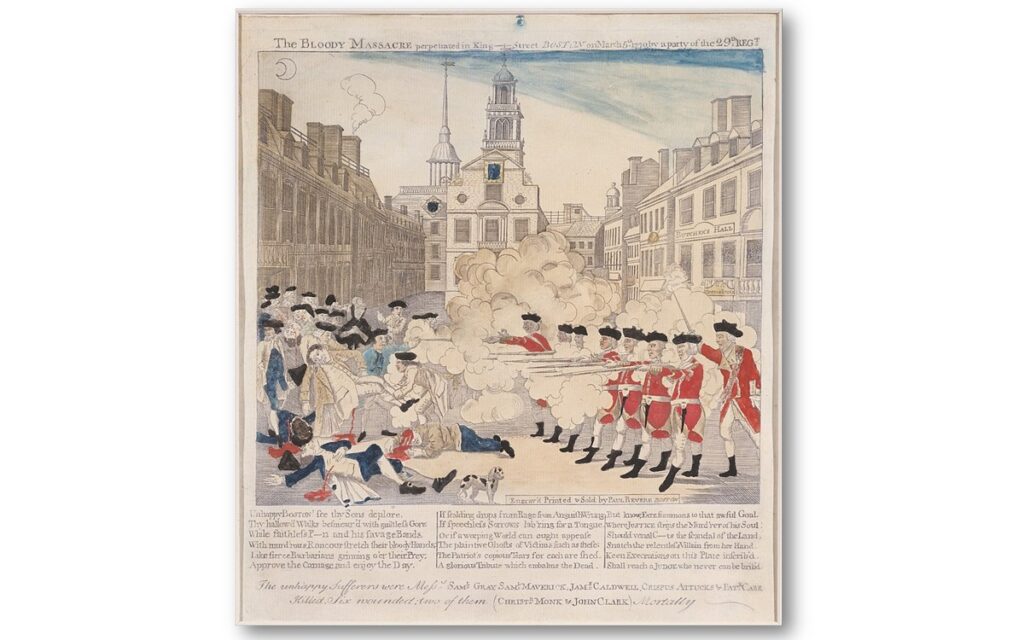
Paul Revere’s engraving of the Boston Massacre is one of the most famous images from 18th-century America—but it is not a neutral snapshot of what happened.
And that’s really the place to start: this is not a photograph of a street scene. It’s a story.
Revere wasn’t trying to capture confusion—he was trying to impose clarity. And in doing so, he reshaped a chaotic, deeply human moment into something far more planned… and far more political.
Order Out of Chaos
If you look at Revere’s engraving in the featured image above, everything feels controlled. The British soldiers stand in a neat line, firing in unison. Across from them, the colonists appear as a distinct, separate group—victims, not participants.
But that’s not how the night of March 5, 1770, actually unfolded.
Eyewitness testimony consistently suggests something much messier. Soldiers and civilians weren’t standing apart in clean columns—they were intermingled. Pushing. Shouting. Arguing. In physical contact with one another.
This wasn’t distance. It was proximity. And more than that—it was familiarity.
These weren’t strangers facing off across a battlefield. Many of them knew each other. They were neighbors, part of the same urban environment, navigating daily tensions long before that night. That reality—uncomfortable, complicated, and human—completely disappears in Revere’s version.
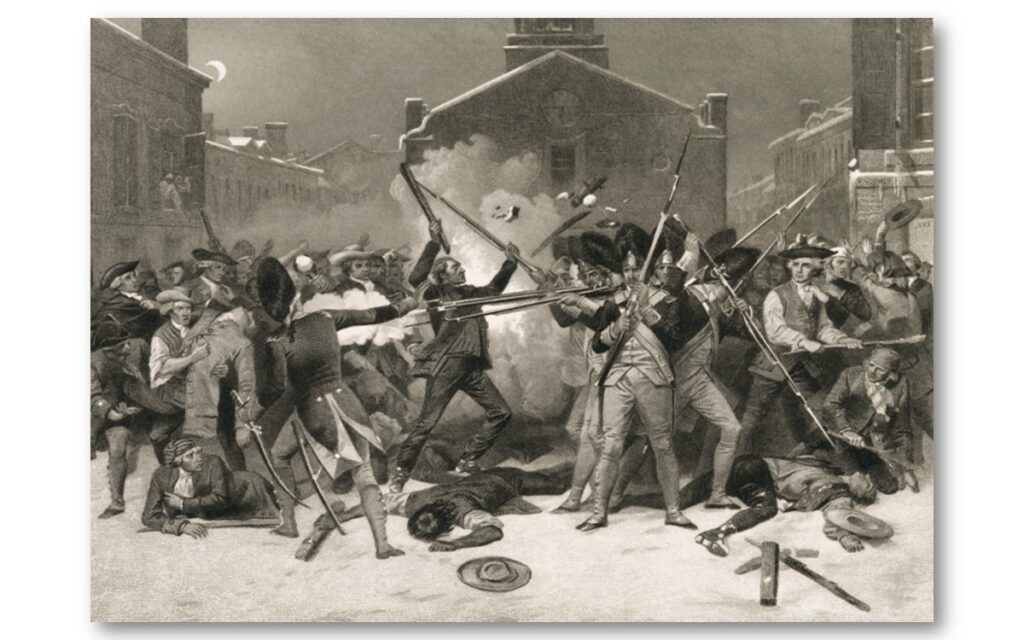 This image depicts the Boston Massacre, showing people in Boston and British soldiers intermingled during the shooting—
unlike Paul Revere’s famous 1770 engraving (featured image in this post), which portrays them as clearly separated by thick plumes of gunshot smoke.
Alonzo Chappel’s 1878 depiction is generally considered more historically accurate.
A Carefully Constructed Crowd
Even the people Revere chose to depict—and how he depicted them—tells us something.
The crowd in the engraving appears orderly, even respectable. Their clothing leans toward a kind of middle-class presentation. But the actual crowd that night included laborers, sailors, and working-class Bostonians—people who might not have looked quite so polished.
That choice matters. Because it reframes the victims. It subtly elevates them. It makes the scene feel less like a volatile street confrontation and more like an unprovoked assault on respectable citizens.
There are other details too—like the presence of a woman placed prominently in the scene. That wasn’t accidental. It would have resonated with viewers at the time, reinforcing a sense of innocence and vulnerability under attack.
Again, this is storytelling.
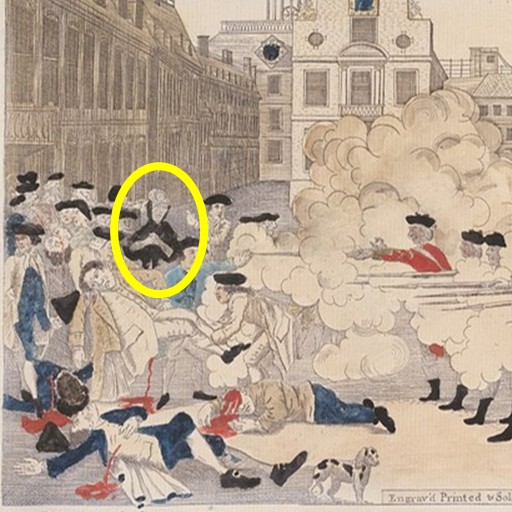 Paul Revere’s depiction of the Boston Massacre.
Enlarged and edited to emphasize the woman in the image.
Conspiracy, Confusion, and the Details That Don’t Hold Up
Some of the specifics in Revere’s engraving are not just questionable—they tap directly into the kinds of conspiracy thinking that were already circulating in the aftermath of the event.
Take the Customs House.
In the engraving, there’s a suggestion that shots may have been fired from a window above the street. At the time, this fed into a much larger claim: that there were sympathizers inside the building—men aligned with the British—secretly firing into the crowd.
But here’s the problem: even contemporaries couldn’t prove it.
Courts at the time investigated the possibility and ultimately couldn’t determine whether any such shooting actually occurred. There were people in the building—but no convincing evidence that they fired weapons. And yet, the idea persisted. Why?
Because it helped explain something that didn’t quite add up.
By some accounts, around eleven people were killed or wounded. But there were only eight soldiers present. So how do we account for the extra shots? Was there time to reload in that chaos? Did bullets ricochet off stone surfaces in the narrow street? At least one witness claimed that happened.
Or… was there someone else firing?
That question—unanswered and perhaps unanswerable—created the perfect opening for speculation. And that’s where the conspiracy element takes hold.
The idea of hidden shooters in the Customs House wasn’t just about evidence—it was about plausibility in a moment that didn’t make sense. It offered a way to impose order on confusion, to fill in gaps that eyewitness testimony couldn’t resolve. And Revere’s engraving leans into that ambiguity. It doesn’t prove the claim—but it visually reinforces the suspicion.
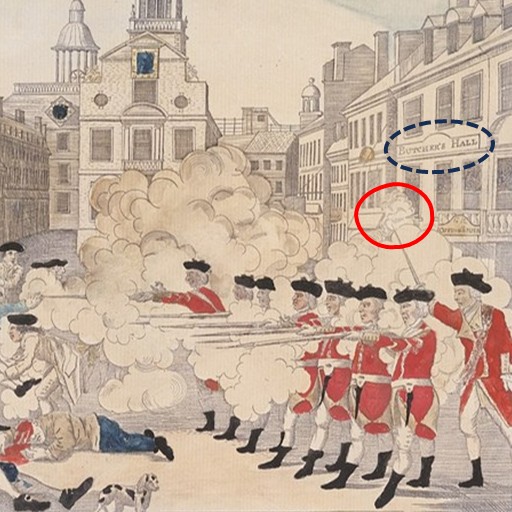 Paul Revere’s depiction of the Boston Massacre.
Enlarged and edited to emphasize Custom’s House
Shaping the Narrative
So what was Revere actually doing?
He was shaping perception.
His engraving takes a confusing, contested, and emotionally charged event and transforms it into something simple and powerful: disciplined soldiers firing on defenseless civilians.
It creates distance where there was closeness. It creates innocence where there was tension. It creates certainty where there was doubt.
And in doing so, it taps directly into colonial anxieties about standing armies in peacetime—about power, control, and the potential for abuse.
Here is the portion of my interview with Dr. Serena Zabin that speaks directly to this point:
About Featured Image
Paul Revere’s 1770 engraving of the Boston Massacre.
Unless otherwise indicated, all images in AARevolution—including those in this post—are in the public domain.
Related Interviews and Essays
For more on the subject on the real history of the Boston Massacre, see my full conversation with Dr. Sophia Serena Zabin—including our interview’s video, timestamps for key sections, and my takeaways.
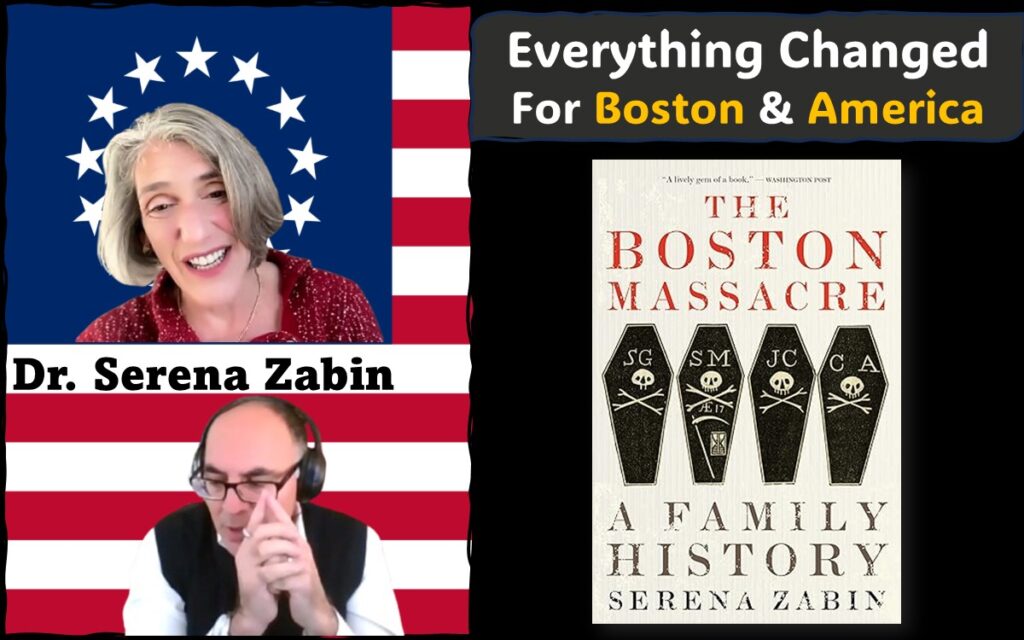 Propaganda and Politics: The Permanent Rupture with Britain
Dr. Zabin’s major works include:
- Dangerous Economies: Status and Commerce in Imperial New York,
- The New York Conspiracy Trials of 1741: Daniel Horsmanden’s “Journal of the Proceedings” with Related Documents, and
- The Boston Massacre: A Family History, which received the 2024 George Washington Book Prize and is the focus of this interview.
This 5-Part Series
- Part I: Was the Boston Massacre Really a “Massacre”?
- Part II: Did British Soldiers and Bostonians Know Each Other?
- Part III: Paul Revere’s Depiction of the Boston Massacre (this essay)
- Part IV: The Trial: Politics & Performance?
- Part V: The Permanent Rupture: Shattered Families and A Broken Imperial Family
About This Program
Analyzing American Revolution (AAR) is a special series podcast production of the History Behind News program. In this series, 33 professors (and counting) analyze the American Revolution from 33 different angles through in-depth interviews with host Adel Aali.
Thematic Collection
Tap below for a closer look at the Revolutionary Era themes we examine—and to meet our guest scholars.

Library
- Interview Transcript Highlights
- Interview Image and Artist Highlights
- Quiz Answers and Backstories

Image Gallery
Explore the backstories and artist bios behind images of our Founding—before and after the American Revolution. These visuals shape how we remember—and reimagine—the Revolutionary Era.

Experienced Analysis of History
About HbN Program
The History Behind News program (HbN) is committed to making in-depth history researched and written by scholars enjoyable and accessible to everyone. Our motto is bridging scholarly works to everyday news.
The histories we’ve uncovered encompass an impressively wide range of subjects from ancient history to U.S. politics and economy to race, women’s rights, immigration, climate, science, military, war, China, Europe, Middle East, Russia & Ukraine, Africa and the Americas to many other issues in the news. We also receive advanced copies of scholarly books and discuss them in our program (in the context of current news).

Adel Aali, host. Snapshot from his introductory video to AAR podcast.
217 Scholars & Counting
Our guests are scholars at leading institutions. They are highly recognized, having received prestigious grants and fellowships as well as notable awards, including the Pulitzer Prize. They include celebrated documentary producers, former White House advisors and other high-ranking government officials, and current and former senior reporters of major national and international newspapers. Many have testified in Congressional hearings, and others frequently contribute to major media outlets and widely read publications.
Think You Know the American Revolution?