Updated: August 6, 2026
The First Member of the British Royalty to Visit the American Colonies
One of the lesser-known episodes of the American Revolution involved the future William IV (r. 1830 to 1837), then known as Prince William Henry, who became the first and only member of Britain’s royal family to visit the American colonies. Arriving in British-occupied New York City in 1781 as a young naval officer, the prince immediately drew enormous attention from Loyalists eager to celebrate the presence of royalty in America at a time when Britain’s hold on the colonies was rapidly weakening. As historian Vaughn Scribner explains in our interview, the prince’s visit carried political and symbolic significance, but it also exposed him to the turbulent military and social world of wartime New York.

Because of his status, Prince William Henry quickly became a figure of interest not only for Loyalists, but also for Patriot leaders. At one point, George Washington approved a plan to capture the prince along with Admiral Robert Digby in a surprise raid. Writing to the officers involved, Washington praised the boldness of the proposal and authorized the operation while specifically instructing that neither man should be insulted or mistreated if captured. The plot ultimately failed after British authorities discovered the plan and tightened security around the prince, who reportedly had previously moved around the city with little protection.
 Prince William Henry at age seventeen, painted by Thomas Gainsborough, circa September 1782. Public domain.
Prince William Henry was also connected to the British campaign surrounding Yorktown. He had been expected to accompany Admiral Digby to assist General Charles Cornwallis, who was under siege by French and American forces at Yorktown. But storms and environmental conditions delayed the expedition. By the time they finally reached Virginia, Cornwallis had already surrendered. The failed mission forced the Prince back to New York, where he spent the winter of 1781–1782 immersed in the city’s British military and Loyalist social circles. In September 1781, he even held court at the Manhattan residence of Governor James Robertson, attended by figures such as New York mayor David Mathews, Admiral Digby, and Loyalist general Oliver De Lancey.
Yet Dr. Scribner notes that the young prince also developed a reputation for reckless behavior during his stay in New York. As Scribner describes it, “He was a royal disappointment. He’s a brat. He drinks too much.” The future king reportedly spent much of his time socializing and drinking in taverns, becoming so well known in the city that one establishment was eventually named after him: the Prince William Henry Tavern. Watch this segment of our interview in the video below.
The First Reigning British Monarch to Visit the United States
The first reigning British monarch to visit the United States was King George VI (r. 1936-1952), father of Queen Elizabeth II (r. 1952-2022) and brother of Edward VIII, who famously abdicated after less than one year on the throne (r. Jan. 20 to Dec. 11, 1936) – more on that below.
As Europe drifted toward war in 1939, the British government recognized that public opinion in the United States could become critically important in the struggle against Nazi Germany. In response, King George VI and Queen Elizabeth (mother of Queen Elizabeth II) embarked on an unprecedented diplomatic mission to America, becoming the first reigning British monarchs to visit the country.
During the June 7–12 tour, Franklin D. Roosevelt and Eleanor Roosevelt personally guided much of the royal visit (see picture below), using ceremonies, public appearances, and informal gatherings to strengthen ties between the two nations at a moment of growing international uncertainty.
Rather than relying only on formal diplomacy, the trip emphasized visibility and personal connection. Crowds filled the streets of New York City during a ticker-tape parade, while the royal couple also visited the 1939 World’s Fair and viewed the city from the Empire State Building. In Washington, D.C., official receptions and a State Dinner showcased the importance of Anglo-American relations, but some of the most influential moments occurred away from ceremonial settings. At Roosevelt’s estate in Hyde Park, the King and Queen attended a relaxed picnic where they were served hot dogs and other distinctly American food, part of a deliberate effort to make the monarchy appear approachable to a still-isolationist American public. The visit ultimately helped soften older American suspicions of Britain and contributed to the warmer political climate that later supported wartime cooperation, including the Destroyers-for-Bases Agreement of 1940.
 Franklin D. Roosevelt and Eleanor Roosevelt traveling with George VI and Queen Elizabeth aboard the USS Potomac en route from Washington, D.C. to Mount Vernon, June 9, 1939. Public Domain.
About Featured Image
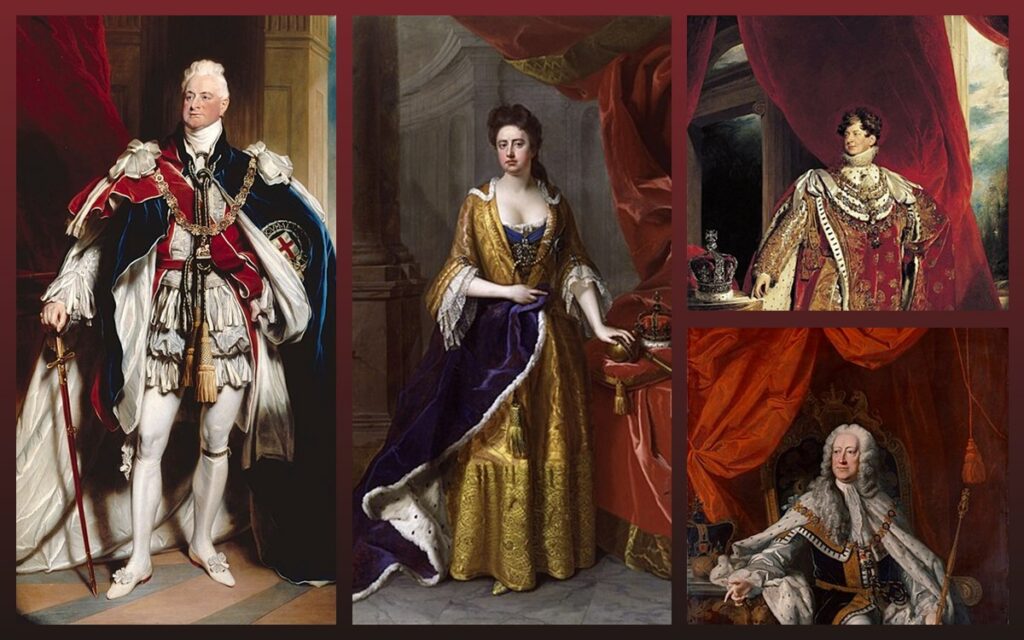
Images in this collages – clockwise from left: William IV, Queen Anne, George IV, and George II.
Unless otherwise indicated, all images in AAR—including those in this post—are in the public domain.
Revisiting the Quiz
Who was the first member of the British Royal family to visit the American colonies?
- William IV
- Queen Anne
- George II
- Geoge IV
By now, the answer should be clear: William IV.
Before concluding, however, it is worth revisiting the other three options.
Queen Anne
One of the quiz hints stated that the visit occurred during the American Revolution. Since Anne died in 1714 — decades before the Revolution — she clearly could not have been the correct answer.
Still, Anne played an important role in British history. During her reign, England and Scotland were united under the Acts of Union in 1707, creating Great Britain. She was also the last monarch of the House of Stuart, and after her death the crown passed to the Hanoverian dynasty under George I.
George II
The quiz hints should also have eliminated George II fairly quickly. Since George III was Britain’s monarch during the American Revolution, George II — who ruled earlier — had already died by the time revolutionary war in the colonies began. In fact, he died in 1760, more than fourteen years before the Battles of Lexington and Concord.
George II was the grandfather of George III and ruled Britain during an earlier phase of imperial expansion and European conflict. He is especially remembered as the last British monarch to personally lead troops in battle, doing so at the Battle of Dettingen in 1743.
George IV
The quiz clues also ruled out George IV, whose reign came long after the American Revolution. Before becoming king in 1820, he served as prince regent during the final years of George III’s mental decline, giving his era the name “the Regency period.”
George IV became known for luxury, architecture, and aristocratic culture, supporting projects such as the Royal Pavilion at Brighton and the remodeling of Buckingham Palace. But his extravagant lifestyle and political controversies also damaged his public reputation and weakened confidence in the monarchy.
Related Interviews and Essays
As stated above, abdications have been rare in the history of British monarchy. Based on knowledge and research, there have only been three:
- Edward II (1327): After losing political support and facing a rebellion backed by Queen Isabella and Roger Mortimer, King Edward II was removed from the throne and replaced by his teenage son, Edward III. He later died under mysterious and violent circumstances while in captivity.
- Richard II (1399): Following a successful uprising led by his cousin Henry Bolingbroke, King Richard II lost control of the kingdom and relinquished the crown, allowing Bolingbroke to rule as Henry IV.
- Edward VIII (1936): He surrendered the throne less than a year after becoming king so he could marry Wallis Simpson, an American socialite who had been divorced twice and was preparing for a third divorce. Because the British government and the Church of England would not accept her as queen, Edward VIII chose marriage over the monarchy, transferring the crown to his brother, George VI, who later became the first reigning British monarch to visit the United States.
So, of the three, Edward VIII was the only voluntary abdication. But this may not be the full account of abdications in the history of British monarchy because there is the hidden story of George III.
Did George III Abdicate?
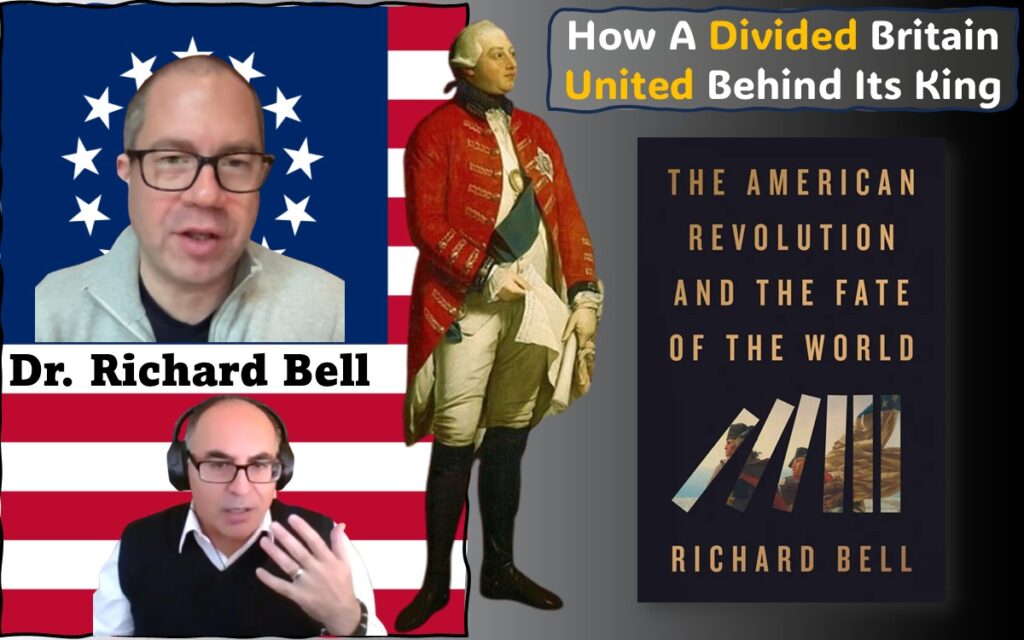
In our program, Richard Bell shares the remarkable story of how George III reacted after Britain’s devastating 1781 defeat at Yorktown. Amazingly, as Dr. Bell explains, this story only came to light relatively recently.
Dr. Bell is a historian of early America. His major works include the following books:
- The American Revolution and the Fate of the World – his most recent book, which is the subject of our interview in this program,
- Stolen: Five Free Boys Kidnapped Into Slavery and Their Astonishing Odyssey Home,
- We Shall Be No More: Suicide and Self-Government in the Newly United States, and
- Buried Lives: Incarcerated in Early America.
 Rethinking King George III: the American Revolution From the British Perspective
About This Program
Analyzing American Revolution (AAR) is a special series podcast production of the History Behind News program. In this series, 33 professors (and counting) analyze the American Revolution from 33 different angles through in-depth interviews with host Adel Aali.
Meet Our Guest Scholars
A structured body of thought on the American Revolution—where leading scholars advancing distinct interpretations that give this program its depth.

Thematic Collection
Tap below for a closer look at the Revolutionary Era themes we examine—and to meet our guest scholars.

Library
- Interview Transcript Highlights
- Interview Image and Artist Highlights
- Quiz Answers and Backstories

Image Gallery
Explore the backstories and artist bios behind images of our Founding—before and after the American Revolution. These visuals shape how we remember—and reimagine—the Revolutionary Era.

Support AAR
AAR is an independent program built on sustained research, preparation, and production. Your support helps continue this series and expand our program.

Experienced Analysis of History
About HbN Program
The History Behind News program (HbN) is committed to making in-depth history researched and written by scholars enjoyable and accessible to everyone. Our motto is bridging scholarly works to everyday news.
The histories we’ve uncovered encompass an impressively wide range of subjects from ancient history to U.S. politics and economy to race, women’s rights, immigration, climate, science, military, war, China, Europe, Middle East, Russia & Ukraine, Africa and the Americas to many other issues in the news. We also receive advanced copies of scholarly books and discuss them in our program (in the context of current news).

Adel Aali, host. Snapshot from his introductory video to AAR podcast.
232 Scholars & Counting
Our guests are scholars at leading institutions. They are highly recognized, having received prestigious grants and fellowships as well as notable awards, including the Pulitzer Prize. They include celebrated documentary producers, former White House advisors and other high-ranking government officials, and current and former senior reporters of major national and international newspapers. Many have testified in Congressional hearings, and others frequently contribute to major media outlets and widely read publications.
Think You Know the American Revolution?