Updated: April 20, 2026
Reconsidering the Boston Massacre – Part I
When we think of the Boston Massacre—which likely reflects what we learned in school and college—the word “massacre” immediately stands out. It evokes tragedy. It carries weight. It paints the British as ruthless tyrants who slaughtered innocent American colonists.
But the reality is far more complicated.
In part one of our five-part series, I focus on the word “massacre,” which in Britain at the time was referred to simply as “the incident.”
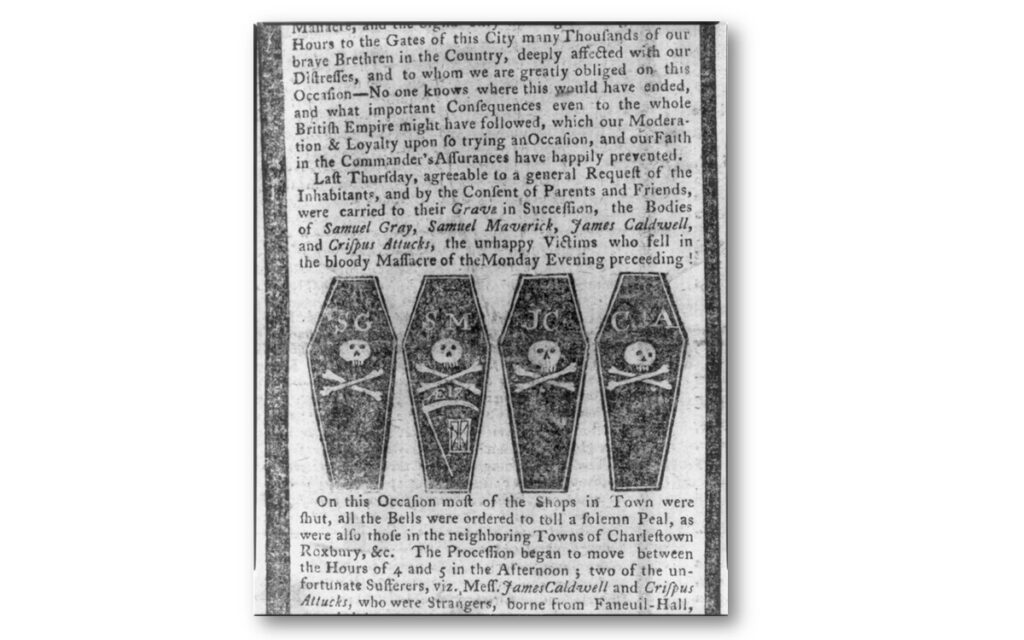
To be sure, five people were killed in the event (or was it six?—see featured image description below), a tragedy by any measure. Yet the event we call the Boston Massacre was not a massacre in the straightforward sense of the word. The term was chosen almost immediately by the Sons of Liberty as part of a political strategy to shape public perception.
At its core, the Boston Massacre was a shooting. Even by the standards of the time, it was relatively small in scale. What matters historically is how the label “massacre” served as propaganda—framing the incident in a way that amplified outrage and mobilized colonial opinion.
This illustrates how much of what we think we know about the Boston Massacre is shaped not just by facts, but by politics and narrative.
Here is the portion of my interview with Dr. Serena Zabin that speaks directly to this point:
About Featured Image
The featured image comes from the Boston Gazette, March 12, 1770—four days after the funeral of the Boston Massacre victims on March 8. Initials on the coffins identify the four men buried that day: Crispus Attucks, Samuel Gray, James Caldwell, and Samuel Maverick. The fifth victim, Patrick Carr, died on March 17 and was not included in this report.
There was also a sixth victim: Christopher Monk. Gravely wounded in the Massacre—shot in the side and groin—he succumbed to his injuries in 1780, around age 27.
Unless otherwise indicated, all images in AARevolution—including those in this post—are in the public domain.
Related Interviews and Essays
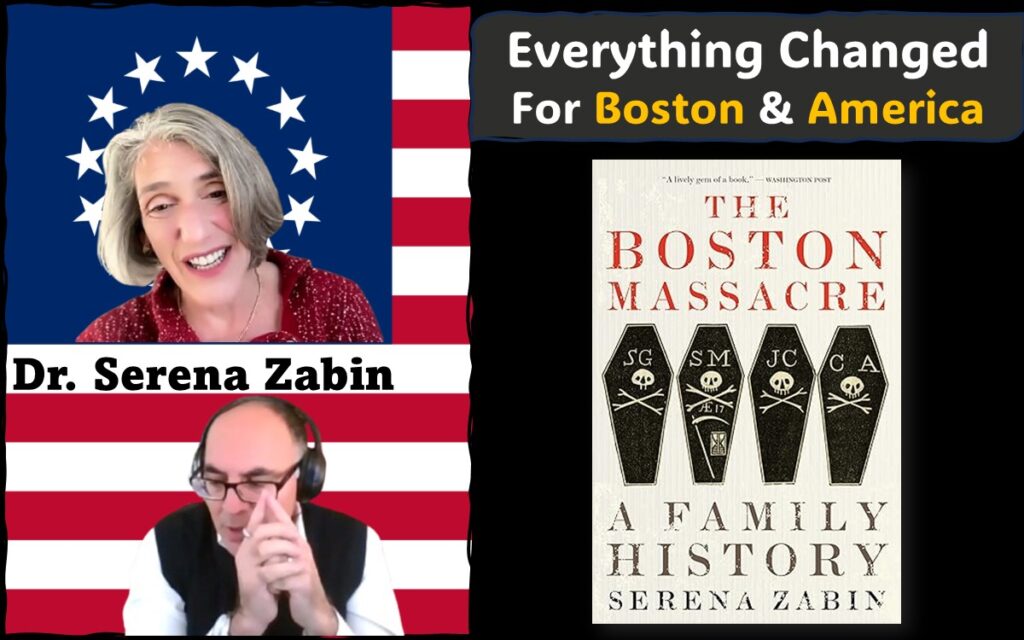
For more on the subject on the real history of the Boston Massacre, see my full conversation with Dr. Sophia Serena Zabin—including our interview’s video, timestamps for key sections, and my takeaways.
 Propaganda and Politics: The Permanent Rupture with Britain
Dr. Zabin’s major works include:
- Dangerous Economies: Status and Commerce in Imperial New York,
- The New York Conspiracy Trials of 1741: Daniel Horsmanden’s “Journal of the Proceedings” with Related Documents, and
- The Boston Massacre: A Family History, which received the 2024 George Washington Book Prize and is the focus of this interview.
This 5-Part Series
- Part I: Was the Boston Massacre Really a “Massacre”? (this essay)
- Part II: Did British Soldiers and Bostonians Know Each Other?
- Part III: Paul Revere’s Depiction of the Boston Massacre
- Part IV: The Trial: Politics & Performance?
- Part V: The Permanent Rupture: Shattered Families and A Broken Imperial Family
About This Program
Analyzing American Revolution (AAR) is a special series podcast production of the History Behind News program. In this series, 33 professors (and counting) analyze the American Revolution from 33 different angles through in-depth interviews with host Adel Aali.
Thematic Collection
Tap below for a closer look at the Revolutionary Era themes we examine—and to meet our guest scholars.

Library
- Interview Transcript Highlights
- Interview Image and Artist Highlights
- Quiz Answers and Backstories

Image Gallery
Explore the backstories and artist bios behind images of our Founding—before and after the American Revolution. These visuals shape how we remember—and reimagine—the Revolutionary Era.

Experienced Analysis of History
About HbN Program
The History Behind News program (HbN) is committed to making in-depth history researched and written by scholars enjoyable and accessible to everyone. Our motto is bridging scholarly works to everyday news.
The histories we’ve uncovered encompass an impressively wide range of subjects from ancient history to U.S. politics and economy to race, women’s rights, immigration, climate, science, military, war, China, Europe, Middle East, Russia & Ukraine, Africa and the Americas to many other issues in the news. We also receive advanced copies of scholarly books and discuss them in our program (in the context of current news).

Adel Aali, host. Snapshot from his introductory video to AAR podcast.
232 Scholars & Counting
Our guests are scholars at leading institutions. They are highly recognized, having received prestigious grants and fellowships as well as notable awards, including the Pulitzer Prize. They include celebrated documentary producers, former White House advisors and other high-ranking government officials, and current and former senior reporters of major national and international newspapers. Many have testified in Congressional hearings, and others frequently contribute to major media outlets and widely read publications.
Think You Know the American Revolution?