Updated: May 25, 2026
Introduction
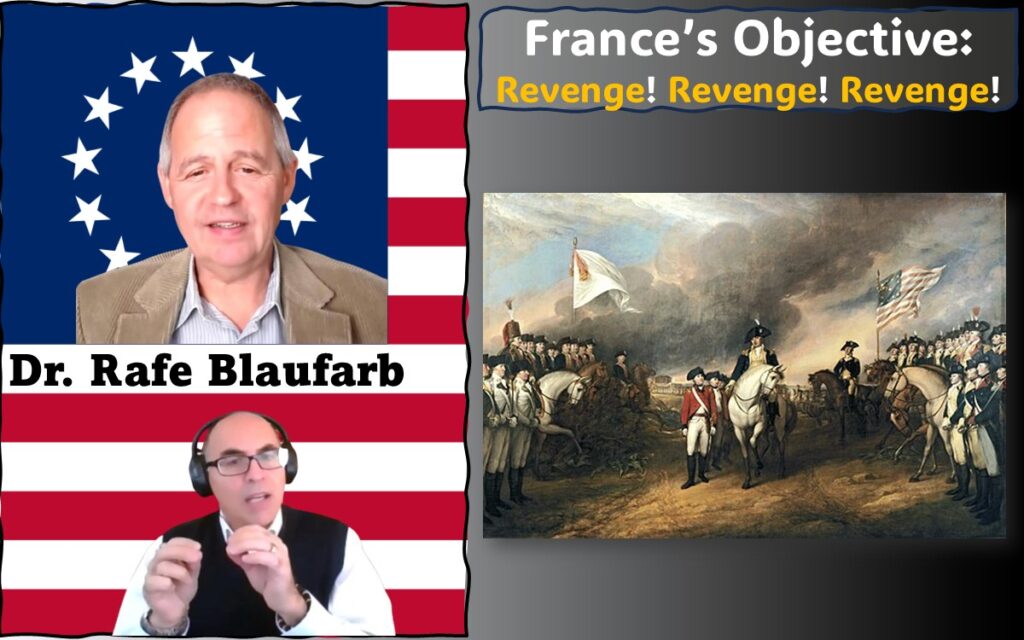
In this interview: “Well, here’s the mindset of the French government. Coming out of the defeat, the humiliating, crushing defeat of the Seven Years’ War, the dominant mood in the French government among, really, the movers and shakers of that country is, really simple, revenge, revenge, revenge on England…. And the United States, North America becomes a sideshow.”
Watch this segment in the video below (00:10:58, 00:31:14).
The American Revolution? Only one theater in a global war—and far from the main event.
Geopolitical rivalry and revenge drove France to rally other powers against Britain. That transformed what started as a colonial rebellion in the Americas into a globe-spanning military conflict—a true world war.
After losing the Seven Years’ War, France pursued a long-term plan to weaken Britain. Direct military intervention and a formal alliance came after the American victory at the Battle of Saratoga. Soon Spain and the Netherlands joined in, and the fighting spread across the Caribbean, the Atlantic, and the Indian Ocean.
Despite its decisive role, France gained little from the 1783 peace. Later, French leaders would see American secret dealings in Paris peace negotiations as a betrayal.
In this interview, my guest shares the French perspective on the American Revolution—views that may surprise you. I’m betting you didn’t learn them in school!

How to Use This Post
Use this post as reference guide to the American Revolution through the lens of this interview and the broader Analyzing American Revolution program (AARevolution). Navigate using the interactive table of contents above and the timestamps below (in gray) to discover how this interview deepens the story of the Revolution—and to explore how the program unfolds: its key themes, insights, image gallery, scholars list, history quizzes, and related interviews across the series.
Video
Watch the full interview (timestamps below)
France’s Global Game: How a Colonial Rebellion Became a World War
When we think of the American Revolution, it’s tempting to imagine thirteen colonies fighting Britain, maybe with France throwing in some support. But here’s the thing—it’s way bigger than that. Like, way bigger.
France wasn’t just helping a bunch of rebels across the ocean. No. For them, this was about revenge. About reasserting themselves after that humiliating defeat in the Seven Years’ War. About sending a message to Britain: “We’re back.” And so, what starts as a rebellion in North America quickly becomes a global game. Spain joins. The Netherlands joins. The navies clash in the Caribbean, the Atlantic, the Gulf Coast, even the Indian Ocean. Armies fight on multiple continents. The Americans? They’re important, sure—but just one piece of a much, much larger puzzle.
By the time peace talks roll around in Paris, Britain is financially drained, alliances are reshaped, and France? They’ve invested massively, gotten a moral victory in principle, but—frankly—very little tangible gain. Independence for the Americans, yes. But the spoils they hoped for? Mostly out of reach. And that, to me, is what makes the French perspective so fascinating.
Central Question
This conversation raises a central question:
If France entered the American Revolution not to advance American liberty but to wage a global war of revenge against Britain, how do we reconcile its decisive role in securing American independence with its inability to translate that intervention into lasting strategic advantage?
About My Guest: Dr. Rafe Blaufarb
Dr. Rafe Blaufarb is a historian in Florida State University. He is an Eminent Scholar of Napoleonic Studies and the director of the Institute On Napoleon and the French Revolution. When I previously interviewed Dr. Blaufarb, he was the 117th guest scholar on our History Behind News program, of which Analyzing American Revolution is a special series.
He is the author of many books, including the following:
- Napoleon: A Symbol for an Age;
- Napoleonic Foot Soldiers and Civilians: A Brief History with Documents,
- The Revolutionary Atlantic: Republican Visions, 1760-1830;
- Bonapartists in the Borderlands: French Exiles and Refugees on the Gulf Coast, 1815-1835;
- The Great Demarcation: The French Revolution and the Invention of Modern Property; and
- The French Army, 1750-1820: Careers, Talent, Merit.
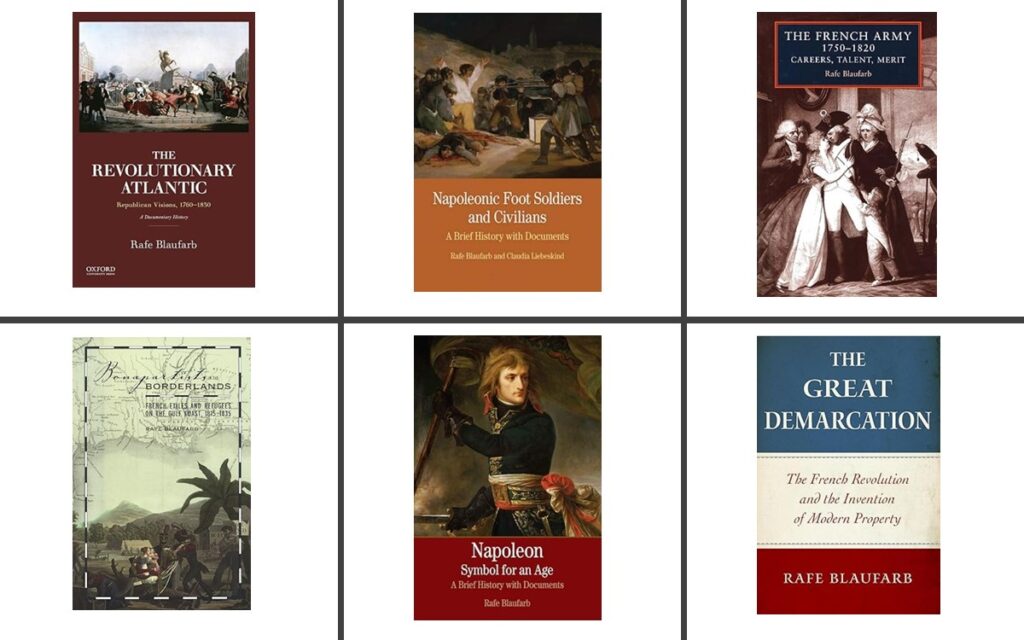 Dr. Blaufarb’s major works
About Featured Image
The featured image brings together images of Dr. Rafe Blaufarb and Adel Aali from the interview, superimposed on the Betsy Ross flag, alongside John Trumbull’s iconic painting titled Surrender of Lord Cornwallis, which now hangs in the rotunda of the U.S. Congress. Click here to learn about Trumbull’s life, the painting’s backstory, and an important person who is surprisingly missing from this painting.
Unless otherwise indicated, all images in AAR—including those in this post—are in the public domain.
AAR Essential Insights
Although the full video and transcript of my conversation with Dr. Blaufarb are included in this post, I’ve selected several insights that I found particularly revealing and worth emphasizing. These moments — some surprising, others that challenge familiar assumptions — help us see France and the American Revolution in a different light.
Why a French Catholic absolute monarch supported Protestant English-speaking anti-monarch rebels?
This is one of those questions that feels like it should have a complicated ideological answer… but it doesn’t.
When I asked it, I was basically trying to reconcile what we’re taught to expect: a Catholic king, ruling as an absolute monarch, backing Protestant, English-speaking colonies that are literally rebelling against a king. On paper, it looks like a contradiction.
But as Dr. Blaufarb explained—and this really stood out to me—by the 18th century, religion just wasn’t driving great power politics the way we might assume.
France had long since made a habit of putting strategy over shared faith. And not occasionally—consistently. If siding with Protestant powers, or even non-Christian ones, helped weaken a rival, that’s the direction France went. The key point here is that their main concern wasn’t religious alignment—it was who their enemy was.
And that enemy, more often than not, was Austria or Britain.
So when France backed the American colonies, it wasn’t wrestling with some internal moral dilemma about helping Protestants or supporting rebels against monarchy. That simply wasn’t the framework they were operating in.
In fact, what really drove this home for me was the example Dr. Blaufarb gave at the end: the chief minister running Louis XVI’s government during the American Revolution… was a Protestant.
At that point, the whole “religious contradiction” idea kind of collapses.
What looks like a paradox from the outside turns out to be something much more straightforward:
This was about power, rivalry, and opportunity—not religion.
Watch this section in the video above (00:03:50).
French Catholicism: Irrelevant Abroad, Eroding at Home
If religion wasn’t driving French foreign policy, you might assume it was still a dominant force at home.
But that’s not really what was happening either.
What Dr. Blaufarb pointed out—and I found this just as striking—is that, even domestically, the grip of Catholicism in France was starting to loosen well before the French Revolution. Not disappearing, not collapsing overnight—but clearly eroding.
Among elites, there’s a growing anti-clerical mood. And it’s hard to ignore the role of Voltaire here—arguably the most popular writer in 18th-century France—who made a career out of attacking the Church. And people weren’t pushing back… they were embracing it.
But what really stayed with me is what was happening at the everyday level.
It’s not that France suddenly became atheist. It’s that people—especially ordinary people—were gradually disengaging. Tuning out. Religion was becoming less central to daily life.
Dr. Blaufarb gave a simple but vivid image:
Go to a French village on a Sunday, and you might find women in church… while many of the men are outside—drinking, socializing, not particularly interested in what’s happening inside.
And then there’s another layer to this.
By around the mid-18th century, the French are already doing things that feel distinctly “modern”—like limiting family size and practicing forms of birth control. That alone tells you something has shifted culturally.
So when you put this together with the geopolitical picture, it reinforces the same conclusion:
Religion wasn’t the organizing force we might expect—not abroad, and increasingly, not even at home.
Watch this section in the video above (00:06:17).
In our program, Dr. Richard Bell, author of The American Revolution and the Fate of the World, explores the British perspective on the Revolution. In his account, French Catholicism is framed as a more significant factor—shaping why many in Britain rallied behind King George III.That interview will be linked here when it publishes.
 Louis XVI
click image for backstory
Revenge! Revenge! Revenge!
I went into this part of the conversation assuming there had to be at least some hesitation on the French side.
Think about it: France had just been crushed by Britain in the Seven Years’ War. A humiliating defeat. Lost territory. Damaged prestige. And now, barely a decade later, a young king—Louis XVI—is supposed to jump back into a major conflict with the same rival?
So I asked the obvious question: where’s the caution?
But Dr. Blaufarb’s answer completely reframed this for me.
There wasn’t hesitation. There wasn’t second-guessing.
There was one dominant mindset inside the French government after 1763:
Revenge.
From the moment the war ended, France wasn’t licking its wounds—it was preparing for a rematch. And that preparation was serious. They rebuilt and modernized their navy, steadily closing the gap with Britain. This wasn’t reactive policy. It was long-term, deliberate planning.
So by the time the American colonies revolted, France didn’t suddenly decide to get involved.
They had been waiting for this.
Waiting for the right opportunity to strike back at Britain—and the American rebellion gave them exactly that opening.
And here’s another layer that stood out to me:
This wasn’t just a government project. Among educated French elites, there was real enthusiasm for the war. Part of it was the appeal of revenge—but part of it was also how they viewed the Americans themselves: as a kind of idealized people—free, uncorrupted, something worth supporting.
So when France enters the war, it’s not a reluctant or cautious move.
It’s the culmination of over a decade of preparation—driven by something very simple, and very powerful:
They wanted payback.
Watch this section in the video above (00:09:58).
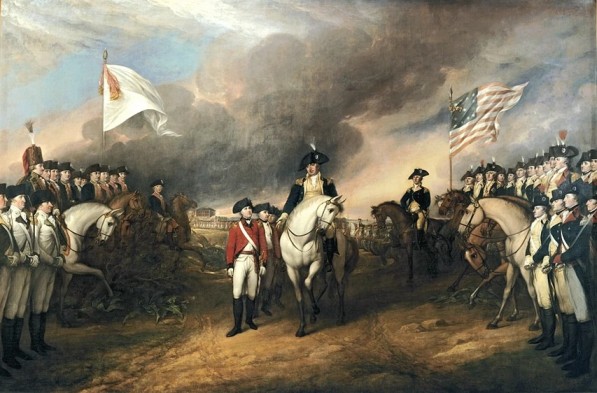
The Surrender of Lord Cornwallis
Who is missing in this iconic painting?
click image for backstory
France’s Only Caution
So was there any caution at all?
Yes—but not about fighting Britain. The French were ready for that. What they wanted was proof that the Americans could actually hold their own.
They weren’t going to commit openly to a cause that might collapse.
That proof comes at the Battle of Saratoga. Once the Americans win there, France has what it needs—and steps in openly against Britain.
Until then, they’re already helping… just quietly.
So “caution” isn’t quite the right word.
They weren’t hesitant.
They were waiting.
Watch this section in the video above (00:12:11).
The Dominant Mood In France
Continue watching at 10:58 in the video above.
Britain Alone: France Rallies the World Against Britain
This is where the story really opens up—and honestly, this was one of the most eye-opening parts of the conversation for me.
We tend to think of the American Revolution as Britain vs. the colonies, with France helping on the side.
But that’s not what this turns into.
As Dr. Blaufarb explained, France plays a major role in pulling other powers into the conflict—or at least pushing them into a position hostile to Britain. And the reason this works is pretty straightforward: after the Seven Years’ War, Britain looks too powerful.
Other colonial powers see what’s coming—and they don’t like it.
So countries like Spain and the Netherlands don’t just sit on the sidelines. They join the fight. Others, like Russia, Sweden, and Denmark, form what’s called a “League of Armed Neutrality”—basically telling Britain: don’t interfere with our shipping, or you’ll have a bigger problem on your hands.
And when you step back and look at the full picture, it’s striking:
Britain isn’t just fighting the American colonies.
It’s fighting France.
It’s fighting Spain.
It’s fighting the Netherlands.
And it’s facing pressure from other European powers as well.
In other words—Britain is alone.
That framing changes everything. This isn’t just a colonial rebellion anymore.
It’s a global war—and Britain is taking on far more than just thirteen colonies.
Watch this section in the video above (00:23:09).
American Revolution A Sideshow
This is the part that really flips the whole story.
Once France enters the war—and brings in Spain and the Netherlands—this stops being a colonial rebellion and becomes a global war.
Fighting breaks out across the Caribbean, the Atlantic, the Indian Ocean… even India. And that’s the key point: Britain’s attention shifts.
The American colonies are no longer the main event.
They’re just one theater in a much bigger war—and, in many ways, a secondary one.
That shift is what ultimately makes American independence possible.
Watch this section in the video above (00:28:08).
Does France Achieve What it wants from its alliance with the American colonies
This is a question we almost never ask.
From the French perspective, the goals were clear: recover lost colonies, weaken Britain, and—just as important—replace Britain as America’s main trading partner.
But it doesn’t really work out that way.
Late in the war, France suffers a major setback at the Battle of the Saintes, and Spain fails to take Gibraltar—suddenly strengthening Britain’s hand in the negotiations.
And then there’s the part that really stood out to me:
The Americans start negotiating directly with Britain—without telling France.
From the French point of view, that feels like a betrayal. They had invested heavily—financially and militarily—only to be cut out at the end.
So no, France doesn’t walk away with what it hoped for.
It helps secure American independence… but gains far less than it expected—and a lot of frustration along the way.
Watch this section in the video above (00:34:37).
 Treaty of Paris, 1783
Who is missing from this painting?
click image for backstory
Did Americans Betray France?
From the French point of view… yes.
France had two big goals: regain colonies from Britain and secure a special trading relationship with the new United States. Neither happened.
After independence, the Americans keep trading with Britain, leaving France out. Minimal concessions, tiny colonies at best. And when France asks for help during the Revolutionary Wars, the Americans basically say “no” via the Jay Treaty.
For the French, it felt like a double betrayal—financially, diplomatically, and strategically.
And that sense of being “shafted” lingers—fading only later with Napoleon’s victories, which helped heal the wounds of earlier disappointments.
Watch this section in the video above (00:39:07).
The Interview (S1E12): Adel Aali and Rafe Blaufarb
In our conversation, Dr. Blaufarb addressed important topics relating to the American Revolution. Below, are my questions to him followed by the interview’s full transcript.
In our conversation, Dr. Blaufarb addresses key questions about France and its support of the American Revolution. The detailed outline and full transcript below supplement the video above.
Podcast
Watch the full interview on this page with the outline and transcript below, or take the conversation with you on the go through our Spotify podcast.

Outlline
Use the in-depth outline below, with its key moments and turning points, to follow the discussion and navigate the interview.
Click for Timestamped Outline
- Selected Highlights (00:00)
- Guest Introduction (01:42)
- French Religion, Realpolitik, and the American Revolution (03:19)
- Louis XVI Supports Protestant Anti-Monarchy Rebels (03:31)
- France Prioritizes National Interest Over Religion – Key Moment (06:05)
- Catholicism and Secularization in 18th-Century France (06:17)
- Voltaire, Anti-Clericalism, and French Elites (06:42)
- American Colonists as More Religious Than Their French Allies (07:57)
- Revenge After the Seven Years’ War (09:58)
- “Revenge, Revenge, Revenge on England” – Key Moment (10:58)
- Saratoga Proves the Americans Have Staying Power – Turning Point (12:44)
- French Nationalism and the American Cause (14:01)
- David Bell’s *The Cult of the Nation* and French Patriotism (14:01)
- England as France’s “Archenemy” (14:22)
- Covert French Aid Before Open War (15:11)
- Silas Deane and American Agents in Paris (16:28)
- Beaumarchais, *The Marriage of Figaro*, and Secret Arms Shipments (18:27)
- Benjamin Franklin and French Enthusiasm for America (20:09)
- Benjamin Franklin at Versailles (20:09)
- Franklin “Hams Up” His Americanness for the French (20:29)
- France Mobilizes the World Against Britain (23:18)
- Spain, the Netherlands, and Colonial Rivals Join the Fight (25:14)
- Russia, Sweden, Denmark, and the League of Armed Neutrality (25:53)
- The French Navy and the Global War for Empire (28:05)
- Naval War as the Key to American Independence – Key Moment (28:18)
- North America Becomes a “Sideshow” – Turning Point (31:14)
- Britain Isolated in a World War (31:46)
- Britain Fighting France, Spain, the Netherlands, and America (31:51)
- Ireland, Hessians, and the Strain on the British Empire (32:10)
- France, the 1783 Peace Negotiations, and American Betrayal (34:32)
- France Wants Colonies and a Trade Deal With the United States (35:32)
- Secret American Negotiations With Britain – Turning Point (37:12)
- Just One Point (45:50)
Transcript
Note: This transcript was generated automatically and may contain minor errors. It is provided for reference and accessibility only.
Click to View Transcript
Adel:
Dr. Blaufarb, it’s a pleasure to have you in our program’s special series. Thank you for taking the time for this conversation with me about the American Revolution. So let’s start from the top, something that I’ve thought of.And if it’s a nothing, you tell me it’s a nothing, but I don’t think so. So let me ask the question. Louis XVI was French, of course, Catholic, and an absolute monarch.And he supports English-speaking, Protestant, anti-monarchy, rebel colonies. Square that for me. How does this work?
Dr. Blaufarb:
Yeah, the basic answer is the religious issue, the Catholic versus Protestant issue, just didn’t matter. It didn’t matter to the French government. It didn’t matter to the French people.It didn’t matter.
Adel:
Wow. So is it the case that religion at this time was no longer a big deal, religious affiliations and alliances? Is that it?Well, there are two things.
Dr. Blaufarb:
When it came to royal politique and international politics and power politics, France had never prioritized religion over its strategic interests. So for example, two striking examples, already in the late 17th century, Louis XIV, who’s an even more absolute and even more Catholic son king, Louis XIV actually intervenes on the side of the Ottomans when they are invading Vienna, when they’re attacking Austria, because as far as the French are concerned, the enemy, the hereditary enemy, it’s the Austrian Habsburgs. And if a huge Ottoman army is about to take Vienna, well, that’s a great opportunity to humiliate and defeat Catholic Austria.
Adel:
So they forsake Christians and help Muslims because of geopolitics.Dr. Blaufarb:
Simply because of geopolitics. Oh, wow. At the end of the day, religion is not what’s determining the geopolitics.And then this is confirmed in the middle of the 18th century, when in the war of Austrian succession, this is the war where Prussia invades Austria and Frederick the Great of Prussia, Protestant king, wins all his military glory. Well, France is on Prussia’s side. It’s on the Protestant side, once again, against Catholic Austria.
So internationally, when it came to geopolitics, the French had not for many, many years, centuries, prioritized religion. The French prioritized national interest, and if it meant siding with Muslims or Protestants or probably anyone at all, they would have just sided with whoever. Now, that’s internationally, but domestically, the French are losing their interest in Catholicism.
I don’t want to exaggerate it. It’s not becoming an atheistic country or anything like that. But there’s a growing anti-clerical sentiment among the elites.
This is led probably by Voltaire, who absolutely hates the Catholic Church and is constantly attacking it. He’s the most popular writer in 18th century France. People love, they love that he attacks the church.
But ordinary people, the great masses of people, they’re kind of tuning out. They’re tuning out.
Adel:
Tuning out from the church.
Dr. Blaufarb:
Yeah, they’re getting less and less religious. So if you were to go to a village on Sunday in the middle of the 18th century in France, the stereotype would be the women would be in the church listening to the priest, and the men would all be out outside, like drinking, playing sports, with zero interest at all in what was going on in the 18th century. Yes.
Yeah. Wow. The French begin limiting family size around 1750.
They begin practicing birth control. The French are just, they’re becoming, dare I say it, modern. They’re becoming more and more secular, and they do it precociously.
Adel:
This comment, it’s literally a comment. I don’t think I have a question here. It’s a bit of a digression, but based on what you say, if you compare that to the American colonies in the 18th century, the American colonies are much more conservative and much more religious, generally speaking, in comparison to France.
Dr. Blaufarb:
That’s right. With the Great Awakening, the American colonists are extraordinarily religious. They’re certainly, I’m sure they’re more fervent in their faith than people in Great Britain.
Then, I mean, they’re really, the American colonists, a lot of them are religious refugees. I mean, they abandoned their old life simply for religious reasons.
Adel:
Yeah. Yeah. That’s fascinating.
Dr. Blaufarb:
They’re a kind of creamed off, like, selected group of particularly religious people.
Adel:
Yeah. Yeah. Dr. Balfour, based on what you just shared with us, to just confirm, this is not a case that there’s internal discussion within Louis XVI’s courts that we are Catholic, or there’s some sort of dichotomy in helping a Protestant set of colonies. This is not an issue that you’re an absolute monarch, they are breaking this- No, not at all. Not at all. Okay.
Dr. Blaufarb:
It has nothing to do with this. In fact, to put a cherry on top of this, Louis XVI’s minister, the guy in charge of his government during the American Revolution is a Swiss Protestant.
Adel:
What’s his name?
Dr. Blaufarb:
His name is, he’s from Geneva. His name is Jacques Necker. He’s a banker.
He’s a financier by trade.
Adel:
Oh, boy. So, okay. So, I think we put a nice cap on that religious potential issue that I thought may have existed.
So, here’s another question I have before we even get into the story and the history of this alliance between France and the American colonies. How about caution? Here is Louis XVI, super young, I think he becomes king in 1774, just a couple of years before our declaration, a year before Bunker Hill and Lexington and Concord.
Is there trepidations on his part about engaging in a major confrontation with Great Britain who had beaten France in the Seven Years’ War, which was what, in the 1750s? Am I saying that correctly? It ends in 1763.
1763. Okay. So, they’re a dozen years earlier.
Exactly. Exactly. So, is there, what about caution?
Is he thinking of this?
Dr. Blaufarb:
Well, here’s the mindset of the French government. Coming out of the defeat, the humiliating, crushing defeat of the Seven Years’ War, the dominant mood in the French government among, really, the movers and shakers of that country is, really simple, revenge, revenge, revenge on England. And what the French government does from 1763 on, you know, from the moment the Seven Years’ War is over, is they start preparing for a rematch.
In particular, they build up their navy. They really, really build up their navy to the point where, well, it’s not as big as the British navy, but it’s getting there. And it’s quite refurbished and modern and effective.
And so, the French, to make the long story short, ever since the defeat in the Seven Years’ War in 1763, the French have been preparing for this. The only caution, the only real caution that they have, the French, about getting in a war with England now, is they want to make sure that the Americans, that the American colonists and their independence movement, isn’t just a flash in the pan. They’re holding off, the only thing kind of holding them back from intervention is they want to see the Americans win a victory.
They want to see the Americans prove that they have standing power. And that comes at the Battle of Saratoga in 1778. As soon as the Americans win at Saratoga, the French intervene openly against Britain.
Before that, they had been covertly supplying the Americans.
Adel:
And let me go back to the word I used. So, caution is not the word. These guys are hot to trot.
Dr. Blaufarb:
Yeah. Everything, their entire soul has been devoted toward preparing for revenge against English. That’s the primary foreign policy goal of the French government.
And they are just waiting for the right opportunity.
Adel:
You told me this is what the French government thinks. This is their motivation. And then you also used the word French.
I want to make sure I draw a distinction between the two. I get the French government side that you just shared with us. Were the French people also thinking this?
Or were the French people? Oh, yeah. Yeah.
Yeah.
Dr. Blaufarb:
My colleague, David Bell, has written a really important book called The Cult of the Nation. It’s really about the rise of French nationalism, the rise of a kind of widespread idea among the French population that we love France, we want our country to be powerful. And above all, that France’s archenemy is England.
And so there is a fairly widespread genuine patriotic or nationalist fervor that expresses itself in anti-English sentiment.
Adel:
Down to the… I mean, I know this is a generalization, but down to like the peasant level.
Dr. Blaufarb:
Not sure how far down it goes. That’s a good question. But certainly literate people, people in the cities, middle class people, let’s say, would have that feeling and possibly peasants do too.
I just don’t know because we don’t have many first hand sources.
Adel:
So you said before the Battle of Saratoga, the French begin to covertly, covertly support the American colonies. When does that start? At what point did the French say, okay, let’s start shipping tents?
Let’s start… Yeah. When does that start?
Dr. Blaufarb:
I believe it starts in 1776. At about the time when the, I’ll call it the United States, but whatever you want to call them, the 13 colonies, the United States, sends over its first essentially ambassadors or agents to try to lobby the French governments for support. And they are greeted with those efforts to get the French to support the American cause, meet with a great deal of success for the reasons we’ve explained that the French were just waiting for the opportunity.
And so already in 1776, a covert aid begins to flow.
Adel:
And do the agents arrive in France before the Declaration of Independence? Yes. Yeah.
Dr. Blaufarb:
Well, the first one I believe is Silas Dean, arrives in the first weeks of 1776. So like six months before the Declaration of Independence. Yeah.
The Americans are already fighting. I mean, this is something about the American War of Independence that the war has been going on. Shots have been fired.
People have been killed. Armies have been raised. For a year, at least, before the Declaration of Independence was issued.
Adel:
So what is the scope of this covert assistance? And what is the scope and what sort of assistance?
Dr. Blaufarb:
Well, I’m not really an expert in this, but it ultimately arrives in the United States in the form of arms. Arms and things like tents, I suppose, you know, military equipment, the stuff the Americans need to fight their war. But it’s not provided directly from France.
It’s covert. And so I think the kind of circuit of this aid is the French government opens secret credits through private companies, possibly in Holland. I have a feeling somewhere that it’s actually not even in France that this is happening.
But in Holland, the French government, through like a kind of shell mercantile company that’s beholden to France, opens credits that the Americans can use to buy weapons in Holland, in the Netherlands. And those end up getting shipped covertly to America as like sort of mercantile shipments, like freight shipments.
Adel:
Wow.
Dr. Blaufarb:
And if you want to wow, it turns out that one of the people involved in this, I think he’s actually in charge of sort of organizing it. His name is Beaumarchais. He is the most popular playwright in France at the time.
He’s the author of The Marriage of Figaro. The opera? And it starts as a play and then becomes an opera.
Yes. He is the one. While he’s not writing scripts, he’s secretly getting arms to the American cause.
Adel:
This is a fascinating story. A playwright is helping the American cause. At this point, do the English know that this is happening covertly?
I’m sure they do.
Dr. Blaufarb:
I mean, I hope they do for their own sake, but possibly not. But either way, what could they do about it if they knew that this was going on, but covertly through real disguised back channels? Yeah.
I mean, if they want to pick a fight with France, France is going to be more than happy to pull off the mask and just declare war and say, okay, we’ll have an overt aid, lots of it.
Adel:
Well, France would be happy to indulge. So the Battle of Saratoga happens. And then what is the sequence of events?
What happens next? I mean, the news reaches France. Is Ben Franklin in France at that time?
Dr. Blaufarb:
Yeah, Ben Franklin arrives at the court of Versailles at the end of 1776. And he immediately becomes extraordinarily popular. He is the most popular celebrity in France.
And in part because he’s very good at hamming up his Americanness. He seems very, very much the ideal American that the French have imagined. He’s witty and independent and funny and charming.
But he has this homespun quality. He wears his raccoon skin cap or beaver skin cap or whatever it was. He hams up his Americanness.
And the French love it.
Adel:
Okay.
Dr. Blaufarb:
He’s virtually, he’s, you know, they can, they see him and they see that he doesn’t have any of the artifice of a corrupt old civilization. He’s honest and direct and free and American, they love it.
Adel:
That’s great. So Ben Franklin is there and the Battle of Saratoga happens. Is this celebrated in France?
What happens next? I mean, does France declare war on Britain? How do these sequences play out?
Dr. Blaufarb:
Yeah, it’s celebrated. The news of the American victory at Saratoga is celebrated. And France shortly after declares war on Britain and mobilizes its forces and actually begins what’s going to become a five-year war with Britain.
Adel:
So to what extent is France committed to this? Is this sort of whole of society committed or is it part of France? What’s the scope of this war from the French side?
Dr. Blaufarb:
My sense is it’s a popular, popular war because educated opinion, and that’s unfortunately the only opinion that has come down to us today because illiterate people who did not write anything down, we really don’t know what they thought. But educated people are very supportive of the war. They’re glad to have an opportunity for revenge.
And they like fighting on behalf of the Americans who, for them, are this unspoiled, natural, free people who they really idealize and admire.
Adel:
Awesome. Let’s take a break here. In the next segment, I’ll ask Dr. Blau-Farb about the 1783 Paris peace negotiations. We’ll be right back. Dr. Blau-Farb, during the break, we discussed a couple of really fascinating points. And I’ll ask you about it so we can share that with the audience.
One of the things that you highlighted for me is how France, actually, in addition to whatever it was doing, fighting in the 13 colonies, it played a major role in rallying other nations, sort of like the world against Britain. I’d love to hear more about that.
Dr. Blaufarb:
Yes. France has a great deal of success in mobilizing other people to take an active part in the war against Britain, or at least to adopt a posture of kind of armed, neutral, quasi-hostility. The basic reason why the French are able to do this is because Britain, after its global triumph in the Seven Years’ War, has emerged so powerful that other countries, especially those with colonial interests, feel deeply, deeply threatened.
They feel that they’re on the verge of an era of complete British global domination that will end up by taking over their own colonies and reducing them to just little tiny European continental countries. And so there’s a kind of global, well, at least a European colonial power alliance against Britain at this point, because countries like Spain and the Netherlands, countries with overseas colonies, they also see this as an opportunity to put Britain in its place. Britain’s getting too powerful, and so the less powerful countries band together.
Adel:
So which countries actually take up arms against Britain along with France?
Dr. Blaufarb:
The countries that end up actually engaging in military operations against Britain during this period are the Spanish and the Dutch. They both have significant but smaller navies, and they go at it with the British. In fact, the Spanish managed during the American Revolution to reconquer their former colony of Florida, which the British had taken from them in the aftermath of the Seven Years’ War, while the Spanish were able to invade it and reconquer it.
In addition to that, other countries, the Baltic powers, I’m talking about Denmark and Sweden and Russia, the Baltic powers form what they call a League of Armed Neutrality, which is an alliance to prevent the British Navy from interfering in any way with their shipping. So that alliance tells the British, do not touch our ships, do not board them, do not inspect them. If you do, you’re going to have to deal with all three of us.
Adel:
So did that mean that, let’s say, Denmark ships some goods to Boston or maybe even arms to Boston, they had already told Britain ahead of time, don’t mess with us, don’t board our ships?
Dr. Blaufarb:
It’s possible. But again, I’m not an expert in this at all, but my guess is that the main export product of the Baltic region at the time, timber, large, large, large tree trunks that you need to make ship masts, I think that those were being exported by those Baltic countries to France to supply the French Navy and maybe to Spain and maybe to Holland to supply their navies. Those are the three countries who are involved in the fight against Britain, and they depend on the naval supplies from the Baltic.
And I suspect that this League of Armed Neutrality is to enable those Baltic powers to continue to provide France, Spain, and the Netherlands with the material they need to keep the naval war going.
Adel:
Oh, that is fascinating. And before the American Revolution started, it was the American colonies who were providing timber to the British Navy for their ships, especially from our northeastern region. That’s really interesting.
So we talked about a naval war. So what was the extent of this? Is France in the forefront of this?
You said they were building their navy. How important does this war on the high seas become to the whole effort?
Dr. Blaufarb:
I believe it’s the key to American independence. I think that’s why the United States finally is able to force Britain to the table and to get Britain to acknowledge the independence of its former North American colonies. The reason is the naval war that begins when France enters the conflict openly in 1778, it spreads across the entire globe.
There’s naval action and also armies on land fighting each other all over the place. There’s fighting in the Caribbean, in the Caribbean islands that are at that point all colonies of various European powers. There’s fighting in the Gulf of Mexico and on the Gulf Coast of the United States, as I mentioned.
What is now Louisiana, Mississippi, Alabama, and Florida? That’s all a scene of war. There’s fighting off the coast of Africa, where the European powers also have small colonial establishments.
There’s fighting in the Indian Ocean and on the Indian subcontinent where a huge war breaks out that’s actually much larger in terms of numbers of soldiers fighting on the ground than anything going on in North America. In other words, when France enters the war against Britain and manages to get the Spanish and the Dutch involved as well, what had been for Britain a rebellion of 13 colonies in North America becomes a global naval war, a global war for empire between Britain and all of its colonial rivals who are put together. This, as you can imagine, is an incredible drain on British finances.
And the real result of this, of the expansion of the war into a global war for empire, is that Britain no longer has the resources to put anything significant into North America. After this global war breaks out, the British do not send any more significant reinforcements to the fight against George Washington. They just have to hold on with what they’ve got, the British.
And in fact, that’s why they’re pretty much, the British are pretty much hold up in New York City and then send Corwin Wallace with the few troops that they have to attempt the Southern strategy. But they don’t, that’s it. They don’t have anything else to devote to the fight because the British are mainly occupied with the much more existential problem of fighting against all of their European colonial rivals for global control at the same time.
And the United States, North America becomes a sideshow.
Adel:
Wow, the American Revolutionary War becomes a sideshow because this is a world war now for Britain.
Dr. Blaufarb:
That’s right. It is a world war. The American Revolution is part of a world war in which ultimately the North American aspect of it becomes secondary.
Adel:
Is Britain alone?
Dr. Blaufarb:
Britain is absolutely alone. It’s fighting France, Spain, the Netherlands. It has, as I mentioned, the Baltic powers basically armed against it, but not yet fighting.
Britain is completely isolated. And of course, Britain is fighting the Americans too.
Adel:
Yeah.
Dr. Blaufarb:
And to the extent that- And one other thing, during this whole period, there are real fears about what Ireland’s going to do. Britain’s original colony, Ireland, might take the opportunity to throw off the British yoke. And the whole British imperial structure is being challenged.
It’s fighting for its life. And America, what becomes the United States, is just one piece in the puzzle.
Adel:
And I think the Irish actually do have a rebellion later, in a decade or so later after the American Revolution. But I’m still thinking about how you put all of this in context, really, because that’s not how we learned it back in school or high school, middle school. It’s like the American Revolution, the patriots, and us against Britain.
But this is not the case. This is essentially, based on what you say, the world against Britain, in which what’s happening in coastal United States, our East Coast, is just part of that. That’s right.
That’s fascinating. And the Hessians, just for the record, the Hessians are paid. They’re not there.
This is not a German states alliance of any sorts with Britain. They’re there. They’re making money.
Wow, that is fascinating. So 1783, 1781, Cornwallis surrenders. There’s still British troops, and there’s still naval wars and skirmishes going on for another two years.
1783, Britain, Spain, the American colonies represented by Franklin, his grandson, I think is John Adams, a couple other, two more Americans. Lawrence, I think is one, and John Jay may be the other one, if I said all the names correctly. They all meet in Paris.
OK, and here is France. It’s done all these things for America. What does France get out of this?
Dr. Blaufarb:
Well, France is negotiating with Britain in Paris for weeks, and France is really looking to essentially take a bunch of colonies from Britain. Britain had taken a bunch of French colonies in the Seven Years’ War. Well, France now wants to take more of the world back, take some of its colonies back, I suppose.
That’s one thing that the French want. The other thing they want is they want a trade deal with the new United States. They want to replace Britain as America’s main trading partner.
They want to turn America into something like an economic colony of Britain, sorry, of France. Of France, yeah. Yeah, because by this time, it’s become clear to everybody in Europe that the sinews of power are money and trade, and that being able to capture the American market, it would be a huge, huge boon.
This is what the French are hoping to continue building their power after the peace by having a special or exclusive trading relationship with the United States.
Adel:
OK.
Dr. Blaufarb:
Well, several things don’t work out. While they’re negotiating, while the French and British are negotiating, word comes that there’s been another huge naval battle. It’s called the Battle of the Saints.
It’s in the Caribbean. It’s off of a Caribbean island. It’s between the British and French navies.
And the French lose. Up until that point, they had won. The French had won, won, won, won, won.
Well, word comes of that French defeat. And then word comes that the Spanish siege of Gibraltar, the British base at Gibraltar, which has been besieged, fails also. And that puts the British in a much stronger position at the bargaining table.
I see. And then there’s one other thing. What?
I admit, I’m biased. I’m a French historian. I’ve devoted my life to studying French history.
But let’s just put it this way. The American negotiators do a dirty on France because without telling the French, they start negotiating directly and secretly with the British.
Adel:
So they sort of leave, put aside their ally, i.e. France, and they’re now directly negotiating with Britain. Exactly. Without consulting with France.
Dr. Blaufarb:
In my look, I admit, I admit my bias. I’m looking at this from the French perspective. And the perspective is, the French perspective is, we just basically went broke getting you your independence.
And we don’t even get so much as a word of thanks. You’ve got your independence. And now you’re like, OK, see ya.
Adel:
Oh, do the French know that this is happening?
Dr. Blaufarb:
That they find out, they’re furious. But it’s too late. They find out when the British and the Americans announce that they’ve signed their own peace treaty.
Adel:
Do they perceive this as a betrayal?
Dr. Blaufarb:
Yes. And they will continue to see American activity as a betrayal all the way up to the quasi-war in 1798, when France finally says, these Americans, they are perfidious backstabbers. They’re unthankful, ungrateful.
They only think about themselves. And so we’re going to have to go to war with them to teach them a lesson.
Adel:
Our former indispensable ally goes to war with us. 1798, 15 years after they helped us win. Oh, wow, that is.
OK, let’s just go back to the two points that France wanted. I think I know the answer to the question I’m about to ask. So they wanted to get a bunch of islands and colonies and land from Britain.
And the second thing, they wanted this special relationship with America to sort of replace Britain and use America as sort of like a lesser partner, if you will, in a global trade relationship with France. Let me take a guess. None of those wants come to fruition.
Dr. Blaufarb:
None of it. None of it works out. What happens is that after American independence, the Americans continue trading with Britain.
Britain remains America’s largest trading partner for decades, maybe a century. I don’t know exactly, but a long, long, long time. And so the French, yeah, they can trade with America, but they don’t have any special in and the British keep all of their advantages and existing connections.
So the Americans are happy now that they’re independent to keep trading with the British. And the French don’t get any significant concessions from the British. They don’t get big colonies back.
I think they might get a colony, a Caribbean island. I mean, it’s really minimal what they get.
Adel:
The French kind of got shafted.
Dr. Blaufarb:
They get shafted by everybody. And at least one of the things that the French thought they had was a treaty with the United States that at least the United States is going to be our ally. When we need them, they’ll come to our aid, just like we came to their aid and got them their independence.
Well, the wars of the French Revolution break out in 1792, and the French go to the Americans. The French ambassador in the United States goes to the American government and says, OK, guys, we need your help. We need you to do something.
The Americans respond by signing a treaty of friendship and peace with Great Britain. Utterly refusing. That’s called the Jay Treaty.
And that’s what really precipitates the French into the quasi-war, because the French feel utterly and completely betrayed by the Americans. And in my opinion, they were. But I’m biased.
Adel:
Again, I’m biased. That’s OK. You’re a scholar of French history, especially this period.
And that’s why I invited you to this program, to talk about that. But I chuckled several times, because on my own right, I’ve read quite a bit about this period, but mainly from the American perspective. Why would I pick up a book and read it from the French or German or Spanish perspective?
I’m reading this from the American perspective. And it’s really narrated differently. We’re a fledgling country.
We’re new. We don’t want to get involved. This is Washington’s presidency.
Hamilton is pushing this way to actually go help, you know, go fight French. Then there’s Jefferson that wants to help the French. So this is really different than the stories that we grow up with in here.
That is fascinating. And this sentiment that the Americans didn’t give us much love or betray us, this obviously continues after the French Revolution, because the Quasi-War starts in 1798. Is this something that the French continue to believe?
Decades and decades later, or does it sort of fade away into history?
Dr. Blaufarb:
That’s a good question. I think it kind of fades away. I think probably my guess is the victories of Napoleon, his 10-year run of massive victories, it kind of cleanses all of the shame of a century of defeats at the hands of the British and others.
It also cleanses, it sort of dulls the pain of American betrayal.
Adel:
It must have, because at some point… I’m sorry?
Dr. Blaufarb:
I should say, though, even as a young republic, the United States is still happy to exploit whatever France gives them for its own purposes. So the United States declares war on Britain in 1812. You know, the War of 1812.
Adel:
Of course.
Dr. Blaufarb:
And it takes advantage of the fact that Napoleon has kind of Britain at bay. Napoleon’s keeping the British occupied.
Adel:
Yeah.
Dr. Blaufarb:
And the United States in 1812 takes advantage of that, the fact that French soldiers are tying down Britain to invade Canada, which the United States wants to annex. It’s been wanting to annex it ever since the beginning. You know, the very first military campaign that the American patriots launch is the 1775 invasion of Canada.
The very first foreign policy aim of this country is to seize Canada. And it tries it repeatedly.
Adel:
Yeah, yeah, yeah. That’s something that continues into the 18th century. Well, I guess one could say 21st century, but that’s a political discussion.
And the reason I asked whether or not the memory of this betrayal by the American side fades away or not is because in the later decades in the 19th century, they send us the Statue of Liberty and everything’s fine. Right. If you wanted our audience to remember just one point about the French alliance with the American colonies, after everything we’ve talked about, what would that be?
Dr. Blaufarb:
It’s really what I’ve been trying to emphasize throughout that it’s a global world war in which the United States is just a one of the theaters and not necessarily even the most important one for the principles involved. That’s the other point that from the American history perspective, the main characters in the story of American independence are the Americans, of course, and their enemies, the British. But if you expand to a global perspective, the main players become the French and the British on a global stage.
And the Americans are just they have a secondary role.
Adel:
Well, that is fascinating. Dr. Blaufarb, thank you so much for educating me and our audience about the American Revolution and to our audience. If you know of any history that could provide more perspective about the American Revolution, please share it with us and tell us what’s your perspective.
Thank you so very much. This was great. Thank you.
Related Interviews and Essays
If you’re interested in the global context of the American Revolutionary War — see my interview with the following guest scholars in our program:
Russia
►My interview with Dr. Ivan Kurilla: Russia & the American Revolution:
 Russian Neutrality in the American Revolution: Fear, Strategy, and Opportunity
3 Guys In France
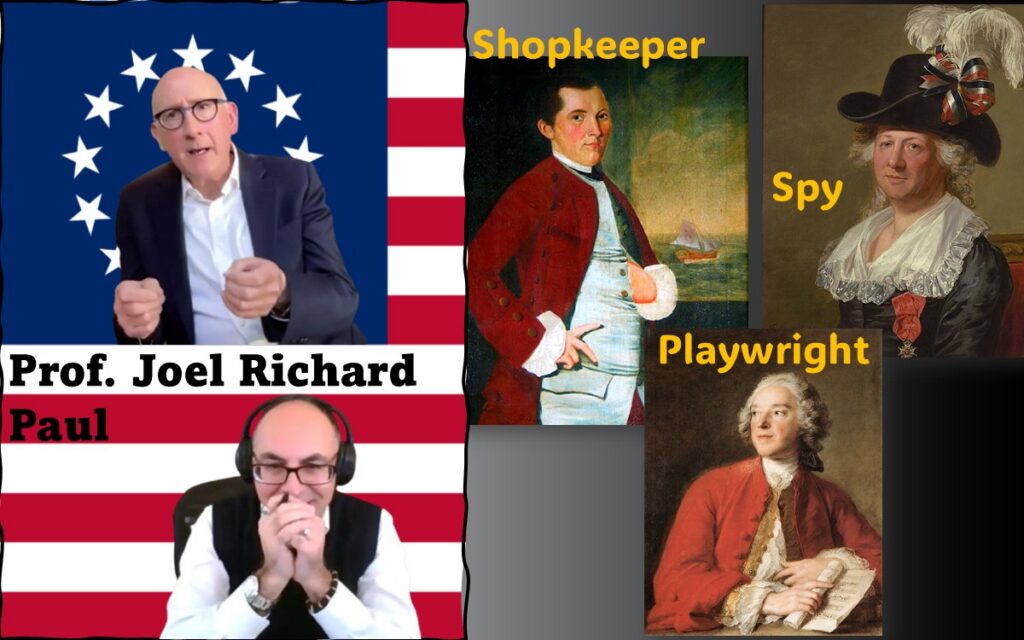
►My interview with Prof. Joel Richard Paul: Extraordinary Men (and a Woman?) Behind a Ludicrous Scheme That Worked Against All Odds
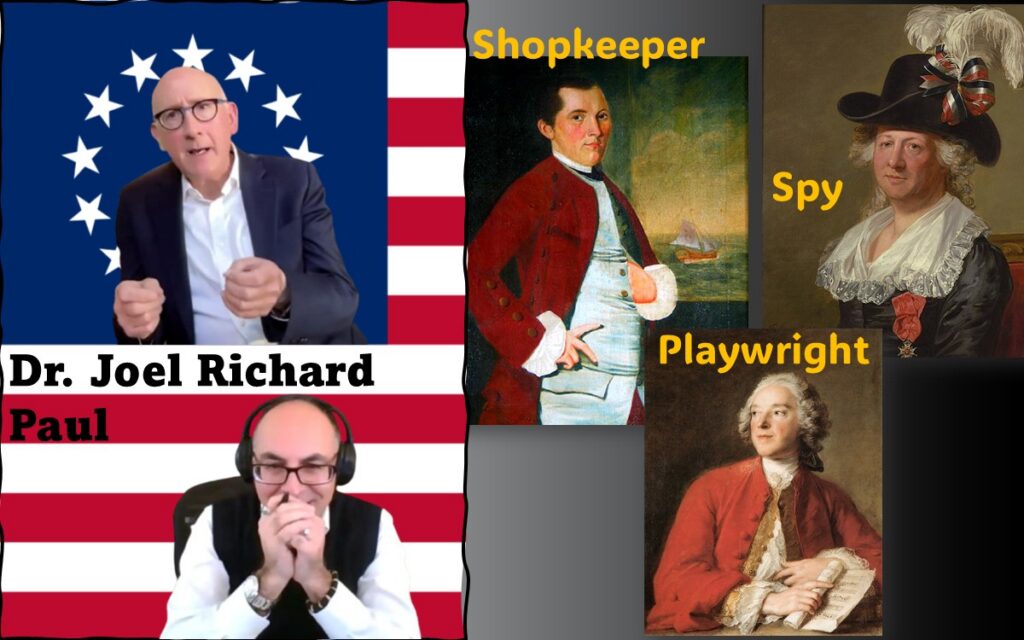 The Bizarre Plot That Armed the American Revolution
Spain
►Interview with Dr. Gonzalo Quintero: Spain & the American Revolution (will be linked here when it publishes)
The Netherlands
►Interview with Dr. Peter Van Cleave: Netherlands & the American Revolution
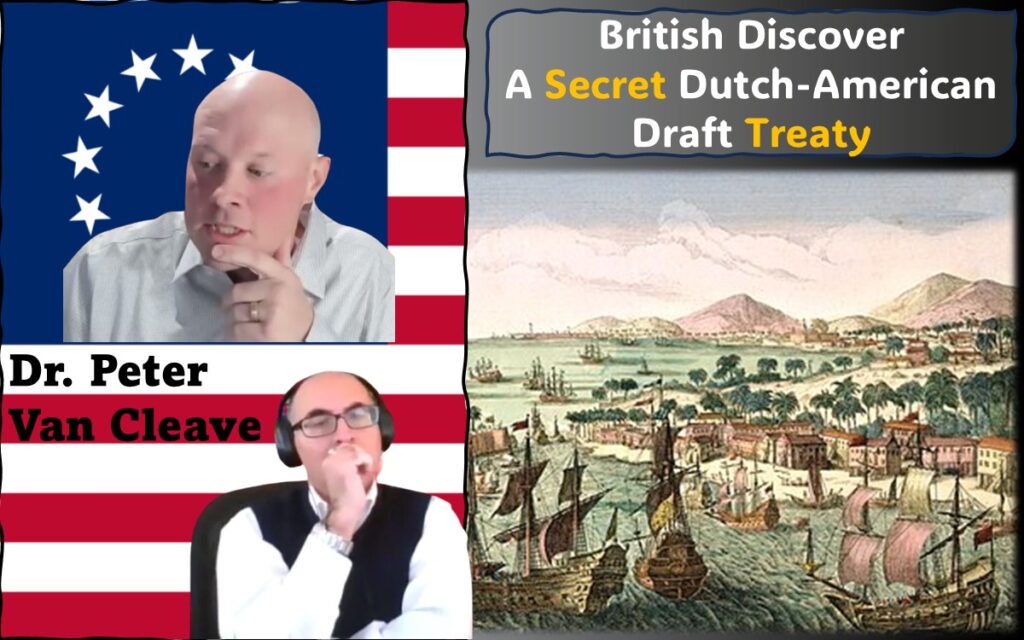 The Dutch Dilemma: Supporting the American Revolution
Ireland & Britain
►Interview with Dr. Richard Bell: Britain, Ireland & the American Revolution
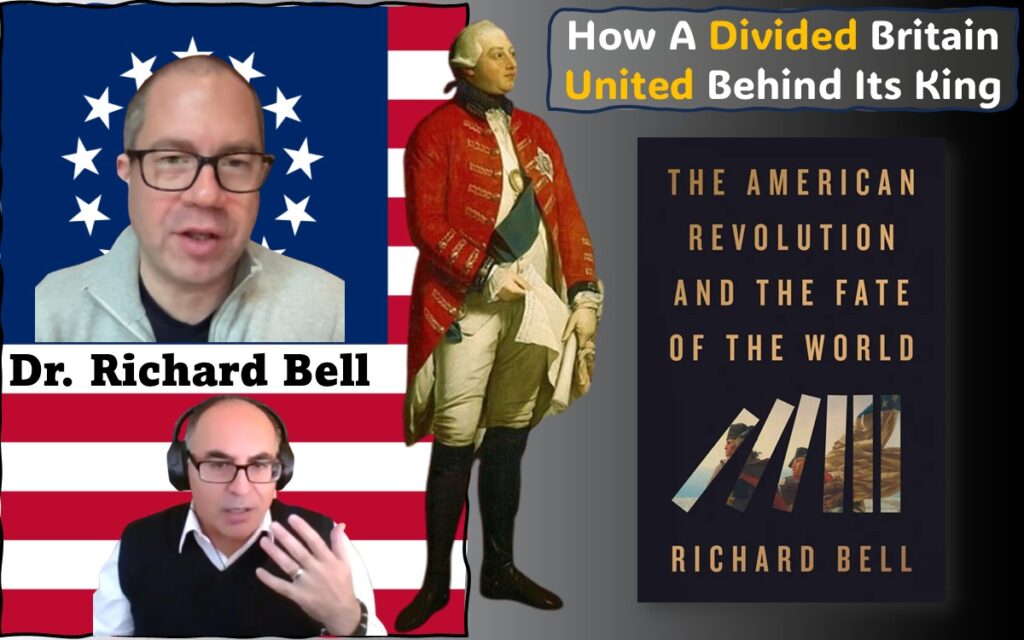 Rethinking King George III: the American Revolution From the British Perspective
About This Program
Analyzing American Revolution (AAR) is a special series podcast production of the History Behind News program. In this series, 33 professors (and counting) analyze the American Revolution from 33 different angles through in-depth interviews with host Adel Aali.
Meet Our Guest Scholars
A structured body of thought on the American Revolution—where leading scholars advancing distinct interpretations that give this program its depth.

Thematic Collection
Tap below for a closer look at the Revolutionary Era themes we examine—and to meet our guest scholars.

Library
- Interview Transcript Highlights
- Interview Image and Artist Highlights
- Quiz Answers and Backstories

Image Gallery
Explore the backstories and artist bios behind images of our Founding—before and after the American Revolution. These visuals shape how we remember—and reimagine—the Revolutionary Era.

Support AAR
AAR is an independent program built on sustained research, preparation, and production. Your support helps continue this series and expand our program.

Experienced Analysis of History
About HbN Program
The History Behind News program (HbN) is committed to making in-depth history researched and written by scholars enjoyable and accessible to everyone. Our motto is bridging scholarly works to everyday news.
The histories we’ve uncovered encompass an impressively wide range of subjects from ancient history to U.S. politics and economy to race, women’s rights, immigration, climate, science, military, war, China, Europe, Middle East, Russia & Ukraine, Africa and the Americas to many other issues in the news. We also receive advanced copies of scholarly books and discuss them in our program (in the context of current news).

Adel Aali, host. Snapshot from his introductory video to AAR podcast.
217 Scholars & Counting
Our guests are scholars at leading institutions. They are highly recognized, having received prestigious grants and fellowships as well as notable awards, including the Pulitzer Prize. They include celebrated documentary producers, former White House advisors and other high-ranking government officials, and current and former senior reporters of major national and international newspapers. Many have testified in Congressional hearings, and others frequently contribute to major media outlets and widely read publications.
Think You Know the American Revolution?