Updated: August 16, 2026
Introduction
In this interview: “May 13, 1779 is not a date well remembered by historians of the American Revolution, but it should be.”
Watch this segment in the video below (00:38:41)
Why did Benjamin Franklin enjoy greater access to Maria Theresa – Holy Roman Empress – than to Louis XVI – the French king?
Did Habsburg neutrality create opportunities to supply the American Revolutionary War?
Was the American Revolution a great commercial opportunity for the Habsburg monarchy?
How did the memory of the Seven Years’ War shape the Habsburg monarchy’s foreign policy toward the American Revolution?
If pursued, what would have been the impact of Vienna’s proposed 1781 peace negotiations? How different would the outcome of the American Revolution have been from the 1783 Treaty of Paris?
Why did the United States wait until 1838 to establish diplomatic relations with the Habsburgs?In this interview, Dr. Jonathan Singerton argues that the Habsburg monarchy was far more consequential to the American Revolution than its absence from most American history books suggests. Drawing on years of archival research, he explains how Habsburg diplomacy, neutrality, commerce, and peace initiatives shaped the Revolutionary era—and why America’s relationship with one of Europe’s greatest powers took decades to materialize.
Video
Watch the full interview with Dr. Singerton (timestamped outline below)
Key Themes
- Habsburg Neutrality and Revolutionary Diplomacy
- The American Revolution as a Cultural Phenomenon in Vienna and throughout the Habsburg Monarchy
- Habsburg Trade During the American Revolution and After the Treaty of Paris
- Vienna’s 1781 Peace Initiative and an Alternative End to the American Revolution
- Thomas Jefferson and Delayed U.S.–Habsburg Relations
Central Question
Did the Habsburg monarchy, an important European empire with the power to influence British, French, and Spanish international relations and military affairs, play a role in the American Revolution or attract the interest of American revolutionaries?

How to Use This Post
Use this post as reference guide to the American Revolution through the lens of this interview and the broader Analyzing American Revolution program (AARevolution). Navigate using the interactive table of contents above and the timestamps below (in gray) to discover how this interview deepens the story of the Revolution—and to explore how the program unfolds: its key themes, insights, image gallery, scholars list, history quizzes, and related interviews across the series.
Why the Habsburg Monarchy Mattered to the American Revolution
The Habsburg monarchy was one of Europe’s largest and most influential powers during the American Revolution, yet it occupies little space in most American accounts of the conflict. As Dr. Jonathan Singerton explains, Habsburg neutrality created commercial opportunities, attracted American diplomacy, and even opened the possibility of a negotiated peace before the 1783 Treaty of Paris. Benjamin Franklin, John Adams, and the Continental Congress all recognized the strategic importance of the Habsburgs and sought closer ties. Understanding their role reveals that the American Revolution was not simply a struggle between Britain and its colonies, but part of a much broader European contest over diplomacy, commerce, and power.
Rather than serving as a military ally, the Habsburg monarchy shaped the Revolutionary era through its diplomatic influence, neutrality, and commercial potential. Vienna’s proposed peace negotiations in 1781 offered an alternative path to ending the war, while Habsburg ports and markets presented new opportunities for American trade. At the same time, the American Revolution became a subject of widespread interest throughout the Habsburg monarchy, attracting the attention of political leaders, intellectuals, merchants, and the public alike. Although the United States would not establish formal diplomatic relations with the Habsburgs until 1838, American leaders understood that one of Europe’s greatest powers could not be ignored.
About My 225th Guest: Dr. Jonathan Singerton
Dr. Jonathan Singerton is a professor for Global Political History at the Free University of Amsterdam (Vrije Universiteit Amsterdam), where he specializes in global approaches to Habsburg history in the eighteenth and nineteenth centuries.
This interview is based on his book The American Revolution and the Habsburg Monarchy, which was awarded the Liechtenstein Prize for Outstanding Research.
About This Post’s Featured Image
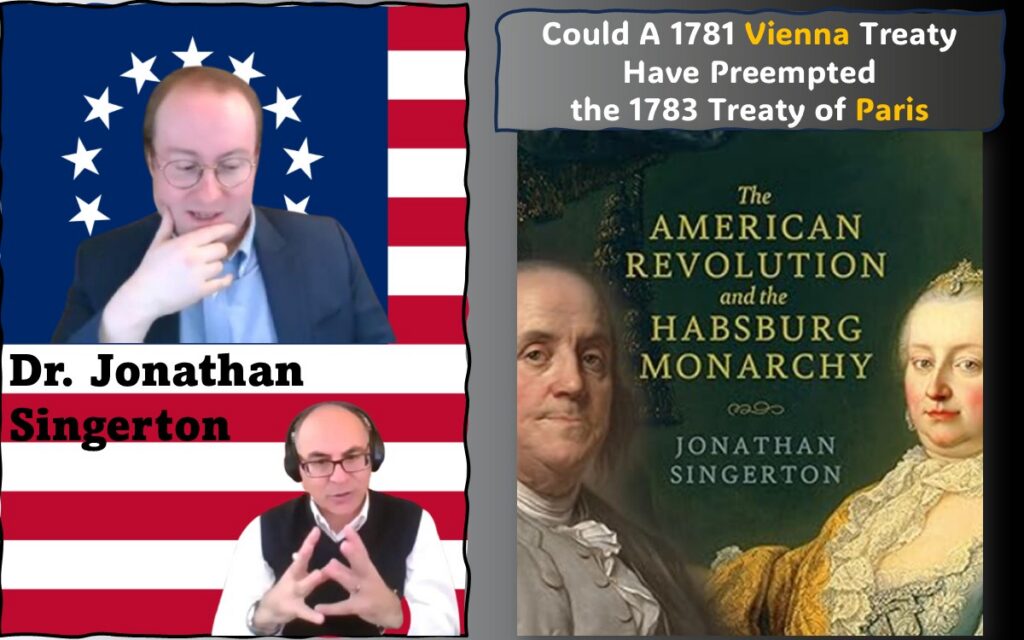
Image of Adel Aali (program host) and his guest, Dr. Jonathan Singerton, superimposed on the Betsy Ross flag, along cover image of “The American Revolution and the Habsburg Monarchy” , a book by Dr. Singerton that we discuss in this interview.
Unless otherwise indicated, all images in AAR—including those in this post—are in the public domain.
AAR Essential Insights
Although the full video and transcript of my conversation with Dr. Singerton are included in this post, I’ve selected and summarized several insights that I found particularly revealing and worth emphasizing. These moments — some surprising, others that challenge familiar assumptions — help us see the Habsburg monarchy and the American Revolution in a different light.
By the way, these insights are my own takes and interpretations from the interview. For Dr. Singerton’s perspective and exact framing, please watch the interview above and view the transcript below in the corresponding sections.
How The American Revolution Captivated and Troubled the Habsburgs
One of the most fascinating revelations in this interview is that the American Revolution became a cultural phenomenon in European lands beyond Britain, France, and Spain—the powers we usually associate with the Revolutionary War. But, as we will note, a cultural phenomenon does not make foreign policy.
Long before the American colonies could prove their Declaration of Independence had a real shot at materializing independence, people across the Habsburg monarchy were reading about events in America, debating them, and following the Revolutionary War with remarkable interest.
Although this is a story that has been largely overlooked in the annals of the history of the American Revolution, Dr. Singerton brings this forgotten world into focus. As he tells it, merchants named their children after Benjamin Franklin, Silas Deane, and Arthur Lee. News from America circulated well beyond royal courts, reaching educated readers throughout the Habsburg lands. And while Franklin in France could not get the attention of Louis XVI, from France he had access to the Empress of the Holy Roman Empire – Maria Therea.
These are powerful signs that the American Revolution had captured the Habsburgs’ imagination. But imperial foreign policy is not built on fascination, and, in this case, the Habsburg government’s policies could not reflect public sentiments towards the American cause.
The prime reason for this divergence is the Habsburg monarchy’s steadfast determination to remain neutral in the American-French-British military conflict. Undoubtedly, Empress Maria Theresa did not want her empire to be engulfed in another European-wide conflict similar to the Seven Years’ War.
Admiration for the American struggle could coexist with a monarchy determined to remain neutral. That distinction becomes one of the central themes of this interview. The Habsburg monarchy did not simply ask whether the Americans deserved support. It also had to ask what neutrality required, what Britain’s reaction might be, and how its own interests could best be protected.
That, to me, is one of the interview’s most valuable contributions. It reminds us that the American Revolution was not unfolding only in Philadelphia, London, or Paris. It was unfolding in the minds of people across Europe, where it became a political question, a diplomatic challenge, and, just as importantly, a cultural phenomenon.
Watch this segment in the video above (00:20:39)
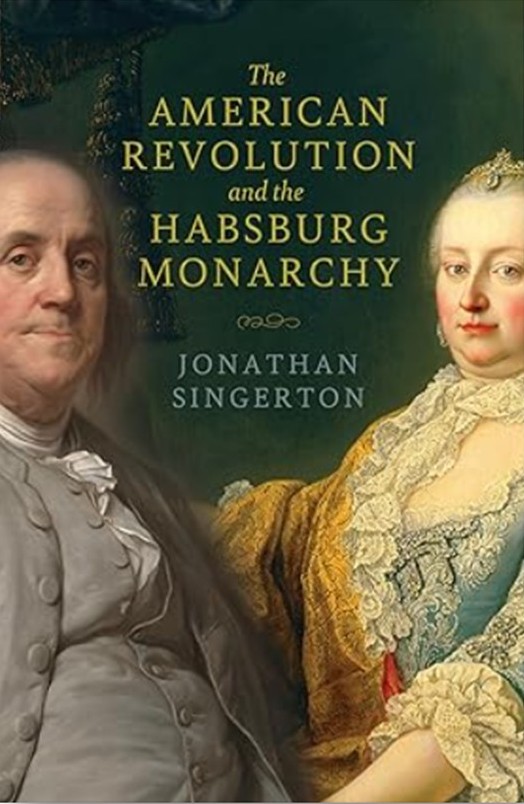 Dr. Singerton’s book discussed in this interview.
Cover images: Benjamin Franklin and Maria Theresa, Holy Roman Empress
In this interview, Dr. Singerton explains how Benjamin Franklin, while in Paris, had access to the Empress in Vienna.
Watch this segment at 17:28
Why Americans Should Know This Date: May 13, 1779
May 13, 1779, is not a date that most Americans associate with the Revolutionary War. Admittedly, before reading Dr. Singerton’s work, this date had no significance for me, even though I had read and researched the American Revolution quite a bit. But by the end of my conversation with Dr. Singerton, I found myself agreeing with him: May 13, 1779, is a date we Americans should remember.
On that date, the Peace of Teschen (also known as the Treaty of Teschen) was officially signed primarily between the Austrian Habsburg Monarchy and the Kingdom of Prussia, with France and Russia acting as guarantors. So how does this relate to the American Revolution, you may rightfully ask?
Its significance lies not in what it did for America directly, but in what it prevented.
Had the War of the Bavarian Succession, which the Peace of Teschen ended, expanded into a much larger European conflict, France might have been forced to redirect its money, attention, and military resources back to the Continent. That, in turn, could have diminished its support for the American cause at one of the most critical moments of the Revolutionary War.
From the British perspective, this was precisely the opportunity they had hoped for. During the Seven Years’ War, Britain had benefited enormously from France being forced to fight on multiple fronts—both on the Continent and in North America.
So it’s not much of a stretch to conclude that a wider European war in 1778-1779 might have recreated those same conditions. Thankfully for the Americans, the Peace of Teschen closed that window.
History often remembers the battles that were fought. This episode reminds us that sometimes history is shaped just as much by the wars that never happened. The Peace of Teschen did not win American independence, but it may have helped preserve the French alliance that made independence possible.
Watch this segment in the video above (00:38:26)
A Peace Proposal That Could Have Divided the American Colonies into Multiple Nations
The Treaty of Paris is one of the best-known diplomatic milestones of the American Revolution. Far less known is that, before the war ended, the Habsburg monarchy explored the possibility of hosting a peace conference in Vienna. Although the proposal never came close to materializing, some of the ideas discussed during these diplomatic efforts reveal just how differently the American Revolution might have ended.
One proposal reportedly envisioned Britain retaining control of Georgia and North Carolina, while the remaining colonies would form a separate American state. Another concern was that the colonies might negotiate with Britain individually rather than as a united front. To John Adams, these ideas represented a dangerous threat to American independence, prompting him to describe the proposal as “the most insidious and dangerous snare that ever was laid for the United States.”
Whether any of these proposals had a realistic chance of succeeding is almost beside the point. Their real value lies in reminding us that the final shape of the United States was not necessarily inevitable. Even during the closing years of the Revolutionary War, European diplomats were still considering political settlements that looked very different from the nation that ultimately emerged.
History remembers the Treaty of Paris. But these forgotten diplomatic discussions remind us that America’s future was shaped not only on the battlefield, but also around negotiating tables where very different maps of North America were still being imagined.
Watch this segment in the video above (00:41:18)
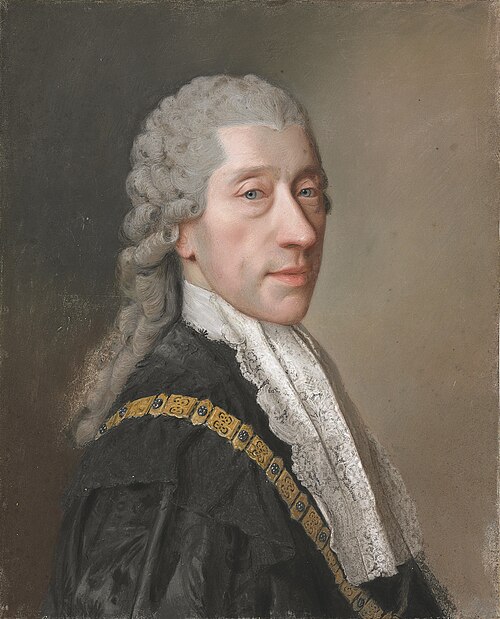 In 1781, Prince Wenzel Anton von Kaunitz, Austrian State Chancellor for nearly four decades, orchestrated a peace proposal to end the American Revolutionary War. His initiative sought to convene a European peace congress in Vienna. In this interview, Dr. Singerton explains how this initiative came about, why it was never adopted, and what consequences it might have had for the American states. This image is a 1762 portrait of Kaunitz wearing the collar of the Order of the Golden Fleece.
Watch this segment at 46:31
How the American Revolution Became a Blueprint for Revolution in Europe
The American Revolution did not simply create a new nation. It also created a political model that others sought to emulate. One of the most fascinating findings of Dr. Singerton’s research is his demonstration that people across the Habsburg monarchy were not merely watching events in America—they were learning from them.
The clearest example came in the Austrian Netherlands (modern-day Belgium). When opposition to Emperor Joseph II’s reforms erupted into revolution, the rebels proclaimed the United Belgian States, also known as the United States of Belgium—a name deliberately modeled on the United States of America. Even more remarkably, one of their leading figures, Hendrik van der Noot, became known as the “Franklin of the Austrian Netherlands,” and contemporary observers recognized striking similarities between the two revolutions.
The American example also resonated elsewhere in the Habsburg monarchy. Hungarian reformers drew inspiration from the American struggle for liberty, while French observers viewed unrest in Transylvania through the lens of the American Revolution, arguing that rulers who ignored the rights of their people risked the same consequences that had befallen George III, King of Great Britain.
To me, this is an important lesson from the interview. Most of us learn about the American Revolution as a national story. But as we learned from my interview with Dr. Sophia Rosenfeld, the European Enlightenment helped shape the intellectual foundations of the American Revolution. In turn, the success of the American Revolution became a blueprint for revolutionaries in Europe.
Taken together, these examples remind us that the American Revolution is not simply an American story. It is an international one. Its influence extended far beyond the thirteen colonies, becoming a source of inspiration—and a point of comparison—for people across Europe who were beginning to rethink liberty, rights, and the relationship between rulers and the governed.
Watch this segment in the video above (00:59:14)
Why It Took the United States More Than Fifty Years to Establish Relations with the Habsburgs
When the American Revolution ended, the United States faced a new challenge: transforming military victory into diplomatic recognition. Establishing relations with the Habsburg monarchy, one of Europe’s most powerful empires, became an important diplomatic objective for the young republic.
Forging a treaty with the Habsburgs was an effort that began even before American independence was secured. In 1777, Joseph II hoped to meet Benjamin Franklin in Paris, but the meeting never took place after British officials intervened. The following year, William Lee traveled to Vienna as an unofficial American representative, only to encounter British meddling and interference, complex diplomatic protocol, and his own inability to gain meaningful access to the Habsburg court.
After the War, John Adams became the strongest American advocate for closer relations with the Habsburg monarchy. Recognizing Austria’s political influence and growing commercial opportunities, he worked to lay the foundation for a treaty of commerce and friendship. And it appears that by the mid-1780s, serious discussions were underway.
Then Thomas Jefferson entered the story.
Unlike Adams, Jefferson saw little strategic value in cultivating relations with the Habsburgs. Dr. Singerton argues that Jefferson’s skepticism toward absolute monarchy—and his handling of the negotiations—effectively derailed the process. The result was extraordinary: despite being one of Europe’s foremost powers, the Habsburg monarchy became the last major European power to establish formal diplomatic relations with the United States.
To me, this is one of the interview’s most surprising lessons. We often remember the Founding Fathers for securing American independence. Less well known is their effort to secure the new nation’s place within the international community. As Dr. Singerton demonstrates, that effort was neither straightforward nor uniformly supported—even among the Founders themselves. In the end, it was shaped as much by personalities and competing visions of American foreign policy as by diplomacy itself.
Watch this segment in the video above (01:07:46–02:01:38)
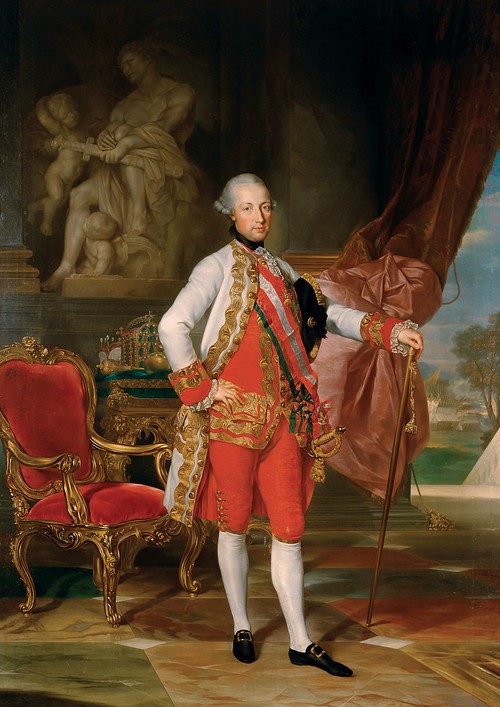 Joseph II (1775), Holy Roman Emperor, eldest son of Empress Maria Theresa
and brother of Marie Antoinette (Queen Consort of France, wife of Louis XVI)
In this interview, Dr. Singerton tells the story of how the British scuttled the Emperor’s plans to have “hot chocolate” with Franklin.
Watch this segment at 01:14:15
The Interview (S1E30): Adel Aali and Jonathan Singerton
In our conversation, Dr. Singerton addresses key questions and reveals untold stories about the Habsburg monarchy and American Revolution. The detailed outline and full transcript below supplement the video above.
Podcast
Watch the full interview on this page with the outline and transcript below, or take the conversation with you on the go through our Spotify podcast.

Outline
Use the in-depth outline below, with its key moments and turning points, to follow the discussion and navigate the interview.
Click for Timestamped Outline
- Selected Highlights (00:00:00)
- Guest Introduction (00:03:02)
- Defining Important Terms (00:05:18)
- The Holy Roman Empire, the Habsburg Monarchy, and the Austrian Empire (00:07:21)
- Why “Habsburg Monarchy” Is the Most Accurate Term (00:11:54)
- Were the Habsburgs an Atlantic Power? (00:12:46)
- Trieste, Fiume, and the Habsburg Mediterranean Ports (00:13:38)
- Ostend and the Habsburg Connection to the Atlantic World (00:15:49)
- Benjamin Franklin’s Access to the Viennese Court (00:16:05)
- Jan Ingenhousz as Franklin’s Link to Maria Theresa (00:18:12)
- Franklin’s Unparalleled Access to the Habsburg Monarchs (00:20:27) – Key Moment (00:20:33)
- The American Revolution as a Cultural Phenomenon (00:20:57)
- How News from America Captivated the Habsburg Lands (00:21:30)
- Benjamin Silas Arthur Schuster and America’s Cultural Appeal (00:22:24)
- Habsburg Neutrality and the Business of War (00:25:14)
- Joseph II and “British Despotism at Sea” (00:27:19)
- The “Garb of Neutrality” and Disguised Shipping (00:28:13) – Turning Point (00:29:31)
- Ostend and the Commercial Boom of Neutral Trade (00:30:23)
- The Explosion of Shipping Through Ostend (00:30:53)
- How Merchants “Ostendized” Their Ships (00:31:39) – Key Moment (00:32:02)
- Vienna’s 1781 Peace Initiative (00:46:31)
- Proposals to Divide Britain’s North American Empire (00:46:53)
- Could the War Have Ended with a Peace of Vienna? (00:47:27) – Turning Point (00:47:32)
- How the American Revolution Affected the Habsburg Lands (00:55:05)
- Winners and Losers in Habsburg Trade (00:56:04)
- Revolutionary Influence in the Austrian Netherlands and Hungary (01:10:54)
- Joseph II, Benjamin Franklin, and American “Militia Diplomacy” (01:11:25)
- Joseph II’s Attempted Meeting with Benjamin Franklin (01:12:20) – Key Moment (01:17:47)
- William Lee’s Uninvited Mission to Vienna (01:21:29) – Turning Point (01:32:24)
- Thomas Jefferson and the Failure of U.S.–Habsburg Diplomacy (01:56:43)
- John Adams and Thomas Jefferson’s Different Views of the Habsburgs (01:57:58)
- Habsburg Treaty Efforts and Jefferson’s Delays (02:04:15) – Turning Point (02:04:39)
- Just One Point (02:26:17)
- The American Revolution Was Part of a Wider Global History (02:26:59)
Transcript
Note: This transcript was generated automatically and may contain minor errors. It is provided for reference and accessibility only.
Click to View Transcript
Adel:
Dr. Singerton, it’s a pleasure to have you on our program’s special series. Thank you for taking the time for this conversation with me about the American Revolution. So I want to speak with you about your book, which is titled The American Revolution and the Habsburg Monarchy, which I read cover to cover, very much enjoyed it, and learned a great deal about Europe, the American Revolution, and our founding fathers.
And we’ll get to all of that momentarily. But before we dive into it, I got to ask you to define and sort of clarify and differentiate these following terms that sometimes are used interchangeably, and I wonder if they are. And the terms are as follows.
The Holy Roman Empire, the Habsburg Empire, and the Austrian Empire. You could see like the confusion that that could cause.
Dr. Singerton:
Absolutely. So first of all, thank you for having me on. It’s really a great pleasure, and I’m very encouraged by your words about the book.
So I really value that. And then secondly, yeah, it’s absolutely important to begin with, where are we? Because when I started this book, when I was a PhD student, essentially, and when I was writing my PhD on this topic, that’s the question I’d get most, especially in the United States, was where are the Habsburgs?
Is this the Spanish? Is this the Austrian? You know, where essentially are we situated with this?
So it’s good to start off with that. You’re quite right. And to break those three points down, so first of all, the Holy Roman Empire and the Habsburg Empire and the Austrian Empire, these are, you know, really quite distinct terms.
Adel:
Distinct.
Dr. Singerton:
You know, the Holy Roman Empire is something we might all be a little bit familiar with as this sort of conglomeration of states. You know, if you look at an old map of Europe, you see in the center this completely atomized, fractured land. You know, it’s not Germany as we know it as one nation or one place.
But instead, it’s a political, supranational sort of conglomerate of many different principalities and little states. There are some large ones, most notably in the early modern period, the Kingdom of Bohemia and so on like this. But at this time of the revolution is still this very, let’s say, fractured Central European German sort of state in the middle of Europe.
What’s important for us, I think, is that they are headed by an emperor who is elected by a series of electors. And the emperor, for most of its history, from really the 1400s when they first bribed their way in, of course, the Habsburg members of the Habsburg dynasty. So they have controlled essentially this Holy Roman Empire throughout most of its history with a short break in the beginning of the 18th century.
So that’s really relevant for us. If I move to the Habsburg Empire itself, this is not really a term that is, let’s say, historical. It is one that is applied or come out of the historiography.
So historians apply this term as such. They did not call themselves the Habsburg Empire. They called themselves many other things.
But this is essentially trying to reflect what is the composite monarchy that is ruled by the Habsburg dynasty. And what do I mean by composite monarchy? Well, it is essentially, again, a cluster or conglomeration of states.
But they have many different constitutions and constitutional levels and so on like this. So one is a principality, the other is a kingdom, the other is an archduchy, the other is just a duchy. But all together, they are ruled over as one sort of political union by the Habsburg monarch.
Adel:
Oh, kind of like Tuscany, which you talk about in your book. I see. I see.
OK.
Dr. Singerton:
So Tuscany is a bit of a special case, because I found it to be really important within the whole story. And we’ll touch upon that later. But Tuscany, after the Medici die out, essentially comes to the Habsburgs and they don’t incorporate it.
This would upset the balance of Europe too much. So it is given to the second son, and this is known as a second janitor. So it will always, let’s say, stay with the family, but it will not be in the main line and therefore absorbed into the main state.
Now, this happened occasionally, but this didn’t happen with Tuscany.
Adel:
And by second son, meaning that the person that was not heir to the throne, but they wanted to give him some sort of important role anyway. So hence the…
Dr. Singerton:
No, that’s helpful too. Yeah, exactly. With family relations in mind, that’s also helpful.
But it was really to make sure that it doesn’t, let’s say, fall completely into the Habsburg orbit as such. I see. But as I point out, you know, it has a role to play.
And of course, the ties then between Florence and Vienna are quite strong due to this whole personal dynamic and these relations. And in this period especially, because the Holy Roman Emperor, the sort of Emperor of Austria as such, is a man called Joseph II and his brother Pietro Leopoldo in Tuscany. They get on, of course, but it’s known that Joseph does not have an heir.
He had two marriages, they ended quite badly, wives died on him. So he was a very unfortunate man in that sense. So it was always known that Pietro Leopoldo will become essentially the Emperor later on, and then his second son would take over Tuscany rather than his direct line, his first male heir.
But that’s how complex the Habsburgs can be. So we’ve already digressed a little bit.
Adel:
That’s okay. How about Austria, the Austrian Empire?
Dr. Singerton:
Yeah. So to return to the Austrian Empire, this is where it gets a little bit more complex yet again. This is really a good label for what is an actual state as such, right?
So between 1804 and 1867, there was an Austrian Empire by that name and used by that name. And that really came about in 1804 because of the Napoleonic threat. So it’s Napoleonic Wars, Napoleon has marched across parts of Europe, he’s brought the Habsburgs in a certain way to their knees, and there’s a great fear that his dominance and his power in the Holy Roman Empire means that he could strip that away from them.
And so there are moves already in 1804, just before that, to install the emperor, the Holy Roman Emperor, as an emperor in his own right. And they do this by essentially uplifting the Austrian lands and calling that an empire, declaring that to be such an empire. And then the emperor at the time, Franz or Francis, changes his number.
So from Franz II to Franz I, because of course, now he’s the first Austrian emperor as such with that name.
Adel:
Oh, interesting. Interesting.
Dr. Singerton:
So it’s done essentially against the Napoleonic threat, and for that reason, we have then this Austrian Empire from 1804 until the middle of the 19th century, when a political compromise is reached with the Hungarians, and essentially the empire is divided into two halves, two equal halves, essentially ruled over by the Habsburg monarch, but with their own parliaments and their own political structures separately. And that’s what we tend to call Austria-Hungary in English discourse, although it wasn’t officially called that at the time either.
Adel:
So lots of labels and lots of terms that are actually historically important. So for the purpose of our conversation, Dr. Singleton, should we refer to it as the Habsburg monarchy, the Habsburg empire? What do you suggest?
Dr. Singerton:
Well, like the name of the book, I call them the Habsburg monarchy because I think that’s the most appropriate label. They were, again, a composite monarchy. I don’t quite like the name empire, although that’s, again, let’s say used by many other scholars and is a good blanket term perhaps for the entire history.
I think the problem with empire in that sense is that we tend to think of them in the line of the British empire, the Spanish empire, the French empire, and so on like this. They were a colonial empire, there’s no doubt about that. They had forays into the colonial world even during the American Revolution and because of it.
So I think that’s appropriate, but I think it’s best to call them the Habsburg monarchy because we’re dealing with these lands in Central Europe and their lands are somewhat minimal to the main story. So for that reason, I think the Habsburg monarchy is.
Adel:
Sounds good. We’ll stick to that. So I want to, let’s do a little, just a brief geography lesson, because I think, Dr. Singer, this will be very important for our conversation, was where the lands within charge of the Habsburg monarchy, were they like, was the Habsburgs, let me ask you this, were the Habsburgs an Atlantic power?
Dr. Singerton:
Yeah, this is a good question. I mean, I sort of argue in the book that they are not necessarily an Atlantic power, but they’re of course affected deeply by what’s happening in the Atlantic, you know, because they are Mediterranean power. They have a very important port on the Adriatic coast, Trieste, which is their sort of main export port for the Austrian lands, and Fiume or Rijeka in Croatia today, which is their main one for the Hungarian lands.
But where they are also, let’s say, deeply affected and tied into the sort of Atlantic world, as we call it, is in Ostend, because Ostend is part of, or Ostenda is part of nowadays Belgium, back then it was the Austrian Netherlands. And again, this is, it has a very long story. It comes from the Burgundians and the inheritances passed through the line to the Spanish of Charles V, think of him, for example, and then eventually it becomes a part of the Austrian patrimony in this century.
So in 1714, with the Treaty of Rastatt.
Adel:
So the fact that they have, if I may interject, please, Ostend, or Ostend, or the way, when I was there, they pronounced it, I think Ostend or something like that. It has, I don’t know, like a few miles of coast on the North Sea, and that leads to the Atlantic Ocean, obviously. Does that not make the Habsburgs then also an Atlantic power?
Because the Netherlands also doesn’t have a coast on the Atlantic. It has a coast just to the North Sea, yet we think of the Netherlands, I think, kind of like a Atlantic power, right?
Dr. Singerton:
Yeah, yeah. I think it’s, I think it’s a good point, but I mean, here, you know, you have Ostenda on the coast and it’s tied into the, through canals and so on like this, to Bruges and to Ghent, and then in further inland as well. They have another port, famously, right, Antwerp, which in many ways is the centre of the capitalist world in the early modern period.
But that’s exactly why the Dutch shut that down. So it’s not, they’re not allowed to trade, essentially, on the main river, the Scheldt River, that leads to the ocean, to the North Sea, and then further to the Atlantic. Why do we think then, perhaps, of the Austrian Netherlands as not being Atlantic, and maybe the Dutch Republic as being Atlantic?
Well, I think because the Dutch have territory in the Atlantic, right? And famously, New Amsterdam was New York. They have other colonies and, you know, and coastlines out there as well.
So, so I think it’s really the Dutch are an Atlantic power, but I, I would be hesitant with this, with the, the Austrians, because really it’s by extension, it’s by proximity to the Atlantic in a certain sense. But the point I make in the book is that, and we’ll get into this, I’m sure, is that Ostend becomes this sort of centre for neutral trade. And that really makes them plugged into then this, this Atlantic trade.
Adel:
That’s a really fascinating story, and we’re going to get into it. So let’s, let’s start it. Let’s, let’s get into the meat of our discussion, which is the Habsburg monarchy and the American Revolution.
And I’ll start the discussion by going to page 54 of your book. In there, you explain how, this was, this really stuck out for me, I’ve, I’ve read about this period. I’ve interviewed other scholars, and here you explain that Benjamin Franklin gained unrivaled access to the Habsburg monarchs, unlike anywhere in Europe.
And you also sort of infer that the American Revolution was a cultural phenomena in the Habsburg monarchy. So I’ll just add a couple of, another line, if I may, please. And on page 48, this is what you say.
I think this brings the point home. In France, American envoys waited on invitations to speak with the king, whereas in Vienna, their desired words could be translated and delivered personally to the Habsburg monarch. The funny thing about this, Dr. Singerton, is that it was the French who end up becoming our ally and not the Habsburgs. So please explain all of this to us. Were the Habsburgs pro-American? What’s the story here?
Dr. Singerton:
Well, there’s a lot to unpack there, but absolutely, I’m glad you picked up on those points. I mean, you know, I think it’s important that when Franklin arrives in Paris or in France at the end of 1777, you know, he’s fated as a great American and as perhaps the most famous American alive at that time. But that only gets you so far to some degree, right?
There’s still a lot of negotiation until the French are sort of entering the war and formal allies. And, you know, Franklin has a lot of inroads in the French court. But the point I make is that despite never being in Vienna, he also has inroads there.
And that comes through his persona, that comes through his personal contacts. And I make a big point in one of the chapters of the book where I explain the role of Jan Iggenhaus, who was a Dutch physician. He was sort of court doctor, although not officially, to Maria Theresia, and he was a very sort of enlightened polymath, right?
He is the person who sort of discovered or first described the process of photosynthesis, right? That was his sort of big claim to fame. And he knew Franklin very well.
They were both in Britain in the years before the Revolution. That’s how they met. That’s how they corresponded.
They were interested sort of scientifically as two scientific minds. And Iggenhaus really is a sort of crucial link then for Franklin in the in the Viennese court. And first of all, he’s a crucial link because, you know, they’re corresponding, they’re letting each other know what happens.
But later, Iggenhaus becomes a sort of defender of Franklin’s, right? He is a bit dismayed about the British ambassador in Vienna spreading rumors, you know, trying essentially to smear the American cause and these things. And so he writes essentially polemics to argue against this.
But he has the ear of people like Maria Theresia, who he sees not on a one to one basis, but he has close contact and proximity to the court. And again, as a well-respected scientific mind, he was brought there as well, you know, especially for his self-prowess, intellectual prowess. He has that sort of clout that he can bring with him.
And Iggenhaus, I found he wrote several essays defending Franklin. He passed on sort of, let’s say, letters that Franklin wished to be seen by the courtiers or by Maria Theresia. And he wrote certain things to try and persuade her, you know, think what would happen if the British do reconquer the colonies or if they take the colonies, right?
The British would be too powerful. So we need to do something about that, for example. And when she died, she dies in the middle of the war, roughly, and her son takes over.
He has the same, let’s say, sort of influence with him as well, not to the same degree, of course, as his mother, but a similar one where he can again share sort of American propaganda in that sense. So he’s really a crucial link between, let’s say, Franklin and the Viennese court. And that’s what I mean by, you know, Franklin would have to wait to see the French king.
But in Vienna, he could simply write a letter to his friend Jan Iggenhaus and it would be read by Maria Theresia within the month. So I really think this is a very sort of pivotal and crucial and in some ways very unparalleled access that Franklin and other revolutionaries had via Franklin to the Viennese court.
Adel:
For sure. And that’s that’s why I picked up on that. And you also use the term cultural phenomena.
Dr. Singerton:
Yeah.
Adel:
Please explain that.
Dr. Singerton:
That’s a good one, because I make sort of the argument in the book that, you know, there’s a diplomatic problem of the American Revolution for the Habsburgs, what you do, what side you take, that kind of thing. There’s an economic opportunity so they can make a bit of money and we’ll get probably into that when we discuss Ostend again. And then there’s the cultural phenomenon.
And I think you can’t separate these three things because they matter so much and they speak essentially to the entire impact of the American Revolution in places like the Habsburg monarchy. What do I mean by then cultural phenomenon? Well, I mean, essentially, how people were obsessed by what was happening in the news in America.
Adel:
By people, do you mean generally the population or the upper class, nobility and aristocracy? What do you mean by people?
Dr. Singerton:
People who could read or had access to newspapers or to literature in some way all heard that through word of mouth. I think that there’s a lot of people. Yeah, there’s a lot of evidence that there are sort of changes like this.
There’s one famous Hungarian writer who says, well, this event, we looked back on the American Revolution a few decades later and he said, well, this really changed everything. You know, what were our discussions in villages other than, you know, which dog was better? And who among us knew whether the Atlantic Ocean was east or west?
Or we all do now. That’s what he was sort of saying. You know, it sort of put America on the map as such.
And so that’s something. Yeah, there are merchants who name their children after people. So there was one, I start the book with one of them, Schuster, who names his son, Benjamin Silas Arthur Schuster, because he wants to honour the three American representatives in Paris, Benjamin Franklin, Silas Dean and Arthur Lee.
So I think it also speaks again to like this power, this gravity that the American Revolution had as a cultural phenomenon, as a sort of occurrence that attracted people’s fascination and attention. And certainly in the court, that was true. They were sort of a buzz with what was going on there, a bit like we are today in the news.
We all follow certain events and current events. You know, it doesn’t matter necessarily what our position is on them. We’re all engaged and fascinated or observant of these things.
And that’s the same thing in Vienna, essentially. That’s across the monarchy, I would argue.
Adel:
I understand the cultural phenomenon now. Yeah. But that’s still.
Well, that still doesn’t answer my question of whether or not the Habsburg monarchy was pro-American or not. And to give credit to both of us, my question is very simplistic because this develops over years and as we’ll discuss over decades. So what I what I’ll suggest and tell me if I’m wrong, there’s a warm, positive feeling.
I think in your book you even use the use the term warm, some warmness towards America. We’re going to talk about sort of sift that out. This is what I want to.
Does the monarchy at some point sour on America?
Dr. Singerton:
Yeah, I think there’s a good point, right? So, you know, first of all, about the position, I mean, I do argue in the sense that there is this widespread perception that there’s a positivity. And I think it’s important to say that that’s because the American Revolution wasn’t something negative and it was not something too radical.
Right. It was as it was portrayed by the revolutionaries, the founders themselves, essentially a struggle for liberty and for their rights. This is what the Declaration of Independence announces.
And so it wasn’t seen as something that is necessarily against a monarch, but against tyranny. And I think that sort of message of liberty is what resonated amongst intellectuals or nobility or or whatever kind of label you want to ascribe to people who were essentially able to read about the revolution or hear about it and discuss it. I think it was this noble cause that they sort of most most sort of adhered to.
When it comes to whether then this has sort of, let’s say, a political position of the monarchy, I think in some ways where you say whether they soured. This certainly happens, right? There’s certainly a degree which the revolution is a cultural phenomenon and it interests people, but it becomes very quickly overnight a diplomatic problem.
Right. If the Habsburgs are going to remain neutral in this war, then they have to fight to remain neutral. And I don’t mean take up arms or anything like this.
I mean, I mean that they have to make sure they toe that line. And that becomes a really difficult thing in many sort of flashpoints throughout the revolutionary years. There is a souring then in that case because they see it as an imposition.
They see it as a sort of problem. When I say they, I mean, again, the sort of ruling class or the leaders, the statesmen, particularly Joseph II, the emperor, who sees it that way. But I think that this souring doesn’t really occur until as a sort of mass phenomenon doesn’t really occur until the French Revolution, because it’s it’s only after the French Revolution where they see it as a let’s say, you know, all revolution is too far and too radical and gone are the good days and these kinds of things.
So it’s really a bloodbath by France. It’s a problem.
Adel:
Yeah. There are several. Terms that you use in your book, you’re quoting different Habsburg monarchy officials, and they’re just really delicious, I’m just going to use them here.
One on page ninety one, you and this deals with the difficulty in maintaining neutrality. One of it is on page ninety one, British despotism at sea. And on page ninety four, you talk about garb of neutrality rather than lawful neutrality.
And I think those tie in together. Do you care to talk about that a little bit?
Dr. Singerton:
And of course, so the despotism at sea was was uttered by Joseph, the emperor, because he, you know, he was responding essentially to the problem of the British in the American Revolution in the sense that they’re all now after 1778 and 1779, with most of Western Europe, France and Spain. And at sea, where that’s the majority of shipping, the British are now plundering anything they can left, right and centre. And it becomes such a political problem that Catherine the Great in Russia establishes a league of armed neutrality, essentially says that, well, we will fight back.
You know, we are still neutral, but we will defend our ships now if you come to pillage us and stop our lumber supplies or these kinds of things. So Joseph is really reacting against that wider sort of, let’s say, what he sees as British tyranny by the Royal Navy. That ties into the garb of neutrality because, again, in Ostende, in Ostend in the Western Netherlands, there are many firms who are profiteering from this kind of business, and they’re doing so by what was, let’s say, conventional at the time, which is masking their ships.
What do I mean by masking their ships? Well, they wouldn’t put a giant mask on it or anything like that. I mean that they were legally, let’s say, obfuscating the origins of their vessel.
So a British merchant, for example, would sell his ship for a pound to a merchant in Bruges or in Brussels. And then officially it is an Ostend ship or it is an Austrian Netherlands ship. It is therefore a neutral ship because the emperor is not a part of this war.
And therefore they could reload the cargo in places like Ostende and then send the ship on and claim that it’s a neutral vessel, even if it has a British crew and nothing else has changed about it and it’s the same cargo going to the same destination. So they were doing this all the time. And this is what then one of the judges of a particular court case that, well, got quite far because of numerous appeals and complications, alleged about the trade then between the Austrian Netherlands and this trade in the Atlantic was that essentially this is just a garb of neutrality.
We all know what’s going on here. The merchants know what they’re doing. It’s blindingly obvious.
And yet, you know, they’re pretending as if this is, you know, neutral and proper and therefore there’s no legal right and so on like this. And he’s essentially calling this out and saying that, you know, these Austrians are tiptoeing very dangerously close to the fire with their, you know, their pretended neutrality in a sense like this. And what he really means is these sort of merchants who are in league with one another across the British Channel, between London and Brussels and Bruges and Ostend and the rest.
Adel:
So were these ships who massed themselves under the garb of the Habsburg monarchy’s neutrality, were they then sending goods to America? And I’m not talking about war materiel. I’m talking about just goods to sell.
Dr. Singerton:
Everywhere and everything almost, right? Ostend becomes such an important hub. You know, most of the French fishing fleet, which was based in places like Dunkirk, all moved to Ostend at that time to do the same thing.
Right. So the French would use this. You know, they would sell their ship for a pound or whatever or formally hand it over to a merchant based in the Austrian Netherlands who was a subject of the emperor and then, you know, sail on.
All of the Dunkirk fishing fleet ends up there. You know, there’s an absolute explosion, right? So they have about 500 ships a year on average.
I think it’s 480 is the exact number on average in the years up to the revolution. And then they have between 6,000 and 9,000 ships a year in the high point of their neutrality. So after the Spanish have entered and especially then after the Dutch have entered.
So for, say, 1780 to 1783, they have about 6,000 to 9,000 ships entering the port a year. So it’s an absolute explosion. You know, they have to tear down the walls of the port because there’s not enough space.
They have to do the infrastructure essentially overnight. They have a verb, right? That’s again how it speaks to how common it was, right?
Ostendisean, right? Essentially to ostendize your ship to, you know, to ostendize it and make it neutral essentially. So these things were, I think, well known and widespread practice.
And, you know, it was done essentially to offset the risk of your ship being captured or sunk by whichever belligerent, by the French or the Spanish navies or by the British. And they carried then everything, right? And the cases I mentioned earlier that this all got into the American court system, that was essentially British merchants just taking supplies to the British colonies in the Caribbean.
So it was really a lifeline for those kind of places. But it was really, let’s say, used by all these belligerents to save themselves, you know.
Adel:
It’s fascinating. British merchants were sending goods to America, essentially making money, even though their country was at war with the 13 colonies. And that changes.
That story is actually complicated, but this is a fascinating side of it. So if all this shipping is occurring and Ostend or Ostland is a hub of this, we’re going to talk more about what happens to Ostend in the long term. Was the Habsburg monarchy and its neutral ports important to the American revolution?
Dr. Singerton:
Yeah. Yeah, I think you can make the case that it was. I mean, there’s levels of importance, right?
So it is not absolutely the priority. So whether we want to say they’re pivotal, I don’t think I want to go that far. But I do think they were influential to some degree.
In the beginning of the war, for example, just to stick with Ostend in this area, there’s a nearby country, the Prince Bishopric of Liège, which is ruled over by the Prince Bishop, part of the Holy Roman Empire, but an independent state within it. And in Liège, they are well known as a manufacturing center for arms, for cannon in particular. And the French, they don’t want to send their cannons to the Americans, say, in 1777 or even in 1776, because they have the royal stamp on them.
So it will be shown straight away that these are French cannons and so on. They source their sort of munitions in the early part of the war from places like Liège. Well, the easy way to get to the sea from Liège is to send it through to Ostend.
And that’s exactly what they did. And so it is very important for the Americans in the early stages of the war to source weapons and resources to fight against what is essentially the biggest empire, most powerful empire at the time. And they do that in part thanks to the position of the House of the Monarchy.
Now, again, we’ll get into more of the relationship in these things later. But I think that whether you want to say that is important for the Americans, I think it’s an open question. But I do think it undoubtedly plays a role towards their success as an influential factor, right?
No Liège weapons, no trade there. That becomes very difficult for you to fight, especially after Lexington and Concord. So I think they certainly play some, let’s say, influential role in American evolution.
Adel:
In your book, on page 90, you make the following statement, and I want to make sure if there’s been an evolution in the way you talk about this or maybe this statement needs some clarification from me. You say, without these shipments throughout the war, the conflict may have never resulted in a patriot victory. Is what we just discussed a reflection of that statement or does it differ a little bit from that?
Dr. Singerton:
I think it’s a reflection of the point I made earlier. So I appreciate being cross-examined on my statements. No, I’m fascinated because…
But I think that encapsulates essentially that point I made that a lot of history requires some imagination. And I think we play down a lot of the time the counterfactual history of what could have been and so on like this. But if they don’t get weapons in the early stages of the war, how are they going to fight?
So it certainly has, let’s say, an impact. It certainly has an influential position in the beginning of the war in that sense. And that’s what I mean.
Imagine if they don’t. The committee, I forget the exact name of the committee, is it Public Safety? I think so.
Adel:
It’s the Committee of Safety.
Dr. Singerton:
Yeah, Committee of Safety. I’m thinking of the French Revolution a bit too much, right? But they spend £25,000 on this, right?
And Franklin talks about this in his correspondence, how important this, what he called a channel of arms from these kind of places were in order to support their cause right at the beginning. So I think it could have gone another way in a certain sense.
Adel:
I want to add to this. I want to sort of share the reason why I read this statement from your page 90, because I think it’s very important. I want to read it again.
You say that without these shipments throughout the war, the conflict may have never resulted in a Patriot victory. The reason I flagged that out is that we’ve done several episodes, in addition to my reading, on how the French were trying to arm the Americans. And you just shared with us, for example, Professor Joel Paul has written a whole book and he talks about it here, how Boucher and others and Silas Dean worked on.
But the point that was always missing for me is, well, where do they go? How could they go out when the British are all over the channel and all over southern Spain? So this sort of.
Is another piece of that puzzle, and maybe in the early years, sort of the central piece, if you will, the point that I’m making is that. I don’t necessarily disagree with it, it’s a matter of degree whether or not it’s entirely correct, but it really, in the early years, becomes an important point for the American Revolution. So for me, that really tied in with other scholarship and scholars in our program.
Dr. Singerton:
I’m grateful you make that connection, and I completely agree with you there. And again, I think the debatable point is, is that, you know, that what if so, you know, if not, then what would happen? That kind of thing.
Exactly. What scale, what degree? But I agree with you, you know, it’s this early phase of the war that European support to the Americans is so vital.
And that’s why I really think that, you know, this could have been lost.
Adel:
Yeah, exactly. And the French can’t just start shipping. They’re not even in the war, for crying out loud.
And they fear the British themselves. I want to move on to another, I chuckle because this is so fascinating, point regarding the Habsburg monarchy in your book. And it’s on page 26.
I’ll just read it. Sure. May 13, 1779 is not a date well remembered by historians of the American Revolution, but it should be.
Now, Dr. Singerton, I want to confess, I’ve read a lot of books about the American Revolution. I’ve talked to a lot of the scholars. I just, May 13, 1779 is not a date that just registers with me.
Dr. Singerton:
Well, burn it into your cranium right now. I will, I will. That’s why all listeners and viewers, because I, again, I make that point quite clearly, and I think quite bluntly in the book, because I think it is an important date.
And, you know, people might be scratching their heads about what went on May 13th. Is it Spain? Is it the Spanish?
This is the piece of Teshin. What’s the piece of Teshin? I now hear the question, right?
The piece of Teshin is the concluding, let’s say, agreement to the War of the Bavarian Succession. And the War of the Bavarian Succession is a brief war. It’s known as the Potato War, because essentially they fought over potatoes and potato fields, and only ate potatoes in northern Bohemia.
They be in Prussia and Austria. So there’s a sort of brief war against Frederick the Great and Joseph with their armies. But the importance of the Bavarian War of the Bavarian Succession is its geopolitical consequences, because where you have that, let’s say, skirmish, that flashpoint between these two German princes, that’s an opportunity, as the British saw it, and a threat, as the French saw it, for this war to escalate.
In continental Europe? Yes. So I think there we need to remind ourselves a little bit of the situation in the mid and late 18th century.
So in the previous war that involved North America, the Seven Years’ War, as it’s known also as the French and Indian War, let’s say Britain’s success is because France is tied down on two fronts. They’re facing Britain in North America and across the oceans and elsewhere, but they’re also supporting a land war within Europe between these German powers. And this, let’s say, this split essentially is what in a certain way helps the British to win so well in North America.
It was the Earl of Chatham, William Pitt the Senior, who said that their war in the Seven Years’ War was won in Germany. North America, as he said, was won in Germany, because they were able to essentially distract the Europeans and keep them busy. And this was a really longstanding British tradition to meddle just enough in European affairs to keep the Europeans busy so we can get on with doing the other things that we want to do across the oceans and so on like this.
And in the American Revolution, this Bavarian War, which is started by essentially a succession crisis when the Elector of Bavaria dies right at the end of 1777 and Joseph wants the territory, but Frederick can’t allow that because then he has just far too much power within the Holy Roman Empire. Again, an Elector means you can elect the Emperor, right? So you don’t want another Habsburg becoming an Elector.
That’s a free giveaway there. So essentially they marched war for this. And this is really the point where the British have been sort of dreaming about this opportunity to recreate the conditions of the Seven Years’ War, to distract the French, to have them fight on both sides.
And why? Well, France is allied to the Habsburgs. They’re allies since the Great Diplomatic Reversal.
And they have this sort of stipulation that they have to supply money and troops and so on like this if the Emperor’s at war. And this is what he wants. He claims this even.
So he’s not very happy with the French during this time. But again, it’s the opportunity for the British, and it’s the threat for the French, and by extension the American allies, that this could really escalate into a wider confrontation and it could become a sort of repeat of the Seven Years’ War. And this is exactly what Maria Theresia was also afraid of.
She’s alive in 1777, dies in 1780, and that whole period until Tertian, she’s completely afraid of getting absorbed into another giant European war that will extend across the world like the Seven Years’ War.
Adel:
That’s why we should remember the date. Let me just rephrase, attempt to articulate the opportunity for the British, and you tell me whether or not I’m correct. We know that I think it’s as early as late 1776, maybe even.
That Silas Dean goes to France. And British know all of this. They know this is happening.
They know that the Americans are trying to suck France into the war. And we know that the French are pining for revenge somehow, somewhere, right? So British are aware of this.
So the opportunity that is extinct, the potential opportunity for the British is that the French gets sucked into a continental war. So when you have the Peace of Tertian on May 13, 1779, that opportunity closes for the British. That means the French are now free to deal with the West and the Atlantic world and the Americans.
Dr. Singerton:
Yes, they can essentially concentrate, as they have done up to that point, their efforts on them. And the British hope is that the French would become distracted by a wider conflict in Europe. So they want these two parallel wars to become one.
And the French do not want that at all.
Adel:
Of course.
Dr. Singerton:
And that’s really the crux of it in a sense.
Adel:
So had that war, the brief war in Bavaria, the Potato War, gone on for months and frightfully maybe years, then the French are not going to be sending troops to the 13 colonies or weapons. They need it for themselves.
Dr. Singerton:
I mean, remember, the biggest issue for the French in this whole thing is money, right? They would have a lot more money either supporting their Austrian allies properly or even entering that war, right, as the defense pact should have called for. You know, it really could have stretched them too thin in that sense, financially at the very least, right?
I mean, they’re not sending Hessian sort of style French troops over to America. They’re sending sort of military advisors and volunteers, right? But it really could have stretched them quite thin in terms of their finances.
And that, I think, as I said, would have been quite detrimental to their alliance and to the American prospects in the war.
Adel:
So you’re right. May 13, 1779 is a date that we should remember.
Dr. Singerton:
Because it is the point at which the dog didn’t bark. It is the point at which this war did not become a wider conflict or definitely could not, right? You know, you could argue that it never quite had the potential for it and so on like this Frederick the Great and Joseph II, they didn’t really want to go to a sort of full-scale war or anything like this.
But it’s the point at which that, let’s say, hope for the British, that fear for the French is extinguished and by extension for the Americans.
Adel:
I want to go to another point of history, which, you know, I knew of this in middle school, in high school. Every American kid knows this. And that’s the Paris Peace Treaty.
There’s a wonderful half-sketched sort of portrait of Franklin and several others, John Adams, and I think John Jay is there. And so is Franklin’s son in the Paris Peace Treaty. And the British spot is not painted because they refuse to pose.
They refuse to pose for that.
Dr. Singerton:
It can be tricky for people.
Adel:
That’s right. So I mentioned this because here I am reading your book and all of a sudden I stumble on this thing that the Habsburgs are trying to bring peace between Britain and the 13 colonies. There are many motivations for this.
And here’s the shocking part. On page 33, and I forget who proposes this, but there’s some discussions that perhaps we break up the new world. Canada goes to France.
Britain retains North Carolina and Georgia, and the rest are the 40 American colonies. And John Adams says something to the effect that this is the most insidious and dangerous plot that was ever laid to ensnare us and deprive us of our independence. What’s going on here?
You know, it’s not the Paris Peace Treaty. We may have had the Vienna Peace Treaty.
Dr. Singerton:
Yeah, exactly. It could very much have been the Peace of Vienna in 1781 rather than the Peace of Paris in 1783. And that requires, again, a little bit of explanation.
So at the end, and it goes back actually to Teshin. It goes back to the Peace of Teshin. It goes back to the Bavarian War of Succession.
And then Maria Theresia sort of issues a standard.
Adel:
She was the co-emperor with Joseph for several years.
Dr. Singerton:
Yes, exactly. So her son is essentially a holy Roman emperor. She cannot accede to that title.
It’s only males. But she is essentially the Archduchess of Austria. She is sort of the lead figure in the family still in that sense.
So there’s a lot of strife between mother and son in this period over who does things and who has sort of the right way. But they’re jointly co-ruling. And Maria Theresia issues a sort of conventional thanks to the two mediators in the Peace of Teshin, which were the French and the Russians.
And when she does that for the French, she simply says, well, you know, we would be happy to assist you in your conflict and to mediate in your conflict. Now, this is not new, right? There were sort of, let’s say, scoutings for peace throughout the American Revolution, like the Carlisle Commission and these others.
And Spain had sort of tentatively, as soon as they entered almost, started sniffing around for peace. You know, their hope was to take Gibraltar quite quickly, maybe a few other possessions and then peace out. So, you know, it’s not necessarily groundbreaking that Maria Theresia was offering this, but it was picked up by the French as, well, is this a real offer?
And is this her or is this Joseph? Because the suspicion they had for Joseph was that he was a little bit more sympathetic to Britain and their aims, that he, you know, especially after Teshin, he found that his French allies hadn’t come to help. He wasn’t best pleased, let’s say, with the alliance.
And so they felt that, well, he could take revenge on us here. So there was a lot of sniffing about by French diplomats and spies to know whether this was real and it came from Maria Theresia or it would be handled by her more than Joseph. But it became, because of this, this is sort of the kernel that, you know, that then builds, it became a sort of serious proposal.
And then over the course of 1780, became a real sort of effort by the Austrians to broker some kind of peace, right? So they bring in the Spanish, they bring in the British to sort of find what could be the common ground. And this is spearheaded by a man who is known as sort of the de facto third head of state, right?
Not to complicate it even further, but essentially by the man who is the state chancellor, right? He is essentially the foreign minister and he runs essentially, you know, one of the most important departments in the Habsburg government. Could you share his name please?
His name is Prince Wenzel Anton von Kaunitz. So he’s a very established noble from a very established noble bohemian line. And he as state chancellor embarks upon this sort of, let’s say, quest to fulfill Maria Theresia’s hopes, right?
That this war will stop, peace will sort of resume and essentially, you know, she can die, let’s say, in a more stable world, right? Or leave things in a more stable order. And again, she dies at the end of 1780, remember?
And the problem really for Kaunitz is that there’s no easy solution in 1780 to this war. Britain’s not defeated militarily in India or in North America. The Spanish haven’t quite got what they want out of this.
The French are still able to sort of push their finances to continue fighting. So nobody’s really quite ready for war, but he really has a good go of this. No one is quite ready for peace.
That’s right. No one’s quite ready for peace, yeah. But he’s really quite ready.
So he himself is then pursuing, he’s pursuing all sorts of plans then to try and bring about a peace, right? Trying to find out what they all want. And in doing that, I think the problem is he pleases nobody.
He prompts the British, yes, of course, we’ll exclude the Americans. And then, of course, the French are up in arms because, as Adams and Franklin rightly remember their alliance states that, well, we have to be part of a peace deal together, right? So by default, the Americans have to be present, essentially.
And one of Kaunitz’s breakthroughs is really where he says, well, we’ll have a peace between the three belligerents, between Spain, the British and the French, and we’ll mediate that. And there will be a side sort of show where the Americans are invited to treat with the British. And we won’t get involved in that unless we’re requested.
And that’s a bit of a sneaky diplomatic maneuver because you know that they’re going to get requested. But his idea essentially was to separate the two peace discussions. So you could end the war between the belligerents and you could have negotiations between just the Americans and the British.
And I think that’s where Adams sees this as insidious and a plot because that basically means, well, if the British end their war with those other two powers, they can focus on us and take us apart.
Adel:
Of course.
Dr. Singerton:
Yeah.
Adel:
French and the Spanish are out of the game. Why would the British then, you know? Exactly.
Dr. Singerton:
And that’s one of the reasons why the British are happy along with this plan. And the French are somewhat happy with it because they’re starting to have some doubts and they’re thinking, well, that does fulfill our treaty obligation if the Americans are there on the side, essentially. And then one of the big issues they sort of have with this plan is how many Americans do you have?
Is it one? You know, negotiated for all of them? Is it every single colony slash state that is represented?
Adel:
Oh, my goodness, because they’re not looking at America yet, even if there’s even though there’s a Declaration of Independence, maybe Europeans are not perceiving America as one nation. They’re looking at this 13.
Dr. Singerton:
Yeah, it’s the United States. And so they really live up to that. And it’s the same when they discuss in 82, for example, whether we should have representation in the United States, count it as like, well, do we send essentially a representative to every state, right?
Because they all have state capitals and everything. I mean, it was really, I wouldn’t say confusion, but it was just sort of honoring the idea that these states are United States, but independent individual states, much as sometimes Jefferson and others saw that as the case. And so really in the peace congress, you know, that’s a problem.
And that’s what Adams also thinks of as part of this plot, because, and that was perhaps agreed upon a little bit between count it’s in the British was, or they can just sort of pick off a few states, right? Maybe the Carolinas or, or Georgia would come back, you know, maybe parts, maybe not New England per se, but you know, we could get parts of the South perhaps in this, in this deal, if, if they’re fractured and splintered and all talking directly to us rather than amongst each other. And this is exactly what Franklin and the rest warned about, right?
They must stand united, otherwise they will simply fall. So that, that was really the insidious plot with it. And it was really the major reason why then this peace negotiation failed.
And by 81, the sort of dreams of this was completely over because not only had counted sort of alienated everybody with these kinds of proposals that, you know, try to please everybody, please nobody. But later that year you have Yorktown, right? And then, and then the British really have no chance and the French know that.
So then it’s only a matter of time that this will take place on French terms. And that’s why we have the peace in Paris and not in Vienna, you know.
Adel:
Because you have the French terms. That is, that is fascinating. Now we’ve talked about the impact of the Habsburg monarchy on the American revolution.
What I want to go to now is how the American revolution might impact the Habsburg empire. I’m sorry, the Habsburg monarchy. I’m correcting myself.
So earlier we touched on three different points and we’ve discussed, we kind of discussed them all, but I want to go back and enumerate them. One is the economic opportunity of the American revolution, the diplomatic problems that it caused, and then also the cultural phenomena. I want to talk more about the economic part.
Did the American revolution economically benefit the Habsburgs?
Dr. Singerton:
Yeah. I mean, that’s a, that’s a really good question. It’s a core question, really.
Adel:
It’s a one question. I’m sorry.
Dr. Singerton:
It’s a core question, a key question. I mean, it strikes at the heart of sort of what I argue is the important ties between the Habsburg lands and the 13 colonies, in a sense. I mean, to start off with, I could say it’s a bit mixed, right?
If you’re a glassmaker in Bohemia, nowadays the Czech Republic or Czechia, you’re not happy, right? The same as if you’re a weaver in the Bohemian lands, because this is disrupted trade. This has really caused problems with the export of glassware and textiles.
Bohemian textiles and Bohemian glass was exported all over Europe and beyond, right? It’s really good quality. And so they’re not happy.
And when the war ends, they’re sort of having a big celebration and a feast to celebrate it because they’re like, at last, right? Things go back to normal. War’s not good for business, basically.
On the other hand, if you are a landowner in Hungary, and there are plenty of them, who dabbles in tobacco production, and you have this Hungarian strain of tobacco that is not as popular in Europe. It tastes a little different. It’s not really suited to the tastes of the time.
But suddenly, people cannot smoke Virginian tobacco, which is the popular brand, is the popular strain of tobacco. Well, you’re in some business because now you’re the only one that can reach the market. And it’s been a pretty good time for you these last couple of years.
And so in a certain way, it is mixed, right? Whether or not they benefited. But the point I sort of make is that there are particular places, and Ostend and Trieste, which is the port on the Adriatic, to return to those two places.
They are the ones that see this sort of, let’s say, greatest impact by the American Revolution. Not necessarily benefit, but impact. And if there is a benefit in those places, it’s relatively short lived.
Adel:
Kind of like a boom and bust?
Dr. Singerton:
Yes, exactly. And I think I even describe it as that in the book. So in Ostend, they’ve had this wonderful neutrality that has given them all these ships, right?
So thousands compared to hundreds per year in the harbor and these kind of things. So they’ve really done quite well. In Trieste, it’s a bit more muted, right?
They understand that there’s something to be done in America because it’s a new market. And I think that’s the thing we also forget a little bit, right? The Declaration of Independence allows them to do other things, like other states among the powers of the earth.
And that includes trade. And they’re essentially throwing their trade open. And they’ve already been doing this to some degree, with embargoes against British products and so on like this, right?
During the sort of run-up to the revolution, or the run-up to independence. And people in Trieste are aware of that, right? In 1776, they’re aware of that.
They’re writing petitions to the court saying, you know, can we have the allowance to trade? Can you give us sort of the imperial protection, so that we can sort of ensure ourselves to go over and trade with the Americans? But it doesn’t really get going until the end of the war, where, you know, this looks like this is going to be an independent nation.
It looks stable. And now we can go for it. And the first ships sail, I think, in 1882, directly for the United States to trade with them.
So in places like Trieste, that really matters, because that’s a new trade and a new lifeline, in a certain sense. It doesn’t amount to an absolute fortune, right, in a certain way. It is not absolutely, you know, pivotal for Trieste trade, because they’re predominantly still a regional port.
So it’s only about 5% of their trade goes beyond the Mediterranean to out towards, say, the Dutch Republic or other places. But this new trade gives them an extra percent, which doesn’t sound like much. But that’s still quite a lot when you look at the figures.
So it’s around, I think, 100,000 florins, which is not an insignificant amount. And this is around 80% of what they make on the Chinese trade, right, where they’ve traded with China and India. And this is something that has an enormous amount of focus in the literature.
You know, these expeditions to India and China during the 1770s and 1780s by the Austrians to sort of try and recapture what they had previously in Ostend in the 1720s. And perhaps we won’t go into that. It’s a very long story.
But that’s still, you know, that’s still only about a percent of their trade. And the American trade in its very first year in 1782, 1783, reaches 80% of that volume. So it’s, you know, it is a benefit.
Adel:
It is a benefit and also has a lot of potential. They just started in 82. Yeah.
OK, so Trieste, which is in modern day Italy, northeast at the very corner of Italy. That’s that story. Ostend, which is in the Flemish part of Belgium.
Did I say that? Yeah, yeah. Flemish part of Belgium now.
That story has a bigger boom. And part of that goes to what you shared with us some 20 minutes ago that at some point, six to nine thousand ships were coming to that port. Wow.
So for them, what was, I don’t know, was peace with America kind of like sour grapes? Because now.
Dr. Singerton:
Yeah, it’s a disaster, right? Because you have this wonderful war where you’re the only neutral power in the neighborhood, so, yeah, there were newspapers that were sort of debating about the future of Ostend in somewhat a mean spirited way by the editors or the authors of these pieces saying, well, you know, they had a good run, but it’s certainly going to come to an end. And they were right.
You know, I mentioned the French fishing fleet being moved from Dunkirk to Ostend during the war. Well, what happens in 83? Well, they just move back.
They go back home. They don’t need to mask their ships. They don’t need to neutralize them, essentially.
So a lot of that trade disappears overnight, but they’re still tied into this sort of, let’s say, Atlantic world that they’ve now tasted. A lot of merchants in the Austrian Netherlands don’t want to let that go. And they try all sorts of things.
They send agents, for example, to the United States to sort of try and solidify their trade there, to try and promote it, you know, all these kind of things. And there’s lots of little firms that are so tempting this. And I think in total, it’s something around 15 ships go between Ostend and the United States up to 88.
So from 1783 to 88. And 15 doesn’t sound a large amount, but that is a significant amount. When 15 ships or so sailed to India in the 1720s and China, it completely upended the tea trade back then.
So 15 is not insignificant, despite the low number in our modern mind. It was too difficult, in a sense. So they simply couldn’t sustain this.
And I think by 88, the trade has really waned. And then, of course, in 1789, they have their own problems, and they have other problems.
Adel:
And the French Revolution, and that’s a different topic we’ll touch on later. So we’re talking about the impact of the American Revolution, sort of the reverse impact from America to the Habsburg monarchy. In addition to economy and the cultural phenomenon and all of that, I’m interested in this.
Did the American Revolution, did it inspire revolutions in Habsburg lands?
Dr. Singerton:
Yeah. Yeah, I think I make that point also towards the end of the book, that it’s a very long lasting legacy, the American Revolution, not just in Habsburg monarchy, but of course, worldwide. I mean, we look at the revolution as one of those pivotal events in the 18th century as a sort of first of its kind, in a sense.
And there were certainly people who were inspired by it in Central Europe and in the other parts of the monarchy. To give, say, two examples, the Austrian-Netherlands, I’ll stick with that for a moment.
Adel:
And is that Belgium? Austrian-Netherlands is Belgium? Okay.
Dr. Singerton:
Yeah, nowadays Belgium. They have a series of issues that are brewing in the background in the 1780s, especially when Joseph becomes sole ruler after the death of his mother in late 1780, which is that he wants to essentially reform things. He’s an enlightened modernizer.
And he thinks, well, we should get rid of all these old privileges and these archaic constitutions and these basically things that go back to the medieval period. We should streamline this. And we should, in the name of progress, make things more efficient and therefore better for everybody.
And raising money and freeing up trade and all these kind of things and raising essentially the living standards of places. And there are people who revolt against that because they see this as, well, this is how we’ve always done things and it works pretty well for us. And there are also those who say, well, those are our ancient rights and you’re just stomping over that.
And in Belgium, this is a really big issue in the Austrian-Netherlands because they see this as the emperor trespassing his rights and their rights, not unlike what the colonists, the future American people argue in the 13 colonies. This is tyranny. This is the king overstepping his mark.
And so, of course, they’re aware of this extremely obvious parallel between what has just been, as I say, this cultural phenomenon, this media event essentially of the decade in North America and now what they’re living through at the end of the 1780s. And so they’re, of course, inspired by this. And what results in one of these revolts or rebellions or whatever you want to call it in Belgium or in the Austrian-Netherlands is a self-proclaimed republic where they say, right, enough of this.
We dissolve these bonds. And they call themselves the United States of Belgium, or I think accurately, the United Belgian States, right?
Adel:
Oh, wow.
Dr. Singerton:
Directly modeled on this, right? And some of the leaders in this, Hendrik van der Note is called the Franklin of the Austrian-Netherlands, for example. You know, it really had a direct, let’s say, inspiration effect in that place.
Adel:
I think at one point, I’m looking at my notes on page 20, 21, 221, you even, you explain this as a, there was a Belgium manifesto of October 1789 that was written in the spirit of the American declaration of independence.
Dr. Singerton:
Yes, yeah, exactly. So they, you know, they looked to the previous example, in a sense, of American, the American struggle for liberty as their own. And this is not just, you know, within the Austrian-Netherlands, this is elsewhere, too.
There were Hungarians who, as I mentioned right at the start of the podcast, that it takes until 1867 for there to be a political recognition and compromise and a splitting of the monarchy into two equal halves. But already in the 18th century, there’s this consciousness of, let’s say, Hungarian identity and a striving for better protections, better rights, and these kinds of things for the Hungarian people or the Hungarian half of the monarchy, which included not just Hungary back then, but, you know, technically today Croatia and Slovenia and Slovakia. So, you know, that was an important struggle.
And there were Hungarian observers, there was one in Brussels who was passing by, who saw what was happening there. And then when he goes back to Budapest, he says, well, you know, we should be the same, we should fight for the same things. And like the Americans did, you know, and there’s all sorts of, let’s say, groups that then sort of, let’s take direct inspiration from the United States and from the American Revolution and seek to recreate that, let’s say, in Hungary, or to seek to recreate then this discussion about liberty in a place like Hungary.
Adel:
Hmm. And then you also mentioned Transylvania. And you talk about the most obvious parallels between the Transylvanian situation and the American Revolution.
Dr. Singerton:
Well, this is right at the beginning, let’s say, of this period, sort of the immediate post-war period in 1784. And it’s not necessarily something I would say that is directly inspired by the American Revolution, but it is something that is seen as connected by observers at the time, particularly by a French author, Brissot, who will later go on to have, of course, very interesting and then unfortunate role in the French Revolution. But to impact that a little bit, in Transylvania, you have certain groups, you know, Hungarians and German speakers and Romanians, and they don’t always get along in this period.
There are tensions over certain rights and privileges and these things. And the Valaks, who are the Romanians, essentially protest this to the imperial court. And when no real help effectively comes, they take matters into their own hands against the other ethnic groups.
And what essentially spirals out of control is this revolt led by a few Romanians who say, well, we want our own rights. We want our ancient liberties and these kinds of things. Not necessarily, let’s say, directly taking a leaf out of an American’s book, but in a way that is, let’s say, part of this Age of Enlightenment or this enlightened thinking.
And people like in France, again, looking at Brissot, see this totally as a parallel, that they are doing exactly the same in Transylvania as they just did in the colonies. Joseph should listen to them or he will face the same fate as George III, and we should support those people. So he writes polemics and he writes these very, very popular letters that get translated and everything against the emperor saying you should treat your subjects more fairly and better in that sense.
So it’s not necessarily direct inspiration or lifting, but I think it’s important to tell that story at the end of the book because it is, again, how people saw the effects of the American Revolution. And in this case, how they saw the effects of the American Revolution in the Habsburg lands, in this case, in the Principality of Transylvania.
Adel:
That makes a lot of sense. And that’s why when I asked you whether or not the American Revolution inspired any revolutions in Habsburg lands, the two that you picked were the Austrian Netherlands and Hungary. That makes sense.
Let’s take a break here. In the next segment, I’m going to speak with Dr. Singerton about what I believe to be the most tragic and scandalous part of this history. And Mr. Thomas Jefferson plays an important role in it. We’ll be right back. Dr. Singerton, the Habsburgs had enormous power and prestige. Perhaps we didn’t discuss that that much, but that’s for a fact.
They were a major European power. So America, a new nation, one would think should have been eager to establish diplomatic relations with the Habsburgs. But that’s not how history plays out.
Things go sideway in this story. So please walk us through how events develop here. And I’ll start, I want to sort of couch, I want to couch this with sort of the excitement of this development.
And I’ll start with this. I’m sorry?
Dr. Singerton:
Spoilers.
Adel:
Did Joseph, the co-emperor of the Habsburg Empire, actually attempt to meet with Benjamin Franklin? Because that would be a huge deal.
Dr. Singerton:
Yeah, that’s a good question to start with. And just to reiterate some of your points, they are a big deal in Europe, right? They are the second largest state in a sense.
They have a pretty strong army. They have a large population, 12 million or so. When the Napoleonic Wars were all around, it’s the Habsburgs that field the largest military at that time to fight Napoleon, and partly because they’re fighting for their lives.
But they’re really such an important power. And then you add into that the prestige of the Holy Roman Empire and its storied history, or even just the dynasty itself. Of course, they’re absolutely important.
And for Franklin, that was the case. He thought quite positively about the Habsburg monarchy. He recognized that.
Yeah, he recognized that. Adams. I think Adams is probably the one who’s bowled over the most by the Habsburgs.
He’s a bit of a fangirl of Joseph II and says, he’s vastly powerful, is one of the lines he says. And he praises him in all these ways. And that fits with the Federalists later on, right?
That they have these, let’s say, attractions towards strong men or something like this, or accretive government. Centralized power. Yeah, but Adams is particularly infatuated a little bit with the Habsburgs.
And we’ll get on to how that plays a role later. But you asked about Joseph and meeting Franklin. And yes, because it was the same in reverse, right?
This is a cultural phenomenon, the American Revolution. We can’t forget that. And Joseph is particularly interested in great minds and interesting people of his time.
Adel:
Yeah, and in the last segment, you said he was sort of an enlightened man. And this was the Enlightenment era.
Dr. Singerton:
Absolutely, absolutely. And this is very early on. We should also mention the time.
So this is in 1777. And Joseph goes on tour. Yeah, he goes on a tour, essentially of Western Europe.
And the main mission is to convince the French couple, his sister, Marie Antoinette, formerly known as Maria Antonia, and his brother-in-law, Louis, the French king, to have a child. Because they’re obviously having some problem. It’s taken a few years and nothing’s quite happening.
So Joseph is swooping in as a helpful older brother in a certain way to box Marie Antoinette’s years about it and to offer some brotherly advice to his brother-in-law, the French king. So that’s the real aim of this trip. But Joseph was a great traveler.
He loved to… He wanted essentially to see what the real world was like and not just read it through the state papers and the people that he had at court. He really wanted to get out there and see for his own eyes what was the case of things.
So that was part of it. And in Paris, of course, is Benjamin Franklin, who Joseph knows has arrived at the end of 1776. I think earlier I said the end of 1777, which is wrong.
At the end of 1776, he arrives. And so he knows Franklin is there. And he has this list of people.
He simply says, well, it would be nice to meet them along the way. And he sort of passes this to one of his secretaries, one of his traveling buddies and says, well, if it’s possible, that would be nice. And so word essentially gets out through the traveling entourage that the emperor would like to meet Franklin.
And Franklin is someone who I think likes to be sort of petted, in a sense, with his ego, the type of guy Franklin was. And so he’s happy to be sort of feted by the emperor or to be included on such a list right back when being names included on lists were a good thing. And so he accepts this sort of, let’s say, tentative invitation.
But the problem is, is how do you do this? Because you can’t have it be formal. You know, it can’t be at court because that would be too striking.
That would be almost tacitly recognizing the American, at this time, rebels, right? Because remember, this is 1777. This is before the French alliance even.
So Joseph can’t make such a bold step like that. And the solution they come up with is essentially this will be hosted by the Tuscan representative in Paris, right? Not the Habsburg ambassador in Paris, but the Tuscan ambassador.
So again, Tuscany is not directly attached to the Habsburg lands, but it’s ruled over by the emperor’s brother. So this is seen as, OK, somewhat more neutral, yet safe meeting ground. And believe it or not, this chap, his name is Francesco Favi.
He’s a fantastic guy, really a bit of a rogue in a way, but he’s a really fantastic guy, an interesting guy in Paris for many years, the Tuscan diplomat and delegate there. And he invites both men for hot chocolate, as absurd as that sounds to us nowadays. But this was a luxury back then, right?
This was a bit of an exotic thing. He invites both of them for hot chocolate. And we know that Franklin received this invitation and Franklin was very happy with this.
So he went along. And as he later writes, he said, I went there, I waited and I waited and I waited. And eventually I left because the emperor doesn’t show up.
And so it’s one of the greatest stand-ups, you know? It’s like Joseph II stood him up. He didn’t show.
And it was believed for a while in some older literature and so on like this that, well, yeah, it’s just because these people could not be seen together or Joseph didn’t have an interest. It was just a mistaken sort of invitation or something like this. But I found evidence during the course of this book and the research that, well, the real reason was, is that Joseph was visited upon quite abruptly by the British, by the British delegation in Paris.
Adel:
And of course, you can imagine- When you say abruptly, you mean this is a non-scheduled visit?
Dr. Singerton:
Yeah. Yeah. Because of course, his schedule was he’s going to go meet with Franklin.
And then lo and behold, the British arrive that morning. And this is recorded in his travel diary that’s kept in the Viennese archives. And it’s also recorded in a diary, which at the time was held by an antiquarian in Germany of one of his attachés on this trip, one of his best friends on the trip.
And it’s now being purchased by the Slovenian National Library. So I’m quite glad to see that it will be accessible to researchers and the public. But at the time, I was very fortunate to be able to use the relevant pages of this diary from this German antiquarian.
And there it confirmed the same thing that, well, this was the plan. But the British scuppered it, essentially. They swooped in unannounced, and they upended Joseph’s plan.
They essentially delayed him and kept him there so he couldn’t go and see Franklin.
Adel:
Are you suggesting that the British knew that this meeting was about to happen, and they essentially sabotaged it?
Dr. Singerton:
Of course they knew, right? Franklin’s secretary, Brancroft, was famously a spy. So of course they knew.
They had spies everywhere. They especially had spies around Franklin, probably even the emperor himself.
Adel:
Oh, boy.
Dr. Singerton:
They knew, and they made sure this was not going to happen. Why? Again, because you cannot possibly have the emperor and Franklin seem to, you know, in any way together or known that they met, because this would be so damaging.
This would, in 1777, this would be essentially a tacit recognition of the Americans. Even if Franklin, as he was invited, is just as a sort of scientific personality, as just a great mind and scholar, you know, Dr. Franklin, this would be totally damaging. Because Dr. Franklin in 1777 is American Revolutionary Franklin, you know?
Adel:
Yeah, yeah. Word would get out very quickly. And so, look, in the last segment, we talked about the cultural phenomena that was the American Revolution among, in the Habsburg monarchy.
Okay, so now we fast forward a little bit. This is a story from 1777. In 1778, William Lee, I identified the correct brother, right?
William Lee. Yes, there’s a lot of Lees. Yes, he is Arthur Lee’s brother, who was also- Older than Arthur Lee, and he’s younger than the rest.
Dr. Singerton:
That’s the way I remember.
Adel:
And then, and this is important because the Lees are a very powerful family in Virginia. So he’s not just somebody random or somebody random’s brother going there. So he goes to Vienna in 1778.
I’m asking all of this in the context and with the backdrop of America being a cultural phenomena in the Habsburg monarchy. First, before we get into the story, why do you call this militia diplomacy? That’s a really interesting word.
Dr. Singerton:
Yes, it’s not my term. So militia diplomacy essentially is uninvited diplomats. And this was the, I wouldn’t say tactic, but this was the practice of the Americans throughout the war to send uninvited diplomats to European courts because they just hoped to get anything they could, whether this is going to be an alliance as perhaps the highest goal, or whether it’s simply recognition or even acceptance of their cause, or whether it’s going to be some kind of arms or some kind of, let’s say, nefarious thing like they had with the French that led to the alliance in 1778. So militia diplomacy is essentially sending an uninvited representative to secure any positive aims you can for the war effort.
Adel:
And in this case, the Americans really have nothing to lose. You can knock on many doors and see what comes out of it to benefit their cause. So William Lee goes to Vienna.
Is he welcomed there? What happens? This is a really interesting story.
Dr. Singerton:
Now, Lee is fascinating. So perhaps we should begin with him because you write about him being part of this sort of Lee dynasty in Virginia. And he’s the older brother of Arthur Lee.
And Arthur Lee is one of these original three commissioners, essentially, along with Franklin and Silas Dean in Paris. Lee is therefore also the younger brother. Both Lees are the younger brothers of Francis Lightfoot Lee in the army, as well as Richard Henry Lee, who is the guy, of course, who, let’s say, pushes them over the edge towards independence in 1776.
Adel:
Yeah, he’s part of, actually, in the Continental Congress.
Dr. Singerton:
Yeah, yeah. So you’re right. They’re a very important family.
But William Lee, I find, is really interesting because of his place in the litter of Lees. He has to make his own way in the world. And he decides to do that in London.
So he’s been in London for the best part of his life before the revolution. And it’s been a really good place. He marries a person named Hannah Philippa Ludwell, who inherits quite a large fortune.
So that’s partly his cushy life secured. But he also dabbles in politics. So in London, he is an alderman.
I think he is one of only two American aldermen of the city.
Adel:
Wow.
Dr. Singerton:
Wow. That’s a big deal. Yes.
And he’s a sheriff of the city, as well. He’s very much in the London world and London politics.
Adel:
May I stop you for a moment, please? I just want to make sure that this is not sort of overlooked by our audience. An American colonist is an alderman and also the sheriff of the city of London?
Dr. Singerton:
Yes. Yes, that was the two positions he held. I think he was the only sheriff.
And I think he was the second American alderman, or at least at the same time as someone else. I think it was Stephen Sawyer. But it’s in the book.
But it’s been a while since I’ve read the book.
Adel:
But I belabored this point, meaning that he said he has to make his own way in the world. This guy’s doing well.
Dr. Singerton:
Yeah. Like a lot of American colonists in the 1760s and 1770s. I mean, remember, Franklin was in London at this time.
I mean, Lee knew Franklin from this time. Because that was the metropole. That was where you would make your fortune in your future.
And of course, this comes crumbling down. And I think we know it and we recognize it much more in Franklin’s case, leading up to the cockpit trial and his role in the revolution. This world is sort of entered, is shattered by the revolution, is absolutely ended by it.
And by the events that rumbled up into the crescendo of the American independence in 1776. And so Lee is a bit like Franklin. Franklin hardened towards independence.
But I think Lee is sort of rejected by it. And he’s a bit saddened by what’s happened. Because he did have a quite nice life in London up to that point.
And that was going to be his future. He might have been an MP, maybe. I mean, who knows, right?
Again, we always be mindful of the what if. But it’s important, I think, as background. Because Lee is in that world.
He’s in that Anglophone world. And so he’s not a linguist. He’s not someone who has experience of Europe.
But there are very few people who can choose to send to certain courts in Europe, right? So Rafe Isard, the southerner planter, is sent to Tuscany and sent to other parts of Italy. Because he taught there before the revolution.
He probably had a smattering of Italian. So that was a wise choice. But with Lee, it’s a bit more, well, what do we do with him, right?
He was hanging around, essentially, his brother in Paris. He was given a few commissions, thanks to his other brother in Congress. But he wasn’t really happy with them.
And Franklin was getting pretty irate with the Lee brothers, feeling that they were sort of stealing part of his territory and undermining him somewhat. And he wanted to be, in his typical megalomaniac way, wanted to be the sole ambassador, which he ended up becoming. So he was very keen to sort of split the Lees up and get them going somewhere and send them off, essentially, just as they wanted Franklin to be the ambassador to Vienna.
Because they thought that would solve our problems, right? Arthur becomes the ambassador in France and Franklin gets sent to Vienna. I mean, a little bit crazy, right?
Given that Franklin’s the one that speaks French and is doing quite well at court with his personality. You wouldn’t want to send him away from that.
Adel:
That would have been the wrong move. Yeah, yeah, yeah.
Dr. Singerton:
So anyway, Lee, William Lee, he gets this commission from his brother, essentially, in Congress, Richard Henry Lee. And he writes a very pointed letter, I found. I’ve been going through all of his correspondence and with the help of the people in Virginia still.
He basically says to his brother, well, I really need something because I’m not happy here and it’s not going well and I have a family to pay for. And his brother gets in this commission to Vienna. And he’s appointed by Congress in 1777, a very pivotal year.
And then in 1778, that’s when his mission, let’s say, begins or when he first arrives in Vienna. And I should also add, before we get to that point, that he’s very uncertain about this. He writes to his brother another letter and he says, well, that’s not quite what I was asking.
He was perhaps aiming for something else. But he said that, you know, I don’t know the language. I don’t know German.
And yes, all these courts speak French, but I don’t have such great French skills. And he says, you know, I’m 40 years of age. It’s very hard for me to go back to school and learn these languages.
You know, so he has big doubts just before he’s about to embark on this mission, you know, in 1778.
Adel:
Okay. So he goes to Vienna. Is he welcome there?
Do people know he’s coming? What happens?
Dr. Singerton:
Well, the British know he’s coming. As we found out with Franklin earlier, you know, the British have spies everywhere. This is a side note, but Arthur Lee went to Vienna in 1777, not really on anything official, but just on a sort of scouting exercise.
And there’s very little known about that. But I’ve tracked down some information about it. And I know the British just they knew everything.
They knew the color of his coach. Right.
Adel:
Wow.
Dr. Singerton:
The same was with William Lee. And Lee exasperated even more because he did it. Right.
So he went first, not to Vienna, but to Frankfurt, basically in the middle of Germany. And he thought, well, do I head north to Berlin or do I head south to Vienna? And that’s because he had a dual appointment to both courts, sort of, you know, keep him away in Franklin’s mind, but also…
Adel:
Oh, dual appointment.
Dr. Singerton:
…American mind. But also with the idea of, well, if we point someone to Vienna, then we should sort of honor Berlin as the other great German power, essentially. So let’s not upset them.
But it was so free to Lee to decide what to do. And he was really unsure whether he should go north or south at a certain point, because he thought, well, maybe I had a better chance in Berlin. But in the end, he decided for Vienna.
But that month or two months or whatever it was that he stayed in Frankfurt, you know, basically gave the game away. So everybody knew he was sort of coming. It was announced in the newspapers.
The British were sort of well-planned. And for weeks ahead of time, the British were working the Habsburg court, working on Kaunitz as the state chancellor to extract promises to say that this guy will not be received at court. And again, they were sort of threatening, you know, their weight in the war and saying that we cannot accept this.
You know, it is dangerous and all these kind of things. And remember, this is the same time as the Bavarian War of Succession has broken out. So the Habsburgs are a little bit preoccupied.
Joseph II is away. That’s quite crucial. He’s off sort of managing the war.
So it’s just his mother at home, essentially, at the court. And if you remember what I said about her, she’s afraid of any of this becoming a wider war. So she doesn’t personally want to meet an American because she’s afraid that, well, this could be something that tips our war into their war.
And then we got a seven years war, Mark II. So Lee really has an immediate problem, essentially, before he knows it, before he even steps foot in Vienna. And his only saving grace, in a sense, although I also argue this was a bit of a disadvantage, was the French ambassador, Brett Rihl.
And Brett Rihl is another guy who’s fascinating, becomes the last prime minister of France before the revolution. So he has a very unfortunate career. But at this point, you know, he has a difficult job in Vienna, especially with Joseph being a bit upset with him and the French, you know, and the alliance and these things.
But he has a difficult job in Vienna. But he sees it as a great opportunity, because if he can wedge Lee into the court, then this could be the thing that helps to pull Joseph into their war. And he’s got to make sure that Joseph doesn’t, you know, get in to join the Bavarian War.
He’s got to keep those two things separate. But this could be a good wedge, right? And especially when he realizes then that Joseph was way, if he can try and get his mother, you know, when she’s sort of old and vulnerable, essentially, as the only regent in the city, if he can get her to meet with Lee, this would be a great coup, essentially.
So he knows the stakes for France are high. And he does all that he can to help Lee. And the reason I say it’s a disadvantage is because he does this disastrously.
Adel:
He does it disastrously.
Dr. Singerton:
Yeah, I mean, he, I think, is in a sense, inspired a little bit by the militia diplomacy that we mentioned earlier. This American sort of plan or American, you know, policy of sending uninvited people and seeing what happens. Well, yeah, that’s what the Bretouille does.
He knows he can’t take him to court because he’s, you know, barred. It’s sort of known that Lee cannot enter the court. He’s not on the list and whatever.
So Bretouille says, well, you come to court as my guest, as an English traveler. They see right through this, right? And of course, it’s not allowed.
And then he tries with Kaunitz. And Kaunitz is sort of confronted by Lee and Bretouille at a billion party, right, in one of his townhouses. And Kaunitz just sort of doesn’t say anything.
He just sort of stonewalls the guy. And he says this afterwards to the British ambassador, even, you know, as if I’ve done a good job, you know, says, well, I didn’t acknowledge him at all. And the British are also in the same room, right?
They’re watching this live, right? And so they’re pleased in a certain sense. But it’s because Kaunitz understands, well, I can’t do anything, right?
We don’t have the emperor in town. You know, I only know from a military Asia that she doesn’t want to meet him. She doesn’t want him at court.
What can I do? So he gives the coldest sort of reception that he can, you know, being sort of, you know, 18th century civil. And Bretouille, I said, makes a hash of it because of this, because he tries to essentially force Lee onto them.
And I think that hardens their resolve to not be pushed around by these sort of impertinent American tactics as such as they see it, you know, of this militia diplomacy. It sort of hardens resolve against Lee’s mission. So that’s the big issue, essentially, for Lee.
That’s why I think he was sort of doomed a little bit before he even got going.
Adel:
So the outcome of all of this is that Lee’s mission essentially fails in Vienna.
Dr. Singerton:
Yeah, and you hear maybe a bit of hesitancy. I mean, that’s because how do we measure failure? And I think that’s something I dwell upon in the chapter I write about Lee, is that on paper, you know, Lee failed.
No doubt about it. What were his goals? Well, they were sort of explicit in his commission, right?
Get some kind of recognition of the American states, of the United States of America. Get Joseph to stop sending Hessian merceries. I mean, he’s not sending them himself, right?
But they see Joseph as Holy Roman Emperor, as someone able to pressure the minor German states into stopping the sale of German soldiers to the British, right? So that’s sort of like goal number two, or, you know, even maybe goal number one. And the third one is get anything you can, right?
Get some trade, get some guns, munitions, whatever it is, army uniforms, which his brother tried earlier to see whether there’s some possible deal with local traders. You know, basically get what you can out of them. And so recognition, you know, stopping the Hessians, and then whatever you can, that’s sort of the list.
And on all three accounts, I mean, that doesn’t work, right? One, because Joseph’s not there. Two, because, you know, he doesn’t even get a shoe in the door, essentially.
He’s blocked. So he can’t get recognition. He can’t get, you know, anything else.
But we are hesitating. The reason why, you know, it might sound ludicrous right now to say there was some success, even amongst that obvious failure, is because if you look at his mission more widely, you notice that he was part of that cultural phenomenon we talked about earlier as well. You know, Lee was a celebrity overnight in Vienna.
Adel:
He was a celebrity. Okay. Yeah.
Dr. Singerton:
And I think it’s fair to use that term, at least amongst the nobility, right? Because the general public, you know, they’re not clued into the political machinations of the court, right? But amongst the nobility, this guy is sort of hot stuff, right?
Because, you know, this rebel, right? This revolutionary is in town. And I mean, that’s the thing, right?
This label of rebel that the British use all the time and try to get everybody to use and sort of deny the Americans their independence and their sovereignty in that sense. That’s actually a bit fashionable because, you know, you’re a rebel. I mean, even nowadays, right?
Sometimes a positive, negative thing, isn’t it? And so Lee is seen as something exotic. And this really attracts quite a lot of Viennese onlookers and nobility in the city.
So he essentially, and that’s something Brett really is smart about, you know, he takes him to these dinner parties. And Lee is sort of, you know, endlessly feted in the beginning with endless dinner parties where they just want to know about him. And it’s the exact same thing that we see with Franklin in Paris, right?
Or perhaps on a greater level because of Franklin’s fame before the revolution. But it’s the same thing. It’s this, you know, and that’s what I talk about with the cultural phenomenon.
It’s this sort of, let’s say, curious obsession that we all have in us, you know, to know something about that. And it was the same with Lee. And so he was at these dinner parties.
They were endlessly asking about American and all these things. And that’s the problem. And that’s where, you know, failure comes back in.
Lee couldn’t really answer the questions. Why? He didn’t speak the languages.
He spoke French very badly, according to one diarist in Vienna, one of these nobles who wrote down these encounters in his diary, who simply said, well, yeah, we couldn’t really understand him. And he made blunders and faux pas. And he, you know, he sort of confused nouns and these things.
And, you know, they were also just shocked by his appearance then, right? That he had a very simple dress compared to them. You know, Jefferson used that to a bit of effect when he was ambassador later.
But, you know, they were just focusing on his appearance then, right? And they noticed that he had smallpox and he had all these sort of facial scars and these kind of things, which you don’t see, by the way, in his portrait that does survive in Stratford Hall in Virginia. But, you know, it’s again, you know, I think speaking to the disappointment that they have then quite quickly.
Adel:
Dr. Singleton, regarding the language barrier, could that not have been mitigated by having an interpreter?
Dr. Singerton:
Well, Bertruis was his interpreter, right? So the French ambassador sort of stepped in. So he had someone there, right?
And he had his secretary, Stephen Sawyer, who was, again, I think the previous person in London, the older one with him. But Sawyer, as far as I know, wasn’t a great linguist and didn’t have the capabilities.
Adel:
Wow.
Dr. Singerton:
So, you know, he relied upon the French ambassador. But that’s also dangerous, right? Because again, the French ambassador has a bit of a reputation, especially in this ongoing war where you’re not supporting the monarch.
So, you know, all of this is playing into essentially the hands of the British. And I think that’s the greatest reason why we can determine it as a failure. But I think in doing so, we must also acknowledge that there was some success, right?
Yeah, yeah. That it helped to spread further this cultural obsession, this, you know, core celeb amongst the nobility in Vienna. And the British ambassador pulls his hair out about this, right?
He’s really upset that basically, you know, Lee does have these inroads. He wants him completely shut out and to have absolutely nothing. And after a while, when, you know, the Viennese are a little bit bored or not excited about him and the sort of party invitations have dried up and he lingers on for a few more weeks, you know, the British ambassador is rubbing his hands with joy saying, ah, at last, you know, he’s sort of shut up now and shut out of things, you know?
Adel:
Yeah.
Dr. Singerton:
That’s what they wanted from the beginning.
Adel:
Let’s go to another segment, kind of like a development of America and the Habsburg monarchies attempts to have some sort of relationship. And I’ll start it with this. In one part of your book, you write this and it comes, it’s in page 207, it comes as a total shock to me.
And I’ll read it. Jefferson’s, as in Thomas Jefferson, Jefferson’s deliberate mishandling, therefore derailed the negotiations and ultimately set the Habsburgs on the path to be the last European great power to recognize and establish formal ties with the United States, the last European power. So just before we start, when does this happen?
When did the Habsburgs finally have a diplomatic relations with the United States?
Dr. Singerton:
That’s a good, good point and a good part to pull out of the book as well. As we said, the Habsburgs are one of the foremost premier European powers. They are in the 19th century seen as this small group of great powers, right?
So Britain, France, Russia, you know, Germany or Prussia into Germany later. So they are seen as a great power. And their relationship with America is set back by Jefferson.
We’ll get into that in a moment. But they don’t have any formal ties with the United States until 1838.
Adel:
I’m sorry, 1838?
Dr. Singerton:
1838, yeah, 1838. And if you’re generous, you can say maybe, you know, 1820 or so where there’s a sort of preliminary treaty. But their full sort of treaty of friendship and commerce and amity and, you know, the standards or treaty is not signed until 1838.
And that’s where I also point out quite pointedly in the book that Jefferson is to blame for that. They are the last European power, or at least power of significance, in a sense, that have a relationship with the United States. And I point out also in the epilogue how that, you know, how that matters.
You know, Switzerland, not to disparage the Swiss in any way, but, you know, the sort of Swiss Republic, they have a treaty with the Americans long before the Habsburgs, you know, like pretty much every other state in Europe does, Denmark, even, you know, Sweden, you know, all these things, right? You know, Morocco famously, right, is one of the first powers to treat with America. But the Habsburgs are the absolute last, right?
Despite the informal ties, they have some attempts and informal things in between, but they are the last ones to officially have a tie with the United States in 1838. And it’s not because of the, you know, typical view we have of them as conservative and Metternich, you know, sort of arch conservative of Europe or anything like this in the 19th century. It is purely because of Jefferson’s setback in the 1780s.
Adel:
Wow. So let’s get into this story. You said Jefferson is to blame for this.
Take us through this. What does Jefferson do? Because I know from your own writings that Adams and Franklin and even the Continental Congress are hot to trot.
They’re like, go Jefferson, make this, you know, shake hands with the Habsburgs. Yeah.
Dr. Singerton:
Yeah, we should, we should wind it back a little bit to sort of the end of the war, right? So I’m thinking about, let’s say 1783 is that point when the treaties are essentially established or, you know, even a bit earlier where the preliminary peace treaties are established, you know, there’s an understanding in Europe that America is now going to be a sovereign nation. And therefore, you know, it’s, it’s completely fair to trade with them.
It’s, it’s on in a sense, right, to have trade and commerce with the United States, just like any other nation. And the Habsburgs are not ignorant of this. And knowing that it’s been very important for their port in Ostend, as well as Trieste, which is now starting to have direct trade in these things, remember I mentioned earlier some of the significance of that.
They begin to plan of how might this work? And they understand, like all the other sort of European states and statesmen, that you need to have a sort of treaty, right? A treaty that gives you some sort of mutual beneficial trading relationship, you know, lowering tariffs or things like this, or some kind of treaty of friendship and recognition, right?
So that your, you know, your traders, your merchants, your seamen and so on are recognised as, you know, as legal entities in that other place. So if there’s any complications, they have a right to recourse and so on like this, right? So there’s a sort of diplomatic, let’s say, safety net below the commerce.
So this is important. And the Americans, you know, are, of course, pleased with Yorktown and pleased with sort of like how their nation has won this war in a sense. But they also realise that, well, we still need to keep a hold of this trade.
We still need to wean ourselves, as some of them will say at least, off of the British trade and we want to have a sort of open commerce with other nations as well. Now, where this comes into play with the Habsburgs is that, as you said, Franklin and Adams are essentially empowered in the beginning to treat with the other nations to essentially forge these ties. But the situation changes quite quickly, right?
So on the one hand, Franklin is retiring, right? So he leaves in 84. He steps down as ambassador to France.
And on the other hand, Adams is sent to London as the first ambassador to the court of St James, right? So to the British monarchy. And this is where Jefferson will later come in.
But up until that point, up until sort of this shift where Jefferson replaces Franklin, there have already been steps and negotiations towards a treaty between the House of Monarchy and the United States. And Franklin, I have to say, is not necessarily the most important person in that discussion. It is more Adams.
Because Adams, again, has this, I wouldn’t say infatuation, you know, but he has this respect for the dignity of the Holy Roman Empire and of the Habsburgs. And he’s seen it as well, right? He is seen on the way to Amsterdam, the city where I am now, where he stayed for a good while during the revolution, getting Dutch loans and these things and being sick at the same time.
He passed through the Austrian Netherlands. So he was aware, very, very aware from first-hand experience in his contacts and people of how important that trade had become between the Austrian Netherlands and Ostend with the Atlantic and by extension with the United States. So he was in favour of such things for that reason as well.
And he tries through various ways to try and get some kind of treaty going. And the difficulty is this, and this is really important in such a crux, is that the Habsburgs are the senior power, right? There’s an emperor and that outweighs the president of Congress or that outweighs whatever the chief or high official of the United States.
Even in Europe, there is a diplomatic sort of order and precedence that has to be acknowledged. And emperors are, as we know, above kings, right? So the Habsburgs cannot be seen because of their diplomatic prestige, let’s say, to go cap in hand to the Americans who are almost now sovereign or non-rebel people.
That would totally be out of order and out of the question. So it has to be that the Americans come to them first. And there’s a guy that we need to introduce into this story.
His name is Claude Florimond Merci d’Argentau, very long name, but we simply call him Merci. And he is a very interesting person, but he is the Habsburg ambassador in France. He’s really the person who minds the Queen Antoinette and is her closest advisor and father figure in a sense, right?
I forget the name of the British actor, the Alan Partridge actor, but he plays him in that Kirsten Dunst film about Marie Antoinette, if you…
Adel:
Oh, yeah, yeah, yeah.
Dr. Singerton:
I forget the name now, it will come to me. Anyway, but Merci is really pivotal because Merci is the one that is sort of, let’s say, instructed to try and bring about these relations without actually initiating it. And he’s sort of lucky in a way because Adams calls on him as he’s trying to do all around with others, and he uses that missed call because Merci was out at the time, probably with Marie Antoinette, and he simply pays Adams a visit in kind, like they’ve initiated essentially, so he can go and talk to Adams.
And they have a great conversation. It lasts all night, much like our interview and podcast show. And he simply says at the end of it, like, yeah, it would be great if we could work something out.
And a few days later, Adams writes, in a very typical Adams way, a very long manuscript saying that these are all the reasons, and he literally bullet points the reasons why we should have a commercial relationship with the Emperor and the Habsburg monarchy, why it would be a wonderful thing and so on like this, because he’s totally, totally convinced by Merci, essentially, if not already by what he experienced in the war. And this is all going quite well.
But again, how do you work out these sort of roots, right? And one of the issues that Merci had also at the same time is he was trying to figure out who was empowered, because you’re right to say Franklin and Adams are given this sort of joint commission to treat with European powers. But, you know, in this archaic, almost sort of convoluted, very German way of trying to make sense of, you know, the minutiae of diplomatic appointments, Merci at a certain point believes that the correct representative is Francis Danner, who is appointed to St. Petersburg. Why? Because Danner is the minister who’s appointed to St. Petersburg, the American ambassador to St. Petersburg. But he is also, by extension, appointed to the League of Armed Neutrality.
And the Habsburgs are a member of that League of Armed Neutrality. So there’s a sort of point at which it’s believed that Danner is the right person to work with. And Merci is telling their ambassador, this Habsburg ambassador in St. Petersburg, hey, go talk to him. And Danner says, no, I have no authority to do this at all. So there’s a lot of confusion that also exists at the same time when, you know, you’re trying to get over this diplomatic hurdle of who asks first, and then you’re trying to also work out the right sort of instructions and appointments and these kinds of things.
Adel:
So Merci does not continue or develop the contact and the letter that John Adams follows after that, does not develop that into a diplomatic sort of negotiations and talks.
Dr. Singerton:
Yeah, so they do get started. But then the problem, as I mentioned, is that Adams is sent to London, and Franklin is on his way out. And Merci knows this as well.
And he writes a sort of very, I think, excoriating report because he’s met with Virgin, the foreign minister of France, trying to scratch his head about this. And he says, well, you know, what can you do? He says, like, Franklin is sick with gout all the time.
You know, he’s pretty much on his way out. Maybe he’ll die. Who knows?
Adams is a little bit sympathetic, they think, to the English, or they believe that. I think Virgin says he has too much English in his blood. I mean, New Englander and all that.
But, you know, and he says John Jay is too lazy, right? John Jay is too lazy. But they have this issue.
And so in a certain way, you’d think that when Jefferson strolls into town in August of 1784, to not replace Franklin, as he says, because Franklin was irreplaceable with his celebrity, but to merely succeed him, you’d think that that actually would be the opening. And that would be the breath of fresh air into this whole situation. And mercy can treat with him, and he’s young and whatever, and learned, you know, all these things.
But that’s the problem. And that’s the thing I focus on in a good part of the last chapter, is that Jefferson doesn’t just arrive to replace Franklin. He arrives with a lot of, let’s say, baggage when it comes to the absolute monarchy, and his position towards the absolute monarchy.
And I think that’s what we might want to dwell upon. I think that’s something that you found particularly interesting.
Adel:
I did. So Jefferson arrives, and there are two issues. One is his preconceived notions, and I’ll just go on and say it’s negativity towards the Habsburgs.
And the other one is the mechanics and the delays, some of which you suggest are intentional. So let’s start with Jefferson’s mind. What does he think of the Habsburgs?
Dr. Singerton:
Yeah, I mean, there are countless books on Jefferson’s mind, right?
Adel:
Yeah, yeah. I mean, for example, in one case, I’ll just tell you this. I think he tells Monroe, who was sort of his protégé and later US Secretary of State and also president, he says, I’m trying to find that line, but he says something to the effect that no great good can come out of this.
So this is a person who’s supposed to have some sort of relations with the Habsburgs, but he already has the mindset that no great good can come out of this. So tell us more about this, please.
Dr. Singerton:
You know, about a relationship with absolute monarchy, no great good can come out of that. And you’re right. To delve into the labyrinth of Jefferson’s mind and his contradictory mind, in my view, is a very arduous experience, perhaps.
But I think it’s worthwhile in this case, because, again, it has such great effect, right, in the sense of this is the last European power to have relations with the United States. Let’s go into it. So Jefferson, before he arrives even in Paris in 1784 as the successor to Franklin, Jefferson has a particular vision, essentially, of the United States and what it should be.
And that’s influenced and framed by his, essentially, his Virginia planter, aristocratic kind of position, in my view. And that is that America should be this wonderful republic of agrarianists who sort of live off their own means and sort of humbly, you know, as a sort of, well, we say autarchy nowadays, but, you know, in a certain way, a very free, independent, detached United States from the rest of the world. That’s his sort of dream.
And of course, we know later it comes into great conflict with the New Englanders, particularly, and even those in middle colonies who, you know, through trade, as the bread and butter of New England and the rest, cannot detach themselves from the world like that, right, and do not want to see it detached from the world like that. As they see it, it is reliant upon slavery and these kinds of ills. Jefferson has that in his mind.
And so part of this, then, in his diplomatic thinking, translates to a policy, almost, if you want to call it that, or an agenda, perhaps is a better word for it, where he wants as much limited contact with other powers as needs be. And he has in his mind a particular hierarchy of European powers and foremost among those highest powers are those that have American possessions, or they have, let’s say, you know, concrete ties or important ties with the Atlantic. So not just Britain and France, of course, and Spain, but also places like Portugal, also places like Sweden, because we forget the Swedish have state justices and they have possessions in the Caribbean, for example, even the Danes.
So those places matter to him, but according to their, you know, relative strength.
Adel:
So he’s looking at nations, countries who have a presence in the Western Hemisphere.
Dr. Singerton:
Yeah, yeah. He’s looking at it as totally what is to gain for us and sort of approximate lens as such. And so unlike Adams, who, you know, again, has been in Europe throughout the war, right, I mean, that’s important.
Jefferson, this is the first time. You know, he didn’t even really leave Virginia until the revolution, right? So he has, in my mind, very sort of provincial kind of perspective on the world.
And I think that shows out here as well is that he is looking through this in the lens of, you know, what can we gain? What do we need and what do we not need? And Adams looks at this in the way that he’s been now, let’s say, indoctrinated almost, but that’s perhaps too strong.
But he’s been influenced by his time in Europe, where, yes, the Habsburgs are a great, important power and they’re illustrious and they’re prestigious and so on like this. But Jefferson, of course, doesn’t have that vision because of his experience. The two men are very, very different in that regard.
And so that’s one part, right? And you mentioned earlier negativity, which I think is a good word for it, but I would go further and say it’s even prejudice, is that Jefferson has a particular view on Joseph II. And remember that Joseph II is now the sole ruler from 1780 onwards after the death of his mother on the 29th of November 1780.
So he is the sole ruler of the Habsburg monarchy. And for Jefferson, an embodiment of what it is, right? Just as later, you know, presidents and leaders in the U.S. would be the embodiment of what they represent. And Jefferson has a very negative view about Joseph II. He starts off originally somewhat favorable because Joseph, in the early 1780s, one of his big points in 1780, 1781 and 1882 was to overhaul the religious constitution of the monarchy, right? He, a bit like Henry VIII, he got rid of lots of monasteries and closed what he thought was useless contemplated monasteries and monks and priestly positions in an attempt, again, to make the state a bit more efficient and to make it, as he saw it, you know, fit into this enlightened time.
Jefferson was on board with that, right? He wrote about that. He was favorable to that.
But Jefferson was not on board with Joseph when he was in Europe from 1784 onwards. Because as he saw it, Joseph was not perhaps a tyrant, but he was a person that was not to be trusted. He was an ambitious young man, is what he called him, who grasps at everything and achieves nothing.
And so, you know, he thought essentially that Joseph was not only trampling on the constitutions in his own countries, right? That, of course, gets to be a very big theme around the end of Jefferson’s time in France, before the revolution. Think of, again, of the Austro-Netherlands.
But he also sees Joseph as just unstable, right? Joseph, at this time, has shifted that monarchy dramatically in terms of his diplomacy towards Russia as an attempt to sort of solve what he sees as the Ottoman problem. So he wants to work with Catherine the Great, essentially to gain land from the Ottomans and to sort of, let’s say, strengthen himself there.
He also wants to maintain a strong position within the Holy Roman Empire and sort of, let’s say, stave off the Prussians while that becomes increasingly harder. And one thing that’s been a bit of a continual project of his is he wants to trade Bavaria for the Austro-Netherlands. And that sounds strange after all we’ve discussed and how important Austro-Netherlands is in this story.
But for Joseph, and I think he’s right in this, it’s far off and we can’t really defend it. It’s a buffer state between the Netherlands and the French. That’s why it came about in 1714 to appease the Dutch.
But we can’t do anything with it. If there’s war with the French or something like that, it’s going to be trampled. So better to have something closer to home that also has power within the Reich, within the Holy Roman Empire, than to have something that’s far off and disconnected.
And so this is adding, again, to Jefferson’s vision because right after the American Revolution, Joseph says, well, I want to open that river that was shut by the Dutch that I mentioned long ago in the first half, this shelled river that sort of diminished Antwerp and allowed a place like Amsterdam to rise. I want to reopen that. And he takes them to the brink of war where essentially a little skirmish results in a kettle getting dinged by a cannonball and it’s known then as the Kettle War.
He takes them that far. And so for Jefferson, that’s another sign. And again, this is happening just as Jefferson arrives and it’s big news essentially because could this be the next European war?
Jefferson thinks, yeah, this guy’s mad. He’s untrustworthy. We don’t want to get in bed with him because he could start the next war and all of these things.
So he has a very diminished view of the emperor and he calls him what I then took as the title for this chapter because I think it’s ironic. He calls the emperor a trifling personage. But really in my view, the irony is is that Jefferson becomes this trifling personage through his own deceit and through his own actions in these negotiations.
Adel:
A trifling personage. The interesting thing here is that we spend a few minutes talking about sort of the hierarchy of diplomatic relations and initiating, who initiates what in Europe and sort of the preeminence of the Holy Roman Empire. Emperor Joseph or Mare Teresa don’t come to or don’t send their emissary or ambassador to you.
You come to them and then they may grace you with an invitation to actually approach them into something to that effect. But the twist here is that at one point in Paris, the Habsburgs actually, I don’t know how that comes about, but they’re sort of inviting and they’re warming up to this relationship and they are the ones who are actually more frequently pushing for this to happen with Jefferson. And they become infuriated at Jefferson for delays and I’ll stop, take it from here, please.
This is an unbelievable story.
Dr. Singerton:
Yeah, you’re right. And I think it shows, it’s not just unbelievable. To me, it shows really a lot about Jefferson and it’s a side of Jefferson that we don’t know.
We can see it in other examples, right? In his love life and his relationships and these things and as a patriarch. But he has a very deceitful time, I would say in Paris diplomatically.
And where this comes from is, as you said, the Habsburgs are gunning for a treaty. They’ve set in train a large amount of discussion in the whole of the monarchy. I say whole, I mean, I’m being perhaps a bit too generous there.
Mainly it’s Brussels and Vienna because that’s where it matters, right? Can we get trade going to sort of restart Ostend or keep Ostend alive and on its good position?
Adel:
You said Belgium and Vienna, but you didn’t mention Tuscany. So this was a big deal in those two places.
Dr. Singerton:
Well, Tuscany is its own completely separate thing. I cover that as well. Jefferson has completely separate dealings with Tuscany.
They’re not connected at all as extensions or anything like that. But there is, let’s say, an effort then by the Habsburgs to do this. They come up with all these plans.
Like I mentioned already, they think of, do we send 13 representatives with one in Philadelphia? So 14 in total, or do we just send one chap? And I mean, realistically, they decide on sending one because it’s cost effective, right?
But they really wonder these kinds of things and they really plan out these things. And a lot of merchants are pushing for the most extensive relationship they can get in all of this. But it’s a real point of discussion between Brussels and Vienna and then spread out from Vienna to industrialists and manufacturers and merchants as well.
What do you need, right? So they’ve really been organizing this from 1782 onwards. And so by 84, despite these slights of false starts with Franklin being too old and Adams going to London, they’re pretty ready, right?
They know what they want out of this deal. And as you say, the issue is they have to have the Americans come to them. And that’s the real issue is that with Jefferson, mercy is flabbergasted, I think in a sense, that Jefferson, who he doesn’t really know, Jefferson is just not impressed by anything.
He’s not there at the court, to be honest. And we know this from Jefferson’s time in Paris. He’s with Maria Causeway, he’s playing cards, he’s shy, Jefferson, right?
And despite the repeated, I think, laudatory remarks about him being a great linguist, Jefferson was very conscious about his French when he arrived. He could read very well in many languages, undoubtedly, but he struggled. Not like William Lee, but he struggled in speaking French, right?
At least at the beginning, he was very conscious about that. And so he’s not really present like Franklin was, right? Where Franklin was conversant and sort of comfortable in the French language.
And I think this immediately has an impact, really, when Mercy is suddenly faced with, oh, right, we have an absent ambassador now, you know? So he tries again ways to sort of bump up against Jefferson and Jefferson evades it. And again, because of his hierarchy of states where he thinks, right, we need to have treaties with places like Portugal and Spain and France and Britain, and maybe that’s it.
Maybe Denmark and Sweden, whoever else has a colony in the Caribbean, but, you know, he evades the rest. And that’s where I describe in the book quite in detail his duplicity and his deceit. Because at one point, I think it’s October of 84, if I’m not mistaken, Congress explicitly says, yes, you should treat with the Habsburgs, with the emperor, you should get a treaty.
And Adams, of course, is like, yeah, great. We’ve been already thinking this, right, great. And I think Jefferson sees this and thinks, well, do I have to, you know, that kind of thing.
And so he becomes really dilatory in his approach then to this treaty. So Mercy is constantly trying to sort of find a way to talk with him without it appearing as sort of groveling. And Jefferson’s just evading him.
And of course, it’s very easy then, right, when either you’re not at court as much or when the guy can’t be seen to initiate. So you have to go to him. It’s very easy then to evade in that sense.
But Mercy really points out certain moments when he’s exasperated by this, where he says, look, we had these initial discussions just before in 84. I’ve heard nothing since Franklin left. It’s now 1785.
It’s been 18 months or so. What’s going on, you know? So it is really shocking for the Habsburgs and for Mercy especially that, you know, they’re not coming to them.
And Jefferson, moreover, is actively avoiding him. And I know that he’s actively avoiding Mercy because Jefferson writes it later on in life. It’s one of the last letters he writes to John Quincy Adams, who is saying, well, back when you were an ambassador, now I’m president, you know, how did you handle with some of these other powers like Austria?
And he said, oh, well, Austria, I evaded the guy despite the fact he was chasing me down all the time. You know, so there’s a smoking gun there. And there’s a point then where Jefferson lies and he lies because he has stalled Mercy so much with many ways, right?
Just not just avoid him at court, but, you know, Jefferson travels in France and Italy and he goes to London, you know, to sign treaties with Adams. And I’m not saying that, you know, he’s doing that to escape the Habsburgs or to escape Mercy, but he’s doing the, you know, it’s a beneficial thing. It’s a by-product, right?
That he can happily, again, avoid Mercy because he’s out of town. And there’s a point at which in September of 85, where Mercy says, you’ve just signed a treaty with the Prussians, you know, how could you kind of thing, right? Because you’ve been stalling with me, you know, it’s been so long, all these things.
And how do you get a treaty with the Prussians? And Jefferson just doesn’t acknowledge it. Jefferson says, we haven’t got a treaty with the Prussians, even though he’s 62 years old.
So he just says, no, no, we don’t, we don’t. You know, and of course, then Mercy later finds out that was a complete lie. And when he does, he’s absolutely enraged.
And Jefferson, I think the quote is, Jefferson says something along the lines of, well, he tore me apart the other day. Mercy tore him apart the other day. You know, publicly, you know, sort of, let’s say, publicly diminishing him saying, well, you lied, you know.
But Jefferson did that. So essentially he could run out the clock because as he argued then to Mercy, and this is the sort of final nail in the whole coffin, is he says, well, I have a commission to treat with the, you know, European courts. That expires in 12 days.
There’s nothing we can do. Despite the fact that, again, the Habsburgs are ready to go. And he’s written to Adams already saying, oh God, you know, what are we going to do about the Habsburgs?
And Adams says, yeah, do it, do it, do it, do it. I’ve been, you know, happy to do this for years, do it. And, you know, but Adams politely in a rare moment, he says, well, do, you know, go as fast as you please, but do it.
And Jefferson, of course, takes that as well. I’ll go very slowly until the clock runs out. And that’s exactly what he does.
And as I described it in the book, it’s like a grandmaster sort of winning because his opponent’s clock has run out, you know?
Adel:
Yeah. And it’s just funny, this, you know, America then, the 13 colonies are a smaller nation. You would think he would be so eager to do this, but you just explain all of that.
Dr. Singerton:
The best were, but that’s, again, why I put the emphasis on Jefferson, because it is him, you know, and it is Jefferson’s particular agenda and personal view, right?
Adel:
Yeah.
Dr. Singerton:
Despite the fact he’s labeled sometimes as an ideologue in foreign policy or as a pragmatist, you know, he was shaped and colored by this view. And so that, I think, is what’s so important here, right? You take Jefferson out of the equation, you put in anybody else, even Adams, right?
If you kept Adams, and probably he would have been desperately unhappy if he was stuck still at the French court, and the French would be very unhappy. But, you know, you put Adams in, and you would have had a treaty along with the rest, and we wouldn’t really be discussing this, and it wouldn’t be a chapter in my book.
Adel:
And you throw in a very interesting, delicious irony here that I want to share with the audience. You basically say, okay, it gets better. So we don’t have a treaty with the Habsburg monarchy, yet Jefferson orders Bohemian glass that instead of coming from Trieste, which is in Northeast Italy and part of the Habsburg monarchy, comes from Hamburg, and hence is more expensive.
It has to go through this, you know, circuitous way.
Dr. Singerton:
And- But not in the distance. They have to pay more tariffs. That’s the entire thing.
Oh, there you go. Yeah. And it costs multiple international lines.
You’ve got to pay more.
Adel:
And that Bohemian glass is not just for Jefferson’s use only, but it’s also used in federal buildings, including the White House, even though we don’t have relations, and we’re paying more. It’s just so funny.
Dr. Singerton:
And the U.S. Capitol. And I’m sad to say, of course, that the glass that came from Bohemia, this is, you know, long after the revolution ended in the 1790s, 1800s, but that glass, of course, was melted when Britain, my lot, you know, sort of walked by in 1812 and set fire to a few things during another- Oh, 18, the War of 1812. Interesting.
So we, you know, we burnt that down. So the glass in the White House, I mean, you know, even now when they replace it for bulletproof stuff, you know, is not the original Bohemian glass. We should make that point clear.
But Jefferson, you know, Monticello, he had something like 1600 panes of glass delivered through one of these agents who were sent by Viennese industrialists to monitor, you know, trade and these things. And Jefferson paid through the nose because of essentially the Hamburg route rather than what would have been Trieste if they made a treaty. So in a certain way, there is an irony because he paid a hefty price personally, you know, for his duplicity.
But I still think it’s wonderful if you go to Monticello, that the cupola and these kinds of things, you know, this was Bohemian glass.
Adel:
So- Still there.
Dr. Singerton:
Yeah, I believe still. I mean, that could have changed. I’m not actually sure of that.
But at least at his time when he was renovating Monticello and the original glass was Bohemian glass. And I have to say, being there a few times, the glass does look a bit old. So I could imagine that a few panes at least are original.
But don’t quote me on that.
Adel:
Okay. I want to close our conversation with three questions. First is, I just want to go back and confirm something that you said before.
We talked about the cultural phenomena of the American Revolution. And, you know, from Joseph II down, everyone was interested in this event that was essentially the headline of the second half of the 18th century. I get that.
But then the thing that sort of maybe extinguishes that fire or cools down that warm feelings towards the American Revolution is the bloodbath of the French Revolution in 1789 and the beheading of Mary Antoinette, the sister of Joseph II. Yeah. Wow.
So that changes sort of the mind frame of Habsburgs towards America.
Dr. Singerton:
Yes. And I think there’s a really clear way to demonstrate this. There’s many examples I could give.
But I think one that sticks in my mind is that Franklin’s works are never banned. You know, works about Franklin are not banned by the censors in Austria or in the Habsburg lands at this time. They have censorship.
They have a very strict censorship. Of course, nobles find their ways around it. So they all read in Tom Paine and the rest and things like this.
Those works are not banned to begin with, but they are in the 1790s and they are then in the 1800s. So I think it’s Polly Baker, if I’m not wrong, that’s the first thing that goes on the list in 1795. And then I think in 1810, there’s some more works and then there’s autobiography, or not autobiography.
Well, there’s the autobiography that’s also banned, but there are biographies of Franklin that are also censored automatically. And I think that tells you something because it shifted. They were open, curious.
In some ways, maybe the revolution was not so consequential in its early days as they saw it. But after the French Revolution, it is seen as one of those consequential things that has led to the deterioration of the modern world at this stage, that it is the American, and by extension, then the French Revolution that have brought about this upheaval and all this turmoil. And so there is a sort of rewriting, in a sense, of what the American Revolution means for the Habsburgs and for Central Europeans.
And I think, again, the clear way to see this is to look at Franklin. He is sort of sanitized, almost, in the works of the 19th century in Central Europe, not to be a revolutionary, but to be a great scientist, right? The guy with the kite and the key, rather than the guy with his fur hat at the French court.
And so I think that’s the great unraveling that happens. And where you see that have another great effect is that Washington then becomes the hero, not Franklin. Because Washington, what does he represent?
He represents military prowess. Of course, there’s many other reasons why in the 19th century, why military prowess might be attractive to people. But it is Washington who is then seen as the sort of, let’s say, standard bearer of the American Revolution, not Franklin, despite the fact that he really didn’t register for most people during the revolution.
He was not in the press as much, if at all. He was not a figure that everybody was so infatuated with or anything like that. But come the 19th century, that’s the clean sort of sanitized figure that you can attach to.
And I think it’s for that reason, you have Washington, not Franklin, in the park in Budapest as a statue, for example, as a sort of freedom fight, almost. Because again, Washington represents that cleaner version of the American Revolution that less revolutionary version of the American Revolution, as opposed to people like Franklin.
Adel:
Wow, that is amazing. You said something that piqued my curiosity. So it wasn’t so much…
So you have the American Revolution, which is a cultural phenomenon, the Habsburg monarchy. Then you have the French Revolution in 1789. When they put it together, it’s not so much that you have a republic, hence not a monarch anymore.
That’s not what jolts the Habsburg nobility and royalty at the very top, Joseph II. They look at the combination of these two, especially as tilted by the French Revolution as a deterioration of the modern world. It’s much bigger than just getting rid of the monarchy.
I’m sorry, say that again, please.
Dr. Singerton:
It’s where it all started to go wrong, I think.
Adel:
Yeah, yeah, yeah. Interesting. I told you I have three questions.
So my second question is this. When people in America, I don’t mean hardcore scholars such as yourself, I’m just people. We talk about the American Revolution, even those that read our posts on our website and watch or listen to our podcasts and interviews.
I don’t think anyone here thinks of the Habsburg monarchy. Yeah, it’s just not something, not that they’re neglecting it, it just doesn’t pop into your head if you’re thinking of this grand history. And yet, and by the way, we have vacationed in the UK and given my background, I’m very much interested in history.
We were in England two years ago, Scotland last year and this year, we’re going to Ireland and Northern Ireland. So I also chat with people when I’m there. You don’t see anyone popping up and talking about the Habsburgs.
I belabor this point because of the following. I noted that even earlier, much earlier, you were interested in this. And even your thesis is on this subject and the title was A Story of Benign Neglect, Relations Between America and Austria, 1776 to 78.
Why this fascination? How did this develop in everything that you could have thought about in the late 1700s?
Dr. Singerton:
Great question. And there’s two parts really, isn’t there? The first is the surprise factor for most people.
And I lived through that a lot. I think my supervisors when I was a PhD student were surprised by the combination here. And every academic I encountered in the United States after that was also the what?
That was the kind of question. And then when you get over the hurdle that yes, it’s not the inbred ones, that’s the Spanish, that’s the next part. So clarifying that it’s about the Austrian Habsburgs was always important.
But yeah, where this started, because you’re right, it was the basis of not only my PhD thesis, but it was also my MA thesis. I wrote my MA thesis on Lee. And then I expanded that into the PhD.
And then I eventually then wrote the book that you see now. And that has much more than I wrote for the PhD because I was able to expand it to a wider word count. I could add in the things I wanted to add.
And I could really reshape it to be the story I wanted it to be, which focuses a large part on distinct individuals and their role. And there are many that we haven’t discussed today even beyond the main characters as such all in there. But where this started for me was that I was fortunate when I was a child to go away with my family to the US on holiday.
So I absorbed a lot of sort of American history through visiting places like Monticello. I remember distinctly that as a child. And it was a great honor to be a researcher at the International Center later on as a PhD.
And seeing firsthand these kind of places really inspired me to follow American history. That’s mixed with when I was 16, a trip to Vienna when I became infatuated with the city of Vienna. And I still very much hold it very dear to my heart.
I’ve been there.
Adel:
It’s very grand, very beautiful. Yeah.
Dr. Singerton:
It’s a wonderful place. And a really, really magnificent place. And so that determined for me that I wanted to study the German language, that I wanted to go to visit Vienna and stay there for a long time.
So I studied both German and history for that reason so that I could go to Vienna for a year abroad and be able to converse with people there. And then when I was studying there, I was a Rasmus student, which is a fantastic program we have here in the EU, funded by the European Union, which sends people abroad or gives them the opportunity paid to go abroad for a year during their studies. And thanks also to the sort of harmonizing of degrees in the EU means we can get credits and transfer between universities quite comfortably.
That was a fantastic experience for me. And I simply, during that Rasmus year, wondered, well, what happened here during the American Revolution? That was sort of the question that just came to me when I thought, well, I’ve always enjoyed the revolution and that bit of American history.
I wonder what happened in this place that I love and I’m in place now. And I couldn’t really find an answer to that. There are some works and some older works and things like this on the topic, but nothing that was so robust.
And so I determined that that would be something I would look at myself, you know, as a history student. And it just snowboard from there. And I’m very glad it did because it led to what I see as a very exhaustive work on a very topic, but one nonetheless that has, let’s say, a lot to tell us about the American Revolution.
Adel:
It does. Just its interaction with Europe, its economic interests, how it developed. By the way, this is not a question.
I just want to share with the audience. There are several sections in your book that are very interesting and worth reading. One of them, I think in one of my communications with you, I told you that I’m very interested in this, but we don’t have time to talk about it.
I think, help me with the pronunciation. Belin or Belin? Sorry?
Can you say it again? The Austrian ambassador. Yeah, Belin.
Dr. Singerton:
I thought he was working in this direction. It’s like Bruno Belin, double E.
Adel:
Okay, yeah, double E.
Dr. Singerton:
Belin Bertholf.
Adel:
So, and I’m interested in that because of the sort of products and raw material he was looking at, and what were the relationships and the shipping lanes and everything. It’s really informative and I encourage people to check that out. So, let’s come to our last question.
And it’s this. If you wanted our audience to remember just one point after everything we’ve talked about in more than two hours, just one point about the American Revolution and the Habsburg monarchy, what would it be?
Dr. Singerton:
Yeah, it’s hard. The hardest question. There’s only one point.
But I think the important thing to take away, not just from my book, but I think in general, especially in this year, 2026, the 250th anniversary, is that the American War of Independence, the American Revolution, is not purely an American event, right? It takes place within a wider, much wider context. And there have been lots of books over the last few decades, even, that have shown more nuances of that context, like the Spanish frontier, the sort of American Midwest or Native American history, indigenous people, these kinds of things, the loyalists, all of this fantastic, fantastic literature.
But it takes place in a much wider system or ecosystem or wherever you want to describe it as, a world that is so intertwined and intermeshed. And I think that the Habsburgs are one aspect of that. And so if you read the book, you can see that, just how interconnected this world was in the 18th century.
And so when an earthquake goes off at Lexington and Concord, the shot here around the world, it is reverberated literally around the world and it is heard and it is echoed in places like Vienna, in Hungary, in the Czech Republic, in modern day Belgium, all these parts of the monarchy, it is heard. And I think that is the sort of key thing I would say, is that not to see the American Revolution in a bubble as, you know, a war won by Washington solely that takes place only within 13 colonies. It is a European war after 1778 and it takes place as a European war for the rest of its period, its continuation until the conclusion.
So I would really try to drill that homework to take that away for listeners and viewers, is that the American Revolution exists outside of itself and in a very large context that is global. And in this case, reverberates very strongly in Central and Eastern Europe.
Adel:
The American Revolution exists outside of itself, is very much a global event and it’s not purely, just solely an American event. That’s fantastic. Dr. Singerton, thank you so much for educating me and our audience about the American Revolution. And to our audience, if you know of any history that could provide more perspective about the American Revolution, please share it with us and tell us what’s your perspective. Thank you so very much, Dr. Singerton. This was wonderful.
Dr. Singerton:
Thank you very much, Adel. Thank you.
Related Interviews and Essays
The following interviews and essays complement my conversation with Dr. Singerton and provide additional context for topics discussed in this interview.
The Russian Empire
►My interview with Dr. Ivan Kurilla: Catherine the Great, the Russian Empire & the American Revolution, a topic discussed at 23:14 in this interview
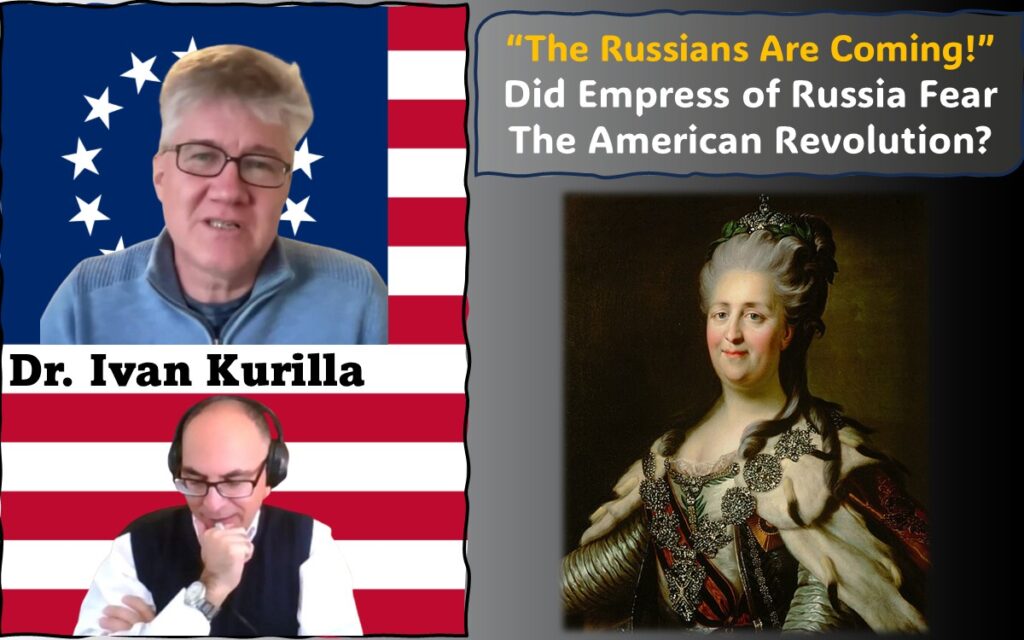 Imperial Russia and the American Revolution: Ideas vs. Empire
Arming the American Revolution
►My interview with Prof. Joel Richard Paul: The Bizarre Plot That Armed the American Revolution, a topic discussed at 32:30 in this interview
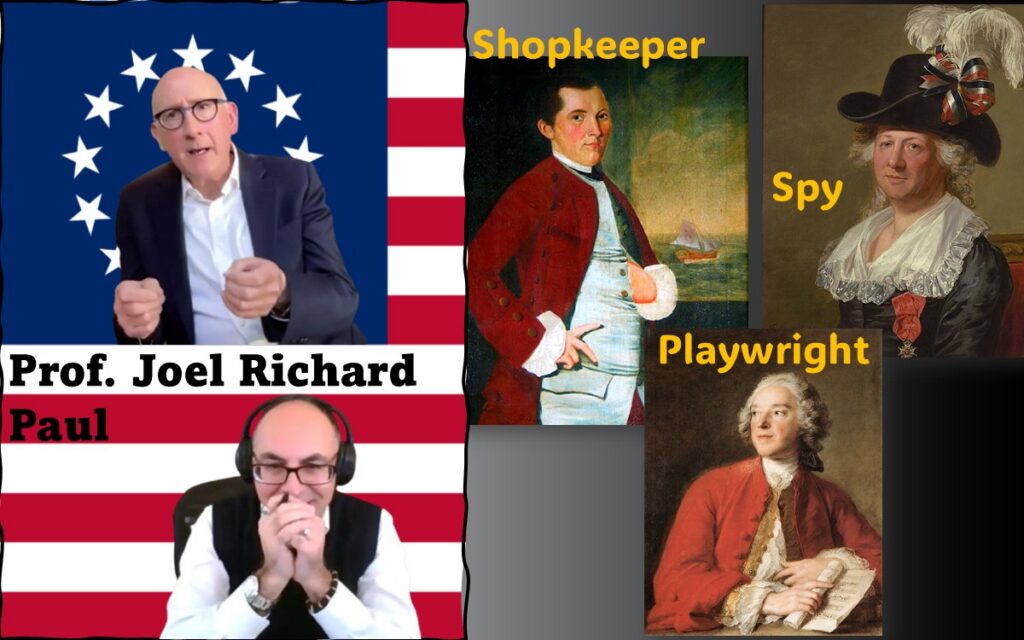 Extraordinary Men (and a Woman?) Behind a Ludicrous Scheme That Worked Against All Odds
The Treaty of Paris
►My interview with Dr. Eliga Gould: Did the Treaty of Paris Create the United States? The Treaty of Paris (1783) is discussed throughout my interview with Dr. Singerton, particularly in relation to the Habsburg monarchy’s 1781 proposal to mediate peace between Great Britain and the United States.
 Why the Treaty of Paris Was More Than a Peace Agreement
About This Program
Analyzing American Revolution (AAR) is a special series podcast production of the History Behind News program. In this series, 33 professors (and counting) analyze the American Revolution from 33 different angles through in-depth interviews with host Adel Aali.
Meet Our Guest Scholars
A structured body of thought on the American Revolution—where leading scholars advancing distinct interpretations that give this program its depth.

Thematic Collection
Tap below for a closer look at the Revolutionary Era themes we examine—and to meet our guest scholars.

Library
- Interview Transcript Highlights
- Interview Image and Artist Highlights
- Quiz Answers and Backstories

Image Gallery
Explore the backstories and artist bios behind images of our Founding—before and after the American Revolution. These visuals shape how we remember—and reimagine—the Revolutionary Era.

Support AAR
AAR is an independent program built on sustained research, preparation, and production. Your support helps continue this series and expand our program.

Experienced Analysis of History
About HbN Program
The History Behind News program (HbN) is committed to making in-depth history researched and written by scholars enjoyable and accessible to everyone. Our motto is bridging scholarly works to everyday news.
The histories we’ve uncovered encompass an impressively wide range of subjects from ancient history to U.S. politics and economy to race, women’s rights, immigration, climate, science, military, war, China, Europe, Middle East, Russia & Ukraine, Africa and the Americas to many other issues in the news. We also receive advanced copies of scholarly books and discuss them in our program (in the context of current news).

Adel Aali, host. Snapshot from his introductory video to AAR podcast.
233 Scholars & Counting
Our guests are scholars at leading institutions. They are highly recognized, having received prestigious grants and fellowships as well as notable awards, including the Pulitzer Prize. They include celebrated documentary producers, former White House advisors and other high-ranking government officials, and current and former senior reporters of major national and international newspapers. Many have testified in Congressional hearings, and others frequently contribute to major media outlets and widely read publications.
Think You Know the American Revolution?