Updated: October 31, 2026
Introduction
In this interview: “So they have the power to decide whether or not a military expedition takes place. They can choose to let it not happen by withholding food.”
Watch this segment in the video below (00:19:01)
Who held that power? The commanders—or the women who grew their food? Why did British officials dismiss as ‘useless mouths’ the families whose labor helped sustain their military alliance?
What did feeding an ally obligate that ally to provide in return? What happened when the British treated the families of their Native American allies as “useless mouths”?
And when American forces destroyed Native villages and cornfields, what were they trying to defeat? How did policies promising to prevent hunger later help take Native land?
In this interview, Dr. Rachel Herrmann explains how control over food shaped the power to negotiate, wage war, and acquire land during the American Revolution and its aftermath. Drawing on her book, “No Useless Mouth: Waging War and Fighting Hunger in the American Revolution,” she shows how Native communities exercised that power—and how military destruction and government policies undermined it. Through the course of these discussions, you’ll discover why comprehending the history of hunger in America changes how we understand both the struggle for American independence and its consequences.
Interview Video
Watch the full interview with Dr. Rachel Herrmann (timestamped outline below)
Key Themes
- Native Women’s Food Production
- Food Diplomacy and Alliances
- Washington’s War on Native Food Supplies
- Hunger Prevention and Land Dispossession
- Native Self-Sufficiency and Colonial Dependence
Central Question
How did food and hunger sustain Native American diplomatic and military power while also becoming instruments of dispossessing them from their land during the American Revolution and its aftermath?

How to Use This Post
Use this post as reference guide to the American Revolution through the lens of this interview and the broader Analyzing American Revolution program (AARevolution). Navigate using the interactive table of contents above and the timestamps below (in gray) to discover how this interview deepens the story of the Revolution—and to explore how the program unfolds: its key themes, insights, image gallery, scholars list, history quizzes, and related interviews across the series.
Control Over Food Meant Power Over War and Diplomacy
Food became an instrument of power through decisions about who would receive provisions, what obligations accompanied them, and whose means of subsistence would be destroyed.
Dr. Herrmann illustrates this relationship through Haudenosaunee women, who cultivated corn, beans, and squash: their ability to withhold food gave them influence over whether military expeditions could proceed. Provisioning also carried diplomatic obligations. In negotiations with Native nations, British representatives were expected to supply food for the journey, provide hospitality during meetings, and offer enough provisions for delegates to share with their communities upon returning home. These practices made food part of maintaining an alliance. The destruction of food supplies attacked that capacity for independent action.
As Dr. Herrmann explains, the Sullivan Expedition of 1779 burned Native villages and damaged crops and fruit trees, driving displaced communities toward British forts for protection and provisions. People who had helped sustain the alliance now needed its support—yet British officials questioned the expense of feeding their families.
About My 237th Guest: Dr. Rachel Herrmann
Dr. Rachel Herrmann is a Senior Lecturer in Modern American History in the School of Global Humanities at Cardiff University. Her books include the following:
–“To Feast on Us as Their Prey: Cannibalism and the Early Modern Atlantic”
–“Claiming Land, Claiming Water: Borders and the People Who Crossed Them in the Early Modern Atlantic”
–“No Useless Mouth: Waging War and Fighting Hunger in the American Revolution”, which we discuss in this interview
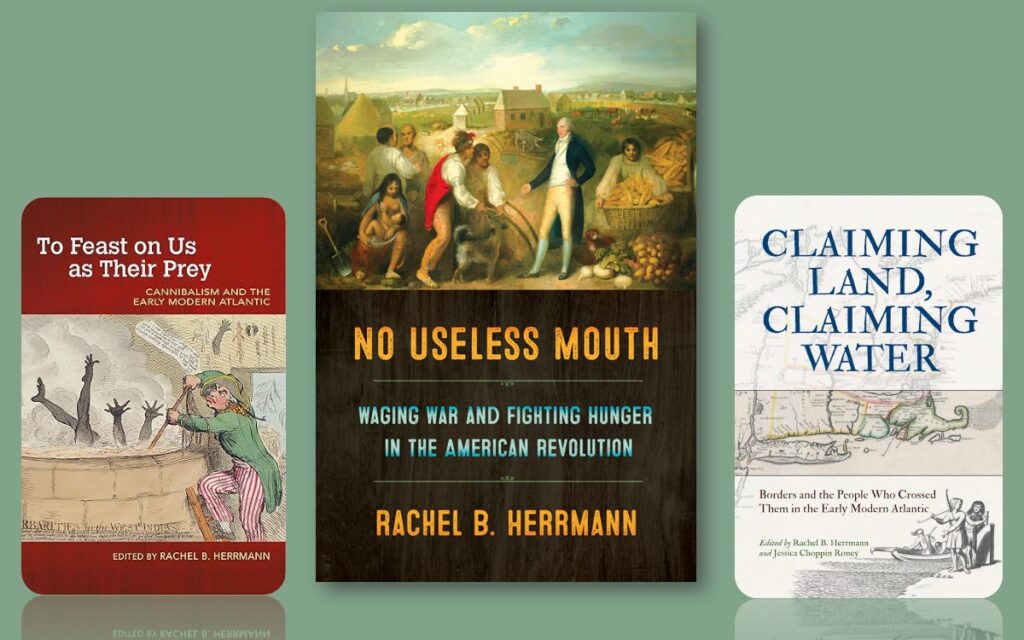 Books by Dr. Herrmann
About This Post’s Featured Image
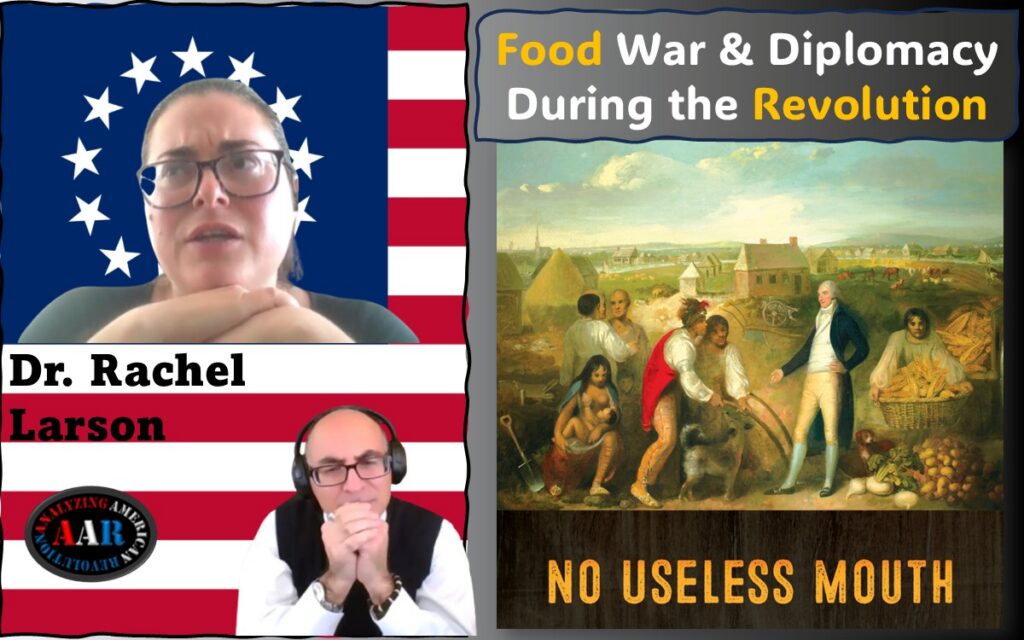
Image of Adel Aali (program host) and his guest, Dr. Rachel Herrmann, superimposed on the Betsy Ross flag, along with a cropped image of “No Useless Mouth: Waging War and Fighting Hunger in the American Revolution”, Dr. Herrmann’s book that we discuss in this interview.
Unless otherwise indicated, all images in AAR—including those in this post—are in the public domain.
AAR Essential Insights
Although the full video and transcript of my conversation with Dr. Herrmann are included in this post, I’ve selected and summarized several insights that I found particularly revealing and worth emphasizing. These moments — some surprising, others that challenge familiar assumptions — help us see how food and hunger fit into the larger history of the American Revolution.
By the way, these insights are my own takes and interpretations from the interview. For Dr. Herrmann’s perspective and exact framing, please watch the interview above and view the transcript below in the corresponding sections.
Hunger Was Physical. Its Meaning Was Political.
Hunger seems like one of history’s least ambiguous experiences. People either had enough to eat or they didn’t. Yet I began this interview by asking Dr. Herrmann about hunger’s “meanings”—plural—because that apparent certainty deserves scrutiny.
Consider the Spanish colonists who did not regard a meal as complete without meat, wheat, and wine. Their expectations complicate what it meant to report hunger.
So a shortage of familiar foods and an absence of food altogether were different conditions, even when the language describing them overlapped. The suffering, however, could be real, and understanding its nature still requires context.
The diplomatic implications of hunger are even more revealing. For example, Native Americans sometimes described themselves as starving when they were not actually hungry. Such language could invite generosity during negotiations. But if colonists interpreted that request as evidence of an inability to provide for themselves, what did they misunderstand about the people across the negotiating table?
Here is the tension I find particularly significant: Native communities could express need diplomatically while possessing greater practical knowledge of surviving hunger than the colonists themselves. That practical knowledge also supported colonial military expeditions, which relied on Native food supplies. As Dr. Herrmann explains later in our conversation, Haudenosaunee women could prevent an expedition by withholding food. So, given this history, who, then, depended on whom?
These revelations change how we read the historical record. A statement of need does not, by itself, establish a relationship of dependence. We have to distinguish the speaker’s purpose from the listener’s interpretation—and avoid turning a colonial misunderstanding into our own historical conclusion. Otherwise, the people who knew how to sustain themselves and their allies can appear in history principally as recipients of help.
Watch this segment in the video above (04:29)
Who Made Native Allies into “Useless Mouths”?
“Useless mouths.” It is an extraordinary way to describe the families of your military allies. Yet, as Dr. Herrmann explains, British governor Frederick Haldimand wanted to limit the Native people wintering at British forts to only warriors – not their families. As Haldimand saw it, feeding women, children, and elders represented an unwelcome expense.
What interests me is the distinction embedded in that calculation. A warrior counted as useful because he fought. But what about the people whose labor made fighting possible?
Among the Haudenosaunee, women grew the crops that sustained their communities and military expeditions. They could withhold food and prevent an expedition from proceeding. Their contribution was hardly peripheral: British officials were assessing military usefulness in a way that discounted some of the very people who helped determine whether military action could happen at all.
Then American forces attacked that very capacity. In 1779, the Sullivan Expedition, operating under George Washington’s orders, destroyed Native villages, crops, and fruit trees. Those attacks displaced communities and drove them toward British forts for protection and provisions.
The sequence matters. People who had produced food and sustained alliances became refugees after their homes and agricultural resources were destroyed. Calling them “useless mouths” reduced the consequences of military devastation to a provisioning expense. It also obscured what Britain owed its allies.
Distributing seeds and agricultural tools could not resolve that problem. As Dr. Herrmann points out, the refugees no longer had safe homelands to farm. An offer to help people feed themselves means little when the conditions that made self-sufficiency possible have been taken away.
This is where food diplomacy becomes especially revealing. Providing food was part of a relationship involving generosity, reciprocity, and obligations to whole communities. Britain benefited from that relationship when Native allies supplied the war. Their displacement tested whether the alliance would also sustain them when they needed help.
Watch this segment in the video above (15:24)
How Dispossession Became a Story of Improvement
Doesn’t taking people’s land accomplish the opposite of improving their lives?
One doesn’t need to dig deep into history to answer in the affirmative. For land-dependent Native peoples of America the outcome was certainly destructive.
Yet in Dr. Herrmann’s account of the early United States, these opposite undertakings became closely connected.
The very policies presented as remedies for Native hunger also helped justify acquiring Native territory. And what interests me is how a particular version of history made that connection appear reasonable.
Officials such as Timothy Pickering portrayed colonists as historically self-sufficient and Native Americans as historically hungry. However, earlier sections of my interview with Dr. Herrmann established a different reality: Native communities possessed extensive knowledge of food production and surviving scarcity, and they had repeatedly supplied colonists with provisions.
Reversing that history was useful for political reasons: it cast the people seeking Native land as qualified to instruct its inhabitants in how to sustain themselves.
Under the “Plan of Civilization,” Native people were supposedly to become farmers rather than hunters, using less territory and making land available to American settlers. The problem was not that established farmers might learn new methods. It was that this justification discounted existing Native agriculture while treating settlers’ demand for land as a reason to reorganize Native life.
So, who would determine how much land these communities needed? And whose interests would that determination serve?
Dr. Herrmann describes how land losses reduced Native communities’ ability to feed themselves, while crop failures compounded their vulnerability. Here is the troubling consequence: hunger arising partly from dispossession could appear to confirm the portrayal of Native people as incapable of providing for themselves. A condition that American policies helped produce could be mistaken for an enduring characteristic of the people affected.
Tellingly, even wartime alliance offered little protection. For example, the Oneidas had supported the Americans, yet subsequent treaties stripped away most of their homelands.
For me, this is why we must interrogate history. We have to ask who is telling the history and for what purpose? In this case, the history told by the United States and White settlers erased what had been established history: self-sufficiency of Native Americans.
Watch this segment in the video above (30:34)
The Interview (S1E37): Adel Aali and Rachel Herrmann
In our conversation, Dr. Herrmann addresses key questions and reveals untold stories about food and hunger as levers of diplomacy and instruments of power in the American Revolution. The detailed outline and full transcript below supplement the video above.
Podcast
Watch the full interview on this page with the outline and transcript below, or take the conversation with you on the go through our Spotify podcast.
Outline
Use the in-depth outline below, with its key moments and turning points, to follow the discussion and navigate the interview.
Click for Timestamped Outline
- Selected Highlights (00:00)
- Guest Introduction (02:30)
- Hunger’s Changing Meanings (04:48)
- “Hangry” Feelings and Expectations of Hunger (05:20)
- Hunger, Famine, and Diplomatic Metaphors (06:42) – Key Moment (09:37)
- Native “Hunger Knowledge” and Colonial Dependence (10:52)
- Why Colonists Expected Native Americans to Feed Them (11:46)
- Feeding Armies Before and After Independence (13:08) – Turning Point (13:44)
- No Useless Mouth: Who Sustained the Alliance? (15:34)
- Native Refugees and the Cost of Feeding Families (16:14)
- Native Allies Supplying—and Refusing—Provisions (17:34)
- Native Women’s Food Production and American Crop Destruction (18:12)
- Haudenosaunee Women’s Power Over Military Expeditions (18:40) – Key Moment (19:01)
- George Washington, John Sullivan, and War Against Cornfields (19:30) – Turning Point (20:13)
- Victual Imperialism: Hunger Prevention and Control (20:53)
- Food Diplomacy, Victual Warfare, and Victual Imperialism (21:42)
- Restricting Hunting, Regulating Food, and Taking Land (22:08)
- British Obligations and Native Food Diplomacy (24:32)
- Seeds Without Safe Farmland—and Hunger Shared by Allies (25:43)
- Treaty Hospitality and Provisions for Communities Back Home (28:34)
- Food Across Enemy Lines and Imperial Boundaries (30:44)
- Patriots and Tories Sharing Provisions and Whiskey (32:23)
- Spanish Diplomacy and George Washington’s Sea Tortoise (33:28) – Key Moment (33:55)
- Valley Forge and the Problem of Feeding Armies (34:45)
- Hunger, Disease, and Transatlantic Supply Failures (35:21)
- American Colonists Provisioning the British (38:38)
- Hunger and Native Land Dispossession After Independence (41:24)
- Timothy Pickering and the “Plan of Civilization” (42:06) – Turning Point (44:23)
- Treaties and the Loss of Oneida Homelands (45:19)
- Hunger Prevention Beyond the United States (46:18)
- Black Migrants, Sierra Leone, and Food Laws (46:49)
- Changing Meanings of Hunger and Humanitarian Intervention (47:38)
- Just One Point (48:31)
Transcript
Note: This transcript was generated automatically and may contain minor errors. It is provided for reference and accessibility only.
Click to View Transcript
Adel:
(4:39) Dr. Herrmann, it’s a pleasure to have you in our program’s special series. (4:42) Thank you for taking the time for this conversation with me about the American Revolution. (4:48) Before we discuss food hunger and the American Revolution, let’s talk about this line that I found on your academic homepage.
(4:56) It states that you are curious about hunger’s meanings, how they have changed over time. (5:04) And meanings is plural, right?
(5:09) So what does that mean?
(5:10) Does hunger have a specific meaning?
Dr. Herrmann:
(5:16) So thanks for having me. (5:18) Thanks for a great starting question. (5:20) I think my answer comes from a very personal place, which is to say that I am a person who gets hangry.
(5:28) Are you, you’re laughing, you’re familiar with the term?
Adel:
(5:31) My entire family is familiar with that term, hangry. (5:35) Yeah.
Dr. Herrmann:
(5:36) Well, for people who aren’t familiar, hangriness is the sensation of being hungry and angry at the same time. (5:45) I am horrible when I’m hungry. (5:49) But what I kind of want to underscore is that this is a very modern emotion and a very modern meaning.
(5:57) People had much more patience with hunger in the past because there was more of an expectation that you would go hungry for a variety of reasons. (6:06) You know, either you were a peasant and you ate badly or you were enslaved and your access to food was controlled by violent masters. (6:16) Or like everyone, you were more affected by the change in seasons, by the hungry gap or by war when people expected to be starved out.
(6:28) But there could be additional challenges because of crop failures or unanticipated changes in the weather. (6:35) So hunger does have more than one meaning.
Adel:
(6:42) So based on what you just explained, how do we distinguish between hunger and starvation? (6:50) Right? (6:51) Are those, is starvation like a gradient of hunger?
Dr. Herrmann:
(6:58) Yeah. (6:59) So scholars do distinguish between hunger and famine. (7:05) Famine and starvation are used somewhat interchangeably.
(7:10) To be hungry is to be without food. (7:15) But famine results from extended periods of hunger and becomes evident in the sources that come down to us in statistical information about actual deaths, in reports about food riots, in price lists for food that are very high. (7:34) In increased property crime and in migration and people choosing to leave.
(7:43) So for me and my writing, hunger always depends on perspective. (7:49) For a new project, I’m reading and writing about the Spanish colonists who went to what became Florida, which they called La Florida, and which stretched from the Atlantic coast all the way to the Mississippi. (8:03) The past part of what becomes Texas.
(8:06) So those Spanish colonists don’t consider a meal a meal without meat, wheat, and wine. (8:13) This is according to the food historian Rebecca Earle. (8:17) So for some people to go hungry is to go without meat or without bread or without rice.
(8:23) It’s not just to go without food. (8:27) It depends on perspective. (8:28) And you can lack these things and be hungry.
(8:32) If you lack several of these things for weeks or months or more, then you will start being and undergoing famine conditions.
Adel:
(8:42) So based on what you just shared with us, hunger could be almost a subjective term. (8:53) For some people or ethnicities, like if I go without meat, I consider I’m hungry versus somebody else is completely fine with it.
Dr. Herrmann:
(9:03) Yes. (9:04) And this is kind of where colonists end up confused in their diplomatic interactions with Native Americans, where it’s common in the first instance to use metaphors in treaty diplomacy. (9:22) And this becomes messy and complicated because there’s multiple interpreters present at these meetings and everything was being translated into multiple languages and then being translated back.
(9:34) So there’s lots of room for misinterpretation. (9:37) And what colonists miss is how frequently Native Americans use metaphors of starvation when they’re not actually hungry. (9:47) So you describe yourself as naked or starving because you want the gift giver who’s going to provide you with clothing and to feast you while you’re at this meeting, you want them to not appear to, you want the request to seem like it’s coming from a place where there is some need.
(10:13) But that means that you need a lot of additional contextual clues to be able to say whether someone’s actually hungry or starving or undergoing famine conditions when you see the word hungry or starved appear in a colonial document.
Adel:
(10:31) Oh, that’s interesting, contextual. (10:34) And we’ll get to that in a moment. (10:35) But I take this.
(10:37) So is some of it, some of how you present yourself as hungry, sort of, at least in this context, performative?
Dr. Herrmann:
(10:47) Yes, I would agree with that.
Adel:
(10:52) Here’s something else. (10:54) We were about to start talking about the American Revolution specifically in a moment, but I’m wondering this. (11:00) In the 18th century, at least from like, you know, I don’t know, after the French and Indian War, like after 1763, let’s like whittle it down to a more specific time.
(11:13) From then on, did the meaning of hunger change? (11:18) Did it like evolve?
Dr. Herrmann:
(11:21) I think the meaning of hunger is likelier to change depending on who you are. (11:29) So enslaved people are kept hungry because of fearful and violent masters. (11:36) But enslaved people working in, say, the low country had more seasonal autonomy and better abilities to raise garden vegetables.
(11:46) The meaning of hunger, again, depends on whether you’re Native American or whether you’re a colonist. (11:52) Colonists, even throughout the 18th century, but certainly before it, either expect to be fed by Native Americans in the places that they are colonizing, or they expect to suffer and starve because they aren’t being supplied by Native Americans. (12:11) Suffering is kind of part of an experiential expectation for the act of colonizing.
(12:19) So the meaning of hunger is that it’s a regular thing. (12:26) If you’re a colonist, especially if you’re an English colonist, France has slightly more experience in the 18th century with periods of dearth and crop failure and starvation. (12:36) So there’s better kind of what the scholar Carla Savasco calls hunger knowledge, how you survive.
(12:43) But her larger point is that Native Americans are generally much more adept than colonists in sustaining themselves. (12:49) They have better hunger knowledge. (12:52) So they have a deep and well-established sense of what hunger is by the 18th century and also how to deal with it.
(13:02) And that knowledge is consistently better than colonists through the 18th century. (13:08) So by the mid-18th century, there’s an established practice of Native American allies supplying colonists and their own warriors with provisions on expeditions during war. (13:28) There’s an expectation on the part of British military planners that the colonies won’t be in rebellion and that you’ll therefore have a countryside that can provision and sustain you.
(13:41) And that changes. (13:44) You know, you have the colonies declare independence. (13:49) And so the whole notion of military planning has to change because they’re not prepared for the logistics of that sort of hunger.
(14:02) So there’s points of change and continuity throughout the 18th century. (14:08) Native Americans are consistently less hungry and better able to deal with hunger than colonists are. (14:17) But by the point of the war for independence, the British also have to rethink what they know about trying to prevent hunger because the infrastructure for supporting a war is not the same as it was during the Seven Years’ War.
Adel:
(14:35) Yeah. (14:37) I really like this phrase, hunger knowledge. (14:40) Is this a phrase that is widely used with experts such as yourself?
Dr. Herrmann:
(14:48) I think it’s a phrase that I use with my students. (14:52) It’s probably, you know, half a decade old. (14:55) Like I said, it’s Carla Cevasco’s term.
(14:58) She’s at Rutgers. (15:00) She’s got a great book called Violent Appetites. (15:04) I’m kind of interested in the mid-18th century on and Carla Cevasco is interested in what comes before.
(15:13) She’s probably a bit more interested in the Northeast. (15:16) I’m interested in the Northeast, but also the Southeast. (15:20) So I wouldn’t say there’s a ton of us using this language, but I hope there’s more once your listeners hear our conversation.
Adel:
(15:29) Hunger knowledge. (15:30) I’ll have to remember that. (15:32) Now, we touched on the American Revolution.
(15:34) So let’s get into it. (15:35) Let’s discuss hunger in the context of the American Revolution. (15:39) And we’ll do that by talking about your book, which is titled “No Useless Mouth, Waging War and Fighting Hunger in the American Revolution”.
(15:48) So let’s just, Dr. Herrmann, start with the title. (15:51) What do you mean by useless mouth when you say no useless mouth?
Dr. Herrmann:
(15:57) Yeah, so that term is a quote from Frederick Haldeman, whose papers are in the British Library in London. (16:09) At the time of writing, he is the governor of Quebec. (16:14) And it’s kind of early 1780s during a time when Britain’s Native American allies were living through what was essentially a refugee crisis in British forts.
(16:27) And when Haldeman wrote that no useless mouth, which can possibly be sent away, could be allowed to remain at these strongholds, what he meant was he hoped that only Native American warriors would spend the winter there. (16:42) He was not pleased with and he was anxious about the financial cost of the women, children and elders at the forts who had accompanied the warriors. (16:54) And it was these people that Haldeman was characterizing as useless mouths.
(17:01) So I think in the book, then there’s a couple different meanings. (17:06) There are the early colonists who have experienced periods of extreme hunger, who are useless mouths. (17:12) And my book also tries to turn this characterization on its head with respect to Native American allies who were not useless mouths.
(17:24) There are no useless mouths in the book. (17:29) These were useful allies and historically resourceful people throughout the war. (17:34) And after it, Native American allies, especially Britain’s Haudenosaunee allies, tested this assumption that only Native fighters were useful.
(17:45) And they do this by supplying their own communities. (17:48) They do it by supplying British soldiers. (17:52) They do it by refusing and in a few rare instances, destroying the provisions of their allies.
(17:59) And they prove their usefulness again by fostering the spread of hunger amongst enemy soldiers and civilians. (18:07) So that’s kind of what the book means in its title.
Adel:
(18:12) Let me repeat what you said in my own words and you tell me whether or not I got it correctly. (18:19) So what you’re saying is that it was not only the warriors, the Native American warriors who were useful, also their families, their entire tribes, they were useful, i.e. they were not useless because of what they did for the whole supply chain of food, right?
Dr. Herrmann:
(18:40) Yes, especially if you’re talking about the Haudenosaunee, it’s women who are the agriculturalists. (18:46) They’re the ones who are growing crops. (18:49) They are the ones producing the famous triad, the three sisters of corn or maize, squash or beans, squash and beans.
(19:01) So they have the power to decide whether or not a military expedition takes place. (19:09) They can choose to let it not happen by withholding food. (19:13) But it’s also their homelands that become, it’s their homelands and their agricultural fields that then become targets of American raids in the summer of 1779.
(19:30) So this is the Sullivan Expedition. (19:34) You can read George Washington’s letters to Major General John Sullivan in the Founders Online Project, but it is essentially a war against civilians and their cornfields. (19:49) They spend the summer burning at least 17 different Seneca, Cayuga and I believe Onondaga villages.
(19:59) They girdle fruit trees so that they can’t produce fruit in subsequent years. (20:07) And this is the kind of context for the Haldimand Quote. (20:13) This burning expedition means that all of these allies to the British lead to British forts because their homes have been destroyed and they are refugees.
(20:25) They don’t have homelands. (20:26) They expect military protection and alliance because that’s what they’ve been offering. (20:32) So these are the people that Haldimand is characterizing as useless mouths.
(20:39) And historically, that’s not who they’ve been.
Adel:
(20:42) Historically, that’s not true. (20:44) And these Native nations that you identify, they’re part of the Iroquois Confederacy, right?
Dr. Herrmann:
(20:51) Yes.
Adel:
(20:52) Yes. (20:53) Another interesting term that I found as I was preparing for this conversation with you is victual imperialism. (21:04) What does that mean?
Dr. Herrmann:
(21:07) So in the book, I talk about three related behaviors. (21:14) The behaviors exist on a spectrum between accommodation and violence. (21:20) This is because when I was starting to think about writing this book, I was struck by this notion that we always talk about food bringing people together.
(21:30) And I think that’s true. (21:32) I use food that way. (21:33) But I was also interested in the ways that food and hunger could be used as weapons.
(21:38) And I wanted to give us room to think about food and violence. (21:42) So in the book, I talk about food diplomacy, victual warfare, and vital imperialism. (21:51) These are ways of using food and hunger.
(21:55) So vital imperialism was the use of hunger prevention food policies, either to seize land or to disrupt or transform trade. (22:08) So examples of hunger prevention food policies include the circumscription of hunting habits and territory, the institution of price-fixing food laws, and the introduction of programs that are so-called civilization programs. (22:25) And the kind of end results of vital imperialism, which is designed to prevent warfare and to stop hunger, often instead has the effect of either reducing food aid or negatively affecting another group’s freedom to produce, market, or eat what and how they wished.
Adel:
(22:50) And the term victual is actually spelled V-I-C-T-U-A-L. (22:58) I emphasize this because I just wanted our audience, if they look it up, they know how to look it up. (23:02) And the term vital itself comes from nourishment, sustenance.
(23:08) Is that correct?
Dr. Herrmann:
(23:08) It’s a verb. (23:09) To vital someone is to provide them with food. (23:13) But vitals can also be a noun that refers to a set of food.
(23:19) You want to eat your vitals to grow big and strong. (23:24) So yes, there’s fun definitions of the word in the Oxford English Dictionary that you can go and look at to kind of understand how it was used and conceived in the 18th century. (23:40) But before the American Revolution, Great Britain didn’t practice vital imperialism.
(23:49) It’s, I should be clear, kind of my concept and term, but it’s also not a behavior that would have been recognized in the past because it’s really only during the late 18th century that hunger prevention initiatives and land seizures begin to occur simultaneously. (24:07) So there’s previous efforts to change land use, particularly from the 16th through 19th centuries. (24:15) Governments in England and Scotland try to restructure land use through the enclosures and clearances.
(24:22) But this isn’t being done alongside efforts to change food. (24:29) So it’s a kind of new behavior.
Adel:
(24:32) Let’s home in on the American Revolution, and I want to ask you this to make sure I’m following you correctly. (24:42) During the American Revolution, the patriots, the Americans, engaged on practices that targeted civilians and food infrastructure of Native Americans, who mostly, with a couple of exceptions, were on the side of the British. (25:01) For example, the Sullivan raids or expedition is one example in 1779, correct?
(25:10) So I get that part. (25:13) Did the British institute any policies that also adversely affected Native American food availability and also their own food availability? (25:26) I ask that specifically because the Natives were their allies.
Dr. Herrmann:
(25:31) Mm hmm. (25:34) Do you mean during the war or?
Adel:
(25:37) Yeah, during the war, let’s say from 1775 as you go all the way to 1783.
Dr. Herrmann:
(25:43) Yeah, so Haldeman, among others, tries to get the refugees to leave the forts. (25:54) He begins a program of trying to distribute seeds for planting and agricultural tools. (26:05) This doesn’t succeed because people no longer have safe homelands to farm.
(26:14) And what Haudenosaunee leaders end up saying to the British is it’s OK. (26:20) You don’t need to worry about provisioning us. (26:23) We will just tighten our belts and go hungry, but we’ll do it together.
(26:27) So we’ll all go hungry. (26:29) And this is how we’re going to kind of demonstrate and show alliance. (26:36) So that’s kind of the extent of any policy making that the British really make during the war.
(26:47) Before the war, there are efforts to enable Native Americans to remain self-sufficient by attempts to protect land. (26:59) This is through the kind of famous 1763 proclamation line that’s meant to keep Native Americans and colonists apart. (27:08) But in the case of Virginia, there’s already Native Americans living east of the line and colonists living west of it.
(27:20) So there’s also a kind of failed history to prevent encroachments on Native American land by the same people that Native Americans are now allied with. (27:32) So the British don’t have an excellent track record of helping to keep their allies fed. (27:40) But you have these allies who kind of turn power relationships on their head and remind British observers that hunger and starvation mean something different to them because of their perspectives by saying, it’s okay.
(27:53) We don’t need provisions. (27:56) We will still remain your allies. (27:59) Yeah, that’s kind of the major role that hunger plays.
Adel:
(28:02) Let me dig in a little bit more by reading a line from your website, academic homepage, and I’ll follow that up with a related question. (28:11) And it reads as such, “conflicting British ideas of hungry and non-hungry Native Americans resulted in a distinctive food diplomacy driven by Indian customs”. (28:26) What does diplomacy mean in this context?
(28:28) And how does this relate to the question that I was asking earlier about the policies?
Dr. Herrmann:
(28:34) It means that in an ideal world, the British should be adhering to a series of norms related to food that sit within the broader practice of forest diplomacy or how you conduct diplomacy during council meetings and treaty negotiations. (28:54) And so that means that there are kind of practices that you’re expected to observe that include providing food on a trail for people who are coming to a meeting, giving them provisions for the journey home. (29:13) And you also are expected not only to do this, but also to be so generous that you give people extra rations for the journey home so that they can be redistributed to clan and kin relations.
(29:32) So there’s an expectation that treaties will start with a mourning or a condolence ceremony to cover the graves of people who have been killed during the conflict or because of feuds. (29:47) There’s an expectation that there will be a welcoming set of speeches with small drinks of alcohol. (29:53) There are expectations that people will bring wampum strings to serve as mnemonic devices what’s been discussed at previous meetings and new gifts of wampum to underscore the importance of new messages.
(30:11) And there’s an expectation that you’ll have confident translators who can convey to everyone what the point of the meeting is. (30:19) So all of these are kind of established practices of food diplomacy, forms of rituals, generosity before, during, and after meetings, and some awareness that these are representatives of much larger communities who have obligations to their folks back home.
Adel:
(30:39) I see. (30:44) We’ve talked about Native Americans quite a bit. (30:50) What I’m wondering is food diplomacy unique to them or did similar practices shape relations with European colonists?
(31:02) White colonists, if you will.
Dr. Herrmann:
(31:07) There is certainly… (31:10) So in my book, I talk a lot about white soldiers. (31:16) And I wouldn’t say that soldiers are exactly acting diplomatically, but they are comporting themselves within the set norms of just war.
(31:33) So you’ve got this famous account by a Connecticut private named Joseph Martin. (31:42) He is unusual in that he leaves behind a written account, and he’s unusual in that he serves for almost the duration of the war. (31:51) Signs up and signs up and signs up again.
(31:54) He doesn’t publish his narrative until the 1830s, at which point it’s a memoir. (32:01) And the context is that American soldiers haven’t been paid for their pensions, for their service in the war. (32:10) And in his account, he personifies hunger.
(32:14) He writes about the monster hunger. (32:17) And it’s there throughout every single campaign that he writes about. (32:23) But he also talks about these instances where food brings his set of the patriots together with the Tories.
(32:34) So there are some instances where there’s a pause in hostilities, and they are encamped within hearing but not seeing distance. (32:45) And there’s provisions that are tossed back and forth. (32:49) Sometimes gunshots are exchanged.
(32:52) Martin talks about the time that they gave them too much whiskey, and they all had trouble climbing a fence because they were drunk. (33:05) So there’s good camaraderie within the unit, a few instances of kind of patriot Tory accommodation.
Adel:
(33:21) Accommodation, interesting.
Dr. Herrmann:
(33:24) Accommodation. (33:25) There’s other types of diplomacy. (33:28) So, you know, the Spanish eventually get involved in the war.
(33:33) They end up coming into the war because of a treaty with France that makes them enemies against the British, but not allies with the Americans. (33:44) So there’s all this backchanneling diplomacy that’s happening between the Spanish and George Washington, because they’re not officially allies. (33:54) And so it’s messy.
(33:55) So there’s some diplomat who gives George Washington a hundred pound sea tortoise as a gift. (34:05) That’s a diplomatic gift that I think does feature into some of these interactions. (34:11) But I don’t write about that in this book.
(34:14) But I probably will for the next.
Adel:
(34:16) Yeah, and I’m sure our modern audience does not appreciate killing a sea tortoise and eating it, right?
Dr. Herrmann:
(34:27) It’s a big, I mean, it’s a big animal.
Adel:
(34:31) Yeah.
Dr. Herrmann:
(34:31) And it’s meant to be an opulent gift for a large crowd. (34:34) You know, it’s the sort of gift that gets shared and put on display. (34:38) And is probably cooked by Washington’s enslaved cooks.
Adel:
(34:42) Yeah.
Dr. Herrmann:
(34:42) I wanted to speculate.
Adel:
(34:45) In our program, we’ve had two scholars, at least, who have talked about the famous Valley Forge supply issues and hunger. (34:55) Do you have anything to add to that with respect to, you know, they said this was essentially a supply chain issue and mismanagement. (35:04) Have you studied this?
(35:06) Is there anything to add, for example, from policy stance or diplomatic relations that contributed to Valley Forge?
Dr. Herrmann:
(35:21) There’s always going to be the question of weather. (35:26) There’s always going to be the question of outbreaks of pests like the Hessian fly. (35:34) We know more now about the interrelationship between smallpox and hunger.
(35:40) So we know that if you’re hungry, smallpox is worse, which means that the hunger that they were experiencing at Valley Forge made the smallpox that much worse, which likely contributed to the change in decision making about inoculation, the precursor of vaccination. (36:00) Most of the soldiers on the British side would have been inoculated during their service in the Seven Years’ War. (36:11) Inoculation, a bit risky.
(36:13) I think George III loses one of his sons to it, if I’m not mistaken. (36:18) But it’s still much more effective at preventing smallpox than the Americans learned this lesson at Valley Forge. (36:25) So I think that adds something to it.
(36:28) I think it’s also helpful to not put Valley Forge in isolation with other aspects of the campaign or the British side of things. (36:39) So I mentioned that the British have the oldest previous experience being supplied by the colonists during the Seven Years’ War. (36:48) That lack of experience is what means it takes them forever to figure out how much to ship across the ocean.
(36:58) And it’s a kind of horrible arithmetic they have to do. (37:02) Do you ship 12 months of provisions and hope no one sinks your ship? (37:07) Or do you send out three ships with four months of provisions each and hope that some of them get through?
(37:16) So they start to use Cork as a midway point. (37:21) Bread from Cork is described in the British…
Adel:
(37:24) Cork as in Ireland, Cork?
Dr. Herrmann:
(37:26) Yes, yes. (37:29) So things going from England to, say, New York via Cork. (37:35) Bread is described as being moldy and shipped in bags short of weight.
(37:41) There’s one instance I found… (37:43) There’s one instance I found of flour that’s definitely from the North American colonies. (37:51) It gets shipped to England before the war.
(37:54) It sits on a dock and gets rained on. (37:56) And then the war begins and it gets shipped back to North America for the British soldiers to use. (38:03) And it is understandably substandard.
(38:08) There’s a guy who gets captured by loyalists and he reports surviving on rattlesnakes. (38:17) So does this have anything new to what we know about Valley Forge? (38:22) I think it does in terms of the smallpox.
(38:24) I think it’s a good reminder to think about the British. (38:27) But I think it’s also a fun way of thinking about all the disgusting things that people ate.
Adel:
(38:32) Yeah. (38:33) Is it… (38:34) Including rats, right?
(38:38) Is it fair to say that, at least at some point, let’s say 1777, late 1776, the British food supply entirely comes from overseas? (38:58) Has that been researched?
Dr. Herrmann:
(39:00) I don’t know if it’s been researched. (39:04) I can think of several reasons why it would be tricky to kind of compile all of that information. (39:11) But at least early in the war, there’s a concentration around New York.
(39:17) And New York is known for having pockets of loyalists and good hinterlands of agricultural fields. (39:28) So there are always going to be the inhabitants of the countryside who either don’t describe themselves as a patriot or Tory, or they do. (39:44) But there will always be people willing to supply the British during the early years of the conflict.
Adel:
(39:50) Interesting.
Dr. Herrmann:
(39:51) Especially in areas where there are people with farmlands in the area.
Adel:
(39:58) Including American colonists.
Dr. Herrmann:
(40:01) Yeah. (40:02) I mean, the percentage of people who support the patriots and those who support the Tories is counterbalanced by the people who do not declare a parasite and remain neutral.
Adel:
(40:20) Yeah. (40:20) Kind of like one-third, one-third, one-third. (40:23) Yeah.
Dr. Herrmann:
(40:24) Just because you’re an American colonist doesn’t… (40:27) There’s no way. (40:28) I mean, there’s obviously contextual factors determining how you decide who to support, if you decide who to support.
(40:37) But it is fairly contingent.
Adel:
(40:39) It is. (40:41) And another scholar has actually discussed this in our program, that loyalties were actually a substantial portion of the population at that time. (40:50) How much of the revolutionary era hunger do you think was caused by genuine scarcity of food?
(41:00) And how much of it because of military decisions?
Dr. Herrmann:
(41:09) I don’t know. (41:11) It’s really difficult to quantify.
Adel:
(41:14) Yeah.
Dr. Herrmann:
(41:14) I’m going to pass on that one.
Adel:
(41:16) That’s okay. (41:17) Let’s take a break here. (41:18) In the next segment, Dr. Herrmann and I talk about hunger after the American Revolution. (41:23) We’ll be right back.
Adel:
(41:24) Dr. Herrmann, how did food, hunger, vital warfare, and food diplomacy change after the American Revolution?
Dr. Herrmann:
(41:40) So by the very end of the century, and certainly by the 1810s or 20s, the colonists who have become Americans have become much more capable of presenting a historical narrative that sort of messes with and rearranges the past as we know it. (42:06) So you have officials who are officially called U.S. Indian agents, like Timothy Pickering, who appear in treaty minutes with Native Americans where Pickering describes colonists as self-sufficient and Native Americans as historically hungry. (42:27) And this counter-narrative of basically everything we’ve been talking about on this podcast appears alongside an initiative that Pickering and others call the Plan of Civilization.
(42:43) The idea of the plan of civilization is a little imperialist idea. (42:50) It is the idea that Native Americans, the Haudenosaunee certainly, but also Cherokee and Creek people, it’s the notion that they use too much of their land by hunting and that they need to be supposedly converted from hunters into husbandmen so that the U.S. government can satisfy its land-hungry settler colonists and give them the land that they wrote a declaration about not having. (43:28) That famous charge in the DOI by Thomas Jefferson, the Virginian, talks about how King George III had been responsible for keeping colonists from getting their lands that Native Americans currently lived on.
(43:46) So the idea of the plan obviously ignored the fact that Native Americans were already agriculturalists, they already farmed. (43:59) And the people who wanted land tended to take it before any supposed conversion could take place. (44:09) So by the early 1800s, there’s a shift where we begin to see (44:15) Native Americans described increasingly as helpless and hungry, but we also begin to see (44:23) outbreaks of actual starvation and famine because of a decreased access to land through (44:31) the ceding of land to the United States and treaties, as well as a series of crop failures (44:37) that strike the whole North and South Atlantic seaboards during this time period.
Adel:
(44:46) And just to make sure that our audience follows, as we established in the last segment, Native Americans were in fact self-sufficient in providing food for themselves and managing hunger. (45:03) I’ll use your word, hunger knowledge. (45:05) They were good at that until everything began to change.
(45:09) America became, American colonists became a nation and policies towards Natives changed, right?
Dr. Herrmann:
(45:19) Policies toward Native Americans changed, U.S. diplomacy changed. (45:23) The U.S. cut its teeth on writing and making treaties with Native Americans. (45:29) And many of those early treaties were very successful at taking land.
(45:34) So the Oneidas, one of the kind of rare example of members of the Haudenosaunee side with the Americans, have something like 2% of their homelands by the early 1800s left, because that’s how much the U.S. has taken through treaty. (45:49) So the treaty system, the rollout of the plan of civilization, the articulation of a false historical narrative that cast Native Americans as historically hungry, contribute to a fairly successful implementation of a policy of middle imperialism that seeks to change food production habits while taking land. (46:14) So that changes, middle imperialism changes.
(46:18) The other thing that happens is that the enslaved people who have been creating and upholding a food system in North America during the war, something like 20,000 end up fleeing to British lines. (46:41) And at the end of the war, they migrate out of the American colonies if they’re lucky enough to be declared free. (46:49) And then some of them go to Nova Scotia and then to Sierra Leone, where they become middle imperialists themselves.
(46:59) They end up passing these food laws that put them into conflict with the Temne. (47:07) And in the process of kind of trying to make themselves British, they end up reproducing a series of laws related to butchering and the cattle trade that come into conflict with the populations.
Adel:
(47:23) Wow. (47:24) OK, so they themselves turn into sort of people that impose policies and rules and others and limit their food supply. (47:36) That’s really interesting.
(47:38) So moving forward to the 1820s, 1810s and 20s that you were mentioning, does the definition of hunger change by then? (47:48) I guess it depends on who you’re talking about, right?
Dr. Herrmann:
(47:51) It depends on who you’re talking about. (47:55) We’re still decades, maybe a century actually, away from kind of quantifying the calorie. (48:04) So it’s going to take more than that in terms of time to really restructure how change happens.
(48:15) But certainly the 19th century is when historians certainly think about humanitarian efforts that begin to seek to prevent hunger. (48:24) And I just think all of this is happening a little bit earlier than we appreciated.
Adel:
(48:29) I see. (48:31) If you want our audience to remember just one point about food, hunger and the American Revolution, what would it be?
Dr. Herrmann:
(48:40) I think I would say that as we enter the 250th, that thinking solely in terms of national perspectives is not that helpful for fully appreciating everything that was going on. (49:00) In this episode, I’ve talked about Native American nations that either didn’t recognize the authority of the British or expected to act interdependently with a variety of other Native American nations or were neutral at best to the cause of American independence. (49:25) Those kind of historical frameworks don’t work very well in the overall narrative of U.S. history from colony to early republic. (49:36) But those frameworks also don’t help us to see the kind of political fault lines of the British and the French and the Spanish empires that resulted in George Washington getting a giant sea animal. (49:53) And it doesn’t help us to think about the kind of messy geography of where the revolution continues to happen after the war is over. (50:04) So, of course, national frameworks are important, but they are also limiting and shouldn’t be the only way we think about the history of the American Revolution, the war for independence, the wider Atlantic world.
Adel:
(50:21) Many scholars similar to you have really emphasized the global nature of the American Revolution, especially as it continues after 1776. (50:30) Dr. Herrmann, thank you so much for interviewing me and our audience about the American Revolution. (50:35) And to our audience, if you have any history that could provide more perspective about the American Revolution, please share it with us and tell us what’s your perspective.
(50:44) Thank you so very much. (50:45) This was great.
Dr. Herrmann:
(50:46) Thanks for having me.
Related Interviews and Essays
The Loyalists
►Dr. Rebecca Brennan: One-third were Loyalists! Was the American Revolution a Civil War?
The Declaration
►Dr. Edward J. Larson: Declaration’s Timeline: 1776 – 7 Months That Changed America
Native Americans
►Dr. David Silverman: Native Americans in the American Revolution: The History We Didn’t Learn
Spanish Empire
►Dr. Gonzalo Quintero: Spain’s Forgotten Role in the American Revolution
Valley Forge
►Dr. Ricardo Herrera: Valley Forge & America’s People Army
►Dr. Paul Douglas Lockhart: Baron de Steuben & Valley Forge
About This Program
Analyzing American Revolution (AAR) is a special series podcast production of the History Behind News program. In this series, 33 professors (and counting) analyze the American Revolution from 33 different angles through in-depth interviews with host Adel Aali.
Meet Our Guest Scholars
A structured body of thought on the American Revolution—where leading scholars advancing distinct interpretations that give this program its depth.

Thematic Collection
Tap below for a closer look at the Revolutionary Era themes we examine—and to meet our guest scholars.

Library
- Interview Transcript Highlights
- Interview Image and Artist Highlights
- Quiz Answers and Backstories

Image Gallery
Explore the backstories and artist bios behind images of our Founding—before and after the American Revolution. These visuals shape how we remember—and reimagine—the Revolutionary Era.

Support AAR
AAR is an independent program built on sustained research, preparation, and production. Your support helps continue this series and expand our program.

Experienced Analysis of History
About HbN Program
The History Behind News program (HbN) is committed to making in-depth history researched and written by scholars enjoyable and accessible to everyone. Our motto is bridging scholarly works to everyday news.
The histories we’ve uncovered encompass an impressively wide range of subjects from ancient history to U.S. politics and economy to race, women’s rights, immigration, climate, science, military, war, China, Europe, Middle East, Russia & Ukraine, Africa and the Americas to many other issues in the news. We also receive advanced copies of scholarly books and discuss them in our program (in the context of current news).

Adel Aali, host. Snapshot from his introductory video to AAR podcast.
239 Scholars & Counting
Our guests are scholars at leading institutions. They are highly recognized, having received prestigious grants and fellowships as well as notable awards, including the Pulitzer Prize. They include celebrated documentary producers, former White House advisors and other high-ranking government officials, and current and former senior reporters of major national and international newspapers. Many have testified in Congressional hearings, and others frequently contribute to major media outlets and widely read publications.
Think You Know the American Revolution?