Updated: August 1, 2026
Introduction
In this interview: “But he’s insisting that both there’s nothing particularly radical in what he’s arguing, because anyone with common sense would know it, and also that ordinary people could probably rule on their own just fine.”
Watch this section in the video below (00:34:08).
To fully comprehend the American Revolution, we have to study the developments that frayed relations between Great Britain and its American colonies in the Pre-Revolutionary Era, generally understood as the years between 1763, which marked the end of the French and Indian War, and 1775, when open and violent hostilities broke out starting with the Battles of Lexington and Concord (April 19, 1775).
In our program, Analyzing American Revolution, several scholars do just that—analyze the Pre-Revolutionary Era. For example, Dr. Robert Gross details the lead-up to Lexington and Concord, Dr. Serena Zabin reexamines the Boston Massacre, and Dr. Dael Norwood describes the American colonies’ infatuation with Chinese luxury and explains how the East India Company’s financial troubles and its monopoly of tea trade led to a series of tea parties, including the Boston Tea Party.
But long before these dramatic developments of the Pre-Revolutionary years, revolutionary ideas were being debated and memorialized in transformative treatises in places like England, Scotland, France and the Netherlands. And although none of these ideas by themselves could have ignited a revolution (as my guest in this interview emphasizes), they nevertheless served as the intellectual foundations of revolutionary movements that began with Committees of Correspondence as early as 1772.
So to better understand this background, I explore the intellectual foundation of the American Revolution in an interview with Dr. Sophia Rosenfeld.

How to Use This Post
Use this post as reference guide to the American Revolution through the lens of this interview and the broader Analyzing American Revolution program (AARevolution). Navigate using the interactive table of contents above and the timestamps below (in gray) to discover how this interview deepens the story of the Revolution—and to explore how the program unfolds: its key themes, insights, image gallery, scholars list, history quizzes, and related interviews across the series.
Video
Watch the full interview (timestamps below)
Exploring Enlightenment Ideas, Common Sense, and the American Revolution with Dr. Sophia Rosenfeld
Thomas Paine’s Common Sense transfigured the Colonists’ fight for their rights as British subjects to a Revolutionary War for independence. In a two-part interview, my guest, Dr. Harvey Kaye, describes Paine’s personal journey in England—from his youth to his failed careers—to his transformation and rise in America.
In this interview, my guest Dr. Sophia Rosenfeld explores how Enlightenment ideas reshaped the way Western Europeans and, by association, American colonists thought about their world and reprocessed contemporary and past events based on new principles that were not just for the elite and intellectually minded. In many ways, these new thoughts were common sense for and by the common people.
In essence, long before the American Revolution, a more profound revolution had been reshaping the minds of 18th-century Europeans and North Americans. It was a revolution of “thinking about thinking,” a term that I borrow from Dr. Rosenfeld, and which she explains in this interview.
Central Question
This conversation raises a central question:
Did Enlightenment ideas cause the American Revolution—or simply give it language and meaning?
About My 199th Guest – Dr. Sophia Rosenfeld
Dr. Sophia Rosenfeld is a professor of history and former chair of the Department of History at the University of Pennsylvania, where she teaches European and American intellectual and cultural history with a special emphasis on the Enlightenment, the trans-Atlantic Age of Revolutions, and the legacy of the eighteenth century for modern democracy.
Her writings and works include the following books:
- The Age of Choice: A History of Freedom in the Modern World
- Common Sense: A Political History
- A Revolution in Language: The Problem of Signs in Late Eighteenth-Century France
- Democracy and Truth: A Short History
To learn more about Dr. Rosenfeld, you can visit her academic homepage and personal website.
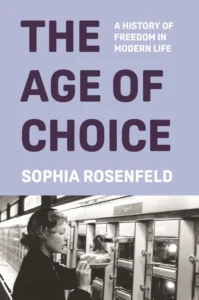 Dr. Rosenfeld’s latest book
Watch this section in the video above (00:43:51).
About the Featured Image
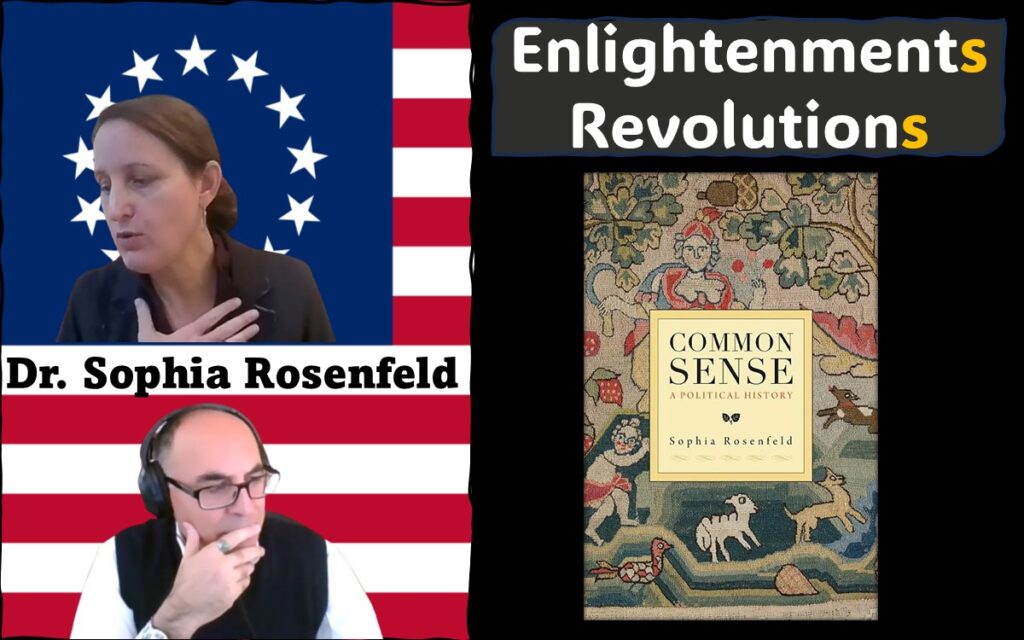
The featured image brings together images of Dr. Sophia Rosenfeld and Adel Aali from the interview, superimposed on the Betsy Ross flag, alongside an image of Dr. Rosenfeld’s book Common Sense: A Political History.
Unless otherwise indicated, all images in AAR—including those in this post—are in the public domain.
AAR Essential Insights
Although the full video and transcript of my conversation with Dr. Rosenfeld are included in this post, I’ve selected and summarized several insights that I found particularly revealing and worth emphasizing. These moments — some surprising, others that challenge familiar assumptions — help us see the Enlightenment and the American Revolution in a different light.
By the way, these insights are my own takes and interpretations from the interview`. For Dr. Rosenfeld’s perspective and exact framing, please watch the interview above and view the transcript below in the corresponding sections.
“Enlightenment” Is Hard to Define
The Enlightenment is surprisingly difficult to define, in part because it wasn’t a term widely used by the very thinkers we now associate with it. Instead, it was applied later to describe a broad cultural and intellectual movement that shaped the 18th century across Europe and the Atlantic world.
Figures like Denis Diderot pointed not to a fixed doctrine, but to a larger goal: transforming how people think. Through projects like the encyclopedia he co-edited with Jean le Rond d’Alembert, the aim was to spark what he called a “revolution in men’s minds.”
In that sense, the Enlightenment is best understood not as a set of ideas, but as a shift in mindset—toward questioning, reasoning, and rethinking the world.
Watch this section in the video above (00:03:18).
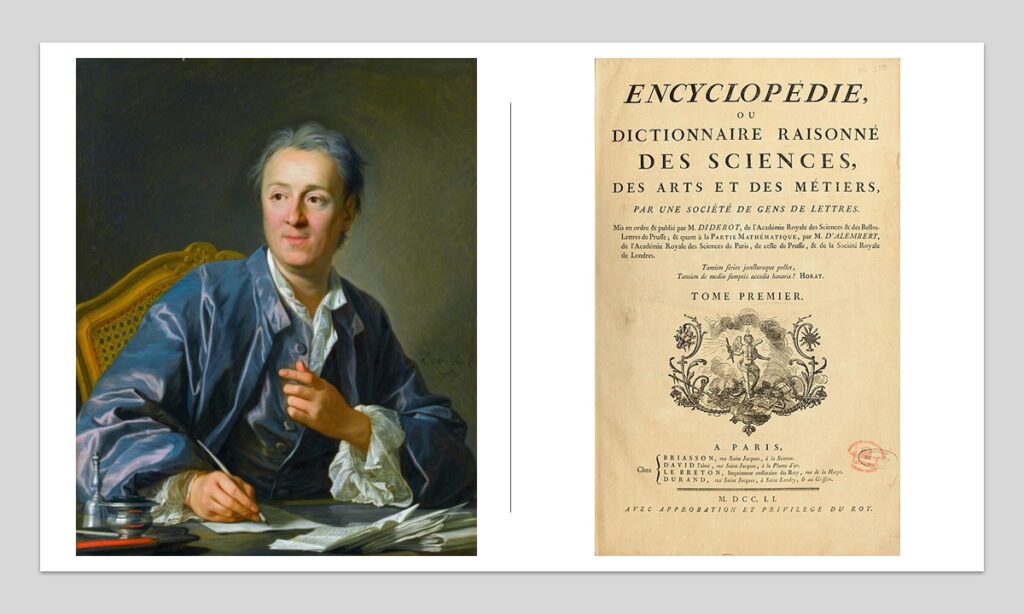 Denis Diderot (1713-1784), 1767 Portrait. Diderot’s Encyclopédie, which he co-created with Jean le Rond d’Alembert in 1751.
More than One Enlightenment
The Enlightenment was not a single, unified movement, but a collection of varied and sometimes conflicting intellectual currents across different regions.
What emerged in places like Philadelphia could look quite different from developments in Russia or Spain, reflecting local cultures and institutions. Some Enlightenment movements were religious, others strongly anti-clerical; some were rooted in universities, while others challenged them.
Because of this diversity, many historians argue it is more accurate to speak of multiple “Enlightenments” rather than just one. What ultimately connects them is a shared shift away from inherited authority toward knowledge grounded in observation, experience, and reason—and a willingness to question long-accepted truths.
Watch this section in the video above (00:12:36).
Age of Enlightenment vs. Age of Reason
The Enlightenment is often called the “Age of Reason,” but that label only tells part of the story.
While thinkers emphasized logic and skepticism—building on earlier figures like René Descartes—they also recognized that reason alone could be misleading if it wasn’t grounded in real-world observation. Unlike earlier scholastic traditions, Enlightenment thinkers increasingly insisted on starting with experience and evidence, then reasoning from there.
This approach reflected the growing influence of the Scientific Revolution, as its methods were applied beyond science to questions about society, politics, and human behavior. In that sense, the Enlightenment was not just about reasoning more—but about reasoning differently, rooted in evidence and lived experience.
Watch this section in the video above (00:14:07).
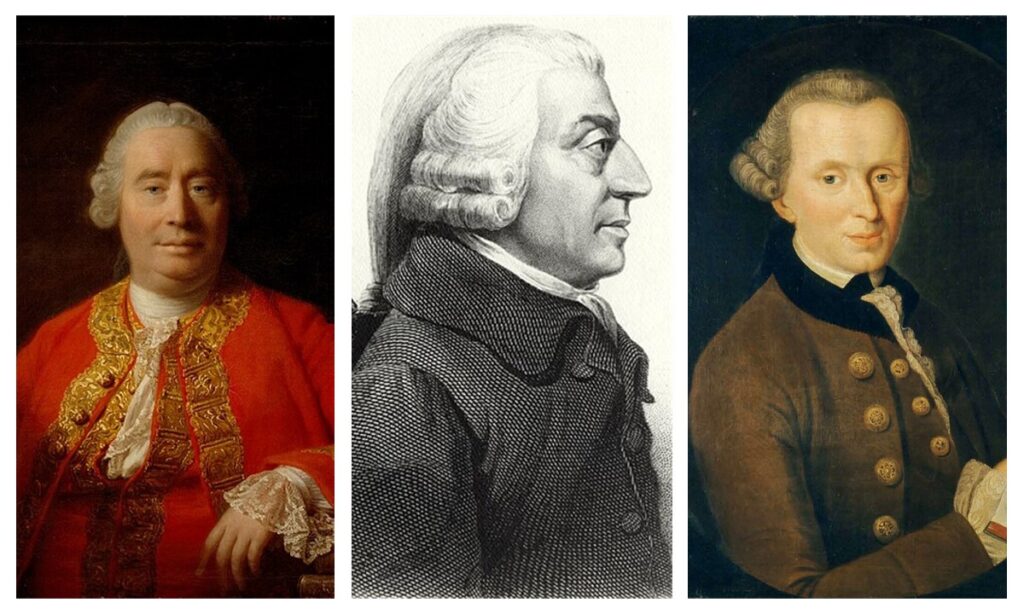 From left to right: David Hume (1711–1776), Adam Smith (1723–1790), and Immanuel Kant (1724–1804) —Enlightenment thinkers mentioned by Dr. Rosenfeld. See interview outline below.
Age of Enlightenment—or Age of Revolution?
The “Age of Enlightenment” and the “Age of Revolution” overlap in time, but their relationship is more complex than simple cause and effect. Major upheavals like the American Revolution and the French Revolution drew on Enlightenment ideas, but were also driven by social tensions, financial crises, and imperial pressures.
Rather than directly causing revolutions, the Enlightenment provided a powerful vocabulary—concepts like liberty, rights, and popular sovereignty—that shaped how revolutionaries understood and justified their actions. These ideas influenced not just revolutionaries, but also their opponents, showing how widely they had spread.
In that sense, the Enlightenment helped define the language and framework of revolutionary change, even if it did not determine when or why revolutions occurred.
Watch this section in the video above (00:19:04).
The Enlightenment and the American Revolution: What Was the Impact?
The Enlightenment played a significant—but not exclusive—role in shaping the American Revolution, especially among its leading thinkers.
Figures like Thomas Jefferson and James Madison drew on Enlightenment ideas, but blended them with other intellectual and political traditions. Concepts such as natural rights and the pursuit of happiness are difficult to imagine without Enlightenment influence, even if they were adapted to the American context.
At the same time, the Revolution cannot be explained by ideas alone, as local conditions, political conflicts, and colonial experiences were equally important. Ultimately, the Enlightenment helped shape how American leaders understood and expressed their cause—providing the language, frameworks, and intellectual environment in which the Revolution took form.
Watch this section in the video above (00:22:37).
Did the Enlightenment cause the American Revolution?
Continue watching at 20:55 in the full interview above.
Common Sense vs. Reason
Common sense (not Common Sense by Thomas Paine), as Dr. Rosenfeld explains, is a more basic, instinctive form of understanding—what we naturally perceive or experience—while reason builds on it to reach higher-level conclusions through logic and inference.
In the 18th century, common sense was increasingly valorized as a kind of shared, everyday knowledge that everyone, from peasants to kings, could understand. Its appeal lay in its accessibility: ordinary people could grasp truths about life, society, and politics without extensive formal education.
Thinkers like Thomas Paine used common sense as a foundation for democratic ideas, arguing that ordinary people could understand what is right, challenge authority, and govern themselves. Interestingly, common sense could be used both conservatively and radically, but in Paine’s hands, it became a powerful tool for challenging monarchy and aristocracy, grounding revolutionary ideas in everyday wisdom.
Watch this section in the video above (00:27:43).
 Thomas Paine and his “Common Sense”, published on January 10, 1776
Common Sense Can Be Used Against People
Common sense, while often celebrated as a foundation for democratic participation, can also be co-opted by those in power.
Dr. Rosenfeld explains that governments or populist leaders can claim to embody common sense and dismiss any dissenting views as nonsense, turning a concept meant to be universal and apolitical into a political weapon. This manipulation can prop up authoritarian or exclusionary agendas, even within democracies, by making ordinary people feel that any alternative perspective is illegitimate.
Words like ‘common sense’ or ‘nation,’ originally seen as neutral or obvious, can thus become tools of persuasion—or control—depending on who wields them. The history of such misuse shows how ideas meant to empower people can also be inverted to constrain them.
Watch this section in the video above (00:31:55).
How Thomas Paine Uses ‘common sense’
In his 50-page pamphlet, Common Sense, Thomas Paine transforms common sense into a radical political tool, showing that ordinary people are fully capable of understanding and participating in governance.
Dr. Rosenfeld notes that Paine’s arguments rely on simple, everyday observations—like questioning why a small island should rule a continent—to challenge the authority of kings and aristocrats. By framing his revolutionary ideas as obvious truths, Paine both undermines the paternalistic logic of monarchy and empowers ordinary citizens to see themselves as capable of self-rule.
His approach turns common sense into a foundation for democratic politics: it’s accessible, relatable, and yet capable of supporting profound change. In this way, Paine uses a familiar concept to advance a revolutionary vision, making radical ideas feel natural and inevitable.
Watch this section in the video above (00:32:52).
The Enlightenment: “Thinking About Thinking”
At its core, the Enlightenment encouraged people to step back and examine not just what they believe, but why they believe it.
Dr. Rosenfeld emphasizes that this “thinking about thinking” opens the door to questioning long-accepted assumptions and imagining alternatives. Rather than directly causing revolutions, ideas work more subtly—prompting individuals to realize that what once seemed like common sense may no longer hold up.
This shift in perspective is essential for any kind of reform or transformation, because it challenges the boundaries of what people consider possible. In that way, the Enlightenment’s lasting impact lies in sparking curiosity and expanding the range of how people understand both the past and the future.
Watch this section in the video above (00:52:36).
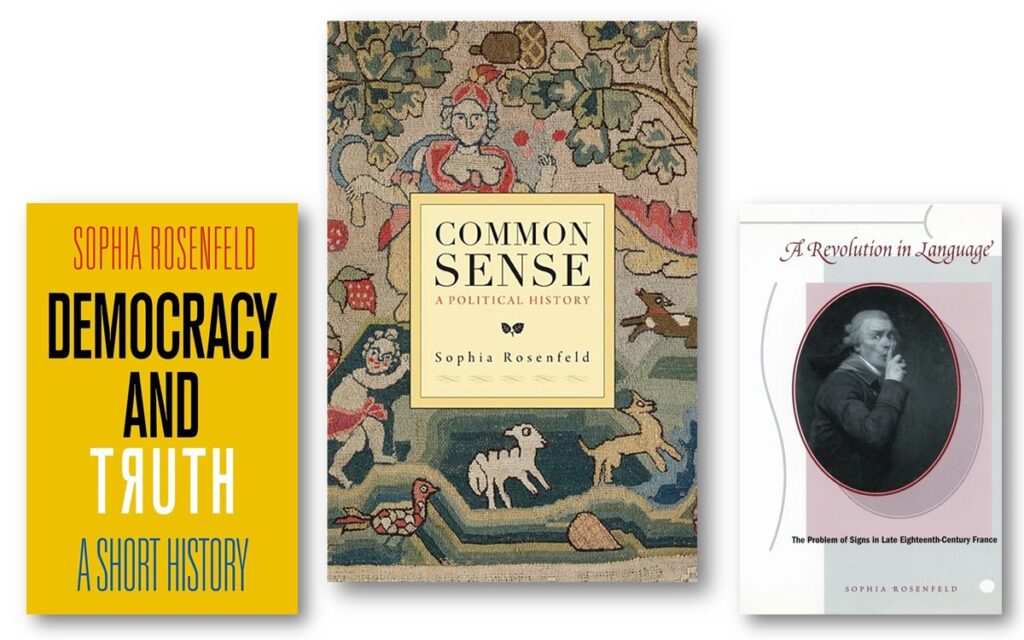 Other major works by Dr. Rosenfeld
The Interview (S1E1): Adel Aali and Sophia Rosenfeld
In our conversation, Dr. Rosenfeld addresses key questions about the Enlightenment, common sense, and how ideas shape revolutions. The detailed outline and transcript below supplement the video above.
Podcast
Watch the full interview on this page with the outline and transcript below, or take the conversation with you on the go through our Spotify podcast.

Outlline
Use the in-depth outline below to follow the discussion and navigate key moments in the interview.
Click for Timestamped Outline
- Selected Highlights (00:00)
- Guest Introduction (02:09)
- Defining the Enlightenment (03:26)
- “A Revolution in Men’s Minds” (04:03)
- Denis Diderot and Jean le Rond d’Alembert (04:03)
- The Reading Public and Public Sphere (05:13)
- “A Revolution in Men’s Minds” (04:03)
- Elites, Intellectuals, and Social Range (06:16)
- Clergy, Aristocracy, and Social Mobility (08:45)
- Immanuel Kant, David Hume, and Adam Smith (08:55)
- Marie Jean Antoine Nicolas de Caritat, Marquis de Condorcet (09:58)
- Artisans and Limited Popular Reach (10:19)
- Enlightenment as a Shift in Knowledge (13:17)
- From Received Wisdom to Empirical Reasoning (13:33)
- Reason vs. Pure Rationalism (14:37)
- René Descartes and John Locke (14:37 / 16:34)
- Periodizing the Enlightenment (16:18)
- The “Long 18th Century” (16:34)
- Enlightenment and Religion (18:52)
- Anti-Clerical and Religious Variants (19:16)
- Enlightenment and the Age of Revolutions (20:20)
- Ideas, Vocabulary, and Revolutionary Forms (21:11)
- Beyond Simple Causation (20:57)
- Enlightenment and the American Revolution (22:39)
- Founding Fathers and Intellectual Influences (23:04)
- Thomas Jefferson and James Madison (23:04)
- Transatlantic Exchange of Ideas (24:03)
- Did They Know They Were in an “Enlightenment”? (24:28)
- Adam Smith (25:34)
- Thomas Jefferson and Benjamin Franklin (25:56)
- Founding Fathers and Intellectual Influences (23:04)
- Common Sense: Definition and Meaning (28:16)
- Common Sense vs. Reason (28:52)
- Ordinary Knowledge and Shared Truths (29:39)
- Common Sense and Politics (31:45)
- Radical and Conservative Uses (32:05)
- Thomas Paine and Democratic Argument (32:54)
- Populism, Power, and Manipulation (34:55)
- Common Sense in American Political Development (38:21)
- Limited Early Use, Later Revival (38:30)
- Ronald Reagan (40:02)
- Donald Trump (40:18)
- Challenging Tradition Through Common Sense (40:48)
- Religion, Miracles, and Skepticism (41:18)
- Jean-Jacques Rousseau and the “State of Nature” (42:33)
- The “Age of Choice” (43:44)
- Choice as Freedom (44:28)
- Roots in the Enlightenment (45:15)
- Collective vs. Individual Choice (45:50)
- Alexander Hamilton (45:50)
- Then vs. Now: How People See Their World (48:04)
- Accepting Reality vs. Questioning It (49:47)
- What Makes People Risk Revolution? (51:09)
- Just One Point (52:26)
Transcript
Note: This transcript was generated automatically and may contain minor errors. It is provided for reference and accessibility only.
Click to View Transcript
Adel:
Dr. Rosenfeld, it’s a pleasure to have you on our program’s special series. Thank you for taking the time for this conversation with me about the American Revolution. So, please define Enlightenment for us.
Dr. Rosenfeld:
Enlightenment is actually a hard term to define because it isn’t the word that many of the people we associate with the Enlightenment themselves used. Sometimes they talked about leading lights, and there are other terms that emerged in the era, but largely Enlightenment is a term that was created after the fact to describe both a cultural and intellectual movement that was vital to the 18th century on both sides of the Atlantic. And I think the closest you might come to a definition comes from Diderot, from his famous encyclopedia that he edited with d’Alembert in the second half of the 18th century, in which he said, the purpose of the encyclopedia, and we might say for the Enlightenment as a whole, was to create a revolution in men’s minds.And that is to say, to change the way people think, not just what they thought.
Adel:
When he said that, a revolution in men’s minds, did he mean the elite men, or is the society sort of all of it?
Dr. Rosenfeld:
It’s ambiguous, isn’t it? Even who the men are is ambiguous. Does it mean people in general, or does it mean intellectuals in particular?I don’t think that most Enlightenment figures imagined that they were transforming the ideas, for instance, of the peasantry, of ordinary people, most of whom would have been illiterate in any of the locations we’re talking about in this period. But I don’t think that he meant only sort of thought, what we call thought leaders or something like that either. Most likely, Diderot had in mind a kind of large reading public.
So we might think, yes, people who are themselves writers, but beyond that, a kind of what we might call a public sphere of people who were engaged in reading journals, in attending lectures or concerts, largely urban, though not exclusively. And ambiguous too, whether he meant people across all religious divides, whether he meant men and women, whether he meant people of different ethnicities and races, it really depends on the thinker.
Adel:
Maybe that itself was part of the revolution, whose minds it is that we’re changing. So that absolutely, perhaps that’s one reason. So if we put this in the European context, and I immediately think of France, would these be like people that are in French salons, that sort of thing?
Dr. Rosenfeld:
So the salons themselves, interestingly, included a lot of members of the aristocracy, as well as people we’d now identify as sort of proto-intellectuals of some kind. In other words, people who were starting to make some money by writing, or by otherwise operating in the sphere of ideas, something that’s hard to do in Europe before there’s a commercial market of any kind for books and publications. So Diderot was somebody, for instance, who tried to take up a variety of projects to carve out a living.
And that’s something relatively new in the 18th century. But most of the people in salons, in particular, that he would have mixed with in France, at least, would have been rather well-off and high-ranking sorts of people. So the mixture is interesting.
But I don’t think we can imagine the Enlightenment, at least initially, as reshaping the lives of people across all the different divisions of class and social status.
Adel:
The impact of the Age of Enlightenment, I’m sort of moving fast forward, and the impact, which we’ll get to in a moment, that may have changed everybody’s lives, but not sort of the intellectual discussions and the beginnings of it. Is that a fair way of saying that?
Dr. Rosenfeld:
I think it’s fair to say that nobody’s life in the West, at least, has not been affected by the Enlightenment in some way at this point. So many of our kind of basic operating premises, the ways we talk about even concepts like freedom and equality are heavily shaped by the Enlightenment to this day. It doesn’t mean that they haven’t been challenged in all kinds of ways and remade in all kinds of ways.
But it is hard to imagine the way we live now, democracy, capitalism, everyday kind of governing norms without the Enlightenment. So yes, I think you can say that over time, the impact has been extraordinarily large.
Adel:
I’m kind of going back to what we just discussed about a revolution in men’s minds. I just want to make sure I walk away from this section fully understanding this point. Was the Enlightenment for the elite or was it by the elite?
Dr. Rosenfeld:
It’s an interesting distinction. Some of both. Those who were its greatest exponents ran across the political spectrum.
Sometimes it depends where you’re talking about. In some places like Prussia or Scotland, it was often university professors who were in the forefront, people like Kant or Hume or Adam Smith. In other places, France, they were usually people who ranged from members of the clergy to people who were born to fairly humble backgrounds, but had managed to get enough education to become literate people.
But there’s a wide range of people who might be called the sort of purveyors of Enlightenment.
Adel:
For France, Dr. Rosenfeld, if I may interject here, for France, you identify two groups of people. One is clergy. The second one was people that are born into humble beginnings and this rise in society.
Dr. Rosenfeld:
Some were titled. Condorcet were members of the aristocracy for sure. They had titles like the Marquis de Condorcet, which suggests everything you need to know about his birth.
There was a wide range of types that could be identified with the Enlightenment.
Adel:
I don’t know the answer to this question. Let’s say an artisan, a person who is literate, and we’ll get to the period of Enlightenment. I think also that makes a difference, who becomes enlightened or aware.
Would an artisan even know that this is the age of Enlightenment? Let’s say you and I go back in time, they would say, what the heck are you talking about?
Dr. Rosenfeld:
So there are some famous, there are a few texts, they’re wonderful to discover when people do, which are say diaries or essays written by rather humble people. Some of them artisans who have in fact been exposed to Enlightenment ideas and take them up and write about them. Artisans, both in the British and in the French context, were often people who had access to the world of ideas.
And so it’s not impossible at all to find the literate artisan who’s thinking about what we now call Enlightenment concepts or participating in some kinds of Enlightenment sociability, going to a cafe or a pub, reading the newspaper, discussing current events, maybe even trying a hand at writing him or herself. That said though, this is not largely a movement of the popular classes. The Enlightenment is what we’d call largely an elite phenomenon and maybe a phenomenon of what you’d call a small but burgeoning middle class.
Adel:
Middle class. And that the artisans had time, some of them, you said it was not numerous, to think about these things and write about these things. That sort of assumes some sort of stability and wealth to actually have the time to think about this, you know.
Dr. Rosenfeld:
Right. Leisure itself is an unusual development of the 18th century, the idea of leisure time in the working world. But this is really, you know, really depends a lot on what location we’re talking about in what years.
There is more of a public sphere, for instance, impossible in Paris in the 18th century than there is in, let’s take a different location, in Munich in the 18th century.
Adel:
Or in Russia.
Dr. Rosenfeld:
Or in Russia, or if you went to Spain, we’d have different answers to the question depending where we were looking. Philadelphia is even different from some other cities in the New World. So there are variations that are really important.
Some people think we should not talk about enlightenment at all, but should talk about enlightenments, plural, because there’s a difference between some were clerical, some were anti-clerical, some were university based, some were opposed to universities. Those differences matter. But if we want to make a kind of generalizable claim, I think we can say that what’s interesting about the Enlightenment is that it’s a pretty broad based effort across a lot of the West to alter the sources of knowledge, to alter the way people think and get ideas.
And that meant moving away from sort of received wisdom, in many cases, what you’d always been told, what you’d always read, what you learned in church, or what you learned by going back to antiquity, and often in many cases, an effort to rethink where knowledge comes from. Rooting it much more in the senses and empirical understandings of things, more in reasoning based on those sense experiences, and are willing to challenge all kinds of different truths that had been established over the years. So I think that’s really the commonality.
Adel:
So I was going to ask you this, but I think I just figured it out. So that’s why they also call the Age of Enlightenment, the Age of Reason, because it’s no longer just what you receive, whatever, in seminaries or also in colleges, which also had a huge amount of religious teaching in them. It’s also what you reason out through logic.
And that’s a whole conversation itself, right?
Dr. Rosenfeld:
Right. But where the difference from someone like Descartes, who also thought humans should come to knowledge by challenging everything through a kind of skepticism and just using human reason, is that Enlightenment figures tended to think reasoning without a solid foundation and kind of sensory evidence, the things you know and see for yourself, could lead you astray. So thinking in a scholastic mode, like the Middle Ages, would lead you to sort of reason how many angels can dance on the head of a pin, is the famous example.
In the Enlightenment, one was more likely to say, let’s start with something concrete that we can see about how people live or about life as we experience it, and then reason based on that. And so that kind of logic alone.
Adel:
Is that like the scientific method of some sorts?
Dr. Rosenfeld:
It’s a certain, it’s many people would say that one of the interesting things about the Enlightenment is the turn of some of the methods of the scientific revolution towards non-scientific subjects, about turning some of the methods towards how do people live, or what is beauty, or what is love, or what should a family be, or what should the state ideally look like. But using some of the methods derived from the scientific revolution.
Adel:
Yeah. You said one of the challenges in defining some of these concepts that we were talking about, defining our sort of drawing a parameter around it, what years you’re talking about, right? So what is the period that is designated to the age of Enlightenment?
Dr. Rosenfeld:
So like all periods, these are categories we use to make it easier to think about the past. They don’t sort of start and end in a specific moment, exactly. Whether you’re talking about, I don’t know, the Renaissance or the Cold War.
But if you had to really give some dates to the Enlightenment, its roots go back to the 17th century, to people like Locke and Descartes. But it really has its heyday in the 18th century, and maybe a little earlier in England than some other places. But we might say, sometimes historians talk about the long 18th century, which means its tale is in the 17th century, and its afterlife is a little bit into the 19th century.
But that’s what we generally mean. So the 1800s is the easiest way of putting it. Sometimes the French Revolution…
Adel:
The 1800s or the 1700s? Sorry. The 1700s, right?
Dr. Rosenfeld:
Let me say that again. The 18th century, the 1700s. Yes.
Apologies.
Adel:
No, that’s okay. I asked this question for this specific reason, Dr. Rosenfeld. Sometimes I see that they sort of put dates around the age of Enlightenment, 1687, which is just a year before the so-called Glorious Revolution in England, to the American Revolution in 1789.
And I think the answer to that, that doesn’t really work that way because it continues. Would you also categorize all the revolutions that happened in the 1840s in Europe, 1848? Would they also be in the age of Enlightenment, or are they sort of the product or the byproduct of the age of Enlightenment?
Dr. Rosenfeld:
I mean, these terms are loose enough that I don’t think there’s anything right or wrong exactly about giving the later ending date to the Enlightenment. But certainly the revolutions of 1848 could not have happened without many of the concepts on which they’re based having originated in the previous century, in the 18th century. Now there are also some new elements by 1848.
The rise of certain kinds of nationalism, the rise of beginnings of socialism, are new developments really of the post-revolutionary world. But nothing about the liberal orientation of the 1848 revolutions is conceivable without first the French Revolution and even prior to that the Enlightenment.
Adel:
Yeah. I had another question, and I think you answered it. I was going to ask you whether or not Enlightenment was a secular movement, and earlier you said there are anti-clerical sort of ideas and ideals and thought leaders, and also clerical.
Dr. Rosenfeld:
So there, yes, it’s a complicated question. In some places Enlightenment and Protestant Christianity, for instance, evolve hand in hand. In other places, particularly in more Catholic regions, though not exclusively, Enlightenment is often set against the Church, which is to say both against the power of clerics over ideas and against the commitment to miracles or what they would have called superstitions as part of religious teaching.
So the challenge when a revolution in men’s minds also means a revolution in the case of Diderot against the teachings that would have been the orthodoxy of the Catholic Church. That, however, is not the case everywhere, and there are versions of Catholic Enlightenment and Jewish Enlightenment and Protestant Enlightenment as well.
Adel:
Yeah, and it’s interesting that you say that because based on my limited knowledge of the French Revolution, there was also a very strong anti-Catholic streak within the French Revolution itself. The Age of Enlightenment is also called the Age of Revolution, and we just discussed some examples such as the French Revolution. Is that because there’s a causal loop between the two, or is there like just an overlapping period?
Dr. Rosenfeld:
Both are the case. Again, the Age of Revolutions could be said to really begin with the American and French Revolutions, or you could go back to the Glorious Revolution, as you suggested, or even the Civil War of the 17th century in England. How are they connected is a complicated question, and the question can’t be answered in a simply monocausal way, like people had new ideas and revolutions followed.
That just doesn’t work. However, the Enlightenment does supply a lot of the key concepts and even the vocabulary that’s appropriated by revolutionaries in the 18th and into the 19th centuries, ideas about liberty, for instance, that really would look different in a different era. So the reasons say the French Revolution happened are much more complicated than simply say the Enlightenment produced it.
There are all kinds of questions about social conflict, there are questions about state finance, there are questions about imperialism and its costs that are all vital, for instance, to the understanding of the coming of the French Revolution. But the very form it took is hard to imagine without the Enlightenment preceding it, and some of the categories of the Enlightenment giving a vocabulary to revolutionaries. Even the counter revolution borrows in certain ways from the Enlightenment and the counter Enlightenment.
So we can find all kinds of links without insisting that one caused the other directly.
Adel:
Dr. Rosenfeld, the more I ask you questions, the more I realize that this is a whole course. So we spoke of revolutions so much. What was the impact, in light of everything you’ve said, this is going to sound like a silly question, but I’m now very eager.
What was the impact of Enlightenment on the American Revolution?
Dr. Rosenfeld:
That’s an interesting question, because the historians have long debated whether there really was an Enlightenment in early America, and how different it was or wasn’t from its European sources. Most people now, I think, consider the Enlightenment’s been very important for leaders, particularly some of the key architects of the key texts of the American Revolution, people like Jefferson and Madison. However, there were other strains of thinking as well that were important to those thinkers.
So again, they weren’t directly taking up Enlightenment ideas as much as combining them with other sets of ideas. And I would argue something similar, that it’s impossible to imagine a discussion of the rights of man, or ideas like the pursuit of happiness, without imagining Enlightenment origins for many of them. The text would sound different if it had been written in a different moment in time.
And so I don’t think the Enlightenment produced the American Revolution directly either. But it’s impossible to understand the nature of the American Revolution, and particularly the actions of its leaders, without some sense of the text they were reading, and of the ideas they were imbued with, and even the socialization and the cultural life that they’d created in places like Philadelphia, with the American Philosophical Society and organizations that were designed really to be transmitters of ideas from Europe to the New World, and vice versa.
Adel:
Did our founding fathers, such as Thomas Jefferson, Madison, later Alexander Hamilton, did they know that we are in this special age? I don’t know, did they even use the term Enlightenment? Is that something that we’re…
No.
Dr. Rosenfeld:
The term, the term there, the French talk about the Les Lumières, which is sort of the leading lights. The Germans talked about Aufklärung by the time of the end of the 18th century. But the term Enlightenment did not exist yet.
It’s a much later invention. And Kant had said, for instance, we’re living in an enlightened age by the 1780s, but not calling the period the Enlightenment in any direct way. That said, I think many people had an idea that this had been an extraordinarily rich moment for new ways of thinking.
And every founding father knew his Locke, for instance. And that’s a 17th century text.
Adel:
Some of them had read Adam Smith, as you mentioned.
Dr. Rosenfeld:
Different, you know, different, well, Adam Smith’s The Wealth of Nations, at least, comes out in 1776, the same year as the Declaration of Independence, etc., that read a little bit later. But books were imported to major cities in the US. Many leading founding fathers had spent time abroad, often in Paris and elsewhere, Jefferson, Franklin and others.
So the new world was not cut off in any sense from this movement of ideas. And I think it’s fair to say that the founding fathers were quite aware that they were attempting to change history to a certain extent. They were attempting to do something that was going to have a large impact globally.
Now, initially in Europe, it was not really seen as a world historical event, because the place was more obscure than France. The French Revolution was taken to be a much more important revolution when it happened. The colonies were kind of impossibly far away and hard to imagine.
But all the founding texts get printed in, not just in Britain, but they get printed in France, they get printed in other languages pretty quickly. They make their way to Latin America very quickly. They become, you can buy Tom Paine in Spanish as well as in French pretty quickly, German too eventually.
And so you have some sense that the transmission of ideas goes both directions.
Adel:
So based on what you just shared with us, American colonists, especially our founding fathers, are receiving information, digesting information that’s coming to them from Europe about Enlightenment, Age of Reason and all these, Locke, Adam Smith. But they themselves are also producing information that’s circulating around the world. And in fact, and in turn is impacting the revolutions and other things that happened then.
Let’s take a break here. In the next segment, I’ll ask Dr. Rosenfeld about common sense. We’ll be right back.
Adel:
Dr. Rosenfeld, most of us Americans remember, or should remember, Thomas Paine and his Common Sense pamphlet from our middle school and high school years, American history, hopefully remember it. And Paine’s pamphlet that came out in January 1776 is really important to the American Revolution, and another scholar discusses that in detail in this series. What I’m interested in discussing with you is common sense in lower cases in the context of your book, Common Sense Political History.
So what is common sense?
Dr. Rosenfeld:
Common sense is hard to define because you’re supposed to know it when you see it, but it generally means the kinds of things that we know based just on instinct or everyday life, and the capacity to know those things. So it’s opposed to things like book learning. It’s the things you just kind of know because you exist in the world.
Adel:
So based on that, is common sense different than reason?
Dr. Rosenfeld:
You know, I think common sense is best understood as something a little more low-level than reason. Reason takes some sort of thinking based on common sense, maybe, but it’s some sort of higher-level kind of thinking that allows you to use logic and inference to get to steps, in a sense, to get to something larger. Common sense is a kind of instinct.
If you put your hand in a flame, it’s going to burn you. That doesn’t take a lot of reasoning, but it’s either you tried it, and that’s what happened, or you sensed in some way, oh, that’s hot. I better not put my hand right there.
And that’s what’s generally meant by common sense. And what’s interesting is that starting in the 18th century, common sense becomes more valorized than before. It’s sort of invented as a category of thinking that is the, you might call the thought of ordinary people about everyday life.
It’s common, therefore, in two senses.
Adel:
Help me out with this. Valorize in the 18th century. Just a couple of minutes ago, the examples you were giving us about sticking your finger in fire.
So if we’re talking about ordinary people, this is about their ordinary lives, right?
Dr. Rosenfeld:
Yeah. What’s interesting about common sense is that it’s common that it’s everyday. Okay.
It’s a kind of an ordinary thought, but it’s also common in the sense of shared. It’s something that everybody, sensible, should agree to. In other words, it’s very hard to find somebody out there who’s going to say, oh, no, I don’t think you get burned if you put your hand in a flame.
Let me show you how I do this, or something like that.
Adel:
That would be a very strange I’m a magician.
Dr. Rosenfeld:
Right. I mean, other than, exactly. Somebody who’s doing something really crazy might argue something else.
But common sense is the stuff we all agree on, and it’s the things that we all know.
Adel:
So if everyone agrees on an emperor, or a king, or an empress, or a queen, have common sense to the same level as a peasant?
Dr. Rosenfeld:
Theoretically, the idea is that not only do, say, ordinary people have the same capacity as you just gave the example of a king or queen, but they might even have a better sense of common sense, because it hasn’t been distorted by book learning and false ideas. Sometimes the simple peasants say knows better than everybody else, because they just see what’s there. They call it as it is.
They don’t use fancy words or anything like that.
Adel:
So why is this valorized in the 18th century? Is this part of enlightenment? Are you giving agency to common folk?
Is that what’s happening?
Dr. Rosenfeld:
So it’s a really interesting question, I think. And I think there’s sort of two strains of how common sense works itself into the enlightenment. In the case of the more radical enlightenment, it becomes a way to challenge established ideas.
You can challenge a miracle, say, by invoking common sense. But sometimes common sense can be used to rather more conservative effect. In the Scottish enlightenment, it’s sometimes used to sort of argue against new notions or against really big philosophical abstractions and for the knowledge of everyday life.
And so from the beginning, it has no real politics that’s obvious about it. It can be used to democratizing effect, and it can be used against democratizing effect. Both are important, I think.
And what’s so interesting about Tom Paine, for instance, is how he turns that notion into a foundation for a kind of democratic politics that says not only can ordinary people know a lot, but in fact, politics itself is perfectly suited to ordinary people’s capacity to know things. It’s not some big abstract science that you need to spend years studying or be born into knowing about. Ordinary people know what’s right and what’s wrong, and that’s all you need to establish a new kind of politics.
Adel:
So based on what you’re saying, common sense sort of undermines the paternalistic view of European monarchs that we’re here to protect you because you don’t know any better.
Dr. Rosenfeld:
That’s in Paine’s usage, yes. He starts with very ordinary things and says, well, you know, an island is smaller than a continent, so why should an island rule a continent? That sort of thing.
And it’s that kind of folksy, everyday wisdom, even though what he’s doing is actually arguing for something quite radical. He’s arguing for getting rid of a king. He’s arguing for getting rid of aristocracy.
He’s arguing for independence for colonies. But he’s insisting that both there’s nothing particularly radical in what he’s arguing, because anyone with common sense would know it, and also that ordinary people could probably rule on their own just fine. They might be representatives, but they have the capacity to determine affairs of state.
And so it’s a radical argument using a clever concept to do this. It can be used differently, which I can explain if you’re interested, but that’s a whole other question.
Adel:
Yeah, well, no, I’m interested because you said earlier, you said common sense can be used for the people, and we discuss much of that now. But it seemed like you were suggesting that it could also be misappropriated or used by governing people, by the ruling class against the people.
Dr. Rosenfeld:
Exactly. I mean, that’s where things get complicated. So democracies were aided and democratic movements have often been helped by invoking common sense, the common sense of women, the common sense of black people, for instance, has been used as a way to say, we all share in the capacity to rule here.
But once a democracy is in principle up and running, it can also be a populist tool, and it can easily turn demagogic. For instance, you could say, if the state starts saying, we embody common sense, anything else that anybody suggests is nonsense, in other words, not common sense, nonsense. And we know best what’s in the people’s common sense, it can actually work to prop up a kind of populist dictatorship.
And we’ve seen this happen in the history of populist movements quite frequently. And there are questions right now about the current administration using often this notion of a revolution in common sense, going back to that notion now, and whether that’s in keeping with the pain tradition, or a reversal of the pain tradition.
Adel:
You know how earlier in the last segment, you said when we were talking about enlightenment and revolutions, so there were the ideas that contributed to revolutions from enlightenment and back and forth also from revolutions. But you also said words and phrases, I think that’s what you said, also were used from enlightenment for purposes of revolution. And here is something similar, here is common sense that’s being used, you sort of get that word, turn it upside down.
And you say, we the ruling people are telling you what is common sense. And these other stuff are nonsense.
Dr. Rosenfeld:
Right, right. And it can be kind of exclusionary doesn’t say those are different opinions. It says anything outside of this is nonsensical in some way.
I mean, words become in politics, words stand for concepts, and concepts can become tools or even weapons for different political movements. And whether we’re talking about a word like nation or a word like common sense, you can imagine how different actors can mobilize those words or those concepts to different purposes. And common sense, I think, is particularly interesting here, because it’s supposed to be something that’s non-manipulable, that’s outside of history, that’s apolitical.
It’s again, don’t put your hand in a flame kind of logic. And yet, we’ve seen up to the present moment, how often it becomes a political tool.
Adel:
And how often it’s manipulated, even though it should not be.
Dr. Rosenfeld:
It’s manipulated to different ends.
Adel:
So, okay, we know about Thomas Paine, and we know about his famous, I don’t know, almost 50 page long pamphlet, Common Sense. Was the concept of common sense also used by our founding fathers in America? Like, I don’t know, Thomas Paine, Ben Franklin, others, Madison, these are some that come to mind.
Dr. Rosenfeld:
It’s used more in later periods, really, in starting the late 19th century than initially, although it’s borrowed from British politics, it’s already there in British politics. Common sense gets very closely associated with Paine as a figure quite quickly. So, when people want to sign something common sense, for instance, as the name of, you know, as a pseudonym, it’s often thought to be Paine or in the tradition of Paine.
I think the place you see most is around the more radical first constitution for the state of Pennsylvania, which is a kind of radically democratic document in its moment. It does not quickly, though, become a kind of key element of American political life. Later on, it does.
And in fact, since the Reagan years, it’s really had a real revival in American political life, more often on the right than on the left, but not exclusively.
Adel:
Oh, wow, this is fascinating. So, it’s not something that plays a huge role in most of 19th century politics. It develops later in the 19th century into the 20th century American politics.
Wow, that’s fascinating.
Dr. Rosenfeld:
It’s not unknown. I mean, it’s certainly a concept that you can find, and it’s in the first populist movements of the farmers’ movements, for instance, in the 19th century. So, there’s certainly echoes of it down through time.
But it’s often thought that Reagan is particularly responsible for the turn towards common sense as a tool of a kind of right-leaning nostalgic politics. And in some ways, Trump is the heir to that Reagan-esque turn, though I would say that he means something a little different by it.
Adel:
Yeah. I want to confirm something to make sure that I’m following our conversation to the point here. You said that you can use common sense to also challenge a miracle.
Like, how does that make sense? I think miracle is the example you gave Dr. Rosenthal. So, if that’s the case, was the religious establishment anti-common sense?
Because you can come and say, this is a statue of Virgin Mary, and she’s crying, or this has happened, and full respect to all of that. But a peasant may say, well, how does that make sense, using common sense?
Dr. Rosenfeld:
Right. So, in the more radical uses of common sense, or sometimes in the French tradition, le bon sens, it’s often given as an attribute to somebody, an imagined figure, say a Native American, or a person in the state of nature, or somebody in the South Sea island, or a child, or somebody who’s kind of hasn’t yet been schooled in traditions of different kinds, who can then sort of say the emperor has no clothes.
It’s a way to sort of challenge miracles as one example, but traditions of various kinds, so that writers could use this figure of the person who’s only endowed with sort of basic common sense, hasn’t learned anything in school, hasn’t learned anything in church, to come in and say, but why does this make sense? Why is a family constituted like this? Or why are some people have so much more power than others?
How is that fair? The kinds of things that you could imagine a child saying.
Adel:
There’s a certain naivete there.
Dr. Rosenfeld:
Yes. So, common sense can go with a kind of imagined naive figure, who’s actually a kind of truth teller.
Adel:
I see. Did Rousseau, this goes back to my college days, Dr. Rosenfeld, did Rousseau write about state of nature or something?
Dr. Rosenfeld:
Yes, absolutely.
Adel:
Yeah, yeah.
Dr. Rosenfeld:
And Rousseau was very interested in, and again, he doesn’t really imagine the state of nature as a kind of place you can go back to exactly, but he imagines it as a helpful counterpart to what have humans become in the modern civilized, quote unquote, world. And much of what he has to say about the civilized world is as a critic to say that we’ve become hypocritical, we’ve become unjust in different ways. And different writers, some of Rousseau himself, but also writers who follow in his tradition, try to sometimes pierce that kind of sense that this is just how the world is by showing that in fact, if you really applied logic of some kind to it, basic logic, you’d see that the whole world we’re living in is kind of nuts.
Adel:
That’s kind of nuts. I want to switch gears, but I’m not sure if this is actually switching gears, because I bet there’s a lot of commonality and overlap. And I want to talk about your book, Age of Choice, which came out this year.
So what is the age of choice?
Dr. Rosenfeld:
So the age of choice in this case is a term that I essentially made up, because historians don’t use the term age of choice. That said, choice is another one of those kinds of concepts that’s central to our existence, and that we don’t usually think about in historical terms very often, much like common sense. And what interests me about choice, and why I think we can call the era we’re living in the age of choice, is that it’s in many ways, the meeting point of our economic lives, and our lives as citizens in a democracy.
From human rights declarations to advertising campaigns, choice is often thought to be the equivalent of freedom. And what I think is important here is that freedom hasn’t always been imagined in all times and places, and still isn’t in parts of the globe today, as involving making choices for oneself. There are lots of different ways one could conceptualize freedom.
A very particular one for our moment is, and this economic and political idea, it’s even our personal idea, is that we’re free when we get to decide for ourselves within a menu of options, which one matches our preferences. So I see the roots of this story going all the way back to the age of enlightenment, back to the 18th, even the 17th century. But it doesn’t really consolidate as an idea, I don’t think, until the 20th century.
Adel:
Were the founding fathers making a choice by imagining a government, a new form of government for themselves? Is that within the rubric of what you’re talking about?
Dr. Rosenfeld:
So yes and no. Yes, definitely, in the sense that even the Federalist Paper starts with this wonderful line about whether we are now, it’s going to be up to Americans to determine whether government can be created by choice, or whether government should always be a matter of power and strength. In other words, the people’s decision, something more democratic, would have been called Republican then, or a matter of power politics and dynasty.
So choice is a concept in the 18th century. But what Hamilton has in mind in that famous passage, for instance, is really the collective decision of the people in a sort of abstract way. It’s not the way we vote today.
It’s not this idea that each of us likes something different. And when we vote, we’re just we’re doing something a lot like going shopping. We’re picking what we, what corresponds best to our own predilections and preferences and values.
Adel:
When you say collective decision of the people, that doesn’t sound like choice if it’s a collective decision. Right.
Dr. Rosenfeld:
And a lot of voting in the 18th century is collective. It’s not always a matter of tabulating. Some places use secret ballots, but many places did not.
Many places voting was kind of by general acclaim or everybody just saying, being in accord. Most people didn’t have the vote initially to begin with. It’s this very particular notion of picking off menus of options on a personal, individualized basis, which is what we now generally think of as making a choice, is a more modern notion.
You can see roots of it in the 18th century. You can see roots of it in commercial practices like shopping. You can see roots of it in notions about religious liberty and choice in ideas.
But it doesn’t really become a political reality till much later.
Adel:
Professor Rosenfeld, when I speak with scholars such as yourself, some of them tell me the past is a foreign country. So what you were just sharing with me made me think of this question about people making personalized choices. Are we Americans now different than the Americans of the time of the American Revolution in this particular aspect?
Did they sort of accept certain things that this is my lot in life, this is how things are, that there’s the House of Burgess in Virginia, or there are the, I don’t know, the Loyalists that are connected to London. Was their notion different than ours? I think you kind of answered that, but I want to make sure that I hone in on the American Revolution period and better understand that.
Dr. Rosenfeld:
I would say that, and this is again a supposition of sorts, yeah, in every era people find the world they live in to be normal. This is what the world is like because we inhabit it.
Adel:
Some may beg to differ with our time right now, Dr. Rosenfeld.
Dr. Rosenfeld:
Maybe they will, yes. In general, other places or other times are strange. So the past is a foreign country is a sense that if you went back in time, sitting where you are, or you traveled around the globe to somewhere else, you’d find things that you found strange because you’re used to your own reality.
So it’s certainly colonists, for instance, if that’s what we’re talking about in the 18th century, didn’t sit around thinking, it’s so strange that we’re an outpost of Britain. This is the reality for most people. What’s harder to imagine is how do people start seeing their own world as strange, which would be a sort of first step towards thinking we need to change this.
You have to see something as wrong because it doesn’t accord with what should be before anybody’s going to turn into a revolutionary of any kind. Revolutions are rare. Most of the time people might grumble about things, but they take the world to be largely as things are.
We accept all kinds of things in daily life that someday somebody’s going to say about us, how could they have lived that way? Our grandchildren will say, how could you maybe, and that’s not even that far off and not that distant, will say, how could you have lived in a world in which X was possible?
Adel:
My daughter asked me that, how could you live in a world there was no cell phones? How did you get to places? There you go.
Dr. Rosenfeld:
Or there were homeless people all over the streets and people just walked around them. How is that not a great injustice? Or things like, you ate this, but not that.
There are all kinds of different ways in which time changes. It’s an interesting question emerges for thinking about the age of revolutions. What would have pushed enough people to risk their lives, their property, their stability to take on a cause that seems to have basically upset what they already knew and expected to be the case?
I would say that about the American Revolution and I would say that about the French Revolution too. It was rather extraordinary to risk upsetting the apple cart to such a profound degree. That’s why historians are still fascinated by the question of causation.
What could have produced this in a world in which I’m sure people were just as settled into their routines as we are into ours?
Adel:
By risk, I think this is a really interesting word that you use, risk, because whether it’s the French Revolution or the American Revolution, this is no longer, let me fix this, let me reform this institution or this way of doing things. This is just essentially just turning everything upside down. That’s a particularly scary, frightening type of risk.
If you want our audience to remember just one point about the age of Enlightenment and the American Revolution after everything we’ve talked about, what would that one point be, Dr. Rosenfeld?
Dr. Rosenfeld:
I think it’s an interesting question. I would say ideas matter. What I mean by that, again, is not that ideas cause events to fall directly out of them.
Nobody says this is what equality is and people go out and actualize that fact. That just isn’t how the world works. And yet, without ideas, without the willingness to think in new ways about old questions or even to ask new questions, we are in a way destined to kind of keep repeating the same behaviors in the same forms.
And sometimes ideas have a quick effect. Sometimes ideas have centuries-long sort of lifespans before anything happens in their wake. But I think I would come back to the idea that the Enlightenment helps one see how thinking about thinking, thinking about why people think what they do, when they do, how they do in different eras, is vital to any kind of, not just revolution, but even any kind of reform movement.
Adel:
Is it fair to say that I, when you say ideas matter, it’s not like they become a spark and a revolution starts. I get that. But is it fair to say that ideas sometimes make you start thinking about, hey, this thing that made sense to me no longer makes sense.
It’s no longer common sense.
Dr. Rosenfeld:
Exactly, exactly. If we don’t sort of ask deep questions about why are things the way they are, which I think is what Enlightenment thinkers really started to do to ask questions, then we can’t ever really imagine alternatives to the way we’re already doing things. And so ideas are kind of spark our imaginations.
And I think studying the history of ideas is important because it helps us see how many different ways people have thought in the past and in different parts of the world, but also stimulates our own thinking about what the future could be like.
Adel:
Yeah, that’s fascinating. Dr. Rosenfeld, thank you so much for educating me and our audience about the American Revolution and about the Enlightenment. And to our audience, if you know of any history that could provide more perspective about the American Revolution, please share it with us and tell us what’s your perspective.
Thank you so very much. This was wonderful.
Dr. Rosenfeld:
Thank you. It’s been a pleasure.
Related Interviews and Essays
If you’re interested in how Thomas Paine became Thomas Paine— why he, of all the Revolutionary leaders, was the one to write Common Sense — and how that 47-page pamphlet helped change the course of the American Revolution, take a look at my interview with Dr. Harvey Kaye: The Origins of “Common Sense”.
Who was Thomas Paine?
Dr. Kaye’s major works include:
- The Powers of the Past: Reflections on the Crisis and the Promise of History,
- Why Do Ruling Classes Fear History?,
- Are We Good Citizens? Affairs Political, Literary, and Academic,
- The Fight for the Four Freedoms: What Made FDR and the Greatest Generation Truly Great,
- Thomas Paine: Firebrand of the Revolution, and
- Thomas Paine and the Promise of America.
 From Artisan Origins to Revolutionary Pen
Why America’s “Original” Founder Still Matters Today
Religion and the Revolution
In the Age of Enlightenment, how religious were America’s founders? Did they reject a national church because religion was weak—or because it was powerful? And how did religious diversity shape the constitutional order that emerged from the Revolution?
►My interview with Dr. Kate Carté: Religion and the Revolution: Why the Founders Rejected a National Church
Dr. Carté major works include the following:
- Religion and the American Revolution: An Imperial History
- Religion and Profit: Moravians in Early America
 Religion Was Not the Problem—Religious Division Was
About This Program
Analyzing American Revolution (AAR) is a special series podcast production of the History Behind News program. In this series, 33 professors (and counting) analyze the American Revolution from 33 different angles through in-depth interviews with host Adel Aali.
Meet Our Guest Scholars
A structured body of thought on the American Revolution—where leading scholars advancing distinct interpretations that give this program its depth.

Thematic Collection
Tap below for a closer look at the Revolutionary Era themes we examine—and to meet our guest scholars.

Library
- Interview Transcript Highlights
- Interview Image and Artist Highlights
- Quiz Answers and Backstories

Image Gallery
Explore the backstories and artist bios behind images of our Founding—before and after the American Revolution. These visuals shape how we remember—and reimagine—the Revolutionary Era.

Support AAR
AAR is an independent program built on sustained research, preparation, and production. Your support helps continue this series and expand our program.

Experienced Analysis of History
About HbN Program
The History Behind News program (HbN) is committed to making in-depth history researched and written by scholars enjoyable and accessible to everyone. Our motto is bridging scholarly works to everyday news.
The histories we’ve uncovered encompass an impressively wide range of subjects from ancient history to U.S. politics and economy to race, women’s rights, immigration, climate, science, military, war, China, Europe, Middle East, Russia & Ukraine, Africa and the Americas to many other issues in the news. We also receive advanced copies of scholarly books and discuss them in our program (in the context of current news).

Adel Aali, host. Snapshot from his introductory video to AAR podcast.
232 Scholars & Counting
Our guests are scholars at leading institutions. They are highly recognized, having received prestigious grants and fellowships as well as notable awards, including the Pulitzer Prize. They include celebrated documentary producers, former White House advisors and other high-ranking government officials, and current and former senior reporters of major national and international newspapers. Many have testified in Congressional hearings, and others frequently contribute to major media outlets and widely read publications.
Think You Know the American Revolution?