Updated: August 19, 2026
Introduction
In this interview: “They wanted to take good care of those German POWs… Hey, if you leave the British and become American, this is how many acres we’re going to promise you.”
Watch this segment in the video below (01:03:57; 01:07:39)
Why treat enemy POWs well?
Why offer them land? Why encourage them to stay? Why not simply exchange them and get American prisoners back?
Who were the Hessians? How were they recruited in the German states? Were the Hessians mercenaries, or does that term not quite fit the multinational armies of the 18th century?
How did the American Revolution upend the practice of POW exchange? How did the long-standing practice of German states renting out troops to foreign powers come to an end shortly after the American Revolution?
In this interview, Dr. Daniel Krebs reframes the familiar story of the Hessians through captivity, military manpower, and loyalty. He explains why German prisoners became strategically valuable to the revolutionaries, why exchanging them could strengthen Britain, and why American leaders tried not only to keep Hessian POWs out of the fighting but, when possible, to win them away from British service altogether.
Video
Watch the full interview with Dr. Krebs (timestamped outline below)
Key Themes
- From Conscription to Mercenary Recruitment in the German States
- How German Troops Became a Major Share of Britain’s War Effort
- Why Holding Hessian POWs Weakened Britain’s Army
- Courting Captives Through German Communities, Generous Treatment, and Land
- From Multinational Armies to National Military Service After the Revolution
Central Question
How did the American Revolution turn Hessian soldiers serving in Britain’s army into strategically valuable POWs, and what does their experience reveal about why Americans held prisoners longer, showered them with care and promises, and helped usher in the decline of the old multinational military order?

How to Use This Post
Use this post as reference guide to the American Revolution through the lens of this interview and the broader Analyzing American Revolution program (AARevolution). Navigate using the interactive table of contents above and the timestamps below (in gray) to discover how this interview deepens the story of the Revolution—and to explore how the program unfolds: its key themes, insights, image gallery, scholars list, history quizzes, and related interviews across the series.
Why Hessian POWs Became Strategically Valuable to the Americans
Roughly 37,000 German soldiers from six German principalities entered British service during the American Revolution, including about 25,000 from the two Hessian states. German troops at times constituted one-third of Britain’s forces in North America—and in some commands even more. This was not a marginal addition by any stretch of the imagination.
But as significant numbers of Hessians became prisoners, such as during the Saratoga campaign, the Americans faced a strategic question that went well beyond the cost of guarding and feeding them.
In earlier European wars, prisoners were commonly exchanged because keeping them was expensive. During the American Revolution, however, returning German and British prisoners meant restoring trained manpower to an army that had to bring replacements across the Atlantic. Conversely, Britain’s return of American prisoners did not offer Washington the same value because many belonged to state units and, once exchanged, they returned to their states rather than rejoining the Continental Army. That imbalance gave American leaders a compelling reason to hold Hessian POWs for longer periods—and eventually to consider an even more ambitious strategy: persuading some of them not to return to British service at all.
About My 227th Guest: Dr. Daniel Krebs
Dr. Daniel Krebs is an Associate Professor of Security Studies in the Department of National Security and Strategy at the U.S. Army War College, where he is the director of Advanced Regional Studies Program. He is the author of A Generous and Merciful Enemy: Life for German Prisoners of War during the American Revolution, which we discuss in this interview.
Special Disclaimer
“The views expressed by here Dr. Krebs are his own and do not necessarily reflect the official policy or position of the United States, the Department of War, or any of its Components.”
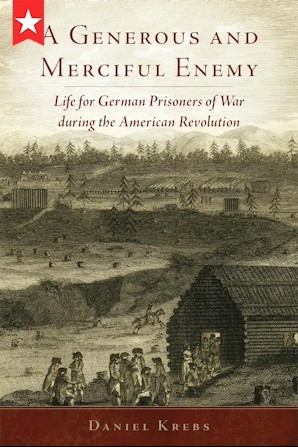 Dr. Krebs’s book we discuss in this interview
About This Post’s Featured Image
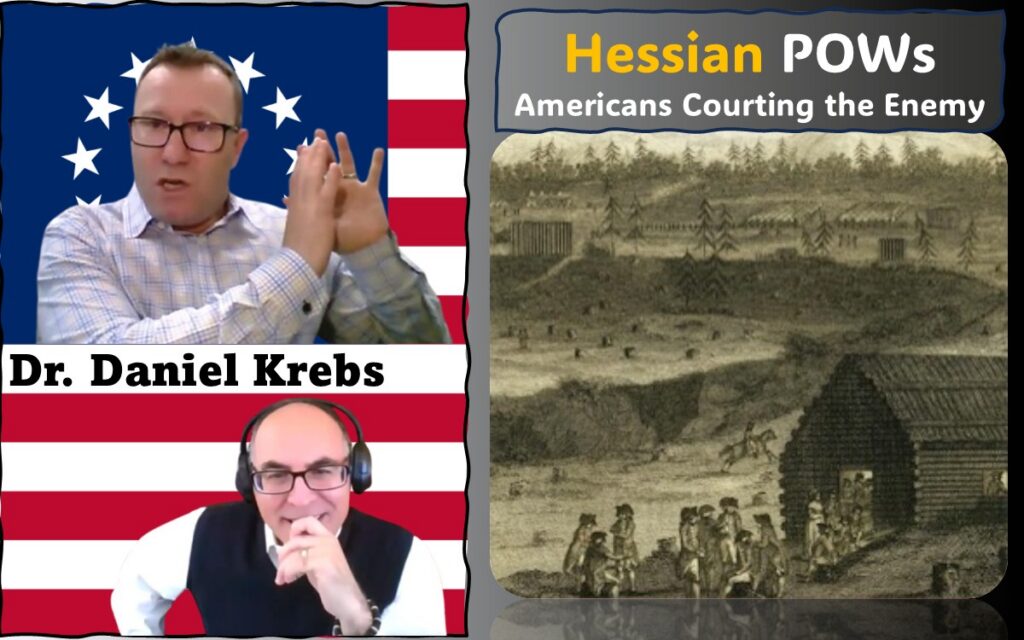
Image of Adel Aali (program host) and his guest, Dr. Daniel Krebs, superimposed on the Betsy Ross flag, along with a cropped image of the cover of A Generous and Merciful Enemy: Life for German Prisoners of War during the American Revolution.
Unless otherwise indicated, all images in AAR—including those in this post—are in the public domain.
AAR Essential Insights
Although the full video and transcript of my conversation with Dr. Krebs are included in this post, I’ve selected and summarized several insights that I found particularly revealing and worth emphasizing. These moments — some surprising, others that challenge familiar assumptions — help us see how the American Revolution has been remembered throughout our history.
By the way, these insights are my own takes and interpretations from the interview. For Dr. Krebs’s perspective and exact framing, please watch the interview above and view the transcript below in the corresponding sections.
A German Army?
Were the Hessian soldiers who fought in America German? Yes, but that answer can fool us into projecting our modern perspective onto the past and creating something that did not exist in the 1770s: Germany.
As Dr. Krebs makes abundantly clear, at the time of the American Revolution, and for nearly a century afterward, there was no such thing as Germany. That did not happen until the formation of the German Empire in 1871 (the Second Reich). For a fascinating telling and analysis of the rise of the German Empire and its ultimate demise at the end of World War I, see my interview in our sister program, History Behind News, with Katja Hoyer, a German-British historian and author of Blood and Iron: The Rise and Fall of the German Empire, 1871-1918.
Now, returning to this interview, as Dr. Krebs explains, the Hessian soldiers Britain brought across the Atlantic were sourced from six sovereign German principalities, each of which negotiated a separate agreement with Britain. Even “Hessian” is only partly accurate—about 25,000 of roughly 37,000 German soldiers came from Hessen-Kassel and Hessen-Hanau; thousands of others did not.
So why would individual German states place their relatively small armies in foreign service? Dr. Krebs’s answer takes us directly into the political economy of 18th-century warfare.
Britain had concentrated heavily on naval power and often looked to other polities and powers when it needed larger land forces. For smaller German principalities, meanwhile, armies were expensive—but also sources of income, diplomatic relevance, and prestige. The devastation and debts left by the Seven Years’ War added still another incentive for these relatively small German states.
So what can look to us like an odd transaction involving “mercenaries” made considerably more sense inside an older European system of dynastic states, international armies, and rented military manpower—a system that was itself nearing the end of its life. That larger transition becomes one of the most important threads running through this interview.
Watch this segment in the video above (00:05:29)
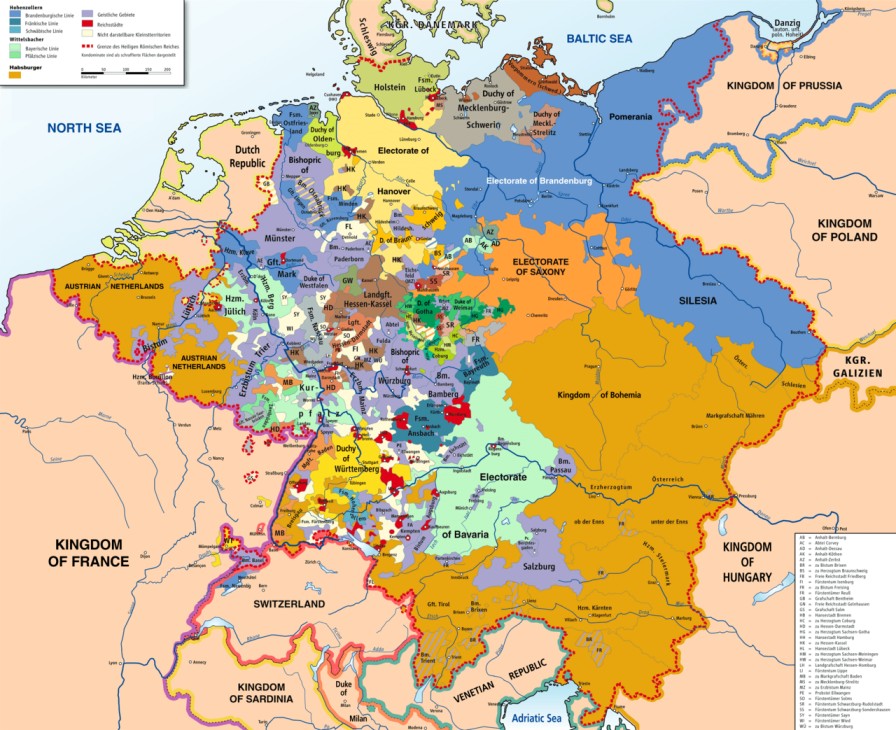 Map of the Holy Roman Empire in 1789, under the Austrian Habsburg monarchy. Its largest territories included the German-speaking lands of Austria (orange) and Prussia (blue), alongside a patchwork of numerous smaller states, many too small to appear individually on the map.
Map by Robert Alfers and ziegelbrenner, via Wikimedia Common. CC BY-SA 3.0 license.
The Hessians: Conscripts, Mercenaries—or Both?
Calling the Hessians “mercenaries” is convenient. It is also incomplete. Dr. Krebs’s answer—appropriately enough—is “it depends.”
Many of the original German contingents sent to America in 1776 and 1777 came out of early conscription systems. German principalities divided territory into recruiting districts, imposed quotas, and required communities to produce men for military service. But as casualties, disease, and desertion created replacement needs, the system began to change. The principalities increasingly turned to bounty money and more traditional mercenary recruitment. By the later stages of the war, the composition of these forces could look very different from the armies that had first crossed the Atlantic to America.
And here is the part I find especially revealing: military recruitment collided directly with the needs of local communities. A town did not necessarily want to lose its farmer, carpenter, or butcher’s son to a war thousands of miles away. So recruiters looked elsewhere—sometimes just across the border into another principality. In this fragmented political landscape, a “foreigner” might live only ten or twenty kilometers away.
That complicates the familiar image of German princes simply “selling” their own subjects to Britain. There was coercion, certainly. But there was also bargaining between states and communities, labor shortages, military manpower demands, and a recruitment system adapting under the pressure of a long war. What Dr. Krebs brings to light in this interview is how the Hessian experience captures a military system in transition: one in which rulers could still hire or rent soldiers across borders, but one that was gradually giving way to armies built more heavily around a state’s own population.
Watch this segment in the video above (26:51)
Is “Auxiliaries” the Right Word Here?
The word “auxiliary” can make the Hessians sound like a supporting force somewhere on the margins of Britain’s war. But their numbers and geographic reach tell a very different story.
German troops served in virtually every major theater of the American Revolution. Thousands marched south from Canada with Burgoyne in 1777. German troops fought around Pensacola against Spain. German soldiers served under Cornwallis and were present at Yorktown. At times, Dr. Krebs notes, German auxiliaries constituted roughly one-third of Britain’s forces—and in some units, as much as half.
And they were not simply British soldiers wearing different uniforms. German contingents retained their own officers and command structures, while their generals participated in planning and strategy. Their rulers back in Europe also remained involved, receiving reports and even replacing commanders when they were dissatisfied with battlefield performance—such as General Heister, who was recalled after the Hessian defeat at Trenton.
So these German contingents were forces placed in British service, not soldiers simply handed over and forgotten.
There is another revealing wrinkle here. Britain already possessed formidable naval power. What it needed was manpower on land. And in the case of North America’s vast distances and its poor roads, Britain particularly sought light infantry units because they could operate independently across the far-flung reaches of the war theater.
So I think my question to Dr. Krebs about the word “auxiliary” matters. Dr. Krebs uses the term deliberately, in part to avoid the derogatory connotations that later became attached to terms such as “subsidy troops.” But if German troops were everywhere, sometimes made up an enormous portion of Britain’s fighting force, and participated directly in command and strategy, “auxiliary” can easily give the modern reader the wrong impression. In this war, German troops were not merely helping Britain fight. They were a major part of Britain’s ability to fight at all.
Watch this segment in the video above (00:40:50)
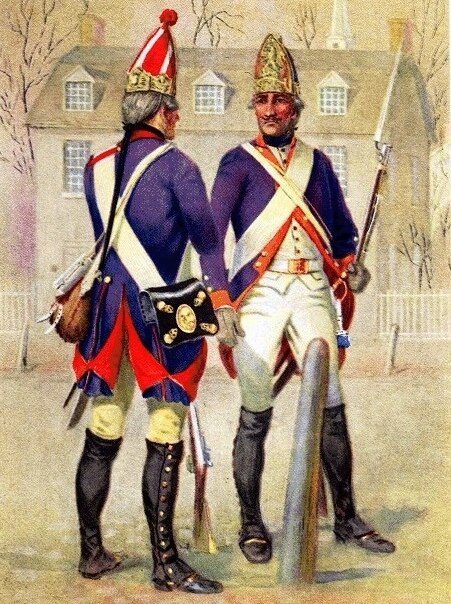 Hessian Grenadiers
This painting is by Charles MacKubin Lefferts (1873-1923), who was an American soldier (New York National Guard and then the federal army) and artist. He is known for his meticulous study and detailed illustrations of uniforms during the American Revolution. After his death, the New York Historical Society, of which he had become a member in 1909, published his works in a book titled “Uniforms of the Armies in the War of the American Revolution, 1775–1783”.
How Hessian POWs Became Unexpected Military Assets
Keeping thousands of prisoners for months or even years sounds costly—and it was. Prisoners had to be housed, fed, guarded, and maintained. In earlier European wars, that was precisely why POWs were often exchanged relatively quickly. Some European states even had standing arrangements specifying how captured soldiers and officers would be exchanged.
But the American Revolution upended that practice. And the reason for it was simple: in America, Britain faced a problem that European armies fighting on the European continent did not—every replacement soldier had to be transported from Europe!
The revolutionaries quickly realized that a British or German POW sitting in American hands was one less trained soldier Britain could put back into the field. Exchange that prisoner, and Britain immediately recovered valuable manpower without having to recruit and ship another soldier across the Atlantic.
Another reason Americans moved away from the old POW exchange system was that they realized they would not necessarily receive the same benefit in return. You see, many captured Americans belonged to state units. So once exchanged, a soldier from Pennsylvania might simply return to Pennsylvania or a North Carolinian to North Carolina rather than rejoin Washington’s Continental Army. From Washington’s perspective, then, what looked like an equal exchange on paper could be militarily unequal in practice: Britain recovered soldiers for its main army; Washington might not.
That is the point I find most striking here. The question for Americans was no longer simply, How do we get our captured men back? It was also: Why return trained enemy soldiers when keeping them prisoner directly weakens the army you are fighting?
And once prisoners were being held for years rather than quickly exchanged, another development followed almost naturally: Americans needed places to keep them. Lancaster, Pennsylvania, became what Dr. Krebs identifies as an early model for the American POW camp—a plan Congress then circulated to other states.
Watch this segment in the video above (00:54:40)
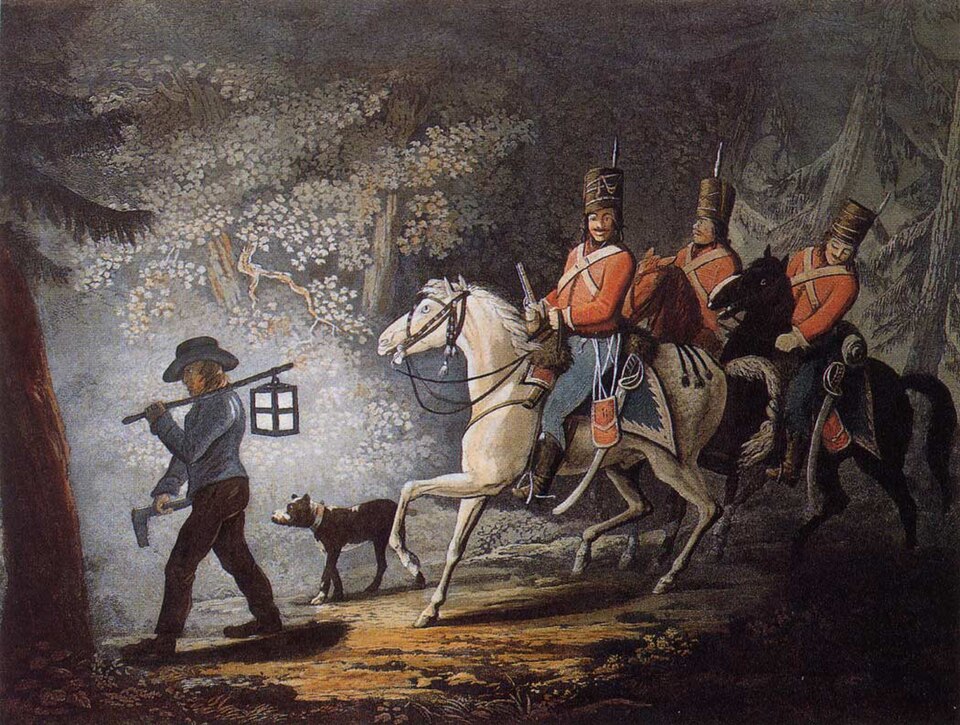 Hessian Hussars
Based on our research, this is a 1799 portrait of Hessian Hussars during the American Revolution. But we were not able to determine the artist who created this work.
The term “hussar” originated with 15th-century Hungarian light cavalry, known for their flamboyant uniforms and skill in scouting and raiding. In later centuries, many European states adopted both the term and the military role for their own forces. Hessian Hussars, for example, also served as light cavalry skilled in scouting and raiding.
Tours, Land, and Promises—Why Didn’t More Hessians Stay?
The American strategy toward Hessian POWs went well beyond simply keeping them away from Britain’s army. Revolutionary leaders actually tried to win them over.
Captured Hessians were shown Philadelphia and the prosperous German communities that had taken root in America. Washington encouraged German-speaking Americans around Lancaster to talk with the prisoners, show them what life in the new country could offer, and treat them as what Dr. Krebs calls a “generous and merciful enemy,” a phrase he selected for the title of his book (see image above). Eventually, some Hessians were even promised land if they abandoned British service and remained in America. As explained previously, the strategic calculation was clear: every German persuaded not to return was one less soldier Britain could put back into the field.
What the Americans offered—and the way they treated the German POWs—was extraordinarily attractive. And that is what makes what happened next so interesting: it did not work nearly as well as the Americans expected.
Many of the Hessians captured at Trenton and elsewhere were not rootless men who had simply been scooped up and shipped to America. They belonged to established military units. Many were veterans. Many had wives, children, parents, and financial obligations back home. Dr. Krebs even found records showing soldiers directing portions of their military pay to family members while they were serving in America. To these men, America was a deployment—not necessarily a new life waiting to happen.
Their military ties mattered too. German officers and non-commissioned officers visited prisoners with fresh uniforms and pay, reinforcing the soldiers’ connection to their units and to the German rulers they still served back home. To Americans trying to persuade Hessians to walk away, this could be difficult to understand. But within the older military world Dr. Krebs describes, the relationship ran both ways: the soldier owed service, while his ruler owed him pay, clothing, and support—even while he was a POW.
So the story behind American efforts is worth telling because it explains why the persuasion and inducements did not succeed as well as hoped. The Americans were asking these men to essentially reimagine themselves—to leave behind an existing military, social, and familial world and become part of a new American one. While land and generous treatment could make that possibility attractive, they could not make everything waiting back home disappear.
Watch this segment in the video above (01:03:57)
America Courted Hessian POWs
Continue watching at 01:05:05 in the video above
Watch more short videos about the American Revolution
The Interview (S1E32): Adel Aali and Daniel Krebs
In our conversation, Dr. Krebs addresses key questions and reveals untold stories about the Hessians and American Revolution. The detailed outline and full transcript below supplement the video above.
Podcast
Watch the full interview on this page with the outline and transcript below, or take the conversation with you on the go through our Spotify podcast.
Outline
Use the in-depth outline below, with its key moments and turning points, to follow the discussion and navigate the interview.
Click for Timestamped Outline
- Selected Highlights (00:00:00)
- Guest Introduction (00:02:57)
- Who Were the Hessians? (00:04:21)
- German Auxiliaries in British Service (00:05:29)
- Six Principalities, Not a German Army (00:06:41)
- Why Britain Turned to German States (00:09:26)
- Hanoverian and Protestant Connections (00:09:55)
- Renting Armies for Income and Influence (00:12:07)
- What Did “Hessian” Mean? (00:16:49)
- 37,000 Germans—25,000 from the Hessian States (00:17:10)
- Regional Identity Before German Unification (00:18:39)
- From Multinational Armies to National Service (00:20:18)
- The International Armies of the 18th Century (00:20:39)
- The French Revolution Changes Military Service (00:22:16) – Turning Point (00:22:41)
- How the Hessians Were Recruited (00:26:10)
- Conscription, Quotas, and the Military Labor Market (00:27:29)
- From Conscripts to Mercenary Replacements (00:31:33) – Turning Point (00:32:41)
- Hessians Across Britain’s War Effort (00:40:26)
- From Saratoga to Pensacola and Yorktown (00:41:08) – Key Moment (00:43:00)
- Commanders, Light Infantry, and the “Auxiliary” Label (00:45:49)
- Hessian POWs Change the Rules of POW Exchange (00:53:24)
- Thousands of German Prisoners of War (00:53:44)
- Why Americans Stopped Exchanging POWs (00:54:40) – Turning Point (00:55:25)
- POW Camps—and Courting the Enemy (00:59:21)
- Lancaster and the American POW Camp Model (00:59:35) – Key Moment (01:01:30)
- A Generous and Merciful Enemy: Care, Persuasion, and Land (01:03:57) – Key Moment (01:07:39)
- Why Hessian POWs Resisted American Persuasion (01:08:14)
- Why George Washington Struggled to Win Hessian POWs Over (01:08:48)
- From Feared Hessians to Hired Workers and Friendly Neighbors (01:15:54)
- The American Revolution as Three Intertwined Wars (01:26:52)
- War of Liberation and Imperial War (01:28:13)
- Civil War and the Creation of the United States (01:29:45)
- Just One Point (01:31:56)
- German Soldiers Were Crucial to Britain’s War Effort (01:32:18)
- Trenton: Surprised, Not Drunk—and Hessians Didn’t Introduce the Christmas Tree (01:32:35)
Transcript
Note: This transcript was generated automatically and may contain minor errors. It is provided for reference and accessibility only.
Click to View Transcript
Adel:
Dr. Krebs, it’s a pleasure to have you in our program’s special series. Thank you for taking the time for this conversation with me about the American Revolution. So, who are the Hessians?
Dr. Krebs:
Hi. So, first of all, thank you for having me on this program. I really appreciate that.
It’s always a pleasure to talk about some of my research, and the Hessians were certainly for many years a big part of my life. Too much of my life, if I could be one.
Adel:
Too much of your life. So, the Hessians. Did you, Dr. Krebs, did you want to state the disclaimer before we go on?
Dr. Krebs:
Yeah. Thank you for reminding me. I always, I tend to forget about that.
That’s okay. The U.S. Army War College, and yeah, I wanted to just state that anything that I say here is just me. It’s my own opinion and my own views, and not the position of the Department of War or the U.S. Government. So, that needs to be stated and made clear that I speak here.
Adel:
Wonderful. So, now let’s go to the big part of your life, the Hessians.
Dr. Krebs:
Now, the Hessians. Yes. Thank you.
Yeah. So, the Hessians, in short, they were German auxiliaries, soldiers hired by Great Britain to fight in the War of Independence or in the American War, as it’s called from the British side. From the U.S. side, of course, the War of Independence. Tens of thousands of them were shipped and sent across the Atlantic to support the British war effort against the colonists or the revolutionaries in the years roughly between 1776 and 1783, although negotiations started before and some of the soldiers, as I’m sure we’re going to discuss later, stayed on beyond 1783.
Adel:
Stayed on. So, you know, this is 2026. We say Germany and we think of Germany, but that’s not what Germany was like.
I think that doesn’t even come about till like, I forget the date, 1870s. We don’t have a Germany, so to speak. So, what German states do Hessians come from?
Is it one? Is it several?
Dr. Krebs:
Yeah. So, I mean, as you might also, and your listeners and viewers might hear, I have a German accent, so I am from Germany originally. Germany as a nation, as a nation state, only came into being in 1870, 1871 during the German-Franco war.
Before that, we had essentially a assembly of different states, sovereignties, principalities that culturally might have thought of themselves as somewhat German, but certainly not at all in terms of a unified state. So, what is really appropriate when we’re thinking about these Hessians is to understand that a series of principalities, all of them sovereign states, all of them part of that larger cultural realm that we would call Germany, sent and made individual treaties with Great Britain to send soldiers to America and fight in that war. So, certainly not at all a German effort or a German army that was sent across the Atlantic.
It was all small individual states. And these states, and there’s a number of them, or, you know, some of them might have been well known, and that is, of course, the Hessians, were in fact two Hessian principalities that sent soldiers. One was Hessen Kassel, and the other one was Hessen Hanau.
And then there were a series of other principalities, Braunschweig, Wolfenbüttel is another one in northern Germany. Then there’s also Waldeck, which is also in nearby Hesse. And then it was Ansbach-Bayreuth, which is today more in Bavaria in southern Germany, and Anhaltsherbst, which is further in eastern Germany today.
So, those principalities all individually made treaties with Great Britain to send soldiers in British service as British soldiers to America.
Adel:
Did you name five or six?
Dr. Krebs:
I was trying to- Those were six.
Adel:
Six, that’s what I thought, six. Now, this is six out of how many principalities?
Dr. Krebs:
Were they like- We’re talking hundreds. Germany at the time was very divided. These principalities got reduced a little bit then with the French Revolution and the Napoleonic Wars and got shrunk further down from the hundreds into the tens.
And later on, and of course today, much smaller states that today make up the state of Germany or the United State of Germany.
Adel:
So, the logical question for me is to ask this, why those particular six? Why not all of them? Why not another set of six or 16 or whatever?
Dr. Krebs:
Yeah, that’s a good question. And I’m trying to keep my answer as short as I can. On the one hand, there was a tradition for some of those states to- Tradition for some of those states.
Yes.
Adel:
Okay.
Dr. Krebs:
To send soldiers in British service. As some of your viewers and listeners might know, during the 18th century, in the early 18th century, the Principality of Hanover and its ruling dynasty became also the rulers of Great Britain, the Hanoverian dynasty. The famous Georges, first, second, third, of course, and the king at the time.
And as Hanoverian princes, they had close relations with a number of principalities, especially Hessen-Kassel, Hessen-Hanau, Brunswick-Wolfenbüttel, and some others. They were part of a larger, if you will, Protestant alliance system that then evolved in the 18th century between Great Britain and these German principalities via that connection over, you know, with Hanover. And traditionally, then, some of those principalities had then made these treaties to send soldiers in British service to the British Isles, sometimes into the Mediterranean and other parts.
One of the reasons for that, and that’s the second reason, so that is that tradition of that connection via Hanover. The second reason is that as Great Britain started building its navy over the 18th century, they simply did not have a large land force. They focused on the naval side of the empire.
And so when larger land forces were needed, Great Britain, again, also traditionally, went and made these treaties with a variety of of principalities and states all across Europe. And then also when these large land forces were needed for America, again, went to these German principalities in order to complete these kind of treaties. Initially, for the War of Independence, some of the negotiations actually were with Russia.
The Russians are coming, the Russians are coming. And for a variety of reasons, these fail. But then, you know, the default was then usually to go back to these Protestant princes in Germany and have them send troops.
For these individual small principalities, this was also a common undertaking of the 18th century. The 18th century was very different from what we understand today. And our understanding today comes largely from the 19th century.
We have a big transition there between the 18th to the 19th century. And in the 18th century, these many principalities, if they wanted to have a voice on that large international scene, they needed to have an army. But armies are expensive.
So to actually keep armies and maintain armies, they needed income. And many of these principalities were simply not big enough to have a steady income to fund expensive armies. So one way of having an army and thus playing a role on the international scene meant that they rented out, if you will, their army that brought in income, allowed them to keep that army, make it a standing army, train, equip, house them, and does have a voice when it came to any kind of international discussions, disputes, etc.
Be part of that, especially in this case with Great Britain, that international Protestant network that was stretching across Europe in support of these causes. Wow. So that is why I said that that’s hence my disclaimer initially, that this might be a longer answer than you were looking for.
Adel:
No, no, it’s a wonderful explanation. And I’m just going to add something that I’m passionate about without inviting either of us to talk more about it. And you said there was a big transition between 18th century to the 19th century.
And our view of the past is mostly formed by the 19th century. And that transition that I think affects mercenaries as well is nation building. And that changes.
I mean, that’s just one of them. But that’s a huge one that sort of limits all of this, sort of renting out your soldiers, if you will.
Dr. Krebs:
Okay. Yeah. I don’t know if you want to go there, but we can table that for a second with the question of mercenaries.
But the other reason for having soldiers sent from Germany into British service and then to America in that period was also the Seven Years’ War. The Seven Years’ War was very destructive in Central Europe. We all know about the famous victories of the Prussian army, but there were a lot of campaigns and massive battles and a lot of destruction in the Seven Years’ War in Central Europe, today Germany.
And so a lot of these principalities were simply financially ruined for a long time. And that war then and the British search for subsidy troops to enlarge their land forces was very enticing them for some of these principalities to find a way to maybe make some money and pay down or pay back some of the debts and some of the funds, some of the infrastructure and other projects stemming from that destruction of the Seven Years’ War.
Adel:
That is so interesting. The more I interview scholars about the American Revolution, the more it seems like the American Revolution, the global war that is sort of ignited, it was trying to resolve some of the issues that were still lingering from the previous world war. It’s not like World War I and World War II, but it makes me think of that unresolved things that continued.
Interesting.
Dr. Krebs:
I mean, Fred Anderson was one of those historians who famously established a clear link between the Seven Years’ War and the War of Independence. And in many ways, the Seven Years’ War, both in the Americas and also in Europe, and its result, its outcome essentially created conditions that then led to that American War of Independence in the Americas and in many ways, also then the French Revolutionary Wars in Europe. So the Seven Years’ War is really then what you want to study if you want to learn about the origins of the American Revolution and also in many ways the origins of the French and French Revolutionary, ultimately Napoleonic Wars.
Adel:
Yeah, I totally agree. Okay, let me just back up for a moment, please, Dr. Krebs, and ask this. The word Hessian mean anything or does it mean like, is it just a geographic location?
Is it an ethnic?
Dr. Krebs:
Yeah, it’s sort of both. So roundabout, and if you want to look at the exact number, so roundabout 37,000 German soldiers from these principalities that are listed, you know, Braunschweig-Wolfenbüttel, Hessen-Kassel, Hessen-Hanau, Weidegg, Anhalts-Zerbst and Ansbach-Beroid, these six principalities, about 37,000 soldiers, as far as I could determine, went into British service during the War of Independence. 25,000 soldiers alone out of those 37,000 came from Hessen-Kassel and Hessen-Hanau.
Oh, that’s a big chunk. So in that sense, we call them Hessians, and that’s a misnomer in a sense that yes, there were other principalities involved that are not Hessian. At the same time, though, when 25,000 out of 37,000 are Hessian, it’s understandable that we associate Hessians with those Germans that fought for the British.
So in that sense, it’s, you know, the typical historian’s answer, it’s all of the above, it’s both. So that’s just to throw a couple of numbers there at your listeners and viewers to understand a little bit with, you know, why Hessians, when we have six different principalities stretching from all kinds of parts of what is Germany today.
Adel:
So since you’re German, I’ll ask this, if we go to Germany today, is it, and we’re talking just, you know, just having a beer with somebody here, they would say, hey, I’m Georgian. I’m a New Yorker. Would someone in Germany today say, I’m Hessian, as in from the West?
Dr. Krebs:
Yes. So in Germany is still, I mean, it’s a federal state. And so the individual states and these regional identities still play a huge role.
I’m from Bavaria, I would often say like, I’m a Bavarian. In reality, I’m more of a Swabian than a Bavarian, which is even, you know, a smaller breakdown of the regional identity. And a Hessian would certainly, and there is a state of Hessian to this day.
So somebody like that would certainly, you know, speak of that regional identity. So because Germany was divided for such a long time over centuries in these smaller regional identities, and only very recently really became a nation state. These regional identities play a big role all the way to today.
Adel:
I see. We were talking about international Protestant network and how Britain for four different reasons tapped into it. And it sort of culminated in bringing Hessians to the Revolutionary War here in the United States, to the American colonies.
So where Hessians, the 37,000 strong force that came to America, were they Protestant or were they Catholics?
Dr. Krebs:
So the principalities were Protestant. Many of the soldiers, I would argue, most of the soldiers were also Protestant. We also have many Catholic soldiers.
Because, and this goes back to the 18th century again, in the 18th century, and forgive me for losing a couple of sentences on there. In the 18th century, in the entire early modern period, armies were not yet national affairs. Armies were not yet, you know, armies that, you know, there was not yet a French army or a English army.
A French or English army in the 18th or 16th or 17th century was often comprised of all kinds of nationalities. You would find Russians, you would find Austrians, you find Italians, you find Danes, you find Norwegians, you find a variety of Germans in all armies. Armies in that early pre-French Revolutionary period were international affairs.
You recruited whomever, it didn’t matter which nationality, which language they spoke. Armies were international affairs. You recruited your army and it meant that all kinds of people ended up in your army.
Among officers, the commanding officers, French was usually the lingua franca on the continent in Europe. And so even if that officer was from Russia or Poland, they would, you know, speak with their French or German fellow officers, often in French. So, so it was a very different understanding of what an army is.
Then came the French Revolution and with the French Revolution, and then the 19th century, what was seen as a legitimate soldier changed. A legitimate soldier. A legitimate soldier.
Exactly. That gets us into the whole mercenary discussion that I’m sure we’re gonna, we’re gonna, we’re gonna.
Adel:
Yeah, yeah.
Dr. Krebs:
I have questions about that. Okay. But basically with the French Revolution and, and the very famous, and I’m sure you, you talked about it with some of your guests, the French famous Lévi-Elmas, when, when France established a conscript army where they called on French citizens to join the armed forces to defend the revolution against these foreign invaders.
In that moment, something switched. From then on, from the French Revolution onward into the 19th and of course in the 20th century, you, you were expected as a Frenchman or a German or a Englishman to fight in the English army, in the French army, in the German army, and not for a foreign army. This is when we have the beginning of what we would call then, you know, the nation states with their armies.
And if you as a German would fight in the French army, or if you as a Pole fight in the Russian army, you were no longer seen as legitimate. This was now that modern terminology of what we call a mercenary, where you’re fighting not for your nation, where you’re not fighting for your cause, but you’re fighting for money for a foreign military. And that was now seen in the 19th century as absolutely wrong, anathema.
In the 18th century, you were a traitor. You would not fight for your nation. This is, this is what begins with the French Revolution.
All Frenchmen had to serve the revolution, had to serve the nation. And, and that was not the case in the 18th century. In the 18th century, if you as, you know, famously, of course, in the American Revolution, a baron von Steuben, a, a Prussian nobleman who signs up with the American revolutionary government was seen as perfectly okay.
20 years later, that was no longer the case.
Adel:
Wow.
Dr. Krebs:
Now you had to serve your nation, you had to save you serve your cause. If you didn’t, that was, you know, you meant you’re an illegitimate, you know, it was not justified, you were a traitor to your nation, you were a traitor to your cause. And in these new nation states, then you, your rights as a citizen came from your military service to that nation.
That means you were really only a true citizen if you also were willing or even served then in that nation’s military. A very different understanding from the 18th century.
Adel:
Yeah.
Dr. Krebs:
That is, and that is what we see a little bit beginning here with these Hessians and why we have some of those discussions. Because those Hessians were very much recruited and put together in their force in that tradition of the 18th century. They thought in a war and in a period where we have that transition, where it’s increasingly debated whether you as Great Britain can just hire some Germans to fight for your war in America.
Is that, that is the beginning criticism that we see.
Adel:
Is that the reason why this was pretty much the last time that the German states, you’re shaking your head in affirmation. So this is, okay, so this becomes even unpopular, I assume, even in the German states and everything is changing sentiments and then view of. So let’s go, let’s go to something that it’s, it’s both definitions, but also I think it’s, it’s a bigger question as, as, as evidenced by what you just shared with us.
You explained that German states, some smaller, some larger to be relevant in Europe, in, in, in the balance of power and everything else that was happening, they have, they had to have an army, but to pay for that standing army, they rented them out. So that was one way, which, which brings this question, okay, where was the army that was formed originally in that German state, smaller or larger? And that doesn’t matter.
Were they conscripts originally? Is that, is that a yes?
Dr. Krebs:
There’s a, it depends.
Adel:
It depends.
Dr. Krebs:
And I want to tell you what college and there is the, that’s the famous answer that we usually give our students. You say it depends.
Adel:
Okay. And I, before you explain that, I want to tell you why I’m asking that, because if they were conscripts and then you rented them out, then do they become mercenaries after that? You see, like if, if somehow we, okay, go ahead, please.
Dr. Krebs:
Exactly. Yeah. That, that is, it’s a big part of, of my book and I’m sure some of my colleagues that work with that, with that issue.
So essentially in that 18th century, especially in the course of the seven years war and some of the larger wars before beginning really with the, with the, already with the Spanish war of succession and then the Austrian war of succession, the need for ever larger armies becomes apparent. That if you wanted to have success in warfare, you, you needed a larger army, more muskets, more cannons aimed at the other side and numbers really started to matter. In order to put together a large army already in the 18th century became obvious that it’s really hard to hire these highly trained, sometimes professionals, these mercenaries that, that you can find on the labor market, if you will, there was a military labor market and then, and then have them in your unit.
If you wanted bigger armies, you needed to tap into other sources and the sources that were available was of course, your population and your principalities in your state, in your territory. And we see the beginning of early conscription. In the case of some of those principalities that sent troops into British service, they usually then divided their territories into districts.
Some called them in the, in the British, in the, in the Prussian case, they call them cantons and all kinds of other terminologies, but small districts and essentially assigned these recruiting districts where within that district officers, local administrations, et cetera, were required to send a certain amount of recruits into the larger army. Sometimes it was then, you know, restricted in terms of mustering that, you know, a, you know, a, a local town would hold an annual muster where everybody in certain ages had to appear. And then they picked, you know, the, the, the suitable ones and sent them, sent them onto the army.
In some cases, some towns didn’t want to, you know, send healthy young man away. They grabbed whomever they could find on the street that did not belong to their town and just, you know, Shanghai them, if you will, and send them away. But this is the beginning of what we would call today conscription, where, where these districts were given certain quotas of recruits that they had to meet.
And that, that begins in the 18th century already. And it evolves over that French Revolutionary Era into the 19th century, where now the call was, and that’s what I mentioned earlier, if you wanted to be a true Frenchman, if you wanted to be a true Englishman, it was your duty to serve in the military. Your rights as a citizen, you were not a full citizen if you did not serve in the military.
This is, by the way, also one of the reasons why for a long, long time in that 19th century and into the 20th century, women often did not have full rights as citizens, because women could not serve in the military. And especially since the French Revolution, the understanding was that you were only a true, full citizen if you were also willing or did serve in the military. Then the origin of what we would call today the draft.
At times when we look before World War I, you know, sometimes two, three years of military service required of a citizen in a particular European state. So this is beginning in that period. And some of these states, especially Hessen-Kassel, but also Ansbach-Bayreuth and Braunschweig-Wolfenbüttel, had these kinds of rudimentary beginning first conscription systems.
I’m saying it depends earlier, because once the initial contingents in 1776 and 1777 left for America, most of these principalities to fill in gaps due to casualties, desertions, sickness, etc., started going away from conscription and simply recruited whomever they could find, mercenary recruitment in that terminology, and send them as replacements to America. Because once the initial contingents had left, these principalities did not want to further deplete the labor force, say, or farmers in their territory to fill in whatever casualties might have happened in America. And then they started literally, you know, offering bounty money, trying to go after vagabonds, trying to go after, you know, people without family, the unbound, etc., etc., you name it, in order to fill and replace those lost in America. So that’s why, initially, many of those contingents looked like conscript forces, these early conscription forces, but over the course of the war, became much more traditionally mercenary forces of the 18th century. That is why it’s, you know, often both. And again, mercenary, not in the sense of the 19th century, but mercenary in the 18th century, simply as somebody willing to commit violent acts for money, regardless of nationality, etc., that did not yet matter in the 18th century, because they were all international affairs. In the 19th century, the term mercenary took on a very specific meaning, and that is, you were somebody that is serving for money in not your own nations, but in somebody else’s nation’s force.
Adel:
It just occurred to me, did the German states, including the two Hessian states, did they at one point just run out of people that would be able to conscript or even grab off the street? And did they subcontract and bring from other nations and send them to America, and they were called Hessians still? Yes, exactly.
Dr. Krebs:
That is exactly what happened. I wouldn’t call it run out of soldiers, but rather than, like, you know, say, town X, it doesn’t matter, in Hesse Castle, and they were suddenly faced with yet another demand for another 10 recruits. I’m just going to keep it at that.
Like, look, I don’t want to send, you know, son of farmer X or son of butcher so-and-so, or I don’t want to send my carpenter into military service because it’s dangerous, we might lose them, they go into America, who knows what’s going to happen to them. This is going to be more of a problem for my town than anything else. Then that town, and I have these cases in my books, I detail them, would then go out and basically search for anybody that they could then send instead of what was demanded and ship them off to America.
And that is then when you had these, you know, local administrators literally trying to grab anybody that maybe walks through town and came and arrived in town and clearly didn’t have a job and did not belong here, and then- It could be some poor Hungarian or Romanian going through town. It could be, and this is, you asked me earlier about how Catholics ended up in these units.
Adel:
Yeah, yeah.
Dr. Krebs:
Because now, you know, a foreigner in Hesse Castle might have been just 10 kilometers away because that’s where the next principality was, that was a foreigner then. And that next principality, one state over, might have been a Catholic principality. And so these recruiters would then just walk these 10, 20 kilometers to the next principality that might have been a Catholic principality and started recruiting there because they didn’t want to send their own people anymore.
Adel:
Oh, that is fascinating.
Dr. Krebs:
And I know these cases from Ansbach-Beroid in particular because in Ansbach-Beroid, they were surrounded by a number of Catholic principalities. Again, just a few kilometers away. So when you have foreigners in Ansbach-Beroid lists of soldiers, they’re not foreigners in terms of they’re Poles or Hungarians or Czechs or whatever.
They’re literally foreigners from maybe the state of Swabia or maybe Bavaria, just about 20 kilometers down the road.
Adel:
That is fascinating.
Dr. Krebs:
And then they were Catholic to the point in Ansbach-Beroid that even Catholic priests were sent with the force to America because now the understanding was that, yes, sure, we’re Protestant and this is a Protestant principality, but we now have a number of Catholics and they do serve their own priest when serving for the British in North America.
Adel:
That is fascinating. We talked about nation building and we talked about the sort of ideological transition that specifically in relation to what we’re talking about, the Hessians and mercenary soldiers are conscripts. I get that.
But you also explained a more pragmatic reason. These towns don’t want to send their own carpenters, able-bodied farmers to America. So that’s a very pragmatic, real, the town’s economy sort of reason.
These reasons must have also been present in the Seven Years’ War and other prior wars in Britain wanted to hire German soldiers. Were these problems also an issue in the past or did they become more problematic now?
Dr. Krebs:
That I can say unequivocally, it’s yes. This was a problem for these mercenary forces of the 18th and the 17th century. Wars are costly and they cost a lot of human life.
And as a result, especially with the ever larger wars of the 18th century, finding the personnel to man these many armies was becoming a problem. This is like I explained earlier, one of the reasons why then suddenly ideas of conscription, et cetera, drafting come into play because the realization starts setting in that we simply can’t recruit enough mercenaries to fill these ever larger armies. We need another way to push people into the military.
Because when given a choice, of course, in the 17th to 18th century, if you were given a choice and if you had the ability to actually make a decision, you usually would not go into the army. The army is dangerous. You might be sent away.
You die of sickness. You might have to go into battle. All kinds of things that might lead you to think of the army as the very last thing that you wanted to do and you tried anything else before you might go into the army.
And so finding soldiers was a problem. And then recruitment through some sort of conscription was a way out of that. Because now you make it a duty for subjects in your principality to serve.
And this is, of course, what manned a lot of the Prussian military. And the Prussian military of the Seven Years’ War and later on became that model for much of Central Europe where the Prussians had essentially created a system in which they decreed that if you are a Prussian and you live in our kingdom and you are living in a particular district and that district had the duty to deliver that many conscripts into the army and so your job and your duty as a Prussian subject is to serve in the army for a certain period. And that model became then some of the models that the rest of these German states started emulating and started copying, adapting maybe to the local situation, but basically trying to solve that problem of we need larger armies and the old system of recruiting mercenaries for our international forces didn’t work anymore.
Adel:
Hmm, that’s fascinating. So 37,000 Hessian soldiers come, not in one fell swoop, they come in waves to America. And that, as I understand it, and correct me if I’m saying this wrong, Dr. Krebs, that comprises about a third of the overall British forces?
Yeah, you’re agreeing. Okay. So where do they serve?
What, I mean, we know they were in New York, we know they were in, you know, the battles for Manhattan and Long Island and all of that and then New Jersey, but where else?
Dr. Krebs:
Yeah, so they serve in every theater of that War of Independence.
Adel:
Okay, every theater.
Dr. Krebs:
Every theater to, you know, geographically from north to south, you have, of course, the very famous British invasion of the colonies in 1777 under General Burgoyne, coming from Canada, marching down south and hoping to split the colonies and does end that revolt. And thousands of these British soldiers under Burgoyne were Germans. Most of them from Braunschweig, Wolfenbüttel, that was the main contingent of German soldiers in that campaign.
So from Canada into New York and then ultimately imprisoned SPOWs near Boston. But you also had, for example, these Waldeck soldiers that served in what is today Florida, around Pensacola. Oh, wow.
All the way down to Pensacola. And there they fought not against, you know, yes, against revolutionaries, but mainly they fought against the Spanish, of course, an ally of the revolutionaries. As I detail a little bit in my book, they can get captured and actually spend some of their captivity in Santa Cruz, Mexico and on Cuba.
Wow. So in that sense, you had them all over. You had a lot of Ansbach-Bereut soldiers were part of the British army under Cornwallis that was then besieged and ultimately defeated at Yorktown in Virginia.
So you had German soldiers in all theaters, north to south. And as I said earlier, at times one third in some units, half of the entire force was a German auxiliary force.
Adel:
So when you say everywhere, you’re really doing it.
Dr. Krebs:
I really mean everywhere.
Adel:
Everywhere. Did they also serve in the Caribbean? Any of the battles over there?
Dr. Krebs:
That was mostly naval engagement.
Adel:
Navy. Yeah, I know, I know.
Dr. Krebs:
So, I mean, I’m sure that there were some Germans there. And I do know that about a rough third of the Waldeck soldiers that got captured in Pensacola in West Florida at the time ultimately actually deserted and joined the Spanish army. And I’m sure that the Spanish army then sent them somewhere in the Caribbean and Mexico.
Wow. But I’m going to be also honest that I have not traced those soldiers.
Adel:
But from what you’re telling me is that, which would confirm my own understanding of this, Hessian soldiers were mainly for armies. They were not recruited to serve in the navies.
Dr. Krebs:
And that was the main demand also on part of the British. The British, as I explained earlier, they had a well-established, very large naval force. What the British lacked over the course of the 18th century are large and established, standing, large land force.
That is usually then where they had to go and find either allies. Famously, of course, Prussia during the Seven Years War, where the English could focus on their naval and overseas empire, while the land force in Europe was essentially the Prussian state and the Prussian kingdom fighting with England. So either with allies or through these subsidy troops, these auxiliaries, in order to actually have then a sizable land force.
Adel:
I see.
Dr. Krebs:
But even big land forces in Europe also had these auxiliary forces. Famously at Yorktown, for example, the French expeditionary force on the Rochambeau that fought at Yorktown included also two regiments from Germany, from Zweibrücken. It’s another principality that traditionally sent subsidy troops under the French king.
And so we had this, you know, in again, in our 1920th and 21st century, understanding this weird situation where at the siege of Yorktown, you would have Germans fighting on the British side and you had Germans fighting on the French side.
Adel:
Germans on both sides. What for the British, let’s go back to Hessians fighting for the British, what role and what capacity did they serve? Were they always, you know, being ordered what to do, subservient, or were they involved with planning and strategy?
I mean, they had their own officers.
Dr. Krebs:
Yeah.
Adel:
Very capable officers at that. Yeah.
Dr. Krebs:
Yeah. So these troops served within their own units, with their own commanding officers, and often on their own command of their own generals. So in that sense, very much contained their own command structure.
And their generals certainly were also partners in planning and strategizing. Most famously, for example, the Brunswick commanding general, who was very involved in planning and conducting and commanding the British invasion force under Burgoyne marching toward Albany and New York City, ultimately defeated by the American revolutionaries in 1777 in Saratoga. But here, Ried is very much part of that overall outcome of war, this planning effort, is commanding both German and British units, simply part of that command team, we would call it today the command team.
That’s the modern language that we would use. I see. And ultimately, even German principalities, the princes, whatever, the dukes back in Europe, had ultimate authority over their officers.
Very famous, for example, after the defeat of Hessians at Trenton, Hessenkassel, the prince recalled the officer that was in command of the Hessenkassel forces, General Heister, and recalled him and sent him back to Germany, because he was disappointed that these three Hessenkassel regiments here were defeated. And he blamed his own commanding general and he replaced them. I’m certainly here indicating that these princes did not just, you know, send those soldiers in British service, you know, wipe their hands and no longer wanted to have anything to do with that.
They were very much involved all the way through, got reports and were part of the planning effort.
Adel:
I see.
Dr. Krebs:
In terms of actual what kind of soldiers, the British were most interested in German infantry. And especially in light infantry.
Adel:
Light infantry, okay.
Dr. Krebs:
Light infantry, yes. The reason for that was from a tactical perspective. America was vast.
And if you wanted to do anything in America, because of its vastness, and because of the lack of a really good infrastructure, roads, etc., you needed to have the best thing that you could have is units that are able to work independently on their own. And traditionally in Europe, those were these light infantry units. You find them in all European armies.
And traditionally, their role was more to act independently to be able to get a mission and then go out, maybe even cut contact with the home base and conduct that mission independently. And that was very much needed in America. And so the British were very interested in these light infantry units from these German princes.
Adel:
I see. Here’s a term that you have used several times. And I’ve seen it used all the time in my readings and in my other conversations.
And that’s auxiliary or auxiliary, depending on how you want to pronounce it. But I have a question about that, Dr. Krebs. Okay.
So we know that the Hessians were part of the command team. They were everywhere. They were in the front lines.
And they comprised one third, a whopping third of the British forces and some regions half. That’s hardly, you know, that hardly sounds like auxiliary when you think about it, right? Like auxiliary to me is like smaller units, like smaller forces that sort of help tie loose ends and corners, you know, take care of this region.
Were they called auxiliary then? Or is that a term that developed later in history for some purpose?
Dr. Krebs:
Or am I reading too much into this? No, no, you’re not. I mean, this is certainly a term that was developed and used much more later.
At the time, it’s in German that the term subsidientruppen or subsidy troops is very often used, essentially indicating that these are fully equipped units that the British essentially, you know, paid for on loan received from a principality and then sent to America. I use the term auxiliary because I wanted to indicate that subsidy troops became, if you will, a pejorative term of the course of the 19th century. It became a term that was then used in a derogatory sense.
You know, these were soldiers that just fought for money or these were units that princes sold, you know, blood sold for gold. And it became really a pejorative term over the course of the 19th century. So I wanted to use a term that is a little bit more neutral.
Of course, often today associated sometimes with these supporting units, etc. Exactly. But in the context that we’re describing, I was just trying to move away a little bit from some of those connotations that developed in that revolutionary period about these subsidy troops and how they were characterized as men that would fight for money somewhere else or as units that were sold by these princes into foreign service.
So I tried to get away a little bit from some of those connotations by using the term auxiliaries rather than subsidy troops or other terms.
Adel:
That makes sense. And I see how it could be used pejoratively later in the 19th century. We already laid the groundwork for that.
How ideologically and nationality everything changed. Now, I want to talk about something else that you almost never hear about when you just like in popular history, you read about the American Revolution, the Revolutionary War. You have some more time for me, Dr. Krebs?
Dr. Krebs:
Yeah, yeah, sure. Yeah, sorry, I did not watch the time. No, no, no.
Adel:
I just want to make sure.
Dr. Krebs:
I’m here.
Adel:
I love it. I love it. Thank you.
So you mentioned Hessian POWs in Boston that we talked about. You also mentioned Cuba and in Santa Cruz, Mexico. How big was the Hessian POW population?
Like, what are we talking about? Hundreds or?
Dr. Krebs:
No, thousands at a time.
Adel:
Wow.
Dr. Krebs:
So, yeah, that was, you know, if, you know, the main topic of my book, I mean, that the rest sort of, you know, I had to study and write about because I wanted to get to the main topic. And that was the treatment and life as a POW in that war for these Germans. Just to take three very famous battles.
If you look at Saratoga, which I already mentioned. And if you look at your town and if you look at Trenton, we’re already talking several thousand German POWs just by looking at these three campaigns and three battles. What also happened during the American Revolution is a big part of my research is that, again, this transition period prior to this conflict and prior to the French Revolution and then these national wars of the 19th century.
It was very common to not keep POWs for a long time because POWs cost money.
Adel:
Yeah.
Dr. Krebs:
Needed to be housed. They needed to be fed. There’s all kinds of reasons why you don’t want to keep POWs.
You want to exchange them ideally as soon as you can to get your own soldiers back and send these foreign soldiers away again. And in some of those wars of the early modern period, we have these kind of standing exchange agreements between certain principalities and kingdoms where in case we are fighting a war, we will exchange soldiers for this much and every officer counts that many privates, et cetera, et cetera. Standing agreements.
This broke down during the War of Independence because this was not the usual war of Europe of a dynastic conflict of some sort. This was a revolutionary war. And what especially the revolutionaries figured out very quickly is that the British had to bring every soldier over from Europe.
And so the revolutionaries understood that the more I keep British soldiers away from going back to the British army, the more I weaken that British army. And so exchanging POWs no longer becomes what you want to do because if you exchange them, the British just get more soldiers back that they don’t have to bring from Europe. So that is why the revolutionaries wanted to hold back.
Also, the British, when they captured revolutionaries, they truly mistreated them. I mean, we can do a whole lot of podcasts on that part of the story, but the treatment of American POWs. The problem that especially George Washington realized is that a lot of these revolutionaries came from state units.
And so when then these North Carolinians or these Pennsylvanians were maybe exchanged, they didn’t come back to the Continental Army. They went back to Pennsylvania. They went back to North Carolina.
And so there was really no reason, especially for the Continental Army and for the Continental Congress to agree to large scale exchange, because the only thing that would happen is the British would get their soldiers back, the Germans and their own English, Scottish soldiers. And the Americans would get soldiers back, sure, but they often came from state lines, from state units, and went then back to their states and their state lines, not to the Continental Army. And so these exchange agreements had to be negotiated.
And sometimes these negotiations took a long, long time. And that is why we find a lot of these POWs, to take the Trenton prisoners as an example, in person for two years until an exchange was negotiated. And so we have a true POW experience here, because again, we’re fighting in a war that is in that transition period where things are no longer working that worked before for a variety of reasons.
Part of it and very important part of it is, of course, this was a revolutionary war in which the revolutionaries, excuse me, wanted to establish their own entity away from the British motherland.
Adel:
Okay, so let me just recap this quickly, make sure I have it. Yeah, all right, lecturing. That’s okay.
No, this is wonderful. So if the American revolutionaries exchanged POWs, the Brits would get their soldiers, they wouldn’t have to bring as much soldiers from Europe, and those soldiers would go to the British Army in the Americas and start fighting again. Versus if Americans got American soldiers back, those American soldiers wouldn’t necessarily go to Washington’s military camp.
They may just go back to North Carolina. They may just go back to Pennsylvania. And it would not be an equal exchange, so to speak, for Washington and his other generals that had to…
That is fascinating. So well, I got to ask this, were there POW camps in the 13 colonies or were they just housed in different locations? How was this structured?
Dr. Krebs:
So, yes, we actually, and this is one of the rare cases where we have a true record, where we even have a plan for a model POW camp. And the first one that I was able to find was in Lancaster, Pennsylvania. In Lancaster, Pennsylvania, about 30, 40 miles west of Philadelphia, important small town.
Especially also in the context of the Seven Years’ War. And far away enough from the coast that the revolutionaries early on, already in 1775, started sending their first POWs into that region. And in Lancaster, they had old barracks from the Seven Years’ War.
And these barracks were not used at the time, and so the first POWs arrived in these barracks. And then the locals realized, look, I mean, if we have them in those barracks, maybe we need to put some kind of fence around this thing. Maybe we need some sort of guard for this.
And long story short, by 1776, what I found in the papers of the Continental Congress is actually a drawing of what Lancaster had done around these barracks with guardhouses and even, you know, of course there was a cemetery, but there was also a hospital ward and et cetera. Essentially created, if you will, the blueprint of a POW camp. Oh, wow.
And then Congress saw that, asked for that plan. The plan was sent to Congress, and then Congress copied that plan and sent it to a variety of other states. Essentially telling these other states, hey, this is the model of what we think of as a POW camp.
They did that in Lancaster. If you have POWs in your state, in your community, this is what you should be doing. And that way we have, if you will, that is the origin of the American POW camp or any POW camp today.
And that came from Lancaster, Pennsylvania.
Adel:
How many of these camps were established by the end of the war, you know, 1783?
Dr. Krebs:
I can’t tell you right now off the top of my head the exact number, but we have POW camps pretty much in every state that contained at some point some fighting. The biggest ones were in Boston where we have the POW camp for the defeated force under Burgoyne, the so-called Convention Army. Then Lancaster, Frederick, Maryland.
We have Winchester, Virginia. Those were some of the biggest ones, but we then also have much smaller ones. And these smaller ones could then be just a few houses or, you know, even just a farm house or something like that somewhere where some groups might have been held for a few weeks or, and this was also very common, churches.
Churches were often, you know, larger buildings that were then appropriated either as hospitals or then as POW camps. That, that, that might happen, you know, we, we, you know, hundreds of those. So, so in terms of these large scale camps, we only have a few, but, you know, some of those churches, some of those larger buildings, we might’ve had many, many, many more.
Adel:
So I want to talk about your book. The title is, and well, we’ve talked about your book. This is the whole foundation of our interview is, is, is your book, but I want to talk about the title more specifically because it relates to my next question that naturally follows what you just shared with us.
The title, the full title, including a subtitle is A Generous and Merciful Enemy. Life for German prisoners of war during the American revolution. So does the beginning part, the title, A Generous and Merciful Enemy mean that Americans took good care of the Hessian POWs?
Is that what you mean by that?
Dr. Krebs:
I could, I could put it that way. They wanted to take good care of those German POWs. And, and behind that is a, is, is a, I wouldn’t call it obsession, but certainly a hope by the revolutionaries because they, they, they of course realized that these Germans coming over the first large group arriving, of course, in New York Harbor with this arrival of the British force there and the initial fights in 1776 surrounding New York and New York City and Long Island.
They realized that a large contingent of these forces were not actually English or Scottish or British in that sense. And the revolutionaries also knew, and many of their leaders were German immigrants. The 18th century, we have tens of thousands of immigrants arriving precisely in that very region, that mid-Atlantic region, especially Pennsylvania, but also Maryland and New Jersey and New York and other parts.
And many of those immigrants were staunch revolutionaries. And so the thinking by the revolutionary leadership, especially by Washington and many in the Continental Congress was that if we only somehow get these Germans to not fight for the British anymore, we really, truly weaken the British army massively. Because again, about a third of the British army was German.
Adel:
Yeah.
Dr. Krebs:
Somehow pry them away. If you somehow entice them not to be with the British anymore, you really, you know, weaken the British strategically, operationally on a massive scale. And we have some of those early efforts.
For example, on Staten Island, I have that story. It’s one of the best stories that I have in my book, I think. We have about six soldiers that were captured from Staten Island, having arrived at this large contingent, and then captured in a raid by General Mercer and some others.
And they were actually sent with guides, German immigrant guides, and shown the city of Philadelphia. These are Hessian POWs? Hessian POWs, shown around Philadelphia.
Look what we did here. Look what all the Germans did here. Look at this region, this area here.
Wouldn’t you want to be part of this and not be part of that British army? And then so instructed, so enticed, sent back to their units in the hope that they would spread the news about all the things that, you know, they saw and hopefully increase desertion and thus weakening of the British forces on Staten Island. And even later on, when we have larger groups of German soldiers in captivity, first in Boston, but of course, also especially then the Trenton prisoners, George Washington drew great care in sending them, when sending them to Lancaster, to tell the German population around Lancaster, and to this day, Lancaster is very, you know, German cultured influence in that part of Pennsylvania.
Hey, talk to them in German, show them what the revolution does, be a generous and merciful enemy, and thus, maybe they’re staying here. And at some point, there were even offers. Hey, if you leave the British and become American, this is how many acres we’re going to promise you.
So there were real efforts to entice these German as soldiers, but also, and especially when you had them in your hands as POWs, away from the British and thus further weaken them, because again, we’re talking about this Revolutionary War, where the revolutionaries very clearly understood that every soldier that did not return to the British force had to be replaced from Europe and cost a lot of effort and money.
Adel:
Um, did it work? I mean, this is a colossal and very well-planned, I applaud Washington and all his colleagues in the Continental Congress for thinking of this. Essentially, these guys reluctantly are just pulled out, yanked out of Central Europe and to fight, and now they’ve become like tourists, well-fed tourists in the Americas.
So does it work? Do they go back or start telling other Hessians, hey, these Americans are really cool?
Dr. Krebs:
Um, to an extent, to an extent, to an extent, and here’s, and I’m going to be honest to sometimes great disappointment of the revolutionaries, not to the extent that they had imagined. And here’s where, you know, we have to go back a little bit to where these units came from, um, and, and who was in those units, especially those initial contingents where we stay with the Trenton prisoners or the convention prisoners, um, or Ansbach-Bereut soldiers that ended up in Yorktown. They were established units in those principalities.
They were not just those replacements that we discussed earlier in our conversation. Those were those initial contingents. Many of them had families.
Many of them were veterans. They had served in these units for a number of years and they now just happened to be, if you will, to use a terminology deployed via the British in America, but they wanted to go back because they might’ve been married. They might’ve had relationships.
They might’ve had, you know, parents and other things. We know that because I have found, and they exist in all these principalities, um, account books where these soldiers, when they went into British service or then America essentially decreed that, you know what? 30% of my income goes to my wife back home in, you know, town Y, town Z, town X, where I want to make sure that whatever price money that I’m, that I’m getting, half of which goes to my son or my daughter in this town.
So they had a real incentive to not stay in America, but actually go back because they were just seeing themselves as a deployed unit as part of that army that just for now happened to fight in America in British service, but really was a unit from Hessen-Kassel-Landsbach And, and that means that these efforts to entice this kind of desertion, to entice this kind of, you know, leave your force, join us or leave your force and at least not join, maybe not join us, but not go back to the British often did not work because these soldiers are like, yeah, I’m, you know, I’m a prisoner right now, but I have a wife back home. So I want to go back home. I might have to endure this year or two in your hands, but then I’m going to go back to my unit and ultimately go back home.
These units also were, they had a fairly strong esprit de corps. And the officers made sure to remind their prisoners of that. So we find, for example, that, that, that non-commissioned officers were regularly visiting these POW camps with uniforms and pay, and then gather all their POWs and tell them you are a POW right now, sure, but you are in service as your uniform.
And here’s a new one that I’m bringing. You reminds you of your prints of your duke back home. And here’s the money that he is paying you.
So you ought to also go back in his service as your contract, as your duty demands. That is something that the Americans struggled with that they couldn’t really understand. And so, so many of these efforts to, to entice this kind of desertion.
Adel:
So I’m surprised you, you, do you just share with us that the commanders of these POWs would visit them with new uniforms and pay while they’re in captivity? Yes. In the hands of it.
So why would Americans would let that happen?
Dr. Krebs:
That’s interesting. Again, this transition period. So we have them as captives because this is kind of like the French Revolutionary 19th century tradition.
Adel:
Yeah.
Dr. Krebs:
But in the 18th and 17th century, it is common, it is indeed expected that POWs would be supplied with uniforms and money from their own units. And so you would have these, these flags of truce or whatever you want to call them, these, emissaries, whatever you call them. That regularly over the course of the 18th, 17th, 16th, all the way back to the middle ages, would essentially then load up a big wagon with uniform pieces, socks, and coats and whatnot, hats, and money, and then travel and supply the soldiers.
Adel:
Oh, wow.
Dr. Krebs:
Because in the soldiers’ understanding, this was also the duty of their Duke. If they stopped supplying them with clothing and money, that means that their Duke did not fulfill their contract, their side of the contract. It is my job to commit violent and be a soldier on your behalf, but it is your job to pay and clothe me.
Adel:
And take care of me if I’m taken prisoner. Oh, wow. That is fascinating.
Dr. Krebs:
We have this back and forth that is happening between these POW camps and the headquarters, especially in New York, and of course, negotiations and the breakdown of negotiations over supplying these soldiers. And those kinds of supplies were much wanted. I have one case, Winchester, that I just mentioned.
Winchester was very excited when these deliveries arrived. For the POWs, because that means suddenly there’s a lot of money in their community.
Adel:
Of course, in the middle of Virginia.
Dr. Krebs:
They would start buying stuff in their community, food and whatever supplies, etc., etc. And so this kind of money that was delivered as paid to these POWs was often then a boon to the local economy.
Adel:
That is fascinating. Let’s take a break here. In the next segment, I’m going to ask Dr. Krebs about something that I’m confused about. And that is how the Americans felt about the Hessians then and afterwards. We’ll be right back. Dr. Krebs, I know both from preparing for this interview and also just from the past for my readings and other discussions and conversations that Hessians do stay in the Americas. And I’m going to ask you about that in a moment. But before I do that, I also know that there are some sentiments that may be developed later. I’m not sure.
So hence, this is a question I’m going to ask you this. Were Hessians especially, particularly detested or feared by the Americans, more so than the British soldiers themselves? Or is this something that sort of developed over the years?
You have your own family. You do Halloween. You know the Headless Horseman.
And the Headless Horseman, thanks to Washington Irving, was, I think, a Hessian officer. So how much of this is really history that happened? How much of this is developed later?
Dr. Krebs:
So as far as I could determine, one of the origins of this connection of Hessians with often these kind of brutal mythical figures, Sleepy Hollow, Headless Horseman, et cetera, et cetera. I was able to find in that first campaign where Hessian soldiers showed up on us in North America, and that was Long Island. What happens here, and I’m not going to go into the tactical details, but essentially what happened, these battles, a series of battles in Long Island and into New York and around New York, saw the revolutionaries struggling on all fronts.
And what was particularly, yes, scary for a lot of these, at that point, militia forces on the revolutionary sides, was the brutal efficiency, discipline, and skill of these professional units that came from Germany, sometimes terrifyingly, brutally efficient in pushing and defeating the revolutionaries out of Long Island and out of New York.
Adel:
Hmm.
Dr. Krebs:
Especially the bayonet attacks, a kind of tactical discipline that the revolutionaries had not experienced before and that they clearly struggled with. And that cemented that first image of these Germans as these terrifying, bayonet-wielding, brutal machines that are killing Americans. And so that is one of the origins that we can really see that, you know, really these battles around Long Island.
The second is then when the revolutionaries, after being pushed out of Long Island and New York and retreating toward Philadelphia and toward Pennsylvania, we have all over New Jersey, you know, smaller, larger battles erupting on that retreat. And again, often in the forefront are very well-trained Hessian infantry units, many of them grenadiers with their grenadier caps, making them taller, that were well-trained. Remember, these were these initial contingents, many of them, several year veterans, well-trained, well-equipped, against which the revolutionaries had very little, you know, to do.
They couldn’t, you know, stand up against them. And that made them, again, very afraid and terrified. And these soldiers, of course, also in the tradition of the early modern period, advanced with a level of brutality that was surprising to the colonists.
Now, I’m going to be honest, they knew this kind of brutality as colonists because they usually meted out this kind of brutality when they fought against Natives.
Adel:
Yeah, yeah, yeah. I chuckled.
Dr. Krebs:
But that was a very different kind of war that they had not in mind. But now these soldiers came and, in the European context, advanced not with a particular brutality, but certainly with the kind of brutality of 18th century warfare, and that terrified them further. And there seemed to be no countermeasure possible.
And that is what I could determine is the origin of this myth of the, you know, the headless horseman, the sleepy hollow, those kinds of legend. Even recently, there’s this TV show, Unturned, that you might have seen or heard about, about Washington’s spy network, you know, great, great show if you want to watch. It’s been on for a while, yeah.
Yeah. And in that show also, the Germans usually appear as these highly professional, cold, efficient troops. And the Americans are really struggling with that.
And so that is what I could determine as a little bit the origin of this kind of image of the Hessians, which, of course, then, with the victory of Trent, made that victory of Trent even more important.
Adel:
Yeah.
Dr. Krebs:
Because here, Washington could then show like, look, even though seemingly, you know, invincible enemies can be defeated by us, the revolutionaries.
Adel:
Which makes the following really interesting. Some of them decide to stay. So first, tell me what, like, do you have any numbers in mind for that?
And two, the community must have accepted them. I mean, how do you go from detesting and also fearing the Hessians, you know, these forces that are almost mythical, and then having them marry your daughter or, you know, your sister or have a farm next to yours?
Dr. Krebs:
How does that transition work? That transition works. And I mean, I’m going to stay with the POW since I know that the best.
Because and we know that from today, even today, when we hear about something that is far away and distant, we can easily imagine a certain person or a group of people as these kind of, you know, brutal enemies. Usually, once you come actually in close contact, and you see them as humans, as men, sometimes women, and you recognize how similar in many ways they are, you might change your perspective. And that certainly happened at a time too, especially when we deal with them as POWs, because they come then in a town like Winchester, or they come in a town like Lancaster.
We have these camps there, and they have fences and circadian courthouses around. But what we cannot expect is that they stay behind there. What usually happens is that these POWs were actually hired by the local community for work.
And again, this is not very different from even what were two POWs. Even, you know, these Italians or Germans that were sent from the European theater and were to the United States. Yes, they ended up in a POW camp, but they were usually used locally to all kinds of work engagements.
And so when we have these POWs arriving, and I’m staying with Lancaster for a minute, immediately, local townspeople show up at the gate, essentially, and ask like, hey, do you have carpenters? We could use like three or four carpenters. And if so, can we get them in the morning?
We promised to bring them back in the evening, but during the day, they could do this carpenter job for us. And that happens in Lancaster. So within the next several weeks after these Trenton prisoners, these feared Hessians, arrived in Lancaster in January 1777, over the next several weeks, especially as we’re getting into spring, more and more of them, you know, carpenters, shoemakers, all kinds of other professions that are essential for an army, were then hired as far as my own town here, Carlisle, where we have actually two buildings here on Carlisle Barracks that were built by Hessian POWs, because we needed workers in the region. And so there was a close contact between the local population and these POWs, and thus a change in, if you will, attitude.
You might have seen the Bronsets before and feared the Hessians. But now, whom you know is, you know, Joey X, who is the carpenter and might have been from Hesse, but you know, guess what? He has been building two weeks now with his three other comrades, building your bar.
You see that person very differently now. And so that is that change, and that is also part of this idea by Washington, treat them as generous and merciful, to then hopefully, with these kind of connections, entice them not to go back.
Adel:
There was no concern that they would, once you take them out of that, like, let’s say a small POW camp in Lancaster, Pennsylvania, and take them to your neck of the woods now, Carlisle, to make, you know, build this building, they would run away? They would escape?
Dr. Krebs:
Oh, yeah. I mean, this is the concern, especially of their own units. And this is what I mentioned earlier with these non-commissioned officers and officers.
So their own units would then send non-commissioned officers and officers around, making sure that they have an account of where are our guys actually, because they’re not obviously a majority in Lancaster, they’re, you know, 10 guys are over here, you know, 15 guys are over there, you know, 30 guys are working over here. And so you would have these non-commissioned officers, German non-commissioned officers, traveling around, trying to locate these small groups of soldiers that are in all kinds of communities and making sure to remind them, first of all, with uniforms and pay, as we explained, that, hey, you still owe, you know, service to your Duke and Prince. And second, this was really important also for the British and ultimately for the Americans.
Once an exchange was negotiated, you actually needed to deliver the kind of 100 soldiers that you needed to. And if they just have kind of like whittled away in some community and wouldn’t come back, this was also a problem.
Adel:
Yeah, yeah. That’s interesting. I want to switch gears a little bit and talk about a book chapter that you have about the American War of Independence, the American Revolution, the Revolutionary War in the Oxford Handbook of American Military History.
Is there a, does it cover or analyze the war from like a particular perspective? A specific angle?
Dr. Krebs:
So the editor in San Juan is fantastic and essentially asked me, he’s like, look, I’m trying to get at the big picture. So think about how would you, from a military historian’s perspective, the larger strategic, higher operational picture, how would you explain the War of Independence to somebody? Give me your understanding from a very broad perspective.
And what I argued in this chapter is that if we’re thinking about the American War of Independence, 1775 to 1783, what we’re really dealing with are three intertwined and connected conflicts.
Adel:
Three conflicts, okay.
Dr. Krebs:
Yeah, so it’s one war, but really three conflicts. The one that we as Americans, of course, know the most and talk about it all the time is that War of Liberation. This effort by the revolutionaries to establish the independence of the first 13 states against the former imperial power that is the king in Britain and imperial England.
So that is that War of Liberation that we talk about, the Boston Massacre and the Tea Party, et cetera, et cetera. Um, but there’s also another conflict and that is a, a imperial war. An imperial war of independence is no longer just a war of the British motherlands against their revolutionary colonists.
It is also a war by the British empire against France. It is a war that involves Spain and it is a war where the British empire is trying to maintain colonies, not just in North America, but all over, especially in the Caribbean. And also in India.
And in India. So now, and of course some, even some, you know, posts and positions in the Mediterranean were threatened. At some point, the British clearly feared a potential invasion of the British motherland by, by France.
So now it becomes also an imperial conflict that has to be taken into account.
Adel:
Hmm.
Dr. Krebs:
And then within North America, it is not just the War of Liberation because there were a lot of American colonists who were quite happy with the, the English colonists being British, the loyalists that, that, that we often hear and talk about. And here it is really becoming a civil war. A war where American colonists who joined the revolutionaries fought against American colonists who wanted to remain with the British motherland.
And this civil war was extremely brutal. Neighbors fighting neighbors, especially in the American South where we have a lot of battles where really neither a British nor a German soldier was really involved because it was on the one hand patriots, revolutionary American colonists, and on the other hand loyalists, meaning American colonists fighting for, for, for King George. Battling it out, killing each other, fighting each other, quite brutal.
And so, so we have to understand that, that in this War of Independence, that there is a larger context to that. And understanding this, that these three different intertwined conflicts were part of that conflict, helps us to really put that into relation. The main point behind that is making sure and make, make people understand that the creation of the United States is not just about the Declaration of Independence or about the Constitution or about, you know, the patriots finding a voice in creating that Continental Congress and, and being able and willing to stand up and risk their lives for, for their cause, but really about that war.
That without that War of Independence, without that civil war, brutal civil war with a lot of costs and a lot of lives lost, without that imperial conflict and without that war of liberation, there would be no United States. And, and that is, if you will, the big argument in that chapter.
Adel:
Well, I’d love to read it. Thank you for explaining it to us. So, if you wanted our audience to remember just one point about the Hessians, after everything we’ve talked about for about an hour and a half, I’m putting you on the spot here.
If you wanted to pick one point, Dr. Krebs, what would it be?
Dr. Krebs:
One point, well, that’s hard for a historian, isn’t it? I mean, the one point, I mean, the real takeaway, what I just also mentioned, I mean, the, the importance of, of the, of, of these Germans for the British war effort is really something that I would like to have people understand how, how important these German soldiers were for the British war effort. But beyond that, I would also like to understand, especially when we’re thinking in terms of Trenton, those Hessians, they were not drunk.
Adel:
They were not. They were not drunk. But that’s the story that we have.
Dr. Krebs:
That is, that is the story. That’s why I make a point in explaining that. They were surprised, but not because they were in some sort of drunken stupor.
And, and when we’re thinking, especially, and this is one thing that I heard from family and friends repeatedly over the years, these Germans, as much as I wanted them, but did not bring over Christmas trees to the United States. The, the, the arrival of the Christmas tree in the United States is not because of these German soldiers or even because of the German immigrants. It’s actually because of Queen Victoria and her German husband.
And the first moment of the 19th century, wherein I think it was in 1848, there was a sketch published where Queen Victoria and Prince Albert standing in front of a Christmas tree in Windsor Castle of all places and shows the influence of the, of the British monarchy to this, you know, then and now on American culture. And that sketch was published all over America. And so immediately the elites all over the East Coast at the time wanted to copy, of course, what the British Royals here are doing and, and, and started celebrating Christmas with a Christmas tree.
Adel:
That’s a lot to unpack and you saved that for the last. I could ask 10 more questions about that, Dr. Krebs. Oh, well, that is fascinating.
Okay, well, thank you so much. I always thought that Queen, well, yeah, I’ll just leave that. Dr. Krebs, thank you so much for educating me and our audience about the American Revolution and to our audience. If you know of any history that could provide more perspective about the American Revolution, please share it with us and tell us what’s your perspective. Thank you so much, Dr. Krebs. This was wonderful.
Dr. Krebs:
Thank you very much. And to your audience and everybody, and I appreciate the time to chat with you today and also your patience in listening to me today. Thank you.
Adel:
For sure. For sure.
Related Interviews and Essays
Russians Instead of Hessians?
►My interview with Dr. Ivan Kurilla (S1E11) – “Russian Neutrality in the American Revolution: Fear, Strategy, and Opportunity”
 Why Russia’s Empress Catherine refused King George – twice!
America’s People’s Army
►My interview with Dr. Ricardo Herrera (S1E14) – Continental Soldier Citizens
 A Strange Army – For Liberty, Not Revolution
Revenge, Revenge, Revenge
►My interview with Dr. Rafe Blaufarb (S1E12) – “Why France Backed the American Revolution (And Got Nothing in Return)”
 Britain Alone: France Rallies the World Against Britain
Fight, But Don’t Win
►My interview with Dr. Gonzalo Quintero (S1E23) – Spain Was Helping Before There Was a United States
 When Spanish Victories Became an American Problem
Britain’s Imperial “Modernization”
►My interview with Dr. Steven Pincus (S1E7) – An Imperial Civil War
 India’s Hyder Ali & American Revolution
Civil War In America
►My interview with Dr. Rebecca Brannon (S1E8) – Was the American Revolution a Minority Project?
 Why be loyal to the British Empire?
About This Program
Analyzing American Revolution (AAR) is a special series podcast production of the History Behind News program. In this series, 33 professors (and counting) analyze the American Revolution from 33 different angles through in-depth interviews with host Adel Aali.
Meet Our Guest Scholars
A structured body of thought on the American Revolution—where leading scholars advancing distinct interpretations that give this program its depth.

Thematic Collection
Tap below for a closer look at the Revolutionary Era themes we examine—and to meet our guest scholars.

Library
- Interview Transcript Highlights
- Interview Image and Artist Highlights
- Quiz Answers and Backstories

Image Gallery
Explore the backstories and artist bios behind images of our Founding—before and after the American Revolution. These visuals shape how we remember—and reimagine—the Revolutionary Era.

Support AAR
AAR is an independent program built on sustained research, preparation, and production. Your support helps continue this series and expand our program.

Experienced Analysis of History
About HbN Program
The History Behind News program (HbN) is committed to making in-depth history researched and written by scholars enjoyable and accessible to everyone. Our motto is bridging scholarly works to everyday news.
The histories we’ve uncovered encompass an impressively wide range of subjects from ancient history to U.S. politics and economy to race, women’s rights, immigration, climate, science, military, war, China, Europe, Middle East, Russia & Ukraine, Africa and the Americas to many other issues in the news. We also receive advanced copies of scholarly books and discuss them in our program (in the context of current news).

Adel Aali, host. Snapshot from his introductory video to AAR podcast.
233 Scholars & Counting
Our guests are scholars at leading institutions. They are highly recognized, having received prestigious grants and fellowships as well as notable awards, including the Pulitzer Prize. They include celebrated documentary producers, former White House advisors and other high-ranking government officials, and current and former senior reporters of major national and international newspapers. Many have testified in Congressional hearings, and others frequently contribute to major media outlets and widely read publications.
Think You Know the American Revolution?