Updated: September 28, 2026
In this interview: “So, the problem for the Americans is that they look and sound exactly like British people.… How are we supposed to tell the difference between Americans and Britons? They look and sound exactly the same.”
Watch this segment in the video below (01:04:30)
Introduction
Who counted as American after the Revolution? And in the years that followed, who got to decide?
This was hardly a trivial question. Consider this: if Americans and Britons looked and sounded alike, what was considered as proof of American citizenship?
Could a British-born sailor become an American? Could Britain simply refuse to recognize that citizenship? And what happened when a sailor’s nationality could determine the fate of an entire ship—and its cargo?
How did ordinary sailors help force the new United States to answer these questions? How did their struggle help turn American citizenship from an assertion into something the government had to document and defend?
In this interview, Dr. Nathan Perl-Rosenthal explains how sailors became important actors in revolutionary protest, essential suppliers of the war effort, and, after independence, a population whose vulnerability abroad exposed a fundamental problem for the new nation. Their story connects the American Revolution to a question independence alone could not settle: what made someone American, and how could that identity be proven to the rest of the world?
Video
Watch the full interview with Dr. Perl-Rosenthal (timestamped outline below)
Key Themes
- Sailors as revolutionary foot soldiers
- Smuggling and imperial commerce
- Race and maritime labor
- Wartime supply and privateering
- Citizenship and national identity
Central Question
How did ordinary sailors—long treated as peripheral to the founding story—help drive the Revolution and force the early United States to define and defend who counted as American?

How to Use This Post
Use this post as reference guide to the American Revolution through the lens of this interview and the broader Analyzing American Revolution program (AARevolution). Navigate using the interactive table of contents above and the timestamps below (in gray) to discover how this interview deepens the story of the Revolution—and to explore how the program unfolds: its key themes, insights, image gallery, scholars list, history quizzes, and related interviews across the series.
Why Sailors Became Revolutionary Foot Soldiers
American sailors were not a marginal occupational group in the world that produced the Revolution. Most were young men, often between fifteen and thirty, and sailors generally stood near the bottom of the eighteenth-century income distribution. Maritime work also drew men who faced limited opportunities elsewhere; Dr. Perl-Rosenthal notes, for example, that perhaps 10 to 20 percent of mariners sailing from Philadelphia were Black, at a time when many skilled occupations were largely closed to Black men.
Just as important, sailors worked directly inside the commercial system that Britain was attempting to regulate. Customs enforcement, smuggling restrictions, taxation, and disputes over Atlantic trade affected their livelihoods immediately. That helps explain why historians have described sailors as the “foot soldiers” of revolutionary crowd action in New York and Boston: they were not merely following political elites but had interests of their own in the imperial crisis.
Once political resistance became war, their role expanded again. American sailors carried weapons, uniforms, and other military supplies into the new states, manned privateers, and served in the small navy created during the Revolution. Their importance to both protest and war sets up the interview’s larger argument: the same mobile population that helped sustain the Revolution would later expose how difficult it was to determine—and prove—who actually belonged to the new United States.
About My 231st Guest: Dr. Nathan Perl-Rosenthal
Dr. Nathan Perl-Rosenthal is a professor of History at USC Dornsife. He is a historian of 18th & early 19th-century Atlantic world. His scholarship focuses on the political and cultural history of Europe and the Americas in the Age of Revolution, with particular attention to the transnational influences that shaped modern national politics.
His publications include the following books:
- Citizen Sailors, Becoming American in the Age of Revolution, which we discuss in this interview
- The Long Revolution, Creating a United States After 1776
- The Age of Revolutions: And the Generations Who Made It
 Dr. Perl-Rosenthal’s book we discuss in this interview
About This Post’s Featured Image
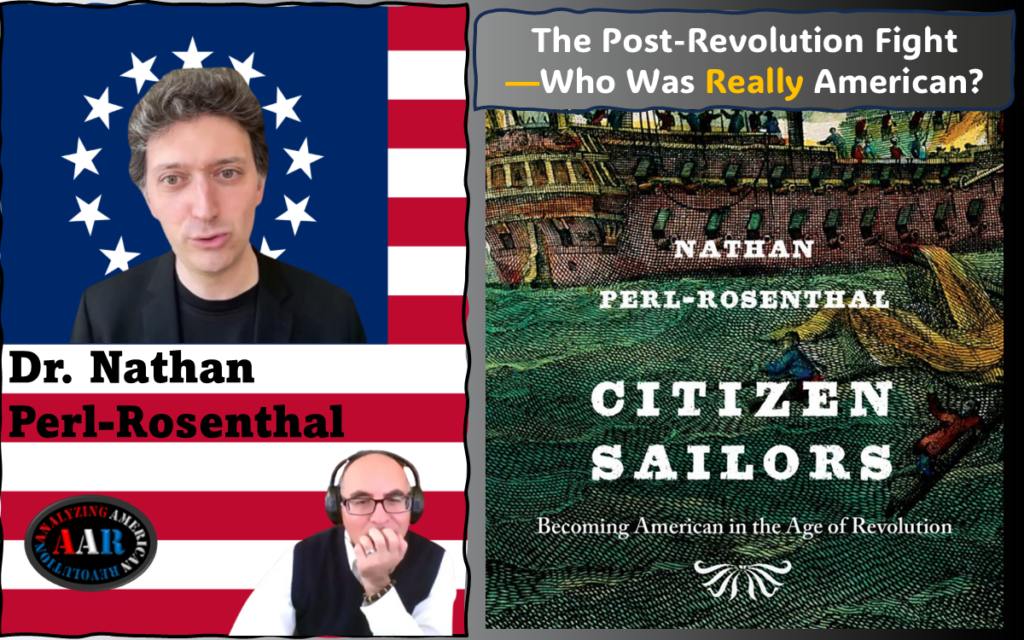
Image of Adel Aali (program host) and his guest, Dr. Perl-Rosenthal, superimposed on the Betsy Ross flag, along with cropped image of Citizen Sailors: Becoming American in the Age of Revolution, Dr. Perl-Rosenthal’s book that we discuss in this interview.
Unless otherwise indicated, all images in AAR—including those in this post—are in the public domain.
AAR Essential Insights
Although the full video and transcript of my conversation with Dr. Perl-Rosenthal are included in this post, I’ve selected and summarized several insights that I found particularly revealing and worth emphasizing. These moments—some surprising, others challenging familiar assumptions—help us see American sailors not only as forgotten revolutionaries, but also as figures who helped shape the meaning of American citizenship.
By the way, these insights are my own takes and interpretations from the interview. For Dr. Perl-Rosenthal’s perspective and exact framing, please watch the interview above and view the transcript below in the corresponding sections.
The Atlantic Economy Britain Couldn’t Contain
Before we get to sailors themselves, there is an economic reality worth keeping firmly in view: the thirteen colonies were part of the British Empire, but their commercial world was much larger than Britain. North American food and building materials moved into the Caribbean; fish reached southern Europe; French molasses flowed into British North America; Dutch tea was smuggled into colonial ports. This was an Atlantic economy with imperial borders running through it—not neatly around it.
That helps explain why the Navigation Acts never produced the closed commercial system Britain wanted. As Dr. Perl-Rosenthal puts it, the “gaps” became “gaping holes.” French molasses was cheaper, so colonists bought and smuggled it. The Tea Act then adds a wonderful twist to the familiar story: it did not raise the duty on tea. It lowered it, partly so the East India Company could undercut smuggled Dutch tea. Economic interests and political fears were operating together.
That is the larger point I take from this section. The imperial crisis was not simply a story of Britain imposing higher taxes and Americans resisting them. Britain was also trying to regain control over a commercial system that had become deeply transimperial—and discovering that regulation alone could not do it. That context matters once sailors enter the story, because they were the people physically moving through this world of legal trade, smuggling, competing empires, and porous commercial boundaries.
Watch this segment in the video above (00:04:24)
Who Became a Sailor? Often Those With Fewest Options
One point in this section deserves more attention than the familiar image of young men going to sea in search of adventure. Sailing was generally low-paid, dangerous work. Most sailors were young—often between fifteen and thirty—and Dr. Perl-Rosenthal gives us the memorable phrase “done or dead” by their early thirties. Yet risk was not distributed evenly. A short New England fishing voyage might involve relatives and neighbors working close to familiar waters. The longest and most dangerous voyages drew disproportionately from men with fewer alternatives.
That creates a revealing tension. Maritime labor could open doors that society on land kept shut. Dr. Perl-Rosenthal recalls that perhaps 10 to 20 percent of mariners on Philadelphia ships were Black, in part because sailing was one of the relatively few occupations available to Black men when many skilled trades were effectively closed to them. Catholics, immigrants, and other outsiders also appear in these crews. But we should be careful about calling the sea egalitarian. Opportunity existed partly because the work was difficult, precarious, and sometimes deadly. Inclusion came with a price.
I find that distinction especially important as we move toward the sailors’ role in the Revolution. These were not a privileged professional class with guild protections or organized political power. They were often young, economically vulnerable, and highly mobile workers living at the edges of established social structures. And yet this is precisely the population that will soon appear in the streets, in wartime supply networks, and eventually at the center of arguments over American citizenship.
Watch this segment in the video above (22:42)
The Revolution’s Foot Soldiers Were Sailors
Here is one part of the Revolution that the familiar story tends to flatten. In New York, sailors were often right at the front of crowd actions against British officials and agents. Jesse Lemisch famously called them the “foot soldiers of the revolution.” But that phrase can mislead if we imagine them simply being directed by wealthier political leaders. Dr. Perl-Rosenthal stresses that sailors had their own interests. Taxation, smuggling rules, and restrictions on overseas trade hit their livelihoods directly.
What I find especially revealing is the alliance across class lines. Figures such as John Hancock and other political and economic elites worked “hand in glove” with maritime crowds. That does not erase the differences between them. It shows something more interesting: the maritime economy created a point of common interest in a Revolution that often struggled to bridge class divisions. Sailors were not background muscle. They were participants with their own stake in the conflict.
And once protest became war, their importance changed again. The same men who had filled the streets became essential to supplying the new states with weapons, uniforms, and other necessities of war; they also manned privateers and the small American navy. In other words, maritime workers linked two phases of the Revolution that we often treat separately: political resistance on land and the practical business of sustaining a war across the Atlantic.
Watch this segment in the video above (37:47)
Independence Did Not Automatically Make Someone American
One of the most revealing points in this interview is that political independence did not automatically solve the practical question of who was American. At sea, the problem became immediate. Americans and Britons could look alike, speak alike, and—as Dr. Perl-Rosenthal emphasizes—sound essentially identical. A French official confronting an English-speaking sailor could not simply “see” American nationality. And Britain complicated matters further by insisting that British allegiance could be permanent, even when someone claimed to have become an American citizen.
That is where sailors become unexpectedly important to the history of citizenship. Their vulnerability abroad forced the new United States to create a way of proving nationality. Beginning in 1796, Seamen’s Protection Certificates identified sailors physically and certified them as citizens. Roughly 100,000 were issued by 1815. Think about what that means: citizenship was becoming not only a political status, but something that had to be documented, carried, presented, verified—and sometimes defended by the federal government itself.
And even then, the paper did not settle everything. Some British officials rejected the certificates; one naval captain famously tore one up and threw it overboard. Others were forged, borrowed, or purchased. To me, that is the deeper significance of this section: the early United States was not merely declaring who its citizens were. It was building the machinery that made citizenship legible to governments beyond its borders—and discovering that national identity depended partly on whether other states were willing to recognize it.
Watch this segment in the video above (00:54:36)
The Interview (S1E34): Adel Aali and Nathan Perl-Rosenthal
In our conversation, Dr. Perl-Rosenthal addresses key questions and reveals untold stories about American sailors, their role in the American Revolution, and how they helped shape the meaning of American citizenship.
Podcast
Watch the full interview on this page with the outline and transcript below, or take the conversation with you on the go through our Spotify podcast.
Outline
Use the in-depth outline below, with its key moments and turning points, to follow the discussion and navigate the interview.
Click for Timestamped Outline
- Selected Highlights (00:00:00)
- Guest Introduction (00:02:16)
- The Atlantic Economy Before Independence (00:04:16)
- Transatlantic and Caribbean Trade as the Colonial Economic System (00:04:52)
- Caribbean Markets, Colonial Exports, and North American Shipbuilding (00:07:23)
- Smuggling and the Limits of British Imperial Control (00:14:24)
- Navigation Acts and the Gaps in the Imperial Trading System (00:14:37)
- The Tea Act Lowered the Duty on Tea (00:17:47) – Key Moment (00:18:05)
- Who Were America’s Sailors? (00:22:48)
- Young Mariners and the “Motley Crew” of Long-Distance Trade (00:23:24)
- Sailing as a Lower-Income and Short-Lived Occupation (00:27:42)
- Dangerous Voyages and Unequal Opportunities (00:30:18)
- The Slave Trade and East Indies Voyages as the Deadliest Trades (00:31:41)
- Black Sailors and Maritime Work in Philadelphia, Baltimore, and New York (00:34:06)
- Sailors as Revolution’s Foot Soldiers (00:37:47)
- Jesse Lemisch and Sailors in Revolutionary New York (00:38:51) – Key Moment (00:39:24)
- John Hancock, Maritime Crowds, and Cooperation Across Class Lines (00:41:49)
- From Imperial Crisis to Revolutionary War (00:45:59)
- Sailors Become Essential to Supplying the New States (00:46:17) – Turning Point (00:46:47)
- St. Eustatius and the Revolutionary War Supply Network (00:47:32)
- John Adams and the War at Sea (00:50:18)
- The 1778 Voyage of the Boston to France (00:51:12)
- Evading British Cruisers, Frigates, and Privateers (00:52:07)
- Who Counted as American? (00:54:28)
- Sailors Confront the Problem of Proving Nationality Abroad (00:54:55)
- Americans and Britons Looked and Sounded Alike (00:56:48) – Key Moment (00:56:55)
- Creating Paper Citizenship (00:58:55)
- French Officials Struggle to Distinguish Americans from Britons (00:59:36)
- Seaman Protection Certificates and a New Nationality Paperwork System (01:00:38) – Turning Point (01:01:24)
- Nationality at Sea—and Reconstructing Its History (01:04:18)
- When Sailors Could Determine the National Character of a Ship (01:06:36)
- Atlantic Archives and the Evolution of the *Citizen Sailors* Argument (01:09:59) – Turning Point (01:13:49)
- Just One Point (01:14:59)
- Citizenship Is Made Through Government and Popular Demands (01:15:10)
- American Sailors Pushed Citizenship Protections From Below (01:16:02)
Transcript
Note: This transcript was generated automatically and may contain minor errors. It is provided for reference and accessibility only.
Click to View Transcript
Adel:
(3:58) Dr. Perl Rosenthal, it’s a pleasure to have you in our program special series. (4:02) Thank you for taking time for this conversation with me about the American Revolution. (4:07) I’m interested in speaking with you about your book, Citizen Sailors, Becoming American in the Age of Revolution.
(4:16) But before we get too deep into this conversation, let me ask you this, what was the scope of transatlantic commerce at that time, before revolution, the years leading up to it, and during it?
Dr. Perl-Rosenthal:
(4:34) Sure. (4:35) So as it happens, we know a fair amount about this, because there are some customs records that survived from the years right before the revolution. (4:45) There are periods during which we have very approximate knowledge, but we have some good data for that period.
(4:52) And the basic story is that transatlantic commerce is essential for the North American colonies. (5:01) The structure of their economy is built around transatlantic and then cisatlantic, that is to say, trade on the same side of the Atlantic and particularly trade to the Caribbean. (5:14) So you have to imagine the North American colonies as really connected both across the Atlantic, but then also up and down to the Caribbean.
(5:24) And in essence, the sort of Atlantic economy of the colonies depends on both of these pieces. (5:33) Britain is the market for some American commodities, notably, some sort of basic goods for things like shipbuilding, and other stuff like that, and production of some weaving, things like that, though, that gets more elaborate later on. (6:00) But what the real relationship…
(6:01) Wasn’t that cotton that came later on? (6:04) Yeah, no, but there was already cotton, there’s already cotton production earlier on, it just takes off later on. (6:08) Yeah, there’s Sea Island, the coastal cotton is usable.
(6:14) Coastal cotton, okay, okay. (6:16) Yeah, the kinds of cotton that only can grow long, what’s called long staple cotton, which has long fibers that could be used before the invention of the industrial scale, before the invention of the cotton gin. (6:31) Anyway, but so the real sort of pillar of the transatlantic relationship is the importation of finished goods from Britain.
(6:39) The colonies basically get most of their finished goods from Europe, finished cloth, manufactured goods, books, paper, a lot of that stuff is coming from Europe. (6:57) And the colonies are an important market for all of those kinds of goods. (7:01) They’re also an important market for one other kind of good, which is to say people, right?
(7:08) The colonies become one of the destinations for trafficked Africans, right, enslaved people. (7:17) So the colonies, you have to imagine the colonies are mostly importing stuff from Britain. (7:22) And how do they pay for this?
(7:23) Well, they pay for it two ways. (7:25) One is they pay for it by exporting lots of things to the Caribbean and getting paid, basically, within this British imperial system, getting paid for those goods. (7:34) So they ship tons and tons of foodstuffs to the Caribbean, because the Caribbean islands largely don’t support themselves in terms of food production, right?
(7:44) The enslaved labor is producing things like sugar, indigo, or cash. (7:50) Right, exactly. (7:51) Coffee, tobacco, right?
(7:52) That stuff is being not so much tobacco, but lots of coffee is being produced there. (7:56) But especially sugar and molasses is being produced there. (7:58) So there’s not a food economy, right?
(8:01) A self-sufficient food economy on most of these Caribbean islands. (8:04) So a lot of the food is coming from North America. (8:08) Rough cloth is coming from North America.
(8:11) And then lots of, you know, building materials, right? (8:13) Because the Caribbean islands, you think of a Caribbean island with a few exceptions. (8:16) So like Jamaica is a larger island that has woods.
(8:19) But if you think about places like, you know, Barbados, or Bermuda, or Dominica, you know, productive plantation colonies in the Caribbean, they have basically no forests at all. (8:34) So if you want to build a house, you’ve got to import wood, bricks, glass, right? (8:42) Everything, essentially.
(8:43) And a lot of that is coming from North America. (8:45) So the way that this economy really seems to work mostly is the North Americans are exporting things to the Caribbean, they’re getting paid, and then they’re using some of that money often to pay off debts that they incur by buying things from Britain. (9:02) The other thing that the colonies are producing that everybody wants is ships.
(9:07) So the shipbuilding industry in New England is also hugely important. (9:10) A huge percentage of the ships that are operating in the Atlantic economy are actually built in North America. (9:17) Because there’s both expertise there, but also enormous quantities of the necessary raw materials, which is to say, timber, primarily, but also tar, of which there’s quite a lot in North America.
(9:29) And, yeah, the other sort of basic materials that you need for shipbuilding.
Adel:
(9:35) Two follow up questions, Dr. Perl-Rosenthal. (9:38) One is, when you were listing the basic goods that North America and our focus is the 13 colonies, but that’s fine. (9:48) North America is really important.
(9:49) Because before the revolution, the British looked at all these colonies as sort of part of their empire. (9:56) Obviously, that makes sense. (9:57) So there’s one item that you left out.
(10:01) I’m not talking about what the colonies shipped to the Caribbean. (10:07) When you were listing things that basic goods that they shipped to Europe, you said shipbuilding material, weaving, I got that. (10:14) But you didn’t say food stuffs.
(10:16) Did the colonies also, I know they shipped food to the Caribbean, I got that, you explained that. (10:21) Did they also ship, like, I don’t know, weed, whatever they grew to Europe, or was that not necessary?
Dr. Perl-Rosenthal:
(10:29) I think you’re gesturing at fish here. (10:31) Which, of course, they do capture quite a lot of in North America, right? (10:35) The North American fisheries are very important.
(10:37) And they do indeed send quite a bit of fish both to the Caribbean, and also to Europe. (10:43) If my memory serves me, and I haven’t looked at this data in a long time, my memory is that the fish, more of the fish tends to go to Southern Europe, in the end than to Northern Europe. (10:58) Because Northern Europe has its own quite extensive fisheries.
(11:03) So my recollection is that a lot of it ends up in Southern Europe. (11:07) But yes, there are foodstuffs. (11:10) There are periods when wheat, especially, is being shipped to Europe.
(11:19) Certainly during the French Revolution, or a little bit later than around the 1790s, American, you know, US wheat supplies are actually fairly important for the French. (11:32) But that’s not, it’s not the most important export of the colonies, by value, if memory serves. (11:45) Again, yeah, Shepard and Walton’s famous book about the balance of trade of the 13 colonies has a lot of tables with all of this in it.
(11:57) But I don’t have it under my…
Adel:
(11:58) You mean you haven’t memorized all those tables, Dr. Perl-Rosenthal?
Dr. Perl-Rosenthal:
(12:01) No, sadly not. (12:02) Sadly not. (12:03) There was a point when I probably had memorized some of them, but that was a long time ago.
Adel:
(12:07) Oh boy, oh boy. (12:09) I also, the reason I picked out wheat, well, this conversation is about sailors, seamen, and mariners. (12:16) We’re going to get into fish.
(12:17) But the reason I picked out wheat, because my own recollection of reading about this trade in general over the years, sort of wheat stuck out, maybe that’s from later years.
Dr. Perl-Rosenthal:
(12:27) The wheat also is, the wheat is the export for the middle colonies, right? (12:31) That’s where it’s cultivated. (12:32) It’s like Pennsylvania, New Jersey, a little bit.
(12:36) As far south, maybe it’s the Potomac estuary. (12:40) So that’s one of the main exports of that region.
Adel:
(12:43) I should add this. (12:44) You also didn’t mention tobacco from the south. (12:48) Was that a big export from the colonies?
(12:51) Let’s say from, I don’t know, South Carolina.
Dr. Perl-Rosenthal:
(12:53) It’s a declining industry in the 18th century. (12:57) Tobacco is a very, very a very intensive crop. (13:06) It exhausts the soil.
(13:08) So one of the problems that they have, especially in the 18th century, is that there’s incredible soil exhaustion in a lot of the tobacco growing regions. (13:17) Again, I couldn’t quote you figures, you know, one way or another, but it’s a diminishing part of the North American trade mix. (13:26) It’s very, very important in the 17th century.
(13:28) It’s, you know, the main export from the south for a time. (13:32) But by the 18th century, by the middle, by the end, by the later parts of the 18th century, it’s the less important part of the overall mix. (13:42) I see.
(13:42) Again, I can’t cite you chapter and verse on that, but it certainly is diminishing.
Adel:
(13:48) So as you were explaining all of this, a question came to mind, and I think you answered it, because you said they were sending fish, Americans were sending fish to also southern Europe, which answers the following question. (14:03) Was all this trade a closed system, i.e. all of it, was it just taking place in the scope of the British empire? (14:14) Or did they also send stuff to, I don’t know, the French empire and its colonies in Spain and, you know, the Dutch and all of that?
Dr. Perl-Rosenthal:
(14:24) Yeah, yeah. (14:25) Well, so theoretically, according to the Navigation Acts, right, so there’s this series of laws that are passed, the first passed in the middle of the 17th century by Britain, or by England at that point, not Britain. (14:37) The English Navigation Acts in the middle of the 17th century, in theory, create a closed colonial system, right, imperial system where the colonies are only supposed to trade with the mother country, and maybe in a limited way with one another, right, but the main idea is that the colonies are there to enrich the mother country, right, England.
(14:58) In practice, this is never the case. (15:01) There are always openings and gaps in the trade, and they become kind of gaping holes by the 18th century. (15:12) So one of the biggest is the molasses trade.
(15:18) The French colonies in the Caribbean are producing enormous quantities of molasses, because it’s essentially a byproduct of sugar production. (15:29) And they have nothing to do with it, basically. (15:33) And so what they end up doing, for various reasons, it’s not it’s not economical to ship it back to France, there isn’t really a market for it there.
(15:40) So what they end up doing is becoming over the course of the middle of the 18th century, deeply enmeshed in a very important trading relationship with North America. (15:51) So there’s actually a two-volume study called Rum and the American Revolution, which basically shows that you know, the lion’s share of French molasses, the molasses from the French Caribbean, is flowing to North America, to the English colonies, on the eve of the American Revolution. (16:14) And that’s during the imperial crisis.
(16:17) And that’s, in fact, it’s explicitly part of the discussion during the early years of the imperial crisis. (16:27) When the Molasses Act and the Sugar Act are passed in the mid-1760s, part of the aim of those acts, actually, is to reorient North American trade, the colonial trade, away from the French Caribbean, and to try to keep it within the British colonies. (16:48) And this makes a lot of people very angry, including, among other people, major smugglers in Boston, because that’s one of the centers of molasses smuggling.
Adel:
(16:59) I know that the Dutch did a lot of smuggling, particularly of lower quality and cheaper tea. (17:07) So are you suggesting that this volume of molasses was also being smuggled?
Dr. Perl-Rosenthal:
(17:13) Oh yeah, yeah.
Adel:
(17:14) Wow, that’s a huge volume then.
Dr. Perl-Rosenthal:
(17:16) Yeah, well, so the deal was that basically the taxation, the tariffs on molasses and sugar were high enough that it was profitable, much more profitable, to purchase French molasses, which was much lower cost, and import that and smuggle that than it was to do it legally. (17:41) And similarly, the famous Tea Act, so you mentioned the smuggling of Dutch tea. (17:47) So the Tea Act, right, 72-73, the point of the Tea Act, this is always one of my favorite things when I’m teaching the American Revolution, is to say, what did the Tea Act actually do?
(17:59) And of course, everybody says it raised taxes on tea, which is exactly wrong. (18:05) It lowers taxes on tea. (18:07) It lowers the duties on tea.
(18:08) Why? (18:09) Because the British government is trying to basically, as best it can, undercut the price of, allow the East India Company to undercut the price of smuggled Dutch tea, because they know that there’s no way that they can enforce, that they can force the North Americans basically to buy more expensive products. (18:27) So this is sort of an attempt, bizarrely, to kind of discount British tea, and therefore get North Americans to buy it.
(18:36) So one of the funniest things is this, you know, this huge outcry over the Tea Act, right, resulting in the Boston Tea Party. (18:41) This is over an act that lowers taxes on tea, not raises them. (18:47) But it cuts into their smuggling business.
(18:50) So it cuts into their smuggling business. (18:52) And what’s very interesting about that moment, and this is always a fascinating moment when (18:56) you’re teaching the American Revolution, is to realize that in the Tea Act, what comes (19:00) together is the interests of smugglers, of tea smugglers, right, who don’t want the competition (19:07) from the East India Company, but also a whole set of ideological arguments, which Bernard (19:15) Balin famously described as basically the, you know, paranoid thinking, where they’re (19:21) fearful. (19:22) And I think this, I think one has to take this seriously. (19:24) This is not, you know, just a cover for interest.
(19:26) They’re genuinely worried that the British government, by lowering taxes on tea, is going to create a monopoly for the East India Company, and then raise the price back up. (19:36) I mean, to be perfectly honest, this is exactly what Amazon does in our day, right? (19:40) They lower the price, kill the competition, and then they’re a monopoly, and they raise the price again, right?
(19:45) So that’s actually the, that’s actually the, if you read the pamphlet controversy around the Tea Act, that’s what they’re worried about. (19:52) It’s not that they’re upset that the price is going down, it’s that they’re worried that the price is going down, and then it’s going to go up, and then they’re going to be over a barrel, basically, and not have any recourse.
Adel:
(20:04) That is fascinating. (20:05) Yeah. (20:05) Do your students have a wow moment?
Dr. Perl-Rosenthal:
(20:08) They do. (20:08) They love, there’s always a little bit of a gasp. (20:11) There aren’t that many moments when you teach the American Revolution when you get a good gasp, because people are so familiar with it in general, but that’s always a good one.
(20:17) Because really, I have asked this question every time I’ve taught the American Revolution, you know, to hundreds and hundreds and hundreds of students. (20:26) I don’t think anybody has ever raised their hand and said, it raised taxes on tea. (20:31) Wow.
(20:32) Because it’s just so, it’s so counterintuitive. (20:34) It is. (20:35) But I think that gives you a sense again of, I’m sorry, lowers taxes on tea.
(20:38) I think that gives you a sense again of the degree to which the British government recognizes that you can’t, just to come back to your original, your initial question here, you can’t force a closed commercial system in this period or any period, probably, right? (20:52) There’s just too much incentive and too much possibility, too many ways to kind of get around it. (20:58) And so they recognize that the only way to do it is actually to basically do it on price, right?
(21:02) To undercut the price. (21:04) And by doing that, to maybe, you know, succeed in…
Adel:
(21:11) Rescuing the East India Company. (21:13) In rescuing the East India Company. (21:14) A lot of members of the House of Parliament are actually shareholders.
(21:21) Here’s one thing for your students. (21:24) They should really go out of their way to taste rum the way it was made in those days. (21:30) I’ve actually tasted that in a place called Louisbourg, which is up in Nova Scotia.
(21:34) It’s from the 18th century. (21:39) Going back to the show, based on everything that we discussed, was the trade balanced, or was it, you know, did the colonies have a trade deficit with Britain?
Dr. Perl-Rosenthal:
(21:53) My understanding is that within the overall Atlantic economy, they don’t have a deficit. (22:00) But this is not my area of expertise. (22:04) I mean, the Walton and Shepard book that I was, the Shepard and Walton book that I was mentioning is a book about the balance of payments.
(22:10) I mean, that’s what it’s fundamentally about. (22:12) It gives you lots of data on trade. (22:15) But the fundamental question is, are the colonies in a balanced trade relationship?
(22:21) And my recollection is that the answer is yes. (22:24) And it’s balanced largely on shipbuilding and trade with the Caribbean. (22:29) That those are the crucial elements in balancing the trade.
(22:34) Okay.
Adel:
(22:34) Now that we have this, thank you for sharing this background. (22:37) Now that we have this, let’s go back to your book. (22:40) I’ll read the title again.
(22:42) Citizen Sailors Becoming American in the Age of Revolution. (22:48) So who are these sailors? (22:51) First of all, there’s three different terms, seamen, sailors, and mariners.
(22:56) There may be, there must be some distinctions between those terms. (23:01) And you shrug your shoulders and know they’re sort of synonymous.
Dr. Perl-Rosenthal:
(23:06) Yeah, they’re used pretty much. (23:07) I mean, mariner is perhaps used a little bit more for higher status sailors, but I wouldn’t say like captains or mates, but… (23:16) I see.
Adel:
(23:16) So for the purpose of our conversation, we’ll just use sailors. (23:20) So who are these sailors? (23:23) Yeah.
Dr. Perl-Rosenthal:
(23:24) So it really depends on a number of factors. (23:28) It depends what kind of trade you’re talking about, which kind of maritime occupation you’re talking about. (23:34) And it depends where you’re talking about.
(23:37) So broadly speaking, the kind of general rule of thumb is the more long distance the trade is, the more, the harder, the more dangerous the work is, the more you’re going to have a kind of motley crew, as they call it in the 18th century. (23:58) Of sailors, kind of of all nationalities, the more you’re going to see sailors who may have very low status. (24:09) And the more, the safer the trade, the more likely you are to have kind of, how to put this, the kind of average young man of that community.
(24:21) So let’s give two extreme examples. (24:26) Maybe I should take one step back. (24:28) Who the sailor is, is it’s someone typically between the ages of about 15 and 30.
(24:33) The vast majority of sailors are in that age range. (24:36) It’s a young man’s game. (24:37) There are older sailors, seafarers, certainly.
(24:42) But, you know, Danny Vickers has done extensive statistical work on this. (24:46) And it’s very clear that the lion’s share of sailors are between those ages. (24:50) They tend to start quite young and be done or dead by the time they’re in their early 30s.
(24:57) Done or dead. (24:58) OK. (24:58) Well, that’s it’s a very, especially if you go on long voyages.
(25:02) So let’s take two contrasting maritime professions. (25:06) Trade to on, let’s say, an East India Company ship. (25:09) So trade to the East Indies, right?
(25:11) So to India or beyond, right? (25:14) Or even, you know, the Spice Islands, right? (25:16) But is that now Indonesia and Enverans.
(25:20) And on the other extreme, let’s think about the New England fishery. (25:27) OK, so the voyage for New England, for New England fishermen, the voyage, they usually go to the Newfoundland banks, which is about, I don’t know, a day’s sail, maybe less from certain parts of New England. (25:42) They go there.
(25:43) They’re in relatively small ships. (25:44) They go generally in the nice season, right? (25:47) They don’t go in, you know, in, you know, in winter.
(25:51) They go when the weather is, you know, tolerable. (25:54) They fish. (25:55) They bring their catch to shore.
(25:58) And, you know, one of these voyages might last. (26:00) I mean, it might last a week. (26:01) It might last a few weeks, right?
(26:05) And the vast majority of the sailors on board, one of those fishing voyages will actually be neighbors. (26:11) They’re recruited and often relatives. (26:13) So the captain will often recruit his cousins or his nephews or even his son or sons to come aboard.
(26:23) If it’s not a direct relative, it’s probably someone who lives down the street, right? (26:27) So these are people who kind of know one another from home. (26:30) You can think of it as a kind of safe environment socially, right?
(26:33) You’re with your family, more or less. (26:35) They’re in not that far from shore. (26:38) I mean, they’re far from shore, but they’re, you know, in relative, they’re in familiar waters, probably with a bunch of other New England fishermen all around them, right?
(26:46) And they’re only out there for a matter of weeks and then they go back. (26:49) So you’re not going to get, you know, you’re not going to get scurvy. (26:53) You’re not going to get rickets.
(26:54) You know, you’re not going to get, you know, you’re not going to eat, you know, spoiled food, right? (27:01) So this is relatively safe. (27:02) It’s a relatively, you know, relatively, I mean, physically it’s always labor, but it’s not very difficult labor.
(27:09) It can be done in part by quite young, young men. (27:14) So that’s kind of a, you know, the kind of the safest and most least dangerous, right? (27:22) And in some sense, that high status exactly.
(27:24) But the sort of the average person in a town like Marblehead or Salem, you know, the average person is one of these sailors, right? (27:34) Is involved in this kind of trade, right? (27:35) So that’s just kind of the norm in this community.
Adel:
(27:37) Would that average person also be a middle class person?
Dr. Perl-Rosenthal:
(27:42) So these are not middle class professions. (27:46) Sailing is not a middle class profession. (27:48) It is a definitely a lower class profession.
(27:52) We don’t really talk about class in the 18th century exactly, but they are certainly at the bottom of the income distribution. (27:58) There’s been lots of work in larger cities in places like Philadelphia, for instance, where we have good tax records for the 18th century. (28:07) You can see sailors are at or near the bottom of the income pyramid.
(28:12) The only people who make less than them are basically day laborers. (28:16) So they’re not well off. (28:18) They don’t tend to have large estates.
(28:25) Yeah, some, let’s say captains might make their way into a sort of what you might call a middle class. (28:33) And especially captains in higher value trades. (28:38) So whaling captains, for instance, if any of your listeners have read Moby Dick, for instance, right?
(28:43) Some of the whaling captains in those voyages can become wealthy. (28:49) And once they become wealthy, they may retire and then sponsor other voyages, right? (28:53) So they sort of become merchants and outfitters in their own right.
(28:57) But most people who remain at sea, it’s a difficult life. (29:02) It’s uncertain. (29:04) Most people remain at sea because they have to, not because they really, really want to, I would say.
(29:10) When people make money off of this, captains or of larger voyages, they tend to leave the sea and then become either merchants in their own right, traders. (29:22) Some of them move into what we would think of as kind of construction or manufacturing jobs that are related. (29:30) So like a sailor might become a sail maker, right?
(29:35) Or a cord wainer or a shipwright, potentially. (29:43) Shipwright’s less common. (29:47) But anyway, might sort of take on shore based roles still in the kind of maritime industries.
(29:54) But it’s just, you know, sailors, you’re just not going to see a lot of sailors in their 40s and 50s. (29:59) It’s a young man’s game.
Adel:
(30:02) So you said there were two contrasting sort of professions or segments when we talk about sailors. (30:10) One was one first example we just discussed, New England fisheries. (30:14) The other one you mentioned, trade.
(30:16) So let’s talk about that.
Dr. Perl-Rosenthal:
(30:18) Yeah. (30:18) So there’s trade and there’s trade, right? (30:20) There’s trade, for instance, the West Indies.
(30:22) Those are voyages of, you know, they can be a matter of weeks, right? (30:25) You can go from New England to the Caribbean and back. (30:28) If you get lucky in about six weeks.
(30:31) And again, think about, you know, the amount of time, you know, for Europeans and Euro-Americans in the Caribbean, the disease environment is very dangerous. (30:40) So if you’re there for, you know, the longer you’re there, the more likely you are to catch yellow fever, malaria, whatever and die, right? (30:48) So the fact that these voyages are relatively quick makes them relatively safer.
(30:52) There’s transatlantic, which is also relatively safe. (30:58) North Atlantic, let’s say, also going from North America to Europe and back. (31:03) Because again, although the voyages are longer, those can be, you know, one, two, three months just of travel.
(31:10) Wow. (31:11) Not including port time. (31:13) Depends on the winds and the currents.
(31:16) I mean, three months is exceptional, but it can happen. (31:20) Mostly on the return. (31:22) From Europe to North America, because then you got to go south, basically.
(31:27) And they tend to get stuck there. (31:32) You know, it’s a longer voyage, but the disease environment in Europe is relatively, especially in northern Europe, is relatively similar. (31:39) So you’re relatively safe.
(31:41) But then the two trades that are really dangerous are where you see high mortality and, you know, where I would say the recruitment for those voyages, because everybody knows that these voyages are dangerous. (31:54) To recruit people for these voyages, you tend to end up with the people who have the fewest options, right? (31:59) Either they’re the poorest or they’re the most excluded or the most desperate for whatever reason.
(32:08) So those two trades are the slave trade, the African slave trade. (32:14) And the very long distance voyages to the East Indies, to the Pacific. (32:19) And those voyages, the Pacific voyages, are just dangerous because they’re really long.
(32:24) You tend to go through places with bad disease environments. (32:32) And, you know, they tend to end up in places where you end up spending a long time there, right? (32:39) So if you go to India, right, these voyages can be, you know, well over a year, sometimes two.
(32:48) And you’re spending months and months in port, often in these places, trading. (32:53) So that creates a lot of opportunities for danger of various kinds. (32:56) And the African slave trade is dangerous both because the African coast has a, you know, hazardous disease environment for Europeans.
(33:04) But the voyage itself is incredibly dangerous. (33:07) The, you know, enormous numbers of enslaved Africans die during the voyage. (33:11) But as we all know, now that COVID has, you know, since COVID, you can’t keep contagious diseases contained.
Adel:
(33:19) Yeah, yeah. (33:20) Locked down below.
Dr. Perl-Rosenthal:
(33:21) You’re a sailor on board one of these voyages, you have a good chance of catching whatever, you know, is circulating in the hold among the enslaved Africans.
Adel:
(33:29) So one of my questions was, are these sailors all white and English speaking? (33:36) And I think you answered some of that by saying that the ones that engage or desperately agree to go on these long voyages, may be excluded for some other stuff, which means that maybe they were immigrants, maybe they were not white as we define them, or maybe they were not Protestant, whatever that the existing system in their area didn’t open up opportunities for them.
Dr. Perl-Rosenthal:
(34:06) Absolutely. (34:07) Yes. (34:07) So there are a lot of black sailors out of Philadelphia, if memory serves something like somewhere between 10 and 20% of mariners on Philadelphia ships are black.
(34:21) It’s one of the few professions where black men are able to work. (34:26) They can work as laborers, they can work as sailors. (34:30) But most of the other professions are effectively closed to them.
(34:35) Most artisanal labor, most kinds of artisanal work, the kind of higher status manual labor is mostly closed to them. (34:41) So there are a lot of black sailors out of Philadelphia, out of Baltimore, out of New York. (34:49) And as you said, lots of non-Protestants, lots of Catholics, again, especially from places like Philadelphia, New York, and the southern states colonies, relatively fewer in New England, which is exceptionally hostile to Catholics, but also has this huge, what they refer to as a nursery for seamen in the fisheries.
(35:18) So the fisheries kind of function as a way to produce lots of sailors. (35:22) So New England is sort of a net exporter of sailors, whereas these other colonies and cities are net importers, really, of maritime labor. (35:30) So they need to bring people in.
(35:32) And this is a dynamic that exists in Europe as well. (35:34) So for instance, the Dutch maritime industries in the 17th century are net importers of labor. (35:41) They draw in tons of Scandinavians, tons of Germans.
(35:47) So the Dutch ships are very polyglot from sort of all of northern Europe, whereas a place like Sweden, Norway, Denmark, those places are actually exporting sailors. (35:59) And again, it’s because they have maritime industries that are relatively safe, and lots of people are engaged in them. (36:05) And so they’re kind of producing more sailors than they are using up, so to speak.
(36:11) Okay, that makes sense.
Adel:
(36:15) And based on what you shared with us, I think I have an answer for the following question that I’m going to ask. (36:21) This is a testament to your great explanation, Dr. Perl-Rosenthal. (36:28) So my question was this, whether these sailors have guilds or associations.
(36:34) And based on what you described, I think the answer is no.
Dr. Perl-Rosenthal:
(36:41) So there are seamen’s associations, but they certainly don’t have a guild structure in the sense, or associational structures in the way that, you know, silver workers might, or printers, you know. (37:03) So they have neither the sort of protective power that that gives, nor is the profession exclusive in the way that those professions might be.
Adel:
(37:15) So which means that they don’t have a body that gives them some sort of political influence. (37:21) In today’s parlance, we would say sort of lobbying power, but back then it was probably…
Dr. Perl-Rosenthal:
(37:26) Yeah, yeah. (37:27) I mean, again, in North America, certainly not. (37:30) It’s a little bit different in a place like France, where actually they do have basically a government body that’s kind of responsible for sailors, and that creates a somewhat different dynamic.
(37:41) But in North America, there’s no formal organization among sailors now.
Adel:
(37:47) So how are these sailors involved in the American Revolution? (37:53) And I think this is a big question, by the way, just to go back to our middle school and high school years. (37:59) We almost never would hear about sailors, except with people like John Paul Jones and other hero figures like that.
Dr. Perl-Rosenthal:
(38:07) Yeah, yeah. (38:09) So it’s a multifaceted story for sure, right? (38:15) Sailors kind of enter into the progress of the American Revolution, the coming of it, and it’s unfolding in various ways.
(38:25) So I think the first thing to bring up, I think, is to name the great pioneer in this field, which is Jesse Lemisch, who was a wonderful, very clever, very innovative, almost too innovative historian.
Adel:
(38:49) Could you repeat his name, please?
Dr. Perl-Rosenthal:
(38:51) Yes, Jesse Lemisch, L-E-M-I-S-C-H. (38:55) So he wrote in 1968, he wrote an article called Jack Tar in the Streets, which was part of his dissertation, which is about the role of sailors in the coming of the revolution in New York. (39:07) This was a really foundational article, not just about the history of sailors, but actually in the sort of beginnings of social history, the idea that you tell the story of major historical events and processes through ordinary people.
(39:24) And Jesse, in that article, makes the case that sailors are kind of the foot soldiers of the revolution in New York, that anytime there’s a crowd, sailors comprise a large part of the crowd. (39:38) Anytime there is a crowd action against British government, against British agents, sailors are right up in the front. (39:50) And he shows as well that some captains, not wealthy captains, but really working captains, are also on the forefront of the political organizing that’s behind some of this.
(40:02) His argument about why that happens is largely that sailors are, you know, they are on the forefront of trade and their interests and their professional lives are tied up in the controversies over overseas trade. (40:32) And so this directly impacts their lives. (40:38) Questions about taxation, about how to deal with smuggling, things like that.
(40:43) These are, they feel the impacts immediately in a way that almost no other group does.
Adel:
(40:54) Dr. Leamish mentions, well, studies sailors and concludes that there were foot soldiers of the revolution, particularly in a place like New York. (41:06) He didn’t talk about their impact in the Boston Massacre, for example. (41:10) In Boston, for example, in the Boston Massacre, several were sort of, maybe they were not sailors, but they were in the sea industry in Boston, right?
Dr. Perl-Rosenthal:
(41:21) Absolutely, absolutely. (41:23) And there’s, so Dirk Herder wrote a book called Crowd Action in Revolutionary Massachusetts, which is from the mid-70s, which really picks up a lot of Leamish’s arguments for Boston. (41:37) And his argument, again, is very much that sailors and their allies among the political and economic elite.
(41:49) So the case in point, the famous example being John Hancock, right, who is a major merchant, a major smuggler in Boston, the richest man in Boston, certainly, and probably in the whole Northern United, you know, future United States. (42:05) He is deeply connected to the maritime trades. (42:09) And, you know, the argument that someone like Herder makes is that the organizing by the committees of correspondence, by the Provincial Congress, by all the kind of early structures of political agitation in Boston and Massachusetts, they’re working hand in glove with the revolutionary crowds who are largely opposed, as you say, of sailors.
(42:33) I think both Herder and Leamish would insist that sailors have their own interests and priorities, and they’re not just being manipulated by these political elites. (42:45) And I think they’re right about that. (42:47) And to my mind, it’s more interesting, in fact, they’re working together with these political elites.
(42:52) That really shows a kind of the power of the maritime industries, and particularly both the fisheries and the long distance trade and the sort of, you know, the trading maritime industries to create a kind of framework for collaboration across class lines, which is otherwise rather difficult in the American Revolution. (43:19) This is not something that American revolutionaries proved to be very good at. (43:22) So this becomes a point of solidarity, a point of connection.
(43:28) Between classes. (43:29) Structure of the, yeah, of the commercial relationship that exists between these groups.
Adel:
(43:36) I want to ask you a question that just goes into the tangent a little bit, but you mentioned it, and it’s just interesting, so I appreciate a brief answer. (43:43) You said that Dr. Leamish’s work is innovative, maybe even too innovative. (43:48) Is that because he started looking at the social roots of significant developments in history?
(43:54) I appreciate that’s not really that substantive.
Dr. Perl-Rosenthal:
(43:58) No, no, no. (43:58) I was dropping a little breadcrumb there. (44:01) So Jesse, I’m calling him by his first name because I knew him, and he’s passed away now, but I knew him and feel very warmly towards him still do.
(44:11) It was very encouraging early on in my work. (44:15) He, you know, he had a very difficult career. (44:19) He got a lot, a lot, a lot of pushback.
(44:21) I’m describing this article as incredibly influential and it was, but it also got a tremendous amount of criticism and attack. (44:29) So in a way, I think Jesse suffered from the creativeness and the innovativeness of his work. (44:38) It really made his career difficult.
Adel:
(44:43) But it was probably a pioneer in what he was doing, the approach that he was taking.
Dr. Perl-Rosenthal:
(44:46) Absolutely, absolutely. (44:47) And I think some people really didn’t like what he had to say. (44:50) In the end, I think he won the argument in a sense, but, or at least, you know, his position is now a standard position in the field, I would say.
(45:00) Oh, I love it. (45:01) So he won. (45:01) So that’s, yeah, it’s beautiful, but for him personally, I think it was very hard.
Adel:
(45:07) I’m sorry to you that he went through that. (45:09) So let’s get back on track. (45:14) So sailors, by many accounts, as you’re telling it, also your colleagues have told it in the past, are the foot soldiers of the revolution, you know, New York, and another colleague talks about Boston.
(45:27) I get that. (45:28) But did they also do any fighting? (45:30) Did they supply?
(45:31) I mean, these supplies are coming clandestinely from Holland and France and Spain. (45:38) This is even before they become former allies. (45:41) Well, Holland and the Netherlands and Spain don’t become former allies.
(45:46) But you know what I mean? (45:46) They formally sort of started fighting the British. (45:50) So how else besides being the foot soldiers in the cities on land, do sailors get involved slash contribute to the American Revolution?
Dr. Perl-Rosenthal:
(45:59) Sure, sure. (46:00) Well, so once the first shots are fired, more or less, right, (46:03) once, you know, what had been a kind of political and economic crisis within the British Empire (46:10) from, let’s say, 1765 to about 1775, once that becomes a shooting war in 1775, very quickly, (46:17) American sailors become crucial both as, you know, the agents for supplying (46:27) the new country or new states with, with weapons and, and other necessaries of war, (46:37) including things like uniforms, which they don’t have, that have to be imported, (46:42) because they don’t have an industry to produce uniforms. (46:47) So that and then also, of course, they man the privateering fleet and the very small navy that ultimately is created starting in late 1775.
(47:00) So in terms of the supply routes, you know, what happens is a large part of the American commerce shifts from legal and semi legal trade with the British Caribbean into what is then a new, a new set of newly legalized trades, legalized by Congress with French Caribbean, and then an enormous trade with with the Dutch Caribbean. (47:32) So one of the most important places in in the whole history of the American Revolution is a tiny rock in the Caribbean called St. Eustatius, or Statia, as the Dutch call it. (47:44) This is an island, which basically is essentially a rocket has almost no agricultural arable land.
(47:50) What it has in the late 18th century, is it’s just basically a rock covered in warehouses. (47:56) And it functions as a sort of entrepot, because the Dutch have allowed it to become a free port, which basically means everybody is allowed to trade there. (48:05) Now, your own empire might not want you to do that, but the Dutch are not going to stop you, right?
(48:10) So all of these ships come to Statia, and kind of do their exchanges there. (48:15) And in 1780, or 81, I think, I think it’s 81.
Adel:
(48:23) Are you talking about Admiral Rodney? (48:25) Is that where you’re going to go?
Dr. Perl-Rosenthal:
(48:26) Yeah, yeah, right. (48:27) Yeah, it’s 81. (48:28) Yeah.
(48:29) So there’s the capture. (48:30) The British basically, you know, have known that this is going on for a long time, and enormous quantities of guns, ammunition, gunpowder has been passing through Statia over the previous five years. (48:45) A lot of it coming from France.
(48:47) Some of it also passed through French colonies, but a lot of it passed through Statia. (48:51) And as you mentioned, Admiral Rodney, right, the British admiral in the Caribbean is, right, goes and captures Statia. (48:59) And in the harbour, when he captures it, again, remember, this island produces nothing, basically, are, I can’t remember the exact number, it’s somewhere between 200 and 250 ships, right, which he seizes and tries to send back to Britain.
(49:13) Most of them are then actually recaptured on the way. (49:16) There’s a lot of fascinating back and forth about that in the British and French archives about those ships. (49:24) I’ve looked at a bunch of the records involving those ships, and they’re super interesting.
(49:27) But anyway, all of that to say, yes, these sailors are, right, providing an enormous share of what the US, the new US needs in terms of war material, because the US doesn’t produce any of those things, right? (49:46) There’s no, basically no gunpowder industry. (49:49) There’s almost no arms industry.
(49:51) There’s certainly no industry that’s producing uniforms. (49:55) There’s no industry that’s producing shoes, really, or not in sufficient quantity. (50:02) Coats, again, all of these things that, you know, if you don’t have an army, it’s unnecessary, right?
(50:09) These are standard things that European nations have been producing for decades, if not centuries. (50:16) So the US just has to import them.
Adel:
(50:18) One of the questions, you mentioned that Admiral Rodney sent 200 or 250 ships back to Britain, and many of them get captured, and it sort of triggered this question. (50:29) So when American sailors or sailors from the 13 colonies are sailing out to, I don’t know, take John Adams from the Boston area to France, and I’m sure they’re taking some goods with them, and they’re bringing back some goods, some of them supplies for the American cause. (50:54) How are they planning to evade the British Navy?
(51:00) They’re not sort of going, thinking that we’re going to duke it out with them if we see them. (51:04) Are there like special routes, or are they just sort of winging it and will try to escape?
Dr. Perl-Rosenthal:
(51:12) Well, it’s funny you mentioned that voyage in particular. (51:16) I actually have worked on that voyage quite a lot. (51:18) The voyage of the Boston, which is the voyage that carries John Adams from Boston to Bordeaux, and starting in February 6th, they leave, 1778.
(51:29) So in that voyage, actually, they’re specifically directed by Congress not to tangle with enemy ships. (51:37) That means they’re not supposed to try to capture enemy merchant ships, which normally you would do if you’re crossing the Atlantic or crossing the ocean in an armed vessel. (51:46) Part of the thing you do is if you see an unarmed merchant vessel, you try to capture it along the way and send it in.
(51:55) Basically, the spoils are divided up between the crew and the captain, and the state takes a cut. (52:01) So they’re directed explicitly not to do that, and they’re directed to try to evade British cruisers. (52:06) They don’t succeed entirely.
(52:07) They have a tangle with one, but the strategy is run away. (52:12) The strategy is try to move faster than the enemy vessel. (52:19) And this is where a merchant vessel can have some advantages.
(52:33) So large naval vessels are quite slow in general, and it’s a big production for them. (52:45) They’re not going to chase a small vessel. (52:49) So I would say, generally speaking, a merchant vessel doesn’t have much to fear from a large naval warship.
(52:56) So a ship of 60, 70, 80 guns, like the equivalent of a battleship, they’re not concerning themselves with naval vessels. (53:04) Is that called the ship of the line? (53:07) The ship of the line, exactly.
(53:08) It’s the smaller vessels, frigates and things like that, in the 30, 40 gun range. (53:13) Those ships are both fast enough and maneuverable enough that they might be able to overtake and capture merchant vessels, and often do. (53:28) And then what merchant vessels really fear most of all is privateers, which are basically smaller ships.
(53:35) These are sometimes only 15, 20 gun ships, which are designed to be fast and are also very heavily manned. (53:43) So they’ll have a very large crew with basically the idea that you capture enemy merchant vessels and you put part of your crew on them to seize them. (53:54) So this is the subject of the book that I’m working on now.
(53:57) I have one coming out in June, but I have a longer term project, which is a global history of maritime prize law and maritime prizes.
Adel:
(54:05) And for our audience, if I may interrupt you for a moment, for our audience, the title of the book that you have coming in June is The Long Revolution, Creating a United States After 1776. (54:17) I’m sorry, I interrupted you. (54:18) Go ahead, please.
(54:19) Not at all.
Dr. Perl-Rosenthal:
(54:19) Not at all. (54:20) That book is a study of 4th of July orations.
Adel:
(54:21) All right. (54:23) I look forward to discussing all of them with you in the future. (54:28) Wonderful.
(54:28) So, okay. (54:30) In your book, the current book that we were discussing, you argue something interesting. (54:36) You say that American seamen held an integral role in shaping the understanding of citizenship in the United States and the development of a sovereign state.
(54:50) That’s a big statement. (54:55) Yeah.
Dr. Perl-Rosenthal:
(54:55) So, broadly speaking, I think sailors are on the forefront of this development because they are on the edge of American territory, right? (55:11) They’re the ones who are outside of American territory. (55:15) They’re the ones who are encountering the problem during the Revolutionary War itself, and then in the post-Revolutionary period, or in the early Republic.
(55:26) They’re the ones who are having to demonstrate that they’re Americans, right? (55:29) If you think about someone, a farmer in upstate New York, it’s not hard to figure out he’s American because he probably has never left upstate New York, right? (55:37) So, he’s born there.
(55:38) His parents were born there. (55:39) Simple, right? (55:40) He’s living there.
(55:41) He might own property there. (55:42) Easy. (55:44) A mariner out on the ocean, right?
(55:47) How do you tell who this person belongs to, so to speak, or what country this person belongs to? (55:54) It’s not like in this period, anybody has passports like we have them now. (55:59) They don’t have microchips.
(56:02) There’s not passport readers. (56:06) So, how do you figure it out? (56:08) And so, Americans become, of all of the people, sort of the population of the United States, they’re the ones who are encountering this problem firsthand.
(56:18) And the reason the problem is so difficult, (56:21) and this is what I argue in the first chapter, the reason the problem is so difficult (56:24) is that before the Revolution, before the American Revolution, basically the way you decided, (56:31) you figured out the way, if you were capturing a vessel at sea, or if a ship had come into port (56:37) and you were the customs officer, the way you figured out the nationality or the subjecthood (56:44) of these sailors was through their native language.
(56:48) You listened to them talking, you looked them over, and then you were able to make a pretty good guess about where they were from. (56:55) So, the problem for the Americans is that they look and sound exactly like British people.
Adel:
(57:04) Especially back then, the accents are not that different, probably.
Dr. Perl-Rosenthal:
(57:07) Identical, as far as we can tell. (57:08) I mean, there’s no clear pattern of distinction, certainly not in the maritime world. (57:15) And there are endless, I mean, I cite some of these in the book itself, but there are endless instances of people saying, how are we supposed to tell the difference between Americans and Britons?
(57:25) They look and sound exactly the same. (57:28) And this is a huge issue because of what we were talking about before. (57:32) Because in theory, the British Empire only allows British people to trade with the British colonies.
(57:39) And similarly, let’s say Britain is at war with France, for instance, as it is from 1791 to… (57:50) 1815 almost. (57:52) Through 1815, with a very brief pause in 1802-1803.
(57:55) That’s it. (57:57) That whole period, they’re at war. (57:59) And the Americans are at war with the British just at the very end, and sort of at war with the French for a couple of years.
(58:05) But the Americans are mostly neutrals. (58:07) The British are the enemy and the Americans are neutrals. (58:09) You imagine a French captain faced with trying to figure out, are these people Americans?
(58:14) Or are they British?
Adel:
(58:17) Endless problem. (58:18) This is an interesting point that you make. (58:20) So couldn’t the reverse also be true?
(58:23) Couldn’t a British person, someone from Manchester, whatever, come and say, oh, I’m American. (58:29) What does a French or a Russian cap, whatever, a Russian…
Dr. Perl-Rosenthal:
(58:33) Absolutely. (58:33) Absolutely. (58:34) One of my favorite moments in the research for this book, for Citizen Sailors.
(58:38) Now, just to put this in context, the book was published in 2015, so more than a decade ago. (58:44) And some of the research I actually did in 2004 and 2003. (58:48) So some of this research is from nearly 20 years ago.
(58:51) But I have such a vivid recollection of this moment. (58:55) There’s a, in the French archives, the National Archives, I was looking through the records of police reports from the French ports. (59:07) And this was, I think, in, where was it?
(59:12) Either Nantes, one of the ports on the west coast of France. (59:15) I forget if it’s Nantes or Vannes, one of those ports. (59:18) Anyway, the local French official in charge of the maritime, the inspector of the Navy, Inspector de la Marine, so basically the naval official, he issues an order to arrest all of the foreigners in the port.
(59:36) And especially anybody who speaks English, arrest all of the English speakers. (59:41) That includes Americans. (59:42) Everyone, right?
(59:43) They take them all to jail. (59:45) And then they interrogate them to try to figure out who’s an American and who’s a Briton. (59:49) And it’s terrible.
(59:51) They have a hugely difficult time trying to figure out who’s an American and who’s not. (59:56) Because especially, it’s not just British people pretending to be Americans. (1:00:00) But then they’re even in these interrogations.
(1:00:02) We have all the interrogations. (1:00:04) Some of the British people say, well, I was born in Britain, but I’ve been living in America for X number of years. (1:00:08) And I think I’m a naturalized American, right?
(1:00:11) Now, of course, according to the British government, that’s impossible. (1:00:14) You can’t become a naturalized American because British allegiance is permanent. (1:00:19) But what does the French government think about that?
(1:00:21) I don’t know. (1:00:22) It’s these very complicated issues that are raised. (1:00:25) Fascinating.
(1:00:27) Absolutely, it goes in both directions.
Adel:
(1:00:29) And we know, Dr. Perl Rosenthal, that there are no passports with microchips, none of those fancy stuff. (1:00:35) But were there any papers at all?
Dr. Perl-Rosenthal:
(1:00:38) Yeah. (1:00:39) So really, the book ultimately is about the creation of what I think is the first nationality paperwork system, certainly in the Western world. (1:00:50) I can’t speak for the world more broadly, but certainly in the Atlantic world.
(1:00:58) So in 1796, faced with this very challenging problem where they have an incredible numbers of American sailors are being captured, American ships are being captured because they’re allegedly British or, you know, or allegedly trading illegally, even though actually they are, you know, if they’re actually American ships, it’s legal. (1:01:19) The U.S. government puts together, creates a system, what they call (1:01:24) the Seaman Protection Certificates, which is a system whereby each customs house, these are (1:01:32) federal government installations in each port, most American ports, are charged with basically (1:01:41) creating a registration system, a voluntary registration system for American sailors, (1:01:47) where American sailors can go to their customs house, they bring witnesses with them who testify (1:01:52) that they’re American, either American born or American naturalized. (1:01:56) And the customs house officer then produces a certificate for them, which says that so-and-so describes them physically, is a citizen of the United States. (1:02:08) And between 1796 and 1815, something like 100,000 of these certificates are issued, 100,000.
(1:02:17) It’s a very large number for this period. (1:02:23) And probably every American sailor, every person sailing from an American port, with few exceptions, has one of these documents. (1:02:32) And we actually have a number of them which were either seized at various points or ended up in archives.
(1:02:39) And you can see, actually, I have some of these reproduced in the book. (1:02:42) You can see that they’ve been carefully reinforced by the person who owned them. (1:02:46) Some of them are in tatters because they’ve been carried around so much.
(1:02:50) Others have been kind of pasted to a piece of heavy cardstock and folded in four. (1:02:56) One of them has been pasted to a piece of newspaper to preserve it, to keep it safe. (1:03:02) We have tons and tons, hundreds of letters from sailors abroad who’ve lost their certificate, who write to their relatives, asking for them to get a copy of their certificate and mail it to them.
(1:03:14) So this is an enormous paperwork bureaucracy, which then is mobilized in Britain, especially. (1:03:23) The federal government sends a special agent to Britain whose only job it is, is to try to check these certificates and make sure that people who are in British jails or being held by the British as British subjects, to try to get them released as Americans. (1:03:47) So there’s a big paperwork ecology that’s created in this period to try to certify American citizenship.
Adel:
(1:03:55) Oh, that is fascinating. (1:03:57) So what I gather from what you share with us is that, if not initially, at least over time, the certificates presented by Americans, a whopping hundred thousand of them are effective, are somewhat honored internationally as America becomes recognized more and more, right?
Dr. Perl-Rosenthal:
(1:04:18) They are. (1:04:19) I think they are quite effective, but they’re not a hundred percent effective for various reasons. (1:04:27) I discuss this in the book.
(1:04:29) This is in the later chapters of the book. (1:04:30) I discuss how some British officials basically refuse to admit the independence of the United States, even into the 1790s, and basically say, no, if you look to me like a Briton, I don’t care if you have a piece of paper. (1:04:46) There’s a famous episode where a British naval captain tears up someone’s certificate and tosses it overboard.
(1:04:52) I’m sure it’s not the only example. (1:04:53) It’s just one we have illustrations of. (1:04:55) It also happens that I was talking about examples of them in the archives.
(1:04:59) So some of the examples we have in the archives are ones that are confiscated by the British government because they’re fraudulent. (1:05:06) And so actually in the British archives, in the National Archives in Kew, there’s a whole stack of these where on the backs of them, the person, the sort of official in this Bureau of the Admiralty writes out an explanation of why this is a fraudulent certificate. (1:05:25) So sometimes they don’t match the description of the person.
(1:05:28) Sometimes the person who was presenting the certificate admitted that they were not in fact the person who was named on the certificate or that they purchased it for a dollar. (1:05:38) So there’s also a market for these things. (1:05:40) And the truth is, the large number that I was citing you, 100,000, that’s a lot of certificates.
(1:05:47) It also exceeds the number of American sailors probably. (1:05:52) So that itself raises some questions. (1:05:54) Now it’s possible over that number of years, maybe there were 100,000 genuine American sailors.
(1:06:00) Probably not. (1:06:01) Probably some substantial proportion of those certificates were given to people who are not at all Americans.
Adel:
(1:06:06) So, okay, we’re talking about citizenship and certificates. (1:06:12) Let me just end this segment of our conversation with this question. (1:06:17) If they’re not accept, if British officials or maybe other kingdoms or empires are reluctant to accept these certificates, are they also for years and decades reluctant to accept American ships coming to their ports?
Dr. Perl-Rosenthal:
(1:06:36) Yeah. (1:06:37) I mean, so there’s a relationship between the two because one of the, one of the, so in the 18th century and into the 19th century, in fact, one of the rules about the flag of a ship, so to speak, right, the national identity, national, what’s called the national character of a ship is that it depends in part on the identities of the sailors. (1:07:00) So if we’re in wartime, let’s say at the end of the 18th century, early 19th century, and there’s an American ship, the Americans are neutral, right?
(1:07:08) In this, in most of this warfare, there’s an American ship sailing from, I don’t know, let’s say, French Guadeloupe, right? (1:07:17) So Guadeloupe, an island belongs to France, to Spain, or even potentially back to the United States. (1:07:28) If that ship, if more than a third of the sailors on board that ship are enemy subjects, if a third of them are French, and it encounters a British vessel, a British warship, the British warship will consider it to be an enemy ship.
(1:07:43) In other words, the fact that there are more than a third of enemy subjects aboard the ship is sufficient to consider it an enemy ship.
Adel:
(1:07:51) Oh, wow. (1:07:52) So forget the flag, whatever they’re flying, the colors they’re flying, it don’t matter none because they’re going to board it and count the number of people, however.
Dr. Perl-Rosenthal:
(1:08:00) And they do in fact, they do in fact do that. (1:08:03) They’re counting quite carefully to see who is, you know, who’s a neutral and who’s not. (1:08:08) So the identities of the sailors actually affect the status of the ship itself in a lot of cases.
(1:08:18) So that’s part of why it matters. (1:08:19) It’s not just a question of, oh, well, you know, it was such and such a guy, an American or not, what’s, you know, what happens to him personally, it actually affects the status of the ship, and then sometimes the cargo as well, depending on the rules that are being applied in that particular case, because then the status of the ship can kind of contaminate the status of the cargo.
Adel:
(1:08:37) Oh, wow, that is fascinating. (1:08:39) I take it that this third rule is no longer…
Dr. Perl-Rosenthal:
(1:08:46) No.
Adel:
(1:08:46) Yeah, that would not make sense.
Dr. Perl-Rosenthal:
(1:08:48) So that we have the modern, yeah, the modern system, that is to say, like late 19th century, mid 19th century onwards, really separates the official flag and sort of flag registry of the ship from the identities of the crew. (1:09:03) Yeah, especially with companies and corporations and all of that really makes sense. (1:09:06) That’s right.
Adel:
(1:09:07) That’s right.
Dr. Perl-Rosenthal:
(1:09:07) But of course, this kind of this kind of complex corporate structure doesn’t exist mostly in the 18th century, right? (1:09:13) Most ships are owned by a person or a small firm, or a couple of people together. (1:09:19) So you don’t have these very elaborate and there’s no real, there’s sort of a registration system, but not really.
(1:09:25) So there’s a lot less certainty about the kind of ownership of vessels than maybe there is now.
Adel:
(1:09:32) I see. (1:09:32) Let’s take a break here. (1:09:34) In the next segment, I’ll ask Dr. Pearl Rosenthal about how he got into this. (1:09:39) We’ll be right back. (1:09:40) Dr. Pearl Rosenthal, how did you research this book? (1:09:45) You told me about all these confiscated certificates of citizenship.
(1:09:53) Did you go to Europe? (1:09:54) How does this work out? (1:09:56) I mean, we’re talking about volume volumes.
Dr. Perl-Rosenthal:
(1:09:59) Yeah, yeah. (1:10:01) So there’s a tremendous amount of material about the maritime world in this period. (1:10:08) You know, overseas trade is absolutely central to the functioning of early modern empires.
(1:10:15) Early modern empires are built, European empires are built on maritime trade. (1:10:20) And they spend a lot of time trying to regulate it, trying to control it, trying to make money off of it. (1:10:26) So that produces a lot of paperwork.
(1:10:33) The challenge for this book especially was the kind of multinational, multi-imperial nature of the problem. (1:10:42) So, you know, I did work for citizen sailors in the American, let’s see, archives in the United States, the Caribbean, France, Britain, Denmark, and I think that’s it.
Adel:
(1:11:05) These are primary sources that you reviewed? (1:11:08) That’s right. (1:11:09) Yeah.
(1:11:10) And you must have had them translated because how many languages do you speak? (1:11:17) I work in six languages.
Dr. Perl-Rosenthal:
(1:11:21) Wow. (1:11:22) But I think that’s what you need for this kind of work, to be able to cross the national barriers, especially, you know, I think for me, it’s been crucial, the French is sort of the primary language that I work in other than English or have worked in, although I do a lot in Spanish as well at this point. (1:11:44) But, you know, the French archives are extraordinarily rich and they have profound connections, as you were, you know, suggesting, right?
(1:11:55) From the beginning of the American Revolutionary War, the French are deeply involved in supporting it first secretly and then overtly. (1:12:02) So there is just an immense amount of material about American seafaring, about American maritime politics and maritime trade in the French archives, which has not been thoroughly examined.
Adel:
(1:12:16) So you must have, well, let me not be presumptuous here, but not assume anything here. (1:12:23) Did you spend time in Europe for this?
Dr. Perl-Rosenthal:
(1:12:25) Yeah. (1:12:25) Yeah. (1:12:26) I’ve spent a lot of time, especially in France.
(1:12:28) Yeah. (1:12:29) I spent, yeah, years in Europe. (1:12:33) Wow.
(1:12:34) How did you become interested in this subject? (1:12:39) Well, that article by Jesse Lemish that I was mentioning, Jack Tar in the Streets, was part of it. (1:12:44) Broadly speaking, I think I was really interested in, from when I went to (1:12:50) college, even around 2000, I was very interested in what at the time we thought of as Atlantic (1:12:58) history, that it’s sort of the history of the broader Atlantic world, the way in which this, (1:13:03) you know, places around the Atlantic rim are interconnected with each other or, you know, (1:13:10) operate in tandem to sort of come back to what we were talking about right at the beginning, (1:13:13) right? (1:13:13) The idea that this is just this integrated trading system.
(1:13:20) And I personally wasn’t particularly fascinated by the kind of economic dimensions of it. (1:13:26) But I was very drawn to the social, the cultural and ultimately really the political dimensions of these connections. (1:13:32) And I became interested in mariners because I was interested in thinking about whether mariners were carriers of revolutionary ideas, transmitters of revolutionary ideas, whether their circulation was also part of the circulation of ideas and political practices.
(1:13:49) And so funnily, what you know, sort of what happened, and this is what real research is about, I think, you know, as I was sort of pursuing that question, what I realized is that what a lot of mariners, American mariners at the end of the 18th and 19th century wanted was not to circulate ideas, was not to be cosmopolitans. (1:14:08) It was actually to have the protection of being under the, firmly under the aegis of the neutral United States. (1:14:15) That was what they really wanted, right?
(1:14:18) That they were engaged in this kind of circulation, but that actually it was a very dangerous kind of world that they were circulating in. (1:14:26) And the way to protect themselves was not in a kind of nationalism, but in a kind of formal embrace of the protections of US citizenship. (1:14:36) So that’s sort of how I, how I came to this argument and this subject, but I started from an interest really in circulation and kind of cosmopolitan revolution, cosmopolitan ideas in this period.
Adel:
(1:14:49) That’s interesting. (1:14:50) That may partially explain the market for those 100,000 certificates that we were talking about, right? (1:14:57) Yeah.
(1:14:59) If you want our audience to remember just one point about American sailors during the American revolution, what would that one point be?
Dr. Perl-Rosenthal:
(1:15:10) So I think for our moment, I think what’s in way most important is to remember that citizenship is always made and it’s made by the government, but by the government in dialogue with in reaction to and in response to the demands of the population, the Siemens protection certificates were created because American sailors were in trouble abroad. (1:15:41) And they essentially demanded that the American government do something to protect them. (1:15:48) And I think that’s a really important lesson that sometimes it seems like, you know, one has no control over the government or what it’s going to do.
(1:16:02) And I think this suggests that, you know, even from its very beginnings, questions of citizenship are contested, but also that, that they’re pushed from, from below sort of organically from below. (1:16:16) That’s what, that’s what one of the things that really makes the citizenship regime, the response to people’s needs and demands.
Adel:
(1:16:24) Dr. Pearl Rosenthal, thank you so much for educating me and our audience about the American revolution. (1:16:30) And to our audience, if you know of any history that could provide more perspective about the American revolution, please share it with us and tell us what’s your perspective. (1:16:39) This was wonderful.
(1:16:40) Thank you so much. (1:16:41) Thank you so much. (1:16:42) This was a wonderful conversation.
(1:16:43) I really appreciate it.
About This Program
Analyzing American Revolution (AAR) is a special series podcast production of the History Behind News program. In this series, 33 professors (and counting) analyze the American Revolution from 33 different angles through in-depth interviews with host Adel Aali.
Meet Our Guest Scholars
A structured body of thought on the American Revolution—where leading scholars advancing distinct interpretations that give this program its depth.

Thematic Collection
Tap below for a closer look at the Revolutionary Era themes we examine—and to meet our guest scholars.

Library
- Interview Transcript Highlights
- Interview Image and Artist Highlights
- Quiz Answers and Backstories

Image Gallery
Explore the backstories and artist bios behind images of our Founding—before and after the American Revolution. These visuals shape how we remember—and reimagine—the Revolutionary Era.

Support AAR
AAR is an independent program built on sustained research, preparation, and production. Your support helps continue this series and expand our program.

Experienced Analysis of History
About HbN Program
The History Behind News program (HbN) is committed to making in-depth history researched and written by scholars enjoyable and accessible to everyone. Our motto is bridging scholarly works to everyday news.
The histories we’ve uncovered encompass an impressively wide range of subjects from ancient history to U.S. politics and economy to race, women’s rights, immigration, climate, science, military, war, China, Europe, Middle East, Russia & Ukraine, Africa and the Americas to many other issues in the news. We also receive advanced copies of scholarly books and discuss them in our program (in the context of current news).

Adel Aali, host. Snapshot from his introductory video to AAR podcast.
233 Scholars & Counting
Our guests are scholars at leading institutions. They are highly recognized, having received prestigious grants and fellowships as well as notable awards, including the Pulitzer Prize. They include celebrated documentary producers, former White House advisors and other high-ranking government officials, and current and former senior reporters of major national and international newspapers. Many have testified in Congressional hearings, and others frequently contribute to major media outlets and widely read publications.
Think You Know the American Revolution?