Updated: August 1, 2026
For a fledgling nation fighting for its survival, any recognition of its sovereignty—however small and symbolic—becomes an important confirmation of its independence. And not surprisingly, for those who oppose that nascent nation’s independence, those very same gestures are viewed as potentially perilous steps toward full diplomatic recognition.
That principle played out throughout the American Revolution. As the American colonies and their patriots would learn, it’s one thing to boldly declare independence. But it’s a whole different matter to win that independence. And that victory would not just happen on the battlefields. It would also have to happen diplomatically—for your declared independence to actually be recognized by the powers that mattered.
The British understood this just as clearly. It was not enough to defeat the American rebels on the battlefield. They also had to close all diplomatic doors to the Americans. And they pursued this with vigor and cunning, as many scholars have explained in our program.

Were the Dutch the First to Recognize America’s Independence?
The USS Andrew Doria (see image below) was a 14-gun brig of the Continental Navy. Purchased by the Continental Congress in November 1775, she is best known for her role in the Battle of Nassau—the first amphibious engagement by the Continental Navy. But more relevant to this post and the quiz below, she is also remembered as the first United States vessel to receive a salute from a foreign power.
Commanded by Captain Isaiah Robinson, the Andrew Doria sailed for the West Indies to secure much-needed munitions and military supplies at the Dutch island of Sint Eustatius. When the brig reached the island on November 16, flying the flag of the newly declared United States, she fired a 13-gun salute upon entering the harbor (one for each colony). From Fort Oranje, under the authority of Governor Johannes de Graaff (more on him below), the Dutch returned an 11-gun salute, which was standard protocol for recognizing a foreign sovereign vessel.
In our conversation, Dr. Peter Van Cleave places this moment in context—not as an isolated gesture, but as part of a much larger story about St. Eustatius and its central role in the American Revolution. As he explains, when the Andrew Doria approached the island flying the new American flag, de Graaff’s response signaled recognition of that flag—and, by extension, of American independence—as early as November 1776. This moment is widely regarded as the first international recognition of the United States.
The Andrew Doria also carried a copy of the Declaration of Independence to the island. News of what became known as the “First Salute” spread quickly in the United States and later gave its name to Barbara Tuchman’s book, The First Salute: A View of the American Revolution.
The British reaction was immediate and furious: a Dutch Caribbean island cannot salute rebel British colonies as if they were an independent foreign nation.
De Graaff, for his part, attempted to deflect the charge, framing the exchange as a matter of protocol rather than politics (this is artfully explained by Dr. Van Cleave in the video below). The British were not convinced.
The incident quickly became a cause célèbre. As Dutch authorities came under increasing pressure from Britain, De Graaff was called back to the Netherlands to answer for his actions before the West India Company. And this did not happen in a vacuum. The British already knew that St. Eustatius was a major hub for smuggling arms and goods to the Americans—making the salute not just symbolic, but consequential. To compound matters, Great Britain was deeply angered by Dutch authorities’ refusal to take action against the illegal arms trade out of St. Eustatius.
In 1777, the island came under a British blockade due to the illicit arms trade carried out by the Dutch trading company Middelburgsche Commercie Compagnie. In 1778, de Graaff explained his actions and was sent back to St. Eustatius the following year.
In the following years of the Revolutionary War, St. Eustatius became even more important for the Americans, as it arguably played a role in shaping the outcome of the American Revolution—even if unintentionally. Dr. Van Cleave explains this fascinating history here.

Painting of Andrea Doria by William Nowland Van Powell (Public Domain)
De Graaff’s Motivations
Johannes de Graaff was not trying to launch a diplomatic revolution. His decision was driven by a mix of economic interest, political caution, and practical reality.
St. Eustatius—known as the “Golden Rock”—was one of the most important trading hubs in the Atlantic world. Supplying goods, including arms and gunpowder, to the Americans was not just tolerated—it was profitable.
At the same time, the Dutch Republic maintained an official policy of neutrality. De Graaff operated within that tension—protecting trade while avoiding a direct break with Britain.
The salute reflects exactly that balance. It acknowledges a new reality without formally declaring it. But in the context of the Revolution, even that kind of ambiguity had consequences.
In this clip, Dr. Van Cleave explains the story of the First Salute.
Revisiting the Quiz
What is widely accepted by historians as the first international recognition of America’s independence?
- A salute to a ship flying the American flag at the Dutch Caribbean island of St. Eustatius on November 16, 1776
- Silas Deane’s official meeting with the French Foreign Minister Comte de Vergennes on July 17, 1776
- When France became an official ally of the American states on February 6, 1778
- When Benjamin Franklin met with Emperor Joseph II of the Habsburg Empire in Paris on May 28, 1777
By now, the answer should be clear: the salute to the Andrew Doria on November 16, 1776.
Before concluding, however, it is worth revisiting the other three options—each of which reflects a different path toward recognition and support.
 Clockwise from top left: Johannes de Graeff (Dutch governor of St. Eustatius); Joseph II (Holy Roman Emperor); Louis XVI (King of France); and comte de Vergennes (French foreign minister)
Silas Deane and Vergennes
The French-American alliance was still far off—and far more uncertain—on November 16, 1776, when the French Foreign Minister, comte de Vergennes, met with Silas Deane, the representative of the American states. The story of how Deane—and later, together with Benjamin Franklin—courted and coaxed the French is a long one, filled with secrets, stratagems, and spies.
It is also the story of how the British, at every turn, attempted to scuttle France’s relations with the American states. And it is, in the end, a tragic story: Deane, a once wealthy American merchant and former delegate to the Continental Congress, lost everything—his fortune, his reputation, and ultimately both his life and his rightful place in the history of the American Revolution.
This story is told by Prof. Joel Richard Paul, author of Unlikely Allies: How a Merchant, a Playwright, and a Spy Saved the American Revolution.
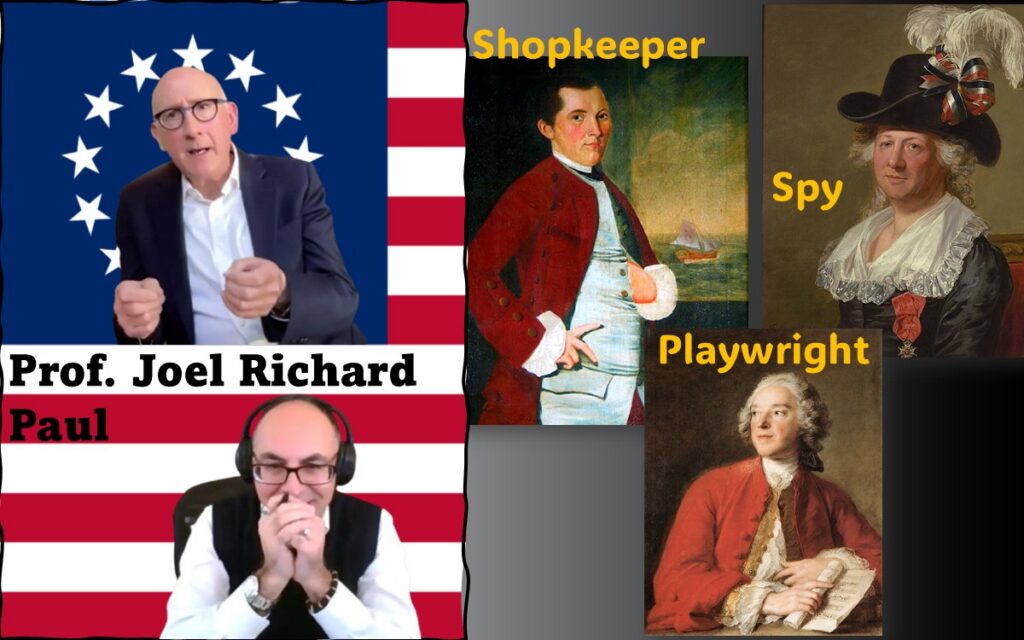 The Bizarre Plot That Armed the American Revolution
Revenge! Revenge! Revenge!
On February 6, 1778, France became an official ally of the American states.
From the very beginning of the American conflict, even before the Declaration of Independence, the French viewed the American Revolution as a “realpolitik” opportunity to weaken Britain. But the opportunity the Americans presented was even more irresistible to the French—it was an opportunity for revenge: the French wanted revenge for the humiliating losses they had suffered at the hands of the British in the Seven Years’ War (1756-1763).
This is history is superbly explained by Dr. Rafe Blaufarb in our interview: “Why France Backed the American Revolution (And Got Nothing in Return)”
Dr. Blaufarb has produced many major works about 18th and 19th century France and its military history, including the following:
- Napoleon: A Symbol for an Age;
- Napoleonic Foot Soldiers and Civilians: A Brief History with Documents,
- The Revolutionary Atlantic: Republican Visions, 1760-1830;
- Bonapartists in the Borderlands: French Exiles and Refugees on the Gulf Coast, 1815-1835;
- The Great Demarcation: The French Revolution and the Invention of Modern Property; and
- The French Army, 1750-1820: Careers, Talent, Merit.
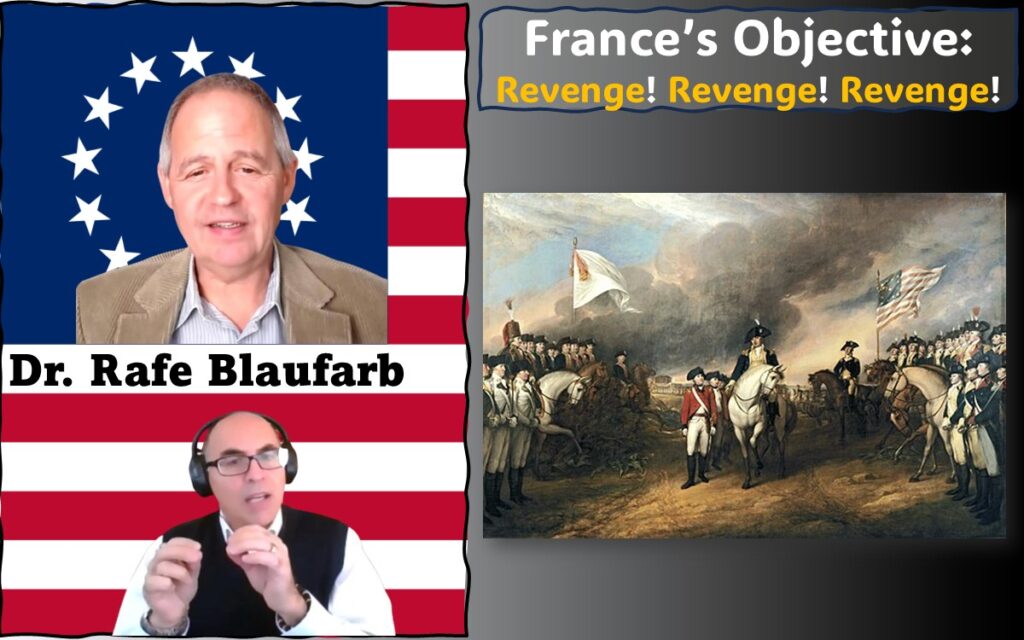 France’s Global Game: How a Colonial Rebellion Became a World War
Franklin and the Emperor — A Trick Question
That Benjamin Franklin was one of the most popular Americans in Austria and across the Habsburg Monarchy is a fact. In fact, “popular” may not fully capture how many in the Habsburg Empire viewed the American Revolution—and Franklin in particular.
Jonathan Singerton, author of The American Revolution and the Habsburg Monarchy, explains how passionately some Austrians felt about the American cause—and about Franklin himself—so much so that some even named their children after him.
To be sure, Emperor Joseph II of the Habsburg Empire, who considered himself enlightened, was very much interested in personally meeting Franklin. And, indeed, such a meeting was scheduled in Paris on May 28, 1777.
But the reason this is a trick question is that the meeting never took place. The British pulled out all the stops to prevent it from happening—for obvious reasons. They did not want a major European power recognizing the American states.
The history of the Habsburgs and the United States is actually even more complex than this. In a mind-boggling course of events—and in open defiance of orders and advice from other prominent Americans—Thomas Jefferson delayed and ultimately did not establish relations with the Habsburgs while he was in Europe. As a result, the Habsburgs became the last major European power to recognize the United States.
Dr. Singerton tells this fascinating story in the following interview in our program:
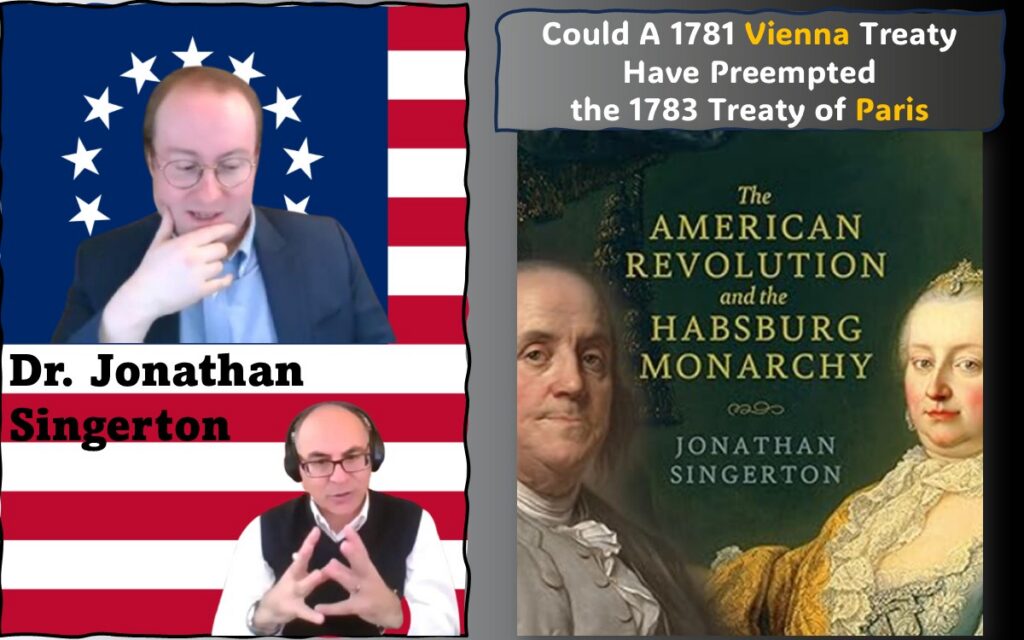 The Habsburgs and the American Revolution: A Missing Chapter
Closing Thought
The “First Salute” was not a treaty. It was not an alliance. It was not even intended as a formal act of recognition.
And yet—it mattered.
Because in a world where legitimacy depended on recognition, even a brief exchange of cannon fire could signal something much larger: that the United States had entered the international stage.
About This Post’s Featured Image
Painting of the first salute to America. Continental Navy brig was saluted by the Dutch in the island of St. Eustatius on November 16, 1776. Public domain image by United States Department of the Navy – Naval History and Heritage Command – Phillips Melville.
Unless otherwise indicated, all images in AAR—including those in this post—are in the public domain.
About This Program
Analyzing American Revolution (AAR) is a special series podcast production of the History Behind News program. In this series, 33 professors (and counting) analyze the American Revolution from 33 different angles through in-depth interviews with host Adel Aali.
Meet Our Guest Scholars
A structured body of thought on the American Revolution—where leading scholars advancing distinct interpretations that give this program its depth.

Thematic Collection
Tap below for a closer look at the Revolutionary Era themes we examine—and to meet our guest scholars.

Library
- Interview Transcript Highlights
- Interview Image and Artist Highlights
- Quiz Answers and Backstories

Image Gallery
Explore the backstories and artist bios behind images of our Founding—before and after the American Revolution. These visuals shape how we remember—and reimagine—the Revolutionary Era.

Support AAR
AAR is an independent program built on sustained research, preparation, and production. Your support helps continue this series and expand our program.

Experienced Analysis of History
About HbN Program
The History Behind News program (HbN) is committed to making in-depth history researched and written by scholars enjoyable and accessible to everyone. Our motto is bridging scholarly works to everyday news.
The histories we’ve uncovered encompass an impressively wide range of subjects from ancient history to U.S. politics and economy to race, women’s rights, immigration, climate, science, military, war, China, Europe, Middle East, Russia & Ukraine, Africa and the Americas to many other issues in the news. We also receive advanced copies of scholarly books and discuss them in our program (in the context of current news).

Adel Aali, host. Snapshot from his introductory video to AAR podcast.
232 Scholars & Counting
Our guests are scholars at leading institutions. They are highly recognized, having received prestigious grants and fellowships as well as notable awards, including the Pulitzer Prize. They include celebrated documentary producers, former White House advisors and other high-ranking government officials, and current and former senior reporters of major national and international newspapers. Many have testified in Congressional hearings, and others frequently contribute to major media outlets and widely read publications.
Think You Know the American Revolution?