Updated: September 17, 2026
- Introduction
In this interview: “By 1780–81, fully one third of the British regular army force in North America is German. So I just want to mention that this is not just a little side story. This is very significant.”
Watch this segment in the video below (14:42)
One-third of Britain’s army? If that’s the case, then the “Hessian” story is much bigger than their defeat at Trenton? So who were these German soldiers?
Why did only six German rulers send them across the Atlantic?
Were they volunteers, conscripts, or subjects with little practical freedom to refuse?
Why did Americans portray the same soldiers as both violent invaders and innocent victims?
What did the Hessians think when they encountered American prosperity, slavery, Native nations, and a rebellion far more determined than they had expected?
And do letters and diaries of German soldiers tell us about the America and the American Revolution?
In this interview, Dr. Friederike Baer restores the Hessians to their proper scale within the American Revolution. Drawing upon German-language letters, diaries, and military records, she explains how they were recruited, how they fought across North America, and how they understood the people and society they encountered. Their experiences reveal a war considerably larger, more human, and more complicated than the familiar story of Washington crossing the Delaware.
Interview Video
Watch the full interview with Dr. Friederike Baer (timestamped outline below)
Key Themes
- One-Third of Britain’s Army
- Rulers, Revenue, and Forced Service
- Women and Children on Campaign
- America Through German Eyes
- Violent Invaders and Innocent Victims
Central Question
How should we understand the roughly 30,000 German soldiers collectively remembered as “Hessians”: as auxiliaries serving German rulers, coerced subjects rented to Britain, violent invaders, perceptive witnesses to American society, or some combination that the familiar Trenton story obscures?

How to Use This Post
Use this post as reference guide to the American Revolution through the lens of this interview and the broader Analyzing American Revolution program (AARevolution). Navigate using the interactive table of contents above and the timestamps below (in gray) to discover how this interview deepens the story of the Revolution—and to explore how the program unfolds: its key themes, insights, image gallery, scholars list, history quizzes, and related interviews across the series.
The Hessians Were Not a Side Story
“Hessians” is the name Americans commonly use for the German soldiers who fought alongside Britain during the American Revolution, but the term conceals more than it explains. These troops came from six different territories within the Holy Roman Empire, not merely from Hesse, and they entered British service through agreements negotiated between Britain and their rulers. They retained their German regiments, officers, uniforms, and military organization while operating under overall British command.
Their numerical importance was enormous. Dr. Baer estimates that at least 30,000 German troops served against the American rebels. By 1780–81, she explains, Germans constituted “fully one third of the British regular army force in North America” (10:26). They fought in every major campaign and in numerous smaller engagements, from Canada to West Florida—not only at Trenton, but also at Long Island, Fort Washington, Saratoga, Newport, Philadelphia, Charleston, Savannah, Pensacola, and Yorktown.
Calling all these soldiers “foreign mercenaries” helped Americans present King George III as a tyrant importing outsiders to destroy his own subjects. It also obscured the different circumstances under which the Germans served. Some volunteered; others were conscripted after German rulers failed to meet their quotas; many possessed little practical freedom to refuse military service. Understanding who these soldiers were therefore requires looking beyond the label—and beyond the American propaganda that shaped how they have been remembered.
About My 232nd Guest: Dr. Friederike Baer
Dr. Friederike Baer is a Professor of History at Penn State Abington College where she is Division Head of Arts and Humanities.
Her research focuses on the American Revolutionary era and Early American Republic, and she is especially interested in the experiences of German-speaking people during this period (1775-1830).
She is the author of “The Trial of Frederick Eberle: Language, Patriotism and Citizenship in Philadelphia’s German Community, 1790-1830”, which was awarded the St. Paul, Biglerville Prize in American Lutheran History, and “Hessians: German Soldiers in the American Revolutionary War”, which was honored with the American Roundtable of Philadelphia Annual Book Award, Inaugural American Battlefield Trust Prize for History Honorable Mention, and Society of the Cincinnati Prize. Dr. Baer is an elected Member of the Colonial Society of Massachusetts. She served as a historical advisor and interviewee for “The American Revolution”, a documentary film by Ken Burns, Sarah Botstein, and David Schmidt.
You can learn more about Dr. Baer by visiting her academic homepage and personal website.
I should also note that Dr. Baer maintains an exceptional personal website where she shares research on German soldiers in the American Revolutionary War, including transcriptions and translations of German-authored letters, diary entries, and other records—many of which have never before been translated or published.
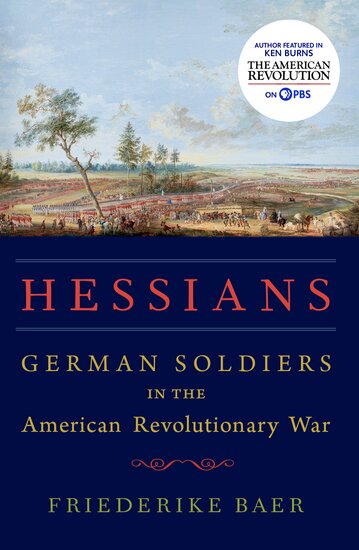 Dr. Baer’s “Hessians,” the scholarship at the heart of this interview.
About This Post’s Featured Image
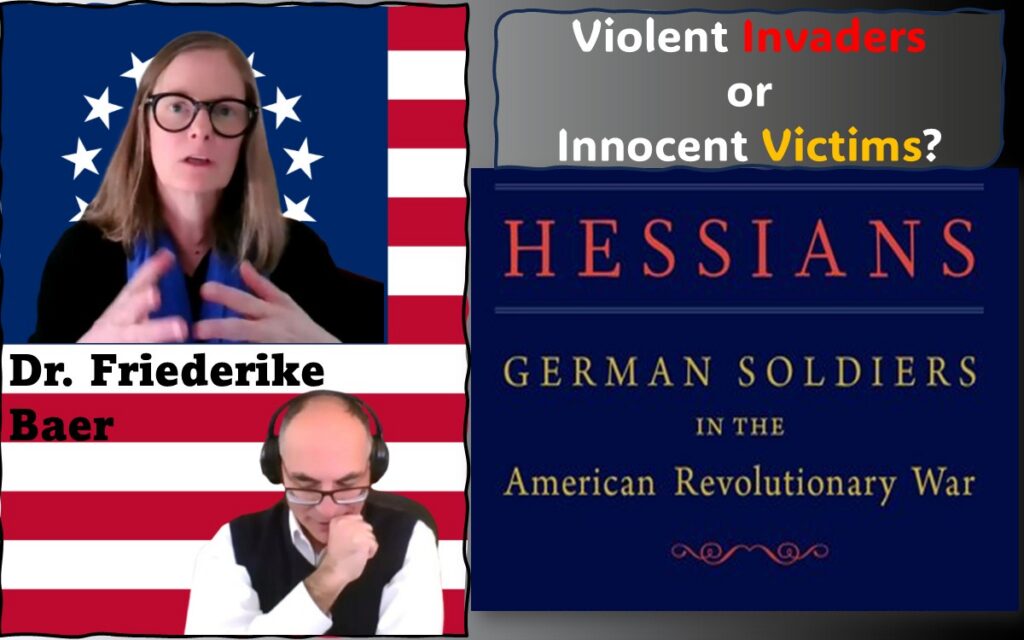
Image of Adel Aali (program host) and his guest, Dr. Friederike Baer, superimposed on the Betsy Ross flag, along with a cropped image of “Hessians: German Soldiers in the American Revolutionary War”, Dr. Baer’s book that is the basis of this interview.
Unless otherwise indicated, all images in AAR—including those in this post—are in the public domain.
The Interview (S1E35): Adel Aali and Friederike Baer
In our conversation, Dr. Baer addresses key questions and reveals untold stories about the Hessians and American Revolution. The detailed outline and full transcript below supplement the video above.
Podcast
Watch the full interview on this page with the outline and transcript below, or take the conversation with you on the go through our Spotify podcast.

Outline
Use the in-depth outline below, with its key moments and turning points, to follow the discussion and navigate the interview.
Click for Timestamped Outline
- Selected Highlights (00:00)
- Guest Introduction (01:50)
- The Declaration’s “Foreign Mercenaries” (00:04:14)
- Why Thomas Jefferson Called Them Mercenaries (00:05:17)
- Foreign Invaders as Revolutionary Propaganda (00:08:35)
- Six German States Send Their Troops (00:09:25)
- The Holy Roman Empire and the Need for Revenue (00:10:17)
- Frederick the Great’s Objections and Intervention (00:11:17) – Turning Point (00:13:25)
- One-Third of Britain’s Army in America (00:14:19)
- Soldiers, Women, and Children Cross the Atlantic (00:14:31) – Key Moment (00:14:42)
- The Eighteenth-Century Army as a Community (00:17:01)
- Volunteers, Conscripts, and Military Profits (00:21:09)
- Recruitment Quotas and the Limits of Voluntary Service (00:22:13)
- German Subjects’ Limited Freedom to Refuse (00:24:44)
- The Hessian War Beyond Trenton (00:28:30)
- German Troops Across the American War (00:29:25)
- From Fort Washington to Yorktown (00:32:19) – Turning Point (00:32:55)
- America Through German Soldiers’ Eyes (00:35:42)
- Fertile Land, Prosperity, and an Unfamiliar Continent (00:36:14)
- Slavery, Black Americans, and the Meaning of Freedom (00:38:25) – Key Moment (00:40:24)
- Native Nations and American Warfare (00:43:20)
- Curiosity, Admiration, and Distrust of Native Allies (00:43:53)
- Why German Soldiers Reassessed the American Army (00:46:20) – Turning Point (00:46:46)
- German Officers Judge British Command (00:48:10)
- Resentment Within the British-German Alliance (00:48:48)
- Saratoga, William Howe, and Orders from London (00:49:31)
- Violent Invaders or Innocent Victims? (00:53:16)
- Hessian Atrocities, Reputation, and American Propaganda (00:54:05)
- Land, Liberty, and Appeals to German Deserters (00:58:03) – Key Moment (00:58:15)
- Hessian Lives Preserved in German Records (01:02:00)
- Thomas Jefferson’s Friendships with German Prisoners (01:02:13)
- Forgotten Sources, Personal Voices, and Friederike Riedesel (01:07:43)
- Just One Point (01:15:47)
- Hessian Experiences Cannot Be Reduced to a Stereotype (01:15:59)
- German Perspectives Humanize a Brutal War (01:16:33)
Transcript
Note: This transcript was generated automatically and may contain minor errors. It is provided for reference and accessibility only.
Click to View Transcript
Adel:
(4:05) Dr. Baer, it’s a pleasure to have you in our program’s special series. (4:08) Thank you for taking the time for this conversation with me about the American Revolution. (4:14) I like to start our conversation by reading the 25th grievance of the Declaration of Independence, which, similar to all 27 grievances, is aimed at King George III.
(4:27) So here it is. (4:28) He’s at this time transporting large armies of foreign mercenaries to complete the works of death, desolation, and tyranny, already begun with circumstances of cruelty and perfidy, scarcely paralleled in the most barbarous ages, and totally, totally unworthy the head of a civilized nation. (4:48) So Dr. Baer, what’s going on here?
(4:50) Surely Thomas Jefferson and others in the Committee of Five who drafted the Declaration of Independence, including John Adams and Benjamin Franklin, I don’t know, I’m saying surely I should backtrack and pose it as a question. (5:04) Did they know that other heads of states in Europe and Asia routinely hired mercenaries like the Hessians? (5:11) Because this grievance is aimed at the Hessians, correct?
Dr. Baer:
(5:15) Yeah, that’s a good question. (5:17) Yeah, I would say, yes, they are clearly aware of the fact that hiring foreign troops is a common practice, and it certainly was common in Europe at the time, and Britain had done it many times before. (5:31) Britain hired, including German troops, of course, had hired Germans for most of its wars in the 17th century and all of its wars in the 18th century.
(5:40) So there is no question that Jefferson, Franklin, and so forth knew about that practice. (5:46) Now, there is, of course, something going on here. (5:50) And, you know, the Declaration of Independence is all these grievances on accusing the king of having done all these horrible things to the American colonists.
(5:57) I want to point out that this particular one is the only one where they’re accusing the king of doing something at this time. (6:05) So this is something that’s happening now, as opposed to many other things that happened at some point in the past, you know, maybe even 100, 150 years before 1776. (6:19) The other thing is, if you quoted from this, that he’s bringing over these foreign mercenaries to complete the work of destruction.
(6:28) So it is a little bit like a combination of all this awful stuff, the destruction of the colonies. (6:35) He’s also not actually mentioning German or Hessian or anything like that. (6:40) It’s just foreign.
(6:42) So I think the emphasis here is the effort by people like Jefferson to present the king as a cruel tyrant who is, even though maybe he’s hired troops, foreign troops before, but this time he’s hiring these mercenaries. (6:59) And mercenaries, I would say, that’s a bad, a bad word.
Adel:
(7:04) Has a bad, negative connotation.
Dr. Baer:
(7:05) Definitely, no negative connotation. (7:07) You know, people have no cause. (7:09) They’re just doing it for money or whatever.
(7:11) And he’s, of course, doing this against his own subjects. (7:15) Now, that’s different from previous conflicts where foreigners or foreign troops were hired to protect British interests, to protect British shores, to ally with Britain against European wars, including most recently, of course, the Seven Years’ War. (7:33) This is different.
(7:34) He’s hiring his mercenaries, his foreigners to come to America to destroy the colonies and fight against his own subjects. (7:43) So I think, and that is completely, I mean, you could agree, disagree, agree with this. (7:49) From the American perspective, of course, it’s like he is uncivilized.
(7:54) Presumably we are, we are civilized. (7:57) There is a little bit of this, we are better than the king.
Adel:
(8:02) Yeah. (8:02) I’m going to ask a question, follow-up question that I thought of, and I think it’s difficult to answer it. (8:08) Do you think that the Committee of Five, especially Thomas Jefferson, sort of bet that most Americans don’t know that this hiring mercenaries is customary practice in other parts of the world?
(8:21) And they were just sort of not taking advantage of, but they were riding a wave of emotional angst against the British. (8:31) Do you think part of the, kind of like propaganda words?
Dr. Baer:
(8:35) Oh, absolutely. (8:36) I mean, the declaration of independence, I mean, the propaganda, there’s definitely propaganda in there. (8:43) No, I definitely think so.
(8:45) This idea that these foreign invaders coming to us to destroy us, that’s very powerful language. (8:53) And I think you’re absolutely right. (8:54) I think the average American was not thinking, oh, but they do this all the time.
(9:00) It’s totally normal. (9:01) No, they were thinking like, well, these foreigners are coming in to, to burn down our villages, you know, and, and take our property. (9:07) And that becomes a very, very powerful rhetoric to rile up Americans to defend their homes from these outsiders, these foreigners.
Adel:
(9:17) Yeah. (9:19) He didn’t specifically mention Germans or Hessians for that matter. (9:25) So I wanted to go to the 18th century German states.
(9:31) Anyone who’s interested in the 18th century, particularly Europe, will definitely read about Prussia. (9:37) It’s one of my favorites I’ve read about him. (9:39) And then there is Frederick the Great.
(9:42) But what’s really interesting is that the six German states that send troops, that rents their troops to King George the Third, Prussia, one of the most powerful ones, is not one of them. (9:55) But it goes further than that, Dr. Baer. (9:59) Not only does King George, I’m sorry, Frederick the Great decline to said, but he also denounces this practice that is, as you and I established by then, is routine.
(10:12) So what’s going on here? (10:14) What’s the motive?
Dr. Baer:
(10:16) Yeah, that’s a good question. (10:17) And just as a reminder for also the audience, yeah, Germany, of course, doesn’t exist at the time. (10:22) What we’re talking about is territories that belong, these six territories belong to the Holy Roman Empire.
(10:28) And the Holy Roman Empire was made up of more than 300 territories from small city states to larger regions. (10:36) So just keep that in mind. (10:38) Yeah, so these six, some of whom had rented out troops to Britain before, including Hessen-Kassel, but also Braunschweig, Hessen-Hanau, are entering into this agreement, essentially, well, there’s different reasons, but one is definitely they need revenue, they need to make money.
(10:57) And Britain, of course, will pay annual subsidy payments for these troops as long as they are in British service, which in 70, 76, or 70, 70, late 75, when the negotiations start, no one knows, of course, how long the war will last. (11:12) Everybody assumes in Europe, oh, year or two, and it’ll be over. (11:17) Prussia does, yeah, Prussia condemns the decision by rulers to hire out their subjects in a foreign war that does not concern them.
(11:30) It is so, it is, you know, Frederick the Great was not exactly a republican ruler. (11:38) I mean, he was a tyrant, he was a very, but he considered himself to be an enlightened tyrant. (11:45) So he felt that you have responsibilities towards your subjects, and this hiring them out to someone who pays money in a war on another continent is like cannon fodder.
(12:01) I mean, he uses language like that, it would be unacceptable. (12:04) At the same time, I should emphasize that he did understand, and he did actually support the decision of a couple of these rulers, including the Duke of Braunschweig to do it, because the territory of Braunschweig was on the verge of bankruptcy, and the revenue was used to pay down debt. (12:26) And in those instances, Frederick the Great agreed.
(12:31) He said, you know, there are these situations, these dire situations, that I understand, that you may have to do that just to keep the duchy or whatever afloat. (12:44) So there are some circumstances that even the King of Prussia agreed, yeah, you know, I get it, you need to raise revenue, because otherwise you’re bankrupt. (12:53) And so that’s one way of doing it.
Adel:
(12:55) I see. (12:56) And it’s not like the other German states needed his agreement or acceptance, but as a powerful German state, it carried a lot of weight, right?
Dr. Baer:
(13:05) It certainly did. (13:06) And he was very offended when there’s a couple of rulers who kind of informed him, we’re going to be doing this, but kind of after the fact, and he was really like, you know, they’re also a lot of times related, there’s a lot of family relations, right back to like, I mean, it would have been nice if he would have kind of got my endorsement or approval before the fact. (13:25) But ultimately, what he did do is he did block early in the early on, a couple of times, he blocked the march or the transport of recruits through his territories out west.
(13:39) So he basically said, you know what, you can, you’re fine, you’re renting out your troops, you need to bring them to the North Sea, either a German or a Dutch port of embarkation. (13:49) But I’m not letting you march through my territories, which meant some of these troops had to take significant detours.
Adel:
(13:57) Oh, wow, that’s really interesting. (13:59) As I shared with you in our prior communications, I had the pleasure of speaking with one of your colleagues, not in your university, but Dr. Daniel Krebs of the US Army War College about the details of the recruitment. (14:13) And there’s some stuff, actually a couple points that I want to explore a little bit more with you, Dr. Baer. (14:19) One is when these troops, the Hessians, we call them Hessians, they were German, not just Hessians. (14:27) Did they take their women and children? (14:30) How did that work out?
Dr. Baer:
(14:31) Yeah, so we believe that there were hundreds of women, thousands of children went with the German troops in North America. (14:42) And maybe we should also mention that we estimate that at least 30,000 troops served in the war against the American rebels, which means that by 1780-81, fully one third of the British regular army force in North America is German. (14:59) So I just want to mention that this is not just a little side story.
(15:03) This is very significant. (15:05) So over the course of the war, the first transport leave in the spring of 76, the last one as late as 1782, every transport included women and children. (15:16) How many exactly, we will probably never know, because the records are not necessarily consistent.
(15:24) But we do have some embarkation lists and detailing provisioning and stuff like that, that do mention, you know, there were 46 women and 12 children on board a ship going to America. (15:37) These women were, in many cases, the wives of soldiers, including rank and file. (15:45) But they were also often employed in, say, the field hospitals, for example, or as laundresses or maids to officers.
(15:54) So some of them were paid employees, essentially, of the military when they went to America.
Adel:
(16:05) So did Britain also pay for their journey to America, or was it just like a lump sum payment that included everybody? (16:16) Did we know that?
Dr. Baer:
(16:19) So Britain furnished the transports for the troops. (16:22) The troops themselves were equipped in Germany, and they got provisions and arms and supplies and so forth. (16:29) Britain furnished the transport and paid for the transportation.
(16:33) And I believe if there were women on board, they were just part of the contingent of people that were carried over to America.
Adel:
(16:40) That addresses my question. (16:42) And I’m wondering, did they, so, you know, to the extent that they were employed maids or laundresses and are the wives, did they, not march along, but did they come along with the Hessians as they moved throughout North America?
Dr. Baer:
(17:01) I’d say for the most part, yes. (17:03) So there were, of course, in the encampments, in the major encampments, and some troops never really see combat. (17:10) They’re in essentially in places like Quebec or even in New York.
(17:16) So many troops, many women and children stayed there. (17:19) But when we see these larger troop movements of, for example, the Philadelphia campaign or Newport, or beginning in the fall of 78, thousands of Germans will be essentially shipped South to participate in the Southern campaign. (17:37) Each one of these transports also typically included some women.
(17:41) Now, some may have stayed behind for various reasons, thinking maybe the core, the unit might not be gone for long, but typically, yes. (17:51) Typically, they went along with the men. (17:54) That was very common.
(17:55) I mean, that’s very common 18th century. (17:57) We really think of the military. (18:00) I think we have to really look at the military as sort of communities.
(18:03) Of course, most members are men, armed, but there are many people, women and children and other civilians that were attached, and I think actually integral parts of the army at that time.
Adel:
(18:16) Integral parts. (18:17) So what would happen? (18:19) You can see the sort of how this follow-up question just naturally comes.
(18:24) What would happen if, let’s say, a German woman’s husband or German kid’s dad dies in America? (18:35) What happens? (18:37) Are they sent back?
(18:38) Someone pays for that trip?
Dr. Baer:
(18:40) Yeah, it’s awful when that happens. (18:43) There was actually efforts made, and I’ve seen records to that effect, to encourage the woman to marry another soldier on the floor to be taken care of, essentially, and that happened. (19:02) That was not that unusual.
(19:05) Other women, especially if they perhaps were not employed, they may have just gone back to Germany. (19:12) They’re regularly, the transports go back, of course, with people on leave or discharged or incapable of serving any longer for whatever reason, so some of them might have gone back. (19:24) But yes, remarrying, marrying someone else, another soldier or officer, that’s not that unusual.
Adel:
(19:30) And I’m just curious, for some of these families, you mentioned wives, that may have sort of went along with their German husbands and fathers, sort of wholesale, do we know who would sort of take care of their homes and farms back home? (19:49) How did that play out?
Dr. Baer:
(19:51) That’s a really good question. (19:52) I would, again, we don’t really have solid information at this point, but I would say, generally speaking, if you have a farm at home, you are unlikely to go with your husband. (20:09) Because you have property at home, and that property needs, like you suggest, needs to be taken care of.
(20:15) But also there’s a chance that maybe you’re not as destitute as other people. (20:23) If you have children, you may be better off at home. (20:28) Although there’s plenty of evidence that many families struggled.
(20:32) I mean, it’s economic hardship, the breadwinner essentially leaving for years. (20:39) The wives, unless they were employed, the women that are most likely to go are the ones that would truly be facing economic hardship without him. (20:54) So being with the husband and the father, if there’s a child, offers some security and, believe it or not, more stability potentially than if they would have been left behind.
Adel:
(21:05) Just stay back home in Germany.
Dr. Baer:
(21:07) Yeah.
Adel:
(21:08) Interesting. (21:09) Another question about recruitment is this, and I’ll just start with this disclaimer. (21:16) The German states of the 18th century were not Russia.
(21:21) I know that. (21:21) Where in Russia, serfdom was sort of a foundational institution that social structure and economy rested on that. (21:31) I get that.
(21:32) But elements of serfdom, as I understand, still continued in the German states to some level. (21:37) We don’t need to discuss that in depth. (21:40) But this is my question, and maybe a small question, maybe not.
(21:43) So I’ll ask it. (21:45) I know at some point, volunteers to go from German states and German states, those six, begin actually drafting soldiers to send out. (21:58) So did vestiges of serfdom and drafting sort of overlap, co-mingle?
(22:09) How did that work out?
Dr. Baer:
(22:11) Yeah. (22:11) I mean, that’s a good question. (22:13) Officially, these six rulers, officially, they said, well, we only want volunteers.
Adel:
(22:23) Officially, that’s what they said.
Dr. Baer:
(22:24) Officially. (22:25) Yeah. (22:25) Because, of course, it was not possible to raise the number of troops that they had contracted out through volunteers alone.
(22:34) And then on top of that, each of the territories also had certain exemptions. (22:40) There were men that were considered to be ineligible, essentially, not for military service, but for military service abroad. (22:50) So apprentices, college students, property owners, only sons of families that were expected to inherit property or maybe a business, people working in essential industries.
Adel:
(23:09) Wow, that whittles down the possibility.
Dr. Baer:
(23:11) Well, yeah, that makes it tough. (23:13) But if you think about it this way, from the rulers and also local officials’ perspectives, you don’t really want to send, like in some cases, I mean, thousands of basically young men in their 20s or whatever abroad, men who could be contributing to the communities or the regional or even the territorial economies in other ways. (23:36) So you’re trying to send men abroad that are poor, don’t have property, maybe even a little bit seen as troublemakers, you know, and then also, quote unquote, foreigners.
(23:51) So by that, I mean a man in, say, if Hessen-Kassel is recruiting soldiers, a man who is from Saxony, say, another German state, is considered a foreigner. (24:03) And hey, why not? (24:05) Why not enlist that man, you know, because he’s so lost to the territory.
(24:08) So we see that. (24:09) Of course, other territories object to that. (24:11) It’s like, no, you can’t do that.
(24:13) And there’s lots of correspondence about that. (24:16) But basically, you want to send men abroad whose loss you’re not going to feel as severely. (24:24) Now, that doesn’t mean, of course, that their families won’t feel that loss, but I’m looking at more the bigger picture of the local economies or regional economies.
(24:32) But yeah, it’s impossible to meet the quotas with that alone.
Adel:
(24:35) I see. (24:35) And from what I gather, so serfdom didn’t really play a role.
Dr. Baer:
(24:44) That’s a good, I would say it plays a role in the sense that these people generally are not as free as in the 21st century when we think of ourselves, you know, in America in particular. (24:57) There is no draft here. (24:59) You know, in the 18th century German states, the people are not truly free to make their own decisions.
(25:07) So you do still have serfdom in some areas. (25:09) You’re absolutely right. (25:10) But even without that, if the local official comes around and says, you are here, you are on my list of eligible young men for military service.
(25:22) You need to report for mustering over there. (25:25) You know, yeah, there is little you could do, except, of course, you could, for example, run away or hide, which people did. (25:31) But in that sense, it is a draft in the in the modern sense.
(25:38) But if you were identified as eligible and yes, we’re going to do this. (25:43) There’s you have you can’t just say, like, no, I don’t feel like it.
Adel:
(25:46) Yeah. (25:46) Yeah, I understand that. (25:50) Not not serfdom, but elements of it still exist.
Dr. Baer:
(25:53) Yes, absolutely.
Adel:
(25:55) You know, earlier you told me that even Frederick the Great, with respect to one or two states, he said in your case that you need money, that you’re about to go bankrupt. (26:07) I understand. (26:08) I understand why you would rent out your soldiers to Britain, which begs the following question.
(26:16) Did these six German states actually make money doing this or were they losing money by supporting families back home and doing this and doing that?
Dr. Baer:
(26:27) So, yeah, there were there were supporting families back home, you know, usually minor. (26:31) Well, I mean, for the families, I’m sure major, but incentives like tax breaks, relief from contributions. (26:38) You know, these people back there were heavily burdened with all kinds of contributions, even even a couple of weeks of labor a year to work on the public road, stuff like that, as school monies.
(26:50) So. (26:51) Families who send a husband abroad or father did get some of these, they get some got some relief, but at the end of the day, the rulers made very good money. (27:07) Oh, yeah, they did.
(27:08) They did. (27:09) We get this another thing where we people have tried to calculate that it’s very difficult to get an exact number. (27:16) But about Braunschweig, for example, Brunswick, that’s the duchy that I mentioned earlier.
(27:22) They did not go bankrupt because of this deal. (27:26) And these territories were able to negotiate treaties that are quite favorable. (27:32) And partly it’s because Britain is under intense pressure to do this quickly and get these troops ready in a matter of weeks.
(27:41) And the Germans know that. (27:43) So negotiate treaties where there are substantial annual subsidy payments while the troops are in British service. (27:53) But then usually the treaties also include clauses like and then one or two years after that, after the war.
(28:00) And again, in 76, no one knows how long this will last. (28:04) So I think that the British gambling a little bit, thinking, well, you know, two, three years. (28:10) You know, but obviously it’s many more years.
Adel:
(28:13) Exactly. (28:14) Yeah.
Dr. Baer:
(28:14) But Britain paid a lot of money. (28:16) And I think the territories, generally speaking, it was definitely a significant source of revenue.
Adel:
(28:23) Yeah. (28:23) And Britain was desperate to get these soldiers. (28:25) Other rulers such as Catherine the Great of Russia had refused Britain.
(28:30) So let’s come to America. (28:34) And I want to go back to my own high school days. (28:38) Okay.
(28:39) An American kid learning about the Hessians. (28:42) I’ll tell you what we learned. (28:44) The Battle of Trenton, Christmas Eve, everyone’s drunk, which is not the full story at all.
(28:49) And then what we remember, the Delaware Crossing, the famous painting that now is at the Met. (28:55) And I’ve seen it, which is not the original, but that’s irrelevant. (29:01) Now, Battle of Trenton.
(29:02) But you just said one third of the British Army, a whopping 30,000 were Hessians. (29:10) So Battle of Trenton is a tiny little event. (29:13) Could you just, I know this could be several podcasts, but could you please just tell us, walk us through some major events and battles that the Hessians were involved with?
Dr. Baer:
(29:25) Yeah. (29:25) No, I think, yeah, that’s a great question. (29:28) I hear that all the time.
(29:29) I mean, yeah, most people have heard of Trenton and that’s always the connection, you know.
Adel:
(29:32) Exactly.
Dr. Baer:
(29:33) But yeah, Trenton is an important battle because it’s this amazing crossing of the Delaware. (29:39) And of course, it is an American victory after a campaign that had not gone so well for the Americans. (29:45) So it’s a big morale booster.
Adel:
(29:47) Exactly.
Dr. Baer:
(29:48) So all of that is important. (29:49) But yeah, it’s a really a tiny percentage of Hessians or German soldiers actually at Trenton in late 76. (29:58) And just reducing their experience to this, it really does the whole story, their experience, I think, a great disservice.
(30:06) It’s also sometimes almost a little bit of a caricature of the, like you already suggested, sort of the drunk Hessian with the metal, the miter cap and all that. (30:16) So, yeah, to just very briefly, these German soldiers participated in every major battle campaign and in many, many minor battles and skirmishes between the summer of 76 when the first Hessians or Germans arrived and the end of the war, from Canada in the north to West Florida in the south. (30:41) There are even some Germans who will be prisoners of war on Cuba.
(30:45) So we have Germans that participate in just to name a few major battles. (30:54) Saratoga, of course, in October 77, which ended on a British defeat. (30:59) Several thousand Germans are captured.
(31:02) Then we have, of course, later in the war, in the fall of 1781, Yorktown in Virginia, also obviously a British defeat and several thousands are captured. (31:13) But then we have the occupation of Newport, Rhode Island, the Philadelphia campaign, the conquest of Charleston, South Carolina, of Savannah, Georgia, the siege of Pensacola. (31:26) All of these included significant numbers of German troops.
(31:32) So it is important, I think, to keep in mind really the great variety of experience, also just the geographic regions and the vastness, it’s really quite incredible. (31:46) So any, I think, account of the German experience needs to consider that. (31:52) Trenton is a blip in that, you know.
(31:56) In a way, I think also much richer in various stories around it.
Adel:
(32:03) Yeah, you just, so Battle of Saratoga, Newport, Rhode Island, Philadelphia, Charleston, Savannah, Pensacola. (32:08) These are all the major stuff. (32:10) And also I would include, I mean, you said that summer of 76, they were also involved in the battles for Long Island and Manhattan.
Dr. Baer:
(32:19) Oh yes, I didn’t even, yeah, White Plains and Long Island. (32:24) And then, of course, the Fort Washington, which is renamed Fort Knipphausen after the Hessian commander, because the Hessians played such an important role in it. (32:33) You know, that fort that the Americans thought, oh, no one’s going to conquer that.
(32:35) Yeah, well, they did conquer it. (32:38) So that, another thing to keep in mind, we know how the war ended. (32:43) But for these German participants, and particularly this first campaign, I mean, things are going quite well, and they are not intimidated by the Americans.
(32:55) They feel like, yeah, we’re obviously going to win this war against this like, you know, ragtag bunch of farmers. (33:02) Trenton, a little bit of a damper, but even after that, I think they’re not over, you know, they’re not generally discouraged.
Adel:
(33:10) Ragtag bunch of farmers. (33:11) We’re going to get into that in a moment. (33:13) But before we go there, I want to go back to one of the earlier communications I had with you.
(33:20) And I shared with you that I had read somewhere, I don’t recall where, that French forces also used German-slash-Hessian regiments in that big battle, well, historically big siege of Yorktown. (33:38) And you said, no, Adele, that’s actually not correct. (33:42) Could you please share that with our audience?
(33:44) That was really enlightening for me.
Dr. Baer:
(33:45) Well, it’s correct that they used Germans, but these Germans had not been specifically hired for the war in America. (33:51) And that’s a big difference to what the British did.
Adel:
(33:53) Yeah.
Dr. Baer:
(33:54) So the French had a German regiment in service since the 1750s, I believe, the exact year, something like 1757. (34:03) That regiment in French, it’s referred to as the Royal Dupont. (34:08) The German word is like the regiment Zwei Brücken.
(34:11) Zwei Brücken is Dupont, basically two bridges. (34:14) Zwei Brücken is a German territory. (34:17) So that regiment had been in service since the 1750s.
(34:22) And when the Comte de Rochambeau was asked to select four regiments to go with him to America in 1780, in the summer of 1780, he picked that regiment as one of the regiments to go with him. (34:38) So this is a German-speaking, predominantly German regiment that becomes part of the forces under Rochambeau. (34:46) And of course, the following year, that is the force that will march down to Yorktown and participate in the siege and the Battle of Yorktown.
Adel:
(34:56) Interesting. (34:57) So just so that I’m clear, so that German regiment comes from a German-speaking part of the Kingdom of France? (35:06) Did I say that correctly or not?
Dr. Baer:
(35:08) Well, I mean, it comes… (35:09) So Zwei Brücken is its own territory within the Holy Roman Empire. (35:14) By the time of the American Revolution, the majority of troops come either from that territory.
(35:21) There also is a significant percentage from the Alsace, which was part of France. (35:25) But it’s sort of that border region. (35:27) But the official language of this regiment was German.
Adel:
(35:31) Okay. (35:31) But they had been part of the service for the French troops way before the American Revolution? (35:37) For about two decades.
(35:42) So when Hessians come to America, and I hope this is not a silly question. (35:48) I’ve been to Europe many times. (35:50) And I want to understand this.
(35:52) This is before there are images, pictures, or even people don’t have maps, you know, regular people, everyday people. (35:59) Were they in any way, Dr. Baer, struck by the geography of America, its vastness? (36:07) I mean, and the geography is different, whether they’re in South or North.
(36:10) I appreciate that. (36:11) But are there any accounts of that?
Dr. Baer:
(36:14) Oh, yeah. (36:14) So many. (36:16) We have a huge volume of records authored by members of the German Corps and official obviously, but also private letters, diaries, and so forth.
(36:27) And quite a few comment on the American land. (36:32) And they’re definitely impressed. (36:37) I do want to mention that to my knowledge, not a single member of the German Corps had ever been to North America before.
(36:46) So some had been in British service before. (36:48) There are even a couple who have been in Britain before, but none of them had been to North America before. (36:52) So this is really new.
(36:53) There’s a nice entry in a diary by a company surgeon who is sailing towards Canada. (37:02) And he says, when we saw land, we felt like Columbus, you know, discovering a new world. (37:08) And so yeah, so when they’re here in North America, they do comment on, they’re really impressed, basically, with the richness of the land, the farmland.
(37:22) I should probably mention that extremely positive assessment doesn’t necessarily apply to the Deep South, Georgia, particularly West Florida, because of the climate. (37:36) There, the commentary tends to be quite harsh. (37:38) It’s just hot and there’s a lot of mosquitoes.
(37:41) And I mean, the disease is rampant. (37:43) But in most of the other territories, the impressions are extremely favorable. (37:49) And high standard of living as well.
Adel:
(37:52) High standard of living.
Dr. Baer:
(37:54) There’s a comment on how well at least white Americans seem to be living. (38:00) They have their property. (38:02) They have nice farms.
(38:03) They’re very impressed.
Adel:
(38:05) Wow. (38:05) Okay. (38:05) So you mentioned, used the word white Americans.
(38:08) And then before that, we were talking about the Deep South, which makes me think of this question. (38:15) Hessians, generally speaking, German soldiers must have interacted, or at least seen, enslaved Blacks. (38:22) Did they write about that?
(38:25) What’s the impression?
Dr. Baer:
(38:26) Yeah. (38:27) Yeah, they do write about it. (38:29) Now, most, maybe not most, but many Germans had, and I think it’s important to point that out as well, had probably seen a Black person before.
(38:40) We, having Black musicians, for example, and Black servants at the courts of Europe was a, was very common at the time. (38:51) Blacks, or they’re referred to as Moors or Mooren in German, are considered to be almost like prestige, I want to say prestige objects, often dressed in very kind of exotic looking outfits and things like that.
Adel:
(39:05) Oh, wow.
Dr. Baer:
(39:08) When they come to North America, of course, yes, wherever they go, not just in the South, but wherever they go, they, of course, encounter Black men, women, and children, enslaved and also free. (39:20) And they do comment on that. (39:21) And very early on, they comment on, they’re very critical of how white Americans treat their, treat enslaved people.
(39:31) They’re often appalled by that, you know, their comments like, oh, in Germany, a farmer treats his cattle better than a slave owner treats their enslaved people in Virginia, things like that.
Adel:
(39:45) Wow.
Dr. Baer:
(39:45) There also are comments, I don’t think they fully understand slavery as a legal institution, but you mentioned serfdom earlier. (39:56) They do definitely make connections between, you know, these people are not free. (40:01) And that’s not necessarily the problem for them, I think.
(40:03) The problem is how they’re treated. (40:05) So to not be free is one thing, but to be treated so poorly and exploited, that’s something that a lot of commentators find highly problematic. (40:16) There’s actually a chaplain, his name is Becker, a Hessian chaplain, who early on, I think it’s in 76 already in New York, writes a letter back home.
(40:24) And he says something like, if there was a people in America that should be fighting for freedom, it would be Black people.
Adel:
(40:29) Oh, wow.
Dr. Baer:
(40:30) Makes that comment.
Adel:
(40:33) Did German troops hire or interact with Blacks in America?
Dr. Baer:
(40:41) Absolutely. (40:42) I would say from the beginning of their time in America, Black men, women, and children are a regular presence in German encampments. (40:52) As we know, you know, tens of thousands of Black people sought refuge with the British Army over the course of the war.
(40:58) And some of them sought refuge or attached themselves to German regiments. (41:04) And German regiments also actively recruited particularly Black drummers. (41:10) And they do show up in the records.
(41:12) So again, that was meant to be prestigious, to have a dark-skinned musician as part of the regimental military unit. (41:25) So they make an effort to recruit individuals.
Adel:
(41:29) That’s fascinating.
Dr. Baer:
(41:30) We estimate that at least 200 Black men, women, and children returned, or not returned, but went with the Germans to Germany after the conclusion of the war.
Adel:
(41:44) You have Blacks from the Americas that went back to the German states in the 1700s?
Dr. Baer:
(41:54) That’s right. (41:55) And some of them married German women, daughters of local citizens. (42:03) They usually stayed in the military because, again, those drummers were sought after.
(42:09) They were well paid.
Adel:
(42:12) Are there, I’m just curious now, are there genealogical records of those Blacks that were in Germany? (42:19) There would be German now. (42:20) They’ve been there for 200, 300 years.
Dr. Baer:
(42:23) Yeah, that’s a good question. (42:24) What I’ve found is, unfortunately, to my knowledge, none of them left a record, like something that, you know, we get there. (42:35) Because sometimes it’s hard to tell.
(42:37) How was it for a Black person in Germany in the late 18th century? (42:43) But we do have baptismal records. (42:46) Basically, church records are very helpful.
(42:49) They were usually baptized. (42:50) Of course, sadly, we also have a lot of records of children dying of disease over the decades or so after the war. (43:00) I’m only aware of one person that was traced a little bit into the second or third generation that was in Braunschweig, a Black drummer who was married to a German woman and had several children.
(43:14) And through one of them, I think there has been efforts to trace them. (43:17) But yeah, more work needs to be done there.
Adel:
(43:20) That’s fascinating. (43:22) So German soldiers must have also interacted with Native Americans. (43:29) I know your thesis was about General Burgoyne and his involvement with German soldiers in the Battle of Sartoga.
(43:39) And I bring that up because I know at least one or perhaps even two nations from Iroquois were also helping the British, right? (43:47) So there must have interacted. (43:49) What do they think of Native Americans?
(43:51) What was that interaction like?
Dr. Baer:
(43:53) Yeah, you’re absolutely right. (43:55) That’s especially the case with Burgoyne. (43:59) To some extent, we also have a little bit of that in the South.
(44:04) The view, generally speaking, the view was ambivalent. (44:08) They’re very ambivalent. (44:11) Yeah, very detailed.
(44:13) I mean, really amazingly detailed descriptions in the German records of Native Americans, what they look like, what they’re dressed, their customs, their artifact, all of that, which signals a real interest and curiosity. (44:31) And there is, on the one hand, some admiration for what the Germans described as a symbol of people, potentially also morally superior to more civilized European nations. (44:47) There’s that element.
(44:50) But there’s also the flip side of that is also very, very often references to Native Americans as animal-like, brutal. (45:02) Sculpting in particular shows up frequently as this is absolutely horrendous practice. (45:10) And a sense of not really knowing whether you can trust them, even if they’re allies, because they seem to be unpredictable.
(45:23) When things don’t go well, for example, for Burgoyne, large numbers of Indians just go home. (45:28) And from the German perspective, of course, there’s something disloyal or unreliable about these presumably allies that makes it very difficult to fight alongside them.
Adel:
(45:41) That’s fascinating. (45:45) Earlier, you told me that, you know, when I asked you about the Manhattan, Long Island, White Plains sort of battles campaign, and that was the Hessians’ first interaction with Americans, and they said, oh, this is going to be easy. (45:59) This is a ragtag army.
(46:02) Do the opinions of the German soldiers fighting in the 13 colonies about American soldiers, American troops, does it change at any time? (46:13) Do they come and say, hey, these guys are actually not fighting, they’re competent? (46:18) I mean, does that happen?
Dr. Baer:
(46:20) Yeah, it happens gradually. (46:22) I think there are some who probably even after Trenton are like, oof, this is going to be tougher than we thought. (46:28) But for most, it takes a little bit longer.
(46:32) I think there is certainly this perception that the Americans are not fighting like a conventional European army. (46:42) And the Europeans initially think that is a sign of weakness. (46:46) Well, it turns out, to some extent, what Germans think of American style of fighting is actually really well suited for the American environment.
(46:55) You know, sort of the irregular warfare, we would call it, that kind of thing. (47:02) I think as the war goes on, if anything, more and more Germans beginning to realize that the Americans are just so determined to win this. (47:14) They are so committed to it that there’s just no way to overcome that, the zeal, the sheer will to win this war against Britain.
(47:26) And there are comments, too, about every time we defeat a small unit or capture some Americans, the next day they raise a thousand new men and they just keep coming. (47:41) I mean, they’re very aware of the disadvantages of fighting a war abroad, essentially. (47:46) Britain, it’s not easy for Britain to fight that war.
(47:49) They’re very aware of the fact that the Americans do have some real advantages there at home.
Adel:
(47:53) Yeah.
Dr. Baer:
(47:54) Presumably, from their perspective, the supply of men will never be exhausted. (48:01) So sheer will. (48:03) They make up with sheer will what they may be lacking in sort of military knowledge and expertise.
Adel:
(48:10) Yeah, military prowess. (48:12) So we know that a third of the British military in the Americas were Hessian. (48:23) And I know that officers were included in strategy and planning along with British officers to whatever extent.
(48:31) But I assume that the ultimate decision was in the hands of the British where to go, what to do. (48:36) Yes. (48:39) The German soldiers and officers must have had some opinions of the British.
(48:45) Yeah. (48:47) Please do share.
Dr. Baer:
(48:48) Yeah, they did. (48:50) So but yeah, you’re absolutely right. (48:52) So that was also already in the treaties that the regiments and the units, they came with their own officer staff and all the military, I mean, the hospital, all of that.
(49:01) But the commanding officer in any place or campaign was always a British one, of course. (49:10) So as you can imagine, that created here and there some resentment because we have some ambitious officers who feel that maybe their advice was not necessarily always taken seriously or taken into consideration. (49:23) And when things go wrong, that’s when these things, maybe with the advantage of hindsight, but that’s when these kind of views are often articulated.
(49:31) And a really good example is Burgoyne’s campaign that, of course, failed at Saratoga in October 77. (49:40) Burgoyne, when he goes back to England and he’s called before parliament to explain what happened, he will basically say, like, well, had my force been all British, maybe. (49:50) I mean, he’s suggesting.
Adel:
(49:51) Oh, wow.
Dr. Baer:
(49:52) The commander of the German Corps, his name is Major General Adolf Rietesel, he issues his own long statement explaining how from the beginning of the campaign, what had gone wrong and basically how the overall commander had made bad decision and was poorly prepared and all those kind of things. (50:13) So there was a lot of finger pointing. (50:16) I think that there’s a couple of criticisms that you see show up throughout the war.
(50:23) One is that the British commanders, people like Howe, particularly William Howe, are too lenient, that they are not going after the Americans as forcefully as the Germans thought would be necessary to really beat them. (50:47) They let the Americans escape too many times. (50:51) And of course, that’s true in New York during the New York campaign.
Adel:
(50:54) Yeah.
Dr. Baer:
(50:55) Let’s say after Brandywine, American victory, I mean, a British victory, and the Americans just kind of allowed to kind of disappear. (51:04) From the German perspective, that is a mistaken generosity. (51:10) Howe maybe looking at these people as British subjects and not really willing to go after them forcefully.
(51:17) That’s one criticism. (51:19) The other criticism is that even during major campaigns, and that’s Burgoyne is a good example, but even Cornwallis is in the south. (51:28) The British seem to be woefully unprepared, underestimated.
Adel:
(51:34) Militarily unprepared?
Dr. Baer:
(51:35) In the sense that no clear, in some cases, even no clear guides or maps of the region or overestimating loyal support is a common mistake. (51:51) I mean, Burgoyne thought when he enters New York, they’re all loyalists and they’re going to support me. (51:55) That did not materialize.
(51:56) And that happens several times over the course of the war. (52:00) So those kind of things. (52:03) But the last thing I just want to say, there’s also this realization, of course, that the British commanders in America are essentially being directed by people in London.
(52:19) 3,000 miles away. (52:21) It takes weeks for communications to reach North America. (52:26) So the Germans, at least towards the end of the war, they understand that even the most brilliant British commander could not really act independently and could not really do what he may have thought would be the best strategy because the directions essentially came from England.
(52:47) From people who were not in America and understood even less of what this war was about.
Adel:
(52:53) Yeah. (52:54) So the British commanders that were doing the fighting were hamstrung by the politicians that were 3,000 miles away and didn’t understand how the fighting should be done. (53:04) Let’s take a break here.
(53:05) In the next segment, I’m going to ask Dr. Baer what Americans thought of Hessians and speak to her about Jefferson’s friendship with the Hessian POW. (53:15) We’ll be right back. (53:16) Dr. Baer, early in the previous segment, when we were talking about the 25th grievance in the Declaration of Independence, you said that, you know, who are these foreigners coming, burning our villages, you know, plundering our towns and all of that. (53:38) Is there a specific battle or incident that gives credence to this image that, you know, Hessians are merciless murderers or sort of pitiless pillagers? (53:57) Does something happen or is that just generally they think of this before even Hessians arrive?
Dr. Baer:
(54:05) They do think of that before the Hessians arrive. (54:08) But yeah, but some of the events that happen in the fall of 76 campaign in New York and also New Jersey do definitely reinforce that image of the Hessian as a merciless plunderer who will destroy villages and worse will hurt or even kill innocent, what we would call civilians, including women and children. (54:35) And there’s definitely examples of this kind of thing.
(54:42) I want to emphasize that that happens on all sides. (54:47) You know, violent acts against locals, including the Americans, people that are deemed to be not loyal to the cause, as we know, the so-called disaffected or loyalists. (54:57) They were treated brutally by the Americans, by the so-called patriots.
(55:02) But the Hessians do have that reputation. (55:05) And it’s hard to separate fact from fiction when you read these accounts. (55:11) But there’s no doubt that they contributed atrocities to doing this, especially that first, you know, the second half of 76.
(55:24) There are some instances that are shared in letters, including at the Battle of Brooklyn, where Hessians did not give quarter, those kind of things. (55:35) Again, I think it’s hard to know to what extent these are descriptions of actual occurrences or whether this was used for propaganda purposes, because the Americans definitely use stories for propaganda purposes. (55:53) As I suggested earlier, you know, if you want to rile up American men, you know, and really want to encourage them to take up arms to fight this war, portraying the enemy as this brutal invader and attacker and murderer of your wife and children is a really effective way of accomplishing that.
(56:14) And so broad sides and letters that are circulated that list presumably all the atrocities that have been committed. (56:23) So that is one that is the reputation. (56:27) And I think to some extent, that is still the reputation of German soldiers to this day.
Adel:
(56:33) I think it’s a really very enduring image, but the reputation of German soldiers during the American Revolution or just other other wars?
Dr. Baer:
(56:44) I mean, but you’re bringing up a good point. (56:46) I think what happened in history since then, including German in the 20th century, has reinforced that image of Germans being particularly merciless and violent. (56:59) And I think that helps, in a sense, that more recent history has reinforced that image of these soldiers in America in the late 18th century.
(57:10) No doubt about it. (57:11) It seems to kind of confirm that Germans are just.
Adel:
(57:14) And this even, by the way, I’m not making light of this, but this even applies to children like the headless horseman in Halloween and all of that, you know, so square this for me. (57:27) I want to in the intro to this segment, I told you I want to speak to you about Jefferson and Hessian POW. (57:33) I’ll ask that question in a moment.
(57:35) But that question itself has an assumption that Jefferson, and there were probably others like him, at some point don’t think of Hessians as merciless and violent people, hence they befriend them. (57:55) Something changes from 76 to 83 and on. (57:59) What is that development?
(58:02) How does that come about?
Dr. Baer:
(58:03) I’ll talk to you about Jefferson in a minute. (58:05) So this image of this violent invader exists again before the first Germans set foot on American soil. (58:15) But pretty much at the exact time, the image of the German soldier as the innocent victim of tyrannical rulers also exists and is perpetuated at the same time.
(58:28) So we have already in the summer of 1776 offers of land and liberty and property for Germans who desert and settle in America. (58:40) And the appeal, it’s really like basically the gist of it is like you poor people were forced by your tyrannical rulers to fight in this war against the people who all they want is their liberty. (58:55) You have nothing at stake here.
(58:57) This is not your cause. (58:59) Look how many of your German compatriots have settled here and they’ve done so well. (59:04) We invite you to do the same.
(59:08) So that is the other side of the coin. (59:13) It’s fascinating.
Adel:
(59:16) And by that time, you just said something I just want to emphasize this for our audience. (59:20) At that time, the US had a sizable German community.
Dr. Baer:
(59:26) Yeah, we estimate that by the time of the revolution, maybe 80,000 German speaking people had emigrated to the colonies. (59:35) So yes, of course, the German soldiers, by the way, they’re also in many regions. (59:41) Notice that they’re German speaking people.
(59:43) They drink beer. (59:44) They eat German. (59:45) I’m not kidding.
(59:46) I mean, it’s like home, you know? (59:48) So ultimately, the temptation to desert will actually will be there. (59:54) But these offers to desert, they’re republished multiple times over the course of the war and particularly circulated in areas where large numbers of prisoners of war are held.
(1:00:07) These people that are waiting to be released or paroled and in some cases for years. (1:00:13) And at some point, some of them are like, you know what? (1:00:15) I’m just going to stay here.
(1:00:17) I met this woman and I’m going to get married. (1:00:19) And so that happened. (1:00:21) But anyway, that view of them as if only given the chance, they would be happy to settle among us does also exist.
Adel:
(1:00:31) Is that a genuine view of the American sort of like dichotomy? (1:00:36) They think of them as violent, but also some think of them as sort of innocent people whose tyrannical ruler sent them here against their will. (1:00:44) Do people feel this?
(1:00:46) Or is this used as as war propaganda to split the British forces? (1:00:51) Those are two different things, right?
Dr. Baer:
(1:00:53) Yes. (1:00:53) And I yeah, I think, of course, you could look at it as a kind of a war measure. (1:00:58) You know, it would be wonderful if they all deserted, you know, the enemy.
(1:01:02) And I think that is the main motivation. (1:01:07) At the same time, again, we have no there’s not been and I think I’m not sure if it’s possible, like a really comprehensive study of how how did these people fare in North America, the people that did take that step? (1:01:21) There’s no evidence that they were treated badly.
(1:01:25) There’s no evidence that they were, you know, people held it against them that that were there were at some point, you know, had come over as part of the British army.
Adel:
(1:01:35) So I think that’s indicative, right? (1:01:38) That’s yeah, yeah.
Dr. Baer:
(1:01:39) I think so, too. (1:01:40) I think that ultimately, maybe initially people were like, who was this person? (1:01:44) But ultimately, especially the people that settled in the newly created United States seem to have done quite well economically and and and in terms of even holding elected offices and things like that.
(1:01:59) Wow.
Adel:
(1:02:00) So you said there’s no evidence that they were treated badly, which makes me think of Jefferson. (1:02:05) So Jefferson actually befriends a German officer. (1:02:10) And I’ll stop.
(1:02:11) Take it away, please.
Dr. Baer:
(1:02:12) Yeah. (1:02:13) So Jefferson is he’s obviously his home is in Charlottesville, Monticello. (1:02:21) And when he is there, a couple of thousand German prisoners of war are sent there.
(1:02:29) These troops were captured. (1:02:32) Soldiers and officers became American captives as a result of Burgoyne’s surrender at Saratoga that we already mentioned in October. (1:02:41) Seventy seven.
(1:02:42) Two thousand four hundred Germans and maybe three thousand British. (1:02:46) The whole army becomes basically kept captive. (1:02:49) They initially sent to Boston because the idea was to send them home to Europe.
(1:02:54) That never happened. (1:02:56) I don’t need to go into details. (1:02:59) But ultimately, after about a year, that army is marched south to Virginia for various reasons.
(1:03:06) So these Germans arrive in Charlottesville in the barracks. (1:03:09) Now, the rank and file and noncommissioned officers that need to fix up the huts and they create this essentially like almost like a village. (1:03:17) The officers, of course, live in, which was customary at the time, are renting their own quarters.
(1:03:23) So, for example, I already mentioned the commander Adolf Riedesel. (1:03:27) He’s there with his wife, Friederike Riedesel, and their three young daughters, who she followed him to North America. (1:03:35) They’re renting the house Kohl, which was the residence of the Italian Philip Marseille.
(1:03:41) Some of your listeners probably know him. (1:03:43) The Italian who was a neighbor of Jefferson and who goes to Italy to rally up support.
Adel:
(1:03:49) Wait a second. (1:03:50) That’s a substantial state. (1:03:53) I mean, that’s not a small…
(1:03:55) Okay.
Dr. Baer:
(1:03:56) They’re prisoners of war, but the officers in particular, I mean, they have to pay their own upkeep, but they can do that. (1:04:02) They have a pretty nice… (1:04:04) I mean, they’re prisoners of war, so I’m sure they don’t enjoy that part.
(1:04:08) But in terms of comfort and their daily lives, it’s not too bad. (1:04:14) So Riedesel and his wife and their daughters befriend Thomas and Martha Jefferson, who have two young daughters around the same age. (1:04:22) They have dinner together.
(1:04:24) They go to the theater together. (1:04:26) And then there are two or three other German officers who, in their letters, will share that, I went to Jefferson’s estate. (1:04:36) I played his violin.
(1:04:38) We had a little concert. (1:04:39) Let me use his copious library. (1:04:43) One is asked to draw a painting of, I forget now what, in Monticello in one of the rooms.
(1:04:53) I think what happens here is Charlottesville is a sleepy village. (1:04:58) There’s not much happening. (1:05:00) So Jefferson, of course, we know, is a learned man.
(1:05:04) He loves culture. (1:05:05) He speaks French, which the officers also do. (1:05:09) He is, I think, really enjoying the company of these educated, cultured, so to speak, German officers you can converse with, play music with, go to see plays with, have dinner with, and he enjoys it.
(1:05:28) So we have, in some cases, the correspondence between them. (1:05:32) Then they get, of course, released gradually, and then the war’s over. (1:05:35) But we have correspondence into the 1780s, 1790s.
(1:05:39) When Jefferson visits Germany later, he tours a spa, still standing, by a spa, I mean huge complex of, you know, grounds and buildings. (1:05:52) It was built in the 1780s in Hanau with British subsidy money. (1:05:59) He tours them, and his tour guide is one of these officers.
Adel:
(1:06:05) Oh, wow.
Dr. Baer:
(1:06:06) That he knew in Charlottesville. (1:06:08) His name is Geismar. (1:06:10) They’re friends, and it’s incredible.
(1:06:13) And so, yes, so there are these officers. (1:06:16) Lafayette has dinner with a couple of these at some point also. (1:06:21) I think then it’s a class thing.
(1:06:23) They enjoy the company of these.
Adel:
(1:06:25) Class thing.
Dr. Baer:
(1:06:26) You know, I mean, I don’t think he would have socialized with a rank and file. (1:06:30) But these officers, these European officers are good company.
Adel:
(1:06:33) Yeah. (1:06:34) Dr. Behr, the more I read about the American Revolution and interview scholars like you, the more I realize there’s just so much more. (1:06:42) It’s so complicated.
(1:06:42) There’s a lot, right? (1:06:43) There’s a lot, yeah. (1:06:46) I’m fascinated by your research for many different reasons.
(1:06:52) And I want to bring up this one particular thing. (1:06:55) You’re German. (1:06:56) I know that.
(1:06:58) And you came here for college. (1:07:00) So you’ve been in the U.S. for a long time. (1:07:05) You love and believe in primary sources.
(1:07:10) Many, many accomplished scholars such as yourself do. (1:07:14) But in your case, you’re reading 18th century German. (1:07:18) Now, I want to tell you something about me.
(1:07:20) My father spent a lot of times with Siemens, which he pronounces Siemens in Munich. (1:07:26) Yeah. (1:07:27) And he always used to tell me, German, if you look at their old stuff, it’s so hard to read.
(1:07:32) And Germans have different accents. (1:07:34) He’s talking about the late 50s and throughout the 60s. (1:07:38) Different accents.
(1:07:39) So that’s a little about my background. (1:07:41) Sort of that triggered me to ask this. (1:07:43) Were you able to read these things from the 18th century?
(1:07:47) Obviously, you were. (1:07:48) But was it a different script? (1:07:51) What was it like?
Dr. Baer:
(1:07:51) Oh, yeah. (1:07:52) It’s a completely different script. (1:07:54) And it is a script that has not been taught in Germany since the 1930s.
(1:07:59) Oh, wow. (1:08:00) When it was modernized, you know, in the 30s, there’s this movement to modernize. (1:08:05) So, like, my mother learned it in the first and second grade.
(1:08:08) And then overnight, they stopped teaching it. (1:08:11) Yeah, it looks very different. (1:08:13) So it’s a barrier for German scholars as well.
(1:08:15) Because it is something, obviously, like everything you can learn. (1:08:18) But it is a different script. (1:08:21) For some bizarre reason, when I was a child, I was really curious about it.
(1:08:27) I actually asked my grandmother to teach it to me. (1:08:29) Oh, wow. (1:08:30) Not knowing that I would ever put it to any kind of use.
(1:08:34) I think I was just curious about it. (1:08:36) And then, I mean, who would have known that I would be working with material that is written that script. (1:08:42) So, yes, it’s German.
(1:08:44) And of course, also, you know, people spoke differently. (1:08:47) The syntax is different. (1:08:48) And then it’s the German, the different script as well.
Adel:
(1:08:52) So people spoke, go ahead, please.
Dr. Baer:
(1:08:55) No, I mean, just generally, when you read an 18th century letter, it’s not the way we would necessarily speak or write today. (1:09:02) So that’s on top of it. (1:09:04) And then you have a lot of military language or terminology in there as well.
(1:09:13) At this point, I’ve read so much of it. (1:09:16) It’s, I mean, obviously, even back then, some people had just really bad handwriting. (1:09:22) But I can read it very easily.
(1:09:25) And I want to just, anyone who studies American history, knowing the language other than English is very helpful, I would say, generally. (1:09:35) I mean, there’s so much material that was written that is not in English. (1:09:43) Yeah, so I had, in a way, the advantage of being able to read this and use this material, so much of it, which had never been really studied by scholars of the American language.
Adel:
(1:09:53) It’s fascinating, what an experience.
Dr. Baer:
(1:09:56) And there’s a lot of it, I should also emphasize.
Adel:
(1:09:58) Yeah, you said a huge amount.
Dr. Baer:
(1:09:59) There’s a lot of it, a huge, I mean, I had no idea. (1:10:01) When I set out on this project, I really have to be honest, I really had no idea. (1:10:05) And there is so much.
Adel:
(1:10:07) Let me ask you this. (1:10:08) Let’s just put the history aside. (1:10:10) Let’s put military aside, all of that, recruitment, everything we discussed.
(1:10:13) Let’s just stop thinking about those for a moment. (1:10:16) Were there any letters that you’ve read that had like a personal angle or something that stick out, sort of stand out for you?
Dr. Baer:
(1:10:31) I mean, I read, the letters that stood out for me, I think the most are letters that really reveal something about the writer’s personality in a sense that we, it doesn’t surprise me anymore now. (1:10:49) But when I first read them, it surprised me because I also have my own kind of assumptions, I guess. (1:10:55) But for example, I think many people would be surprised how funny these German officers could be.
Adel:
(1:11:05) How funny?
Dr. Baer:
(1:11:06) Yeah, you might as well take the image of a German, I think. (1:11:09) But there are very, there’s quite a bit that’s really humorous the way they’re describing even the war or the Americans or what happened to them, things like, oh, I went to this concert and there were these loyalists and there was this woman, I would call the Venus of America. (1:11:31) And I would marry this rebel lady if I could, but then I spilled red wine on her dress and it was really awkward.
(1:11:36) I mean, you have stories like that. (1:11:38) I mean, you wouldn’t expect that, but there’s a lot like that, which really, I think, humanizes all of this. (1:11:45) Yeah, yeah.
(1:11:46) It’s helpful. (1:11:47) And then the other account that I’m actually working on now that some of you listeners, I’m sure know of, is that the wife of the general that I mentioned earlier, Friederike Rietesel, she actually, when she, after return, wrote her memoir about the war that was published in Germany in 1800. (1:12:08) So this is a woman who spent, she spent one year in England and then from 77 to 83, she’s in North America.
(1:12:15) She witnesses the Battle of Saratoga. (1:12:17) Literally, she’s in a cellar, like cannonballs, literally flying in the rooms, through the rooms above. (1:12:24) She then is a prisoner of war.
(1:12:26) She’s the one who befriends Jefferson. (1:12:29) She has two more daughters. (1:12:31) She comes over with three daughters.
(1:12:32) She has two more daughters here in North America. (1:12:35) One she names America and the other one she names Canada. (1:12:40) That alone, that alone, right?
(1:12:42) So those are really unusual. (1:12:46) That’s another example of a really unusual description of the war and the people and the land that you don’t often get. (1:12:59) So those are the kind of things that really stand out to me and stood out to me when I did my- This is a forthcoming book that you have.
(1:13:06) I’m working on that now. (1:13:08) I’m hoping, yeah. (1:13:09) So kind of using her as a, almost like a guide through the war, through the Anglo-American world.
(1:13:16) From, again, she’s in Quebec and then all the way to Virginia. (1:13:19) So she lives with the Moravians for a few weeks. (1:13:23) It’s a fascinating story.
Adel:
(1:13:24) So I’m working on that, yeah. (1:13:24) That is a fascinating story. (1:13:26) Do you have a tentative title or that’s off in the future?
Dr. Baer:
(1:13:28) That’s off in the future.
Adel:
(1:13:29) Okay. (1:13:30) I wish I could give you a title, but- Well, speaking of stories and interesting background to the American Revolution, I know you participated in the PBS series, The American Revolution by Mr. Ken Burns and two other of his colleagues. (1:13:50) And you were a historical advisor and interviewer in the documentary.
(1:13:55) What was that experience like? (1:13:56) It’s a big production and it’s a beautiful production.
Dr. Baer:
(1:14:00) What was that like? (1:14:03) Oh, it was really an amazing experience. (1:14:05) When Sarah Botstein and David Schmidt, they contacted me a few years ago because they had read my book, Hessians, to ask me a little bit about that German dimension or perspective of the war and then invited me to be part of it.
(1:14:22) It was really thrilling. (1:14:25) And I saw a couple of earlier versions of the documentary. (1:14:28) I gave feedback.
(1:14:29) And then, of course, like you said, I was also interviewed. (1:14:31) And what was really so gratifying, it was you working with a group of people from intern to the producers who are just really, really good at what they do. (1:14:49) Well, I really mean that, you know, like so top-notch, but also so really committed to telling the story as comprehensively as possible, as balanced as possible, and to tell it well.
(1:15:06) And honestly, it’s a long series, but it’s actually not a lot of time to be able to cover all the complexities of the American Revolution and particularly the war. (1:15:16) So to work with people who are really, and of course, obviously, amazing resumes.
Adel:
(1:15:23) Yeah, of course.
Dr. Baer:
(1:15:24) But to bring that to the American people and millions of people watched it, to be invited to be part of it was extremely gratifying. (1:15:34) And also a lot of fun, a lot of fun working with other historians alongside them. (1:15:40) And yeah, it was a great experience.
Adel:
(1:15:42) I’m so glad that you enjoyed it. (1:15:43) It was fun. (1:15:44) And I encourage people to watch it.
(1:15:46) It’s a wonderful series. (1:15:47) If you want our audience to remember just one point about Hessians in America, what would it be? (1:15:57) After everything we’ve talked about?
Dr. Baer:
(1:15:59) Well, I mean, I think I want to say that, like we started out with that, just bring it back to them, that their participation, their contributions, their experiences are varied. (1:16:15) They cannot be reduced to one almost, again, like caricatures kind of stereotype or cliche image of the Hessian. (1:16:23) And I would also say that when we’re paying attention to their records and their perspectives, we do humanize the war.
(1:16:33) I think the American Revolutionary War, because it’s 18th century, it’s a long time ago. (1:16:38) There’s almost a romantic notion about it. (1:16:41) We have these red coats and, but it is a really violent war.
(1:16:45) It’s a very brutal war. (1:16:47) And that’s another thing that comes out when you look at these records, it’s emphasizing that this is, these are people, I mean, it’s simple, almost like who are on another continent who are fighting this war and who are, I think knowing about them and hearing their perspective enriches our understanding of what is obviously, I think, the pivotal event in our nation’s history.
Adel:
(1:17:19) Yeah, that’s wonderful. (1:17:19) And you’re right, these are people. (1:17:22) And you shared some of that from the letters that you told us about based on your research of primary sources.
(1:17:28) Dr. Baer, thank you so much for educating me and our audience about the American Revolution. (1:17:32) And to our audience, if you know of any history that could provide more perspective about the American Revolution, please share it with us and tell us what’s your perspective. (1:17:41) Thank you so very much.
(1:17:42) This was wonderful.
Dr. Baer:
(1:17:43) Thank you so much.
About This Program
Analyzing American Revolution (AAR) is a special series podcast production of the History Behind News program. In this series, 33 professors (and counting) analyze the American Revolution from 33 different angles through in-depth interviews with host Adel Aali.
Meet Our Guest Scholars
A structured body of thought on the American Revolution—where leading scholars advancing distinct interpretations that give this program its depth.

Thematic Collection
Tap below for a closer look at the Revolutionary Era themes we examine—and to meet our guest scholars.

Library
- Interview Transcript Highlights
- Interview Image and Artist Highlights
- Quiz Answers and Backstories

Image Gallery
Explore the backstories and artist bios behind images of our Founding—before and after the American Revolution. These visuals shape how we remember—and reimagine—the Revolutionary Era.

Support AAR
AAR is an independent program built on sustained research, preparation, and production. Your support helps continue this series and expand our program.

Experienced Analysis of History
About HbN Program
The History Behind News program (HbN) is committed to making in-depth history researched and written by scholars enjoyable and accessible to everyone. Our motto is bridging scholarly works to everyday news.
The histories we’ve uncovered encompass an impressively wide range of subjects from ancient history to U.S. politics and economy to race, women’s rights, immigration, climate, science, military, war, China, Europe, Middle East, Russia & Ukraine, Africa and the Americas to many other issues in the news. We also receive advanced copies of scholarly books and discuss them in our program (in the context of current news).

Adel Aali, host. Snapshot from his introductory video to AAR podcast.
232 Scholars & Counting
Our guests are scholars at leading institutions. They are highly recognized, having received prestigious grants and fellowships as well as notable awards, including the Pulitzer Prize. They include celebrated documentary producers, former White House advisors and other high-ranking government officials, and current and former senior reporters of major national and international newspapers. Many have testified in Congressional hearings, and others frequently contribute to major media outlets and widely read publications.
Think You Know the American Revolution?