Updated: August 21, 2026
Introduction
In this interview: “If they default on the Continental dollar, that’s going to wipe off a lot of debt … and the minute you do that, you go from a negative 40 million net worth to a positive 40 million net worth.”
Watch this segment in the video below (01:16:19)
How could default create credit? Why settle at 100 to 1? Was that conversion financially necessary—or politically useful?
Who absorbed the loss? Did repudiating the Continental dollar transform the new nation’s financial position? Was American credit built, in part, by refusing to honor an earlier promise? Did America default deliberately on the paper that financed its Revolution?
In this interview, Dr. Farley Grubb challenges the familiar story of a fiat currency destroyed by reckless printing. He argues that the Continental dollar was a tax-backed bond currency—and that its 100-to-1 settlement shifted losses onto soldiers and other holders while erasing a major national liability and making the United States more creditworthy.
Video
Watch the full interview with Dr. Grubb (timestamped outline below)
Key Themes
- Bond Currency and Future Taxes
- Time Discounting and Fiscal Credibility
- Soldiers’ Pay and Currency Decline
- Federal Default and National Credit
- Banking Interests and Constitutional Power
Central Question
Should the Continental dollar be understood as a failed fiat currency destroyed by over issuance, or as a tax-backed bond currency whose eventual repudiation helped establish the new nation’s credit?

How to Use This Post
Use this post as reference guide to the American Revolution through the lens of this interview and the broader Analyzing American Revolution program (AARevolution). Navigate using the interactive table of contents above and the timestamps below (in gray) to discover how this interview deepens the story of the Revolution—and to explore how the program unfolds: its key themes, insights, image gallery, scholars list, history quizzes, and related interviews across the series.
The Continental Dollar Was Bond Currency, Not Fiat Money
The Continental dollar was not currency in the modern sense. It was a bill of credit—a transferable debt obligation issued by the Continental Congress and intended to be redeemed through future state taxes. But Congress had no taxing power of its own. Instead, the states were assigned redemption quotas and expected to accept the notes at face value for taxes.
Taxpayers without Continental dollars could pay an equivalent amount in gold or silver, giving the paper an anchor in real value. Dr. Grubb therefore calls it “bond currency” because, unlike modern fiat money, it represented a legal obligation tied to future redemption.
Because the notes paid no annual interest, they functioned as zero-coupon bearer bonds. They could circulate, but their present value depended on how long holders would have to wait for redemption and whether the required future taxes remained credible. The initial two emissions were assigned successive redemption windows to keep annual state taxes within historically feasible levels. But as Congress issued additional notes and pushed redemption farther into the future, their present value fell. Before 1779, this was not yet a loss of the promised principal—and it was not simply the result of conventional inflation. That distinction is essential to understanding both the Continental dollar’s early performance and the later federal default.
About My 228th Guest: Dr. Farley Grubb
Dr. Farley Grubb is a professor of Economics and history at the University of Delaware, and a former research associate at the National Bureau of Economic Research. He is the author of The Continental Dollar: How the American Revolution was Financed with Paper Money, which we discuss in this interview.
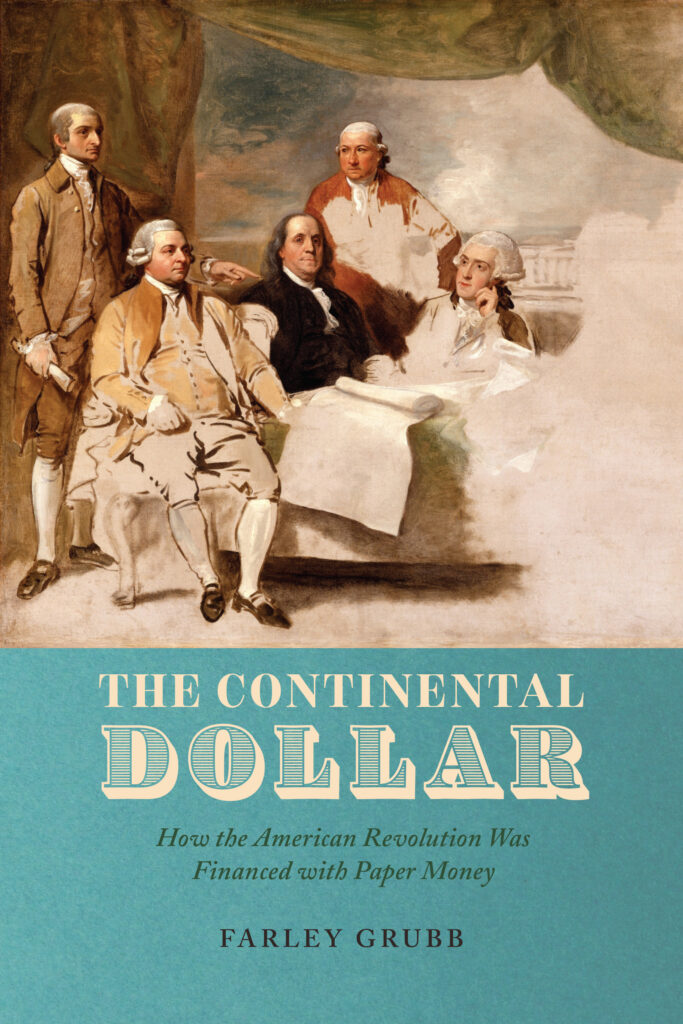 Dr. Grubb’s book we discuss in this interview
About This Post’s Featured Image
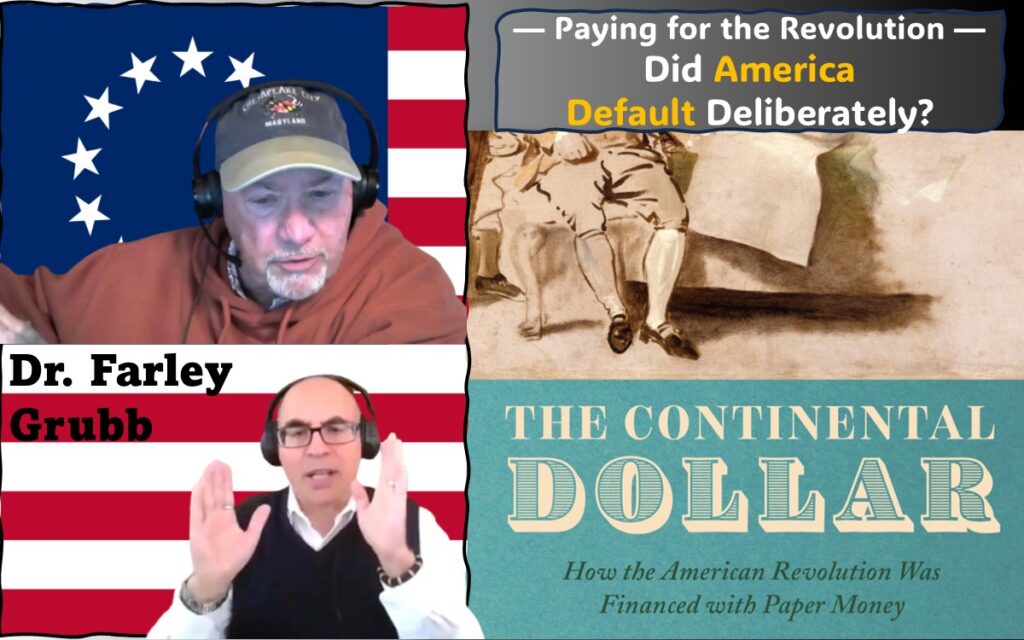
Image of Adel Aali (program host) and his guest, Dr. Farley Grubb, superimposed on the Betsy Ross flag, along cropped cover image of The Continental Dollar: How the American Revolution was Financed with Paper Money.
Unless otherwise indicated, all images in AAR—including those in this post—are in the public domain.
AAR Essential Insights
Although the full video and transcript of my conversation with Dr. Grubb are included in this post, I’ve selected and summarized several insights that I found particularly revealing and worth emphasizing. These moments — some surprising, others that challenge familiar assumptions — help us see how the American Revolution was financed by the Continental Congress.
By the way, these insights are my own takes and interpretations from the interview. For Dr. Grubb’s perspective and exact framing, please watch the interview above and view the transcript below in the corresponding sections.
Colonial America Was Nearly Cashless
Here is the first surprise: colonial America had no incorporated banking system and no banknotes during most of the Revolution. Yet it was not financially primitive. Part of the explanation was political. Incorporating a bank required authority held by the British Crown, and that authority was not extended to the colonies. The first successful incorporated bank—the Bank of North America—did not arrive until 1782.
Gold and silver entered through trade with Spanish America, but much of it quickly passed through the colonies to England to purchase manufactured goods. So how did people conduct local trade? Through running tabs, book credit, promissory notes, bills of exchange, tobacco, cattle—whatever could eventually settle an obligation.
Nearly cashless, yes. But certainly not creditless.
Credit was the connective tissue of this economy. A tavernkeeper might carry a customer’s debt until the harvest; a written promise could then circulate to someone else. Value moved through promises and time rather than coins alone. The vulnerability was trust: Who stood behind the promise, and what happened if payment never arrived?
This is why this segment matters to our story about the Continental dollar. Congress did not introduce paper obligations into a society that understood money only as gold and silver. It scaled up a familiar credit practice—transforming local and colonial promises into a continental obligation capable of financing a war. Without banks. Without its own taxing power.
The fundamental question was not whether paper could function as medium of exchange. It was whether Congress and the states could make a future promise credible enough to carry value in the present.
Watch this segment in the video above (11:02)
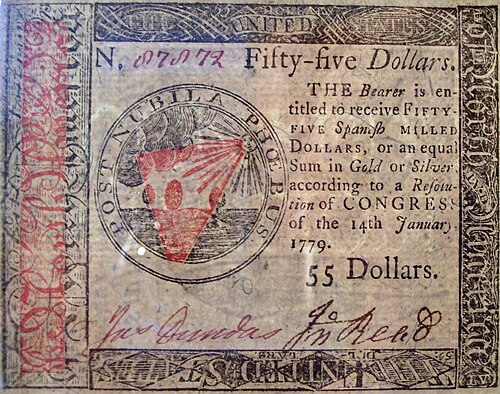 A fifty-five dollar Continental issued in 1779.
By Beyond My Ken, provided under CC BY-SA 3.0 license.
In this interview, Dr. Grubb details “the bizarre part of the story” of financing the American Revolution:
“The Continental dollar has the most bizarre spacing that I have ever seen in any money anywhere in time.”
Watch this segment at 38:25
Were Continental Dollars Designed to Be Hard to Spend?
A one-dollar Continental note could cover a soldier’s lodging and food for an entire week. And that was generally the smallest denomination Congress issued. The main sequence ran from one through eight dollars, then jumped to twenty and thirty. In an economy where ordinary purchases required far less, these were not convenient denominations.
Imagine trying to buy a drink with a note worth a week of subsistence from a tavernkeeper who had neither an obligation nor a practical means to make change.
So why create paper meant to circulate in denominations that made circulation difficult?
Dr. Grubb offers a careful interpretation: Congress expected much of the initial issue to pay soldiers and may have assumed that soldiers would hold it as a wartime bond until its future redemption. Congress could meet a soldier’s monthly payroll with only a few notes. Administrative convenience for the issuer. Illiquidity for the recipient.
For me, this turns a technical question about denominations into a question about who financed the Revolution. Congress was an extralegal association with no bank, no independent revenue stream, and no taxing power. It could raise an army and print bills, but the future taxes required to redeem those bills had to come from the states. In effect, soldiers supplied their labor in the present and were asked to wait for much of its economic value until after the war.
Before 1777, Continental dollars were not legal tender, so a merchant could simply refuse them. Once the states made them legal tender, acceptance improved—but the practical problem remained. Large notes still required change in state currency or book credit.
The Continental dollar was therefore more than depreciating paper. It could also be a cumbersome promise placed in the hands of people with immediate needs. The Revolution’s financial ingenuity reduced Congress’s immediate cash problem by transferring the waiting—and the risk—to its soldiers.
Watch this segment in the video above (26:27)
Time—Not Inflation—Drove the Continental Dollar’s Value Down
Benjamin Franklin understood the structural problem before its consequences fully emerged. For a bill of credit to circulate at face value, its holder had to receive annual interest as compensation for waiting. In January 1776, a congressional committee that included Benjamin Franklin recommended paying that interest. Congress rejected the proposal.
The reason was painfully practical. Congress had no taxing power, and colonial commerce was being throttled by the British blockade. It could promise future redemption, but it could not generate the revenue needed to pay annual interest. The Continental dollar therefore became a zero-coupon bond.
That decision changes the meaning of its declining value. As Congress issued additional notes, it had to push their redemption farther into the future to keep the required state taxes within credible limits. Every postponement reduced the notes’ present value—even if the promise of eventual payment at face value remained intact.
Quantity mattered as well, but not through the familiar story of reckless printing and conventional inflation. More notes meant more future taxes. More future taxes required a longer redemption schedule. And a longer wait produced a steeper discount.
What stands out to me is how easily a fixed salary can conceal declining compensation. Dr. Grubb calculates that an American private’s initial pay in Continental dollars approximately matched a British private’s pay in gold and silver when measured in present-value terms. But American soldiers’ nominal salaries remained unchanged as the present value of their paper pay continued to fall.
So, while the salary looked the same, its immediate economic value did not.
The uncertainty became even greater after Congress combined the emissions into one redemption window extending from 1779 to 1797—without establishing which dollars would be redeemed in which year. A promise to pay face value someday is not equivalent to a promise to pay on a known date.
This is why describing the entire episode as inflation obscures its most important distributional consequence. Congress transferred the costs of waiting and uncertainty onto the people it paid. A voluntary investor can price that risk or refuse it. Soldiers could not.
Watch this segment in the video above (51:31)
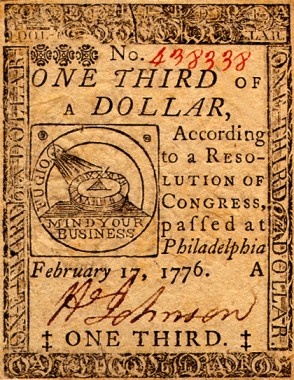 Continental One Third Dollar Note (obverse)
Britain’s Finances—Not Battles Alone—Helped Decide the War
By 1779 and 1780, the Continental Congress was reaching the limit of a financial system that had once been rational. Congress could issue additional bills, but every new emission pushed credible taxation—and therefore redemption—farther into the future. That reduced the present value of each new Continental dollar. The system produced diminishing purchasing power precisely when the war demanded more food, clothing, gunpowder, and military pay.
This is where European intervention takes on a different meaning. We usually picture French troops, the French fleet, and the victory at Yorktown. But France also brought gold and silver into an American economy whose wartime paper could no longer command enough resources. French troops were paid in specie, and direct financial assistance supplied hard money at a critical point in the war.
European assistance was no longer merely helpful. It was becoming essential to sustaining the American war effort.
Meanwhile, the entry of Spain and the Dutch Republic forced Britain to fight a much wider war while it was still carrying debt from the Seven Years’ War. Britain was no longer calculating the cost of suppressing an American rebellion alone. It was confronting another global conflict against major European rivals.
For me, this changes the financial map of the Revolution. European involvement worked in two directions at once: it supplied resources that the Americans could no longer generate adequately through Continental currency, while increasing Britain’s military commitments and financial burdens elsewhere.
Dr. Grubb’s point is direct: Britain could likely have outlasted the Americans financially if the struggle had remained primarily between Britain and its former colonies. What changed the equation was a convergence of pressures. European money helped sustain the American war effort. European belligerents raised the cost of continuing the war for Britain. Yorktown then made that increasingly unfavorable calculation impossible to ignore.
The Revolution was not won solely by defeating British armies. It was also won by changing which side could afford to continue fighting.
Watch this segment in the video above (01:21:18)
America Built Its Credit by Defaulting
Continue watching at 1:16:18 in the video above
Who Benefited from the Continental Dollar Myth?
The familiar history of the Continental dollar does more than explain a failed currency. It assigns monetary authority. Legislatures print recklessly and drive the economy “off a cliff.” Banks impose discipline. Alexander Hamilton rescues the financial system.
Once that becomes the accepted origin story, the Continental dollar’s collapse appears to prove that legislatures should never be trusted with monetary power.
Yet this interview draws an important distinction between the practical advantages of banknotes and the moral story later attached to them. Banknotes were redeemable on demand and therefore circulated close to face value. Bills of credit that paid no interest and promised redemption at a future date circulated below face value. For ordinary transactions, banknotes were simply easier to price and use. Dr. Grubb argues that they probably would have displaced bills of credit through market competition anyway.
But banking itself was new and not necessarily reassuring to an 18th-century observer. Banks issued more notes than the gold and silver held in their vaults. Fractional-reserve banking might sound perfectly familiar today, but at the time it was an unfamiliar and difficult system to assess.
This is the distinction I find most revealing: one financial instrument can be more convenient without its competitor being reckless, worthless, or evil. The practical superiority of banknotes as a medium of exchange does not prove that the Continental dollar was fiat money, that its early decline resulted from conventional inflation, or that legislatures were incapable of issuing credible bills of credit.
According to Dr. Grubb, banking interests also had an immediate reason to oppose public paper: they did not want to compete with bills issued by state governments or Congress. Calling those bills “mischievous” did political work. It frightened people without explaining the financial mechanism.
The institution that prevailed in the marketplace also gained the power to define what came before it. Banking became progress; the Continental dollar became folly; and Alexander Hamilton became the indispensable rescuer. That is how an institutional victory can harden into historical myth.
Watch this segment in the video above (01:28:58)
The Interview (S1E33): Adel Aali and Farley Grubb
In our conversation, Dr. Grubb addresses key questions and reveals untold stories about the Continental Dollar and American Revolution. The detailed outline and full transcript below supplement the video above.
Podcast
Watch the full interview on this page with the outline and transcript below, or take the conversation with you on the go through our Spotify podcast.

Outline
Use the in-depth outline below, with its key moments and turning points, to follow the discussion and navigate the interview.\
Click for Timestamped Outline
- Selected Highlights (00:00:00)
- Guest Introduction (00:02:26)
- Rewriting the Continental Dollar Story (00:03:44)
- The Familiar Inflation Story (00:04:06)
- Time Value and Fiscal Credibility (00:05:13)
- Money Without Banks (00:06:25)
- Fiat Money and the Tax Anchor (00:06:41)
- Book Credit and a Nearly Cashless Economy (00:11:02)
- From Colonial Bills to Bond Currency (00:17:46)
- Spanish Dollars and Colonial Paper Money (00:18:00)
- Future Taxes and the Savings-Bond Model (00:19:57) – Key Moment (00:26:10)
- Creating Continental Money Without Taxing Power (00:26:49)
- Massachusetts Proposes a Currency Union (00:28:34)
- Secret Instructions for Continental Money (00:29:37) – Turning Point (00:30:42)
- Strange Denominations and Forced Holding (00:35:10)
- Bizarre Denominations and Oversized Notes (00:35:16)
- Soldiers, Fixed Salaries, and Legal-Tender Laws (00:39:04) – Turning Point (00:41:17)
- Rational Design Under Fiscal Constraint (00:45:29)
- Secret Deliberations and Richard Smith’s Diary (00:45:55)
- Redemption Windows and Benjamin Franklin’s Interest Proposal (00:47:37)
- Why the Continental Dollar Lost Value (00:54:17)
- Time Discounting, Not Conventional Inflation (00:54:25)
- Fixed Soldier Pay and Mounting Losses (00:56:19) – Key Moment (00:57:52)
- State Redemption and Federal Default (01:01:52)
- Thomas Jefferson’s Proposal to James Madison (01:02:21)
- The Funding Act’s 100-to-1 Conversion (01:05:34) – Turning Point (01:07:22)
- How Default Helped Build American Credit (01:10:56)
- Land, Debt Erasure, and Constitutional Limits (01:13:36) – Key Moment (01:16:18)
- European Aid and British Financial Exhaustion (01:23:57)
- Who Created the Continental Dollar Myth? (01:28:58)
- Alexander Hamilton and Banking Interests (01:29:24)
- Researching Money and Constitutional Power (01:35:16)
- Just One Point (01:44:36)
- Clever War Finance Under Severe Constraints (01:44:54)
- Bond Currency, Not Modern Fiat Money (01:45:47)
Transcript
Note: This transcript was generated automatically and may contain minor errors. It is provided for reference and accessibility only.
Click to View Transcript
Adel:
Dr. Grubb, it’s a pleasure to have you in our program special series Thank you for taking the time for this conversation with me about the American revolution so going back to my school and college years and even my own sort of layperson study of the American revolution I think similar to most Americans. This is what I think of when I think of the continental dollar the continental congress Issued printed bunch of paper money Fiat money and we’ll get to that in a second what that what that means and it flooded the market And as a result, we had inflation and the value of the continental dollar Plummeted hence the often repeated term not worth a continental so As an initial matter is this story correct
Dr. Grubb
Correct Only one aspect is correct.
Adel:
Uh-huh.
Dr. Grubb
They printed a lot of this stuff and its value declined Okay Why it declines a whole different story than what you’ve taught And I see and and and is it that Do you upend this story?
Adel:
In your book, which is titled the continental dollar how the American revolution was financed with paper money Do you do you sort of this is a big revelation for us Americans
Dr. Grubb
um part of its technical financial it’s trying to get people to think in terms of the value of time That has to be incorporated in the story and the value of fiscal credibility the ability to pay Um a level of taxes that that is possible Those two things have been left out of the story that we’re told
Adel:
And that value of time is that different than inflation? Yes Ah, there you go.
Dr. Grubb
That is different not inflation, okay, so it’s Basically, it’s saying the value of something is plummeting Why is it because of an excess amount? Or is it because The value isn’t lost it’s just that you don’t get that value until some distant time in the future And as you push that time farther into the future the current value gets lower okay, and it’s That’s the core question the value of something i.e. the currency Of the 13 colonies is plummeting and we’re going to get to the why now.
Adel:
Yeah, so Before we we get deeper though, dr. Grubb, let’s clear some sort of Background understandings and and also perhaps get some terms. I use the term fiat money What does that even mean?
Dr. Grubb
Um, if you go back to the 17th 18th century, no one knew what that you know, there was no fiat money That’s a modern some modern concept. Okay, you know, um, basically Today if you take a dollar bill and you walk into the federal reserve and say give me what this is worth And they’ll give you another dollar bill That’s that’s what fiat money basically is the value of this dollar bill is whatever It commands in the marketplace today So they won’t the fed reserve won’t give you a dollar’s worth of Gold or any other real assets. They won’t give you a chair.
They won’t give you a bicycle They won’t give you anything real.
Adel:
They’ll give you another dollar bill and has America’s currency our country’s currency essentially been uh been Fiat money since the 70s.
Dr. Grubb
Is that the case since the since basically we went off the gold standard Where technically you were supposed to be able to cash in a dollar bill and get? The equivalent in a real good in this case gold Once we went off the gold standard. Yes, it’s it’s been fiat The question is always with fiat money.
What gives it value if you can’t get something Real for it and by redeeming it and typically there people say well We’ve made it a legal tender. So we’re Means you can pay your debts in it But I think what also anchors it is the government will always accept These dollar bills to pay your taxes I see now there’s no explicit Linkage between the amount of dollar bills and the amount of taxes and that again. What is what makes it fiat?
If you go back historically to what we’re going to talk about in terms of the continental dollar colonial paper money When they issued this money They put explicit taxes in place That matched up with that money and that linkage And that linkage or what some people call an anchor is what made it not You know more of a bond Than fiat money.
Adel:
Okay. There’s a lot of terms and concepts here that we need to Get into value of the fiat money Redeeming it which is a big deal whether or not it’s legal tender and whether or not it’s pegged in any way to paying your taxes A couple more questions before we dig deeper. Dr. Grubb. I think you answered this question. You said fiat money is a modern You know concoction that in the 17th and 18th century it didn’t really exist So which goes to this question in the 18th century when just before the American revolution and during it No states in the world The Habsburgs the Russians the Chinese whoever had fiat money, correct?
Dr. Grubb
What what they relied on was mostly some kind of specie gold and silver gold silver coins gold silver bullion When you start getting into the world where you can print paper and have paper contracts That you know are basically a contract to deliver or pay gold and silver you know Again, that’s not fiat. It’s it’s a it’s a debt obligation So they have debt obligations in paper, but they’re connected to gold and silver whether in the private sector like a bill of exchange where I say Um, i’m going to give you this piece of paper It’s a bill of exchange and you can cash it in for gold and silver Uh in six months in London If you get it there or something like that
Adel:
I see I see and that and credit plays a part in that and we’ll get to that in a second, but essentially uh instead of you walking around with two thousand dollars Bars of gold and two thousand dollars a lot of heavy heavy you would have a contract essentially that would yeah that would serve the same so okay, so There are there must be institutions To facilitate all of this which begs the following question in America in the 13 colonies We have a banking system
Dr. Grubb
We don’t have a banking system Exactly why we don’t it’s a little unclear Some of it has to do with the fact that in order to have a bank.
Usually you need um like a corporation You need to pool a lot of resources behind it so most banks Uh have to be incorporated now the British king Had the power of incorporation and he wasn’t going to extend that to the colonies so You know basically to form a bank in the colonies You’d have to go to the parliament and the king and say allow us to have a corporation And that wasn’t happening Now when the revolution happens and we get rid of the king we can do what we want exactly but we The first incorporated bank and it gets incorporated at the state level Uh that’s successful is the bank of north America in 1782 Right towards the end of the revolution now banks are like what you looked at before in terms of We’re going to take in gold and silver and put it in the vault and we’re going to issue Contracts based bank notes or a contract That are a claim to that gold and silver in our vault And so i’m going to walk around with bank notes rather than all this heavy gold and silver and use that um We don’t have bank notes in the colonies. We don’t have bank notes during the revolution.
We don’t have banks until even at the Constitutional convention there’s only three incorporated banks in the United States at that point and that’s so that’s something new That’s something new and that’s why hamilton’s first bank of the United States is such a big deal because it And that’s a whole different podcast.
Adel:
Yeah So if we don’t have banks and you know, this this credit system that you go there’s a contract you go to an institution A bank and essentially say look give me Species give me something for this note How what was the currency of these colonies did they barter like how did this work, okay
Dr. Grubb
Basically, they’re exporting goods In exchange for gold and silver mostly to Spanish America So they’re getting gold and silver coins, but then they’re exporting gold and silver coins to england to buy english goods There’s a lot of what we call pass through so Pass-through we import a lot of gold and silver for exports and then we export a lot of gold and silver for imports How much of that gold and silver lingers in the economy in order to trade locally with it’s a little bit of a debate From what i’ve seen and other scholars seen not that much. It’s very quick pass-through And there’s always complaints that as soon as we import gold and silver we export it to buy english goods It’s the international currency International currency now, um, is that?
Adel:
Is that gold and silver you mentioned Spanish? Are those British pounds or Spanish dollars like Carlos Carlos dollars?
Dr. Grubb
I think they were called we’re bringing in Spanish and Portuguese gold and silver coins Stuff gets rated in pounds sterling but silver is silver And they have lots of equivalents, you know, and they they publish tables. What’s the equivalent silver of this to that? And so they can easily convert um Spanish silver into pound sterling silver and so on or a you know a silver shilling For english currency, but the point being is if you think about it We got to buy imports because we don’t produce a lot of things.
Adel:
We want like yeah We don’t have a we don’t and we don’t have like a there’s tea, but we don’t have a manufacturing base either Yeah.
Dr. Grubb
Yeah.
Adel:
Okay.
Dr. Grubb
So so we’re gonna we want to export all our gold and silver to get these good imports How do we trade locally? Should we use up our gold and silver to trade locally to go to the tavern and get a flagon of? ale No, let’s find some other way so that we can use our gold and silver to buy these valuable imported goods And the other way they find is largely a mixture of book credit.
So i’ll go to the tavern and you’ll keep a running tab You know for my for my flagons of ale and then at some point i’ll come in and say okay I gotta pay off on this um, you know, I I got some cattle you want some sides of beef. Okay, we’ll clear the decks that way Uh, that’s just like barter It is part of book credit is a kind of barter with a time dimension embedded into it um and You also get You know private promissory notes and bills of exchange So I might go to the tavern keeper and i’ll say why I don’t have anything but i’ll write you a promissory note that you can that i’ll promise to pay in in a year when my harvest is in when I sell my tobacco and I’ll have something and you might be able to trade that promissory note to someone else as a tavern keeper So that might circulate but the problem is private promissory notes and private bills of exchange have a limited Exchange medium of exchange ability because you don’t know who’s going to default on them.
Exactly and Bills of exchange were constantly protested. Oh I show up and you’re supposed to pay this off and no one’s there to pay it off yeah, so so you got book credit, but there’s a constant effort to try to get people to You know pay off on these things.
Adel:
Um Dr. Grubb i’m about to make a statement and I hope I don’t mean it categorically but this almost sounds like a cashless Economy, I don’t mean entirely cashless.
Dr. Grubb
Oh Yeah, it it very much. So it’s it’s it’s kind of like you’d go. There’s this storekeeper in towns in Maryland and he’s basically Taking goods from Philadelphia selling them to local tobacco farmers taking in tobacco from them In exchange and shipping it up to Philadelphia to send out but you could see him in his account book saying Please you’ve you borrow from me equipment and food and stuff like that You know, please for a minute, you know, give me your your tobacco at some rate to pay this off or really give me anything
Adel:
you know
Dr. Grubb
So in some sense, it’s it’s a it’s a credit economy without direct cash in that sense um, the direct cash was gold and silver coins and those were You could find them. They were just infrequent and hard to come by
Adel:
Okay Let’s get into it then Where do the continental dollars come from and embedded in that question are they called dollars from the beginning
Dr. Grubb
yes, because they’re going to use Spanish silver dollars as their anchor for future payoff And Spanish silver dollars were the most frequent Silver coins in colonial America and that’s because they came in because we traded we had a trade surplus with The Spanish colonies and they so we shipped we basically shipped them foodstuffs and barrel staves and things like this and they shipped us gold and silver coins to Mostly silver coins silver dollars to pay that off.
Adel:
Okay.
Dr. Grubb
Um, so that was the most common coinage in colonial America, so it became the basis For uh the continental dollar the um, where did the continental dollar come from? Okay Every colony and now state in the 13 colonies Issued their own paper money. It was usually priced in their Pound sterling but not sterling it was so you had Massachusetts pounds Pennsylvania pounds Maryland pounds Virginia pounds all with a slightly different rating to pound sterling today you start this Let’s say after the Declaration of Independence or is no this goes back.
This goes back to 1690 And every colony started doing this the last colonies did this, uh, Georgia and Virginia did this Uh in 1755 during the French and indian war It was usually a wartime expedient the provincial governments the colonial governments Like had very limited budgets And they were expected to contribute resources to fighting wars against Native Americans and against the French How you know, how do they do this?
They they have very very low taxing power And so they do this by saying we got to borrow money. How do you borrow money? You move taxes through time So you say we don’t have enough tax revenue to raise today to field Troops and to pay for gunpowder But we’ll issue a bill of credit a credit against us the legislature um, and we’ll use that to buy to pay troops and buy gunpowder Now this bill of credit Is is a credit against us that you can redeem at some future date that we put in law Uh, my favorite is colonial new jersey, which I looked at Look at the seven years war from 1755 To 1764 colonial new jersey has to pay pay for their own troops and their own gunpowder They issue a lot of these bills of credit And they explicitly in law say, okay this bill you can use to pay your taxes In these future years and some of this went on, you know, the future redemption Went like 20 years into the future almost 30 years into the future Um, and basically they said we’re going to put taxes in place today In the future that you can use this money to pay those taxes And then the other thing they do and this is something also done with the continental dollar So people knew exactly how this worked unlike today They said okay in the future when these taxes come due If you have these pieces of paper these new jersey pounds you can show up and pay your taxes in them at face value But suppose you don’t have these new jersey pieces of paper and you still owe taxes You got to be legally allowed to pay in some other way What other way is that? Well, we’re going to fix that other way to be an amount of gold and silver or pound sterling That’s the anchor So you show up and you say I can either pay in these pieces of paper or I can pay the face value in gold and silver coins And then the question is well Suppose I have more pieces of paper than I owe in taxes But then I paid my taxes and now I got these pieces of paper Well, you can go to the treasury then and the other people who paid their taxes in gold and silver You can collect that for these pieces of paper
Adel:
Oh that almost well that doesn’t sound like fiat that sounds like it’s anchored to something
Dr. Grubb
Yes, that is a that is the value anchor and it’s also a way of saying when it comes time to redeem this stuff you know the distribution of paper Obligations is not equal to the distribution of tax obligations. So we have to Rebalance this somehow and the anchor then that that rebalances this is that equivalent to gold and silver at the point of redemption And the continental dollar is designed exactly the same way as these colonial paper money Um I need to write this so I can follow uh exactly what you’re saying Equivalent to specie at the time of redemption.
Adel:
This is an important point. But before we even parse this out more I want you to draw an analogy for us modern Americans who are Who are familiar with treasuries? So you go I mean People usually institutions buy 20 30 40 year Bonds, we usually buy bills or notes that are shorter term, right?
But just let’s say I’m an institution and I buy a 20-year bond.
Dr. Grubb
I can yeah, I can actually make this a lot easier for the listener Most of us at least our age know what um a u.s. Savings bond is. Yeah.
Adel:
Yeah.
Dr. Grubb
Yeah So grandma gave you a u.s. Savings bond. It said a hundred dollars on it. I had a rich grandma And you’re thinking as a little kid you’re thinking.
Oh, this is great. I got a hundred dollars but if you go and try to cash it in you don’t get a hundred dollars you get like $55 You only get the hundred dollars if you hold on to it For 20 years and when it matures The cash-in value of a savings bond is not its face value It’s it’s a value time discounted back From what that future redemption date is most of us as kids realize that when we got a savings bond from mom or grandma, you know, we Wasn’t worth its value we had to we had to hold it for 20 years or we had to take a lesser That’s exactly what a continental dollar is It’s like a u.s. Savings bond. The only difference is a u.s. Savings bond. You can’t Trade it’s it’s not currency.
You’re not allowed to do that Uh, it’s not a what we’d call a bearer bond. It’s a it’s a you know dedicated your name is on it put it that way Where a continental dollar is a bearer bond whoever has it Can redeem it So yeah, the the savings the savings bond is very much like the continental dollar Uh where treasuries today when you buy a treasury today And it has a maturity date say 30 years in the future. It’s also paying yearly interest Yeah And so the value of the treasury as long as that interest rate is approximately the market market interest rate What the value of that treasury bond is going to hold constant at its face value?
Over time because the interest you earn each year makes up for the time Postponement to maturity.
Adel:
Yeah, and then if should you want to sell that treasury? Depending on where the interest rate is it may be higher than its principal amount or maybe lower and that also applies to you know All sorts of local debts that you may buy from municipalities and stuff so um this I don’t want to jump The gun here, but suddenly this doesn’t sound like fiat.
Dr. Grubb
I mean if you hold on to it Yeah, it’s not it’s it’s it’s what I call it. It’s a bond currency because there is some anchor to real value That’s a legal obligation This complicates the story now.
Adel:
Uh, yeah Okay. Okay. Let’s do it this way.
Uh, dr. Grubb Why don’t you walk us through if you would please of sort of what what choices did continental congress have In in coming up with this because you were telling me this is what happened and it’s easy to sort of how do they get there? How do they get there?
Yeah, I mean there are all these choices to make. Yeah
Dr. Grubb
Okay, let’s let’s start Second continental congress gets together in early may 1775 Now that decision was made by the first continental congress at the end of 1774 first continental congress said Let’s write letters to the king uh Protesting what they’re doing in boston with the the closure of boston port Uh because of the boston tea party, you know This is this is a violation of the english constitution to punish everyone for the crimes of a few people So they they write this and then let’s also have a an import Boycott against British goods, which they’d done before During the townsend acts and other things as a way of trying to get parliament to back down on certain taxes But they said okay until you redress this problem Of of the the corrosive acts against boston. We’re gonna ban imports They agree to get together in may of 1775 to see Did parliament and the king respond to their letters? Are they going to respond to the import boycott?
They also are going to put an export boycott on for september 1775 an expected boycott so they get together in may to see what the what the government what the British government was doing now Events change dramatically before they meet they’re going to meet in early may 1775 the battles of lexicon and conquered had already happened in april 19th. Yeah, and The British had retreated to boston. They’re under siege by Massachusetts militia Militia from other colonies by their own volition are going to join this And the second continental congress is faced with what do we do about this?
And the second day they meet Massachusetts delegates show up and they say They show them we we’re issuing our own paper money. It’s a two-year interest-bearing bond to pay our militiamen you know and Colonies had done this while now states had done this, you know, that’s how they’d issued paper money to pay troops during Prior wars we’re going to issue this but Massachusetts asked the congress Help us Make this a currency throughout the rest of the colonies In other words get the other states or the other colonies to agree to accept our pieces of paper um now In essence, this is like a request to create a currency union All the other states had issued their own paper money or had during wars And it’s like can we kind of form a union of different currencies and we’ll each accept each other’s currency now With that request Secret letters are sent from the new york delegation To the to the from the new york, uh revolutionary assembly to the new york delegation in congress uh, this is in the uh, the Papers of governors governor morris who is a delegate from from new york um, and you got to read the 1832 biography by jared sparks to find this So so read the old biographies
Adel:
1830 biography, okay
Dr. Grubb
1832 biography Jared sparks anyway in there. He says look these letters were sent and they’re telling governor morris as a delegate from new york First of all, keep this secret.
Don’t tell anyone second Don’t let them obligate us to accept Massachusetts paper money Instead oh get Yes And their fear was that if we’re obligated to accept the paper money of other colonies or other states They’ll impose a cost on us that we don’t control instead Let’s get the the whole continental congress to agree to issue its own paper money and Get all the colonies together to agree To back it or redeem it in the future
Adel:
Okay, if I may stop you there one moment, please. Um You keep on using the word money, but we just said this is a bond currency.
Dr. Grubb
It’s a bond currency Yeah, it’s a I I use money loosely here. It’s just a medium of exchange. You can you can trade it.
Adel:
There’s no no I’m, i’m fine with you using that word, but is that what they used before is that did they call it money? Did they understand? They refer to it as paper money Hmm That’s a very common term, but they couldn’t take a bond currency And get the same value for it until it’s matured.
Dr. Grubb
Yeah.
Adel:
Okay.
Dr. Grubb
Well, they refer to it as bills of credit Okay in virginia, they actually refer to it as treasury notes But bills of credit is the most common term But then they they kind of equate that with quote paper money because that’s the only paper money they knew I see I see No, I mean, um, i’m i’m I wasn’t splitting hairs here because just you know Fast forwarding to the 20th century and 21st century.
Adel:
No one walks around with bills of credit to do things.
Dr. Grubb
I know it’s it’s That’s the that’s been the historical problem is yes When I first went into this I felt like we were taking modern monetary models and imposing them incorrectly on historical institutions Yeah, you know And and that was I think that was one of the problems in some of the traditional history I’m, i’m glad I asked that question.
Adel:
So I mean there’s a lot more to dig into there sort of what they were thinking um all so from what I understand so far is that con the continental congress Is going to Take up the mantle on this, right?
Dr. Grubb
Yeah They’re going to make themselves Basically the revolutionary government you have to understand the continental congress Is an extra legal? um Body With no institutional structure. It’s basically a voluntary association of colonies.
They have no power They have no power to enforce any edicts. They have no power to tax. They’re a voluntary association That works by consent they all have to get together and agree that this is what we’re going to do together we’re gonna we’re gonna We’re going to fight the revolution together And how could they issue paper money?
Adel:
They don’t have institutions. They don’t have resources on it’s not the federal government, right?
Dr. Grubb
you know what they basically what they do is they say we’re going to print this and And we’re going to form a continental army along with state militias together And pay that But who’s going to pay for this stuff individual states have to agree to Because they’re the only ones with taxing power. They have to agree that they’re going to tax in the future to pay this stuff off and that’s what the initial in uh, um June of 1775 when they devised this stuff they say, okay How is it going to be redeemed? Because it’s a bill of credit Individual states are going to have to put their taxes in place to redeem this stuff.
How do we do that?
Adel:
how it’s fair and when you say to You brought up the word tax. So which means that these Bills of credit are legal tender are meant to be legal tender.
Dr. Grubb
Uh, no, no So basically if you say i’m going to put a tax in place and you can pay it in this or that Uh, as long as I accept the bills of credit There’s no problem and bills of credit were not a legal tender in the colonies after britain banned them as legal tender in 1764 But they still worked because as long as the issuing government accepted them for taxes So as long as the state government says I will accept them for taxes they don’t have to be a legal tender Basically, they’ve agreed to do this.
Adel:
Yeah um What denominations are we talking about like?
Dr. Grubb
Um, this is probably the most bizarre part of the story that no one has ever looked at or noticed before that. I know When you look at You got two things when you when you create a new paper money, you got a lot of choices Yeah, one of the choices are What units do we create it in and the other choice is how big should these units be in terms of value? so value and spacing now The continental dollar has the most bizarre Spacing that I have ever seen in any money anywhere in time So so this is you know now now You know the the delegates to the continental congress these were all smart people Most of them had been involved in the paper money of their individual colonies or had lived under Their paper money regimes or the individual colonies.
They knew the denominational spacing of coinage So, you know, they they kind of knew a little bit of this and yet when they issued continental dollars the core Most of this stuff is in a sequence of a one dollar bill a two dollar bill a three dollar bill a four dollar bill A five dollar bill a six dollar bill a seven dollar bill and an eight dollar bill That’s a weird sequence Then there’s a twenty dollar bill and a thirty dollar bill There’s only one emission in which they have fractions of a dollar And that ends up being almost next to nothing in terms of total stuff issue so What’s one puzzle? That’s a really bizarre Sequence have a core sequence be one two, three, four, five, six, seven eight You know if you look at our current at our money today We have a penny a nickel a dime a quarter a 50 cent piece a one dollar bill a two dollar decimal system Yeah, so it tends to be You know, there tends to be a lot of weight put on uh, uh units divisible by five You know and units, you know, and then and then units divisible by two Um, but anyway, it’s not it’s not this tight sequence of numbers The other thing is and I think what’s leaked linked to this is the value size of continental dollars initially issued The smallest unit except for that one emission that has a few fractions of it all smallest unit is a one dollar bill And later on they even stopped issuing that now What’s the value of a one dollar one continental dollar I found one reference to a real value and that is One continental dollar would pay For lodging and feeding a soldier for an entire week waiting to go into the ranks So that’s a huge value So the smallest value of a continental dollar initially is a very large dollar very large value It’s like what today be like walking around with a fifty dollar bill in your pocket What can you buy with a fifty dollar bill if you can’t make change because there’s nothing small
Adel:
Yeah Well, it’s gonna be a week of lodging. It’s even way more than fifty dollars today.
Dr. Grubb
Oh, yeah, that’s humongous So so the question is why did why did they do this? You know because like I said, these are smart people. They’re all engaged All the all the money ish paper money issued by the colonies was in smaller value units so I think one of the things they’re thinking of is Okay, we hope Most of this money initially in the first couple years is going to be paid to soldiers and we fix their salary And we give them these large what’s the fewest number of bills we can use to pay these soldiers?
Well, if you’re going to look at you know, one month’s pay I could pay you in a two and a three dollar bill I’ll give you a two and a three dollar bill. That’s a month’s salary It’s kind of harder to spend not unless you make change in some other money. Yeah So the thinking is I I think the thinking is they never say this Because they think well soldiers are going to be forced to sit on this stuff and hold it till after the war So it really is a bond kind of thing We’re going to give you this stuff and you’re going to have to hold on to it until after the war to cash it in It really is a bond in that sense now um If you’re going to let me kind of finish this now if you if you do say well, i’m in desperate straits I got to use this stuff. It’s really a big unit. It’s really hard to spend I go to the tavern and I say, you know, I need I need some flagons of ale
Adel:
I’m
Dr. Grubb
You know, well, yeah Can you make change and you say well I can give you a change but it has to be in Pennsylvania pounds or book credit or something else in other words I think they think that the the local exchange economy is still going to be in state paper money Or or or book credit and only really big transactions will be in this continental dollar So I think that’s initially how they think they’re going to use these continental dollars
Adel:
so this is kind of um I’ve always walked away thinking of uh Members of the continental congress the second continental congress, um, Sort of elite of America. Most of them were quite wealthy.
There are exceptions. For example, sam adams was not a very wealthy man, but so when you when you were explaining this I was thinking maybe they were just too detached from everyday Into like, you know necessities exigencies of a soldier’s life that he Cannot wait two months to spend this money or two years. They need this to pay rent to send money back home I don’t know if that has anything to do Compassion doesn’t play a part here.
But this is really fascinating.
Dr. Grubb
You literally are incentivizing people not to cash in these bills of credit especially especially early on Congress doesn’t make the continental dollar a legal tender Exactly why I don’t know. I don’t think they thought they had the power to do that or Even if they thought they had the power they had to get the states to opt in It’s not until 1777 a couple years, you know until there’s 11 emissions and not until emission eight really That they turn to the states and they say please make the continental dollar a legal tender in your state So What that means is early on Someone could simply refuse you show up you show up, uh to the tavern and you say I I got this.
Uh, You know eight dollar continental dollar. I want to buy something and someone says I can’t I can’t take it. It’s too big and then I I don’t have to make change Because making change would be Pennsylvania pounds or some other money.
I don’t have to do that. It’s not a legal tenure I don’t have to take it go away go pound sand
Adel:
Wow
Dr. Grubb
But once they make it a legal tender you create a legal some kind of legal connection Between the continental dollar and then the local money Whether it’s Pennsylvania pounds or Virginia pounds or something like that And so you show up at the tavern and you say I got this continental dollar and it’s a legal tender You got to take it and the guy says well How do I make change with you know this big? Well, i’ll have to give you some Pennsylvania pounds or something else.
Adel:
Yeah um That is so darn complicated. Dr. Grubb and then so this happens in the in 1777 it becomes legal tender um After the eighth emission and emission is like issuance right issuance
Dr. Grubb
There were 11 emissions and they haven’t they run from 1775 The last one is in 1779 So we’re only talking about a four-year period and they got to load a lot of money into the economy doing that Now I think I kind of they never tell you why they do this. You got to kind of infer it They keep everything very secret And they they’re pledged to secrecy so we don’t get the debates from congress. We only get the resolutions now I think they turn to the states and ask them to make it a legal tender because by the time you get to 1777 Most of the continental dollars are being used not to pay for soldiers who have to take them.
That’s their pay rate But they’re being used by the quartermaster corps and the commissary department to buy supplies to buy You know gunpowder to buy food to buy, you know uniforms Now that’s in the marketplace And you walk in the marketplace and you say, you know, we want some cloth to make uniforms and they say You’re going to pay us in this we don’t have to take it Well, if the state makes the continental dollar a legal tender They’re forced to accept that pain.
So I I think I think it’s the fact that so much of the spending It’s it’s really the the quartermaster corps in the commissary department that breaks Breaks the congressional budget late in the war.
Adel:
They’re the big spenders and it’s for equipment It’s for equipment, you know and uh resources food clothing gunpowder for the military um before we go any further, I just want to confirm this with you kind of just Yeah, uh Were these were the Members of the continental congress which included very savvy financiers such as robert morris You know the financier of the revolution. He was called that Were they making rational choices? That they they they believed would have a chance of success or were they sort of?
I don’t want to be rude or anything, but sort of being clueless and crazy and they were just let’s try this let’s try that haphazard and then Which one is it?
Dr. Grubb
I I actually think this to start off with they made very rational choices that had some chance of success and I think it’s really the the outcome of long war and Some of the changes that happened After 1779 When they tried to salvage this thing that destroyed the continental dollar, but I think initially And again, the problem we have is we have the resolutions, but because they were sworn to secrecy You don’t know their deliberations except for Richard smith delegate from new jersey um who Kept a diary So he’s not he’s not violating his oath of secrecy But if you go through the 20 to the 24 volumes of the letters of the delegates of the continental congress Wow, they’re they’re really they’re like they’re like we we don’t tell anything about what we you know, our deliberations are they’re they’re very scrupulous or very careful about not revealing deliberations but a diary is different and The diary entries entrance of richard smith are recorded in in the letters of the continental congress richard smith Knew a lot about new jersey paper money. His brother samuel smith was the treasurer of new jersey Richard smith would return to new jersey Uh in march of 1776 to replace his brother when his brother died His name is on new jersey paper money.
He’s an endorser Wow, you know So he knew a lot. So so it made he kept in his diary He’s one of the only people we know who explained some of the deliberations one of the deliberations was We issued the first continental dollar in uh, um, uh, june 1775 3 million We quickly spend that it’s clear. It’s not going to be a one-off Event we got to issue more to keep the revolution going in november 1775.
They’re going to have a second emission another three million Now the question is how do we structure this? in the first emission We decided that states are going to repay this stuff Based on state population to be fair. That’s kind of a the best measure we have of state’s ability to pay taxes and We set a redemption date four to seven years in the future When we think the revolution will be over and commerce will generate the kind of revenue from selling exports to pay taxes During the war we’re not going to be able to pay much many taxes because commerce has stopped.
We can’t export goods That’s how we get money so So they do that in the first they get the second emission another three million dollars And the question is when is that going to be redeemed and richard smith in his diary says james dewane delegate from new york comes in and says We expect everything to be the same as the first emission. So states are going to have the same proportion Population taxes due and then he says and I propose that we pay it in the same Um four-year window from 1779 to 1783 pay the same stuff back as the first emission now the problem is That would double the taxes required in that redemption window And I I calculate For the first emission the amount of taxes is within what had been historically feasible before the revolution If you look at the level of taxes collected by individual colonies I kind of calculate what that was and take that as what people could could bear It’s historically feasible and acceptable tax level.
If you look at the tax level for the first continental dollar, it’s in that range And I think they chose a four-year redemption window with equal amounts in those four years to keep Yearly taxes to be within that in that range Otherwise a four-year window makes no sense. You’d like to have a one-year redemption rate point because that means everything Is redeemed at the same time, but if they did that taxes would be too high and people couldn’t pay them People can’t pay their taxes Redemption is unsure the value of your bonds disappear so Oh, so james dewane. So james dewane says with the second emission Let’s pay them all back in the same period as the first emission that would double the tax level and it looks like That wouldn’t be possible People knew you couldn’t pay your taxes.
Therefore This stuff might not have value now Richard smith says we debated this stuff. We debated it for three days and we decided no What we’re going to do is the first emission is going to be redeemed from 1779 to 1783 This new emission second emission will be will start right after that and we’ll be redeemed in a four-year window from 1784 to 1787 1788 In other words, we’re going to move there. We’re going to move the redemption window forward in time.
Oh, they’re not overlapping. So they’re not overlapping And that’s logical, right? Right and what what I argue is this is a sensible thing They’re saying we we’re going to side with fiscal credibility.
We got to keep the expected taxes to be within the credible range what is historically Acceptable and feasible for the public in order for them to have faith in this system Um, okay this this this all sounds good.
Adel:
Uh, you explained it to me. I’m a layperson. You are the scholar I get it.
So how does the continental?
Dr. Grubb
Dollar well Well, let’s just this add one more thing for me and this will help with the plummeting. Okay, so they form a committee To evaluate the first two of emissions and it comes up with a set of recommendations in january of 1776 Very famous committee benjamin franklin’s on it A few others and they come in and what they say their recommendation is let’s call in all the continental dollars The six million we’ve issued so far and let’s reissue them and even bigger denominations For as big as a one dollar continental dollar is they wanted to call it in and issue stuff and even bigger denominations So it’d be impossible to use really a bond stuff and they also recommend that we pay interest On this stuff between now and when they’re redeemed in the future Benjamin franklin if you go back and read his writings as far back as 1760s he realized that for a bill of credit To circulate at face value.
You had to pay yearly interest on it to make up for the waiting time To redemption if you paid interest on it kind of like a modern treasury bill, it should circulate at face value So he was recommending that we pay interest on this stuff so this stuff will circulate at face value They voted that down So richard smith in his diary says we we ably debated this stuff. I think he said we debated for four hours and Turned it down. We’re not going to issue it in bigger denominations is already pretty big And we’re not going to pay interest now why they don’t say but congress has no power to tax The state’s commerce is in shambles because of British blockade There’s no ability for them to pay yearly interest So they can’t pay interest and so this thing is what we call a zero coupon bond rather than an interest-bearing bond And a lot of bills of credit in the colonial period were zero coupon bonds If you go back long ways There are people who say why should we pay interest on these bills of credit that’s just taxing people more One group to pay another group interest. It’s kind of like today I hold treasury bonds and you pay taxes that pays me.
Adel:
Thank you very much You know, so they’re thinking why do that, you know, but there there is a huge difference in the hypothetical that you just posed that I choose to be involved with that you choose to purchase that in this case. These poor soldiers have no other choice They’re being told This is your pay
Dr. Grubb
So that what causes the value to decline at least precipitously down to 1779 Is time discount so you say we got to keep issuing more of this stuff And the expectation is as we issue more we’re going to move that redemption Window farther into the future and farther in the future So the time discount Is going to lower that value and that’s what’s basically it’s rational bond pricing and what I show is that is that uh, Rational bond pricing given the expectation of when this stuff is going to be redeemed in the future Is pricing it correctly pricing it at that lower value current present value? It’ll eventually be worth the face value way out in the future But we’re driving that value down And again, it comes back to that fiscal credibility issue Every time we issue more if taxes in the future are going to be credible we got to move those taxes forward in time And this is a much different story than flooding the market with money And there’s too much money not enough goods. Hence You know It’s not a quantity theory of money story now the quantity matters because as they issue more quantity The expectation is that the present value will decline because the because of greater time discount but the principle the point is is that If this stuff is really going to be redeemed as expected There’s no loss of principle.
The bond will still pay face value at some time in the future so it’s If you think of depreciation as a loss of principle There’s no depreciation before 1779 There’s a declining value and that’s because the present value is lower because the time discounting Is getting longer and longer Now you’re right that the poor soldiers get screwed in all this And that’s because now one of the things that’s puzzled me is Initially when they issue this stuff in The first emission comes almost at the same time that they they fix the salaries of soldiers Of privates of sergeants of corporals of generals.
They fix those salaries in june and august of 1775 Now what’s interesting and I calculate this if for a private they fix his salary to be identical to a British private’s salary In present value terms not in face value British soldiers paid in gold and silver American soldiers paid in paper money He’s paid more in face value paper money But because that’s not redeemed until in the future the present value is less than the face value But that present value turns out to be almost identical to the present value of a British soldier’s pay So in other words, it’s as though they figured out we’re going to pay you in a savings bond That that is not worth its face value, but we’re gonna we’re gonna raise your salary today So that it’s equal to what a British soldier gets, but they never change That pay rate So in other words as the war goes on from 1775 Into 1779 Then they never change the nominal pay rate for soldiers So soldiers keep getting paid in continental dollars that have a lower and lower present value And at some point you’re not going to fight for something whose present value is You know 10 of its face value And it’s not Not until they get really 1779 1780 that they realize we got to fix this We can’t recruit anyone and they promise that they’ll make up for this in the future They promise they’ll make up the deficiency in the in the lower present value of what’s being paid And
Adel:
They try to do that they try to do that. Um, okay, I get it how the present value begins to Diminish even plummet by 1779 but If they hold on to that bill of credit and When it’s due I think we picked on two different they fixed it There were two different phases that you shared with me 1779 to 83 then 84 to 88 So if they held on to that first phase till 83 that first emission or if they held on to that second emission to 88 The principal should not have depreciated, right?
Dr. Grubb
Right, right and there is a few commentaries from some of the congressmen those from Calculating funding where they actually try to price differently by the When these emissions will be due But one of the things that happens is in 1777 when the states make a continental dollar a legal tender When you make something illegal tender it becomes fungible across redemption windows Once you make it a legal tender It doesn’t you know, if you got taxes in place It doesn’t matter which continental dollar from which emission you use to pay those taxes because it’s a legal tender and they Formally congress formally does this with the last emission in 1779 They basically say all continental dollars are the same and there’s one big redemption window not individual windows for each emission And in 1779 they say okay, there’s one big redemption window it’s going to start in 1779 and it’s going to run to 1797 oh, wow, and what and what that means is is You got a continental dollar and suppose you expect them to really honor this stuff and you’re going to show up at the treasury in say uh 1780 and say okay, you’re supposed to start redeeming this stuff. Yeah, but everyone’s going to show up at the treasury all You know 200 million of this stuff And they’re like a run on the bank Yeah, they’re only obligated to redeem a small portion Of this stuff in that year because each year is supposed to be an equal portion They never establish any mechanism to determine which continental dollar gets redeemed In which year that’s a major problem
Adel:
Wow
Dr. Grubb
That’s a major problem and that makes the continental dollar a very difficult um Or cumber what I call a cumbersome medium of exchange You can calculate the expected value, but the realized value has a huge range around that depend, you know Maybe you are your buddy with a continental treasurer and you can get there first and you get your continental dollars redeemed early on That’s really valuable Someone else has to wait till 1797 You know, that’s less value
Adel:
um
Dr. Grubb
So that’s that’s a mechanical problem. They never At some point they never figure that out never figure out how to establish Exactly when which dollars get redeemed This is beyond the scope of um our conversation, but i’m just wondering and i’ll pose it would this not create an opportunity?
Adel:
Uh for rich people to see soldiers walking around with these bills of credit saying okay here i’ll give you x number of gold coins Give me this bill of credit. I can sit on this for 20 years I’m rich and then in 20 years i’ll go get it. So this poor soldier is getting I don’t know five dollars Five percent whatever five cents on a dollar so to speak To just have some money did that happen?
Dr. Grubb
Well, there’s there’s kind of two things going on one Once you get to 1780 congress asks the states to remove the legal tender Laws and the states do so the continental dollar is no longer a legal tender And then the states are supposed to redeem this stuff. Although it’s a little murky towards the end What because there’s several different resolutions and which one are we going to obey to redeem this stuff? But they know there’s going to be an accounting at some point later on after the revolution to Sort out funding across the states Um, it turns out that the states as a whole between 1780 and 1790 Redeemed about 60 percent of the continental dollars That were issued And they send them to the continental treasury to be burned and they’re given credit in the accounting process for having having done this Um now by removing the legal tender law Individual states can say okay It’s no longer a legal tender and who knows what congress is doing and this stuff the present value is close to You know five percent two percent who knows?
Um, so we’ll let you pay taxes in it, but not at face value We’ll take it, you know two cents on the dollar or whatever That’s that’s something that still Research still needs to be done. I don’t know how the states ended up getting This many continental dollars between 1780 and 1790 to pay back To the continental treasury, but they had they couldn’t have raised taxes That much to face value. Yeah, they had to take them at a discount So they turned to soldiers and they say you owe this big tax on your property And yeah, we’ll take some of those continental dollars you got but at a real discount And so states start sending them in and there’s a great quote from jefferson to madison saying You know, there’s going to be an accounting now if we could secretly buy up some continental dollars um We could probably be in a good position vis-a-vis other states if we could secretly do this and send them to the treasury, uh, And then when the accounting comes other states will have to pay Uh real money where we pay these phony continental dollars in oh, you know So he thinks he thinks other states are going to try to do this, you know. Yeah Um, so both delaware and rhode island completely pay off their quota of continental dollars Delaware is the first one to do this and in delaware state law. They said we’ve paid off our quota the treasury We’re not going to take any more continental dollars in state taxes from anyone So if you got continental dollars, you either got to go to the continental treasury or you got to go to some other state Who’s still taking continental?
So again, yeah soldiers are sitting around saying yeah, i’m not getting face value for this My state is willing to take them at some discount. I don’t know if it’s a fair discount or what? but they’re also speculators who are buying this stuff up because They expect there’s going to be an accounting of some type down the road and the funding act of 1790 after The constitutional convention congress adopts the constitutional the new constitution in 1789 1790 we get the funding act august 4th The funding act is the great usually they call it the Hamilton act or you know, whatever But it’s it’s really congress is passing this and that lists all the debts that congress owes And how they’re going to fund it now amongst all these debts They list the continental dollar as one of those debts. Now.
The other debts are interest-bearing debts uh loan office certificates foreign debts, but debts that that paid interest And then some state obligations now the continental dollar doesn’t pay interest. This is zero coupon bond Now they’re going to take all those debts. They’re going to put them into one They’re going to kind of reprocess them into one big debt that pays interest So if you think about it The continental dollar is a zero coupon bond non-interest-bearing bond that you’re going to now convert into an interest-bearing bond So the question is what’s the correct conversion rate to use to do that?
Now all the other debts are interest-bearing debts So you’re going to convert them into interest-bearing bonds at face value because they’re paying interest their values their face value So there’s no problem there But a zero coupon bond You can’t convert it at face value. You got to convert it at what you expect its current present value to be now Initially Hamilton says let’s convert it at at 40 to 1 so, you know 40 continental dollars gets you one species off and that’s kind of the rate that congress said back in the 17 80s for crediting state contributions um But congress changes that congress changes it in their legislation to be 100 to 1 100 continental dollars Gets you one specie dollar.
So you got to turn in 100 continental dollars and we’ll give you one specie dollar as a bond But even that won’t pay interest right away you Uh a third of that you got to wait till set to 1800 to get interest on So there is a default here Now the question is is that the correct conversion rate and I go back and I argue No, it’s not basically if you take the forecasts I create Of how this stuff should work based on those first couple of missions The continental dollars should be trading at about four to one or six to one. Oh, so that should have been Yes So that should have been the conversion rate.
We’ll give you Uh, it’ll take four continental dollars to get one specie dollar in the new bond package And that would have been the present value. I would have got you a no default uh change now Here’s back to your question the speculators at 100 to 1 There’s roughly 80 million continental dollars still outstanding Almost no one brings them in speculators buy them up and think Only 6 million out of the 80 million outstandings brought in to convert to these new bonds in the funding act So that leaves 74 million still out there And even even I think yeah the 18 28 congress when they investigated that came to the conclusion that there was still 17 Or sorry, 74 million continental dollars
Adel:
1828 congress.
Dr. Grubb
Yeah, they they investigated this again.
Adel:
Yeah.
Dr. Grubb
Yeah You know, wow, this is going on 32. Yeah. Yeah, they’re looking, you know, whatever happened They they concluded that 74 million continental dollars Were are unaccounted for never redeemed.
They’re they’re what you can buy on ebay now, I guess So anyway, so only 6 million are turned in now Why didn’t more people turn in? Well at 100 to 1 they’re close to useless. There’s almost no funding of them And I went through and I read letters written to the secretary of the treasury um, not just hamilton, but uh Wolcott and then gallatin people who become secretaries of the treasury after Hamilton up to 1797 They get these letters from people holding continental dollars probably speculators saying come on change the law pay off on this pay off on this And the secretary of the treasury point to the 1790 funding act as the last word That’s the last word and that funding act the redemption expires in 1797 after that nothing’s going to be given at all 1797 was also the the last redemption date in the 1779 resolution in congress So there had to be speculators who bought this stuff off who thought they could muscle somebody or muscle Into paying more than 100 to 1 I do a calculation at the end of the book saying was this default necessary and I basically argue If you look at what was paid They they could have they could have converted this at 4 to 1 or 6 to 1 You know at the present value and it wouldn’t have hurt the budget
Adel:
So why did they go all the way to 100 to 1?
Dr. Grubb
That’s a hard thing to explain I’d give an answer. I don’t know how good it is. One of the answers I give is uh Converting all this stuff into callable perpetuities a perpetuity is a bond that pays interest forever It never has a maturity it just pays yearly interest That was known.
That’s what the British did. That was the British consul. That’s how British funded a lot of this stuff They turned all this debt into callable perpetuities The government only had to pay yearly interest that inflated the debt to face value Or raise the debt to face so it could be traded in the marketplace at face value And that’s the smallest amount of government revenue each year that would be needed to satisfy Raising the debt to face value so you could trade in the marketplace and get face value for it um I calculate how much funding they have and It wouldn’t have it would have cost them maybe a quarter to half a year’s funding to to have Not defaulted on the continental dollar okay, so But the question then is that’s only one issue on credit worthiness The other issue is if you’re going to go out and borrow in the marketplace, especially from foreigners now In the 1790 funding act foreign debt is treated differently We’re going to we’re going to swap it at face value and we’re going to pay market interest starting right now So it trades at face value Where the other local debt they do some things with that Doesn’t quite raise it to face value.
They default a little bit on but foreign debt We’re always so they want to maintain a credit worthiness in foreign markets so they can borrow again well besides that Credit worthiness I think also depends on your net worth So just like you and I if we go and borrow people want to know what’s our assets? What’s our net worth? You know if we default Are there some assets that we have that we can sell?
So it’s kind of like a mortgage on a house, you know when I go borrow They want to make sure my house value is a lot more than my my mortgage debt. Yeah As opposed to the mortgage crisis when it wasn’t but anyway, um So I go through and I try to calculate what is the national government’s? asset position versus its debt position and this is a an article I published in the um American economic review short little piece some time back um Where I said, okay, and I I got another piece published in a founding choices book.
I said, okay The only asset the national government really has is land the treaty of paris Ceded all this land to the United States now most of it was claimed by individual states based on old colonial grants But they slowly ceded this western lands to the national government And so that’s the one asset so I go through and I try to calculate You know, what’s the value of this land asset? Because they could sell now they couldn’t sell it right away But it’s an ad it’s like you can’t sell your house right away But you have all these assets and in the funding act the 1790 funding act It actually says one of the clauses people don’t look at because because they’re so thrilled by Hamilton They don’t look at this clause and the clause says any any sale Of land has to be used to redeem principle of debt
Adel:
Any sale of land
Dr. Grubb
Say that has to be has to be used to pay off the principle of the federal debt And this this shows up first when they uh, they transfer some land to Pennsylvania the eerie triangle That payment actually goes to pay off some of the the 1790 national debt bonds Now they don’t sell enough land to do this. But when they get to I think it’s in the 1730s they finally Are dead free 18 30 1830s, so the government isn’t debt free Until you get to they actually pay off some of that and some of that comes from land sales and they actually debate In the 1830s, we now are selling land and we have to have to use it to pay the national debt How are we going to use this?
You know, there’s a debate over how to use that Andrew Jackson famously Which is zero debt and for a few months we were debt free Okay, so that is so I do that calculation and I say, okay It’s still a negative. The United States still has a negative net worth position And it’s going to have a negative net worth position up until 1800 Because it’s not going to get all this land assets right away In fact, the last transfer of land the biggest transfer is Georgia the southern lands that doesn’t come until was it? 1802 Anyway So I go through so their problem is they got to wipe some of the debts off the book Books, they need a positive net worth In order to have a good credit rating in foreign markets They got to have a positive net worth.
They got to get rid of some debt and if they default on the continental dollar That’s going to wipe off a lot of debt face value a lot of debt off the books And the minute you do that you go from a a negative 40 million net worth to a positive 40 million net worth
Adel:
Instantly
Dr. Grubb
So I go through so they have a great credit rating in Europe in in by the middle 1790 1774 1775 How do they get this incredible credit rating in Europe?
Well, they have a massive Positive net worth for one and all the Europeans know this in terms of land value but they also You I also try to explain well But if they have this reputation for defaulting on debt like the continental dollar, that’s how they got this massive net worth Isn’t that a danger? And I go through and I say yeah at the constitutional convention They don’t allow the national government to ever issue this kind of debt again So How do we get a positive net worth and a great credit rating? We get rid of this debt and we tie our hands constitutionally to say we can never issue this kind of debt again And they don’t they don’t explicitly say that but if you read through what they do to eliminate The power of congress to issue bills of credit like the continental dollar It is very strident and vehement.
It’s like, you know, we got to vote this clause out of the constitution And I argue that when you vote to remove that power from congress That’s an absolute removal. You can’t bring it back in.
Adel:
Is that right there in article one?
Dr. Grubb
It’s it’s it’s in article one but you see what you do is is you have to go to the Draft constitution from the committee of detail and you go to the last draft if you look at all the list of congressional powers One of those powers is congress has the power to emit bills of credit And at the very end of the constitution they debate that And everyone oh, this is mischievous. This is my favorite is is uh, George Reid from Delaware delegate from Delaware This is the mark of the beast from revelations We gotta vote it out and they vote to remove that power now if you vote to remove a power from the list of powers I would argue That trumps the implied power clause Yeah, you know it has to or else or else the logic makes no sense exactly and anyway, so They don’t they don’t if you read that debate, they don’t explain why it’s just evil. It’s just an evil thing to
Adel:
It’s in the book of revelations So, um, you know, you need a positive net worth then doesn’t this explain why congress wanted a hundred to one Ratio here because you just get rid of these so they create a positive net worth credit great credit rating Uh in Europe damn what the soldiers think here Yeah
Dr. Grubb
At 100 to 1 when they converted when they if they were to convert everything at 101 to uh interest-bearing bonds, it would have cost them next to nothing You know, and they still would have had a net positive network And then the fact that no one turned anything in
Adel:
Yeah When it expires, I think you said in 1797 Then that also just they’re scot-free.
They don’t have to worry about it.
Dr. Grubb
Oh, yeah You know, they just they they basically point back to the 1790 funding net and said that’s the last word end of the story What you have now is just is is souvenirs for to sell on eBay in the future I’m sure they thought of eBay back then let’s take a break here.
Adel:
Go ahead.
Dr. Grubb
Well, let me just say that There’s been a lot of debate about what happened to the continental dollar when it stopped circulating as a as a currency which it stopped doing in 1781 and Some of the old literature says oh it got it was just trash or you know They they they had funny games with it or things like this. I went through and tracked all this stuff and And one of the things I do in the book that I don’t think it’s been done is really track how much the states Removed from circulation and sent into the continental treasury and then tracked how much was left over from that That was then turned in And that’s a new part of the story that just doesn’t show up in the old literature at all Wow, wow.
Adel:
Um Let’s take it I don’t think people burned it as trash You don’t think I think yeah, I think they held on it hoping hoping hoping Yeah, I mean even because burning us trash what value would that have? For them, you know, um Let’s take a break here in the next segment. I’m going to ask.
Dr. Grubh about the big picture. We’ll be right back Dr. Grubh We did a great job. I mean you did a great job of detailing the history of the continental dollars uh, I think it makes sense to just recap some of its Salient features and the things it debunks for us um briefly at least um So let me return to the initial question that I asked Above that is this common telling?
Of the continental dollars correct or not? So we already know it’s not correct. Let’s just Touch on what is not correct about them that they were Money as we know Today they were not correct Correct.
Yeah, there were bills of credit. They were not just money That It was not their flooding that i’m sorry Sort of flooding the market that decreased Their value it had a lot to do with how much time Had to pass before they’re redeemed
Dr. Grubb
Correct and that was predicated on What would be a sensible tax level a feasible tax level And if you’re going to print a lot of this stuff more and more That feasible tax level if you keep that level That means you got a tax fare farther and farther into the future.
Adel:
Yeah
Dr. Grubb
Yeah, yeah, and so and so there is a connection between the amount that’s issued and the plummeting value It has to do with with with the limits of what the fiscal fiscally credible tax level would be
Adel:
But that’s different It makes that paper worthless in a different way That inflation and flooding the market with paper money that we’re familiar with for example, let’s say things that happen in Argentina or other countries where
Dr. Grubb
It’s a lower present value but If things work out correctly The principle what you’ll get at some future date will be that face value. That’s a very different story. Yeah Yeah, now the fact that that doesn’t happen is a whole nother story, but initially up to 1779 I think people acted as if that’s what they expected to happen I see Does your research Changed the way We should think about the American revolution In a couple different ways one.
I I think the initial founding fathers at the start of the second continental congress Were pretty sharp people dealing with very complex problems Wars are wars are won as much on finance as they are on military prowess you know and for them to kind of for an extra legal questionable legitimate Voluntary association to be able to finance a common military Effort against the British is really quite an outstanding thing And I think they were very clever at trying to put together A finance system where they didn’t have powers to tax and they didn’t have powers to coerce and um And understood how to move taxes through time And get the states to agree to do that. I’m in some ways.
They were very clever on how they could set this up Uh, so that’s that’s kind of one story. Yeah, they’re pretty bright people um I think the second story is Is what happens as we get towards the end of the revolution and I in the book I kind of kind of phrase this as You know 1779 1780. They’re between a rock and a hard place the problem They have they’re issuing continental dollars to pay troops supplies and things like that But in order to be fiscally credible in taxes, they got to redeem it farther and farther and farther in the future So the current purchasing power of a new continental dollar is getting less and less in other words They’re printing more of this stuff, but they can’t buy much in the marketplace because of time discount because the present value is very low they’re clearly Getting to the end of using this method.
So the question becomes in 1779 1780 How do we keep financing the revolution? either we do some crazy system or we confiscate goods or They’re really between a rock and a hard place and what I go through in the book is they do try to Figure out how to extract a few resources out of the continental dollar system In a way that’s just not fiscally credible and it fundamentally crashes the continental dollar system and ruins it and I think that puts a lot more emphasis on the resources brought in by European powers 1780 1781
Adel:
like Spain and France that
Dr. Grubb
Yeah, it’s yeah, it’s Partly and you know, some of the loans early on Are just minuscule they’re really doing nothing.
But if you get to 1780 1781 What you see is the French coming to America and they’re paying their troops in golden zone So there’s there’s more gold and silver coming into the states um in addition There is some direct Payments I know I forget what exactly when it was but I remember reading congress getting together and saying oh my god The French are going to send us some gold and silver How are we going to spend it and they’re debating how to spend this stuff? It’s like it’s like manor from Avon falling But I think there’s one more thing. So I mean really it puts a lot more emphasis on The help that comes from European powers at the end of the revolution both military, but also financially You know Robert Morris running the finance department from 1781 to 84 Despite his self-serving schemes.
They were they were some helpful I mean, you know, he’s going to line his pockets as well as help the revolution but I think there’s one more thing that that people don’t calculate and that is Not just the French coming in But then you get the Spanish and the Dutch and all of a sudden the British are at war With European, you know European powers again, not just the Americans now the last war the British fought against European powers the French the Dutch the Spanish was the uh, Seven years war the French and Indian And the British were still paying for that war They were still paying debt on that war.
And so all of a sudden they’re looking at their own finances saying, okay You know, we’re now in another war like like the seven years war and this is bigger and You know financially we’re going to have struggle with this And I think that put pressure on the British to say, okay, we got to offload this war you know, um So it wasn’t just I mean the military victory visit at Yorktown mattered the war goes on at sea for a couple years Negotiating the treaty of Paris But the agreement that the Americans wouldn’t sign on for peace until the French and the others did too I mean that was all important in there to get that to work So I I really think that pressure on the is on the British side financially Then because the British would have outlasted the Americans financially if it wasn’t for facing French Uh Spanish Dutch both financing and war.
Adel:
Yeah Class um, so how has this Incorrect version Of the continental dollar why it was issued what it was actually and why it crashed or plum like, you know plummeted in value Why has that incorrect? history story Endured for so long Economists love it.
Dr. Grubb
That’s why I’m a good Chicago economist, you know, Millie Freeman Robert Lucas. I’m a good quantity of theorist guy. It’s just And partly people love Hamilton.
I I don’t i’m not a Hamilton devotee But basically The story people want to tell is you can’t give Legislatures monetary power because they’re crazy people and they’ll run you off a cliff. How do we know look at the continental dollar? Give monetary power to like bankers or a federal reserve Or something like that and I kind of argue elsewhere that eventually I mean banking was new and people didn’t know how to understand fractional reserve banking Sounds a little bit like a Ponzi scheme if you just tell it to someone
Adel:
Yeah, you know
Dr. Grubb
That there’s all these bank notes, but there’s a lot more bank notes than there’s gold and silver in the vault How does that work?
Adel:
Yeah
Dr. Grubb
but You know banking was new and I would argue that given enough time bank notes would You know supplant bills of credit as the common medium of exchange in the economy That’s because bank notes trade always trade close to face value because of a redeemable on demand You know and James Madison explains this Adam Smith explains this something a paper currency That’s redeemable on demand circulates at its face value a paper currency That’s redeemable at some future date Without interest paid circulates below its face value So what’s what’s the better medium of exchange to use in the economy the one that circulates at face value? Because that’s easy to calculate and Benjamin Franklin was even good at this.
He at some point he said look If we don’t pay if we pay interest on a bill of credit, it’ll circulate at face value, but Calculating what that interest is and day-to-day Transactions is very cumbersome and difficult and the common people just can’t do that Yeah, so it just just doesn’t work. You need something that trades at face value at every every day in the year
Adel:
They should have created a currency at the get-go perhaps
Dr. Grubb
So so I really think the banking interests were like we don’t want to compete with state bills of credit We don’t want to compete with Congressional bills of credit eventually will out-compete them in the marketplace But in the meantime, this is a struggle and even bankers are kind of like well, you know If we got to take deposits of bills of credit from a state or national government, how do we price those versus gold and silver? You know They they just wanted to they wanted to tell a story that says all that stuff’s just evil It’s missed the the most common word they use Is bills of credit are mischievous Now That’s like saying something’s dubious You know, you’re involved in dubious pleasures.
Now. It doesn’t mean anything But it frightens people Mischievous is the same thing doesn’t mean anything but it frightens people.
Adel:
They never explain why Yeah Did you have you gotten pushback? About your book and your research by economists
Dr. Grubb
um
Adel:
by historians
Dr. Grubb
no I The few people i’ve gotten comments from are kind of like, you know I’ve presented this off and on at places both history and economic conferences for years before I wrote this book And I always got people coming and saying well, yeah, i’m convinced You know, um There are some hardcore finance people out there There there’s some people in the economic history profession who who are Hamilton acolytes who aren’t real happy With what I do because i’m not a Hamilton acolyte um Uh as far as that goes um I don’t think Hamilton saved the financial system In any in any way actually in the book I go through and show the funding act of 1790 It could have been done different with no default at all And I show what the default is not just on the continental dollar but default on some of the interest-bearing loans as well Um And I don’t think I think the first bank of the u.s was fundamentally unconstitutional And if you read through the constitutional convention the same thing they vote not to include the power of incorporation In the constitution for congress and they explicitly state that includes the power to incorporate a bank So wow so when you get to the the the The first bank of the u.s There’s no supreme court yet that makes judgments on this they turn to Washington as as president says well You got to decide whether to veto this or not whether it’s constitutional or not And I think Washington slept through most of the constitution, but he doesn’t talk at all at the cost.
Adel:
Yeah.
Dr. Grubb
Yeah um And Hamilton writes this long thing saying no one remembers anything and the point is the deliberations are supposed to be kept secret And madison and randolph said look we were there you should veto this We vote we didn’t vote for this, but but we can’t reveal the debates because they’re kept secret till we’re all dead And Washington sides with Hamilton doesn’t veto it um
Adel:
You’re talking about the first first first bank first
Dr. Grubb
But you know, I think at some point states have the power of incorporation. They’re going to charter state banks State bank notes come to dominate Come to dominate the the medium of exchange You know throughout the 19th century Um How did you How did this become the focus of your research? Okay I started out as a good Microeconomist a good Gary Becker student labor contracts.
I studied uh indentured immigration indentured servitude convict transportation um Apprenticeship all colonial period. I was fascinated with the 18th century colonial period. I think I think partly because in 1975 Stanley Kubrick Had a movie called Barry Lyndon Go watch it’s a William make pea snackery movie.
I was just fascinated with that century um, plus I do have a little bit of a talent for Disjoint disparate and small data sets You know, if you go to the 19th century you become wedded to the census And very large data sets. I tend to be very good with with small disparate merged together data sets So I was working on that and in the process of doing that I was Created a standalone class to teach colonial economic history so I could talk about myself You know to my students and indenture servitude and convict labor. That’s all You know and I wanted to have a little bit of a unit on money and macro because I knew the money being used Because I had all these contracts being priced was different than 19th and 20th century America And I wanted a little macroeconomics So I went and I found some articles published in the journal political economy in the journal of economic history in the 1980s Talking about some of these monetary experiments and I thought those were my students And as most of us who are academics and teachers know as we As we read something we think oh, this is really cool And then we teach it a few times we teach you a few more times and we say this is really bad You know, so so, you know familiarity breeds contempt and that happens in teaching as well And I get to the point.
Basically. I had a lot more questions things didn’t make sense to me And so I started looking deeper and deeper into it and then I have to have a call out to one of the first things I did was to try to Figure out how they use different currencies Kind of at the end of the revolution And I had these contracts and what? What currency were they pricing these contracts in Pennsylvania pounds state money, um different specie coins Dollars things like that trying to look at how they chose, you know how that changed over time And this was kind of at the period where they’re adopting the U.S. dollar as a kind of the unit of account um And it was the first time I taught at university Lumiere Leon do In the 1990s and the people invited me to come teach. We’re all excited by this little paper I wrote about currency choice because they were starting to look at the euro And leaving the frank and the Deutsch point and they wanted to know how did this currency union in the U.S. work You know, and when was it so I did a little more to kind of work on that um And then in the process It kind of it kind of went from there. I just I kept looking at this stuff And initially I tried to figure out. Okay. How did the period after the constitution work versus before the constitution?
How did this transition in the economy work? And finally at the end I realized the continental dollar when I partly it’s I’m as much a historian as I am an economist. Well, I’m an economist first get all this quantitative data.
I got all these models I’m doing all this pyrotechnic statistics But I want to go back and read the law and the instant look at the institutions I’m, also a Doug North student so institutions matter and Doug North was a great economist But my joke about Doug North is institutions institutions institutions and we all said well, so what? No, you got to go back and actually read the details about the institutional structure And so I I realized that that the structure of money matters the institutional structure the law structure And how it’s treated and so I started reading a lot of colonial laws On colonial paper and realized the continental dollar is structured the same as As these colonial bills of credit and the colonial bills of credit were not Unbacked paper money were not fiat money. They were bond money you know and so I spent a lot of time trying to go through and use data to Actually estimate how these things performed and once I did that then I felt like I could do it on the continental dollar um And in the process, I maybe it comes down to something like this, uh When I wrote a paper back in 2006 financial history review on The constitutional convention and how they ended up changing the monetary structure of the country Got rid of bills of credit at the state level You know article 1 section 10 states can’t issue bills of credit anymore and so on how they ended up doing that And what what were the debates?
I sat down and I read word for word all the works of the debates at the constitutional convention the famous Farrand volumes all four volumes When you do that You walk away with no heroes at all No heroes at all. No heroes. I’m, sorry.
None of the founding fathers are heroes Some of them worse than others, but you have no if it came down to it perhaps the one hero I’d have would be Uh George Mason Not for mason university or the economists who are George Mason But George Mason seemed to be pretty sensible and and some of it some of the debates and things but a lot of the founding fathers are like You know do what I want. I’m going to take my basketball and go home You know You know and and a lot of the debates over over monetary issues you get the banking the Pennsylvania delegation is the largest delegation They speak the most and they speak the most on monetary matters and they all have connections to the bank of north America Gouverneur Morris and James Walth Wilson are are officers of the bank of north America and they speak the most on monetary issues James Wilson is on the committee of details and he sneaks in Into the stuff they debated into the draft drafts of the constitution monetary clauses You know you read through this stuff and and you end up, you know even tongue-in-cheek Benjamin Franklin’s not he’s kind of a hero, but at one point he’s kind of you know as non-religious as Benjamin Franklin was he’s like Everyone get down on your knees. Let’s pray to god.
Let’s try to keep things together. It’s almost more humorous And it is yeah, so you read through some of these debates and it is hard You know the serious stuff But you wonder how they end ever ended up With the compromise that they ended up with it is truly I think a miracle at the end That the thing didn’t fall apart and there there are basically there are basically three in three issues that would have destroyed the constitutional convention one was The primary issue and that’s the division of power between states in congress I mean Congress is going to be given the power to tax so that the power division of power is paramount And the whole compromise of house of representatives and senate and what we have today was the compromise Between small states and large states. That was the first but the other two issues that would have ended the convention were slavery and how they treated slavery And paper money If you read that last last debate Governor Morris says right out you know um The money the monetary interest will oppose the plan of government if paper emissions be not prohibited He comes right out and says that The monetary is this will oppose this plan of government unless you ban paper money
Adel:
I didn’t mean paper money In all forms or he was talking about bills of credit the way because he says a responsible minister
Dr. Grubb
Can issue paper money? Well, who did he mean responsible? Who is that?
It can’t be a legislature I say he meant his Bank of north America.
Adel:
Yeah And it’s no coincidence that later Correct me if i’m wrong the first bank of the united states. Certainly the second bank of the United States are in Philadelphia Yeah, yeah.
Dr. Grubb
Yeah
Adel:
Yeah, yeah, and Philadelphia back then turns out to be a more powerful sort of finance center than
Dr. Grubb
Yeah, it was a finance center up in the what 1820s I really think new york explodes once the erie canal is open and all that commerce goes through goes to it And then it becomes a financial dominant
Adel:
if you wanted our audience to remember just one point about The continental currency and the American revolution after everything we’ve talked about for the last hour and a half What would that one point be?
Dr. Grubb
That initially, it was a very Clever way to try to finance the war given their constraints That congress was under And and the key there is to understand the constraints they were under and what they could do and couldn’t do um The destruction, I mean the next thing to come away with is The whole story and the destruction of the continental dollar that ended up leading us into a bank-based economy You know that’s largely been fabricated that’s a myth You know Yeah, now the bank-based economy would have dominated in the marketplace that was going to happen But The story that that’s a wonderful thing and this other thing was a mischievous evil thing That’s that’s a myth that was created
Adel:
what would one point be that The continental dollar was not money as we think of today and it was not fiat money as we think of today
Dr. Grubb
That would be another that would be another that would be another point it’s not fiat money You know, and the question is it so it’s a bond kind of thing So it’d be like saying well suppose the government said you could you could trade your savings bonds now
Adel:
And they were
Dr. Grubb
So it’d be like that.
Adel:
Yeah, dr. Grubb. Thank you so much for educating me and our audience about the American revolution And to our audience if you know of any history that could provide My perspective buy the book and he’s holding it up If you know of any history that could provide more perspective about the American revolution Please share it with us and tell us what’s your perspective?
Thank you so much.
Dr. Grubb
I should I should say The book you can buy the book for 65 bucks on amazon And it’s that lower price because I waived most of the royalties In order to keep the price low because I want people to buy the book Okay, so I don’t get I don’t get anything out of that other than just a lot of a lot of a lot of thrill Sounds good.
Adel:
Wonderful
About This Program
Analyzing American Revolution (AAR) is a special series podcast production of the History Behind News program. In this series, 33 professors (and counting) analyze the American Revolution from 33 different angles through in-depth interviews with host Adel Aali.
Meet Our Guest Scholars
A structured body of thought on the American Revolution—where leading scholars advancing distinct interpretations that give this program its depth.

Thematic Collection
Tap below for a closer look at the Revolutionary Era themes we examine—and to meet our guest scholars.

Library
- Interview Transcript Highlights
- Interview Image and Artist Highlights
- Quiz Answers and Backstories

Image Gallery
Explore the backstories and artist bios behind images of our Founding—before and after the American Revolution. These visuals shape how we remember—and reimagine—the Revolutionary Era.

Support AAR
AAR is an independent program built on sustained research, preparation, and production. Your support helps continue this series and expand our program.

Experienced Analysis of History
About HbN Program
The History Behind News program (HbN) is committed to making in-depth history researched and written by scholars enjoyable and accessible to everyone. Our motto is bridging scholarly works to everyday news.
The histories we’ve uncovered encompass an impressively wide range of subjects from ancient history to U.S. politics and economy to race, women’s rights, immigration, climate, science, military, war, China, Europe, Middle East, Russia & Ukraine, Africa and the Americas to many other issues in the news. We also receive advanced copies of scholarly books and discuss them in our program (in the context of current news).

Adel Aali, host. Snapshot from his introductory video to AAR podcast.
230 Scholars & Counting
Our guests are scholars at leading institutions. They are highly recognized, having received prestigious grants and fellowships as well as notable awards, including the Pulitzer Prize. They include celebrated documentary producers, former White House advisors and other high-ranking government officials, and current and former senior reporters of major national and international newspapers. Many have testified in Congressional hearings, and others frequently contribute to major media outlets and widely read publications.
Think You Know the American Revolution?