Updated: May 21, 2026
Introduction
In this interview: “I think he’s having a real crisis of faith at that point, because we know that he will actually draft a letter of abdication, a letter of resignation to basically quit the royal family and go back to the German states where he was from.”
Watch this section in the video below (00:14:25).
When we think about the American Revolution, we tend to see it through a familiar lens—one that magnifies our perspective, which should be familiar to you: our fight against British tyranny, our grievances against the King, our resentment of Parliament, the brutality of British forces in the American colonies, and much more.
But what if that picture is not just incomplete—but deeply one-sided? After all, weren’t the British the other party to the Revolutionary War?
Understanding the British political, cultural, and societal reactions to the events unfolding in the American colonies does more than add context—it challenges the way we’ve been taught to see the Revolution itself.
To start with, without the transformations and reorganizations of British policies that began after the French and Indian War (1754–1763), and the subsequent hardening of British policies and attitudes toward the colonies, the American Revolution would not have happened. These were not background developments—they were central to the story.
Earlier in our program, Dr. Steven Pincus explained how massive changes in the British imperial system—what was then called modernization—created the conditions that eventually led to the American Revolution. He also showed how what began as a colonial conflict did not stay contained, but expanded into a global war.
In this interview, Dr. Richard Bell takes us deeper into the British perspective and challenges much of what we think we know about the British Empire—its Parliament, its people, and even its king, George III—during the American Revolution.

How to Use This Post
Use this post as reference guide to the American Revolution through the lens of this interview and the broader Analyzing American Revolution program (AARevolution). Navigate using the interactive table of contents above and the timestamps below (in gray) to discover how this interview deepens the story of the Revolution—and to explore how the program unfolds: its key themes, insights, image gallery, scholars list, history quizzes, and related interviews across the series.
Video
Watch the full interview (timestamps below)
The Missing—and Misunderstood—British Side of the American Revolution
How much power did King George III actually wield over British imperial policy? This is no idle question. After all, the 27 grievances listed in the American Declaration of Independence are directed squarely at the King.
Those grievances—and the stories that surround them—have shaped how generations of Americans understand the Revolution. Consider the famous story of John Hancock’s bold signature on the Declaration. As the story goes, Hancock declared, “There, John Bull can read my name without spectacles…” “John Bull,” of course, was a direct reference not just to King George III, but to England itself—much like “Uncle Sam” represents the United States.
Whether that statement is myth or fact almost doesn’t matter. What does matter is this: in the American imagination, the king looms large as an all-powerful monarch. That perception has endured—even if it is, at best, only partially true. In this interview, we take a closer look at that assumption.
And the story of Britain, its people and their king becomes far more complicated when viewed from the British side.
In Britain, a king who was often ridiculed by his own people somehow became a symbol of national unity—so much so that the country shifted from “Rule, Britannia!” to “God Save the King” as a central expression of identity, even in the wake of losing the American colonies. In the midst of a failing effort to suppress rebellion in America, George III is recast—not as a weak or ineffective ruler—but as a kind of national and even religious figure, a defender of Britain against its enemies. How does that transformation happen?
To answer that, we have to look beyond the king alone.
In this post, I highlight the broader British perspective on the American colonies and the American Revolution—one that includes not just the monarchy, but Parliament, the British public, and a nation deeply divided over how to respond to events across the Atlantic. This story contains many angles—political, cultural, and societal—many of which have been minimized or lost in the way the Revolution is typically taught in the United States. I bring those forward here, even if not always in full detail.
This interview is based on Dr. Bell’s latest book, “The American Revolution and the Fate of the World,” an expansive work that explores the global impact of the Revolution. While the book reaches far beyond Britain, this post—and our interview—focuses specifically on the British perspective.
Central Question
This conversation raises a central question:
If George III was neither the absolutist tyrant imagined by the Declaration nor the commanding architect of British policy, what does his transformation from a constrained and ridiculed monarch into a Protestant “holy warrior” and protector of the British people reveal about the American Revolution as a crisis within a disunited British Empire?
About My 208th Guest: Dr. Richard Bell
Dr. Richard Bell is a historian at the University of Maryland. He has held major research fellowships at Yale, Cambridge, and the Library of Congress, and is the recipient of the National Endowment of the Humanities Public Scholar award and the Andrew Carnegie Fellowship.
His research interests focus on American history between 1750 and 1877, about which he has published extensively, including the following book:
- The American Revolution and the Fate of the World – his most recent book, which is the subject of this interview,
- Stolen: Five Free Boys Kidnapped Into Slavery and Their Astonishing Odyssey Home,
- We Shall Be No More: Suicide and Self-Government in the Newly United States, and
- Buried Lives: Incarcerated in Early America.
You can learn more about Dr. Bell by visiting his academic homepage and personal website.
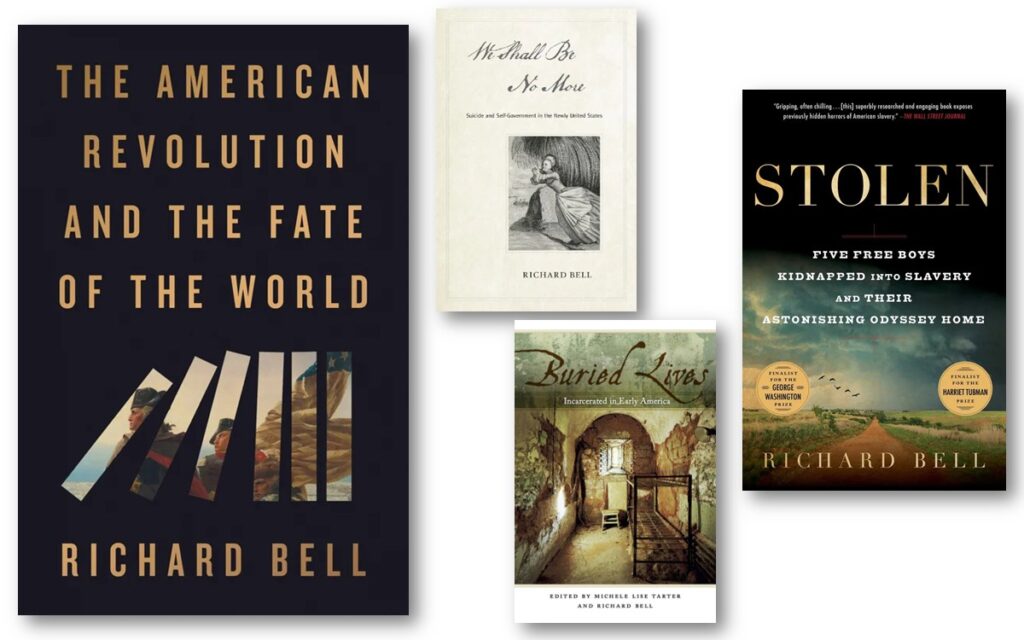
Dr. Bell’s major works
About Featured Image
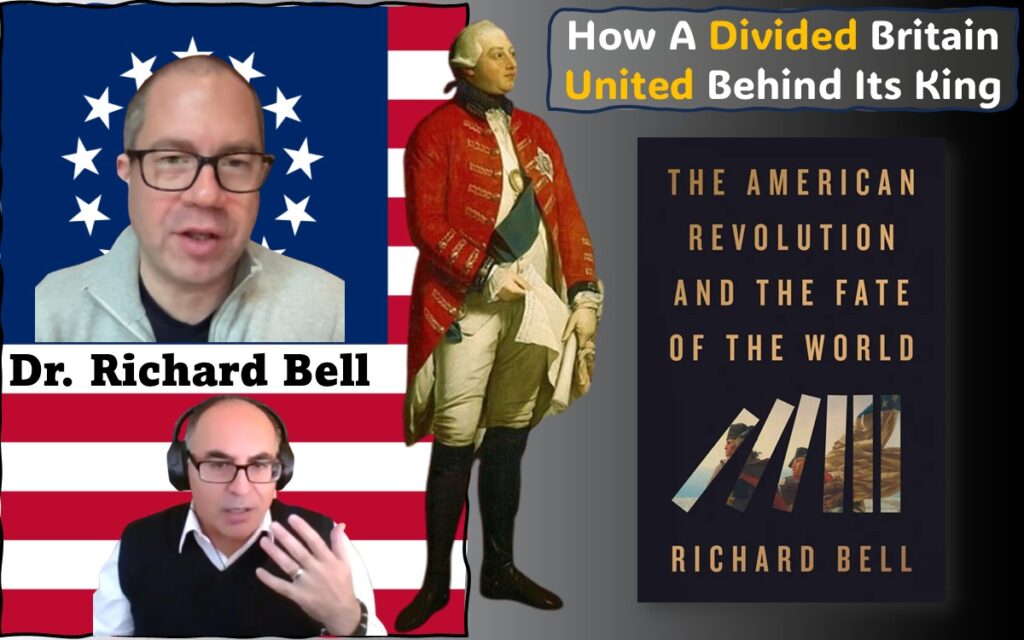
The featured image brings together images of Dr. Richard Bell and Adel Aali from the interview, superimposed on the Betsy Ross flag, alongside with image of King George III and cover image of Dr. Bell’s book that is discussed in this interview, The American Revolution and the Fate of the World.
Unless otherwise indicated, all images in AAR—including those in this post—are in the public domain.
AAR Essential Insights
Although the full video and transcript of my conversation with Dr. Bell are included in this post, I’ve selected several insights that I found particularly revealing and worth emphasizing. These moments — some surprising, others that challenge familiar assumptions — help us see Britain and the American Revolution in a different light.
By the way, these insights are my own takes and interpretations from the interview`. For Dr. Bell’s perspective and exact framing, please watch the interview above and view the transcript below in the corresponding sections.
Was King George III Really an All-Powerful Tyrant?
What struck me right away in this interview is just how quickly the narrative flips. In early 1776, even George Washington and his officers are still toasting George III. And then—within months—he becomes the face of tyranny in the Declaration of Independence. That’s a dramatic reversal. So I found myself asking Dr. Bell: how does someone go from being “the King” to basically Nero, Richard III, and Attila the Hun all rolled into one?
When you actually sit with the text of the Declaration—Jefferson’s language is brutal. Thomas Jefferson doesn’t hold back: plundering seas, burning towns, “abuses of executive power”… the whole catalogue. So it’s easy to walk away with the impression that George III must have been an absolute monarch calling every shot from the top. But Dr. Bell pulls back the curtain and reveals the real George III. His point is almost disorienting at first: George III would have been surprised by that portrayal—genuinely surprised.
And this is where it gets even more interesting. Dr. Bell reminds us that post–Glorious Revolution Britain wasn’t an absolutist system at all. It was a “king-in-parliament” structure. Parliament made the laws. The king signed them. This backdrop reframes so much for us.
George III is not the political puppet master Americans often imagine—he’s constrained, even “hamstrung” by the system itself. And according to historian Andrew Roberts, he was often more of a conciliator in American policy than a driving force behind escalation, even questioning the tax policies that ended up inflaming tensions in the colonies.
Below, I summarize how Dr. Bell addresses this critical point. See my take in “Boston Tea Party” and “From Ridicule to Reverence”.
Watch this section in the video above (00:03:24).
The King Was A Complicated Figure
What I keep coming back to in this part of the conversation is how narrow our “mental image” of King George really is. Dr. Bell is basically saying: look, the version most of us carry around is filtered through one very specific source—Jefferson’s grievances. And once that filter is in place, everything else gets flattened. Even popular culture doubles down on it. In the musical Hamilton, for example, the King becomes almost theatrical in his villainy, this exaggerated, almost comic-book ruler who exists to contrast the Founders’ virtue.
But then I pause on Dr. Bell’s point: that’s not history, that’s framing.
Thomas Jefferson is writing in a moment of political rupture, not academic balance. So of course the language is sharp, moralizing, even absolute. And I don’t think Dr. Bell is saying we should “defend” George III—he’s pretty clear about that. What he is pushing us toward is something more uncomfortable: rethinking our certainty. Asking whether we’ve mistaken a political argument for a complete portrait of a human being.
And I actually appreciate how careful Dr. Bell is here. He even steps back and says, in effect, don’t misread my accent as an apology. That matters. Because the goal isn’t reversal or rehabilitation. Rather, it’s to recognize real complexity. It’s the idea that historical figures—especially ones we’ve turned into symbols—rarely survive that process intact. So the real question becomes: what have we lost by only ever seeing the “Jefferson version” of the king?
Watch this section in the video above (00:06:19).
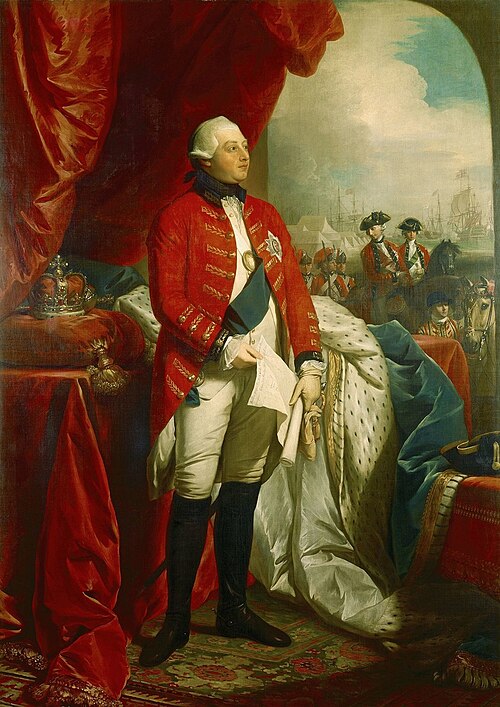 George III in 1779, with symbols of rule, scenes of the Royal Navy and British Army at war, by Benjamin West.
Was King George III a Despot?
Continue watching at 03:57 in the video above.
British People Neither Feared Nor Respected their King
One of the most surprising turns in this conversation is just how unremarkable George III could be to his own people. We tend to imagine a monarch wrapped in authority, almost untouchable. But Dr. Bell flips that completely. In Britain itself, he says, the relationship wasn’t built on fear or reverence in the way we might assume. In fact, it often looked closer to ridicule than awe.
And that’s where it gets interesting for me. Because while the American colonies were elevating George III into this towering symbol of tyranny, the British press and cultural commentators were doing almost the opposite at home. They were poking fun at him—his personality, his manners, a kind of awkward, almost ‘dad-joke’ persona and awkwardness in polite society. There’s something almost disarming about that image. Not a distant despot… but a slightly awkward public figure people felt comfortable joking about.
Dr. Bell even pushes this further by suggesting that, in some strange way, Americans in the 1760s may have actually respected him more than many Britons did—because of his perceived role in protecting the American colonies during the Seven Years’ War.
And then, Dr. Bell lands on something that really stuck with me: this idea that British political culture has a long tradition of anti-authoritarian humor. Not just disagreement with authority, but humor that actively undercuts it. You see it in modern satire too, the kind of sensibility you might recognize in figures like John Oliver—authority isn’t just challenged, it’s gently dismantled through laughter.
So I’m left thinking: what happens when a king becomes a punchline at home, but a tyrant abroad? That gap might tell us more about the Revolution than we usually admit.
Watch this section in the video above (00:10:31).
The Boston Tea Party Hardens the King’s Attitude Toward the American Colonies
I’ve always thought the Boston Tea Party sits in this almost mythologized space in American memory, but Dr. Bell brings it back down to something far more grounded—and honestly, more unsettling. Because even though we have been inculcated to think of the Boston Tea Party as a defiant act of political protest, at its core, it was an act of large-scale destruction that was condemned across the board, in both Britain and the colonies. That alone complicates the story we usually tell ourselves.
And I find myself struck by how language reshapes memory. On December 16, 1773, and for decades later, no one called it the ‘Boston Tea Party’—or any of the other tea protests for that matter (e.g., in New York, Philadelphia, Yorktown, Charleston). That label didn’t emerge until the 1820s. So, if not Tea Party, how did Americans refer to this transformative event?
They called it “the destruction of the tea” – which, in plain terms, meant destruction of private property.
And that is what truly appalled the King – massive destruction of private property.
As Dr. Bell explains, up until then, the King is trying—at least in his own way—to stay somewhat above the political chaos, acting almost like a stabilizing figure between Parliament and the colonies. Not a warmonger, not a detached tyrant, but something closer to a reluctant mediator. But after the Tea Party, that posture starts to collapse.
And this is where the shift becomes visible. The destruction of the tea pushes him past the point of conciliation. Even figures like George Washington and Benjamin Franklin recognize the risk immediately—they worry it will provoke retaliation. And they’re not wrong. The response comes in the form of the Coercive Acts—what the Americans, very deliberately, rename the “Intolerable Acts.” That naming battle alone tells you how deeply both sides are now digging in.
Dr. Bell’s point, though, is sharper than just “things escalated.” It’s that this is the moment George III stops imagining the colonies as negotiable partners. After this, he’s no longer looking for balance. He’s demanding submission. And once that shift happens, the path forward narrows fast.
Watch this section in the video above (00:05:56).
Yorktown and the Shock in Britain
Yorktown is one of those moments Americans tend to treat as an ending—but Dr. Bell is careful to reframe it as something much larger and more complicated. Because when you zoom out, this isn’t just a battlefield loss in Virginia. It’s an imperial shockwave moving through a global system. Britain isn’t just fighting in North America—it’s managing global conflicts stretching across India, Europe, the Caribbean. So when Yorktown falls, it lands inside a much wider web of pressure points.
That shift in scale really stands out. For George III, this isn’t simply “bad news from the colonies.” It’s a sign that the entire imperial project is wobbling. Dr. Bell notes that the surrender at Yorktown—when British forces under Lord Cornwallis are captured—effectively halts British offensive capacity in North America and pushes the conflict toward its endgame. But what really stands out is the emotional register back in Britain. The war is suddenly no longer something distant or manageable. It feels, to many, unwinnable.
Even the political response reflects that tension. Lord North’s reaction—“Oh God, it is all over”—captures both collapse and exhaustion in a single breath. And yet publicly, George III still performs stability. “We will soldier on,” he insists. But Dr. Bell is very clear here: that’s not conviction. That’s posture. It’s bluster in the face of reality.
And then we get the more striking layer beneath all of that. Privately, Dr. Bell suggests George III enters a genuine moment of crisis—so much so that he even drafts a letter of abdication, a resignation of sorts from the crown itself. It’s an extraordinary detail. Not because it necessarily happens in a formal sense, but because it reveals a kind of emotional collapse at the center of imperial authority. The King we imagine as fixed and commanding is, in this moment, uncertain enough to imagine walking away entirely.
Watch this section in the video above (00:12:36).
From Ridicule to Reverence: George III’s Transformation
This is one of those moments in the interview where I realized that, for whatever reason, all my readings and prior interviews never revealed an immense contradiction in Britain’s side of the American Revolution history. And the contradiction is this: Britain loses the American colonies, yet the king’s popularity rises at home.
That’s not how we usually imagine political fallout playing out.
Dr. Bell’s explanation starts to make that paradox clearer. We often think of George III as the symbolic face of British failure in the war. So you’d expect his reputation to collapse alongside the military outcome. But instead, something unexpected happens: British political culture begins to rally around him more strongly, not less.
Dr. Bell points to a key turning point—France entering the war in 1778.
Once France formally allies with the American cause, the conflict stops being a colonial rebellion in British eyes and becomes something much bigger: a global war between major powers. And that shift matters. It reframes the entire struggle from “lost colonies” to “defending Britain against continental enemies.”
And I find that moment of reframing really important. Because suddenly, loyalty isn’t just about winning or losing America anymore. It’s about national survival. Even symbols like “Rule, Britannia!” start to give way to “God Save the King,” not because everything is going well, but because the stakes feel higher, more existential. It’s almost as if the loss of control abroad triggers a tightening of identity at home.
Watch this section in the video above (00:18:19).
From A Civil War to a Holy War
In this section of the interview, we get a glimpse into how the emotional logic of the War shifts in Britain, and Dr. Bell makes that pivot really clear.
Before France enters the conflict, Britain is fighting what feels, internally at least, like a deeply uncomfortable civil war inside its own empire. After all, the so-called “rebels” are still British subjects. So there’s hesitation, even ambivalence—how enthusiastic do you get about fighting people who speak your language, religion and legal system, and are, in a sense, still part of you?
And that’s why the entry of France changes everything. Once George III and Britain find themselves facing not just colonial resistance but Catholic France—and later Catholic Spain—the emotional frame of the war shifts completely. Suddenly, this is no longer just about suppressing rebellion in America. It becomes something older, deeper, and far more combustible.
Dr. Bell is really clear about the effect this has on British society. Young men who were unsure about fighting fellow British subjects in America now feel a very different pull: the chance to fight France, Britain’s historic rival. And I find that distinction really striking. It’s not just strategy changing—it’s motivation, identity, even imagination.
So what had started as an imperial crisis inside the British world begins to resemble something much closer to a “holy war,” as Dr. Bell puts it—Britain versus its traditional Catholic rivals. And that reframing doesn’t just sustain the war effort; it transforms it.
And in this transformation, George III is recast as a “holy warrior,” which is striking. Because now the king is no longer just managing a colonial crisis; he’s symbolically positioned as defending Protestant Britain against Catholic European powers like France and Spain.
It is worth noting, however, that the same emotional energy of holy war does not exist in Catholic France. As Dr. Rafe Blaufarb explains in our program, supporting anti-monarchist, English-speaking Protestants did not faze Louis XVI or his Protestant chief minister.
Watch this section in the video above (00:19:35).
What Did the British Think of American Colonists?
An important takeaway from this interview is how uneven the relationship really was—not just politically, but perceptually. We tend to assume both sides were watching each other closely, almost like mirror images locked in conflict. But Dr. Bell complicates that. Yes, there was information flowing across the Atlantic, but it was fragmented, selective, and often filtered through wartime urgency.
So when Britons looked at the colonies, they weren’t seeing a fully developed society in the way we might expect. They were seeing snapshots—news reports from conflicts like the Stamp Act protests, the Boston Massacre, the Tea Party. And from those fragments, a much rougher image forms. Not a nuanced political community, but something closer to being seen as “backward country cousins,” as Dr. Bell puts it.
And then it gets even more blunt. In some British commentary, Americans are described in ways that collapse categories entirely—white colonists blurred together with Native Americans, or reduced to stereotypes of savagery and disorder. There’s also this unsettling undercurrent that I didn’t fully appreciate until hearing it laid out like this: the idea of America as a place of punishment. A dumping ground for convicts transported from Britain—tens of thousands over decades—shaping a perception of the colonies as a kind of penal outpost.
That matters for how we interpret the Revolution. Because if you already think of a people as socially inferior, politically immature, or even criminal by association, it becomes much easier to justify governing them without real consent. And I think that’s the uncomfortable thread running through Dr. Bell’s answer: misunderstanding wasn’t just ignorance—it actively shaped policy.
So maybe the question isn’t just whether Britain understood America. It’s whether they ever really tried to see it on equal terms at all.
Watch this section in the video above (00:24:52).
Banishing Britons to America – A Forgotten Story of Pre-Revolutionary America
Before the American Revolution, Britain sent roughly 50,000 convicts across the Atlantic. It’s easy to think of it as a marginal side story. But Dr. Bell makes it clear: this wasn’t incidental—it was a system. A deliberate, structured form of punishment that reshaped both Britain and colonial America.
And what really struck me is how limited the justice system actually was in the early 1700s. There was no modern prison network. No long-term incarceration as we understand it. Instead, punishment swings between extremes—whipping or hanging. And that gap in the middle creates pressure. What do you do with crimes that don’t “deserve” death, but are too serious for a beating? That’s where transportation enters the picture.
So Britain essentially invents a workaround: send convicted people to the colonies for years of forced labor. Not just exile, but economic utility built into punishment. And suddenly, the American colonies aren’t just settlements—they’re part of a broader penal system. Labor becomes cheap, abundant, and organized through state policy.
And this is where it gets even more revealing. Because this system doesn’t just shape abstract policy—it touches real figures we recognize. Dr. Bell notes that people like George Washington were directly involved in purchasing convict labor alongside enslaved Africans and indentured servants. That detail alone forces a harder question about how deeply embedded this system was in the everyday economy of colonial life.
So when we talk about “Britain sending criminals to America,” it’s not just a footnote. It’s part of the infrastructure that helped build the colonies themselves. And that makes the relationship between Britain and America feel less like two distant societies—and more like one system trying to manage its own overflow.
But then the system breaks down completely once war begins. With the outbreak of the Revolution and naval blockades cutting off Atlantic routes, Britain can no longer send convicts across the ocean. So suddenly you have this growing crisis at home: courts still issuing sentences, prisons filling up, and nowhere for people to go. The solution is almost surreal—abandoned ships on the Thames are converted into floating prisons under the Hulks Act, holding convicts in limbo until the war ends. It’s hard not to picture that image: overcrowded vessels just sitting in the river, filled with people waiting for a destination that no longer exists.
And then comes the even stranger postscript. After independence, Britain still tries to restart the system as if nothing has changed—attempting to send convicts to places like Maryland, now part of the independent United States. The reactions are almost comical if they weren’t so revealing: American authorities refuse, other colonies reject them, and ships are literally turned away. It’s a system operating on outdated assumptions, unable to recognize that the world it depended on no longer exists.
Watch this section in the video above (00:27:13).
The Parliament: When Opposition Couldn’t Stop the War
The Essential Insight here is how familiar the structure of political conflict feels—even in the 18th century. Dr. Bell is essentially describing a legislature that looks surprisingly recognizable: a governing majority aligned with executive power, and an opposition trying to resist a war they see as misguided, costly, or even morally wrong.
And in Britain’s case, that opposition is not small or symbolic. There are major political figures—former and future prime ministers like Chatham, Rockingham, and Shelburne—actively questioning the war, even condemning it as ruinous and, in some cases, openly sympathizing with figures like George Washington. That detail alone is striking. These are not fringe voices. These are elite actors trying to redirect national policy.
But Dr. Bell makes it clear why they still fail. First, there’s the arithmetic of power. The government majority under Lord North controls Parliament, and that alone sets the baseline. Opposition members may have strong arguments—economic, ideological, geopolitical—but they don’t have the numbers. And then there’s something more informal but just as important: political pressure. Votes are shaped not just by persuasion, but by patronage, promises, and outright coercion. Dr. Bell is blunt about it—this is politics in its most transactional form.
What I also found interesting is how the meaning of “peace” itself changes over the course of the war. Once France enters the conflict, opposing the war stops being just a policy disagreement and starts to look like disloyalty. Even calling for a ceasefire becomes politically dangerous. So the language of patriotism gets flipped. “Peace” becomes suspect. “War” becomes duty. And that shift narrows the space for opposition even further.
It’s only after the catastrophic setback at Yorktown that the balance finally shifts enough for Parliament to act. Not because the arguments suddenly become more persuasive, but because the political conditions finally force recognition of reality.
Watch this section in the video above (00:37:11).
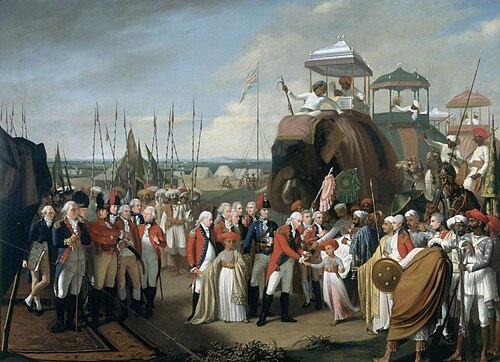 General Lord Cornwallis in India, receiving Tipoo Sultan’s sons as hostages to ensure that the Treaty was fulfilled, by Robert Home, c. 1793.
Cornwallis After Yorktown: The Second and Third Acts
Our assumptions about “failure” collapse when you look at the British system from the inside. In the American imagination, Lord Charles Cornwallis is basically the face of defeat at Yorktown—end of story. But Dr. Bell forces us to rethink that entire narrative structure. Because in Britain, Yorktown isn’t treated as personal disgrace in the way we expect at all.
And that disconnect matters. When Cornwallis returns, he isn’t ostracized or ruined. Instead, the response sounds strikingly bureaucratic in tone: “tough luck, the odds were stacked against you.” The war itself is understood as a collective imperial loss, not a personal collapse. So the idea that one general “lost America” doesn’t really hold up in the way American storytelling often frames it.
What happens next is even more surprising. Instead of fading into obscurity, Cornwallis continues to rise. Dr. Bell walks us through this second act in India, where he is tasked with reforming and stabilizing the East India Company’s operations. And here, he’s not treated as a damaged figure being sidelined—he’s trusted with some of the most consequential imperial work Britain has. That alone tells you something about how differently competence and failure were being evaluated in imperial contexts.
And Dr. Bell makes a broader point: Britain didn’t have the luxury of only choosing “winners.” After losing the American colonies, every available general had, by definition, just come off a loss. So Cornwallis doesn’t stand out as uniquely discredited—he stands out as experienced. Yorktown doesn’t “stick” to him in the way we might expect. Dr. Bell even uses that idea of him being almost “Teflon,” which is a striking way to put it.
Then the story expands again—this time to Ireland. And here, Cornwallis is deployed not as an administrator but as an agent of suppression, during the 1798 Irish independence movement. It’s a reminder that the consequences of the American Revolution don’t stay in America. They ripple into other parts of the empire where similar pressures begin to emerge.
Watch this section in the video above (00:47:40).
The Interview (S1E13): Adel Aali and Richard Bell
In our conversation, Dr. Bell addressed important topics relating to the British Empire and the American Revolution. Below, are my questions to him followed by the interview’s full transcript.
In our conversation, Dr. Bell addresses key questions about the British Empire, King George III and the American Revolution. The detailed outline and full transcript below supplement the video above.
Podcast
Watch the full interview on this page with the outline and transcript below, or take the conversation with you on the go through our Spotify podcast.

Outlline
Use the in-depth outline below, with its key moments and turning points, to follow the discussion and navigate the interview.
Click for Timestamped Outline
- Selected Highlights (00:00)
- Guest Introduction (01:29)
- King George III and the Declaration of Independence (03:24)
- Thomas Jefferson’s Portrayal of King George III (03:37)
- Was King George III an “All-Powerful Tyrant”? – Key Moment (04:15)
- The Boston Tea Party and the Collapse of Conciliation (05:56)
- “The Destruction of the Tea” and Colonial Backlash (08:07)
- The Tea Party “Breaks” King George III – Turning Point (10:02)
- British Attitudes Toward King George III (10:31)
- Mocking the King in British Political Culture (11:16)
- King George III as “Boring and Impotent” (12:22)
- Yorktown and Britain’s Crisis of Confidence (12:36)
- Lord North Receives News of Cornwallis’s Surrender (13:56)
- King George III’s Draft Abdication Letter – Key Moment (14:42)
- Pop Culture, Myth, and the Historical King George III (16:18)
- Hamilton and the Modern Image of the King (16:47)
- Historians “Closing the Gap Between History and Myth” (17:27)
- From Civil War to “Holy War” Against France (18:19)
- France Enters the War and Changes British Opinion – Turning Point (19:11)
- King George III as a “Holy Warrior” Against Catholic France (20:51)
- British Views of the American Colonists (22:06)
- Americans as “Second-Class British Subjects” (24:15)
- America as a “Race of Convicts” (26:36)
- Convict Transportation and the British Empire (27:13)
- The Transportation Act of 1718 and Penal Labor (30:12)
- Britain’s Prison Ships and the Hulks Act (34:41)
- Parliament, Ireland, and Opposition to the War (37:11)
- Anti-War Voices in Parliament and British Politics (38:42)
- “Irish Scotch Presbyterian Rebellion” and Irish Resistance (41:58)
- Charles Cornwallis After Yorktown (47:40)
- Cornwallis’s “Second Act” in India – Key Moment (49:33)
- Cornwallis Crushes Ireland’s Independence Movement (54:05)
- Just One Point (55:05)
- “Disunited Kingdom” and Britain’s Internal Divisions (55:17)
Transcript
Note: This transcript was generated automatically and may contain minor errors. It is provided for reference and accessibility only.
Click to View Transcript
Adel:
Dr. Bell, it’s a pleasure to have you in our program’s special series. Thank you for taking the time for this conversation with me about the American Revolution. I want to start our interview on page 39 of your book, which is titled The American Revolution and the Fate of the World.
And it reads as such. I won’t identify all the quotation marks, so I’ll just read it. And the audience is welcome to go to page 39 of your book for themselves.
The Declaration of Independence depicted King George as a royal brute, unfit to be the ruler of a free people. Thomas Jefferson, the Declaration’s draftsman, leveled all sorts of charges against the British monarch, accusing George of having plundered our seas, ravaged our coast, burned our towns and destroyed the lives of our people, while also committing innumerable abuses of executive power. The picture the Declaration painted of the king was unsparing, rendering George as Nero, Richard III, and Attila the Hun all rolled into one.
So I chuckle because George III comes across as an all-powerful despot. Was that the case?
Dr. Bell:
He would have been surprised. In fact, he was surprised when he read the Declaration of Independence, or had it read to him later on, to be accused of being this all-powerful tyrant, because he felt very hamstrung, actually, by the British constitution, which, you know, since the English Civil War and the Glorious Revolution, two key events in British history 100 years earlier on, the king had not had the power of an absolutist monarch, right? You’re thinking of France when you think of that at that time.
The king was bounded by parliament. It’s the king in parliament. The king appoints the prime minister and the government and tries to steer their agenda, but he can’t dictate to them.
The British constitution is very clear about that. The king’s job is to… The parliament’s job is to write the laws.
The king’s job is to sign them. So to see him depicted as an all-powerful tyrant in the list of grievances in Thomas Jefferson’s Declaration of Independence must have come somewhat as a surprise. Also, we know from the work of Andrew Roberts, who published a big, thick biography of George III about five years ago, called The Last King of America, that George had long been a conciliator when it comes to American affairs.
He’d long been second-guessing the tax hikes imposed by his various prime ministers in the 1760s as being wrongheaded and counterproductive and likely to provoke a backlash in America, which of course it did. It’s really only after the Boston Tea Party, an act of massive property destruction, which is condemned by people all across the political spectrum, both in America and in Britain, that George decides he requires submission from rebellious subjects in Boston and passes the Coercive Acts, which only of course makes things worse. So I guess I’m saying here that King George is a much more complicated, maybe even ambivalent figure than we in America have long thought, because we have come to our understanding of who King George was solely through Jefferson’s list of grievances in the Declaration or through the portrayal of him in the Hamilton musical, where he’s a bloodthirsty psychopath who wants to kill your friends and family to remind you of his love.
That’s the Jefferson version of King George. And it shouldn’t surprise us that the Jefferson version of King George in a list of grievances is not exactly an objective portrayal. I’m not here to apologize for King George.
Don’t mistake this British accent as any sort of defense of King George or the British government here. But it’s also true that we should take him seriously as a much more complicated figure than Jefferson’s grievances do.
Adel:
You used the word conciliator, and this is a far cry from the warmonger that we think of him. He’s more like a peacemaker, at least early on. At least early on, correct.
Yeah, between his government and the colonies. And you mentioned the Boston Tea Party. Could we put a pin mark on that as the event that changed George III’s thinking about the events in the Americas?
Dr. Bell:
I think we really can, actually. We can see him signing the coercive acts and being glad to do so, which, you know, retaliate against the people of Boston and Massachusetts more broadly for the destruction of the tea in Boston Harbor. Let’s remember that the word Tea Party has long, you know, mythologized and romanticized a massive act of private property destruction.
At the time, no one called it the Tea Party. People on all sides called it the destruction of the tea. The word party only gets added in the 1830s as we try to sort of romanticize the more violent outbursts among some of the future patriots that mark the path to the American Revolution.
So in 1773 and 1774, news of the Tea Party is greeted with utter condemnation by many Americans. Ben Franklin thinks it is a terrible development for the anti-crown cause. George Washington condemns it as deeply unwise.
And he said folks like Franklin and Washington say this will only blow up in our faces. It will only bring down the angry retaliation of the king, which it does. And that’s a change for King George.
He’s tried to act as maybe peacemakers too strong a word, but a sort of a middleman between his government led by a series of blundering prime ministers in the 1760s and early 1770s and anti-parliament protesters. He sees himself as above the fray, bringing people to the table. But the Tea Party, or the destruction of the tea, makes him second guess whether the colonists are people who can actually come to any sort of conciliation table.
And so he rejects the destruction of the tea. He comes down hard on the colonists. And after 1774, he will be an increasingly loud and vocal voice demanding submission.
But again, if you look at him 10 years earlier, five years earlier, or two months earlier, it’s a very different king. It’s the Tea Party that really breaks him.
Adel:
And just to confirm, you mentioned coercive acts. Those are called intolerable acts on this side of the Atlantic.
Dr. Bell:
That’s right. Their official name is the Coercive Act, which already tells you a lot, right? The word coercive suggests submission.
But the Americans say they’re not just coercive, they are intolerable. So they nickname them the intolerable acts. Yeah.
Adel:
Going back to your book, it’s not one or two specific pages. It’s sort of a trend, especially early on when you’re talking about King George III. And tell me if I’m making too much of this, Dr. Bell. Did the British people sort of mock him, poke fun of him? Of the king?
Dr. Bell:
They certainly did. They certainly did. I will say that King George was not a much feared and respected monarch in Britain itself.
Ironically, I think many of the colonists probably held him in higher regard in the 1760s than many in Britain did. And that’s because of his role, quote unquote, protecting them in the Seven Years’ War, the French and Indian War. In Britain itself, British cultural commentators, think of the British tabloid newspapers, for instance, generally poked fun at King George as being a bit crass and sort of uncouth, making tasteless sort of dad jokes in polite company.
And I’m a dad myself. Me too. And also having a scandal free personal life.
If this king didn’t even have a mistress, for God’s sake, what a ridiculous figure.
Adel:
For goodness sake, yeah.
Dr. Bell:
They have a lot of fun at his expense. And I just want to remind folks, you know, that the British people are often very critical of their sovereigns and the royal family. And that’s anti-authoritarianism is, I think, at the root of British character in a lot of ways.
The British sense of humor is a very anti-authoritarian, sort of subversive sense of humor. Think of John Oliver, the comedian in the US. His sensibility is very much the sensibility of many people in the British press.
They have a lot of fun at King George’s expense for being so boring and impotent, really. Wow, funny.
Adel:
So how dare he? He doesn’t have any marriage scandals. Let’s talk about Yorktown, which was a significant event in American history, obviously.
How did the king respond to the news of Cornwallis’ surrender?
Dr. Bell:
Not well, I would say. Let’s just remind folks that the Battle of Yorktown in October of 1781 in Virginia is the last big battle on the American mainland. It will lead to the capture of about a third of the British army in North America.
It will bring British offensive operations in North America to a standstill, and it will send peacemakers from Britain and other places too, like France and Spain, rushing to Paris to hammer out the terms of a global peace treaty. It doesn’t actually mark the end of the war, but it does mark a major milestone on the road to peace. And so it’s a disaster for the British military and the British cause in North America.
It sends the message to people in Britain that the war is either completely unwinnable or unwinnable for years and years and years, and will require many more troops to go over there and be shot at and killed if they’re ever going to turn the fortunes around. So it’s terrible news for the British cause in America. And we know that when King George’s prime minister, Lord North, reads the dispatch from Yorktown, which of course takes many weeks to arrive, I think 12 weeks to arrive, he said, oh God, it is all over in what is probably a mixture of horror and relief.
George publicly doesn’t bat an eyelid and says, we will soldier on, we will still prevail, which is nonsense, of course. It’s bravado, it’s bluster. Privately, I think he’s having a real crisis of faith at that point, because we know that he will actually draft a letter of abdication, a letter of resignation to basically quit the royal family and go back to the German states where he was from.
But he never sends that letter because his son, the heir apparent, the Prince of Wales, is completely ill-suited to succeed him as king. So he doesn’t send the letter and stay stuck unhappily on the throne of Britain for the next 40 years. And it takes him a while to come to terms with just how catastrophic a loss the British army’s defeat at Yorktown was.
Adel:
A couple of follow-up questions on that. First of all, does that abdication letter exist? Do we know what it says?
Dr. Bell:
Yeah, I believe it does. I believe it does, and I believe we do. I’ve not seen it myself, but we learned about it just quite recently, in the last 20 years or so, because our late queen in Britain, Queen Elizabeth II, who passed away a few years ago, in the early 2000s, she opened up the private files of the royal family in Windsor Castle to academic researchers.
So we can now go read King George’s diary, you can read his mailbag and everything else, which is the basis for Andrew Roberts’s great new book, The Last King of America. And so scholars like Andrew Roberts, and I’m also thinking of Rick Atkinson too, have been able to go up to the Round Tower in Windsor Castle and read the personal archives of King George. And they found, you know, this letter stuffed effectively in his desk drawer that he never actually sent.
So I believe we do have access to that. But this is changing our opinion of who George was, and it’s thanks to this opening up of the archives, of course.
Adel:
When I read this passage in your book, I was quite shocked, which brings me to this question. Do you share this with your students? Do you tell them about this?
And if so, what do they say?
Dr. Bell:
So, you know, I teach University of Maryland, and the students I teach are probably 18, 19, 20. So they are about 10 years out from when the Hamilton musical premiered in New York in 2015. And some of them have seen the show, or some of them, their parents have made them see the show or whatever else.
And I think, you know, if they’ve ever thought about King George III before, it’s usually through the lens of the Hamilton musical, right? Where he is a stock figure, a figure of fun. He’s the villain.
He’s the bad guy. He’s also a maniac, who, as I said earlier on, will kill your friends and family to remind you of his love. And so when I talk about King George using the latest research done by folks like Andrew Roberts and Rick Atkinson, I’m able to sort of puncture that balloon of what pop culture says about King George, and given the facts and the documents.
And I think that’s what historians are always trying to do, to sort of close the gap between history and myth and pop culture, because they’re not usually on the same page.
Adel:
Yeah, they’re not. And that’s what we tend to do, to bring reality and a deeper story about the American Revolution in this series. Now, we talked about how the king was surprised at the charges level against him, and how in the Declaration of Independence, and how the Declaration of Independence made him out to be this big, powerful man.
We talked about how his own subjects in Britain poked fun of him, and how he could not push things through, even if he wanted to. To me, as I’m reading your book, so he is, using your words, an impotent king, unpopular. Then, I get to page 59, and you write this, George’s subjects largely abandoned rule Britannia, their long time anthem, and embrace God save the king as their new national hymn.
That sounds to me, he’s suddenly popular. Am I, is that right? You are right, you are right.
Dr. Bell:
So George’s public- undergoes quite the transformation by the end of the American War. This strike, many of your listeners are strange, right? Because Britain loses the war, right?
Adel:
Yeah, yeah.
Dr. Bell:
So why would the king, the sort of face of British aggression against the Americans, why would his stock be rising in British popular culture? The answer is France. In 1778, about three years into the American War, France officially signs a treaty of military alliance with the United States.
France becomes the first European power to recognize the independence of the United States, and to contribute military troops, French soldiers, ships, sailors, supplies to the war effort. This is transformative in lots of ways. The entrance of France into the war is an absolute game changer.
But one little byproduct of its game-changing arrival is that British people now have an enemy they really actually want to hate, want to go to war with. Many British people have been remarkably ambivalent about going to America and beating up on other British subjects. I mean, George Washington’s a British subject, remember, right?
So is John Adams and all the rest. And so there’s a lot of division within Britain about whether the American War is a good idea. But when Catholic France enters the war on the patriot side, Britain finds itself at war with its oldest, most hated enemy, Catholic France, and then Catholic Spain will jump in a year later.
Britain’s at war with them too. And that is a huge boost for military recruitment in Britain. Suddenly loads of young men who were definitely very ambivalent about fighting George Washington cannot wait to fight King Louis and King Carlos and their troops.
And so we see what had been this civil war within the British Empire now become a holy war to defeat Catholic France and Catholic Spain. And so King George takes on the mantle of holy warrior, right? Leading his Protestant troops into battle against evil Catholic France, evil Catholic Spain.
And his stock increases, his cultural cachet increases, his reputation as a war leader increases once he’s got King Louis to fight. And so we see King George go from being someone regarded as impotent and laughable to someone who’s trying to protect Britain from literally a French invasion in 1779 and a Spanish invasion too. And he sees off that, or his commanders see off that invasion.
So you could argue, if you really squint a lot, that George III is like Winston Churchill fighting the Nazis, right? Once Catholic France and Catholic Spain get in. So by the end of the war, British people have actually embraced King George, who was a new king, who only came to power, I think, in like 1762 or something like that.
And they’ve made him into a national hero because he’s beaten back the Spanish French Catholic threat.
Adel:
That’s a huge transformation for his own personal stature in the country. You said something that I want to go back on and confirm, make sure I understood it correctly. You said that the British people hated fighting against the American colonies, colonists, who they believed to be British subjects.
Is that what they thought? That people in Britain, in England, and by then, well, England and Scotland, think of American colonists as equal British subjects?
Dr. Bell:
So I didn’t say they hated it. I said they were divided about it.
Adel:
That’s right.
Dr. Bell:
So there are definitely British people who are all too happy to go and beat up on George Washington and his folks. And there are other British people who want nothing to do with that. They’re a disunited kingdom when it comes to that.
But yes, you’re right. Colonists in British North America are British subjects. In fact, that’s how King George sees them, of course, as his rebellious subjects who are acting up like ungrateful children.
And if you had asked many colonists before the war to identify themselves, they wouldn’t have said, we’re Americans. They would have said, either we’re South Carolinians or Rhode Islanders, or they would have said, we’re British. We’re British subjects.
Now, whether they are equal British subjects with the people who live in Britain, that is the $64,000 question here, right? Yeah. Because I think as we all remember from high school, especially if you guys grew up in the US, which I definitely didn’t, then we all remember from high school that one of the rising sources of tension, in fact, the rising source of tension between the colonists and Parliament is that Parliament is treating the colonists as second class British subjects, right?
As less than, as the people who get stuck paying all the taxes that Britain wants to levy to dig itself out of its debts. And that these, unlike British subjects in Britain itself, the colonists have absolutely no representation in Parliament, right? So no taxation without representation becomes one of the rallying cries.
So that is a reminder that the colonists are British subjects, they see themselves as British subjects, and they hate being seen by Britain as second class British subjects.
Adel:
Did people in Britain know and understand Americans? I mean, you know, we’re in 2025, right? I could Google Thailand, I could, you know, Argentina, but this is the 18th century.
Was America and the British subjects in America just entirely foreign to them?
Dr. Bell:
What was that like? So no, and yes. The no is that London papers, British newspapers do carry news from America with some regularity, especially in times of war.
So the news from the French and Indian War had been major news, of course, in British newspapers, and reactions by the colonists to the Stamp Act, the Townshend duties, the Boston Massacre, the Tea Party, they also make, you know, the news in British newspapers. So British people are not unaware of what’s happening in America. But they’re certainly not well informed.
They’re certainly not careful students of American politics or American cultural society. And they tend to paint in a broad brush when they think about Americans, they think of Americans as their sort of backward country cousins. They think of them as savage and uncivilized, often sort of blurring white Americans in their minds with native Americans, if you see that move there.
And also, British people also think of Americans as a race of convicts, to use a quote from a one British commentator. And that’s because even though we’ve chosen to forget today, 50,000 British convicts are sent to America to serve out terms of hard labor in the decades before the revolution. So many British people think of America as a place we dump our scum and dregs, our convicted felons.
You can see that this adds up to a rather nasty sort of betrayal of who the American colonists are. No wonder that British politicians treated them as less than, because on some level, they thought of them as less than.
Adel:
The 50,000 convicts that you mentioned sort of that make, turn America into a dumping ground for the scum of Britain. This is one of, I think, the most fascinating topics in your book. So let me start from the top then.
What was the Transportation Act?
Dr. Bell:
Yeah, let’s do this, because I think this is a story most Americans don’t know. Yeah, yeah, yeah. So we think in America and in Britain today, when we think of convict transportation, we think of Australia.
And I’ll come to Australia in a minute, but let’s get to the story of how we get to Australia. In the 1700s, the British justice system is pretty rudimentary. There are no long-term penitentiaries.
No one’s invented a penitentiary yet. The first penitentiary in the world will be built in Philadelphia in 1829. That’s a long way in the future.
Wow. Instead, they have short-term jails. Think of like the jail in your local police station in your town.
Or they have a hangman’s noose, or they have a whip. So after a temporary detention, until you get trial.
Adel:
So no prisons here.
Dr. Bell:
You don’t have anyone staying behind bars for five years. No, no, no, no, no. That’s a 19th century invention, right?
Think of Pentonville Prison in London. Think of Eastern State in Philadelphia, a 19th century invention. So after a temporary detention in a jail while you await trial, your sentence for a crime might be a whipping, a branding, or a hanging.
Those are basically the choices, right? And depending on the nature of the crime, the British justice system may take the view that a whipping is too lenient, but a hanging is too severe, right? So there’s no intermediate punishment between a whipping and a hanging.
Enter penal transportation. When Britain builds colonies following the Spanish example, the Portuguese example, and many other European examples, the British justice ministers determine that we can invent a new punishment whereby we banish our convicted felons to our overseas colonies for a minimum of, let’s say, 14 years. We can sentence them to 14 years of hard labor in the colonies, and their labor will help to build those colonies, providing cheap, below-market manpower of twice the length of a regular indentured servitude contract, and much cheaper than the cost of buying an enslaved African for life.
So hard labor and convict penal transportation become, in the early 1700s, a major new weapon in the fight against crime in Britain, a new intermediate punishment between whipping and hanging. And this is the Transportation Act that you referred to of 1718. This makes convict transportation to the American colonies a routine punishment for a range of mid-level crimes, like burglary, and bigamy, and insurance fraud, and perjury, and all these sorts of things.
So murderers are still going to get hanged, and the pettiest crimes may still result in a whipping, but almost everything else results in convict transportation. And so we see a whole sort of military-industrial complex arise, designed to ship convict felons from the jails of Britain. Think of London, Bristol, Liverpool, and Dublin, to the banks of coastal rivers in Virginia and Maryland, where they’ll be put up for auction, and people can buy their labor very cheaply for 14 years.
One person who buys a lot of convict labor is actually George Washington, who puts convict laborers alongside enslaved Africans and voluntary indentured servants as he’s building his labor force at Mount Vernon. In fact, one of his early tutors when he was a kid is a convict laborer.
Adel:
You describe in your book how these convicts that were sentenced to transportation to go over to the Americas hated this, they feared it. I forget the exact words you used, but there was something to this effect. And as I was thinking, well, the other choice is being hanged, but that’s not the sentence.
Being shipped to this land, isn’t that preferable versus being somewhere and rotting away?
Dr. Bell:
Why do they hate this so much? So this comes back to what we were just talking about, right? British people don’t know nearly enough about what America is like.
And so with the lack of reliable information, their minds assume the worst. Many people sentenced to convict transportation, who of course are generally Britain’s working poor, they’re not a super literate group of people necessarily, they haven’t gone to college and studied things and read treaties from Ben Franklin or whatever else, they tend to assume that America is hell really, right? And that they will be eaten alive by whoever they meet there, whether white or native or anyone else.
And so there’s even one poor woman who’s sentenced to convict transportation who begs to be hanged instead of going to America, which tells you all you need to know, I think, right? And then those people who do make it to America as convict laborers, many of them try to escape and get back to Britain as swiftly as they can. I write about one amazing guy who does that.
And others serve out their terms as best they can. And maybe they come back to Britain after they finish their terms, or maybe they stay in America for the rest of their lives. I think that was the most common outcome, that convict laborers become assimilated into the free population after they finish.
And the point really is we’ve forgotten that story. And then when the revolution comes, Britain can no longer ship its convicts to America. That’s when things get interesting.
Adel:
And does this lead to these decrepit ships on the Thames full of convicts?
Dr. Bell:
Yeah, that’s right. So when the American War begins and the Royal Navy starts blockading the East Coast, convict transport ships can no longer get through. And of course, the patriots definitely don’t want to be receiving the scum and dregs from Britain.
Of course. So this convict transportation scheme comes to an abrupt halt. They think it’s a pause.
They think that Britain will win the war and this will resume quickly. But of course, as that pause extends and extends and extends from months to years to years, judges in Britain are still handing down sentences of convict transportation to the colonies. And so what that means is the jails in Britain are rapidly getting full to overcrowding with people who’ve been sentenced to convict transportation but can’t actually go because there’s a war on.
And so we see the British government in 1776 to pass a stopgap measure called the Hulks Act. And the Hulks Act says, OK, we’re going to repurpose a bunch of empty, abandoned cargo ships, which normally go back and forth to America in peacetime, which are just sitting idle on the banks of the Thames River in London or any other river you care to name around Britain or Ireland. And we’re going to turn those cargo ships into floating prisons to temporarily house these convicts until Britain wins the war and we can send them to Maryland.
And so the Hulks Act sees all sorts of zombie cargo ships filled to bursting with British convicts waiting to be shipped overseas. And even that, of course, is not a permanent solution.
Adel:
And I bet internally inside Britain, this becomes a political issue as people see this. And it’s just it’s not something that can go on forever. I read this and this was really funny to me.
After the war, the British assume that it’s business as usual and they attempt to send convicts back to America.
Dr. Bell:
This is wild to me, right? In 1784, faced with overcrowded jails, Hulks full to bursting on the Thames River, Britain’s desperate to resume convict transportation to Maryland. Maryland is now independent.
Maryland’s not a British colony anymore. It’s part of the United States, an independent country. So when they start sending ships over to Maryland, Maryland authorities are like, what the hell are you doing?
You know, we’re not part of your country anymore, right? And they turn them around. They send them away, even sending one ship on to Honduras, which is also a British colony.
And Hondurans say, no, thanks. We prefer African slaves. Thank you very much.
And so the point I’m making here is that after the war, after American independence, Britain is desperate to send all its convicts somewhere. And the independent United States is one of just six different places they try and all of which fail or are rebuffed or don’t get off the drawing board, forcing Britain to some very, I would say, desperate choices by 1786.
Adel:
And in your book, you talk about how this story leads to Australia. That’s a separate conversation, but it’s really fascinating. Actually, it’s a circuitous path to go to Australia.
Even the decision making within the halls of Parliament in Britain is not like a straightforward decision. Let’s do this. I want to close this segment by asking you about Parliament in this very specific aspect.
At some point in your book, you talk about how Chatham, Rockingham, and Shelburne, who are former and future prime ministers of Britain at the time in the 1770s, along with other members of Parliament, are trying to stop this war. I think at one point they call it a natural ruinous war. And they even drink toasts to George Washington.
This is probably in the early years. Yeah, that’s right. Can you explain for us how it is that they never succeeded?
I mean, these are powerful people. Yeah, to be sure.
Dr. Bell:
So we’re talking about Parliament right now, right? So Parliament, which is not unlike Congress in the US today, is very divided. There is a government majority, and its members of Parliament generally do whatever the prime minister, Lord North, tells them.
And they’re generally in lockstep with the king, who is demanding submission from the American colonists, which is why there’s a war. But there are plenty of other members of Parliament, at least 200, who are not part of the British government, who see themselves as the opposition to the British government. And they are launching all sorts of criticisms of the British government’s prosecution of the American war.
And in fact, all the different opposition members of Parliament, the only thing they really have in common is they all don’t like the way Britain is running the war. Otherwise, they fight like cats in a bag against each other. But this is the one thing that brings them together.
And they’re criticising the British prosecution of the war in a number of ways. You know, some think that ideologically, it is the wrong choice to be waging war against British subjects in America. Others say that it’s calamitous for the British economy to be fighting with British people in America, that it’s bad for trade, it’s bad for business.
Others say this is geopolitically very stupid, because it’s going to invite France and Spain, our global enemies, into the war on the enemy’s side, which is correct, of course. And others say, you know, my brother, my uncle is an American. They’re not so bad, right?
Don’t believe all the propaganda you read, right? So there’s lots of reasons why British people and some opposition members of Parliament take what we could call anti-war stances. And there’s enough members of Parliament to get motions in Parliament, votes on the table to try to vote for a ceasefire and put down arms.
But those votes never get a majority of members of Parliament to vote for it, in part because the government controls about 400 members of Parliament, leaving only 200 others to oppose it. And also because the government ministers like Lord North are very happy to bribe opponents to vote a certain way on a given day. Welcome to Politics 101, right?
Exactly. It’s like getting a call from the president these days. There’s a lot of people getting a call from Lord North, so to speak.
And sometimes he’s shouting and sometimes he’s promising you things down the phone. And also, once France joins the war on the Patriot side, to be an opponent of the war against France is to be seen as a domestic terrorist who’s in love with France, or to be seen as someone who doesn’t support the troops, to use a familiar American expression.
Adel:
Unpatriotic.
Dr. Bell:
Unpatriotic, right. So it’s ironic that peace becomes coded as unpatriotic, right? Ceasefire becomes coded as unpatriotic.
And so it’s not till the massive setback of Yorktown in October of 1781 that opponents in Parliament can get enough votes together. And that’s when they do get enough votes together and they force the British government to negotiate for peace, only after Yorktown.
Adel:
And to our audience, I invite you to actually read this section in Dr. Bell’s book. You actually talk about some acts that could be construed as terrorism, such as burning shipyards and all of that. Let’s take a break here.
In the next segment, I’ll ask Dr. Bell about Ireland, India, and Cornwallis. We’ll be right back. Dr. Bell, I want to read a line from an 18th century letter that’s in your book. It’s on page 116. No wonder then that when one Hessian captain wrote to a friend, he urged him to call it not an American rebellion. It is nothing more nor less than an Irish Scotch Presbyterian rebellion.
What is this talking about?
Dr. Bell:
Yeah, that’s a bit of an inside baseball point, but let’s unpack it for listeners, right? So one of my chapters is about the role of the Irish in the American Revolution, and the role is completely fascinating. Let’s start with Irish migrants to North America, people who’ve come to the American colonies like Pennsylvania in the decades before the revolution.
Your listeners may be surprised to learn that most Irish migrants to North America before the revolution were not Catholic. Most Catholic people in Ireland who would love to leave Ireland because times are very hard there are too poor to leave and basically are forced to stay. Most Catholics who arrive in America from Ireland won’t arrive until much later, the 1840s and 1850s, the era of the Irish potato famine.
I’m sure some of your listeners have heard of. So Irish migrants to America before the revolution are generally Presbyterian Protestants. They call themselves the Scotch Irish because they’re originally their ancestors were from Scotland and they fill up in the back country.
They fill up in the cheap and mountainous and hilly land of Appalachia, and they’ve come for lots of reasons. One, to seek economic opportunity, and number two, because British Protestant Anglicans treated them very badly back in Ireland. And so they regard Britain as, to a greater or lesser extent, an imperial oppressor.
And so these Scotch Irish Presbyterians living in Appalachia, when the war breaks out in 1775, they know exactly which side they’re going to be on. And it’s not going to be the loyalist side. It’s going to be the patriot side.
So we see many Irish migrants to America break solidly for the patriots when the civil war within the American colonies breaks out. And so what you heard in that quote you read is a German soldier fighting on the king’s side saying, you know what, when we fight these patriot soldiers, most of them seem to have Irish accents, maybe they’re Irish migrants to America, and they all say they’re Presbyterians, right? What on earth is going on?
And that’s what’s going on. The consequences of the Irish diaspora, the Irish global migration out of Ireland is what’s going on and manifesting in those encounters.
Adel:
At this point, I know Scotland and England have united, hence Great Britain. I think that happened in 1707 or thereabouts. What is the status of Ireland?
Is it a colony of Great Britain at that time? What is that officially?
Dr. Bell:
Yeah, so technically speaking, it’s not a colony. Technically speaking, it is an equal sister kingdom to the kingdom of Great Britain. There’s the kingdom of Ireland and the kingdom of Great Britain.
And the same guy is the king of both those places, King George III. So technically speaking, they are separate yet equal to use a language from the American civil rights era. But in practice, there’s no such thing as separate but equal.
There’s always a junior partner and a senior partner. And it’s very clear that Ireland is the junior partner. So in my book, I say, you know, Ireland was Britain’s sister, but also Britain’s slave.
And I think that’s a good way to remember the unequal relationship between the two.
Adel:
And the Americans know this, right? Yes. I say that because I noted that in your book.
Tell us about this. Are they trying to take advantage of this to sort of draw a wedge between?
Dr. Bell:
Yes, you can figure it out right there. So, you know, when the American war begins, the patriot strategy is to not only bring any foreign allies like France and Spain onto the patriot side as quickly as possible, but also to sow division among other British colonies, right, to whip up anti-British opposition in Jamaica, in Canada, and even in Ireland, which is technically not a colony, but functions like a colony of the British government.
So, you know, patriots like James Otis and Ben Franklin would love to see the Irish people rise up in rebellion against King George during the American war, because it’s going to distract King George and make it harder for him to beat George Washington in North America. So this is patriot strategy to sow division in other British colonies and territories and protect turrets, or in this case, a kingdom. And there’s some evidence that, yes, the Irish people are very divided, just like the British people are, about whether prosecuting this war in America is a good idea.
Adel:
Let’s go to Cornwallis. He has this colossal defeat in Yorktown, and I paused for a moment before I asked you the question, because I was just trying to mentally transport myself, not to… just trying to figure out what was in his mind at that time, because this was such a defeat that he doesn’t even come to accept the terms of surrender.
You know, generals, heads of militaries did that, but he doesn’t even do that. He’s so sharp. This is beneath him, right?
Then he gets up and leaves. At some point, he goes back to Britain. But there’s a whole story here, Dr. Bell, that I don’t think most of us Americans know. He gets to Britain. Is he, you know, his head down? Is he ashamed?
What happens next?
Dr. Bell:
So I think, you know, to the extent we in America have thought about Cornwallis, we tend to assume a couple of things, right? That number one, he is personally responsible for the British defeat at Yorktown. Number two, that he hangs his head in shame.
And number three, he goes back to Britain and his career as a military leader is over. None of those things are really borne out. When he returns to Britain, British commanders and the British civilian leadership think of the king and the prime minister.
They say, oh, tough luck, old boy. The odds were against you, right? You were against France and George Washington.
You were cornered. You were surrounded. I would have capitulated too, right?
There’s not the sort of ruinous consequences to his military career in the British military that we might expect. And the proof of that is what happens next to Cornwallis. And as I know, you know, Cornwallis will go on to not just have a second act in the British empire, but a third act as well.
The second act is in the early 1790s, he is dispatched to India to take charge of the bloated, corrupt and vulnerable East India Company to weed out corruption in its ranks, get it on an even financial keel, and with any luck, stop the bleeding of British territory in India. And he proves himself remarkably effective at all those things. He even bans child slavery in India, which is, I think, something to be proud of, of course.
And he’s so good at his job in reestablishing British authority in India that he doesn’t just hold the line for Britain in India. He eventually goes on the offensive for Britain in India and is able to take through military conquest a surprising amount of territory from Indian princes and start flying the British flag in more places in India. So we start to see the rapid expansion of British power in India after the revolution, thanks to Cornwallis’s presence.
He spends a few years there, and then he comes back to Britain.
Adel:
And so- May I stop you for a second? This is remarkable. Just look at it from an American perspective.
He has this colossal loss. I know I already said that, but I want to emphasize it because I think it’s a big deal. Fast forward to 1790s, this is just a few years later.
This happens in 1781, so you’re going a decade later. But when it comes to dealing with India, which is in disarray, and it’s very important, India was even more important to the British than the Americas were. Of all the generals, administrators, powerful men in Britain, they choose Cornwallis to do this?
Dr. Bell:
Well, listen, you’re making a good point, right? India will become more and more important to the British Empire over time, in part because Cornwallis shows what’s possible in India. But think about it from the British perspective.
If you are looking to send military men on new missions after the American Revolution, any general you send will have been defeated in the American War, because Britain lost the American War, right? So no matter who you choose, you’re choosing someone whose last matchup is an L rather than a W. So again, Cornwallis had a sterling reputation before Yorktown.
Yorktown doesn’t stick to him. He’s like Teflon. It doesn’t stick to him.
So they send him back out for another try. And my point is that he continues to demonstrate he’s a man of considerable ability. Whether you like those abilities or not, he’s very good at soldiering.
And so they will keep sending him back on other missions subsequently, including one to Ireland in 1798.
Adel:
Tell us about Ireland, please, briefly.
Dr. Bell:
So I was mentioning in our earlier conversation that within Ireland, there is real division about support for the British government against the Americans. And there’s actually a sort of proto-independence movement in Ireland during the war. It gets squashed, of course, by the return of peace, when Britain can start sending troops back to Ireland.
But that independence sentiment comes bubbling back, roaring back in 1798. And there’s a genuine effort in Ireland by about 20,000 activists and militia there to achieve Irish independence in 1798. And so Britain gets wind of this effort.
Britain fears that if it lets it get out of hand, France may start offering naval support and military support to the Irish rebels. And soon there’ll be Irish independence, just like American independence 15 years earlier. And given that Ireland is like, you know, 40 miles away from Britain, that would be catastrophic for that to happen.
So when the Irish independence movement kicks off in 1798, London is spooked and spooked badly. And so they send their best guy over to Ireland to squash it under his boot. And that guy, of course, is Cornwallis.
And Cornwallis, sadly, I think, does a very effective job in squashing that independence movement, strangling that baby in its cradle, if you will. He even cuts the throat, supposedly, of one of the Irish radicals, the Theobald Wolfe Tone. Certainly, he’s not averse to using any species of violence to- You mean personally cuts the throat?
Not personally. No, I’m saying British troops commit all sorts of war crimes and atrocities to put the genie back into the bottle, which is a reminder that if Britain’s learned anything from the loss of 13 colonies in the American Revolution, is that they must nip the first whiff of resistance in their own colonies in the bud ever after.
Adel:
So, Ireland, then, is Cornwallis’ third act.
Dr. Bell:
I would say so, yeah.
Adel:
Yeah. If you want our audience to remember just one point about the British during the American Revolution, after everything we’ve talked about, what would that one point be?
Dr. Bell:
Well, the title of my chapter on Britain, and my book has 14 chapters, about 14 very different things. The title of my chapter on Britain is Disunited Kingdom. If you can remember one phrase, Disunited Kingdom, I think that tells you everything you need to know about internal division and second guessing about every aspect of King George’s war in America.
Disunited Kingdom.
Adel:
That’s wonderful. Dr. Bell, thank you so much for educating me and our audience about the American Revolution. To our audience, if you know of any history that could provide more perspective about the American Revolution, please share it with us and tell us what’s your perspective.
Thank you so very much. This was wonderful.
Dr. Bell:
My pleasure.
Related Interviews and Essays
If you’re interested in how other empires were involved with the American Revolution — see my interview with the following guest scholars in our program:
France
►My interview with Dr. Rafe Blaufarb: France & the American Revolution
 Why France Backed the American Revolution (And Got Nothing in Return)
Spain
►My interview with Dr. Gonzalo Quintero: Spain & the American Revolution (that interview will be linked here when it publishes)
The Habsburgs
►My interview with Dr. Jonathan Singerton: the Habsburgs & the American Revolution (that interview will be linked here when it publishes)
About This Program
Analyzing American Revolution (AAR) is a special series podcast production of the History Behind News program. In this series, 33 professors (and counting) analyze the American Revolution from 33 different angles through in-depth interviews with host Adel Aali.
Thematic Collection
Tap below for a closer look at the Revolutionary Era themes we examine—and to meet our guest scholars.

Library
- Interview Transcript Highlights
- Interview Image and Artist Highlights
- Quiz Answers and Backstories

Image Gallery
Explore the backstories and artist bios behind images of our Founding—before and after the American Revolution. These visuals shape how we remember—and reimagine—the Revolutionary Era.

Experienced Analysis of History
About HbN Program
The History Behind News program (HbN) is committed to making in-depth history researched and written by scholars enjoyable and accessible to everyone. Our motto is bridging scholarly works to everyday news.
The histories we’ve uncovered encompass an impressively wide range of subjects from ancient history to U.S. politics and economy to race, women’s rights, immigration, climate, science, military, war, China, Europe, Middle East, Russia & Ukraine, Africa and the Americas to many other issues in the news. We also receive advanced copies of scholarly books and discuss them in our program (in the context of current news).

Adel Aali, host. Snapshot from his introductory video to AAR podcast.
217 Scholars & Counting
Our guests are scholars at leading institutions. They are highly recognized, having received prestigious grants and fellowships as well as notable awards, including the Pulitzer Prize. They include celebrated documentary producers, former White House advisors and other high-ranking government officials, and current and former senior reporters of major national and international newspapers. Many have testified in Congressional hearings, and others frequently contribute to major media outlets and widely read publications.
Think You Know the American Revolution?