Updated: April 20, 2026
In “Common Sense”, Thomas Paine wrote, “We have it in our power to begin the world over again” to urge American colonists to break from British rule and create a new, independent, and democratic republic.
In the answer to our quiz, we mentioned there is a twist: this famous sentence was not published in the original edition of “Common Sense”.
Making the Case for Independence
A crucial point often missed in our understanding of the American Revolution is that it didn’t start as a full-scale revolutionary war. Early in the conflict, what we now call the Revolution was initially a rebellion aimed at securing more rights as British subjects, not a complete break from Britain.
In previous writings, we’ve explored the backbone and structure of the Revolution. The early battles—Lexington and Concord and later Bunker Hill—were fought in response to grievances and abuses, but the colonists were still, in many ways, asserting their rights within the framework of the British Empire.
As Dr. Harvey Kaye explained in an interview in this program, as late as January 1776, George Washington and his officers were toasting King George III.
It was only after the publication of Common Sense that the struggle transformed into a revolutionary war for independence. Paine’s clear, persuasive arguments shifted public opinion, making the idea of a fully independent, democratic America both imaginable and urgent.
So what changed?
What transformed the American colonists’ struggle from a fight for more British rights into a war for independence?
The answer is Common Sense.
The Influence of Common Sense
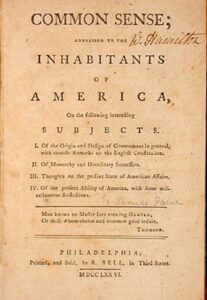
In Common Sense, Paine spoke in plain, compelling terms, making the case for why America should separate from the British Empire.
But the phrase “We have it in our power to begin the world over again” did not appear in the first edition of the pamphlet published on January 10, 1776. It was added to the new edition released on February 14, 1776.
The Full Excerpt
Here is the fuller quote from the appendix of the second edition:
“We have it in our power to begin the world over again. A situation, similar to the present, hath not happened since the days of Noah until now. The birthday of a new world is at hand, and a race of men, perhaps as numerous as all Europe contains, are to receive their portion of freedom from the events of a few months. The reflection is awful, and in this point of view, how trifling, how ridiculous, do the little paltry cavilings of a few weak or interested men appear, when weighed against the business of a world.”
Why the Appendix Was Added
The appendix in the second edition of Common Sense was added for several reasons:
• Keep the Momentum Going: While exact sales figures for the first month of Common Sense are hard to confirm, we know that 120,000 copies were sold within three months of its release. Some historians estimate that up to half a million copies circulated in its first year—remarkable considering the 13 colonies had a population of roughly 2.5 million. These numbers make it clear that the pamphlet was immediately popular. With this rapid success, Paine aimed to ensure that public support for independence remained strong and that the push for a break from Britain continued without losing steam.
• Address Early Critiques: The appendix allowed Paine to respond to objections and questions that readers and critics raised after the first edition, sharpening his arguments and making them more persuasive.
• Answer Pacifist Concerns: Some Quaker leaders had objected to taking up arms or fully endorsing separation from Britain. Paine used the new material to directly counter these pacifist positions.
• Stress Immediate Action: The added content made clear that independence wasn’t just inevitable—it was urgent. Paine argued that delaying separation would only prolong conflict and make it more difficult.
• Reinforce the Vision: Overall, the appendix strengthened the case for creating a new, democratic nation, turning Paine’s ideas into a compelling call to action for the colonies.
About Featured Image
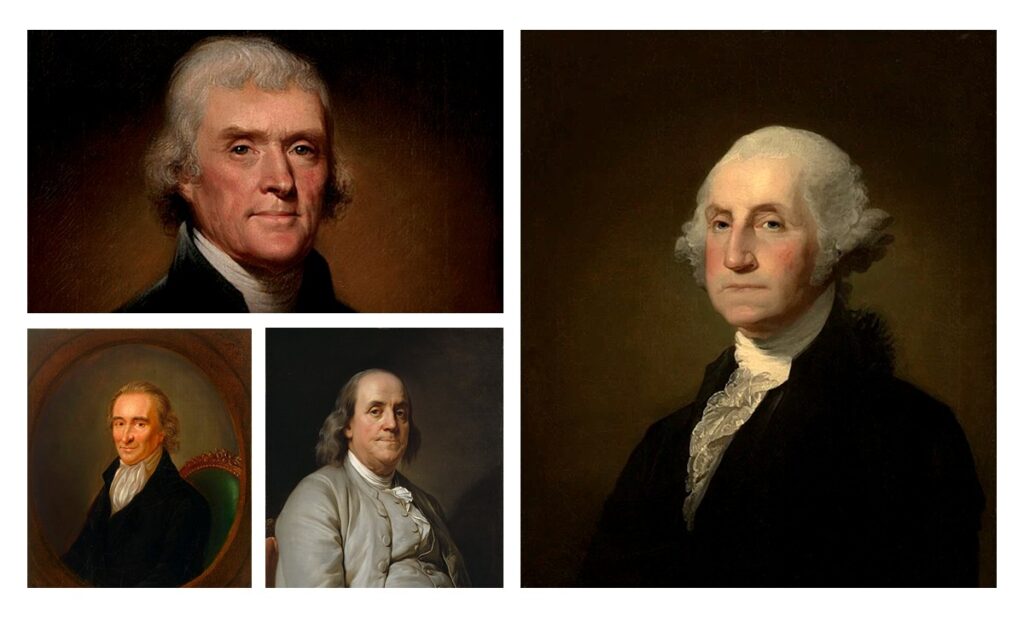
Image of four American founders, clockwise from top: Thomas Jefferson, George Washington, Benjamin Franklin, and Thomas Paine.
Related Interviews and Essays
In a two-part interview, Dr. Harvey Kaye explores the life of Thomas Paine, tracing his journey from a man trying to reshape his own life to a figure who changed history, and telling the story behind Common Sense—the pamphlet that transformed a rebellion into a revolution.
If you want the deeper story of Thomas Paine, I highly recommend my interviews with Dr. Kaye:
- How Thomas Paine Became Thomas Paine: The Origins of “Common Sense”
- Thomas Paine to Obama: Why America’s “Original” Founder Still Matters Today
Dr. Kaye’s major works include:
- The Powers of the Past: Reflections on the Crisis and the Promise of History,
- Why Do Ruling Classes Fear History?,
- Are We Good Citizens? Affairs Political, Literary, and Academic,
- The Fight for the Four Freedoms: What Made FDR and the Greatest Generation Truly Great,
- Thomas Paine: Firebrand of the Revolution, and
- Thomas Paine and the Promise of America.
 How Thomas Paine became the clarion voice of the Revolution?
About This Program
Analyzing American Revolution (AAR) is a special series podcast production of the History Behind News program. In this series, 33 professors (and counting) analyze the American Revolution from 33 different angles through in-depth interviews with host Adel Aali.
Themes of the Revolution
Tap below for a closer look at the Revolutionary Era themes we examine—and to meet our guest scholars.

Visit our Revolutionary Era Blog page for
- Interview Transcript Highlights
- Interview Image and Artist Highlights
- Quiz Answers and Backstories

Visual Index of the American Revolution
Explore the backstories and artist bios behind images of our Founding—before and after the American Revolution. These visuals shape how we remember—and reimagine—the Revolutionary Era.

Experienced Analysis of History
About HbN Program:
The History Behind News program (HbN) is committed to making in-depth history researched and written by scholars enjoyable and accessible to everyone. Our motto is bridging scholarly works to everyday news.
The histories we’ve uncovered encompass an impressively wide range of subjects from ancient history to U.S. politics and economy to race, women’s rights, immigration, climate, science, military, war, China, Europe, Middle East, Russia & Ukraine, Africa and the Americas to many other issues in the news. We also receive advanced copies of scholarly books and discuss them in our program (in the context of current news).

Adel Aali, host. Snapshot from his introductory video to AAR podcast. Click to learn more about AAR.
217 Scholars & Counting:
Our guests are scholars in prestigious institutions, such as Oxford, Yale, Caltech, Harvard, MIT, Stanford, the Hoover Institution, the American Enterprise Institute, Quincy Institute for Responsible Statecraft, King’s College London, Princeton University, Notre Dame, Dartmouth College, University of Pennsylvania, Columbia University, the Atlantic Council, Duke, Amherst College, University of Michigan, Rhodes College, Emory University, Northwestern Law, Vanderbilt University, US Naval War College, Air Command and Staff College, Marine Corp University, UVA, Johns Hopkins, Cornell, NYU, Rice, University of Chicago, White House Historical Association, Baylor University, USC, UC Berkeley, UCSF, UCI, UCSD, UC Davis, UCR, Tel Aviv University, Hebrew University of Jerusalem, the Israel Democracy Institute, University of Aberdeen, Universidad Complutense de Madrid, University of Navarra, University of Seville, Helsinki University, Diego Portales University (Chile), Lund University (Sweden), University of Edinburgh, Near East University (Türkiye), Cardiff University, the Free University of Berlin and many others.
They include Pulitzer Prize winners, renowned documentary producers, former White House advisors and other high-ranking government officials, and current and former senior reporters at The Wall Street Journal and New York Times Magazine. Many have testified in Congressional hearings and others frequently contribute to major media outlets and widely read publications, ranging from the BBC, NPR, PBS and MSNBC to The Wall Street Journal and The New York Times.
Think You Know the American Revolution?