Updated: September 28, 2026
Introduction
In this interview: “It’s actually the other way. Nova Scotia asks to be invaded.”
Watch this segment in the video below (37:49)
Did Nova Scotia really asked to be invaded? If so, then why did George Washington refuse? And why did he invade Quebec instead – a campaign that ultimately failed?
Why did Congress expect French Canadians in Quebec to welcome American troops? Why did Quebec reject repeated invitations to join the Revolution? And what does Canada’s refusal reveal about why thirteen other colonies ultimately became the United States?
In this interview, Dr. Jeffers Lennox repositions Canada within the history of the American Revolution, showing that the northern colonies were neither distant observers nor inevitable parts of a separate country. They influenced American military strategy, the movement toward independence and early conceptions of how far the new union might extend.
Video
Watch the full interview with Dr. Lennox (timestamped outline below)
Key Themes
- Why Only Thirteen British Colonies Rebelled
- American and Canadian Identities Before Nationhood
- American Efforts to Bring Canada into the Revolution
- How American Defeat in Quebec Strengthened the Case for Independence
- Why New England Rebelled and Nova Scotia Did Not
Central Question
Why did thirteen British colonies rebel while Quebec, Nova Scotia, and Newfoundland remained within the British Empire, and how did that divergence shape American independence and the eventual boundary between the United States and Canada?

How to Use This Post
Use this post as reference guide to the American Revolution through the lens of this interview and the broader Analyzing American Revolution program (AARevolution). Navigate using the interactive table of contents above and the timestamps below (in gray) to discover how this interview deepens the story of the Revolution—and to explore how the program unfolds: its key themes, insights, image gallery, scholars list, history quizzes, and related interviews across the series.
The Revolution’s Northern Border Was Not Inevitable
In 1775, no national border cleanly separated “Americans” from “Canadians.” Canada did not yet exist as a country; Quebec, Nova Scotia and Newfoundland were separate British colonies, while most of the surrounding territory remained Indigenous homelands. Nor were the northern colonies in Canada entirely foreign to the thirteen colonies that rebelled. Nearly half of Nova Scotia’s settler population consisted of relatively recent migrants from New England, British American merchants moved regularly between British ports and Montreal, and a person in Boston might have felt more connected to Nova Scotia than to Georgia. Even “American” was primarily a geographic designation encompassing the whole of British North America rather than a national identity.
The more revealing question, therefore, is not why Canada remained outside an already-defined American nation, but why closely connected British colonies chose different paths. In Quebec, Britain secured the cooperation of Catholic bishops by protecting French religion and language; those bishops subsequently warned their parishioners against supporting the rebellion. Nova Scotia lacked New England’s dense network of self-governing towns through which Committees of Correspondence and Committees of Safety could be organized, while its institutional relationship with Parliament also gave it less basis for rejecting parliamentary authority. Yet separation was hardly predetermined: Nova Scotian Patriots asked for American troops, Congress repeatedly appealed to Quebec, and American forces invaded Quebec expecting to be welcomed as liberators.
The eventual border between Canada and the United States emerged from these competing loyalties, political institutions, failed appeals and military decisions—not from two clearly separated national communities that already existed before the Revolution.
About My 226th Guest: Dr. Jeffers Lennox
Dr. Jeffers Lennox is a professor at Wesleyan University, where he is a historian of early North America, with a specific focus on the history of interactions between British, French, and Indigenous peoples. His books include the following:
- Homelands and Empires: Indigenous Spaces, Imperial Fictions, and Competition for Territory in Northeastern North America, 1690–1763, which won the following key historical award: (1) Canadian Historical Association, Clio Award, Atlantic History; (2) Canadian Historical Association, Best Book in Canadian History; and (3) North American Society for Oceanic History, John Lyman Book Award, Canadian Maritime History
- North of America: Loyalists, Indigenous Nations, and the Borders of the Long American Revolution
- Historical Dictionary of the Early American Republic, 2nd ed., coauthored with Richard Buel Jr.
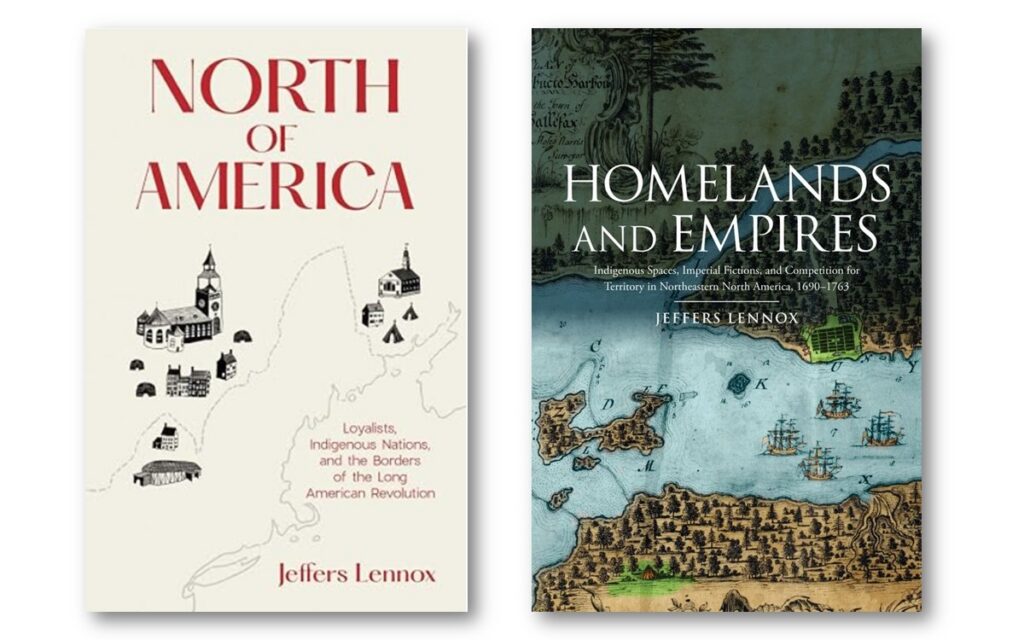 Books by Dr. Lennox
About This Post’s Featured Image
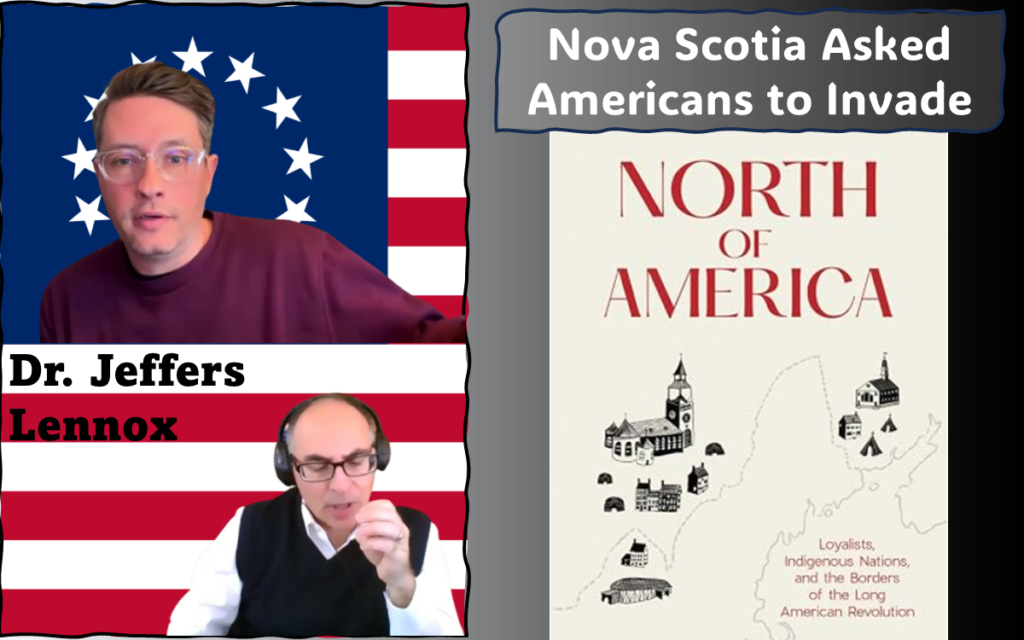
Image of Adel Aali (program host) and his guest, Dr. Jeffers Lennox, superimposed on the Betsy Ross flag, along cover image of “North of America: Loyalists, Indigenous Nations, and the Borders of the Long American Revolution”.
Unless otherwise indicated, all images in AAR—including those in this post—are in the public domain.
AAR Essential Insights
Although the full video and transcript of my conversation with Dr. Lennox are included in this post, I’ve selected and summarized several insights that I found particularly revealing and worth emphasizing. These moments — some surprising, others that challenge familiar assumptions — help us see how the American Revolution has been remembered throughout our history.
By the way, these insights are my own takes and interpretations from the interview. For Dr. Lennox’s perspective and exact framing, please watch the interview above and view the transcript below in the corresponding sections.
Stop Reading the Revolution Backward
We begin with thirteen colonies because we know how the story ends. That is precisely the trap. The thirteen did not enter the 1770s as a natural political unit waiting to become the United States. British officials viewed them as part of a much larger collection of colonies. And to be sure, those colonies—Massachusetts and Virginia and the others—had vastly different origins, governments, economies and social structures.
And in the beginning, with the “shot heard ’round the world” in the Battles of Lexington and Concord on April 19, 1775, independence was not the objective. In fact, independence was not on most people’s minds as late as January 1776. Rather, it emerged from choices made during the crisis.
Just as we should not read the Revolution backward with respect to America’s Declaration of Independence, we should also not read the Revolution backward regarding the eventual border between the United States and Canada. As Dr. Lennox explains, there was nothing inevitable about it.
For example, half of Nova Scotia’s settler population came from New England. Merchants and ideas moved between the colonies and Montreal. For someone in Boston, Nova Scotia or Montreal could feel more familiar than Savannah. Identity followed province, region, religion, occupation and economy—a “sea person” in New England might understand another maritime community in Nova Scotia or Newfoundland more readily than a plantation society in South Carolina hundreds of miles to the south.
Canada did not remain outside an already coherent American nation—because no such nation yet existed. The more difficult historical question is why some closely connected British colonies eventually made common cause in rebellion while others did not. The international border followed those contingent decisions. It did not precede them.
Watch this segment in the video above (14:19)
When “American” Included People from Montreal
Who counted as an American in the eighteenth century?
The answer may surprise you: not just the future citizens of the United States.
A British subject in Montreal could be a British American just as readily as one in Charleston. “American” described geography—the continent—rather than nationality. That is why a British officer could appeal to Ethan Allen by telling him they were “both Americans” while attempting to bring Vermont back into the British Empire. The statement sounds strange to us because we treat “American” as a national identity. In the eighteenth century, however, it made perfect sense.
“Canadian” was no more straightforward. It commonly referred to a French person living in Quebec, while Indigenous nations defined themselves through their own peoples and homelands. The Wabanaki, for example, were the “people of the Dawnland.” British Protestants, French Catholics, Acadians and Indigenous nations did not constitute a single Canadian public with one political identity or one response to the Revolution.
I would go further: this is not merely a vocabulary lesson. The Revolution changed the political meaning of “American.” Some British Americans stopped defining themselves as British and gradually transformed “American” from a geographic, continental designation into a national identity. And yes, others did retain their British allegiance.
So if we impose our present-day labels on that earlier world, we assign national loyalties before people had actually chosen or embraced them—and once again mistake the Revolution’s outcome for its starting point.
Watch this segment in the video above (22:10)
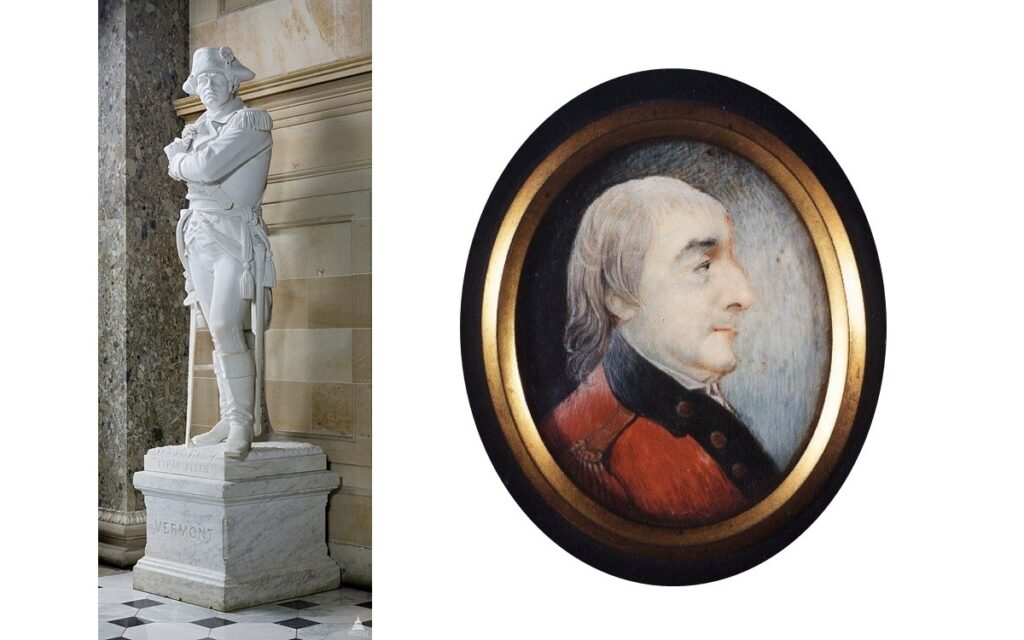 Statue of Ethan Allen (1738–1789), carved from Vermont marble, in National Statuary Hall at the U.S. Capitol.
Portrait of Beverley Robinson (1721–1792).
In this interview, Dr. Lennox discusses a letter from Robinson to Allen that helps explain the eighteenth-century meaning of “American.
Watch this segment at 24:54
The Colony That Asked to Be Invaded Was Refused
In October 1774, the Continental Congress sent Quebec a translated appeal promising the British rights its residents supposedly lacked: representative government, trial by jury and a place in Congress. Yet at roughly the same time, Congress appealed to the people of Great Britain by condemning Catholicism—the faith practiced by most French Canadians. This was more than a messaging failure. It exposed the distance between the Revolution’s universal language of rights and the religious prejudices carried by many of its advocates.
So, it’s not surprising that Quebec sent no delegates to the Continental Congress. But that didn’t stop Congress from trying again. When persuasion didn’t work, American revolutionaries turned to military action. They assumed that French Canadians, conquered by Britain only a little more than a decade earlier, would welcome them as liberators. What they failed to appreciate was that Britain had actually protected the Catholic Church and preserved the authority of Quebec’s bishops. Congress’s mistake was that it interpreted French memories of conquest as natural support for rebellion while underestimating the accommodations that made British rule acceptable.
The response of some Patriots in Nova Scotia to the Revolution in the Thirteen Colonies turns the story of the Patriots’ invasion of Canada on its head.
The reversal is striking—and it surprised me: a small group of Nova Scotian Patriots asked Congress to send troops there and promised to rebel against Britain. George Washington, however, refused this seemingly easier target because he believed invading Nova Scotia would be “an act of aggression” and would transform a defensive struggle for British rights into a different kind of war. Shortly afterward, however, he approved an invasion of Quebec—a colony that had ignored American appeals—because capturing it would provide a more valuable bargaining chip against Britain.
For me, this is the larger insight: American strategy did not simply follow local enthusiasm for revolution. The colony requesting intervention was refused; the colony resisting recruitment was invaded. Military value, political assumptions and the still-uncertain purpose of the war mattered more than the preferences of the populations America claimed it intended to liberate.
Watch this segment in the video above (30:15)
Why Washington Invaded Quebec—Not Nova Scotia
Continue watching at 33:25 in the video above
Watch more short videos about the American Revolution
How Defeat in Quebec Strengthened the Case for Independence
Initially, the invasion of Quebec was not part of a campaign for national independence. In fact, at the time of the invasion in 1775, independence was not yet the objective!
For American revolutionaries, a captured Quebec would be a valuable “bargaining chip” with Britain. In addition, patriot interest in the region was connected to western land: the Proclamation of 1763 had restricted settlement beyond the Appalachians, and the Quebec Act subsequently placed much of the Ohio River Valley under Quebec’s administration. The campaign therefore combined the language of British rights with military pressure and continental ambition.
Then the invasion failed. News of the American retreat reached the colonies in January 1776 just as Thomas Paine published “Common Sense”. That convergence matters. Readers encountered Paine’s case for independence alongside accounts of defeat, retreat and sacrifice in Quebec. Congressional delegate Abraham Clark reasoned that independence could take some of the sting out of the failure because the colonies now faced a sharper choice: independence or conquest.
Thomas Paine soon reinforced that connection through an anonymous story in which the ghost of Richard Montgomery—killed during the assault on Quebec—warned that the colonies “cannot go back” to Britain without rendering his death meaningless. Military sacrifice was changing the moral calculation. Reconciliation could now be portrayed not merely as a political retreat but as a betrayal of those who had already died.
I would not draw a direct causal chain from the he failed Quebec campaign to the decision for independence. But the defeat helped transform the purpose of the conflict. A war initially fought to preserve British rights increasingly became a war in which returning to British rule appeared impossible.
What I find telling—and quite remarkable—is that even after the invasion failed the Articles of Confederation allowed Canada to enter the union automatically—without the vote required of any other prospective state. The military campaign had ended; the ambition to incorporate Canada had not.
Watch this segment in the video above (38:45)
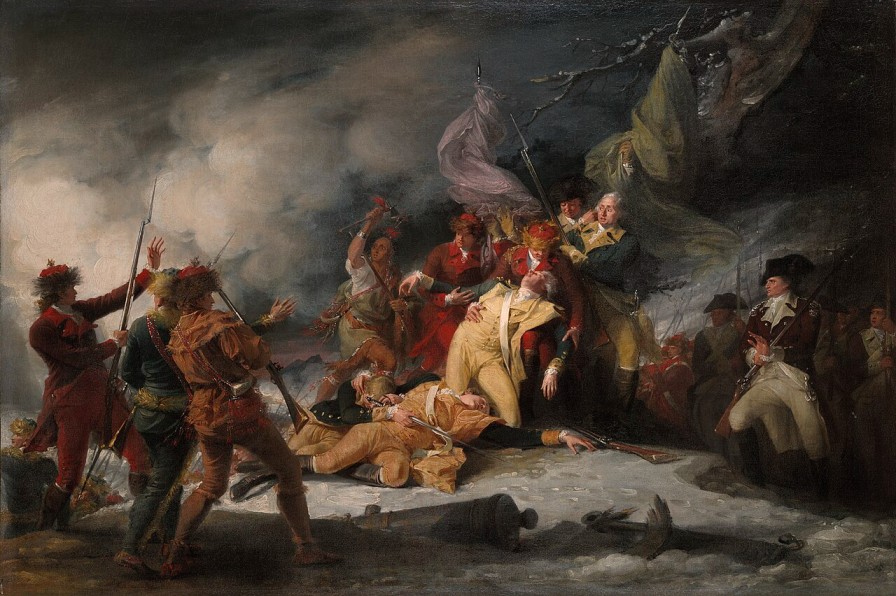 “The Death of General Montgomery in the Attack on Quebec, December 31, 1775”, a 1786 painting by John Trumbull, whose iconic paintings include “The Declaration of Independence”, “Surrender of Lord Cornwallis”, “Surrender of General Burgoyne”, “General George Washington Resigning His Commission” and many others.
In this interview, Dr. Lennox describes how Richard Montgomery’s martyrdom—and Thomas Paine’s story of Montgomery’s ghost—helped transform a rebellion for British rights into a revolution for independence.
Watch this segment at 45:27
Why New England Could Mobilize for Revolution but Nova Scotia Could Not
Battles dominate the history we learn because they are the most visible part of the Revolution. But before armies could fight, communities had to communicate, organize and exercise authority.
New England’s densely settled, self-governing towns provided that machinery. Committees of Correspondence circulated information, while Committees of Safety coordinated resistance. By the Revolution, these local institutions were helping govern the colonies regardless of what British officials directed.
Nova Scotia provides a revealing comparison because it possessed strong connections to New England and a substantial population of recent New England migrants. Yet its settlements were more dispersed, its towns were fewer and its Congregational institutions were weaker. It lacked the numerous local centers of authority through which opposition could spread and become coordinated political action. Some Nova Scotian Patriots wanted to rebel, but sympathy for rebellion was not the same as possessing the institutional capacity to sustain one.
The colonies also had different constitutional relationships with Parliament. Many of the rebelling colonies had been established before the Glorious Revolution of 1688, when royal charters could serve as the basis for arguing that Parliament had no authority over them. Nova Scotia and Quebec developed within a later imperial structure in which Parliament was already part of their political creation. Parliamentary taxation could still be unwelcome, but it was harder to characterize as an entirely new and illegitimate intrusion. But Georgia was the exception, and it reminds us that this distinction was influential rather than determinative.
What stands out to me is that revolutions require more than grievances or persuasive ideas. They require institutions capable of translating dissatisfaction into collective action. Local government was not merely the administrative backdrop to the American Revolution; it was part of the infrastructure that made resistance possible. If we concentrate only on battles, we miss a central reason why one closely connected society could organize a revolution while another could not.
Watch this segment in the video above (49:57)
The Interview (S1E31): Adel Aali and Jeffers Lennox
In our conversation, Dr. Lennox addresses key questions and reveals untold stories about Canada and American Revolution. The detailed outline and full transcript below supplement the video above.
Podcast
Watch the full interview on this page with the outline and transcript below, or take the conversation with you on the go through our Spotify podcast.
Outline
Use the in-depth outline below, with its key moments and turning points, to follow the discussion and navigate the interview.
Click for Timestamped Outline
- Selected Highlights (00:00:00)
- British Canada Before Canada (00:04:00)
- Quebec, Nova Scotia, Newfoundland, and Hudson’s Bay Company Territory (00:04:46)
- Indigenous Homelands and Shifting Colonial Claims (00:07:21) – Turning Point (00:10:18)
- How Britain Governed Its Northern Colonies (00:10:38)
- Upper and Lower Canada and Newfoundland’s Rule of the Admirals (00:11:11)
- Halifax, Quebec, and Military Government (00:12:11)
- The American Revolution Beyond Thirteen Colonies (00:14:10)
- Connections and Differences Across British North America (00:14:59)
- Why Independence Was Not Inevitable (00:16:47) – Key Moment (00:17:29)
- Local Identities Before the United States (00:18:14)
- Thomas Jefferson’s Virginia and Benjamin Franklin’s Pennsylvania (00:18:44)
- New England’s Ties to Nova Scotia and Montreal (00:20:16)
- Who Counted as an American? (00:22:10)
- Canadiens, Indigenous Nations, and British Americans (00:22:35)
- “American” as a Geographic Identity (00:24:05) – Key Moment (00:25:40)
- Religion, Settlement, and Appeals to Quebec (00:27:01)
- Protestants, Catholics, and the Great Deportation (00:27:19)
- Congress’s Letters and Its Anti-Catholic Contradiction (00:30:45)
- Nova Scotia’s Invitation and George Washington’s Choice (00:33:17)
- Nova Scotia Asks to Be Invaded (00:33:32) – Key Moment (00:33:57)
- George Washington Rejects Nova Scotia but Approves Quebec (00:34:03) – Turning Point (00:34:32)
- Why Quebec Refused—and Why Americans Wanted It (00:35:02)
- Expected Liberators and Catholic Opposition (00:35:10)
- The Quebec Act and American Ambitions for Western Land (00:38:45)
- American Defeat in Quebec and the Case for Independence (00:43:25)
- The Failed Invasion and Common Sense (00:43:36) – Turning Point (00:44:26)
- Richard Montgomery’s Ghost and Canada’s Automatic Admission (00:45:44)
- Why the Northern Colonies Remained British (00:49:57)
- Nova Scotia’s Missing Networks of Local Resistance (00:51:46)
- Parliament, Salutary Neglect, and Religious Accommodation (00:54:10)
- Just One Point (00:59:36)
- Commemorating the Revolution as an Attempt to Build Something Better (00:59:55)
- Canada as an Alternate Revolutionary Outcome (01:01:00)
Transcript
Note: This transcript was generated automatically and may contain minor errors. It is provided for reference and accessibility only.
Click to View Transcript
Adel:
Dr. Lennox, it’s a pleasure to have you in our program’s special series. Thank you for taking the time for this conversation with me about the American Revolution. So before we discuss the American Revolution in the context of North America, let’s set the stage for our audience with some basic points that I bet won’t be so basic after all.
To be sure, in the years up to the American Revolution and beyond, the country of Canada obviously had not been founded yet, so we’re talking about British Canada. So what was this massive geography above the 13 colonies called?
Dr. Lennox:
Yeah, that’s an interesting point. Canada at the time was a shorthand. A shorthand, okay.
Yeah, because there was nothing there that was actually called Canada. We had the colony of Quebec that they would refer to at times as Canada, but it was in fact Quebec. That was just one of the British colonies north of the rebelling colonies.
At the time, we had Quebec, you have Nova Scotia, you have Newfoundland. Those are sort of the big three. West of Quebec is the Hudson’s Bay Company territory, so it’s sort of a- Not even a colony, just a territory of Hudson Bay Company?
Yeah, it’s not really a colony. It’s sort of a commercial enterprise that the British passed off to the Hudson’s Bay Company to run. I think the important thing to keep in mind is all of these places are largely indigenous homelands.
They’re sort of small pockets of settlements. Halifax is established in 1749. There’s obviously Montreal, Trois-Rivières, Quebec City.
There are increasingly sort of military posts as you go farther west, like trading posts. The mass of the geography are indigenous homelands that are governed by indigenous nations and that are protected by indigenous warriors who are very wary of any kind of settlers trying to take their territories.
Adel:
Encroachment. The way you describe it then, we’re talking no Alberta, no British Columbia, certainly no Yukon or any of that.
Dr. Lennox:
No, those are all 19th century creations and 19th and early 20th century creations. Those become provinces after the country of Canada is created in 1867. I see.
But it is very much just the main colonies of Quebec, Nova Scotia, Newfoundland are the primary ones, but those are still largely indigenous.
Adel:
Okay. Here’s a little bit of a mix of nomenclature, geography, and history. Three colonies, Newfoundland, Nova Scotia, and colony of Quebec.
Were these newly formed or newly acquired colonies, like if we go back to 1740s or 1730s, were these French territories? How did this work? Was there like a whole cauldron of activity and changes happening in the North?
Dr. Lennox:
Definitely, yeah. Newfoundland is sort of British from the 17th century on. The French have regions on Newfoundland where they fish.
There’s not a lot of permanent European settlement in Newfoundland. It is seasonal, it’s transitory. They come in for the fishery and then many go home and they leave a handful of people to overwinter, to hold their sites.
This doesn’t have a huge population, but it is primarily British. Still has a low population. Still does, yeah, but they love it there.
Newfoundlanders are a special breed of Canadian.
Adel:
Have you been?
Dr. Lennox:
I have not, no. It’s my great, I think it’s one of my great faults is I haven’t been there yet.
Adel:
No, mine too. As I told you, I’ve been to Nova Scotia and maybe Newfoundland is my next one, but go ahead.
Dr. Lennox:
Nova Scotia, it started as French Acadia. Nova Scotia, the way that we think of it today is Mi’kma’ki. It’s the homeland of the Mi’kmaq peoples and they had been there for 13,000 years.
The French arrive at the beginning of the 17th century. Samuel Champlain and others set up the first French settlements in what becomes what they call Acadia, La Cadie. There are, over the course of the 17th century, a few conflicts where New Englanders go up and they capture a fort in Acadia and they claim they’ve captured the whole place.
It goes back to the French at various pieces. In 1710, the British capture the post of Port Royal, which is Annapolis Royal today, and they hold it. From that point on, from 1710 on, although there are battles and some conflicting ideas over the boundaries, French Acadia is essentially Nova Scotia at that point.
Quebec had also been established early, 1608. Champlain establishes the settlement at what is now Quebec City. It stayed French until the end of the Seven Years’ War when the British were able to conquer Montreal and Quebec City and eventually all of New France and to make it a British territory.
They are much newer than many of what will become the rebelling colonies.
Adel:
I see. In the British world, they’re much newer. What was the British administration or geographic division of administration of Canada like?
I asked this question, when you see the maps you read about, or even in video games about that time, you see Upper Canada, Lower Canada. What was that like?
Dr. Lennox:
Upper Canada and Lower Canada are a little bit more…
Adel:
By the way, great. Everyone now knows that I play video games.
Dr. Lennox:
That’s right. Exactly. Upper Canada and Lower Canada is a 19th century separation.
When we think about these places as administrative units, it’s pretty fascinating. Newfoundland has a strange system of government that my PhD supervisor wrote about. It’s called the Rule of the Admirals.
Because it was just a fishing site, it was run much more by custom than by law. Each year, the first ship that arrived, the captain of that ship would be the governor for the season. It was a lot more based on tradition and custom and less of a strictly state-run colony.
Nova Scotia, with the founding of Halifax in 1749, it becomes a much more important place to the British Empire, in part because they established Halifax as a military site. Unlike most of the British American colonies, it’s not supposed to make money. It’s not supposed to necessarily produce anything.
Halifax is there because they want to protect Massachusetts from the French at Louisbourg. The French have this massive fortress at Louisbourg. They’re worried.
They build Halifax in the middle there.
Adel:
Louisbourg itself has changed hands several times between the French and the British.
Dr. Lennox:
Yeah, it is captured in the 1740s. New Englanders capture it and then they return it at the peace. Then when they capture it the second time during the Seven Years’ War, they actually level it so that it can’t go back.
The Louisbourg that exists now is a recreation.
Adel:
Yeah, we’ve visited it. It’s really interesting.
Dr. Lennox:
It’s an amazing place. In Nova Scotia, it takes a little while to get an assembly. It takes them over a decade to actually have an assembly there because it’s a military rule.
When the British eventually capture Quebec, they just run it as a military colony. There isn’t an assembly there. The British are pretty good at winning over the Catholic bishops and the leaders of the Catholic Church.
That’s where most power and instruction comes from for the French Canadians who are very Catholic and go to church to get their instructions. All three of these have obviously recognizable administrations, but they’re not run like Massachusetts or Virginia or other places.
Adel:
Yeah. I have this question queued up for you, Dr. Lennox, and I think I now have the answer for it. I wanted to know, okay, after 1763, after the French-Indian War is over, the Seven Years’ War is over, why didn’t the British just mix the 13 colonies in the South, kind of like the 14 in Florida and all of that, with Canada, what we’ve been discussing, the three colonies in particular?
But they’re so different. Halifax, you said, was just a military base. Quebec was sort of a military colony.
They had Catholics, and Newfoundland was just a whole different thing. Is that a good sort of summation?
Dr. Lennox:
Yeah, I think so. One of the challenges is, of course, not reading the 13 colonies backwards and not reading the revolution backwards, because these colonies were, in the 1760s and the 1770s, 50% of the people who lived in Nova Scotia were migrants from New England. There was a ton of movement.
Lots of British American merchants go to Montreal. There’s regular ideological ideas are crossing these borders. Even the 13 American colonies were founded under different conditions and ran themselves differently.
Massachusetts is kind of a theocracy. Virginia is really just an outpost for capitalists and resource extraction. Most of these colonies are actually quite different.
It’s a fairly diverse group of British colonies that exist right up to the time of the revolution. British officials certainly thought of them as a collection. They didn’t think of 13 and then these other groups.
They thought of all of them together. Affinities tended to be more regional than we might think of today.
Adel:
I see. That’s an interesting phrase. I understood what you just shared with us.
I just want to go back to the way you phrased it, sort of phrased the paragraph before you started explaining. You said, not reading the revolution backwards. Just explain that last word.
Is this something that has previously been asked of you or you’ve been approached about?
Dr. Lennox:
This is how I start most of my classes on the revolution. I say, okay, how many colonies were there in 1776? People say 13.
I say, no. Then we start listing the other colonies, British colonies in the Caribbean. There are a whole bunch of British colonies in North America.
In the 1760s and even in the early 1770s, independence wasn’t the goal. Not a lot of people were thinking about independence even at the beginning of the American Revolution. It was fought for different reasons.
It’s important, I think, to keep that context front and center because it does help complicate some of the questions we ask about the revolution. It helps us, I think, understand more clearly the outcome of the revolution when we realize it wasn’t inevitable. Nothing’s inevitable.
People had to make decisions about what they were going to do. Just because we know the revolution happens and independence happens, we can’t then use that knowledge when we’re thinking about 1750 and 1760 because those folks didn’t have that knowledge.
Adel:
That’s very interesting and that’s very true. Let me ask another question to complicate this further. You, in the first day of class, ask your kids, your students who are not necessarily kids, how many colonies, and they say 13 and you correct them.
The 13, and I use that T capital because there were other colonies as well, those 13 colonies were part of a collection. Did the American colonies collectively together, like let’s say someone going from Georgia to Pennsylvania, did they think that the person from GA and PA was different than the person from Nova Scotia? Did they see themselves?
They did.
Dr. Lennox:
They did, but I would say the person from Georgia saw themselves differently than the person from Virginia and the person from Massachusetts. When you go back and you read, this is another kind of tricky thing that I play with with the students, when you go back in the 18th century, well up into the 1760s, 1770s, and someone like Thomas Jefferson writes about his country or Ben Franklin writes about his country. Jefferson’s talking about Virginia.
Franklin is talking about Pennsylvania. They are not talking about the country of the United States until you get into the 1790s when there actually is a country. They are thinking about their state as the place where they’re from and what defines them.
There were all kinds of regional differences that made someone from New England as different as someone from Georgia, as they would think is different from Nova Scotia. They are thinking very locally at this point. It takes a while for nationalism as a concept to be born out of what happens during the revolution.
Adel:
Although they thought locally, okay, let’s say a person from Massachusetts knew that he is different than a person from GA, but did that person, that hypothetical person, would have thought, okay, I have more in common with a person from Georgia than I do from a person from Nova Scotia?
Dr. Lennox:
No, they would have said much more similar. Half of my family is in Nova Scotia. I spend three months a year fishing off the coast of Nova Scotia and Newfoundland.
I’m a sea person. I’m not a crop person. There’s all kinds of ways that they would imagine their identity.
Obviously, the difference between states that are slave societies versus states that are societies with slaves would be another way of distinguishing. People in the South, that’s an economy based on enslavement and forced labor, whereas in the North, there are enslaved people who are unfree and laboring, but they’re not underpinning the economy in the same way. People understood their identities in a variety of ways and could certainly find commonalities between New England and Georgia, but it was easier to talk about, even to talk about probably Montreal was easier than to talk about Savannah if you’re somebody who’s living in Boston.
There’s a geography textbook, this guy Jedediah Morse, who’s a geographer and a guy from New Haven. He writes one of the first geography textbooks and then he starts contextualizing American geography. He’s a New Englander and you get from reading his books that Montreal makes more sense to him than the South.
When he does his tours of the South to collect geographic information, that’s more of a foreign country than when he has to make his way up through upstate New York and then into Quebec. He recognizes things in those places in ways that he doesn’t recognize when he goes to the South.
Adel:
Okay, we’ve talked geography and I’ve also used the term people of Canada and Canada, so let me ask this, who are the people of British Canada? I mean, you said Indigenous people and I also heard you say Catholics and French, so let me just stop there and have you share that with us.
Dr. Lennox:
Sure, so French Canadians from Quebec, living in Quebec, would have called themselves Canadien, right? They would have been, the truest sense of someone calling someone a Canadian would have been a French person living in Quebec. Indigenous nations were, I mean this is another kind of fascinating one that I try to get through with my students.
They are, for the most part, and there’s all kinds of caveats, but they define themselves by where they are and you can see that in the names that they have for themselves. So you’ve got in the northeast, the Wabanaki, the Abenaki, that translates to people of the Dawnland because they live somewhere where the sun hits first. Most Indigenous names translate into something like the people or the people of the place.
Many Indigenous nations have a second name that they didn’t give to themselves, that someone else gave to them, and it’s usually something that translates into the people that talk funny or the people who are very violent and we’re afraid of. And so it can be difficult for students to kind of decide what term they should use when they’re talking about an Indigenous nation. And we always try to find the one that they call themselves, which usually, as I said, is a version of the people.
And then, of course, there are the British Americans and they define themselves as being British. And the British Americans in Montreal define themselves as being British, just as the British Americans in Charleston define themselves as being British. It really was their identity was tied to their belief that they are part of the British Empire.
And that was an important breaking point in the revolution, where people stopped thinking of themselves as British and started thinking of themselves as something else.
Adel:
And when you say, if I may interject here, when you say British Americans, let’s say Montreal, by that American, you mean of North America, not as in America, as in the future USA.
Dr. Lennox:
Yes. But that was how it was understood at the time. In the 18th century, everyone considered themselves British Americans and Americans.
I mean, American was a term that the British would use as well. There’s a good example I came across researching this last book, where Ethan Allen of Vermont, who’s this Green Mountain boy, rebel, really wants, helps establish the independent republic of Vermont. And Beverly Robinson, who’s a British army official, is trying to win Ethan Allen over to the British side, really wants them to join Quebec.
That’s always an option for Vermont, is to become a British colony. And Beverly Robinson writes to him and says, look, we’re both Americans. So let’s talk about our relationship to each other and what we may be able to offer you.
And that was really common. The term American is not a national term. It’s a geographic term for the continent of America.
But it doesn’t take on the meaning that we have for it until later, after the revolution, after the constitution, and then you start to have like citizens of the United States of America. Then American takes a slightly different turn.
Adel:
Oh, that’s interesting. So let’s say, I don’t know, in 1768, 1769, two businessmen or politicians speaking in London about an American. They could have been talking about someone in Nova Scotia or Montreal or someone in New York City.
Absolutely. Yeah, that’s really interesting. Okay.
Okay. So were these British Americans who I’m betting were pretty much all of them white? Were these Protestant?
Were these from Great Britain? Ireland was not part of Great Britain yet then. So tell us a little bit more about that, please.
Dr. Lennox:
Yeah, so they are, I mean, many are, you know, I guess the proper term would be Creole, right? They were born in North America. It is primarily a Protestant place.
Obviously, in the rebelling colonies, you have parts of Virginia and a whole lot of Maryland that are Catholic. But those Catholics are always, they’re looked at upon with some suspicion because they’re not Protestant, but they’re generally accepted. We have several exceptional Catholics from Maryland that go on to hold important government positions and all the rest of it.
There are clearly divisions within this broad Protestant faith, you know, the evangelicals and the congregationalists living in the northeast. And you have Anglicans or what become Episcopalians after the revolution. That’s sort of the state church of Great Britain or of England.
And lots of atheists and Baptists and, you know, the Great Awakening has happened. So there’s lots of kind of dissenting, more radical sects. You’ve got Quakers.
Adel:
How about places like Lisbon, Nova Scotia and Quebec? Were they still Catholic, sort of remnants of France?
Dr. Lennox:
Quebec was very much Catholic. Yes, very Catholic. There are places like Montreal where you get more British American migration and settlement, have more Protestants.
But Quebec is quite Catholic. Nova Scotia have the Acadians, the original French settlers. They outnumber most of the Protestants in the province until after the American Revolution because, well, during the Seven Years’ War, Britain rounds up 15,000 of these Acadians and deports them in the Great Deportation.
And that’s where you get, you know, Cajuns in Louisiana are French Acadians who had moved down. So, yeah, lots of Catholics. And then the traditional sort of Anglican British Protestants practicing, you know, the state religion of England.
Adel:
So to some extent, it seems it’s very much similar to the US. I’m sorry, not the US, the 13 colonies. And one of the biggest differences is maybe that it has a higher population, a higher concentration of Catholics than the 13 colonies, especially in Quebec.
By the way, with respect to the kicking out the 15,000 French out of Nova Scotia, there’s actually a great monument in Grand Prix Nova Scotia about it.
Dr. Lennox:
Evangeline, yeah.
Adel:
Thank you. Yeah, yeah. I think Henry Wadsworth wrote a poem about her or something like that.
So how did British Canada react to the American Revolution? How did they view it? This is happening, starts slowly, 1775, April 19, Battles of Lexington and Concord.
But little by little, this rebellion is becoming not just a fight for more British rights, it’s becoming an outright revolutionary war for independence. What do people in the North think of this?
Dr. Lennox:
Well, they’re brought in ideologically, they’re brought in very early, before Lexington and Concord, the first Continental Congress in 1774. One of the first things they do, they start sitting in September. And by October, they’ve drafted a letter to the people of Quebec, an open letter to Quebec, which they send up and they have translated.
And this is a letter that basically says, you know, you are a British province, but you’re not being treated as a British province. You do not have British rights, the rights that you should have. There is no assembly, and you should have an assembly.
You do not, there’s no trial by jury, and you should, that’s an English right, a British right, you should have trial by jury. And they list off, you know, they list off some French Enlightenment thinkers that also point to sort of the rights that people are supposed to have. And they say, look, you should, we’re getting together as a Congress, as a collection of independent colonies or independent states, or to be independent, and we want you to join us.
And so they send a letter, and nobody comes, the French are not interested. They don’t realize, in fact, that, you know, they send this letter to Quebec, but at the same time, they send an open letter, Congress does, to the people of Great Britain, just complaining about Catholics, talking about how, you know, you’re British, you know, all the damage that the Catholics have done on your island. Wait, that’s going to backfire.
It sure does. They don’t seem to realize that the people in Britain might tell the people in Quebec what had happened. So eventually, you know, the word circulates that Congress is sort of speaking out of both sides of its mouth, but it doesn’t give up.
You know, it sends a second letter after Lexington and Concord, and says, you know, can’t help but notice you haven’t sent anyone. But, you know, I think maybe we’ll just bring, we’ll bring British rights to you. And they sort of announce that we’re going to, we’re going to make our way north as part of an invasion.
And when that invasion fails, they send a third letter that says, oh, you might have noticed that you’re not yet free, but we’re not giving up on you quite yet, but we’ll find another way to get you part of, to make you part of Congress.
Adel:
Oh, wow. I think there’s an incident where George Washington, or anyway, or maybe just the Continentals, the second Continental Congress, sends a letter to Nova Scotia to join us, but they sort of demur.
Dr. Lennox:
It’s actually the other way. Nova Scotia asks to be invaded. There are enough…
Oh, wow. Yeah. There’s a small pocket of patriots in Nova Scotia, because so many of them, as I said, 50% of the settler population in Nova Scotia are fairly recent immigrants from Massachusetts.
So there’s a handful of patriots there that send a letter to Congress saying, we’re ready. Send some people in and we will rebel with you. And Washington gets this letter, and he’s very thoughtful about it.
And he makes the decision, because this is still 1775, he makes the decision that to attack Nova Scotia would be an act of aggression. And as far as he’s concerned right now, they are fighting a defensive war for British rights. And if we invade somewhere else, it changes the landscape and it turns the war into something else.
So he says no to this request from Nova Scotia, but very quickly afterwards decides to yes to invade Quebec. And that’s why Benedict Arnold, who is part of the invading force of Quebec, he has to leave from Cambridge, Massachusetts, because they’ve kind of been rallying, preparing, thinking they’re going to go to Nova Scotia. And Washington says, no, no, no, but I will let you go to Quebec.
So Benedict Arnold has to take off on this impossible trek up to…
Adel:
Why target Quebec instead of Nova Scotia? It seems like Nova Scotia would be a softer target. They’re saying, come, come, we’ll help you.
Dr. Lennox:
Yeah, yeah, I think, you know, the general consensus is at this point, because independence is not yet on the table, the idea is if they capture Quebec, they have a much bigger bargaining chip to get Britain to give in to some of their demands. And Quebec is also seen, they’re pretty sure, you know, it’s almost this early idea of like, we’ll be welcomed as liberators. They have a hard time wrapping their head around the fact that the French will not want to fight with them, because the French have always hated the British.
They were only conquered a little more than a decade earlier. Surely we can convince them to fight with us. So it seems like the safer bet for Washington, but he’s mistaken, unfortunately.
Is why?
Adel:
Well, there’s a lot of reasons. And I’m wondering if you can distill it for us, distill it for us. I mean, they’re just so different.
Why didn’t the people of Quebec join the American Revolution? Seems like half of Nova Scotia wanted to.
Dr. Lennox:
Yeah, yeah. I mean, half of Nova Scotia is probably an overestimate, but there were certainly more voices. Yeah, there were more vocal voices.
Part of the challenge in Quebec is, as I mentioned, the French Canadians are very religious and very Catholic. And their priests and their bishops had told them that you should not join this revolution. Part of the Catholic faith at the time is you follow the authority that you’re under and you may suffer now.
But what does that mean? Because really, all we’re trying to do is get to our death and move on to heaven. And you have to follow the rules to move on to heaven.
So the bishops in Quebec, who had been treated very well by the British after the conquest, the British did a really good job of recognizing how to govern Quebec through the bishops, allow the bishops to maintain their power, didn’t really get too involved with how priests are selected and distributed and the system of diocese. And so the bishops were kind of okay under the British, and they were suspicious of what it would be like under the Americans. And they even, they passed, I mean, they’re not encyclicals, I can’t remember what the French term is, but basically said, to help the Americans is a sin.
And so we can’t do that. And so the bishops are pretty active, and the French Canadians are just used to following the instructions that they get from their priests. So they are not eager.
There are some, there are certainly some who do join. There’s a whole, a regiment from Canada, the Canadian regiment that fights on behalf of Congress. It’s not a lot of French Canadians.
There are some, it’s more English Canadians living in Quebec, but they have no luck winning the French Canadians to fight for their cause.
Adel:
Is there a deeper story in the American, the 13 American colonies obsession? Obsession is probably a strong word here. Let’s say the Patriots keen interest in invading Canada, like, let’s say, going back to 30 years before that, 40 years before that, 60 years, would like these colonies individually be interested in increasing their territory north and getting chunks of what I’m calling Canada?
Was there history there?
Dr. Lennox:
Yeah, there certainly is. I mean, part of this is a result of the Seven Years’ War, where so many of the British Americans, the members of what will become the rebelling colonies, fought on behalf of the British to defeat the French. They had attempted, the British had attempted to capture Quebec several times over the 17th and 18th centuries and failed.
When they succeed in the Seven Years’ War, one of the first things that the British government does is prevent the British Americans from moving into the territory that they’ve captured. In 1763, they draw a proclamation line, basically along the height of the Appalachian Mountains, and say, you can’t go west of here. West of here, we’re keeping this as indigenous homelands.
Adel:
That ought to tick off the American colonies.
Dr. Lennox:
Oh, it infuriated them. People like George Washington are just ready to speculate in the Ohio River Valley. That’s what they’re interested in.
There’s lots of these companies that now can’t. Individual settlers ignore this, and they push west. Indigenous nations are fine with that, as long as they can accept them as neighbors and as trading partners in small numbers.
That’s all fine. But then what happens about 10 years later in 1774, the British make all of that territory or most of the territory west of the Appalachian Mount raids becomes Quebec. They extend the territory of Quebec to include what is now Quebec, Ontario, Ohio, Michigan, everything in the Ohio River Valley to the Mississippi becomes Quebec.
That’s humongous. Yes, it’s huge. That means that that territory is also French and Catholic, officially, even though it remains primarily indigenous homelands.
These are just sort of sketches on maps that they’re using to help explain the position. The idea at that point, and it’s on purpose, is we’ll also probably have a good opportunity or a good chance of preventing people from moving west because they don’t want to live in a French and Catholic territory. Then Quebec becomes much more of a target because we need to conquer this place so we can have access to all the territory that we want.
Adel:
This is interesting. I’m just going to make a statement. I don’t intend for us to open this up.
I’m just finishing a book about the biography of Samuel Adams, who was very religious. Many of the times where he talks about the Catholics in Quebec, this is even before the revolution, he’s probably referring to this giant land that is all north and west of Massachusetts.
Dr. Lennox:
Yeah, if it’s after 1774. There’s a bit of frustration, I think, on the side of what will become the Patriot Colonies because as they were trying to figure out what to do with this territory, they did pitch it to New York and Pennsylvania saying, hey, do you want to take control of this? Can we make this part of your colonies?
They weren’t willing to spend the money that it would take to administer the region. They dragged their feet. Then finally, in consultation with some officials from Quebec, they said, all right, let’s just extend Quebec and we’ll do that for now.
The benefit is it’ll probably keep people from moving west. They don’t want people to move west because they know as soon as they do, there’ll be more indigenous wars and Great Britain can’t afford to keep doing that. They’re hoping to recover a little bit from the Seven Years’ War economically before making their next moves.
Adel:
Without getting into the whole history of invasions, are there any specifics about the invasions or the rhetorics that stood out for you that you want to share briefly with us?
Dr. Lennox:
Sure. The invasion of Canada is fascinating. It is a perpetual concern for Congress.
They do invade and it fails in 1775. There are two or three other plans to invade during the course of the revolution that don’t happen. Lafayette was supposed to lead one.
He was really excited. It ends up being cancelled. What I have always found fascinating is the links between the invasion of Canada and independence.
Here, it’s something of a coincidence, but I think we can see some causal relation between the two events. They invade Canada and it fails. News of this failure hits in January 1776 just as Thomas Paine publishes Common Sense.
Common Sense is appearing as a pamphlet. Sections of it are appearing in the colonial press. Right alongside that are stories of the failures from Canada and the sad march of the militia and the army back from Quebec.
Delegates from Congress make this connection. One of them, Abraham Clark, who’s a New Jersey delegate, is reminiscing about what’s happened. He said, look, this is such a failure for us in Canada, but independence is going to take the sting out of this a little bit because now we know that we’re either going to be an independent country, and he’s kind of talking about New Jersey, but we’re either going to be independent or we’ll be conquered.
Now we know what the stakes are that we’re fighting for. Benjamin Rush talks about the defeat, but says, at some day, the banner of liberty will be hung by Americans on the walls of Quebec. Just about a few weeks later, so during the invasion of Quebec, Richard Montgomery is killed and becomes a martyr pretty quickly.
He’s killed immediately. Benedict Arnold is wounded. They’re the two who were sort of leading the invasion.
A few weeks later, Thomas Paine publishes an anonymous little story in the press. It’s the story of the ghost of Richard Montgomery talking to a delegate from Congress in the woods outside of Philadelphia. Montgomery says to this delegate, we cannot go back to the British.
We can’t, or my death is completely meaningless. You’re starting to see him amping up the cause for independence by playing up what has happened in Quebec. I think that’s why I and others have made this argument that the war is kind of two conflicts.
There is the Revolutionary War, where they are fighting to be British, and then there’s the war for independence, when they’ve kind of crossed that Rubicon and can’t go back. They can no longer reconcile with Great Britain because they just see that as it would go against all the efforts that they have made so far. So independence then becomes this goal.
Just one quick other additional thing that I’ve always found fascinating is when they’re crafting the Articles of Confederation, which sort of are the precursor to the Confederation, a lot of the Articles of Confederation look similar to the Constitution. They have the thing that says, if any additional state wants to join the Union, we’ll need to have nine states vote yes. But then they have an article that says, except for Canada, as soon as Canada wants to join, they’re in.
We don’t have to have a vote. Nothing. They will be part of the Union.
They take that out by the time they get to the Constitution. They use Canada differently in the Constitution debates. But in these early years, the goal is certainly to win Canada for the cause of the rebelling colonies.
Adel:
So this is fascinating. I’ve spoken with several scholars about Thomas Paine and the timing of his 47, 50 page, whatever, pamphlet, Common Sense, which was published on January 10, 1776. That really starts making people think of a majority of people independence.
But then what you’re sharing with us is that it was a double whammy. It was that common sense and the repulse, the failure of the American invasion of Canada that made him realize that this is not just a war, sort of a defensive, or just for more British rights. This is actually for independence.
That’s fascinating.
Dr. Lennox:
Just to make that extra clear, because I found this one really great example of someone who has read Common Sense and was not uncommon for people to then write into the press, open letters to the author of Common Sense. He says, whoever this person wrote, doesn’t leave a name, but says, totally convinced by this pamphlet, and we should make it the project of our Congress to secure independence for the 13 rebelling states and at least Nova Scotia and Quebec. They’re putting the connections together, the failure in Quebec, Common Sense, independence, and seeing this project now has to be bigger than what we’ve got right now.
We should be trying to win independence for Canada.
Adel:
I’m glad you share that. That’s a great point. Let’s take a break here.
In the next segment, I’m going to speak with Dr. Lennox about Canada and a little bit more about the American identity. We’ll be right back. Dr. Lennox, what are the features of pre-revolutionary New England townships that I find fascinating from all my conversations, interviews, and readings is their independence. I’m talking about the townships and self-governance. This becomes immediately recognizable in the early 70s. For example, they are able to put committees of correspondence, safety inspection.
For example, the committee of correspondence goes back to 1772. They’re able to organize themselves. By the time of the revolution, they’re almost running the colony regardless of what the British say.
That’s the part we don’t really read about. We read about the battles. We don’t read about that.
In the South, it’s different. They’re more county-based governments. In the North, it’s more township.
The question I have for you is this. I’ve also read that this penchant for self-governance was a little bit different or perhaps entirely missing in the Canadian colonies. That itself becomes an identity of the American colonies, particularly to the North, that I just shared with you.
I hope I articulated my question cogently for you to follow. Do these things make sense?
Dr. Lennox:
I think they do make sense, particularly when you compare New England to Nova Scotia. Those are societies that are very similar. Nova Scotia faces exactly the challenges that you are talking about in terms of organizing any kind of coherent resistance to the British because there aren’t as many towns.
The towns are much more spread out. They don’t have the sort of congregationalist town structure that defines New England to this day. I live in Connecticut.
My little town has its own dog catcher, its own fire department, and police department. The town beside it has its dog catcher, its fire department, and police department. It becomes quite inefficient and expensive.
This is how the Northeast has come to define itself by these hundreds and hundreds of little towns that see themselves as unique. It wasn’t the case in Nova Scotia. It didn’t have as strong a religious culture.
It didn’t have the sort of architectural connections that come from that strong religious culture. People were more spread out. It was harder to spread the word.
There were not these sort of smaller but numerous centers of power where you could organize things like committees of correspondence or committees of public safety.
Adel:
Committees of safety. I think public safety are part of French Revolution.
Dr. Lennox:
I’m thinking of universities. I’m kind of like, deal with those more. Yeah, they weren’t able to do that kind of work.
There’s another interesting difference between these two places. A fantastic historian who unfortunately passed recently, Elizabeth Mankey, wrote a wonderful book about what she called “The Fault Lines of Empire”. She compared a couple of towns, one in Massachusetts and one in Nova Scotia.
And there are also just different political identities to those places and their connections to Britain. This is another thing I try to explain to my students when I’m saying why is it that Nova Scotia is so hesitant but New England is raring to go in the revolution. Part of it is the connection to Parliament.
Most of the rebelling colonies or what become the rebelling colonies were founded before 1688. And this was a time when the king just kind of ruled with a council, but he could do things like say, I’m going to give you a proprietorship to establish Pennsylvania or Maryland. Or he would allow other groups to head out as a commercial enterprise to establish a colony.
But the glorious revolution of 1688 afterwards means that the king has to rule with Parliament. The king no longer rules as like a sole sovereign, but agrees that Parliament is part of the rule and will have a significant say in how the British empire is governed. Colonies founded after 1688 have a different relationship with Parliament.
They can’t, like most of the rebelling colonies, they can’t say, we’re not going to listen to Parliament because you didn’t exist when we were founded. They have to say, oh, you know, I exist because Parliament decided that I get to exist. The tricky part here is it doesn’t explain Georgia.
Georgia was also created after 1688 and clearly does participate in the American Revolution. But I think there is an argument here about the links to Parliament that some of these colonies have. Nova Scotia has it.
Quebec certainly has it. And so that also, I think, accounts a little bit for not being as annoyed when Parliament passes a tax that you don’t like, because Parliament has always passed taxes for where you live. And you’ve never had the argument that you don’t have to listen because Parliament didn’t make you.
Adel:
You didn’t have this history of, you know, we were fine on our own. Now you’re passing taxes. It’s not like that.
Dr. Lennox:
You don’t have the argument that you can’t do that. You don’t have a charter that says, I was established by charter of the king, so I only have to listen to the king. These other places know that they’re creations of Parliament.
And so they don’t really have an argument against Parliament passing taxes for them.
Adel:
So if that’s the case, Dr. Lennox, did the three colonies that we talked about, well, New Finland is very small and is a special case, but Nova Scotia and Quebec, did they also experience this thing called salutary neglect from Britain as well, just where Britain left them alone? It seems like no. I’m sorry, salutary neglect.
Dr. Lennox:
Yeah. No, you know what? They kind of did though.
Nova Scotia certainly did. I mean, to different degrees. We still, we talk about salutary neglect in the colonies, but they were still getting the same.
All of these British colonies were getting the same letters from the bodies that govern them, which, you know, it was the board of trade implantations, which was this sort of advisory council or an advisory body to the Privy Council. And they would send out letters to all the colonies that said the same thing. But all of them were also able to kind of develop in their own way.
In Nova Scotia, for example, there were lots of traditions and opportunities for the British government in Nova Scotia to just kind of allow the Acadians to govern themselves. If there were problems, they would call, you know, a council of Acadians to figure out what was wrong and how can we make it better. Most of these places are finding their own ways to, most of the colonies are making their own treaties with indigenous nations.
So they tend to be treaties with Pennsylvania or treaties with Virginia or treaties with Nova Scotia. They’re all able to do this. We tend to think that salutary neglect ends, you know, with the Seven Years War, the end of the Seven Years War.
I would suggest it ends a little bit earlier. I think the founding of Halifax is one of the first moments where the British government is saying, oh, we’re really going to take control here and start to direct things a little bit more clearly. But they all, I mean, I think the Quebec example is another one where it’s even later there, because 1760s, the end of the Seven Years War, the British get Quebec.
And the idea is, you know, the instructions that the governors of Quebec get are, we need to turn these French Catholics into good Protestants. And how do we do that? The problem is that the governors, the first governors of Quebec end up loving the French Catholics.
They keep saying they’re wonderful subjects. They don’t argue much. I think if we can just give them what they want, which is really just protect their religion and protect their language, they’ll be good British subjects.
They just won’t be English Protestants. But I think we can make space for them. And it turns out they’re right, because when the invasion comes to Quebec, they don’t join the patriots.
They’re happy to stay with the British.
Adel:
Oh, wow. That’s fascinating. If you wanted our audience to remember just one point about British Canada during the American Revolution, after everything we’ve talked about for the last hour, what would that one point be?
I’m putting you on the spot here.
Dr. Lennox:
Yeah, I think, I mean, it’s both about British Canada. I think it’s more about the revolution generally. And this is one of the things I’ve been dealing with, particularly this year, is coming up to the anniversary of the 250th and making sure that people think about the difference between celebrating something and commemorating something.
The revolution wasn’t launched because the people at the time thought they were the best and that they had everything figured out. It was launched because they thought they could build something better. And they were paying attention to places outside of the colonies.
I mean, that’s the thing that really struck me when I was doing this research is they knew about Canada, they knew about the Caribbean, they knew what was happening. This was a very literate and curious population. They also were not captivated by the past.
They were looking forward, they were trying to imagine a better future. And that certainly, they hoped that would include Canada, but it didn’t. And consequently, I think Americans have benefited from growing up and always being able to see sort of an alternate universe, what happens to the place that didn’t join the revolution.
And for most of this period, Canada and the United States have been best of friends, excellent allies, you know, certainly have their differences. But we’re always able to find sort of a common ground. And I think that’s something that’s in danger of being lost today.
And I think that I think I would want Americans to look to their past to see how curious the people were, and how they were really trying to build a better place. And we can still do that, you know, a better world is always possible. And I think that’s a good lesson from the revolution.
Adel:
That’s, that’s excellent. And as I share with you, during a break, you know, we live in California, I’m an American, and we’ve traveled and vacation actually long vacations in Canada multiple times, including Nova Scotia, and other parts, wonderful country. Dr. Lennox, thank you so much for educating me and our audience about the American Revolution. And to our audience, if you know of any history that could provide more perspective about the American Revolution, please share it with us and tell us what’s your perspective. Thank you so very much.
Dr. Lennox:
Thank you so much for the invitation. It was a pleasure.
Adel:
Same here.
Related Interviews and Essays
“Canadian anti-Americanism”
►My interview with Dr. Patrick James – History of U.S.-Canada Friendly & Fraught Relationship
 Can Canada Protect Itself Without America?
Religion
►My interview with Dr. Katherine Carté – America’s Religions and the Revolution
 Religion Was Not the Problem—Religious Division Was
1776
►My interview with Dr. Edward Larson – January to July – 7 Months in 1776
 The Evolution to Independence in 1776
Thomas Paine
►My interview with Dr. Harvey Kaye – “Common Sense” — How Thomas Paine became “Thomas Paine”
 From Corset Maker to the Revolution’s Voice: Paine’s Journey
British Empire
►My interview with Dr. Steven Pincus – “Modernization” of British Empire and Revolution in America
 Did the British Empire Cause the American Revolution?
About This Program
Analyzing American Revolution (AAR) is a special series podcast production of the History Behind News program. In this series, 33 professors (and counting) analyze the American Revolution from 33 different angles through in-depth interviews with host Adel Aali.
Meet Our Guest Scholars
A structured body of thought on the American Revolution—where leading scholars advancing distinct interpretations that give this program its depth.

Thematic Collection
Tap below for a closer look at the Revolutionary Era themes we examine—and to meet our guest scholars.

Library
- Interview Transcript Highlights
- Interview Image and Artist Highlights
- Quiz Answers and Backstories

Image Gallery
Explore the backstories and artist bios behind images of our Founding—before and after the American Revolution. These visuals shape how we remember—and reimagine—the Revolutionary Era.

Support AAR
AAR is an independent program built on sustained research, preparation, and production. Your support helps continue this series and expand our program.

Experienced Analysis of History
About HbN Program
The History Behind News program (HbN) is committed to making in-depth history researched and written by scholars enjoyable and accessible to everyone. Our motto is bridging scholarly works to everyday news.
The histories we’ve uncovered encompass an impressively wide range of subjects from ancient history to U.S. politics and economy to race, women’s rights, immigration, climate, science, military, war, China, Europe, Middle East, Russia & Ukraine, Africa and the Americas to many other issues in the news. We also receive advanced copies of scholarly books and discuss them in our program (in the context of current news).

Adel Aali, host. Snapshot from his introductory video to AAR podcast.
233 Scholars & Counting
Our guests are scholars at leading institutions. They are highly recognized, having received prestigious grants and fellowships as well as notable awards, including the Pulitzer Prize. They include celebrated documentary producers, former White House advisors and other high-ranking government officials, and current and former senior reporters of major national and international newspapers. Many have testified in Congressional hearings, and others frequently contribute to major media outlets and widely read publications.
Think You Know the American Revolution?