Updated: May 17, 2026
Thomas Paine Didn’t Just Call for Independence — He Tried to Destroy the Idea of Kings
By early 1776, many American colonists were angry with Britain — but that did not necessarily mean they opposed monarchy itself. In fact, many still believed kings were natural, legitimate, even divinely sanctioned rulers. That is what makes Thomas Paine’s Common Sense so explosive. Paine was not merely arguing that Parliament had mistreated the colonies. He was attacking the entire intellectual foundation of hereditary monarchy.
What made Paine dangerous was his refusal to treat kingship with reverence. He traced the English monarchy back to conquest and force, mocking the idea that royal authority possessed any sacred legitimacy. In one of the pamphlet’s most brutal passages, he argued that hereditary monarchy regularly turns “an ass for a lion” — a devastating rejection of the belief that wisdom, virtue, or leadership could somehow pass through bloodlines. The point was larger than insult. Paine was telling ordinary people that monarchy was not natural at all. It was a political illusion sustained by habit, fear, and tradition.
“The Law is King”
What is striking is that Paine did not stop at tearing monarchy down. He also tried to replace it with a radically different understanding of authority. Anticipating the obvious question — who, then, would rule America? — Paine answered with one of the most important political phrases of the Revolution: “the law is king.”
In monarchies, the king stood above the law, as many Americans believed to be the case with George III of Great Britain. However, in a republic, Paine argued, the law must stand above everyone. This was not simply rhetoric. It was a direct shift away from personal rule and toward constitutional government, civic equality, and the rule of law itself.
Paine also connected monarchy to perpetual war. Kings, he argued, dragged nations into conflicts driven less by the interests of ordinary people than by dynastic ambition and royal rivalry. Seen this way, monarchy was not merely outdated — it was dangerous. Common Sense therefore did something far more ambitious than advocating separation from Britain. It attempted to retrain how people thought about political authority itself. Independence was only possible once Americans stopped believing that society required a king in the first place.
That is why Common Sense became revolutionary in the deepest sense of the word. Paine was not simply calling for a new nation. He was dismantling one of the oldest political assumptions in the Western world: that some families were born to rule over everyone else. In its place, he offered a radically different proposition — that legitimate government derives not from blood, dynasty, or inherited privilege, but from the people and the laws they create together.
In many ways, Paine’s belief in the people went too far even for many Revolutionaries. In our program, Dr. Harvey Kaye explains why parts of America’s elite came to hate Paine and later attempted to erase him from the nation’s Founding history.
Where is the King of America?
The video below begins at the point where Dr. Kaye addresses this question.
About Featured Image
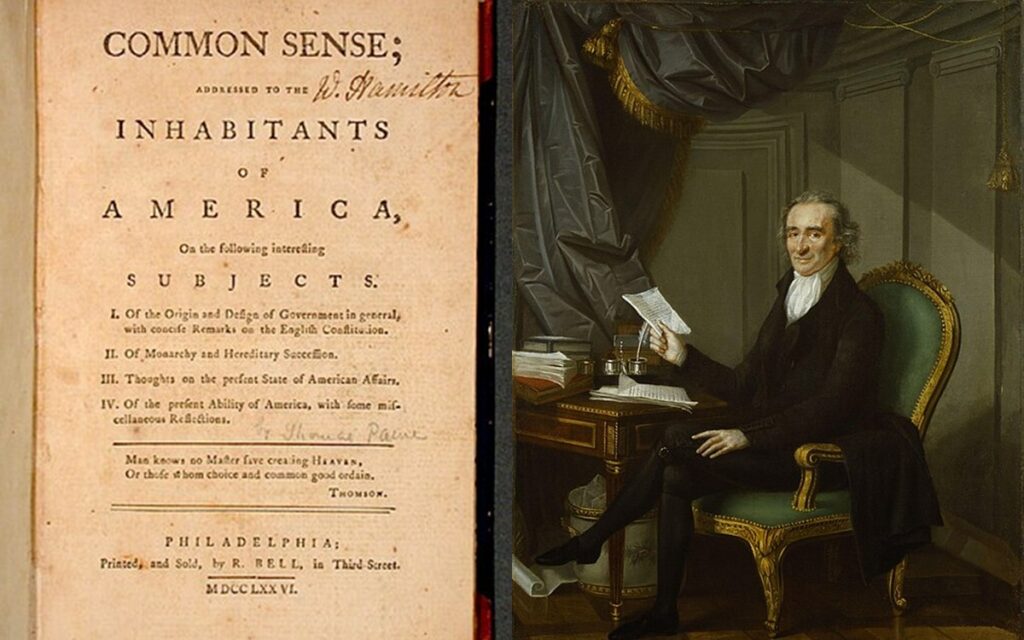
Portrait of Thomas Paine by Laurent Dabos (1791) alongside Paine’s 47-page pamphlet Common Sense. Public domain images.
Related Interviews and Essays
If you’re interested in how Thomas Paine became Thomas Paine— why he, of all the Revolutionary leaders, was the one to write Common Sense — and how that 47-page pamphlet helped change the course of the American Revolution, take a look at my interview with Dr. Harvey Kaye: The Origins of “Common Sense”.
Who was Thomas Paine?
Dr. Kaye’s major works include:
- The Powers of the Past: Reflections on the Crisis and the Promise of History,
- Why Do Ruling Classes Fear History?,
- Are We Good Citizens? Affairs Political, Literary, and Academic,
- The Fight for the Four Freedoms: What Made FDR and the Greatest Generation Truly Great,
- Thomas Paine: Firebrand of the Revolution, and
- Thomas Paine and the Promise of America.
 From Artisan Origins to Revolutionary Pen
Why America’s “Original” Founder Still Matters Today
About This Program
Analyzing American Revolution (AAR) is a special series podcast production of the History Behind News program. In this series, 33 professors (and counting) analyze the American Revolution from 33 different angles through in-depth interviews with host Adel Aali.
Meet Our Guest Scholars
A structured body of thought on the American Revolution—where leading scholars advancing distinct interpretations that give this program its depth.

Thematic Collection
Tap below for a closer look at the Revolutionary Era themes we examine—and to meet our guest scholars.

Library
- Interview Transcript Highlights
- Interview Image and Artist Highlights
- Quiz Answers and Backstories

Image Gallery
Explore the backstories and artist bios behind images of our Founding—before and after the American Revolution. These visuals shape how we remember—and reimagine—the Revolutionary Era.

Support AAR
AAR is an independent program built on sustained research, preparation, and production. Your support helps continue this series and expand our program.

Experienced Analysis of History
About HbN Program
The History Behind News program (HbN) is committed to making in-depth history researched and written by scholars enjoyable and accessible to everyone. Our motto is bridging scholarly works to everyday news.
The histories we’ve uncovered encompass an impressively wide range of subjects from ancient history to U.S. politics and economy to race, women’s rights, immigration, climate, science, military, war, China, Europe, Middle East, Russia & Ukraine, Africa and the Americas to many other issues in the news. We also receive advanced copies of scholarly books and discuss them in our program (in the context of current news).

Adel Aali, host. Snapshot from his introductory video to AAR podcast.
232 Scholars & Counting
Our guests are scholars at leading institutions. They are highly recognized, having received prestigious grants and fellowships as well as notable awards, including the Pulitzer Prize. They include celebrated documentary producers, former White House advisors and other high-ranking government officials, and current and former senior reporters of major national and international newspapers. Many have testified in Congressional hearings, and others frequently contribute to major media outlets and widely read publications.
Think You Know the American Revolution?