Updated: August 9, 2026
Discover images of the American Revolution from Concord’s perspective, offering context beyond our videos and posts. These visuals help shape how we remember—and reimagine—the Revolutionary Era. Each image tells its own story, highlighting a key figure, event, or idea, while providing insight into the artist and its historical significance. Explore these Revolutionary Era visuals to dive even deeper into history.
Explore the Images of the American Revolution – A Concord Perspective
One of my favorite aspects of the American Revolution is its wonderful images. Images from the perspective of Concord, Massachusetts, that inform us about the Revolution complement our videos and posts, where space is often limited for sharing more about the images themselves, their artists, and their backstories. Yet we believe you should know them—at least to some extent—because they add depth to how we Americans perceive and picture the Revolution and, equally important, how our collective memory of the Revolutionary Era has been shaped and reshaped over the centuries.
The images in this post relate to my interview with Dr. Robert A. Gross about Concord’s road to Revolution (video and transcript available).
Almost all of the images we use in our program, as well as the music, are in the Public Domain. For those that aren’t, we’ve included links, licenses, and attributions. If you use any of these images, please provide proper credit and include links when required.
This post features Continental view images of the American Revolution, each presented individually with its historical significance and the artist’s background. These posts are designed for exploration—enjoy browsing, learning, and linking to related history posts. Explore these Revolutionary Era visuals to dig even deeper into history.

North Bridge in Minute Man National Historical Park
Concord, Massachusetts

This Public Domain image is provided by National Park Service Digital Image Archives.
The North Bridge, sometimes called the Old North Bridge, crosses the Concord River in Concord, Massachusetts, and played a key role on April 19, 1775, the first day of the American Revolutionary War. That day, about 400 colonial minutemen and militia faced roughly 90 British troops. The clash marked the first time American forces advanced in formation against the British, inflicted casualties, and forced a retreat—an event Ralph Waldo Emerson famously called the “shot heard round the world.”
Over the centuries, at least eight versions of the North Bridge have been built. The current wooden pedestrian bridge, a faithful replica of the one from 1775, was constructed in 1956 and fully restored in 2005. Together with 114 surrounding acres, it forms the North Bridge unit of Minute Man National Historical Park, managed by the National Park Service, and remains a popular destination for visitors exploring Revolutionary history.
The Concord Minuteman

“The Minute Man”, by Daniel Chester French (1875), Concord — commonly known as the “Concord Minute Man.”
Created between 1871 and 1874, Daniel Chester French’s statue was intended to represent the typical minuteman of 1775 rather than any one individual, though French had sketched descendants of Isaac Davis, the first colonial killed at the North Bridge. The statue stands in Minute Man National Historical Park, and the first stanza of Emerson’s Concord Hymn is inscribed at its base. It is commonly called the Concord Minuteman and is sometimes confused with Henry Hudson Kitson’s 1899 statue of Captain John Parker in Lexington.
Originally planned in stone, the work was cast in bronze using ten Civil War–era cannons provided by Congress. The sculpture depicts a young minuteman leaving his plow to join the patriots at the Battle of Concord. With a musket in hand and an overcoat draped over the plow, the figure’s pose drew comparisons to classical statues, including the Apollo Belvedere, though French drew inspiration from multiple sources.
Unveiled in 1875 for the centennial of the Battle of Concord, the statue was widely praised and has remained a symbol of American patriotism. Over time, it has represented suffragette causes, the U.S. National Guard—including its Army and Air components—and has appeared on coins, such as the 1925 Lexington–Concord Sesquicentennial half dollar and the 2000 Massachusetts state quarter.
Daniel Chester French (1850–1931) was a leading American sculptor of the late 19th and early 20th centuries. His works include The Minute Man in Concord and the monumental statue of Abraham Lincoln at the Lincoln Memorial in Washington, D.C. French was known for combining classical inspiration with distinctly American subjects, creating enduring symbols of the nation’s history and ideals.
This image is in the Public Domain.
Paul Revere on the Ride

Paul Revere rides through the night, carrying the message that sparked a revolution.
Image from Belle Moses, Paul Revere, the Torch Bearer of the Revolution (New York: D. Appleton and Company, 1916). Image has no restrictions.
Most of us know the story of Revere’s midnight ride, but in our interview, Dr. Gross doesn’t dwell on the familiar tales of Lexington and Concord. Instead, we explore the lesser-known details behind the events. This excerpt of our transcript gives a glimpse of our interview:
Dr. Gross:
Paul Revere was on his horse. And the popular lore is, it’s as if he’s shouting as he’s riding. And the regulars are coming, the regulars are coming out.
And every farmer hears it. The town bells are ringing, the farmers hear it. And suddenly, everyone grabs his musket and turns out.
Adel:
And you’re suggesting it wasn’t like that.
The Ride
Paul Revere’s midnight ride on April 18, 1775, warned Massachusetts minutemen that British troops were on the move before the battles of Lexington and Concord. Patriots had learned the British planned to seize the Massachusetts Provincial Congress in Concord, so urgent action was needed.
Revere and William Dawes rode from Boston to Lexington to alert John Hancock, Samuel Adams, and other riders. With Samuel Prescott, they continued toward Concord, but a British patrol intercepted them in Lincoln. Prescott and Dawes escaped; Revere was briefly detained and questioned before being released.
The advance warning helped the minutemen prepare, making it a key factor in the Patriot resistance. The ride has been celebrated in art, literature, and culture—most famously in Henry Wadsworth Longfellow’s poem, which shaped the popular image of Revere’s ride.
The Poem
Henry Wadsworth Longfellow’s Paul Revere’s Ride was published in January 1861 in The Atlantic Monthly and later in his 1863 collection Tales of a Wayside Inn as “The Landlord’s Tale.”
The poem takes liberties with the facts, but Longfellow wrote it to inspire Americans during rising tensions before the Civil War. Its verses turned Paul Revere into a lasting symbol in the public imagination and the story of the Revolution.
Boston Tea Party

“The Destruction of Tea at Boston Harbor”, an 1846 lithograph by Nathaniel Currier, captures the famous protest, though the term “Boston Tea Party” was not yet in common use. Contrary to Currier’s image, only a few of the men throwing the tea were actually disguised as Native Americans.
The Boston Tea Party took place on December 16, 1773, as a bold act of protest during the American Revolution. Organized by the Sons of Liberty in Boston, the event intensified tensions between the British government and colonists opposing its policies. Less than two years later, on April 19, 1775, the Battles of Lexington and Concord marked the outbreak of the Revolutionary War.
The protest was sparked by the Tea Act, passed by the British Parliament on May 10, 1773. The law allowed the East India Company to sell tea in the colonies without paying taxes beyond the Townshend duties, which many colonists viewed as a violation of their “rights as Englishmen” to be free from taxation without representation.
On the night of December 16, members of the Sons of Liberty, some in Native American disguises, boarded the Dartmouth, a ship docked in Boston with a large shipment of East India Company tea. They threw 340–342 chests of tea into the harbor. The British government considered the act treasonous and responded with punitive measures. Shortly after, on December 25, a similar protest in Philadelphia forced the merchant ship Polly to return to England without unloading its tea.
To learn more about tea in Boston, check out my interview with Dr. Dael Norwood, who explores the Tea Act, the colonies’ appetite for Chinese luxuries, and their desire for direct trade with China.
This impage is in the Public Domain.
The Lexington Minuteman

The Lexington Minuteman, a statue by Henry Hudson Kitson, stands on the town green in Lexington, Massachusetts, and is commonly believed to represent Captain John Parker. Originally intended to symbolize a generic minuteman, it has become closely associated with Parker, who commanded the Lexington militia during the first battle of the American Revolution on April 19, 1775. No known portrait of Parker exists.
It’s worth noting that this statue is often mistaken for Daniel Chester French’s The Minute Man in nearby Concord (shown above).
Captain John Parker (1729–1775) was a farmer and military officer from Lexington, Massachusetts. A descendant of Deacon Thomas Parker, founder of Reading, he was also the grandfather of reformer Theodore Parker. On the morning of April 19, Parker, suffering from tuberculosis, led his men into the confrontation that would spark the Revolutionary War, with only a few months remaining in his life.
Henry Hudson Kitson (1863–1947) was an English-American sculptor celebrated for his works honoring American military heroes. He created The Lexington Minuteman in 1900, and his art often combined historical research with heroic symbolism. Knighted by Romania’s Queen Elisabeth for a marble bust, Kitson came from a family of artists—his wife and student Theo Alice Ruggles Kitson and his brothers were also sculptors. He is best known in the United States for his depictions of the “Minute Man,” including the iconic statue on Lexington Green.
This image is in the Public Domain.
The Liberty Tree

This image is deeply entrenched in the history of the American Revolution. It is titled The Colonists Under Liberty Tree, and was published in John Cassell’s Illustrated History of England (1865). This image is in the Public Domain.
It depicts the Boston Committee of Correspondence meeting under the Liberty Tree, their usual gathering location.
Now, the Liberty Tree, an elm tree that lived for 129 years (1646-1775), has a fascinating history. Standing near Boston Common, it became the site of Boston Patriots’ open protest against the Stamp Act in 1765. From that moment on, the tree served as a central gathering and rallying spot for resistance against British rule.
It was cut down by Loyalists in 1775!
Today, a plaque commemorating it adorns the exterior of the Little Building (part of Emerson College), which overlooks the spot where the Liberty Tree once stood.

Resolution by the Massachusetts Provincial Congress

This document is a printed version of the Resolution of the Massachusetts Provincial Congress dated March 24, 1775, and signed by its president, John Hancock. The text appeared in The Virginia Gazette (Williamsburg) on April 21, 1775, reflecting how colonial resistance messages circulated across the colonies in the tense weeks before the outbreak of war.
In the resolution, the Provincial Congress warned that liberty could only be preserved if the people remained prepared to defend themselves. With British troops stationed in Boston and Parliament’s policies seen as a direct threat to colonial rights, the Congress urged towns and individuals to continue strengthening their defenses and to remain vigilant against both force and deception.
The document called on the inhabitants of Massachusetts to persist with determination and readiness, emphasizing that any weakening of resolve would endanger not only the colony but all of America. The resolution was issued under the authority of the Provincial Congress, signed by John Hancock as president, and recorded by Secretary Benjamin Lincoln.
This image is in the Public Domain.
American Farmers Forming Ranks at Concord — Massachusetts Militia, American Revolution

This illustration was created by Charles MacKubin Lefferts (April 19, 1873 – March 17, 1923), an American military artist and soldier. Lefferts served intermittently with the New York National Guard beginning in 1893 and later joined the United States Army in 1917, retiring in 1921 with the rank of lieutenant. In his early life he lived in Wilkes-Barre, Pennsylvania, where he met his future wife, Anne Harrison.
Lefferts devoted much of his civilian life to researching and documenting the uniforms of the American Revolution, including Hessian uniforms. Largely self-taught, he produced detailed and carefully researched illustrations depicting the clothing and equipment worn by the various armies of the conflict, while also studying and preserving earlier artistic works on the subject. His dedication earned him election to the New York Historical Society in 1909.
Three years after his death, the Society published a large collection of his work, along with his notes, in the volume Uniforms of the Armies in the War of the American Revolution, 1775–1783.
This image is in the Public Domain.
Minutemen Memorial, Town Common, Leicester, Massachusetts
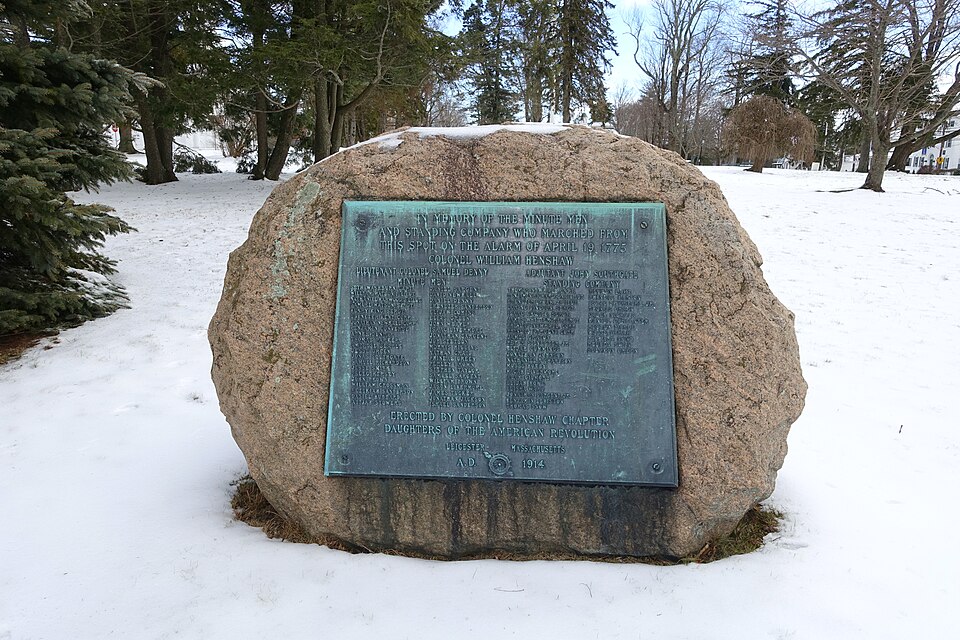
The Leicester Minutemen Memorial, also known as the Leicester Revolutionary War Memorial, stands on the Leicester Town Common and was dedicated in 1914. Commissioned by the Colonel Henshaw Chapter of the Daughters of the American Revolution, the monument honors the local Minute Men and Standing Company who answered the alarm and marched on April 19, 1775.
Key Details
• Location: Leicester Town Common, Leicester, Massachusetts
• Dedicated: 1914
• Purpose: Commemorates Leicester’s militia, including Lieutenant Colonel Samuel Denny, who mobilized in response to the opening crisis of the American Revolution
Although no major battles were fought in Leicester itself, the town played a meaningful role at the outbreak of the Revolution.
In 1774, during a Committee of Safety meeting, Colonel William Henshaw urged that men be ready to march “at a minute’s notice,” helping popularize the term “minutemen” for rapid-response militia. Henshaw later served as adjutant general to Artemas Ward, second in command to George Washington in the Continental Army.
In the tense months before British forces marched on Lexington and Concord, military supplies were quietly moved westward and stored in several locations in Leicester, including the house built by Dr. Green at 2 Charlton Street. When news arrived that fighting had begun, Leicester’s Minutemen assembled on the Common and quickly marched east on April 19, 1775, joining other Massachusetts militia in the opening engagements of the war.
Leicester is also connected to later events in the Revolution. On June 17, 1775, Peter Salem—a formerly enslaved man from Leicester—fought at the Battle of Bunker Hill, where he is traditionally credited with shooting British Major John Pitcairn. Their names, along with Colonel Henshaw’s, are remembered in local street names.
The town also lay along the route used by General Henry Knox when he transported captured artillery from New York to Boston in the winter of 1775–1776. Those cannons were placed on Dorchester Heights, forcing the British evacuation of Boston. A separate marker near the Leicester Library commemorates Knox’s passage through the town.
This image is dedicated to the Public Domain.
Burning of Stamp Act

The Stamp Act of 1765—formally titled the Duties in American Colonies Act (5 Geo. 3. c. 12)—was passed by the British Parliament to raise revenue from its American colonies. It imposed a direct tax requiring many printed materials to be produced on official stamped paper from London, bearing an embossed revenue mark. The measure applied broadly to everyday items such as legal documents, newspapers, magazines, and even playing cards, and the tax had to be paid in scarce British currency rather than in colonial paper money. Parliament justified the tax as a way to help fund British troops stationed in North America after the French and Indian War, though many colonists argued they had already contributed to the war effort and saw the measure as serving British political and military interests rather than colonial security.
Colonial opposition was immediate and widespread. Many Americans viewed the tax as a violation of their rights as Englishmen, insisting that only their own elected assemblies could levy taxes—an idea captured in the slogan “No taxation without representation.” Petitions, protests, and boycotts followed, while the Stamp Act Congress of 1765 marked the first coordinated intercolonial challenge to British authority. British officials defended the policy by claiming the colonists were “virtually represented” in Parliament, but critics such as Daniel Dulany rejected that argument, and organized resistance—often led by groups like the Sons of Liberty—forced stamp distributors to resign, preventing the tax from being effectively enforced. Pressure from colonial boycotts also alarmed British merchants, contributing to Parliament’s repeal of the act in March 1766. At the same time, however, the Declaratory Act asserted Parliament’s full authority over the colonies, setting the stage for further conflict and helping shape the grievances that eventually fueled the American Revolution.
Click here to see how colonial newspapers responded to the Stamp Act and helped rally resistance against it.
This Public Domain image is by an unknow author.
Colonial muster in Massachusetts Bay Colony

The First Muster
The origins of today’s National Guard trace back to December 13, 1636, when the Massachusetts Bay Colony organized its militia into three regional regiments—North, South, and East—by order of the General Court. Following the English militia tradition, nearly all able-bodied men between sixteen and sixty were required to own weapons and serve in local defense. These early citizen-soldiers trained regularly and maintained nightly watches to warn their communities of danger.
Rising tensions with the Pequot heightened the need for readiness, and the new regimental structure improved coordination and response. The first known gathering, or “muster,” of the East Regiment occurred in Salem, Massachusetts. Today, the Massachusetts Army National Guard’s 101st Engineer Battalion carries forward this legacy, representing more than three and a half centuries of continuous service.
About the Illustration
This artwork was created by Don Troiani (born 1949), an American historical painter known for his detailed depictions of the nation’s military past, particularly the American Revolution, the War of 1812, and the Civil War.
Working in oil and watercolor, Troiani is widely recognized for combining artistic realism with careful historical research. His paintings appear in books, museum collections, government holdings, and limited-edition prints. He is also an avid collector of historical military artifacts.
This image is in the Public Domain.
The British Army in Concord
April 19, 1775

The second image in a four-print series created in 1775 by engraver Amos Doolittle, illustrating British forces as they moved into Concord.
The British in Concord, April 19, 1775 — Plate II: View of the town of Concord. From the set commonly known as The Doolittle engravings of the Battles of Lexington and Concord (1775). Held in the New York Public Library, Humanities and Social Sciences Library, Miriam and Ira D. Wallach Division of Art, Prints and Photographs, within the Picturing America, 1497–1899 collection of prints, maps, and drawings related to early American history.
Amos Doolittle (May 18, 1754 – January 30, 1832) was an American artisan specializing in engraving and silversmithing, often nicknamed the “Revere of Connecticut.” Working from his shop in New Haven, he produced portraits, maps, and historical scenes. He is best remembered for a four-part series depicting the opening clashes at Lexington and Concord, developed from his direct examination of the battlefield soon after the fighting.
Doolittle was born in Cheshire, Connecticut, in 1754. He learned copperplate engraving largely through independent study along with practical training. His earliest published engraving appeared during his service in 1775 with the New Haven company of the Governor’s Guards. Commanded by Benedict Arnold, the unit reached Cambridge, Massachusetts roughly ten days after the engagements at Lexington and Concord, at the very beginning of the Revolutionary War. After arriving, Doolittle received permission to visit the sites of the fighting, accompanied by artist Ralph Earl. While Earl sketched the terrain, Doolittle gathered accounts from militia participants and townspeople to reconstruct the events. Using Earl’s drawings as a foundation, Doolittle produced a set of copper engravings depicting the battles, which were advertised for sale in the Connecticut Journal in December 1775.
This image is in the Public Domain.
Battle of Lexington, April 19, 1775

Prints and engravings of this pivotal skirmish were produced by multiple historical artists over time, including Luigi Schiavonetti in the early 19th century and, later, Henry Bryan Hall.
This print depicts the first skirmish of the American Revolutionary War at Lexington, where colonial militiamen faced advancing British troops in a tense early-morning confrontation. The clash marked the opening of hostilities, setting the stage for the larger engagements that followed in Concord.
About the Artists
Henry Bryan Hall (1808–1884) was an English-born engraver who trained in London before relocating to New York in 1850, where he established H. B. Hall and Sons. He produced numerous illustrations of historical events, Revolutionary War figures, and portraits, becoming a key figure in American historical printmaking.
Luigi Schiavonetti (1765–1810) was an Italian-born artist renowned for his work in England as a stipple engraver. Collaborating with leading figures like Francesco Bartolozzi, he specialized in high-quality depictions of historical scenes and portraiture.
Historical Context
Both Hall and Schiavonetti are credited in the Emmet Collection of Manuscripts and Prints relating to American history, housed at the New York Public Library. Their works include portrayals of Revolutionary War leaders, the Battle of Lexington, and subsequent events such as the Battle of Concord. Other notable contributors to the collection include William Hamlin and Max Rosenthal.
This image is in the Public Domain.
Other Images of the Revolution
 1775: Revolution’s First Year
Click for backstories.
 Pre-Revolutionary period (1763-1774)
Click for backstories.
About the Featured Image
Featured image: Side-by-side images of the Lexington Minutemen (right) and the Concord Minute Man (left).
About This Program
Analyzing American Revolution (AAR) is a special series podcast production of the History Behind News program. In this series, 33 professors (and counting) analyze the American Revolution from 33 different angles through in-depth interviews with host Adel Aali.
Themes of the Revolution
Tap below for a closer look at the Revolutionary Era themeswe examine—and to meet our guest scholars.

Visit our Revolutionary Era Blog page for
- Interview Transcript Highlights
- Interview Image and Artist Highlights
- Quiz Answers and Backstories

Visual Index of the American Revolution
Explore the backstories and artist bios behind images of our Founding—before and after the American Revolution. These visuals shape how we remember—and reimagine—the Revolutionary Era.

Experienced Analysis of History
About HbN Program:
The History Behind News program (HbN) is committed to making in-depth history researched and written by scholars enjoyable and accessible to everyone. Our motto is bridging scholarly works to everyday news.
The histories we’ve uncovered encompass an impressively wide range of subjects from ancient history to U.S. politics and economy to race, women’s rights, immigration, climate, science, military, war, China, Europe, Middle East, Russia & Ukraine, Africa and the Americas to many other issues in the news. We also receive advanced copies of scholarly books and discuss them in our program (in the context of current news).

Adel Aali, host. Snapshot from his introductory video to AAR podcast. Click to learn more about AAR.
233 Scholars & Counting:
Our guests are scholars in prestigious institutions, such as Oxford, Yale, Caltech, Harvard, MIT, Stanford, the Hoover Institution, the American Enterprise Institute, Quincy Institute for Responsible Statecraft, King’s College London, Princeton University, Notre Dame, Dartmouth College, University of Pennsylvania, Columbia University, the Atlantic Council, Duke, Amherst College, University of Michigan, Rhodes College, Emory University, Northwestern Law, Vanderbilt University, US Naval War College, Air Command and Staff College, Marine Corp University, UVA, Johns Hopkins, Cornell, NYU, Rice, University of Chicago, White House Historical Association, Baylor University, USC, UC Berkeley, UCSF, UCI, UCSD, UC Davis, UCR, Tel Aviv University, Hebrew University of Jerusalem, the Israel Democracy Institute, University of Aberdeen, Universidad Complutense de Madrid, University of Navarra, University of Seville, Helsinki University, Diego Portales University (Chile), Lund University (Sweden), University of Edinburgh, Near East University (Türkiye), Cardiff University, the Free University of Berlin and many others.
They include Pulitzer Prize winners, renowned documentary producers, former White House advisors and other high-ranking government officials, and current and former senior reporters at The Wall Street Journal and New York Times Magazine. Many have testified in Congressional hearings and others frequently contribute to major media outlets and widely read publications, ranging from the BBC, NPR, PBS and MSNBC to The Wall Street Journal and The New York Times.
Think You Know the American Revolution?