Updated: August 6, 2026
The American Declaration of Independence lists 27 grievances against King George III.
It portrays him as an all-powerful tyrant—or as Dr. Richard Bell puts it, “Nero, Richard III, and Attila the Hun all rolled into one.”
But that image misses something important.
Behind the posture of control, the American Revolution tormented and wounded the King deeply—so much so that he drafted a letter of abdication.
From Bravado to Crisis: The King After Yorktown
Yorktown is one of those moments Americans tend to treat as an ending—but Dr. Bell reframes it as something much larger and more complicated. This isn’t just a battlefield loss in Virginia. It’s an imperial shockwave moving through a global system. Because Britain isn’t just fighting in North America—it’s managing conflicts stretching across India, Europe, and the Caribbean. So when Yorktown falls, it lands within a much wider web of pressure points.
That shift in scale matters. For George III, this isn’t simply “bad news from the colonies.” It signals that the entire imperial project is wobbling. As Dr. Bell explains, the surrender at Yorktown halts British offensive capacity in North America and pushes the war toward its endgame. Back in Britain, the emotional register shifts as well. The war is no longer distant or manageable. It feels, to many, unwinnable.
The political reaction reflects that tension. Lord North’s response—“Oh God, it is all over”—captures both collapse and exhaustion in a single breath. And yet publicly, George III performs stability. “We will soldier on,” he insists. But this is not conviction. It is posture—bravado in the face of reality.
Privately, however, a different picture emerges. As Dr. Bell notes, the King enters a genuine moment of crisis—so much so that he drafts a letter of abdication, a resignation from the crown itself. It’s an extraordinary detail. Not because it is ever sent, but because it reveals something deeper: a moment of emotional collapse at the center of imperial authority. The King we imagine as fixed and commanding is, in this moment, uncertain enough to consider walking away entirely.
Transcript excerpt (Dr. Bell on the King’s reaction to Yorktown):
Adel:
Let’s talk about Yorktown, which was a significant event in American history, obviously.
How did the king respond to the news of Cornwallis’ surrender?
Dr. Bell:
Not well, I would say. Let’s just remind folks that the Battle of Yorktown in October of 1781 in Virginia is the last big battle on the American mainland. It will lead to the capture of about a third of the British army in North America.
It will bring British offensive operations in North America to a standstill, and it will send peacemakers from Britain and other places too, like France and Spain, rushing to Paris to hammer out the terms of a global peace treaty. It doesn’t actually mark the end of the war, but it does mark a major milestone on the road to peace. And so it’s a disaster for the British military and the British cause in North America.
It sends the message to people in Britain that the war is either completely unwinnable or unwinnable for years and years and years… So it’s terrible news for the British cause in America. And we know that when King George’s prime minister, Lord North, reads the dispatch from Yorktown… he said, ‘Oh God, it is all over.’
George publicly doesn’t bat an eyelid and says, ‘We will soldier on…’ which is nonsense, of course. It’s bravado. It’s bluster. Privately… he’s having a real crisis of faith… because we know that he will actually draft a letter of abdication… But he never sends that letter… and stays on the throne… and it takes him a while to come to terms with just how catastrophic Yorktown was.”
Watch this moment from the interview on how the King’s draft letter was discovered:
The King’s Hanoverian Background
In the story above, Dr. Bell mentions that the King wanted to leave Britain for Hanover, which was part of the Holy Roman Empire. But why Hanover?
The answer lies in the origins of Britain’s Hanoverian dynasty. In 1714, George I became King of Great Britain because the Act of Settlement of 1701 required a Protestant monarch, bypassing more than 50 Catholic relatives with stronger hereditary claims. As the son of Sophia of Hanover, granddaughter of James I, George I was the closest Protestant heir when Queen Anne died childless.
George III succeeded his grandfather, George II, in 1760 and became the third Hanoverian monarch. He was the great-grandson of George I and the eldest son of Frederick, Prince of Wales, who died before inheriting the throne.
George III (r. 1760-1820) is the first in a line of Georges who was born in Great Britain, spoke English as his first language. Although he was the prince-elector of Hanover, and became the King of Hanover in 1814, he never visited Hanover.
That makes Dr. Bell’s point all the more striking: in his moment of crisis, the King imagined leaving Britain for a place that was dynastically his, but personally unfamiliar.
About Featured Image
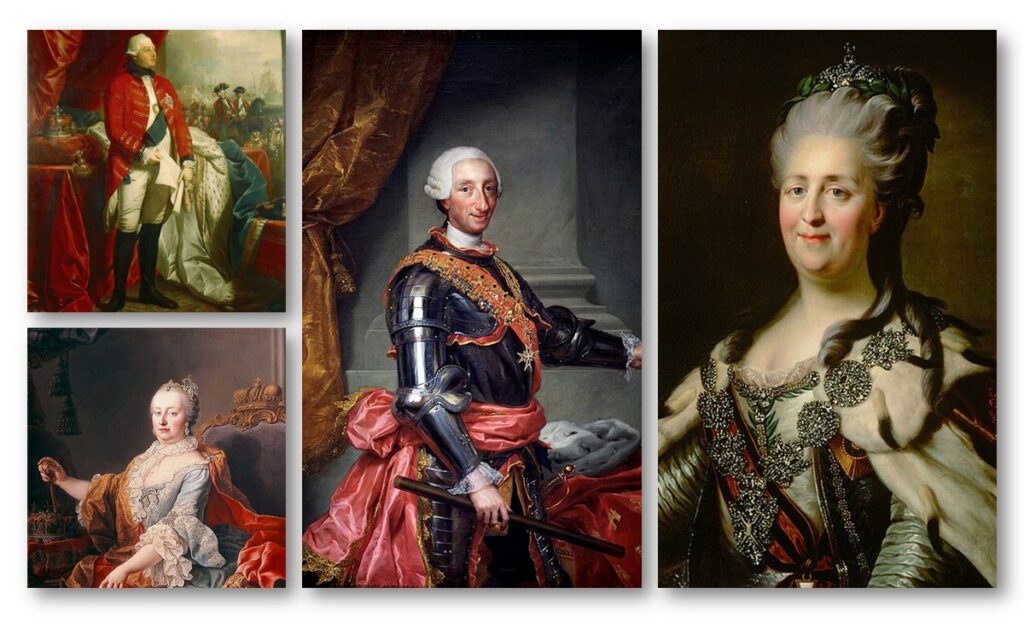
Clockwise from bottom left: Empress Maria Theresa, King George III, King Carlos III, Empress Catherine II.
Unless otherwise indicated, all images in AAR—including those in this post—are in the public domain.
Revisiting the Quiz
Let’s return to the quiz:
Which monarch drafted a secret letter of abdication during the American Revolution?
- King Carlos III
- Empress Maria Theresa
- King George III
- Empress Catherine II
By now, the answer is clear: King George III
Before concluding, however, it is worth briefly revisiting the other three options—as each monarch played an important role in the global history of the American Revolution.
King Carlos III
We almost never hear about Spain or its king in the context of the American Revolution. Yet their impact on the American Revolution and the young republic that emerged is profound.
Spain’s King Carlos III (r. 1759–1788) decided that supporting the American Revolution was in Spain’s strategic interest. Accordingly, Spain began providing covert support as early as 1775–1776, supplying arms, gunpowder, and money to the Continental Army. While avoiding formal recognition of U.S. independence, Spain formally entered the war against Great Britain in June 1779 through the Treaty of Aranjuez.
In the Americas, Bernardo de Gálvez (1746–1786), the Spanish governor of Louisiana, became one of the Revolution’s most important—yet often overlooked—allies. From 1779 to 1781, he led military campaigns against British forces along the Gulf Coast, capturing Baton Rouge, Mobile, and Pensacola, while also supplying the Continental Army with vital funds, arms, and ammunition.
This is the story that Dr. Gonzalo Quintero tells in our program. Dr. Quintero is the author of Bernardo de Gálvez: Spanish Hero of the American Revolution, among other works on Spain’s role in the American Revolutionary War.
As mentioned above, Spain also supported the Revolution financially. While Dr. Quintero explains the scale of that assistance, another scholar in our program, Dr. Dael Norwood, shows how the Spanish dollar continued to dominate American global transactions for decades after independence.
From my perspective, I see two main reasons why Spain is often overlooked in the history of the American Revolution. First, unlike France, Spain did not fight within the Thirteen Colonies. Second—and more importantly—America’s relationship with Spain deteriorated in the 19th century, culminating in the Spanish-American War of 1898.
But I don’t leave this as speculation. I also ask Dr. Quintero about this directly. That discussion will be linked here when the interview is published.
Empress Maria Theresa
Maria Theresa (r. 1740–1780), ruler of the Habsburg dominions, played a limited and largely neutral role in the American Revolution. While her daughter, Marie Antoinette, was Queen of France—a key American ally—Maria Theresa viewed the conflict with caution and sought to shield her territories from its potential upheaval.
But the story doesn’t end there.
In our program, we explore how leading American figures—most notably John Adams and Benjamin Franklin—recognized the strategic and economic importance of establishing relations with the Habsburg Empire. Yet despite these efforts, the United States did not establish formal diplomatic ties with the Habsburgs until well into the 19th century.
How is this possible? After all, the Habsburgs were a major European power whose wars and alliances shaped global developments.
In our program, Dr. Jonathan Singerton explains how Thomas Jefferson opposed closer ties with the Habsburgs, effectively blocking early efforts at formal relations. He is the author of The American Revolution and the Habsburg Monarchy.
Empress Catherine II
The Russians are coming! The Russians are coming!
Paul Revere could have been shouting those words during his midnight ride in April 1775.
It sounds far-fetched—but it’s grounded in historical reality.
As Dr. Ivan Kurilla explains in our program, Britain requested troops from Russia—more than once. But Catherine II rejected those requests, including a personal appeal from George III.
Her impact, however, extended well beyond that decision. In 1780, she established the League of Armed Neutrality, which helped shape the global dynamics of the war. By protecting neutral shipping from British interference and challenging British naval dominance, the League diplomatically isolated Britain and supported the broader conditions that favored the American cause.
Dr. Kurilla, author of Distant Friends and Intimate Enemies: A History of American-Russian Relations, explores this story in depth. His interview is linked in the image below.
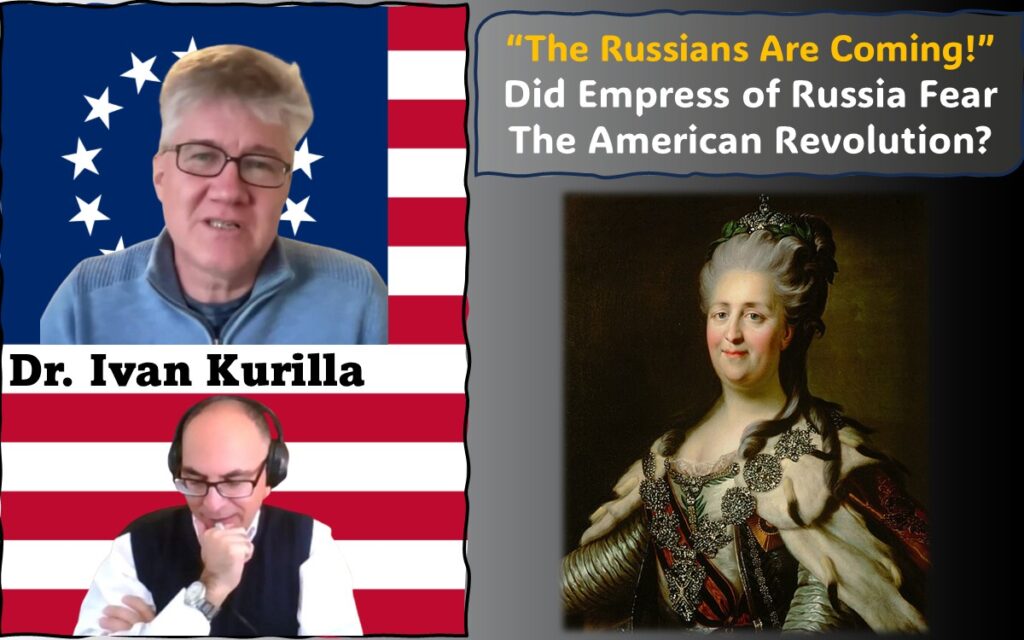 Russian Neutrality in the American Revolution: Fear, Strategy, and Opportunity
About This Program
Analyzing American Revolution (AAR) is a special series podcast production of the History Behind News program. In this series, 33 professors (and counting) analyze the American Revolution from 33 different angles through in-depth interviews with host Adel Aali.
Thematic Collection
Tap below for a closer look at the Revolutionary Era themes we examine—and to meet our guest scholars.

Library
- Interview Transcript Highlights
- Interview Image and Artist Highlights
- Quiz Answers and Backstories

Image Gallery
Explore the backstories and artist bios behind images of our Founding—before and after the American Revolution. These visuals shape how we remember—and reimagine—the Revolutionary Era.

Experienced Analysis of History
About HbN Program
The History Behind News program (HbN) is committed to making in-depth history researched and written by scholars enjoyable and accessible to everyone. Our motto is bridging scholarly works to everyday news.
The histories we’ve uncovered encompass an impressively wide range of subjects from ancient history to U.S. politics and economy to race, women’s rights, immigration, climate, science, military, war, China, Europe, Middle East, Russia & Ukraine, Africa and the Americas to many other issues in the news. We also receive advanced copies of scholarly books and discuss them in our program (in the context of current news).

Adel Aali, host. Snapshot from his introductory video to AAR podcast.
233 Scholars & Counting
Our guests are scholars at leading institutions. They are highly recognized, having received prestigious grants and fellowships as well as notable awards, including the Pulitzer Prize. They include celebrated documentary producers, former White House advisors and other high-ranking government officials, and current and former senior reporters of major national and international newspapers. Many have testified in Congressional hearings, and others frequently contribute to major media outlets and widely read publications.
Think You Know the American Revolution?