Updated: April 6, 2026
In Analyzing American Revolution, the global nature of the Revolutionary War has become an inescapable theme. As you will see in the examples below, many of our guest scholars reference and discuss how the fighting in the Thirteen American Colonies transformed into a truly world-spanning conflict.
It should therefore come as no surprise that Britain’s resources were stretched to their absolute limits in defending its homeland and its far-flung possessions across Ireland, India, Spain (Gibraltar), the Caribbean, Canada, the Thirteen Colonies, and Florida.
Of all these theaters, perhaps none had a more decisive impact on the Siege of Yorktown than Britain’s efforts to save India.
Why India Mattered More Than the American Colonies
Following its victory in the French and Indian War (1754–1763), which was the North American theatre of the Seven Years’ War, Britain emerged as a dominant global power. However, that success came at a cost: substantial national debt.
As Dr. Steven Pincus explains in our program, Britain responded after 1763 with a major effort to modernize and reorganize its empire. This transformation affected not only the American colonies but also India, the Caribbean, and Canada.
One key shift toward modernization involved taxation. To protect the interests of Britain’s landowning political class—many of whom sat in Parliament—the government redirected the tax burden toward its many colonies. Here, the financial comparison between colonial sources of tax revenue for the British Empire is quite revealing and outright astounding
According to Dr. Pincus, at its peak, British revenue from the American colonies ranged between 50,000 and 70,000 pounds. By contrast, revenue from India reached between one and two and a half million pounds.
For Britain, India was not simply another colony—it was the economic heart of the empire. Preserving it became a strategic priority, one that shaped decisions across the globe, including for Yorktown in 1781 (September 28 – October 19).
Parallel Crises: Britain’s Challenges in India and America
In both India and North America, Britain pursued reforms aimed at strengthening imperial control and maximizing revenue. In both regions, these efforts generated resistance and instability.
In North America, admiralty courts played a central role in enforcing taxation and trade regulations. A comparable development took place in India with the establishment of new judicial and administrative structures designed to facilitate revenue collection.
These parallel developments were not coincidental. In the wake of unrest in the American colonies—particularly following the Boston Tea Party and the passage of the Intolerable Acts—Britain was also restructuring its governance in India.
In 1773, Parliament passed the Regulating Act of 1773 (often associated with the East India Company Act), marking the first direct intervention by the British government into the territorial affairs of the East India Company.
The Act established a centralized system of governance, including a governor-general, a governing council, and a Supreme Court in Bengal. In function, this concentration of authority bore comparison to the appointment of Thomas Gage in North America, who exercised both military and administrative control.
Under Warren Hastings, British authorities pursued an aggressive expansion of revenue collection in India. These policies were driven by fiscal pressures within the Empire and a determination to extract greater wealth from India. The result, however, was resistance from local rulers and populations, drawing Britain into a series of military conflicts across the subcontinent.
Among these were the Rohilla War and conflicts with the Marathas, including a significant British defeat in 1778. Yet the most consequential conflict—particularly for the American story—was Britain’s war against Hyder Ali in southern India.
Hyder Ali, the ruler of Mysore, emerged as one of Britain’s most formidable opponents. He organized a broad, multi-confessional alliance to resist British expansion, uniting diverse groups under a shared objective: halting the continued encroachment of British power, which was widely understood to be driven by fiscal and territorial ambitions.
In 1780, Hyder Ali launched a highly successful military campaign in the Carnatic. His forces advanced to within proximity of Madras (modern Chennai), one of Britain’s most critical centers in India, and inflicted a devastating defeat on British forces at the Battle of Pollilur (September 10, 1780).
The scale of this defeat—and the broader threat it represented—sent shockwaves through the British Empire. It was this crisis in India that would trigger a chain of strategic decisions with consequences far beyond the subcontinent, including in North America.
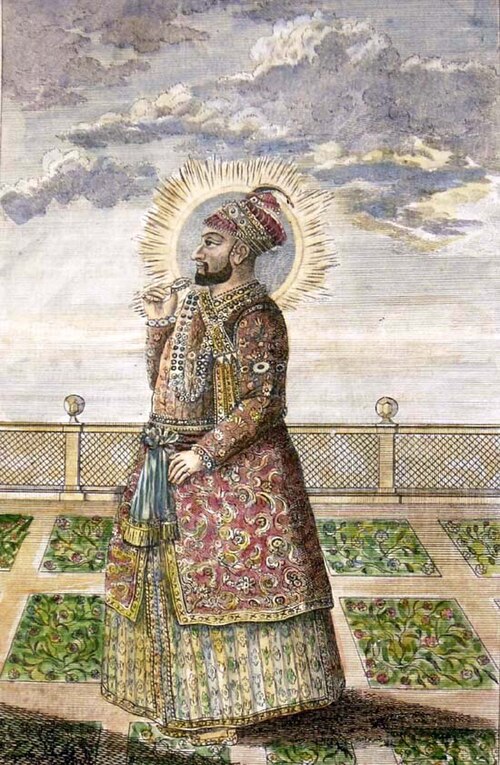 “Hyder Ali,” a steel engraving from the 1790’s (with modern hand coloring).
Hyder Ali: A Strategic Threat to British India
Hyder Ali (r. 1761–1782) was the ruler of the Kingdom of Mysore in southern India. Mysore had been an independent state since 1399 before later becoming a princely state under British suzerainty. In 1950, with the formation of the Republic of India, it was formally integrated into modern India.
A formidable military leader, Hyder Ali organized a broad, multi-confessional confederacy to resist British expansion. Though a Muslim ruler, he united diverse political and religious groups under a common objective: to halt the continued territorial and fiscal encroachment of the British.
His reputation extended far beyond the Indian subcontinent. American Patriots followed his campaigns with interest. Benjamin Franklin took note of his resistance, the Pennsylvania State Navy commissioned a warship named Hyder-Ally in his honor, and Philip Morin Freneau—often referred to as the “Poet of the American Revolution”—wrote a poem celebrating his achievements.
As Dr. Steven Pincus explains in our program, Hyder Ali’s challenge to British power in India was not confined to the region. It had direct and far-reaching consequences for the American war effort, including the Siege of Yorktown.
How War in India Shaped the Outcome at Yorktown
The scale of Hyder Ali’s victories in 1780 triggered alarm across British India. Administrators feared that the entire imperial structure in the region was at risk of collapse—threatened not only by Hyder Ali’s confederacy in the Carnatic, but also by the power of the Marathas in western India and growing discontent in Bengal.
Reports sent back to Britain emphasized the magnitude of the crisis. The scale of British defeat in India, particularly following the Battle of Pollilur, was described as exceeding even the loss that would occur at Yorktown the following year.
Faced with this situation, the British government under Lord North made a critical strategic decision: India had to be saved. The stakes were clear—India generated revenues far exceeding those of the American colonies and was central to the empire’s financial stability.
As a result, Britain diverted substantial military resources. Approximately half of the British fleet stationed in the Atlantic was reassigned to the Indian Ocean. In addition, 8,000 troops that had been prepared in Ireland for deployment to North America were instead redirected to India to defend Madras.
These decisions had direct consequences for the war in North America. When French naval forces under Comte de Grasse engaged the British in the Atlantic, they did so with a decisive numerical advantage—an advantage made possible in part by Britain’s redeployment of naval power to India.
This imbalance at sea proved critical. French naval superiority in the Chesapeake enabled the encirclement of British forces under Charles Cornwallis during the Siege of Yorktown, setting the stage for the British surrender.
At the same time, British officials feared that Hyder Ali’s successes might allow France to reestablish its position in India following its losses in the Seven Years’ War. French support for Hyder Ali reinforced these concerns and underscored the global nature of the conflict.
In this way, the crisis in India was not peripheral to the American Revolution—it was a decisive factor shaping the outcome at Yorktown.
Britain Isolated In an Expanding Global War
As Dr. Rafe Blaufarb emphasizes in our program, the American Revolution evolved into a broader international conflict.
Following France’s entry into the war, other powers either joined the fighting or positioned themselves against Britain. Spain and Dutch Republic entered the war directly, while Russia, Sweden, and Denmark formed the League of Armed Neutrality to challenge British naval policies.
At the same time, Britain faced conflict in Gibraltar, the Caribbean, and beyond. The cumulative effect was clear: Britain was no longer confronting a colonial rebellion—it was engaged in a global war against multiple adversaries.
The American Revolution Was a Sideshow
As the war expanded, Britain’s strategic priorities shifted.
With conflicts spanning Europe, the Atlantic, the Caribbean, and the Indian Ocean, the American colonies became only one theater among many. In strategic terms, they were no longer the central focus of British military planning.
This redistribution of attention and resources created the conditions that made American independence possible. The outcome at Yorktown cannot be understood in isolation—it was the product of a global conflict in which events in India played a decisive role.
Revisiting the Quiz
Which of the following played a pivotal role in success of the Siege of Yorktown in 1781?
- Russia’s Declaration of Armed Neutrality
- Spain’s attack on British Gibraltar, called the Great Siege of Gibraltar
- Britain’s war with Hyder Ali in India
- Britain’s attack on the Dutch island of St. Eustatius
By now, the answer is clear: Britain’s war with Hyder Ali in India.
Before concluding, however, it is worth revisiting the other three options—each of which played a meaningful role in shaping the broader global conflict.
Russia’s Strategic Pressure on Britain
As the American Revolution expanded into a global conflict, Catherine the Great, the Empress of Russia, issued the Declaration of Armed Neutrality on March 11, 1780. While not an official alliance with the American colonies, the declaration established principles that effectively limited British naval dominance:
(1) Neutral ships could freely access ports of warring powers.
(2) Goods from belligerent nations on neutral ships could pass unhindered, except for war contraband.
(3) Only ports actually blocked by naval forces counted as blockaded.
Most European nations accepted these rules, forming a broader league of armed neutrality. Britain, however, rejected them, as they directly challenged its blockade of American ports. While Russia’s navy was much smaller than Britain’s, the declaration had a ripple effect. It encouraged other European powers to resist British maritime control, indirectly easing pressure on the American colonies. The Dutch, for example, were emboldened to challenge Britain’s dominance, which eventually led to war between Britain and the Netherlands in December 1780, drawing British attention and resources away from North America.
Catherine the Great also attempted to mediate a peace settlement, briefly worrying American leaders, though the eventual Allied victory at Yorktown rendered these efforts moot. Strategically, the declaration forced Britain to spread its navy thinner across multiple theaters, weakening its control over the Atlantic and Mediterranean and allowing the French fleet to establish the temporary superiority needed to support the siege of Cornwallis at Yorktown.
In our program, Dr. Ivan Kurilla provides deeper insight into how Imperial Russia’s stance contributed to Britain’s strategic isolation and ultimately shaped the global context of the American Revolution. Dr. Kurilla is a historian of U.S.-Russian Relations, and has published extensively on this important subject, including his book Distant Friends and Intimate Enemies: A History of American-Russian Relations.
Spain, Gibraltar, and the Wider War
As the Elector of Hanover and therefore the ruler of Hanover, King George III commissioned Hanoverian troops to defend Britain’s imperial interests in Europe during the Revolutionary War and the global conflict is generated. A notable example of their importance is in the Great Siege of Gibraltar (1779–1783), where Hanoverian forces played a key role in successfully defending the fortress against Spanish and French attacks.
But Spain’s involvement in the wider war went far beyond Gibraltar and had a direct impact on the Siege of Yorktown. As Dr. Gonzalo Quintero explains in our program, Spain’s campaign under Bernardo de Gálvez—including the Siege of Pensacola (March 9 to May 10, 1781)—secured the Gulf Coast. By defeating the British there, Spain prevented reinforcements from reaching Lord Cornwallis in Yorktown. This allowed the French navy to concentrate its efforts in the Chesapeake, giving the Allies a decisive advantage.
In addition to these military contributions, Spain provided critical financial support to the Allied war effort, further strengthening the conditions that led to British defeat. Dr. Quintero also explains how Spanish and French coordination achieved combined naval superiority over Britain and how Spain’s resources and actions were instrumental in the success of the Yorktown campaign. My interview with Dr. Quintero will be linked here when it publishes.
The Capture of the Golden Rock
On February 13, 1781, British forces under Admiral George Rodney and General John Vaughan (though Rodney is better remembered for this victory) captured the Dutch-held island of St. Eustatius, known as the “Golden Rock,” during the Fourth Anglo-Dutch War. The island served as a major neutral trading hub, channeling arms and supplies to the American colonies.
Far from undermining British efforts to support Cornwallis’s troops in Yorktown, the British capture of St. Eustatius cut off American supplies, because roughly half of all military supplies for the American rebellion passed through the Golden Rock. The seizure crippled American supply lines and enriched the British command, though it did not stop the overall flow of supplies through the Caribbean.
But the history of Dutch physical presence and cultural influence on the American colonies, as well as their financial and material support for the American Revolution, goes much deeper. In our program, we dig into how the Dutch—despite internal divisions—were involved in the American Revolution and how their actions contributed to Britain declaring war against them.
In our program, we explore the Dutch perspective on the American Revolution with Dr. Peter Van Cleave, author of “The Dutch Origins of the Quasi War: John Adams, the Netherlands, and Atlantic Politics in the 1790s”. That interview will be linked here when it publishes.
About Featured Image
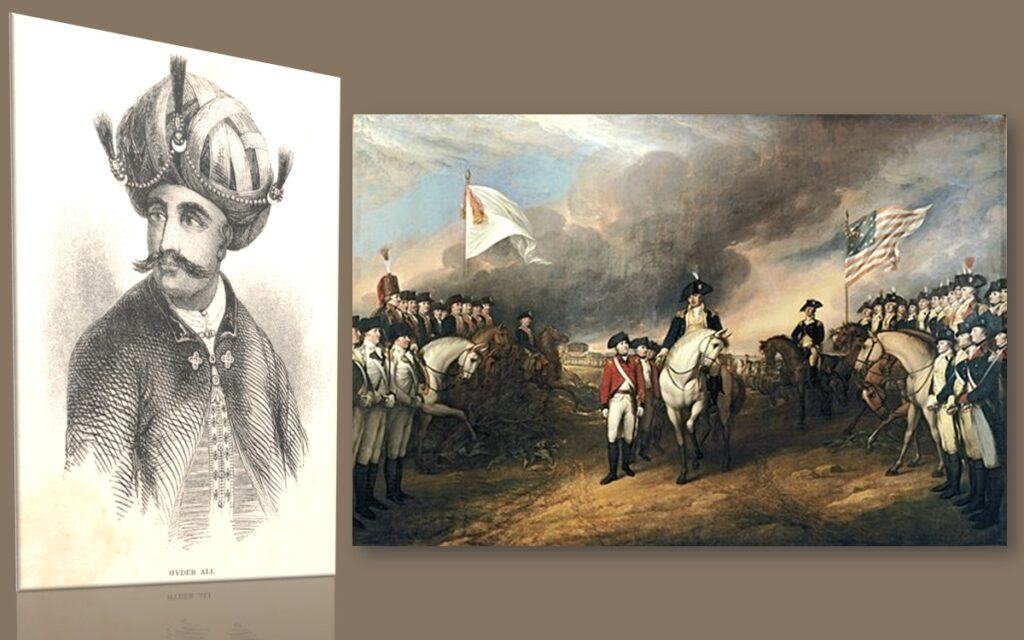
The featured image brings together images of Hyder Ali and Surrender of Lord Cornwallis, a painting by John Trumbull. But did you know an important person is missing from this painting? Click here to find out who.
Unless otherwise indicated, all images in AAR—including those in this post—are in the public domain.
About This Program
Analyzing American Revolution (AAR) is a special series podcast production of the History Behind News program. In this series, 33 professors (and counting) analyze the American Revolution from 33 different angles through in-depth interviews with host Adel Aali.
Thematic Collection
Tap below for a closer look at the Revolutionary Era themes we examine—and to meet our guest scholars.

Library
- Interview Transcript Highlights
- Interview Image and Artist Highlights
- Quiz Answers and Backstories

Image Gallery
Explore the backstories and artist bios behind images of our Founding—before and after the American Revolution. These visuals shape how we remember—and reimagine—the Revolutionary Era.

Experienced Analysis of History
About HbN Program
The History Behind News program (HbN) is committed to making in-depth history researched and written by scholars enjoyable and accessible to everyone. Our motto is bridging scholarly works to everyday news.
The histories we’ve uncovered encompass an impressively wide range of subjects from ancient history to U.S. politics and economy to race, women’s rights, immigration, climate, science, military, war, China, Europe, Middle East, Russia & Ukraine, Africa and the Americas to many other issues in the news. We also receive advanced copies of scholarly books and discuss them in our program (in the context of current news).

Adel Aali, host. Snapshot from his introductory video to AAR podcast.
207 Scholars & Counting
Our guests are scholars at leading institutions. They are highly recognized, having received prestigious grants and fellowships as well as notable awards, including the Pulitzer Prize. They include celebrated documentary producers, former White House advisors and other high-ranking government officials, and current and former senior reporters of major national and international newspapers. Many have testified in Congressional hearings, and others frequently contribute to major media outlets and widely read publications.
Think You Know the American Revolution?