Updated: April 7, 2026
Intellectual Foundations of the American Revolution — Part V
At its core, the Enlightenment encouraged people to step back and examine not just what they believe, but why they believe it. In essence, the Enlightenment was a revolution in “thinking about thinking”
How “Thinking About Thinking” Shaped Revolutionary Perspectives
As AAR’s guest scholar, Dr. Sophia Rosenfeld, emphasizes that this “thinking about thinking” opens the door to questioning long-accepted assumptions and imagining alternatives. Rather than directly causing revolutions, ideas work more subtly—prompting individuals to realize that what once seemed like common sense may no longer hold up.
This shift in perspective is essential for any kind of reform or transformation, because it challenges the boundaries of what people consider possible. In that way, the Enlightenment’s lasting impact lies in sparking curiosity and expanding the range of how people understand both the past and the future.
Here is the portion of my interview with Dr. Sophia Rosenfeld that speaks directly to this point:
About Featured Image
Logo of Analyzing American Revolution in the corner of this text: “A Revolution in Thinking”
Unless otherwise indicated, all images in AARevolution—including those in this post—are in the public domain.
Related Interviews and Essays
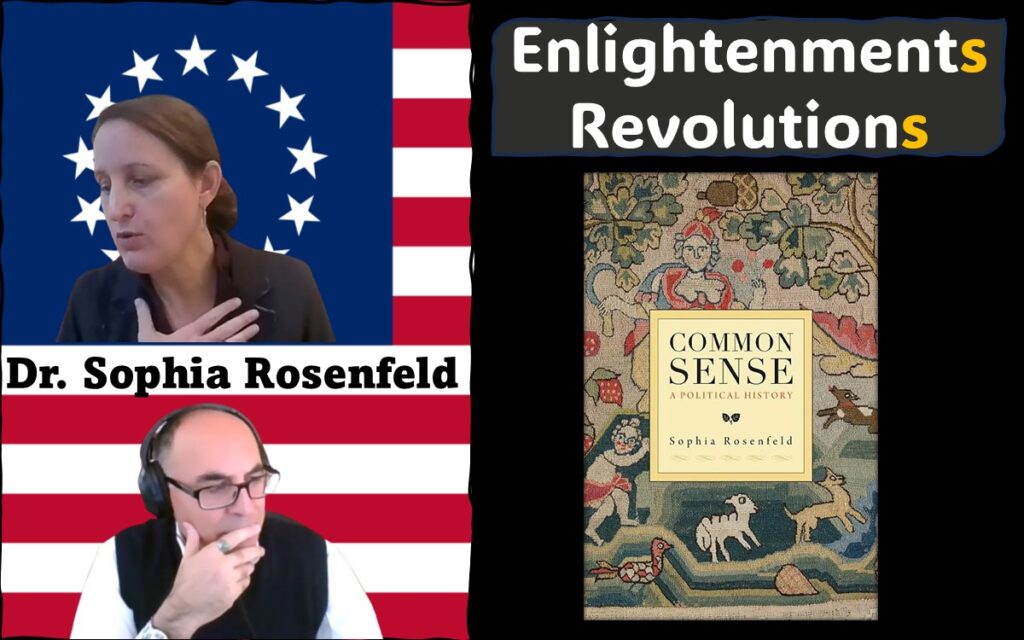
For more on the subject on the impact of the Age of Enlightenment on the American Revolution and our Founding Fathers, see my full conversation with Dr. Sophia Rosenfeld—including our interview’s video, timestamps for key sections, and my takeaways.
 The Enlightenment and Intellectual Foundations of the American Revolution
Dr. Rosenfeld’s major works include the following:
- The Age of Choice: A History of Freedom in the Modern World
- Common Sense: A Political History
- A Revolution in Language: The Problem of Signs in Late Eighteenth-Century France
- Democracy and Truth: A Short History”
This 5-Part Series
- Part I: The Enlightenment Is Hard to Define
- Part II: Age of Enlightenment, Reason, and Revolution
- Part III: The Enlightenment’s Impact on the American Revolution
- Part IV: Common Sense and Reason in the American Revolution
- Part V: The Enlightenment and the Power of Reflection (this essay)
About This Program
Analyzing American Revolution (AAR) is a special series podcast production of the History Behind News program. In this series, 33 professors (and counting) analyze the American Revolution from 33 different angles through in-depth interviews with host Adel Aali.
Thematic Collection
Tap below for a closer look at the Revolutionary Era themes we examine—and to meet our guest scholars.

Library
- Interview Transcript Highlights
- Interview Image and Artist Highlights
- Quiz Answers and Backstories

Image Gallery
Explore the backstories and artist bios behind images of our Founding—before and after the American Revolution. These visuals shape how we remember—and reimagine—the Revolutionary Era.

Experienced Analysis of History
About HbN Program
The History Behind News program (HbN) is committed to making in-depth history researched and written by scholars enjoyable and accessible to everyone. Our motto is bridging scholarly works to everyday news.
The histories we’ve uncovered encompass an impressively wide range of subjects from ancient history to U.S. politics and economy to race, women’s rights, immigration, climate, science, military, war, China, Europe, Middle East, Russia & Ukraine, Africa and the Americas to many other issues in the news. We also receive advanced copies of scholarly books and discuss them in our program (in the context of current news).

Adel Aali, host. Snapshot from his introductory video to AAR podcast.
207 Scholars & Counting
Our guests are scholars at leading institutions. They are highly recognized, having received prestigious grants and fellowships as well as notable awards, including the Pulitzer Prize. They include celebrated documentary producers, former White House advisors and other high-ranking government officials, and current and former senior reporters of major national and international newspapers. Many have testified in Congressional hearings, and others frequently contribute to major media outlets and widely read publications.
Think You Know the American Revolution?