Updated: May 25, 2026
Introduction
In this interview: “In fact, I would argue there’s probably no general or no officer in the army at the end of the Valley Forge encampment and possibly at the end of the revolution who is better recognized, better known by the soldiers than Stubin.”
Watch this segment in the video below (00:54:35).
Baron von Steuben in Valley Forge. We’ve all heard the story: a pedophile Prussian officer drilling the Continental Army in the coldest winter of the American Revolution.
It’s a good story—except most of it is false, and the rest is only half true.
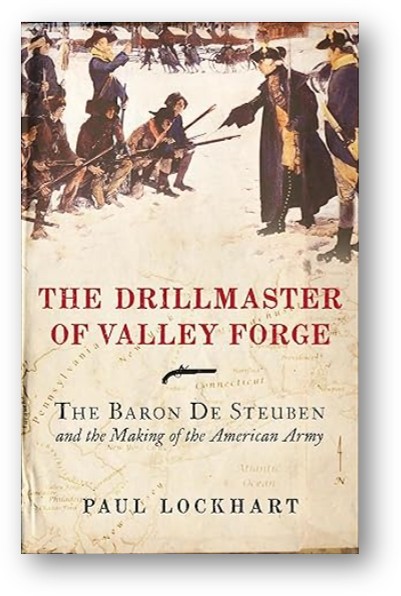
First, his name was Baron de Steuben – not von Steuben (see book cover below). As Dr. Paul Lockhart explains in this interview, there is no historical evidence supporting the pedophilia accusations. Valley Forge wasn’t the coldest winter either. And Steuben’s biggest contributions to the American cause came after Valley Forge.
By the way, the featured image notes that Steuben was the officer most recognized by American soldiers—and it’s simple why: he spent more time with them than any other officer!

How to Use This Post
Use this post as reference guide to the American Revolution through the lens of this interview and the broader Analyzing American Revolution program (AARevolution). Navigate using the interactive table of contents above and the timestamps below (in gray) to discover how this interview deepens the story of the Revolution—and to explore how the program unfolds: its key themes, insights, image gallery, scholars list, history quizzes, and related interviews across the series.
Video
Watch the full interview (timestamps below)
From Europe’s Battlefields to the American Revolution
The end of the Seven Years’ War left many European officers without careers. Steuben was one of them. He bet what remained of his reputation and professional life on the American cause.
A man of the Enlightenment, he understood the ideological foundation of the Revolution and could speak of an American republic—the very thing he had come to fight for. The Continental Congress eagerly anticipated his arrival; John Hancock personally went to meet him.
What they didn’t anticipate was that combat wasn’t what the army needed most. What Steuben brought to the table were systems and structures, turning the Continental Army into a disciplined, effective fighting force.
And yes—he cursed. A lot. By some accounts, he won the war with the sheer force of his “Goddamns.”
This is the story of a bored, desperate, disgraced—but capable—Prussian officer, using all his talent, charm, and cunning to serve the American Revolution.
Central Question
This conversation raises a central question:
If the American Revolution required the creation of political structures to sustain rebellion, does Steuben’s experience at Valley Forge reveal that its military success likewise depended not on battlefield heroics but on the imposition of administrative systems that transformed an ill-supplied and structurally deficient force into an army?
About My Guest: Dr. Paul Lockhart
Dr. Paul Douglas Lockhart is a professor at Wright State University. He is a historian of war and society in the Western world from 1500-1945. His research focuses on Northern Europe, with a specialization on Denmark. In recognition of his contributions to the study of Danish history , he has been elected to membership in the Royal Society for Danish History, which is a rare accolade for a foreign scholar.
I have previously interviewed Dr. Lockhart about Denmark and its military history: “The Longest Continuous Monarchy – Denmark’s History – How An Empire Can Decline in a ‘Flash’“.
Dr. Lockhart has also researched and written extensively on the military history of the American Revolution, including his book titled The Drillmaster of Valley Forge: The Baron de Steuben and the Making of the American Army, which is the subject of our conversation.
Dr. Lockhart’s other major works include the following:
- Frederik II and the Protestant Cause: Denmark’s Role in the Wars of Religion, 1559-1596
- Denmark in the Thirty Years’ War, 1618-1648: King Christian IV and the Decline of the Oldenburg State
- Denmark, 1513-1660: The Rise and Decline of a Renaissance Monarchy
- Sweden in the Seventeenth Century
- The Whites of Their Eyes: Bunker Hill, the First American Army, and the Emergence of George Washington
- Firepower: How Weapons Shaped Warfare
About the Featured Image
The featured image brings together images of Dr. Paul Lockhart and Adel Aali from the interview, superimposed on the Betsy Ross flag, alongside the cropped image of Dr. Lockhart’s book, The Drillmaster of Valley Forge: The Baron de Steuben and the Making of the American Army.
Unless otherwise indicated, all images in AAR—including those in this post—are in the public domain.
AAR Essential Insights
Although the full video and transcript of my conversation with Dr. Lockhart are included in this post, I’ve selected several insights that I found particularly revealing and worth emphasizing. These moments — some surprising, others that challenge familiar assumptions — help us see the American Revolution in a different light.
Steuben and the Army at valley Forge
Dr. Lockhart compares the Continental Army to contemporary European armies. At Valley Forge, Washington commanded roughly 12,000 men—a modest size by European standards, where 40,000–50,000 soldiers were common. Yet 12,000 was substantial for colonial America, given Philadelphia’s population of about 30,000.
The winter of 1777–78 was cold, but far from the harshest. Supply chain failures—not the weather—made life miserable. Steuben’s role? More than drilling soldiers for two hours a day, he created systems to manage, motivate, and professionalize the army. He realized Americans were not Prussians: they needed reasons for every order. This insight led to the foundation of the Blue Book, the first regulations manual for the U.S. Army.
Watch this section in the video above (00:12:32).
Why Valley Forge Lasted Six Months
The Valley Forge encampment ran six months—from December 19, 1777, to June 19, 1778. Why so long? Why not march in April, when the weather warmed?
There are three main reasons.
First, 18th-century European armies did not march in spring because melting snow and heavy rain turned roads to mud, making movement nearly impossible.
Second, Washington’s army simply wasn’t ready. Thanks to Steuben, what left Valley Forge in June was a professional, disciplined force capable of fighting—but getting there took the full six months.
Third, Washington’s strategy wasn’t about defeating the British immediately—it was about avoiding defeat. Lafayette’s reconnaissance at Barren Hill illustrates this: a reconnaissance mission that could have triggered disaster shows why caution mattered.
Valley Forge wasn’t a delay; it was preparation—both tactical and strategic—for the long game of winning the war by not losing it.
Watch this section in the video above (00:17:26).
Steuben’s Volunteer Terms
Steuben’s decision to volunteer for the American cause—without demanding a commission or salary upfront—made it easier for America’s representatives in Paris, Silas Deane and Benjamin Franklin, to support his recruitment efforts.
He did, however, have a few requests:
- that his voyage to America be funded (ultimately covered by French playwright Caron de Beaumarchais),
- that his small staff be paid,
- that he be allowed to fight in battle, and
- that he be reimbursed and compensated if and when the American Revolution succeeded.
In this interview, we explore these demands, including Steuben’s disappointments and anguish: Did Congress ever fully pay him? Did he ever receive the commission he deserved? And did he get to fight? The answers reveal much about the challenges and politics of building a new army from scratch.
I should also note that in our program, Prof. Joel Richard Paul tells the tantalizing story of how Beaumarchais helped arm the American Revolution—arms that arrived just in time for the Battle of Saratoga. It’s a tale of court intrigue, financial schemes, international espionage, sexual affairs, and deep, debilitating divisions in the Continental Congress.
Watch this section in the video above (00:41:14).
Steuben’s Biggest Contribution
Steuben’s most important contribution to the Revolutionary War was creating a comprehensive set of standard operating procedures—covering everything a European army would have had at the time—so the Continental Army could operate smoothly and efficiently. Crucially, he recognized that American soldiers were not Prussian soldiers.
As Dr. Lockhart explains, unlike what many historians suggest, Steuben didn’t simply translate a Prussian drill manual for the Americans. For context, that would have been a reasonable approach—the British drill manual was basically a translated Prussian manual. His reforms professionalized the army, laying the infrastructure that allowed it to function effectively against Britain’s larger, more experienced forces.
Watch this section in the video above (00:48:16).
Lafayette, Steuben & Jefferson
Continue watching at 1:05:15 in the video above.
After the War
Contrary to expectations, Steuben opposed a standing army. He advocated for a trained officer corps capable of raising armies when needed, along with military academies—ideas that informed the creation of West Point. His vision balanced European military efficiency with American democratic character, showing foresight far beyond his time.
Watch this section in the video above (01:08:51).
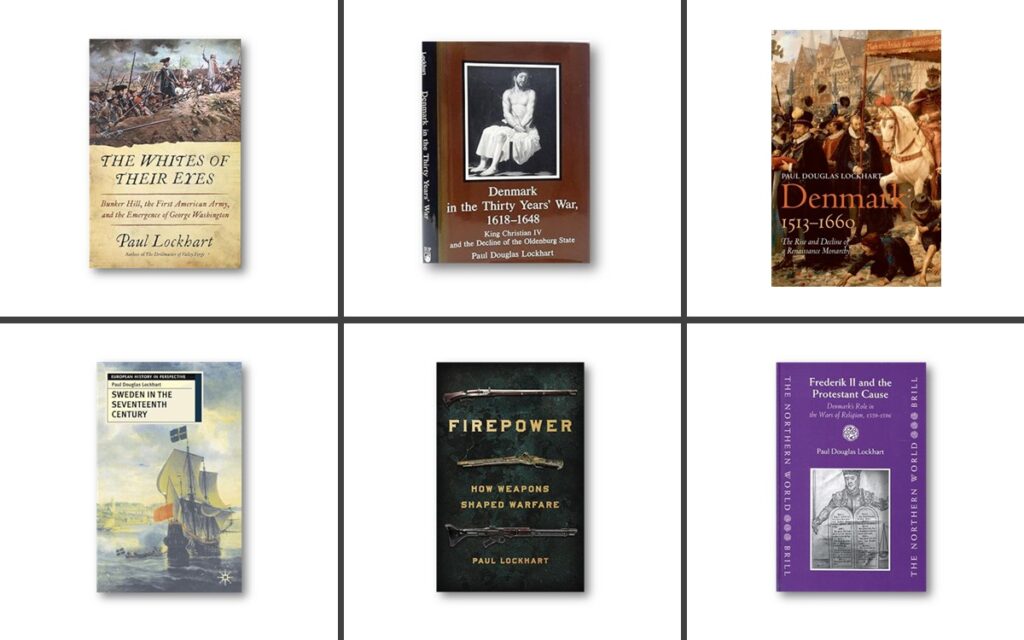
Other major works by Dr. Lockhart
Interview Transcript (S1E10): Adel Aali and Paul Lockhart
In our conversation, Dr. Lockhart addresses key questions about the Continental Army, Valley Forge, Baron de Steuben and the American Revolution. Below is a structured outline to help you navigate the discussion, followed by the full transcript.
Podcast
Watch the full interview on this page with the outline and transcript below, or take the conversation with you on the go through our Spotify podcast.

Outlline
Use the in-depth outline below to follow the discussion and navigate key moments in the interview.
Click for Timestamped Outline
- Selected Highlights (00:00)
- Guest Introduction (02:25)
- Why George Washington Chose Valley Forge (00:04:13)
- Philadelphia, Strategy, and the British Occupation (00:04:42)
- Valley Forge as a Defensive Encampment Near Philadelphia (00:05:17)
- The Continental Army at Valley Forge (00:07:13)
- Horatio Gates, Saratoga, and the Wider War in 1777 (00:07:24)
- 12,000-Man Army in an American Theater of War – Key Moment (00:08:54)
- Diversity and Daily Realities in the Continental Army (00:10:43)
- German, Scottish, Irish, and Welsh Soldiers in the Army (00:11:17)
- Arriving at a “Blank Slate” and Building the Encampment (00:13:24)
- The Winter at Valley Forge and the Supply Crisis (00:14:00)
- The Main Problem Was Supply, Not Weather – Turning Point (00:14:09)
- British Gold, Continental Currency, and Local Farmers (00:15:35)
- Why the Continental Army Stayed at Valley Forge (00:17:41)
- Mud, Roads, and 18th-Century Military Campaigning (00:18:32)
- George Washington’s Strategy of “Not Losing” the War – Key Moment (00:20:34)
- Baron de Steuben Before America (00:23:25)
- Silas Deane, Benjamin Franklin, and Recruiting European Officers (00:27:18)
- Rumors, Poverty, and Steuben’s Search for Military Service (00:28:30)
- Baron de Steuben’s Arrival in America (00:35:36)
- Steuben’s Reception in Portsmouth, Boston, and York (00:35:48)
- Henry Laurens, Horatio Gates, and the Continental Congress (00:39:07)
- Baron de Steuben and George Washington at Valley Forge (00:43:57)
- Steuben’s “System” and the Reorganization of the Army – Turning Point (00:48:14)
- Drill, Discipline, and the Origins of the “Blue Book” (00:49:16)
- Baron de Steuben’s Personality and Leadership (00:52:42)
- Profanity, Broken English, and Popularity with Soldiers (00:52:52)
- Officers, Discipline, and Love for the Soldier – Key Moment (00:56:34)
- Baron de Steuben After Valley Forge (00:57:58)
- Monmouth, Combat Ambitions, and Inspector General Duties (00:58:28)
- Writing Regulations for the Order and Discipline of the Troops of the United States (00:59:26)
- Just One Point (01:15:56)
Transcript
Note: This transcript was generated automatically and may contain minor errors. It is provided for reference and accessibility only.
Click to View Transcript
Dr. Lockhart, it’s a pleasure to have you in our program’s special series. Thank you for taking the time for this conversation with me about the American Revolution. So why Valley Forge?What circumstances led General Washington’s decision to winter in Valley Forge?
Well, it’s not an illogical decision. Of course, the main concern at this point is that the primary British Army, the one that had been centered around New York and which had taken Philadelphia in the late summer and early fall of 1777, needed to be watched. Philadelphia, of course, was effectively the capital, up until that point, the American capital of the Declaration of Independence.It was the site where the Second Continental Congress met. And once Howell moved his army towards Pennsylvania and took the war in that direction, taking Philadelphia, getting Philadelphia back, of course, is a major concern. Not just for symbolic value, but it’s an important population center, of course.And Valley Forge had already been, it already served as a supply depot before. It was an area that was well known and actually fit the bill for most things, in terms of defensibility, especially.
Didn’t the British raid that supply depot? I don’t know. I think it was the prior or something like that.
It was the middle of September of 1777. Yeah, the Recession Force under Knapphausen had raided it. So, you know, it’s not, it is within a day’s march of Philadelphia, roughly 18 miles northwest of the center of Philadelphia at that time.Um, so it’s, I mean, it’s within striking distance, but, but not so close that it could be taken by surprise. And just because of the topography of the place and the high ground and the, where the Schuylkill River moves around it, it’s actually reasonably easy to defend, but it’s as defensible as anything else is within a reasonable distance of Philadelphia.
Did General Washington and other officers of the Continental Army consider other locations, or was Valley Forge the location from the get-go?
There were other locations, even, you know, even within the context of American strategy in this part of the, in this part of the theater of war, not counting the, you know, the Northern Department, where Horatio Gates had been in command. There were still, you know, there were still outlying depots. There was one at Wilmington, Delaware, and there was a supply depot at Redding, Pennsylvania, and another one at Trenton, New Jersey.I think Trenton is where I think Washington kept most of his mounted troops. So it wasn’t the only option. Just that it served well as a, as a principal location.Adel:
Did, so based on what you just told me, should I deduce that not the entire Continental Army was at Valley Forge? You, you, so there were spread in other, other places as well.Dr. Lockhart:
Well, you know, the figure just during the fall of 1777, there are, you know, two major portions of the Continental Army in action. The one with the Northern Department under Horatio Gates and also Benedict Arnold that had been, you know, ejected from Canada during the abortive, you know, Canadian expedition in 75, 76. And then which, you know, came back to defeat Burgoyne’s army.The Battle of Saratoga? Yes, the two battles of Saratoga in the fall of 77. And at the same time, Washington’s army, which I guess you could call the main army, is the one that is fighting the, fighting Howe and Clinton around New York.And then, of course, then to Pennsylvania.Adel:
It, I don’t have any evidence to ask this question for, for, for posing this question, but I’m just curious now, Dr. Lockhart, did politics play a part in selecting Valley Forge? You know how in our modern times, let’s say a military base opens in an area in a state and brings more economy to that area. Was that part of the calculation for Valley Forge?Dr. Lockhart:
I could be wrong, but I’ve never seen anything like that. Yeah, yeah. Really, the idea is proximity to Philadelphia more than anything else.And Valley Forge was such a sparsely populated settlement anyway.Adel:
Yeah, yeah.Dr. Lockhart:
It was primarily agrarian.Adel:
Yeah, I hadn’t, I hadn’t read anything to that, to that account either. I was just confirming with you. So how big was the army in Valley Forge?Dr. Lockhart:
Oh, it’s about roughly about 12,000 men. Wow. Which for, you know, for an American force, you know, again, one thing I always remind you, because I do primarily work in European military history and, and, you know, do American, American military history.Adel:
You and I did a podcast about Denmark a couple of years ago.Dr. Lockhart:
Denmark, that’s right, that’s right. Is that, you know, by 18th century European standards, 12,000 men army is pretty small. Most field armies in the seven years war or in the 50, 40 to 50,000 plus range, or sometimes even larger.You look at the Austrian army, for example, the Battle of Leuten in 1756 and 1757, excuse me. And, you know, that’s, that’s quite, you know, it’s much, much larger than 12,000 men, I’ll put it that way.Adel:
Wow.Dr. Lockhart:
Those are 100 to 100,000 men. So, but by American standards in the American Revolution, where yes, the, the, the terrain is large, the theater of war is large, but the armies themselves are relatively small. So 12,000 men is a, it’s a, it’s a good size group and, and the mechanics and the logistics, obviously, of, of tending to 12,000 men in a, in the winter, you know, in the late fall through early, through mid spring, it’s not, it’s not easy, especially for Americans who are essentially unaccustomed to doing anything like this.Adel:
Yeah. And we’re going to get into that particular supply chain. You know, 12,000, I want to put this in perspective and correct me if I’m wrong on this.At that time, you mentioned Philly. So I think that’s a good, good, Philadelphia is a good comparison in numbers. Philadelphia’s population then at this time, what was it?30 some thousand?Dr. Lockhart:
Yeah.Adel:
Yeah. So 12,000 is a substantial sum. Okay.Were all of these soldiers and officers, British, American, did they all speak English? I guess I should ask that.Dr. Lockhart:
Well, good question. Well, I mean, technically in a sense, not until the declaration of the dependence, and of course, the British government would debate that anyway. They are already subjects of King George.And so they’re by definition British. Yeah. But if we’re talking about ethnicity and national origin, they’re not all Anglo by any means.And just like the colonies themselves are surprisingly diverse. And in particular, Pennsylvania had, especially had a really large portion of recent German emigres. And so German was, German was known, you know, in the army and outside of the army.Stoyban himself points out that when he’s traveling from Portsmouth to York, Pennsylvania, he first comes to America, that he encounters German speakers.Adel:
And Stoyban, you’re referring to Baron von Stoyban, who we’re going to talk about momentarily.Dr. Lockhart:
Right, right. So, and then of course, there are a lot of British emigres who are not English, you know, Scots and Irish. So one presumes probably some Gaelic, definitely some Scots.I don’t really, at one point that Welsh was even, you know, known in the army. So who knows? Yeah, it’s not, you know, probably a good, and I’m spitballing here, but from what I’ve seen, probably close to a third of the army is not English in that sense.Adel:
I’ve seen that number too, somewhere around 30%. Yeah. Not English speaking.So General Washington and his army marched towards Valley Forge and they get there. Were they disappointed from the get-go at the conditions they saw? How did that play out?Dr. Lockhart:
I don’t think Washington was disappointed. I think Washington knew what he was getting into. Certainly this is a different, not necessarily related to the site, except for the fact that it is kind of in the middle of nowhere.But of course, you know, a lot of colonial North America is in the middle of nowhere, right? Once you get away from the big settlements.Adel:
Most of it is on the coast. So you go west.Dr. Lockhart:
Exactly. And it’s not as if these soldiers are not accustomed to rural life. The vast majority of them, of course, are rural in origins.But the fact that at Valley Forge that they come upon basically a blank slate. I mean, there’s no huts waiting for them. There’s no buildings to take over, except for those that general officers have taken over for headquarters.They have to build huts for the beginning in December. So I think in that sense, nobody was especially happy with the encampment site. And it does seem to have come to us as a surprise, I think, to a significant portion of Washington’s army.Adel:
Was the main issue in Valley Forge a supply chain issue? You think?Dr. Lockhart:
Yeah, I think that’s probably the thing that makes the winter miserable. It’s not really the weather, because it’s one thing that clearly stands out. There are much, in terms of weather, in terms of snow and cold, there are much worse winters.I think primarily of 79-80 in Jockey Hollow in Morristown, 1779-1780, which was absolutely miserable in terms of volume of snow and your soldiers waking up and finding themselves practically drowning in snow. Valley Forge is, I don’t want to say it’s exactly a mild winter, but not an especially harsh one either. It’s really the lack of something that bedevils the Continental Army, certainly for the first couple of years of the war, and one way or another throughout, the lack of adequate clothing, blankets, food, the usual.There’s not a lot of points where the Continental Army is really, really well supplied, and Valley Forge seems to be one of the low points.Adel:
It’s so interesting that you say weather was not the worst in the history of the Revolutionary War, because that’s what we often hear about, the winter at Valley Forge in middle school and high school when we learn history. I read this story. I just want to run it by you.Tell me whether or not you’ve read such a thing as well in your research. Is it true that many colonists, Americans, sold their food and supplies to the British instead of the patriots at Valley Forge, because the British paid more for them?Dr. Lockhart:
Yeah, certainly in the surrounding region, it was not unusual. Of course, the British needed supplies too, far away. It’s not just that the British paid better, it’s the British paid in gold.Incontinental script is not worth much of anything. It’s worth a tentative promise that when this is all over and the United States is successful, it’ll be worth something. But yeah, definitely from a purely economic point of view, it’s far more preferable to sell to the British than to sell to the Americans.Adel:
Of course, and did that cause Continental Army soldiers to go raid some of the farms around or acquisition?Dr. Lockhart:
This is a fairly well-disciplined camp. There’s been a lot of… Incidentally, I’m going to make a plug for a colleague and friend of mine, Rick Herrera, who wrote essentially about the rebuilding of the quartermaster’s role within the army with Valley Forge has contributed a lot to this.But the army itself is pretty well-disciplined. There’s supposed to be a lot of soldiers raiding.Adel:
By the way, you mentioned Rick Herrera. I just want you to know Dr. Herrera will be joining our program to specifically talk about the Continental Army.Dr. Lockhart:
Oh, great. Okay, good, good.Adel:
So that’s going to be very interesting. Here’s a question just because I’m not familiar with how campaigns were launched at that time. If the question is naive, I apologize both to you and our audience.The Valley Forge, the story of the Valley Forge lasts from December 1777 to June 1778. This is when the Continental Army is there. Couldn’t the Continental Army start campaigning, I don’t know, somewhere late March, April, when the weather starts to be more accommodating?They stay there when the weather is warm for another two, three months, right? Right. Let’s say April, May, June.Yeah, June when the British leave Philadelphia and Washington sets off in pursuit. So the several months that the weather is cooperating is more strategic reasons for continuing to stay there than anything else? Is that the story?Dr. Lockhart:
Yeah, and there’s a number of ways you can address this. Actually, there’s several considerations. Some of those specific revolutions, some of those specific or general about the art of war in the 18th century.Okay. And first of all, when it comes to the art of war in the 18th century, nobody likes to move in the spring. Not until later spring.Adel:
Really, huh?Dr. Lockhart:
Well, because the roads, roads are mud when it’s rainy. And so, honestly, the best times to move an army are in the deep of winter and in high summer when the roads are either dry or frozen. They’re much easier to, much easier to slog cannon over a frozen road than through one that’s got mud so deep you could drown a mule, right?Adel:
Yeah.Dr. Lockhart:
So there’s that.Adel:
I’m so glad I asked that question. That’s interesting. Yeah.Dr. Lockhart:
So, you know, spring, early spring campaigning, definitely nobody really likes to take off in March or April. Not in more temperate climes, you know, like we have here.Adel:
Okay.
Dr. Lockhart:
Especially with snowmelt adding to the rains and all that. So there’s that. Another issue, of course, is that, you know, Washington is well aware of the shortcomings of his army and they’re being redressed.
I mean, the army in June is a much different beast than it was in a lot of ways. I don’t know if I have colleagues who disagree with me on this, at least to a degree, but the army is much better disciplined and more uniform in terms of its tactical and administrative systems in May than it was in March. You know, so huge difference there.
Also, you know, it’s still a smaller army than what than what Howe has in Philadelphia. And the army had already, you know, already gotten a good bloody nose at Germantown in October, where the American, the Continental Army had done quite well in some ways. But Germantown was also a big disappointment.
The army fought well, but ultimately it was not a not a successful battle for Washington. And, you know, the idea of attacking, of just attacking the British, it doesn’t make a great deal of sense. And Washington also understood, you know, a couple of things here.
Much as he wanted to maintain an army that was European-like in its structure, in its discipline, in its tactics, you know, really the strategy that wins the American Revolution is not losing. You know, not a matter of beating the enemy, just not getting beaten. And in courting open battle, except under really favorable circumstances, is not really wise.
You realize, you know, with relatively few exceptions, the big successes of the Continental Army are either when battle is forced upon them and they don’t have any choice, or when they pick their conditions very carefully. I’m thinking like the assault on Stony Point, for example, or they have an army that’s already on the move, like in Monmouth, where the British are, in fact, retreating and Washington hits them while they’re retreating. So there’s all sorts of reasons not to attack the British.
And there’s a good reason and another good reason, namely, that it’s in mid-May that Lafayette leads essentially a reconnaissance expedition to see what the British are doing. And there’s some rumors that the British are getting rid of Philadelphia. And the result is the so-called Battle of Barren Hill, which could have been a gigantic disaster for the Americans.
It’s fortunate because the British responded to this American expeditionary force very quickly and cut off nearly all of its avenues of retreat. And fortunately, the army kept its cool. Lafayette, and I’ll say upfront, I’m not a big Lafayette fan.
Lafayette is, Lafayette fortunately keeps his head too, and they’re able to take advantage of a road that the British were not all that familiar with to escape. But, you know, had Lafayette been trapped, which could easily have happened, it would have been disastrous. And we’ve got to figure out how big Lafayette’s force was, it was well over a thousand men.
That, you know, the Barren Hill showed you don’t just take on the British lightly.
Adel:
Yeah. We lucked out that Lafayette didn’t turn a reconnaissance mission, a skirmish into a full-on battle that could have obliterated his forces. So four reasons.
One is road conditions. The second is the shortcomings of the army. The army in March was way different than the army that marched out in June.
And the size was small. And three, their experience in mid-May by Lafayette. So, great, you said two things.
One is a shortcoming, and then European-like armies. And as I was thinking about that, it made me think of a character that I contacted you to talk about in this story. That was one of my main reasons.
And before we get into talking about who he is, let’s get his name, Dr. Lockhart. That’s a complicated issue. Yeah, so I’ve known him as Baron von Steuben, but you pronounced him differently.
So tell me which one is correct. Steuben, or go ahead. Well, technically, it would be Steuben, because he’s- Steuben.
Okay. However, this is- Well, we all know him as Steuben.
Dr. Lockhart:
People use Steuben occasionally. My problem with that, and even the army still uses the term Baron von Steuben. And when I wrote Drillmaster, I came up with this, what does he call himself?
And you know what? In thousands and thousands of letters, he never refers to himself as the Baron von Steuben, and virtually none of his contemporaries do. It’s a 19th century thing.
I think it’s done primarily by German-American heritage groups who were interested in claiming him as one of their own. The fact of the matter is, yes, he’s the Freiherr von Steuben. He does have the title of Freiherr.
It’s given to him as an honorific in 1767. A Freiherr roughly translates, I mean, the closest French or English approximation would be Baron, right? It’s a title that he has legitimately.
It’s not a title, although he was a nobleman, don’t get me wrong. I mean, this thing about him being this magnificent fraud, as he’s often been portrayed, is a lot of that is just plain incorrect. He was, in fact, of noble birth from the Prussian Juncker, the minor nobility.
He was the Freiherr von Steuben, but when he goes to Paris in 1777 and seeks a commission and then a position as a volunteer fighting with the Continental Army, he presents himself as any man of the Enlightenment would. Understand, this is the Enlightenment. Learned men speak French, right?
German is not considered an especially sophisticated language. And Frederick the Great himself, you know, Steuben’s idol preferred French over German. His correspondence is mostly in French.
But he presented also understanding that a lot more learned people understood French than understood German. He referred to himself in the French as the Baron de Steuben. So it’s not even fun.
The V-O-N is gone because that’s German. It’s de, as you would say in DE, as you would say in French, Baron de Steuben. So in his correspondence, he’s always the Baron de Steuben or Baron Steuben or just Steuben.
And we also know from looking at Americans writing about him, the Americans very often wrote foreign names kind of phonetically because they weren’t, if they didn’t know the language, what else would they do? You never see his name written in a way that would have an OY sound in it. And you never see the V-O-N, the phon.
It’s always the Baron, Baron Steuben or Baron de Steuben.
Adel:
Oh, interesting.
Dr. Lockhart:
I had lots of readers who were upset with me because they had always heard of this Baron von Steuben, said, well, he must be rolling over, his ancestors, his descendants must be very upset with you. Well, he didn’t have any kids, so that’s not an issue. Then that’s like saying the Marquis von Lafayette.
And I say, no saying Baron von Steuben is like saying the Marquis von Lafayette. It’s a French title combined with a German preposition.
Adel:
OK. So if that’s the case, we’re going to call him Steuben for the purpose of this.
Dr. Lockhart:
It’s wonderful. But de Steuben just, you know, I work with German sources a lot.
Adel:
So is it true that Benjamin Franklin in Paris initially rejected his application to come to America and serve as a volunteer?
Dr. Lockhart:
Well, yes and no. So they want to clear up here because this is an important thing to me. Franklin was never Steuben’s supporter.
It was Silas Dean. And for some reason, American historians never seem to get past this. Franklin himself, Dean himself noted that.
First of all, Dean of the two, Silas Dean of Connecticut and Benjamin Franklin of Pennsylvania, of course, were acting as American emissaries in Paris. Dean was the one who acted as a talent scout. In other words, he’s the one that French officers looking for an American commission went to.
Now, a little bit of background here. By the fall of 1777, there have been lots of European officers, Europe’s at peace, you know, for the most part. And a lot of European officers like Steuben, for example, once the Seven Years War ended in 1763, they’re out of a job.
So they’re looking for wars in which to fight. They’re looking for a job.
Adel:
If I may interject here for a second, Dr. Lockhart, didn’t Steuben have land or other means of income back in? No.
Dr. Lockhart:
OK, nothing significant. And again, that’s again, that comes up a lot. OK, so this is not the same thing as being noble.
Adel:
OK, so this is not the same story as Lafayette, who had actually who was financially well off back in France.
Dr. Lockhart:
He had basically been a professional courtier since the mid-1760s, and he hated it. And it wasn’t a special remunerative. He had heard about the American Revolution.
And he went to Paris looking for, of course, he had friends in Paris, very important, influential friends in Paris.
Adel:
Yeah.
Dr. Lockhart:
But in the meantime, he was offered a position at the court of the Margraviate of Baden in Karlsruhe, went to take care of that. A nasty rumor caught up with him there. He goes back to Paris and looks for looks for a.
Adel:
And that nasty rumor, I know we’re sort of digressing. Is that the story of him being allegedly being a pedophile or something to that?
Dr. Lockhart:
Yes, yes. And that he was, of course, there’s very little exists of what this actual charge was a reference to him taking liberties with young boys who were under his care. And this is there’s nothing else to it.
I know there are a few activists who have wanted to have a stupid monument taken down in D.C. because of this. There’s there’s nothing to suggest that there’s any validity to this, but the stupid fled because what else are you going to do? And so, you know, that just the charge itself is enough to condemn him.
Adel:
So historically investigating this, we relegate this to essentially a rumor. There’s you found no records, no evidence to substantiate. I see.
So let’s get back to Franklin and Silas. Here is Steuben essentially looking for work for purposes of income and also perhaps some glory and adventure.
Dr. Lockhart:
Right. OK, mostly a job, mostly a job, mostly a job, mostly a job. And one thing also comes up as stupid.
This is a critical issue in his career. Later on, Steuben loved being a soldier. And I’m not just talking.
I’m not talking about the pomp or the uniforms or whatever. He loved a good fight. And you occasionally you run into, you know, Grant, for example, is another great example of somebody who just even if they’re kind, merciful, decent people, they just got something out of the thrill of battle that they couldn’t get from anything else.
And Steuben was very much that way. He saw himself as being a combat commander and he hated being a courtier. It just was boring to him.
He wanted to be in action.
Adel:
So America makes sense. There’s this big war going on. Great war.
Dr. Lockhart:
OK, he doesn’t have a lot of time left. It was 47. You know, there’s a there’s a he’s getting to the point now that he’s getting towards the end of his physically active years by the, you know, by the standards of the 18th century.
So so the American American Revolution comes up at a great time for him. His arrival in Paris is a bad time for Dean and Franklin because they’re getting complaints from Congress. Stop sending us so many foreign officers.
American officers were beginning to feel kind of cheated, you know, when they see foreign officers preferred over them. And, you know, some of the foreign officers proved to be incompetent. There’s obviously for every DeKalb or every Lafayette, there are, you know, probably half a dozen foreign officers, mostly French, who proved to be incompetent or or not sufficiently attached to the cause.
And so, but Steuben, first of all, very gregarious, very extroverted. Also, generally speaking, with a very good political sense. In other words, he knew which buttons to push and and and how to phrase things.
Plus, the French minister of war, Saint-Germain, was an old friend of his.
Adel:
Well, not a bad connection to have.
Dr. Lockhart:
Right? No. And that led him immediately to the Comte de Vergennes, who is Louis XVI’s foreign minister, and to the playwright slash political activist, Caron de Beaumarchais.
So he has three significant, very powerful people at the French court who are who are vying for him. And Dean immediately liked Steuben and understood that he was not overblown. He actually knew what he was talking about.
And Dean understood, too, that Steuben’s paper credentials did not really do the man a lot of service compared to his actual experience. And that’s where the whole fraud thing comes about. Because it’s not Steuben over-portraying himself.
It’s basically him being advertised first by Dean. Eventually, Franklin comes on board. But throughout the process, Dean points out, I can’t.
You know, Franklin just won’t. He’s not interested. There’s no enthusiasm.
Steuben points out that he can’t. Franklin throws up obstacles. So the story that Franklin brings him aboard is just it’s just plain wrong.
Silas Dean is the person who deserves the credit here entirely. He’s the one who stuck with it.
Adel:
Oh, wow. OK, we almost never hear that side of the story. We always hear that Franklin rejected him.
OK, so he interviews once or twice with Franklin and Silas Dean. Twice. Twice.
Dr. Lockhart:
In June and then again in August of 1777.
Adel:
OK, so the August one is a go and he sets himself up to go to America. Is he paying for all this trip for himself?
Dr. Lockhart:
That’s a really good question. That’s one of the only reason I think that that Dean was able to and that Franklin could make himself support the. Steuben’s candidacy was that he was not demanding a commission before he left.
He was not demanding a promise of a commission. He was not demanding a salary. You say he would be willing to go as a volunteer if somebody paid for the voyage for him.
He could not afford to travel. This ended up being a critical point in the first negotiations is why he brought them up, why he why he broke them off. But Caron de Beaumarchais, the playwright, promised to underwrite the costs of the voyage from with a personal loan.
And so Steuben goes over with a with a with a small with a small staff, mostly young French officers to to ultimately the Portsmouth, New Hampshire. Over the over the late fall, early winter of 1777.
Adel:
So he gets to New Hampshire, Portsmouth, is he. There’s an interview with the Continental Congress, a certain I don’t know, review body before he goes off to Valley Forge.
Dr. Lockhart:
Steuben, again, partly good political sense and partly knew who to talk to. And of course, he also had advice from his from his French friends. And Portsmouth, he was Portsmouth.
He was actually welcomed like a like a hero, partly because he wasn’t French.
Adel:
Really?
Dr. Lockhart:
There’s that. Oh, yeah. Yeah.
Well, he’s a German. They’re not used to running into Germans. Even even de Kalb, who was actually German, more or less presented himself as being French.
But also because Steuben was stupid. You have a lack of a better term. He’s a party animal.
Steuben was a was a very gregarious man who could get anybody practically that seemed to like him. He could also get his friends to hate him. I mean, he’s very good at that, too.
Very chaotic, very, very mercurial disposition, you might say. But he he’s really celebrated when he gets to parent to Boston. Those big two big two stops reports with Boston.
And then he hurries along to York. He doesn’t stop in New York City at that point. He crosses the Hudson.
Adel:
Dr. Lockhart. And when he when he comes to America, Portsmouth and then Boston and York, there’s no associating him with the Hessian soldiers. Oh, no, no.
There’s this clarity there. OK. Yeah.
Dr. Lockhart:
You know, Americans didn’t really even educated. Americans didn’t really know a lot about the Holy Roman Empire. But they knew that they knew more than most Americans would today.
Adel:
Yeah.
Dr. Lockhart:
And, you know, they understood that there were lots of petty principalities and margraviates and land graviates and what have you in the empire, and that the Hessian mercenaries came from some of these lesser princes. But they also understood Frederick the Great was a war. He was a hero.
Right. And Frederick the Great is a very, very much a a warrior legend, not just in Europe, but in but in the American colonies as well. So a soldier who was being presented, even though he didn’t present himself that way, Dean and Franklin did, being presented as a man who had served for 20 years under Frederick the Great as a lieutenant general.
You know, this is a this is an important dude.
Adel:
This is a big deal. Wow.
Dr. Lockhart:
Yeah. And and he’s fun. Yeah.
And he likes to drink. So it’s funny that he was on his way to Boston. He had been advised to seek out John Hancock in particular.
Now, granted, you know, a lot of important Boston leaders are at the Second Continental Congress there in New York. But he had been advised that Hancock had a great deal of influence. He was really surprised that Hancock came looking for him.
That was a mark of just how big a splash Steuben had made very quickly in the social scene in the northern colonies, almost in a matter of a few days after he arrives in Portsmouth.
Adel:
Wow. So there’s anticipation about what this guy is going to do and how he’s going to contribute. OK.
Dr. Lockhart:
We know by this point, too, that he spoke English. He clearly was able to communicate. He was learning while he was ship bound on the way over.
But one of his aides, in fact, pointed out that, you know, that Steuben, unlike most of the French staff officers with him, understood, you know, was able to converse in English.
Adel:
So this is like broken English to communicate.
Dr. Lockhart:
Yeah, but he didn’t make himself understood.
Adel:
Good. That’s OK. So anything else before we get to Valley Forge?
Anything else you want to point out?
Dr. Lockhart:
Well, I should point out before he gets to Valley Forge, he has to go through York. And you asked about Continental Congress. He does.
He did, in fact, contact the Congress as a whole. He contacted Henry Lawrence, who was the president of Congress at that point, and effectively chief executive officer of the United States at that point. And a few others, including, and this is just brilliant, somebody must have advised him about this, Horatio Gates.
Now, Horatio Gates was, of course, the victor of Saratoga, even if you really want to ascribe a lot of that credit to Benedict Arnold.
Adel:
Yeah, yeah.
Dr. Lockhart:
Horatio Gates was the victor of Saratoga. And Steuben sends him this letter that is just, I mean, it’s dripping with flattery, but it is so earnest. It doesn’t read like flattery.
I’m looking forward to meeting the victor of Saratoga of whom we’ve heard in Europe. And Gates, who was notoriously vain, just ate it up. Steuben even gained a fair amount of respect for the fact that Gates’s wife, who was thoroughly disliked within the, among the high society of the Continental Army, that even she just absolutely loves Steuben.
And one of them pointed out, one of Gates’s friends pointed out that this is a Medusa who rules with a rod of scorpions, you know, and even she likes Steuben.
Adel:
You know, just the way you describe Steuben, first of all, it’s so fresh. I haven’t heard this sort of angle of his personality, but he comes across as so socially capable.
Dr. Lockhart:
Well, yeah, and sometimes so socially idiotic.
Adel:
Goes to the party animal. Okay, so he interviewed, we’re in New York and he’s interviewing with…
Dr. Lockhart:
He met with Congress and met with the board, met with a special subcommittee that was set up to meet with him and charmed all of them.
Adel:
Oh, nice, nice.
Dr. Lockhart:
Part of it was his demand was, you know, again, he wanted to be a volunteer. He wanted his staff, not himself. He wanted his staff to all get appointments as captains and be paid accordingly as Continental Army captains.
It was a pretty modest demand. And if Congress was satisfied with what he had contributed to the army when the war was over, he would like to be compensated for his expenses and maybe pay.
Adel:
You know, which is… He’s saying no to that.
Dr. Lockhart:
No, exactly. It was perfect. They’re getting the right of essentially, well, we didn’t like what you contributed.
You’re out. You’re out of luck. You get the right to do that.
And so, and they already, overall, I mean, Henry Lawrence, for example, was the president of Congress. He and Stubin were tight from the very beginning. And they all recognized that he was not somebody who was full of himself, but somebody who was extraordinarily well-read.
And not just in military science, but also in politics. Again, Stubin was, I mean, you have to, I think, think of him this way. He was very much a child of the Enlightenment.
He was, you know, like so many other kind of lower philosophers of the period. He knew, he read Montesquieu. He had read Rousseau.
You know, he had read the great works of the French Enlightenment.
Adel:
And in America, except for the sort of, correct me if you think I’m wrong on this, the middle class, perhaps upper middle class and the elite, they weren’t really familiar with the Enlightenment.
Dr. Lockhart:
No, but people like Jefferson were.
Adel:
Oh, there you go. That’s an elite. Yeah, yeah, yeah.
Dr. Lockhart:
And at least we’re familiar. I mean, look at the impact that Montesquieu has on American constitutional thought. There’s definitely connections there.
And of course, that also helps that Stubin is not just some guy who’s showing up and wants a general’s commission so he can take advantage of the revolution. He’s somebody who speaks their language and makes references to wanting to serve the republic. He used the word republic deliberately.
And so he’s signaling that ideologically he’s with them.
Adel:
Yeah, yeah.
Dr. Lockhart:
The way that you don’t see with other foreign officers.
Adel:
Yeah, that you were saying that their attachment to the cause was shaky, some of the other foreign officers. So he gets to Valley Forge, and please take it from here. And he must have met with Washington.
There’s that first meeting. What happens next?
Dr. Lockhart:
Well, first meeting, and it’s funny because the dynamic and the chemistry between Washington and Stubin I’ve always found fascinating. I don’t think the two men read each other very well. And there’s a fair amount, there’s a great deal of respect between the two.
And there’s also a fair amount of friction. And indications are that Washington was very happy to see Stubin. He, especially once they began to talk and Washington realized that Stubin had all sorts of really useful ideas that could be employed in doing something with the army.
But Washington also was notoriously taciturn and reserved. And when Stubin described his meeting with Washington to his friends in Prussia, there’s where Stubin just lies outright. An honor guard comes out to meet me, you know, fanfare.
There’s a, I’m feted like a conquering hero. And when Washington shows up, there’s a number of officers there. And basically, he and Stubin just ride together from meeting points of the Forge of the Schoolkill into Valley Forge.
Adel:
So the public ceremony that he was writing to his friends in Prussia, that just didn’t happen?
Dr. Lockhart:
No, no, it just didn’t happen. And Washington didn’t really show outwardly any great joy over this. But it’s clear from Washington’s writings that he was, that he saw very early on, so Stubin is an asset.
So, and at that point, again, he’s just a volunteer. And what Washington mostly needed help with, of course, was logistics. He really needed a functioning quartermaster.
That’s another issue. And Stubin wasn’t interested in that. And Stubin was, now I should again say, Stubin, despite his professed willingness to accept whatever was dumped on him, really aspired to combat command.
He even confessed this to, I remember it was to John Lawrence, Henry Lawrence’s son, who was a staff officer at Valley Forge, to John Lawrence or to Alexander Hamilton, who quickly became his buddies. They were both French literate and young, and they all bonded. But he confessed to one of them that his goal was to become a major general, which was the highest rank of general after Washington himself, which is a hell of an aspiration for a guy who just recently learned English.
But anyway, Stubin initially, his contact with Washington is getting together in the evenings, and Stubin is basically poking his head around the encampment, seeing where he sees issues, talking to the soldiers, getting an idea of how they feel, of what food issues are like, getting an idea of the actual physical reality of the army. And then talks with Washington about his experience, both as a officer in the Prussian army and as somebody who’s extremely well read in military science. And it becomes clear that to Washington, this is probably where Stubin’s assets are going to be, his talents are going to be most useful, is to fill the role of inspector general.
There already was an inspector general, Thomas Conway, who was, unfortunately, if you become familiar with the so-called Conway Cabal, yeah, was one of a group of officers who were not especially happy with Washington, and were a bit more closely affiliated with Horatio Gates. But this is where Washington saw Stubin as being most useful. And Stubin threw himself into it, not because he enjoyed it, just because he understood that of all the things the Continental Army was missing, without getting into enough food and enough uniforms, was system.
The army just didn’t really have a standard operating procedure to cover everything as any European army had. Not just not a standard drill manual or a standard tactical manual, but just a standard way of doing it, of forming a bivouac, of encampment, of keeping soldiers accountable for the gear and uniforms that were issued. All these things were lacking.
And really, if you get right down to it, that is Stubin’s most important contribution, I would argue, to the revolution, is creating, or at least fostering, this infrastructure that allows for the relatively smooth administration of the army.
Adel:
When you say systems, is part of that drilling the soldiers?
Dr. Lockhart:
Yes, part of that is. And that’s, of course, the part he’s famous for. He would have said it was the least important thing he did.
It’s funny that we remember him for that.
Adel:
Yeah, yeah.
Dr. Lockhart:
But he did, and, you know, I’ve got a good number of friends who’ve been involved in revolutionary war living history slash, you know, reenacting for years. And they’re familiar with Stubin primarily as the author of the blue book of the army’s first published regulations, which includes a drill manual. And Stubin, you know, but they’re familiar primarily with what we call the manual exercise, which is how the individual soldier, who’s for the most part, of course, the average soldiers and infantrymen, how they use the musket, how they move the musket around.
How do you get from shoulder arms to order arms? How do you load the musket in a certain number of times that everybody does everything in synchronized, timed fashion so that the entire army can move as one. Now, to Stubin, that was a stupid headache that he had to deal with.
You know, it wasn’t very important to him, but it’s what we remember him most for.
Adel:
Yeah, yeah, yeah.
Dr. Lockhart:
He just noticed that, you know, that there were multiple manuals being used. It was essentially at the level of the preference of the individual regimental commander, whether they use the British 1764 regulations or one of a number of American versions of that. And for the longest time, historians say, well, he takes the Prussian drill manual and he translates it.
And that’s not true at all. The British drill manual was basically a Prussian manual, but he simplified it so that men could learn it really, really quickly. Takes away all the frills out of the drill.
The main thing he understood, and drill heads like me will appreciate this, is that the army can’t move effectively as one if they don’t have the same marching stride, the length of step, and they don’t have the same marching cadence. You know, and so to him, the most important thing was just teaching the soldiers how to march. And then from marching, we get into the maneuvers, into wheeling, into forming, going from line into column, from column into line.
All the things that make an 18th century army be able to go from a marching formation to a battle formation in minutes as opposed to hours. Because that’s really what 18th century minor tactics are all about. And he does this because Washington, he presents his ideas to Washington mid-March.
He’s trying this out within a week. Washington realizes what a huge impact this is having on an army. And Steuben did so by first training a model company, which was made up primarily of non-commissioned officers taken from all regiments of the army.
So in other words, he’s training the people who are going to train the rest of the soldiers. And within a matter of a few weeks, the army is significantly, everything’s completely solved. But the army is moving in a much more professional way than it had been before.
Adel:
It’s like a different army altogether.
Dr. Lockhart:
Yeah, it’s like a European army.
Adel:
I’m going to ask you about something, I chuckle. It’s a small point, but every time I read about Steuben and Valley Forge, it just amuses me. There are all these stories about how Steuben was foul-mouthed.
Is there anything you’d like to share?
Dr. Lockhart:
Oh yeah, a number of things. He seems to have been inclined to swear a great deal whenever he was frustrated, including when he was frustrated with himself. And from the very first time working with a model company, he combined his broken English with soldiers who were not accustomed to hearing the kind of accent that he had, that invariably wires would be crossed and men would do things that they weren’t ordered to do, or what have you.
And Steuben’s response was usually to swear. And of course, when soldiers, when individual soldiers messed up, he’d swear at them. But the soldiers themselves never took this badly.
They thought of Steuben as being one of them. Of course, they’re themselves connoisseurs of fine expletives, you know? I mean, they’re an appreciative audience.
And there’s a couple of moments that especially stand out. The only curse in English that he was really comfortable with was goddamn, which he used a lot.
Adel:
He used a lot.
Dr. Lockhart:
Mentioned to friends of his that he reformed the army once, you know, by the force of his goddams. But he was quite adept in swearing, both in French and in German. There’s a couple of moments.
Adel:
Were those the French or German expletives?
Dr. Lockhart:
Would they be translated for the soldiers? Well, that’s the thing. I’m talking if it was Billy North that he summoned to him once during a drill, while he was training some troops, that he had run out of curse words and he wanted North there to help him translate.
Or, you know, come swear for me. So, yeah, of course, this just added to, you know, his. In fact, I would argue there’s probably no general or no officer in the army at the end of the Valley Forge encampment and possibly at the end of the revolution who is better recognized, better known by the soldiers than Stubin.
Adel:
Oh, wow.
Dr. Lockhart:
Even Washington. Washington made himself visible quite a bit, but Stubin was just with soldiers all the time, whether he’s poking his nose into their encampments and seeing how they’re cooking or seeing what the quality of the food the cooks are making for them or participating in inspections of individual regiments or actually doing the training himself. But here’s a man that everybody knew who he was and generally everybody saw him both as tough, but also fair and with a really good sense of humor.
Adel:
Oh, that’s a great combination.
Dr. Lockhart:
Yeah, yeah, yeah, yeah. And so you enlisted men’s reminiscences of Stubin are almost invariably positive. I mean, outside of the usual complaining about we had to drill a lot, which soldiers always complain about.
Um, that there’s really nothing and even there, Stubin believed, you know, that soldiers should not be forced to drill more than two hours a day. Um, that that was just that was too fatiguing and it would wear them out and they wouldn’t be as good the next day. Um, now in this interesting point, I think this leads to when Stubin composed, which he did in 1779, uh, the so-called Blue Book, the first regulations of the U.S. Army, which was, of course, a drill manual, a tactical manual, but it also has practical advice for non-commissioned officers and for officers of various grades. And one of the most important things, and I think this is very typical of the 18th century, um, he points out is that an officer should love his soldiers. They love him in a way that a kind and indulgent father loves his children. Um, in other words, he, he disciplines them when they require it.
He’s stern when they require it, but overall he’s concerned for their well-being and he puts their well-being ahead of his own.
Adel:
Is that something particular to him? Or is that something that sort of love towards one soldier? Is that something that he learned back in Prussia?
Dr. Lockhart:
I would say, I would argue that’s a kind of a fundamental feature of, of, uh, of mid-18th century armies, but especially, you know, I would, I would say that’s, uh, you know, let’s say, uh, definitely something that, that Stubin picked up in the Prussian army.
Adel:
Interesting.
Dr. Lockhart:
That, um, but it was something, but something also that was, it was extraordinarily important to Stubin. The idea of officers, um, attending to their own needs before they attended to those of the soldiers to him was just, and it’s terrible. That’s not what an officer, an officer is self-sacrifice.
Adel:
Well, let’s take a break here. In the next segment, I’ll ask Dr. Lockhart, about Baron von Stubin after Valley Forge. We’ll be right back.
Dr. Lockhart, what did Baron von Stubin do after Valley Forge?
Dr. Lockhart:
Well, I would argue, well, first of all, I did a lot, but I would argue that’s really where the heart of his contribution to the American war effort and the revolution, but also the, um, the foundation of the permanent military establishment of the United States. That, um, first of all, and where it comes to after Valley Forge in general, um, again, keeping in mind, Stubin wanted to be a combat commander. He really saw what he did at Valley Forge as a means of proving to Washington that he could handle any assignment that was thrown at him.
Now, when the, when the Continental army breaks camp in pursuit of the British, when they evacuate Philadelphia in June of 1778, um, Washington, everybody is, everybody’s on deck. And Stubin in particular is heavily involved in reconnaissance leading up to the Battle of Monmouth, but he’s also heavily involved actually in the action at Monmouth. Um, and, and incredibly so.
Um, because I think overall, with the exception of Charles Lee, the American command does reasonably well. And Monmouth is a, is a, um, you know, the pretty good example of what the, what the Continental army could do, uh, in the right circumstances. Um, but he really thought, Stubin really thought that he’d proved himself between Valley Forge and Monmouth.
And now Washington would make him a major general and put him in charge of a division. And of course that, that didn’t happen. Washington needed him as an inspector general.
And so following that, it’s the, the creation of the Blue Book, which takes a long time and a lot of frustration. Um, this is really where Stubin is on his worst temper, I think is when he’s composing the Blue Book.
Adel:
What, why, why, why is he frustrated?
Dr. Lockhart:
Well, he’s not getting paid, um, putting a lot of work into it. Because again, not just a translation of some manual, he and his aides were putting together, were bringing together, uh, French, British, um, Prussian, other German manuals, um, as well as works of theory. Like for example, those of Guybert, which were, you know, this is cutting edge military, military theory in the latter part of the, uh, the 18th century.
Um, and more, more important, his aides were not getting paid and they were falling into debt, just trying to feed themselves in Philadelphia. It was an expensive place to live. Um, and so Stubin saw this as a personal slight, you know, that his, that his contribution to the cause isn’t valued.
He doesn’t understand that the Continental Congress is broke. You don’t have money to pay anybody. You know, let alone, let alone, uh, his, his staff.
Um, it was one point where he, um, he, he pretty much, he loses several of his friends. He, Henry Lawrence, the president, former president of Congress, uh, and, and, and Stubin become, well, they, their friendship sours really over these kinds of issues. Um, and there was a, there was a big flap, for example, just over finding engravers to do the copper plates, uh, for the printing of the Blue Book.
Um, there weren’t qualified engravers to be found in Philadelphia because most, most, uh, journeymen and apprentices were, were going on privateers. They’re making, they’re making a fortune by essentially, you know, by, by, through legitimate, legitimized piracy. Um, so skilled labor isn’t available, but Stubin takes this as a, as a slight.
So, um, his, his, and when he feels he’s slighted, his, his temper boils over and that’s when he really begins to tick people off. Um, ultimately he, again, it’s during that period that he also expands the role of the inspector general in some of the more important, um, um, issues, for example, regarding accountability. Um, the introduction of a soldier’s book, for example, every soldier carried a book that listed all the items of equipment, clothing, even ammunition that they were issued.
And every day at inspection, they would have to be able to account for all that, uh, all that material or be fined if they’re, if they’re missing any of it. It was a way of, it was a way of discouraging soldiers from just walking off with their equipment when their enlistments were up, uh, and of, um, and of just randomly throwing away ammunition, for example. Um, so, I mean, in those little ways, Steuben, you know, was, was, um, contributing to a more, to a more modern or modernized American army.
Uh, but it’s also, again, the continual inspection of the, of the troops, the continual, um, putting them through, um, uh, field maneuvers. I mean, this is why the Continental Army, you know, certainly by 1781 is just French, you know, French observers, for example, are convinced that they’re seeing a Prussian army in different uniforms. You know, that they’re, that they’re, that they’re that, that they’re that tactically proficient.
Um, and that’s, that’s the work of Steuben and his several sub inspectors.
Adel:
Um, Dr. Lockhart, just if I may interrupt for one moment, please, is the reason that we don’t hear about Baron von Steuben after Valley Forge, and by we, I mean, non-scholars such as me, just the general population. We just, you know, we mostly hear about him during Valley Forge is one reason is because he doesn’t come out as, you know, a war hero, kind of like Lafayette. He’s more like, you know, inspector general role.
He’s like in the back office, if you will, and not in the forefront. Like, you know, you hear about, for example, Pulaski who went and died in, I think it was a Savannah and he was from Poland. These are sort of heroic figures that we learn about.
Dr. Lockhart:
Yeah, I think that’s a lot of it. I mean, the fact that, you know, he does get, finally get a military command. He ends up being detailed with Nathaniel Green to the Carolinas.
Green leaves him behind at Virginia because Virginia was something of a mess in 1780, 1781. And so Steuben spends most of the time up before Yorktown trying to help Thomas Jefferson, who was then governor of Virginia, to get the defenses ready in preparation for British invasions. And I think at that point, Steuben really begins to regret wanting a combat command because there’s so much work to be done.
And although Thomas Jefferson was an affable sort, he wasn’t a particularly effective wartime governor. So this was an endless frustration for him. But yeah, aside from that, there’s really no, you’re right, there’s no glory.
And think about it, you know, what does Steuben do? I mean, the things he does are distinctly unsexy, right? A drill manual, you know, making soldiers accountable for their gear, daily inspections of regiments.
I mean, they’re not particularly as vital as they are. They don’t exercise a hold on the imagination in a way that a combat command would, or a victorious or successful combat command. The other thing, of course, is there is a matter of personality.
And Steuben, I mean, he and Lafayette did not, there are points at which they worked all right together, but basically they did not get along. Lafayette a couple of times made remarks about Steuben being a mediocre Prussian. And to Steuben, what made Lafayette successful is that he was young and good looking.
And that there really wasn’t anything beyond that. And anyway, I’m not a big fan of Lafayette as a combat commander. I think he was, there are a good number of American generals who are considerably more talented than he was.
But there’s this wonderful quote, wonderful and awful at the same time that Steuben makes when he’s told that Lafayette back in France is being adored by the women of the French court. You know, we see him as having single-handedly won the revolution. And Steuben’s remark is, but you know how women always need their little miracle producing Jesus.
There’s a certain amount of bitterness there. And really that’s, honestly, that’s the tragedy of Steuben’s life. Certainly seen from Steuben’s eyes is that during his lifetime, despite the accolades of ordinary soldiers, he never got the recognition he deserved.
And he was aware of that. He never got the pay that he was promised. Oh, he never got paid.
He had some, you know, as a fraction of it. Interestingly, the person who campaigned the hardest to get him all his back pay was Thomas Jefferson. And I say interestingly, because he and Steuben were not friends when Steuben was working with him in Virginia.
It says a lot about Thomas Jefferson, honestly, though Jefferson didn’t especially like Steuben, that he worked very hard to make sure that he was recognized. But yeah, Steuben, on the one hand, was a spendthrift. He dies in 1794, essentially broke, living practically alone in a cabin in the upstate New York wilderness.
Adel:
Oh, so he didn’t go back to Prussia.
Dr. Lockhart:
No, no, he didn’t, but he did. He kind of wanted to. Once he realized that he couldn’t afford to leave the United States, although he considered himself an American, very much an American, the last few years of his life, which are fascinating, he was constantly commenting on American politics prior to the ratification of the Constitution.
And he thought the prognosis was pretty bad. He really didn’t think the Republic would survive.
Adel:
Oh.
Dr. Lockhart:
That when Shays’ Rebellion broke out in Massachusetts, he sided with the rebels. I mean, he didn’t fight with them, but he cheered on the rebels.
Adel:
And the Shays’ Rebellion was in that interim several years between 1783 and the Constitution in 1789. Yes. That’s what convinced the Continental, the Confederation, that, look, we need a Constitution.
We need a strong national government.
Dr. Lockhart:
But the Stuben, the rebellion came about because Congress screwed over the Continental Army, that the soldiers were not getting paid.
Adel:
Which kind of is not wrong, right?
Dr. Lockhart:
No, it’s not wrong at all.
Adel:
He was right.
Dr. Lockhart:
The Continental Congress did a terrible thing by the Army and by its officers in particular, I think. But one additional note in terms of contributions, that I don’t want to let get past us.
Adel:
Okay.
Dr. Lockhart:
Even before the war ended, he and Washington and Henry Knox and others were talking about what the Army should look like when the war is over. You know, it’s increasingly obvious that Britain would probably stop and that the Americans would get what they wanted. And Stuben, more or less, people expected Stuben to be in favor of a standing army in the European way.
And he was not. He said this does not fit American character. That, you know, we’ve seen from the revolution, how hard it is to get Congress to support a standing army when there is a war going on.
You know, how are they going to support an army when there isn’t actually a war? Exactly, exactly. Plus, we’ve got the Atlantic Ocean protecting us from Europe.
It’ll take a while for any hostile power to actually send forces over here. So unless we’re engaging directly in European politics, we don’t need to have a major standing army. So instead, we’ll keep a skeleton force, enough to man fortifications along the coastline and along the western frontier.
We will make sure, though, that citizens are all trained, you know, to be able to at least handle a musket. That we have, in other words, an army that’s expandable through a semi-trained militia. But the most important thing, he argued, more important than making sure that ordinary folks knew how to handle a musket, was making sure that you had a trained officer corps.
It’s harder to train officers than it is to train a guy carrying a gun.
Adel:
Like West Point?
Dr. Lockhart:
Like West Point. In fact, he suggested a series of military academies, of which West Point would be kind of the center. And in fact, he’s already, well before West Point was actually founded, recommended a curriculum for West Point, which went along with mostly with current European ideas about what a military academy should teach.
That’s effectively a liberal arts education. You know, they learn languages. They learn natural sciences and philosophy.
They learn history, as well as engineering and military science.
Adel:
This is interesting. I don’t know how much impact he had on, I don’t know, on Washington or like society of Cincinnati or anything like that. But by having a small army, you also have a former commander-in-chief that becomes president, but doesn’t become a Napoleon, starts to leave afterwards.
I don’t know if Steuben directly contributed to that, but his proposition sort of makes sense in light of what happens in history.
Dr. Lockhart:
Yeah, and I think it came from, one of the things that Steuben had, I think, that we often don’t give him quite enough credit for, was a fairly good understanding of American character, of what Americans collectively would tolerate and would not tolerate. And that Americans, even when, and I think it’s not all that, unfortunately, it’d be very controversial today, but that Americans, even when they’re fighting to defend themselves, even when they’re fighting for their best interests, get bored of war pretty quickly. And, you know, oh, this again, you know, and they don’t want to, they really don’t want to support, make the kind of sacrifices that are necessary for a prolonged, I mean, who does?
But of course, in a monarchy, it’s easier to maintain a war effort, despite popular opinion.
Adel:
So you’re saying that Americans getting bored, let’s say at that time of war, it just goes on and on and on.
Dr. Lockhart:
Yeah.
Adel:
It’s not so much different than how Europeans may have felt about war as people, but it’s just that in Europe, you had monarchies who could, you know, push them and shove them to continue.
Dr. Lockhart:
And not just that you have monarchies, but also that you have habits of deference that are not really part of American character, certainly in the 18th century. Getting back to the drill thing, the very famous letter he wrote to one of his friends in Germany, where he pointed out, you know, when I teach the troops drill, it’s different than when I used to do this in Prussia, or than what you have to do. When you want a soldier to do something, you say, do this, and they do that.
And I tell a soldier I want him to do something, and he says, why?
Adel:
You mean an American soldier?
Dr. Lockhart:
American soldier, yeah, he says, why? So I have to have a good reason for everything. And this was part of his rationale for taking the manual exercise, the postures of the musket, and taking away unnecessary, you know, the motion to go from the position of shoulder, your firelock, of holding it at the left shoulder, to bringing it down to the position of order, bringing it down to so the butt rests on the ground next to the outside of your right foot.
It’s six motions in the British manual. It’s two motions in Steuben’s manual. Anything that he said didn’t, you know, really didn’t make sense that he tried to eliminate.
And he said, once you explain to your soldiers why you should do this, then they’re all right with it. But they don’t just obey for the sake of obeying.
Adel:
Which is different than what was happening in soldiers.
Dr. Lockhart:
He said, an American is not a Prussian.
Adel:
Yeah.
Dr. Lockhart:
They don’t think the same way. And I think he understood this, not just in small matters and trivial matters like drill, but also in bigger matters like military policy and popular support for prolonged military engagements.
Adel:
If you wanted our audience to remember just one point about Baron von Steuben, after everything we’ve talked about, what would that one point be?
Dr. Lockhart:
That he created, I think, not single-handedly, but he was a mastermind behind it. He created the infrastructure that was necessary to make the first truly American army an army and not just an aggregation of units. I think the big contribution there is the, again, it’s not a sexy one.
It’s not a glorious one. But it’s probably, this is where I would put his accomplishments well ahead of somebody like Lafayette. It’s not pretty.
It’s not glamorous. But Steuben plays a major, if not the major role, in reforming the Continental Army into a fighting force that was capable at least of standing toe-to-toe with the British.
Adel:
That’s wonderful. Dr. Lockhart, thank you so much for educating me and our audience about the American Revolution. And to our audience, if you know of any history that could provide more perspective about the American Revolution, please share it with us and tell us what’s your perspective.
Thank you so much, Dr. Lockhart.
Dr. Lockhart:
This was wonderful.
Related Interviews and Essays
Soldier Citizens
►Interview with Dr. Rick Herrera, author of Feeding Washington’s Army: Surviving the Valley Forge Winter of 1778.
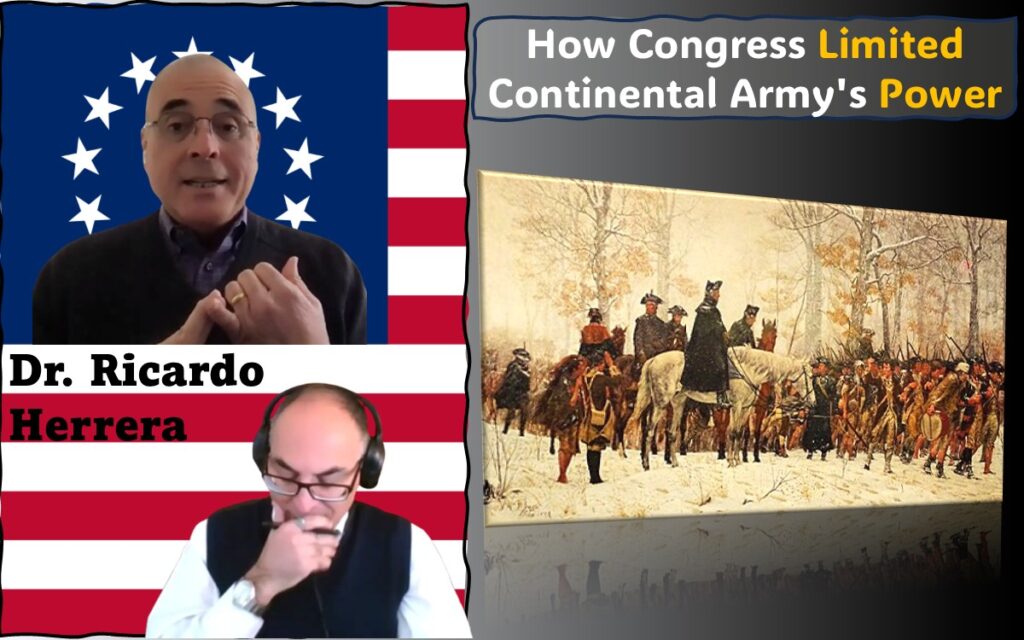 Continental Soldier Citizens – America’s People’s Army
3 Men Who Saved the American Revolution
►Interview with Prof. Joel Richard Paul about Silas Deane, Benjamin Franklin & Arthur Lee in Paris. This is a tale of court intrigue, financial schemes, international espionage, sexual affairs, and deep, debilitating divisions in the Continental Congress that Prof. Paul tantalizingly narrates in his book, Unlikely Allies: How a Merchant, a Playwright, and a Spy Saved the American Revolution.
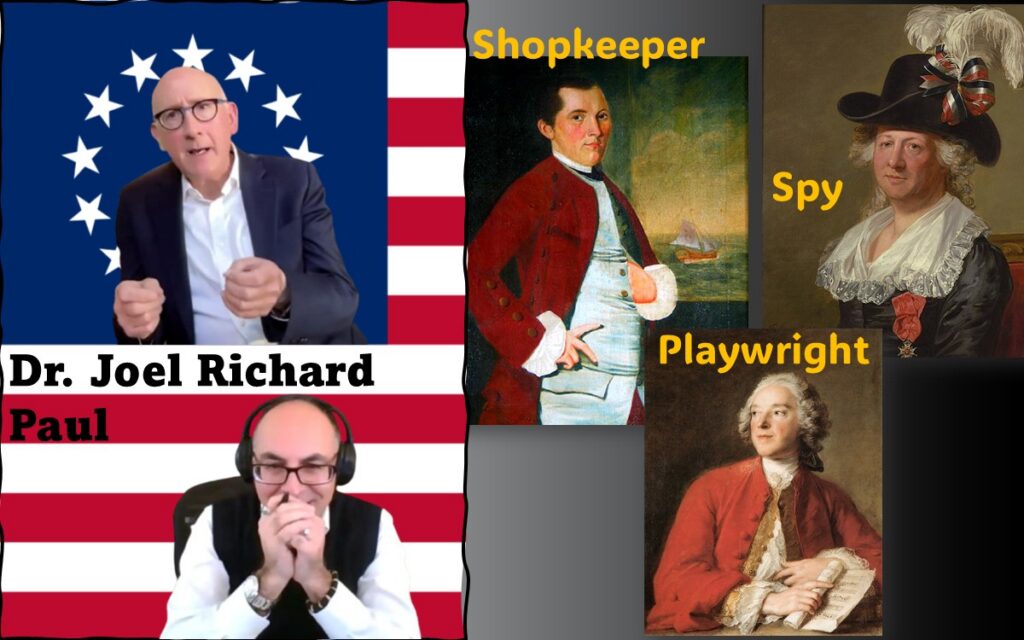 The Bizarre Plot That Armed the American Revolution
About This Program
Analyzing American Revolution (AAR) is a special series podcast production of the History Behind News program. In this series, 33 professors (and counting) analyze the American Revolution from 33 different angles through in-depth interviews with host Adel Aali.
Meet Our Guest Scholars
A structured body of thought on the American Revolution—where leading scholars advancing distinct interpretations that give this program its depth.

Thematic Collection
Tap below for a closer look at the Revolutionary Era themeswe examine—and to meet our guest scholars.

Library
- Interview Transcript Highlights
- Interview Image and Artist Highlights
- Quiz Answers and Backstories

Image Gallery
Explore the backstories and artist bios behind images of our Founding—before and after the American Revolution. These visuals shape how we remember—and reimagine—the Revolutionary Era.

Support AAR
AAR is an independent program built on sustained research, preparation, and production. Your support helps continue this series and expand our program.

Experienced Analysis of History
About HbN Program
The History Behind News program (HbN) is committed to making in-depth history researched and written by scholars enjoyable and accessible to everyone. Our motto is bridging scholarly works to everyday news.
The histories we’ve uncovered encompass an impressively wide range of subjects from ancient history to U.S. politics and economy to race, women’s rights, immigration, climate, science, military, war, China, Europe, Middle East, Russia & Ukraine, Africa and the Americas to many other issues in the news. We also receive advanced copies of scholarly books and discuss them in our program (in the context of current news).

Adel Aali, host. Snapshot from his introductory video to AAR podcast.
217 Scholars & Counting
Our guests are scholars at leading institutions. They are highly recognized, having received prestigious grants and fellowships as well as notable awards, including the Pulitzer Prize. They include celebrated documentary producers, former White House advisors and other high-ranking government officials, and current and former senior reporters of major national and international newspapers. Many have testified in Congressional hearings, and others frequently contribute to major media outlets and widely read publications.
Think You Know the American Revolution?