Updated: August 2, 2026
Introduction
In this interview: “They have to wait for the colonies to give them authority to go along with this. So the whole status of exactly the authority of the Declaration of Independence, it couldn’t stand alone. It required each colony to also declare independence, which they basically did.”
Watch this segment in the video below (00:19:28)
Why did the Declaration matter? What gave it authority?
Could Congress legally declare independence? If Britain rejected its authority, why did anyone take it seriously?
Why did dozens of prominent delegates publicly sign it? And how did a document with uncertain legal status become America’s defining statement of liberty?
In this interview, Dr. Edward Larson explains why the Declaration of Independence was far more legally and politically complicated than most Americans realize. He traces how Congress transformed Jefferson’s draft, why the signatures mattered as much as the text itself, how Britain viewed the Declaration, and why later generations—from Abraham Lincoln to Martin Luther King Jr.—elevated it into one of the most influential documents in American history.
Video
Watch the full interview with Dr. Larson (timestamped outline below)
Key Themes
- Continental Congress’s Revisions of Jefferson’s Draft
- The Declaration’s Uncertain Authority
- Why the Signatures Mattered
- Britain’s Response to Independence
- From Revolutionary Statement to National Creed
Central Question
How did the Declaration of Independence – which was never ratified – acquire authority, and why did later generations elevate it above its original legal function?

How to Use This Post
Use this post as reference guide to the American Revolution through the lens of this interview and the broader Analyzing American Revolution program (AARevolution). Navigate using the interactive table of contents above and the timestamps below (in gray) to discover how this interview deepens the story of the Revolution—and to explore how the program unfolds: its key themes, insights, image gallery, scholars list, history quizzes, and related interviews across the series.
Why the Declaration’s Authority Was Never Self-Evident
The Declaration of Independence is often treated as the moment the United States legally came into existence. Dr. Larson argues that the historical reality was considerably more complicated. The Second Continental Congress was not a permanent national legislature, and its delegates themselves wrestled with the question of what authority they actually possessed. The Declaration did not, by itself, establish a fully recognized nation. Each colony still had to declare its own independence through its own governmental process, while foreign powers had to decide whether they were dealing with thirteen independent states or a single emerging nation.
That uncertainty helps explain several otherwise puzzling features of the Declaration. Congress substantially revised Jefferson’s original draft before approving it, making the grievances shorter, clearer, and more persuasive. The delegates then publicly signed the document—not merely as a ceremonial gesture, but as a demonstration that many of America’s most respected political, economic, and military leaders were personally committing their lives, fortunes, and reputations to the cause. In Britain, many officials questioned whether the Declaration possessed any legal force at all. Yet those same officials recognized that the signatures of figures such as John Hancock, Benjamin Franklin, and other leading Americans gave the document political weight that could not easily be dismissed.
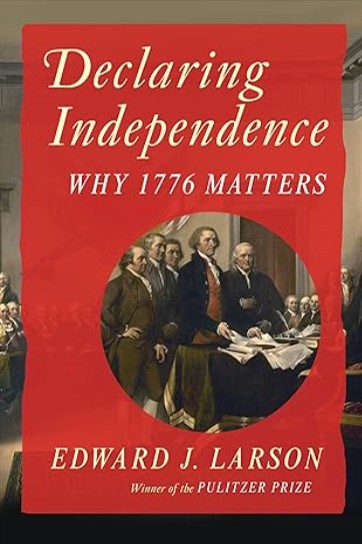 Dr. Larson’s book discussed in this interview
About My 221st Guest: Dr. Edward Larson
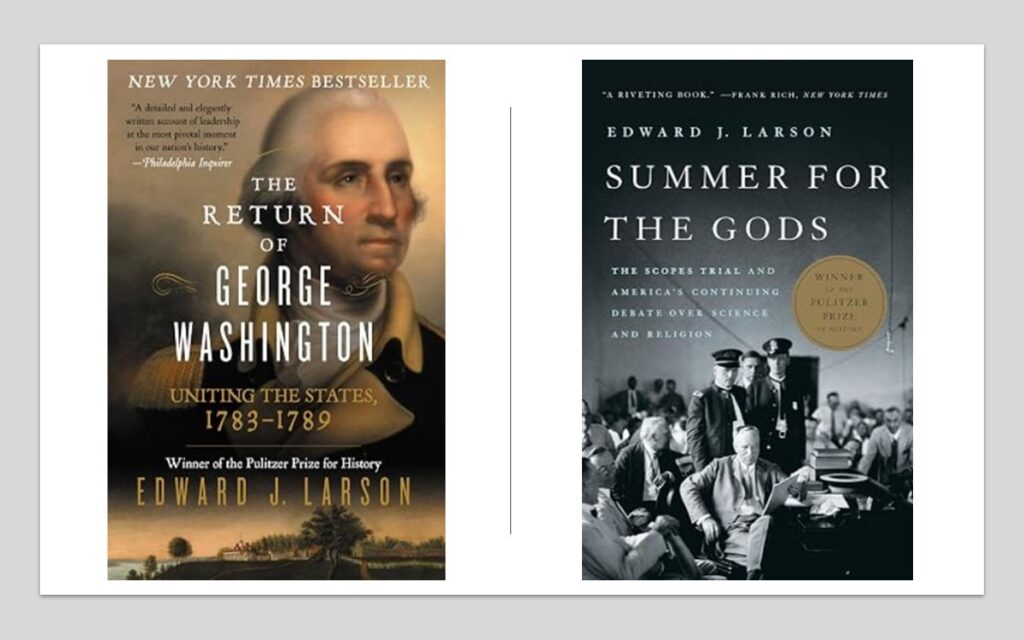
Dr. Edward Larson holds the Hugh and Hazel Darling Chair in Law and is University Professor of History at Pepperdine University. Dr. Larson has published more than one hundred articles and a dozen books, including the following:
►”The Return of George Washington: Uniting the States, 1783-1789″ – New York Times Bestseller
►”Summer for the Gods: The Scopes Trial and America’s Continuing Debate Over Science and Religion” – winner of the Pulitzer Prize
►”Declaring Independence: Why 1776 Matters” – his most recent book, discussed in this interview.
This is Part II of my two-part interview with Dr. Larson. In Part I, we discuss “1776: Seven Months That Changed America”
About Featured Image
Image of Adel Aali (program host) and his guest, Dr. Edward Larson, superimposed on the Betsy Ross flag, along with the cover image of Dr. Larson’s recent book “Declaring Independence: Why 1776 Matters”.
AAR Essential Insights
Although the full video and transcript of my conversation with Dr. Larson are included in this post, I’ve selected and summarized several insights that I found particularly revealing and worth emphasizing. These moments — some surprising, others that challenge familiar assumptions — help us see 1776, the Declaration of Independence and the American Revolution in a different light.
By the way, these insights are my own takes and interpretations from the interview. For Dr. Larson’s perspective and exact framing, please watch the interview above and view the transcript below in the corresponding sections.
How Congress Sharpened Jefferson’s Declaration
One of the most insightful points in our discussion is that the Declaration of Independence was not simply authored. It was edited into political force.
Jefferson’s draft mattered, of course. But Congress was not preserving a literary artifact. It was trying to produce a public document that could persuade Americans, answer Britain, and speak to foreign powers. That helps explain why the preamble largely survived, while many of the grievances were cut, compressed, or strengthened. The delegates knew which complaints would hit hardest in 1776.
The slavery passage is the most revealing example. Jefferson, himself a major enslaver, tried to blame the king for the slave trade. Dr. Larson points out why that was both politically explosive and historically strained. Virginia had turned against further importation, but Virginia was also profiting from the sale of enslaved people further south. So Congress cut the passage. Not because slavery was irrelevant, but because the argument was too tangled, too hypocritical, and too vulnerable.
This is where the Declaration becomes more interesting than the schoolbook version. Its power came not only from Jefferson’s pen, but also from Congress’s willingness to reshape his draft into a document that could unite Americans and persuade the world.
Watch this segment in the video above (00:06:00)
 Other notable books by Dr. Larson
Power of an Unusual Act: Signing the Declaration
An overlooked feature of the Declaration of Independence is that it was signed by so many delegates. Think about this… how many other national documents or legislative pieces include a slate of signatures?
One of the most surprising arguments in this interview is that the delegates did not sign the Declaration primarily to create a list of men willing to die for independence. They signed because the Declaration needed their authority. Its legal status was uncertain. The Second Continental Congress was an ad hoc body, and Britain did not recognize its legitimacy. So a declaration alone was not enough.
The signatures squarely tackled that problem because the signatories were not anonymous revolutionaries. They were governors, wealthy merchants, major landowners, military leaders, and some of the most influential men in North America. Their names carried political weight in the colonies and were recognized in London, Paris, Madrid, and Amsterdam. By publicly pledging their lives, their fortunes, and their sacred honor, they were also lending their reputations to the cause.
That reframes the way I think about the Declaration. The signatures were not merely symbolic. They helped transform a declaration with uncertain legal authority into a document that Americans, Britain, and foreign governments had to take seriously.
Watch this segment in the video above (00:17:32, 00:33:17)
For Britain, What Was the Declaration, Exactly?
We now read the Declaration of Independence as America’s founding document. But that’s not the reaction it received then – at least not from the British. Political leaders in Great Britain did not know how to classify the Americans’ declaration.
Was it a legal act? A political manifesto? A justification for rebellion? Or simply an eloquent piece of propaganda? Even many of Britain’s Whigs—who sympathized with the colonists—struggled with that question.
That uncertainty mattered. If the Declaration had no recognized legal authority, then who exactly had declared independence? A Congress with questionable authority? Thirteen newly sovereign states? Or merely a group of influential individuals acting together? As Dr. Larson explains, those questions shaped everything that followed, from Britain’s attempts at reconciliation to its negotiations with American leaders.
I also found it striking that some British observers recognized the document’s rhetorical power even while rejecting its legal force. They saw it as a powerful political argument—a polemic—but not as a document that could, by itself, create a new nation. That distinction helps us appreciate why the question of authority remained central throughout the Revolution.
Watch this segment in the video above (00:41:06)
Did the Declaration Have Legal Authority?
Continue watching at 19:28 in the video above
The Declaration’s Rise Beyond Its Original Purpose
Did the Declaration become America’s defining document in 1776?
In this interview, Dr. Larson explains how the Declaration, regardless of its importance in 1776 and throughout the Revolution, grew into America’s defining document because successive generations kept finding new meaning in it.
Jefferson’s supporters elevated it politically. Abolitionists found in it a moral argument against slavery. Women’s suffrage advocates adapted its language to demand equal rights. Abraham Lincoln anchored the Civil War in its ideals rather than the Constitution’s compromises. Martin Luther King Jr. appealed to its promises during the Civil Rights Movement. The document itself did not change. Americans changed the way they read it.
That may be the Declaration’s greatest legacy. Unlike the Constitution, whose language is largely fixed in legal disputes, the Declaration has remained a statement of national aspirations. Each generation has returned to it, asking whether the country has lived up to its own principles. In that sense, its words and ideals continued to resonate as each generation confronted its own challenges. The Declaration is writ large across American history because it has continued to speak to new audiences in new eras.
Watch this segment in the video above (00:49:33)
The Real Revolution: From the Rule of Men to the Rule of Law
Was the American Revolution simply about replacing British rule with American rule?
This interview argues that the Founders had something far more ambitious in mind. Independence was necessary, but it was only the beginning. The deeper revolution was the creation of a government in which the law—not a king, not a president, not even a celebrated revolutionary—would be sovereign.
That idea required more than lofty principles. It required representative government, free, fair and frequent elections, and legislatures that genuinely reflected the people they served. As Dr. Larson explains, the rule of law could exist only if political authority flowed from the people through their elected representatives. Otherwise, America would have substituted one ruler for another.
One exchange near the end of our conversation particularly stays with me. I suggested that 1776 involved two transformations: first, from rebellion within the British Empire to independence; and second, from the rule of King George III to the sovereignty of law itself. Dr. Larson’s response was immediate: “That’s the real revolution.”
Watch this segment in the video above (01:07:02)
The Interview (S1E26): Adel Aali and Edward Larson
In our conversation, Dr. Larson addresses key questions about 1776, the road to declaring independence, and the American Revolution. The detailed outline and full transcript below supplement the video above.
Podcast
Watch the full interview on this page with the outline and transcript below, or take the conversation with you on the go through our Spotify podcast.
Outline
Use the in-depth outline below, with its key moments and turning points, to follow the discussion and navigate the interview.
Click for Timestamped Outline
- Selected Highlights (00:00:00)
- Guest Introduction (00:02:38)
- Congress Rewrites Thomas Jefferson’s Draft (00:06:00)
- Jefferson’s Draft and the Committee Process (00:06:18)
- Why the Preamble Survived Almost Intact (00:08:54)
- The Grievances Become Shorter and Sharper (00:10:41)
- Why Congress Cut Jefferson’s Longer Complaints (00:10:50)
- Why the Grievances Spoke to 1776 (00:16:40) – Key Moment (00:16:44)
- The Slavery Passage Congress Removed (00:10:50)
- Jefferson Blames the King for the Slave Trade (00:12:23)
- Why the Passage Was Politically and Factually Complicated (00:14:29)
- The Declaration’s Uncertain Authority (00:17:32)
- The Second Continental Congress Was Not a Formal National Legislature (00:18:16)
- Why Each State Had to Declare Independence (00:18:53) – Turning Point (00:19:28)
- Who or What Did the Delegates Represent? (00:20:48)
- Why the Declaration Was Not Ratified by the People or the States (00:21:38)
- Why the Constitution Was Ratified (00:22:10)
- Independence Required More Than a Declaration (00:22:27)
- John Adams’s Definition of Independence (00:22:51)
- Foreign Recognition and the Problem of Thirteen States (00:23:37) – Key Moment (00:23:54)
- Why the Signatures Mattered (00:25:23)
- Why Signing the Declaration Was Unusual (00:25:51)
- Why the Delegates Needed a Parchment Copy (00:27:12)
- Divided Delegations and Public Commitment (00:28:30)
- Delaware, Pennsylvania, and the Push for Unanimity (00:29:58)
- Why Some Delegates Signed and Others Did Not (00:32:40)
- How Signatures Gave the Declaration Force (00:33:17)
- Leading Citizens Put Their Names on the Line (00:35:05)
- Why Britain and Europe Recognized the Signers’ Weight (00:36:21) – Turning Point (00:36:22)
- From Political Argument to National Creed (00:41:09)
- Britain Questions the Declaration’s Legal Force (00:45:54)
- Lincoln, Abolitionists, Suffragists, and Martin Luther King Jr. Elevate Its Meaning (00:57:44) – Key Moment (01:02:06)
- Just One Point (01:06:47)
- Republics, Representation, and the Rule of Law (01:08:06)
- Why “The Law Is King” Became the Lesson of 1776 (01:10:05)
Transcript
Note: This transcript was generated automatically and may contain minor errors. It is provided for reference and accessibility only.
Click to View Transcript
Adel:
Dr. Larson, it’s a pleasure to have you in our program special series. Thank you for taking the time for this conversation with me about the American Revolution. So this is part two of our two-part interview about why the year 1776 matters.
And we’re having this conversation in the context of your recent book, which has an appropriate and great title, Declaring Independence, Why 1776 Matters. So in part one, we went through every month of 1776 from January through July, discussing their major events and how they contributed to the transformation of the American colonies. And this is my interpretation, Dr. Larson, from rebellion within the British Empire to revolution for independence to separate from the British Empire. That was a major transformation of the way they thought, and we discussed that. But in part one, you said something interesting that I kept thinking about. When we finished talking about July and the Declaration of Independence, you said about a third of the Declaration of Independence was edited out.
Did I get that correct? Yes. So what was cut?
Do we know?
Dr. Larson:
Oh, absolutely, because we have Jefferson’s draft. We have the documents. We have the final document.
We have marked up copies. And we’re talking now about cut by Congress because, as we said before, a five-person committee was appointed, and they may or may not have ever met. Adams later recalled that they met, but Adams always tries to move himself to the center of everything in his recollections.
Thomas Jefferson doesn’t recall that they ever met, that they just asked him as chair of the committee to go ahead and draft it. They were all very busy with many other duties. They were on other committees.
Franklin was on the committee to write the Articles of Confederation, the initial draft. So they all had other duties. And Jefferson apparently did sound them out of the things that should be in.
But then he puts together, he pulls together pieces from other sources. Adams said it took a work of a day. And Jefferson doesn’t ever really protest that that’s not true, that it was a very quick work.
But what got cut was he follows the style that, he follows closely the Virginia. Virginia had already written its constitution. He had sent drafts down, and George Mason was mostly responsible.
And what they were, all the states were, because of the resolution on independent governments been passed in May, calling on all states to adopt a government of the people. That is, government for the people are sovereign to replace the royal charters where king is sovereign. They all basically have a similar format.
They include grievances. They include a declaration of rights, and they include a structure of government. Well, they’re not going to have a structure in government and declaration of independence.
This is an overarching document that would include all the states, now former colonies, now states. But what Virginia has done, Mason’s done, is he’s put the declaration of rights first, leading with that, and then doing the grievances. Whereas most of the revolutionary documents went the other way.
Here’s all our grievances against the king. Now we’re saying we’re going to be a republic.
Adel:
And with declaration of rights, for our sort of modern parlance and understanding, you’re talking about the big preamble.
Dr. Larson:
Yeah, we preamble that what is the nature of government? We hold these truths to be self-evident, that all men are created equal, endowed by their creators with certain inalienable rights. And then starts listing sort of those rights, life, liberty, and the pursuit of happiness, and that you have a right to rebel.
That’s a declaration of rights. Well, those are basically the first three rights sort of just barely adjusted. Those are Mason’s first three rights in the Virginia Declaration of Rights, that sovereignty is in the people, that all people are created equal, and that they are endowed with certain rights.
And those rights are life, liberty, property, and the pursuit of happiness. We had read this before. Thomas Paine had said it in Common Sense in January.
John Adams’ preamble in his preamble for the resolution of independent governance, and then his Thoughts in Government pamphlets, which comes out in May, he says the same thing.
Adel:
Both of which were discussed in part one.
Dr. Larson:
Both of which were discussed in part one. Well, Jefferson’s working with those. Mason worked with those.
So that’s where he’s coming from. But as in Mason’s Constitution, he puts that first, and then he goes into the grievances. Well, the first part, that soaring preamble, that’s hardly changed at all.
Little tweaking here and there. What is where the big changes are, is Jefferson’s pulled together a list of grievances. And those get chopped up.
Because really, when you think about it, now you’ve got all the delegates. They know the grievances that resonate. And so what they do is they take out grievances such as blaming the king for slavery in America.
They take those out. That’s an enormous grievance. That’s the longest single grievances in Jefferson’s text.
Partly because Jefferson is struggling to make it make any sense. Because it’s not factually true. Really, slavery in the colonies was, because there wasn’t slavery in England, was a domestic development.
It grew. Now, certainly England benefited from it. And when they tried to restrict the new resolutions to restrict the import of more enslaved people, the king vetoed it.
Sure, the king profited from the slavery because he ran, he was a co-owner in the big factory in what’s now Sierra Leone, which was the source of a lot of the enslaved people coming to the colonies. So the king was involved with it, but he’s not really the source. And Jefferson tries to stay within the realms of truth by a weird long resolution.
He also…
Adel:
If I may just interrupt you, Dr. Larson. Why would Jefferson critically comment via a grievance about slavery? He was a huge slave owner.
Didn’t he like slavery? I mean, like is a silly word to use. Didn’t he benefit profit from slavery?
He did. He owned them.
Dr. Larson:
He had quite a large, he was a large slave holder. But it resonated. And so what he had in there, and I have it out in front of me, that’s why I’m looking down.
He, referring to the king, he has waged cruel war against human nature itself, violating its most sacred rights and liberties in the persons of a distant people who have never offended him, capturing and carrying them into slavery into another hemisphere, and to incur miserable death in their transportation hither. And then he talks about this piratical, pirate-like warfare. So he’s really, if you parse it, he’s really criticizing the Atlantic slave trade.
And Virginia had already turned against the Atlantic slave trade. Now, Southerners, that is further South, the people from the Carolinas and Georgia just thought it was hypocritical because Virginia had so many enslaved people, but now they were profiting off of the sale of the offspring of enslaved. They were basically harvesting enslaved people because they had so many and they were selling them to the Deep South, which was opening and moving West into the area of Alabama.
So they had tried, they had passed various resolutions to ban the future importations of enslaved people. Now that played on. The North was turning against slavery and everyone, you know, the capturing of a person in Africa, taking them from their family.
And they knew these slave ships were horrible places. And so it sounds like, if you read it closely, it sounds like he’s an attacking slavery, but Virginia again and Maryland, the middle colonies, had turned against importing any more enslaved people. And Virginia and the king had vetoed, they passed resolutions, they passed legislation, the king vetoed it because he wanted to continue the slave trade.
The South wanted it too. And so he could write a resolution that talked and sounded of liberty. It’s very artfully written.
It’s very long. You know, most of his grievances are nice and short and terse. He has constrained our fellow citizens taken captive in the high seas.
He has endeavored to bring on the inhabitants of our frontiers, the merciless Indian savages. Nice, short. Well, they kept those.
Adel:
Kind of punchy.
Dr. Larson:
They’re punchy and they’re clear. But then these big long ones, and then ones where he tries to bring in the whole British people as supporting it. So if you look through the grievances, it’s basic.
And then he attacks the Scots and he attacks the, you know, he takes all these different resolutions and they basically cut the grievances in half. And they become much pithier. There’s been truly, you’d say that the grievances were much more effective.
The Congress as a whole really improved the grievances. They were short. They became short rather than some of these big, long, complicated ones that Jefferson.
He’s just taking words and trying to tease out something. And you could, you know, if you’re a good editor, you look at something and you say, he thinks he protests too much. He’s struggling here and cut it down and make it pithy.
And they turn the grievances into the pithy. So that at the time, the grievances were the most effective. Now, today, we love the preamble because it speaks to the ages.
But the grievances spoke to the people then. And that’s the part, best we can tell, that’s the part that really resonated and people loved. Then they also, the last part always was the shortest part.
That’s where they declare independence. They cut that down and they say, rather than a lot of words, they just shorten it down to basically the Virginia resolution that these colonies are, and by right, should be free and independent states. And then they do an interesting thing.
Jefferson had done this to an extent, but they elaborate on this a little bit. This is the one place where Congress extended it. There’s always been a question of what authority this ad hoc Second Continental Congress had.
Because the sovereignty lie in the king and then the various colonies. The colonies became states. Each state asserted that it was sovereign.
So each state had to declare its independence and each state did in their initial constitutions. They declare their independence. Rhode Island and Connecticut do it slightly differently that I could explain.
But they all have to declare their independence within a union. And so in the end, they add this part and it leads to the reason why the delegates sign it, which is a very unusual act back then, is they don’t quite know whether they’re doing it in the capacity of their states or now states, former colonies, which they sort of represent, but it’s not a formal, the Second Continental Congress is not a formal body like the later US Congress or even the later Confederation Congress.
So they make it that we’re doing it. As they end it in the new language and for the support of this declaration with the firm reliance on the protection of divine providence, that’s their own addition. They add a lot of references to God in it.
We mutually, we being there, the delegates who are signing, we mutually pledge to each other, our lives, our fortunes, and our sacred honor. That is, we’re doing it as individuals and we’re doing it on behalf of our colonies. And it makes it an interesting because they don’t have the formal authority.
They have to wait for the colonies to give them authority to go along with this. So the whole status of exactly the authority of the Declaration of Independence, it couldn’t stand alone. It required each colony to also declare independence, which they basically did.
Adel:
That is fascinating. So that’s why in our prior conversation in part one, you kept on emphasizing we the delegates, we the delegates. So it’s not I Ed Larson, senator or representative of Virginia is we the delegates from Virginia.
It’s a term we don’t use now, except I guess we still use it in for, do we use it for electoral college delegates? But generally we don’t use it, right? We use representative.
That’s what we use because you represent.
Dr. Larson:
Right.
Adel:
Interesting.
Dr. Larson:
And you can, if I add to that, think about this, they had the same problem a few years later at the Constitutional Convention. What in the world did they represent? And so there they said, okay, unlike the Declaration of Independence, that doesn’t go back to the people.
That doesn’t go back to the states. The colonies are now states. And so they say that this only takes effect when it’s ratified by the people of each state at a convention called elected delegates.
And so they begin with we the people. Again, there’s we again, as opposed to this document, which is we the delegates, a different we. And that causes Patrick Henry at the Virginia Convention to pull out his hair.
And he says, why in the world do you say we the people? You should say we the states, because this is being ratified by the states. Well, nobody’s ratifying the Declaration of Independence.
So it’s a funny, legally the status of the Declaration of Independence is sort of a, it has a, it’s really a declaration by a body that doesn’t, that its actual legal authority is very questionable. You have to figure out where does it claim to have its authority? That’s why John Adams, when he was writing in May, after the earlier in May, and then later, both before and after the Resolution on Independent Governments, where it calls on each state to adopt an independent government, replace the royal charters that they had with independent governments.
He says, that’s independence. It means each state adopting a resolution on their own independent constitution. He says, that’s independence, he writes.
And he doesn’t even mention the Declaration of Independence. He doesn’t, he says, independence is the adoption of an independent government in each state, some sort of a confederation among them and recognition by a foreign power. And that’s independence, he says.
So there’s no even listing of Declaration of Independence. Many people went along with it. He went along with it because they thought they needed to explain this to foreign countries.
They needed to explain to countries that also had colonies that they wanted their support of. They needed the support of France, the Netherlands, and Spain. They knew they needed it.
Those were the other global powers at the time, three other main global powers. They know they needed their support. So they needed a joint explanation of it.
But when France and when Spain and when England later, when they tried to write the peace treaty, they had a devil of a time figuring out, were they dealing with 13 independent states or were they dealing with one independent, one country, one nation? They couldn’t figure it out. We couldn’t figure it out.
Adel:
I’m sure they would have preferred to deal with 13 independent states and separate them instead of having one substantial-sized country. I have a couple of follow-up questions from this. Okay, we discuss, we the delegates, and there’s so much more to discuss about that, but I’ll refrain from going there because a couple of more things stand out for me.
One is, in the last conversation, you mentioned that on July 4th, John Hancock, the president of the Second Continental Congress at the time, signs it, and he signs it large because he doesn’t know how big it is. He should sign it. That thing about, so the king can see it without his glasses, I don’t think that’s a true statement, but neither here nor there.
And I think another delegate, the secretary of the Continental Congress also signs it.
Dr. Larson:
Yeah, he wasn’t a delegate, Charles Thompson. He attests, he’s listed as, attests that this is sort of like a notary. He attests that this is John Hancock’s signature.
Adel:
That’s what he says. Two people signed it on the 4th of July, and others continue signing it. I think there’s even one person that signs it in 1777, if I remember correctly.
Very, very late. But my question is not about who signed it and when. My question is this.
Dr. Larson, you’re the expert here, you’re the historian, but I’ve read quite a bit of historical documents, not primary sources, but in books. I haven’t really come across anything in which, like, out of a legislative or pseudo-legislative body, the legislators or delegates signed that document. Isn’t that unusual?
Like, I haven’t seen too many examples like that.
Dr. Larson:
Well, the authority, no, it is very unusual. And of course, in England, their precedent, everything would be signed by the king.
Adel:
Yeah.
Dr. Larson:
But they were dealing with an odd situation. What they were doing was they were creating, which they themselves described as something new under the sun, or as it says, a new order under heaven. That became the motto of the new government.
It’s on, you can see it on the Great Seal, which was crafted by Charles Thompson, the person we just mentioned, a year later. And it’s on the back of the $1 bill. It’s that weird pyramid with a little eye.
And it says, a new order under heaven. It’s in Latin, I think. Then it gives the date, 1776.
And that new order under the heaven, which they view as something entirely novel, is popular sovereignty. The people are sovereign. That’s why all the new state constitution says, you can read it in Virginia, North Carolina, you can read it in any of them, that the people here are sovereign.
Well, then you get to the idea, okay, then what authority are these guys working on? We can’t have just Hancock sign it, who’s the president of this convention. We can’t have all the people run around and sign it.
What authority do these people have to do it? Now, the reason why only Hancock signed then, and more people signed later, is they needed to make a parchment copy. What they had was just a working draft with carotid, where additions were made and things were crossed out.
That’s all Hancock signed at the time. They needed to go back and make on parchment a real copy. And as soon as they had that done, then Hancock re-signed it, the attest re-signed it, and then the delegates were invited forward.
That’s why the others signed later. They had to get this permanent parchment copy made. And then the idea was that everybody who supported it, the people who voted no, and of course, they only required a majority of each delegation that was there.
So basically the colonies, later states, could send as many delegates as they wanted. And a majority of the people present from that colony had the voting power for that colony. So if they abstained, or if they weren’t in the room at the time, they didn’t count.
And that’s how you’d get a majority. Well, then anybody could sign who wanted to. So Pennsylvania and Delaware are two of the most interesting examples of this.
Pennsylvania, when they had the preliminary votes, all you needed to pass independence, the resolution on independence, under the rules of the convention, is all you needed was a super majority. I think that was nine. And they got to that nine in late June, when Maryland finally joined Delaware and Pennsylvania, no, joined Delaware, Pennsylvania, and New Jersey in revoking their prohibition on their delegates voting for independence.
They didn’t tell them to vote for independence. Some states did. The New England states directed their delegates to vote for independence.
But these middle colonies just said, you’re free to use your own judgment. Before, they had had, late in 1775, they’d all adopted resolutions telling their delegates they could not vote for independence. Now they were free to.
So then the question was getting a majority out of that state. And Delaware got, it was uncertain. So how do you, there were many people there who thought we really need to speak with unanimity.
It’s just, go fast forward. Think of this when Earl Warren was, this is a real historical jump, but Earl Warren thought to desegregate the schools, he really needed unanimity. So he really- You’re going to the 1950s now.
1950s. So he had his majority, but he tried to write it in a way that the Supreme Court spoke with unanimity in desegregating the schools because he thought it’d have more force. Adams and others thought that same way.
We wanna speak with unanimity. So once they had their nine, they tried to get these others to vote yes. Well, how they did it with Delaware was one of their delegates was away and one delegate was for independence and one was against of the two that were there.
But there was a third, Rodney, and they sent through the night, gotta get up here because he was back on state business. He was doing state business back in Delaware. And so he famously rode through the night so that he would be, because he was for independence.
So it would be two to one in Delaware. In Pennsylvania, there was this pressure to have Pennsylvania vote yes. And the way they got it was that two of the delegates, Robert Morris and John Dickinson, just walked out of the hallway because they could have made Pennsylvania either not vote for independence or vote no.
And so they walked out in the hallway and let the others vote. Dickinson never voted for it. Morris never voted for it.
So then they get to the signing and most of the people who voted no simply didn’t sign. They didn’t add their authority. Robert Morris comes around to it and he signed.
John Dickinson never signs. Delegates up and down many other states were split. New York had not yet had authorization to vote for independence.
They of course were not directed to, but they didn’t have authority to. But they did have authority to abstain. And so they abstained, but later when they were given authority later after the declaration passed, they too signed.
So it’s a funny group that signs some people who didn’t vote, some people who weren’t even there signed, but they were members. Other people who voted no didn’t sign, but other people who did. So it’s an odd mix of people who ends up signing.
And as you say, most of them sign in August. Benjamin Franklin signs before he heads off to France to be the delegate. Most of them sign in August, but it trickles on and people are signing later.
And some people who vote yes and totally support it get called off to war or other activity and never sign. So it’s an odd group that signed, but it makes them visible. And what they’re doing is we are important people.
The people who get elected to the Second Continental Congress at this time, it’s not true later, but at this time, these were some of the leading citizens, all patriots, but on either side, because the war a year before, they were already fighting a war. Bunker Hill was happening, Lexington and Concord, the occupation of Boston, the siege of Boston, all these things were happening. The attack on Charleston being turned back, all these things were happening.
And yet the patriots were split. Some were fighting for rights and reconciliation. That is, we want our rights as English citizens of the King and we will fight for those.
Others were, by 1776, others were fighting for liberty and independence. We want our rights, our basic rights as Anglo-American citizens, but the only way we’re going to get them is as an independent country. So they were split on that.
And the Declaration of Independence divides them. So this is, but they were important. They were the leading citizens.
John Hancock was probably the richest person in Massachusetts. Robert Morris was allegedly the richest person in Pennsylvania. George Washington was probably the least, land-wise, the richest person in Virginia.
Same way with the delegates from South Carolina. These people were wealthy, substantial citizens. They’d had, they’d been governors of their states.
In most, many of the states, a governor or former governor is right there. And to have them sign the document, that’s what gave it force, both among the other citizens in America, but also overseas. These people were known.
People in England knew these names. They knew these people. They were the people who had large plantations and large fleets of ships like Hancock.
And they were the ones trading with England. Their names, many of them, people like Benjamin Franklin, were known in every country in Europe. And to see these people backing it, then even the elites in England and in France and Netherlands and Spain could realize this isn’t some rabble.
These are the citizens of substance who are putting their own name and pledging their lives, their fortunes. They knew these fortunes were substantial. Their lives, their fortunes.
And this really mattered back then. I don’t think we care much about sacred honor anymore. But back then, people really did care about sacred honor.
And so they say all this and they pledge it in the name of God. And this gave, this is what gave the document force. It wasn’t that it was passed by some rebel ad hoc convention.
England never took the Continental Congress seriously because you don’t even have any authority to meet. On what authority are you even holding this meeting, they could say. But when they read the names of these people, these are the pillars of American economic, political, and social society.
Adel:
This is, you know, I had never thought of it that way, that having the elite of America sign this is not only for the benefit of the American colonists to know that this is serious. Our leaders are doing this, but also it’s a message to Europeans. And from this program, having talked to scholars about the Habsburgs and the American Revolution and the Russians and the American Revolution and the Dutch and the American Revolution, they all knew George Washington and they all knew Franklin.
He was a celebrity in Vienna as he was in St. Petersburg. This is really fascinating. So one of the things that I always thought about, you know, in the past is, okay, you put your name there on the Declaration of Independence.
It almost becomes a list of people for the British to go after, arrest, or do whatever. But from your book, and this is on page 150, I find it fascinating. So I noted this.
This list actually becomes sort of, the purpose initially anyway, it’s kind of the reverse of what I just suggested. The British get this list of signatories and they go and say, look, we’ll pardon you with, well, with the exception of a couple, I think John Hancock, we’ll pardon you as the signatory to the Declaration of Independence if you give up. Am I paraphrasing?
Go ahead.
Dr. Larson:
If you pledge, if you pledge, again, the English took sacred virtue seriously and sacred honor. If you pledge to relinquish your revolution and pledge your support to the king, we’ll pardon you. I mean, you almost had to do that because these were the most important people.
These were in the colonies. And if they then flipped, and one of them does flip, one of the signers from New Jersey does flip, Richard Stockwell, who forever becomes a byword in America, sort of like Benedict Arnold. If you do flip, that will, the people will flip.
I mean, because they’re trusting you. And so it’s again, but the Howe’s are given the authority to grant pardons to these people if they’ll flip. And so they want the same reason why they thought they must sign.
And that’s what gives, it’s a quip, but that’s what gives such strength of force. I mean, Benjamin Franklin, in a quip could say things of more matter than the most serious document. But when John Hancock says, when they’re all signing, when John Hancock famously says, we must all hang together, because he really thought John Hancock was a man of great stature and great dignity.
And he says, we’re the leaders of society. We’ve got to hang together on this. And Franklin, who’s in line to sign says, or we’ll all hang separately.
And he’s right. Between the two of them, that’s what they need to do. They need to show that the leaders, the great landowners, the people who’d been governors, the people who’d been the leaders of the colonies, we’re committed.
We’re committed to this venture. We’re committed to, that all men are created equal and endowed by their creator with certain inalienable rights, among which are life, liberty, and the pursuit of happiness. And any government that takes this away, we have a right to revolt.
These are powerful words, words for the ages, and they’re pledging themselves to those. And back then, pledges meant a lot.
Adel:
Hopefully, we’ll go to a time where pledges and sacred honor would mean a lot. So we’ll return to a time. So let’s just go across the water to Britain.
So they received the Declaration of Independence within six, eight weeks, 12 weeks, however long it takes to get there. There are two things that you bring up in your book, and I find it really interesting. One of it is, I haven’t thought about this, earlier in this conversation, you said, we, the people, we discussed that several times.
We, we, we, the delegates, we, the people. What, if we step back for a moment, as you suggest in your book, and sort of think about Britain and their declarations and proclamations, right? It says, King George III, or the parliament, it doesn’t say, we, the people.
They get this, or, you know, what do they think? Like, this almost doesn’t sound official from their perspective, because it’s not from the parliament. It’s not from a sovereign, right?
Dr. Larson:
Yeah, they absolutely, they view it as a, when you read, when the Howes get it, they’re not even in England, the Howes are leading the attack, the Howe brothers. When they lead it, and they’re, and we had the notes of their secretary, who kept a extensive diary, and they were just, you know, they were just dumbfounded. They said, well, this makes our whole task of reconciliation, because they truly wanted reconciliation, as did Clinton, their chief lieutenant.
They really wanted reconciliation with these people, and they were Whigs. They supported the idea. They thought the colonists should have rights.
So they, that’s why they were put in charge, trying to work this reconciliation out. They said, well, this makes our task a lot more difficult. They’ve got these people pledging now, and they were so, they found it so frustrating.
He says, what authority do you have? And in the same way in England, and you get them coming at, the most interesting ones are the Whigs. Now, the Tories have no problem.
They, that is the people who pack the monarchy, and especially the Hanoverian monarchy, the Georges that are now ruling. He says, well, they can’t do that. And you get this in the church.
The bishops are saying this. They can’t do this in the name of God. The king is made by, is created by God.
The authority comes by the divine right of kings to rule. They can’t just go off. The only reason they exist was because the king authorized Cabot to go over and discover the place.
It’s only because they rule the places because of the God-given authority of the king. So the Tories have no problem saying that this item has no authority whatsoever, but the Whigs are in a little more confused situation because the Whig side, those, the Addison and Steeles, and then by this time, people like Edmund Burke, who you’ve mentioned, certainly thought this way, and others, they’re struggling with, well, what authority? What are they doing?
Adel:
And one of them- And the Whigs are not in power. Lord North is not a Whig. He’s a Tory.
Dr. Larson:
Come and go. Come and go. Pitt was a Whig of sort.
And when the king gets in big trouble, he puts the prime minister in who leans on the Whig side. But certainly North was, Lord North was in power then, and he’s on the Tory side. But occasionally he brings in a Pitt.
He occasionally brings in somebody, Rothingham, he had brought him in for a few months as prime minister, and he leaned toward the Whig side. And certainly Edmund Burke had authority. And within parliament.
So he goes back and forth, and they sort of struggle with this. But one of them says, well, I wish that this high-sounding document, I wish it came from somebody else than a slaveholder, slaveholders, because they sound like hypocrites. They’re calling for liberty, and they own all these enslaved people.
Remember that in England, slavery was illegal. Nobody had slaves in England. It was against the common law.
It was against natural law. But they allowed them in their colonies because they made money from them. And the colonies had positive laws that allowed it.
So they viewed the document as altivars. It was just beyond the power of this body to adopt and as a complicating device. But some of them did recognize this is a pretty darn good polemic.
And they viewed it as a polemic document.
Adel:
A polemic document, interesting. So to them, it didn’t have the force of law, the authority to declare anything. It’s a nice polemic.
Dr. Larson:
Yeah, to them, the only authority it had really were the signatures.
Adel:
Yeah.
Dr. Larson:
That these people with this credibility, a person like a Benjamin Franklin or a John Hancock would sign this document and put themselves out there. So they viewed it more as the actions, not of a convention or of the different states, but of these individuals.
Adel:
And the fact that such prominent individuals, I’m just referring, I’m repeating what you said earlier. They sign it. It just, it confirms that these are not just a bunch of rebels.
Dr. Larson:
Yeah, and shortly, right. And shortly after this happens, of course, the House asked for a meeting. It’s a meeting that took place on Staten Island.
They still have the house where they met in the Southern end of Staten Island, right across from New Jersey, trying to bring reconciliation. And Congress goes along with this meeting. But the meeting, they were very careful.
The British were not meeting with them as, and John Adams was there. Benjamin Franklin was there. A committee was sent over to meet with them.
And the British would not acknowledge that they were meeting with representatives of the United States, whatever that was. They were meeting with individuals of credibility and authority. And like John Adams and who they respected and Benjamin Franklin.
And of course, the House who met with them, the Admiral Howe, he was an old friend of Franklin. They used to play chess together.
Adel:
Oh, wow.
Dr. Larson:
In England during the years that Franklin was the representative of his colony and then later other colonies in England. So they knew each other well. And the problem was they couldn’t even agree on what their authority was.
Were they meeting with them as individuals or were they meeting them as representatives of this new confederation? And all that turned on what was the status of the Declaration of Independence? A document that had any legitimate force, which Franklin and Adams maintained, or was it simply some random statement?
Adel:
Yeah. And if the Howe brothers agreed that, OK, you’re representing these states, that itself is they’re almost acceding to their declaration saying, OK, yeah. So they couldn’t go there.
Now, let’s move forward for a second there. You took us to the 1950s. So I’m going to take us to the 1950s, the 20th century step by step for one specific reason, and that’s the Declaration of Independence.
Most of us are familiar with the Declaration of Independence, how it sounds, less so with the Constitution. I’ve interviewed scholars in the past who sort of have suggested to me in various sort of lengths of conversation that the Declaration of Independence became more important over time. It was elevated over time.
And then I saw that in your book. I read it starting page 100. You start talking about this.
So let me ask a question that I have had. Thomas Jefferson writes the Declaration of Independence, right? He’s then, we discussed that, he’s the chief sort of, yeah, author.
And then he’s president for eight years, but he also becomes sort of a head of a party that continues all the way to John Quincy Adams, I think it’s in 1824, 1828, right? And then who’s of a different party and then Jackson in 1832 changes all of that. American politics, popular politics takes over.
So the reason I belabored this, that Jefferson himself is a two-term president and then his proteges or his colleagues become presidents, there’s this era in which there’s an opportunity to sort of elevate the importance of the Declaration of Independence. Is that a thing? Does that happen during that time?
Is Jefferson pulling the levers, the levers that make this important?
Dr. Larson:
I think so. I think that’s an interesting observation to say, to push this in a way, initially somewhat partisan use. Jefferson and Madison together had created a formal political party out of a faction, sort of a consolidation of the anti-federalists who had opposed the new constitution and the state’s rightses.
People who supported the constitution, but read it pushing state’s rights and ended up drawing in a lot of the working class Americans, farmers, immigrants, put together a coalition, loosely organized coalition, a faction that congealed into an actual party all the way down to the ward level with organization by the 1790s. Now they’re pushing Jefferson for president. Washington is already retired.
There’s a competition. Jefferson had been, of course, in Washington’s cabinet. Meanwhile, Hamilton is leading the same coalescing of the federalist side, the old supporters of the constitution, but it’s narrowed down.
It’s more the elite business faction, merchant faction. They coalesce around their special interests. Neither are confined north or south.
When they run for president, they always are very careful to have one, either their candidate for president or vice president is pro-slavery and the other one doesn’t have any enslaved people or is anti-slavery all the way through. That continues all the way up to the civil war. And your bona fides, your revolutionary bona fides are important.
That’s no problem with Washington. It’s really no problem with Adams. Adams was a towering figure of the revolution.
Jefferson, it’s a little trickier because Jefferson, he didn’t really fight in the revolution and his services, revolutionary era governor of Virginia, didn’t go all that well.
Adel:
He ran.
Dr. Larson:
And yeah, he didn’t go all that well. But what he does have is the declaration of independence. And so in a way, his party pushes that to increase his bona fides because when you look back, it’s a soaring document.
It’s really, it’s tradition to read it. Even back from the very beginning, it was read out. It was copies were sent out to all the colonies and it was read in all the colonies.
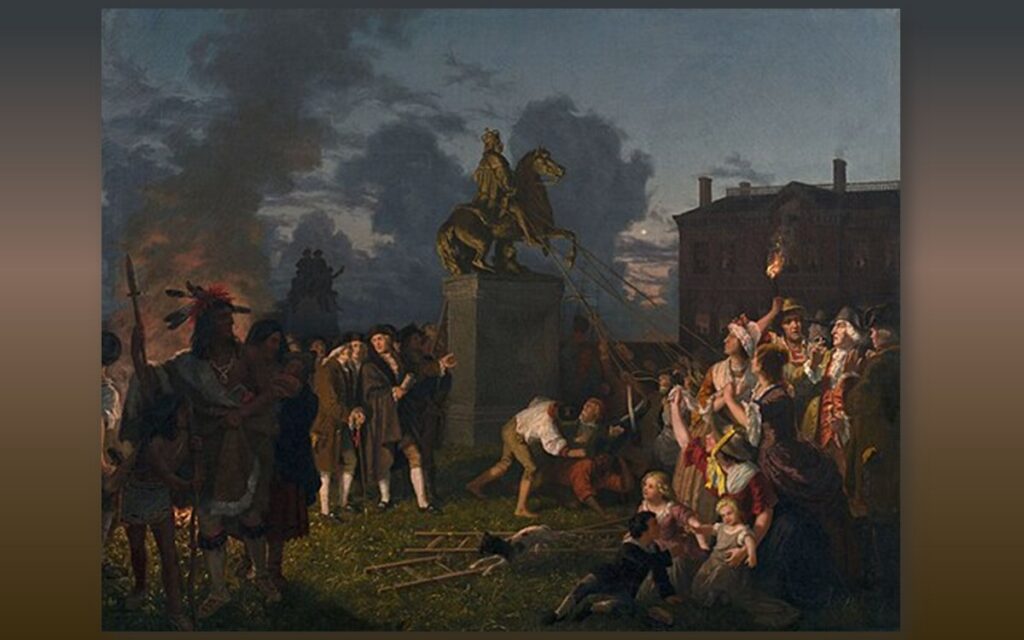
It was read out in Georgia. It was read out in New York. When it was read in New York City, the people ran off and tore down the statue of the king in 1776.
It was read out everywhere. So it was read. And then there was a tradition of reading it again every 4th of July, which was the date it was passed.
And so it does have that standing. But then since it was, since Jefferson claims that, he doesn’t initially stress that he is the author because it is a composite work. Franklin certainly contributed to it.
Adams contributes a little in committee. Whether or not the committee ever met, nobody knows. Adams later said the committee met.
Jefferson says the committee didn’t meet. So we really don’t know. And that the Congress itself had transformed it significantly.
About 40% of the document is the work of the Congress, either what they cut out or what they add. And, but Franklin, but Jefferson wraps himself up in it. It’s his bona fides.
It’s his major contribution to the Revolutionary War where Washington and Franklin and Adams, and then even the other candidates who he’s running against. He runs against Pinckney, is the candidate running against Jefferson in the second election. Pinckney had bona fides.
He was a major role in defending South Carolina. These people had revolutionary bona fides and Jefferson’s best is really, his best was this document. So he ends up pushing it.
It also, the language it uses, life, liberty, and the pursuit of happiness just resonates with the policies, sort of the vague ideals of the Jefferson’s party. The first called the Republican party, then called the Democratic Republican party, and later morphed into more commonly called the Democratic party. It morphed into their ideas of what’s this?
What’s the goal? Life, liberty, and the pursuit of happiness. It’s egalitarian.
It’s all men are created equal. It has an egalitarian ring to it. And then when they embrace it so fully, where the Federalists are pushing more toward the Constitution, it becomes, it gradually elevates in prominence.
People forget the grievances, mostly they forget, but they remember that. Kids memorize in school, they memorize that soaring preamble. It’s a beautifully written document.
And then you get various groups that want rights. You get the abolitionists embrace it. All men are created equal, endowed by their creator, with life, liberty, and the pursuit of happiness.
The suffragettes, the people for women’s rights, embrace it so that the Declaration of Sentiments from Seneca Falls is, paraphrases it, we hold these truths to be self-evident that all men and women are created equal. Frederick Douglass says that in his famous oration, what is the 4th of July to a enslaved person back in the 1850s? He says, it doesn’t, it’s really nothing to us, but I draw inspiration from the words of the Declaration of Independence.
And then Lincoln, when he’s trying to fight a civil war, which becomes a war over slavery. First, it’s a war to keep the union together. And then what’s important is the constitution says, it’s a one-way ratchet.
You go into the constitution, you can’t leave. But when it becomes a war after the Emancipation Proclamation, it becomes a war for the abolition of slavery. You see Lincoln at Gettysburg, fourscore and seven years ago, our forefathers brought forth from this continent a new nation, a new nation.
Well, they didn’t do it fourscore and seven years ago. Whatever the Declaration of Independence did, it didn’t create a nation. It authorized independence by a bunch of states.
But it fourscore and seven years ago, doesn’t date back to the constitution. It leapfrogs the constitution back to the Declaration of Independence because Lincoln could better anchor what he was trying to do. Thanks to the work of the abolitionists, thanks to the work of the women’s suffragists, he could anchor what he was trying to do to give this nation a new birth of freedom, conceived in liberties, dedicated the proposition that all men are created equal.
And now we’re gonna have a new birth of freedom. That all echoes the Declaration of Independence. And so from then on, this Declaration of Independence, it becomes, you can see it in two ways.
In some ways, the declaration becomes the noblest depiction of American values. And during World War II, Franklin uses it that way. Ronald Reagan uses it that way in his fight against the Soviets and the Cold War.
You can see people drawing on this, the sentiments of this document rather than the constitution, which is a very compromised document. And the other way I like to see it is, these words, certain inalienable rights, among which are life, liberty, and the pursuit of happiness, those become the American dream. People just accept them.
And you can see it all the way from John Ford Westerns to, as I say, Kennedy in his speech in the Berlin Wall. You can just see it. That’s the personification of the American dream.
Adel:
I guess in a way, and I’m speaking as a lawyer, a former lawyer now, the constitution are sort of perceived as the laws, the overarching laws of our nation. And you’re a lawyer too, so you appreciate this. But the Declaration of Independence may be perceived as the spirit of our country.
Dr. Larson:
I think that’s a great way to put it. Another way as a lawyer, I’d put it, in some ways, it’s like the Declaration of Independence is the articles of, if it was a corporation, the articles of incorporation, and the constitution is the bylaws.
Adel:
That’s a good one. That’s a good one. That’s really good.
By the way, did MLK invoke the Declaration of Independence? Absolutely.
Dr. Larson:
Much more than the constitution. Martin Luther King directly invoked the spirit of the Declaration of Independence and those phrase, all men are created equal. Now that’s funny because it’s interesting.
They would invoke, because people knew the Declaration of Independence, all men are created equal. But there’s a lot of weasel room in what all men are created equal means. When Benjamin Franklin in July of 1776, after the Declaration of Independence, when he’s chairing the convention, the popularly elected convention of Pennsylvania, drafting the Pennsylvania Constitution, which declares Pennsylvania independent, he changes that opening line from all men are created equal to all, because he’s an abolitionist.
He changes it because he knew that came from Virginia. He changes to all men are born free.
Adel:
Oh, wow.
Dr. Larson:
And that’s how the Pennsylvania Constitution starts. And that leads Pennsylvania to be the first state by statute to abolish slavery. And then other states pick that up.
So Massachusetts, when it drafts its constitution, it starts with the phrase, as does Vermont and New Hampshire, all men are born free. And when that’s in the New Hampshire and the Massachusetts Constitution, the courts in those states, by court order, they abolish slavery. They say, by the constitution, you can’t enslave people.
So that ends slavery in Massachusetts, New Hampshire, Vermont. And that’s Franklin tweaking all men are created equal, which is pretty abstract. And you can go back to when were they created?
To all men are born free. And now that does begin that anybody born after that date in Pennsylvania, this is what the statute said. Anybody born after this statute, and the statutes passed in the midst of the revolution, you’re born free.
You’re born from this date forward. It didn’t abolish slavery for people who were already enslaved, but it no longer did it pass by birth.
Adel:
You know, it’s funny when you say all men are born free, and then by Massachusetts, because this is in the constitution of several states, Pennsylvania, I think you mentioned Massachusetts and Vermont as well. So here today, 2026, we think of the word free and freedom as these grand sort of ideas and ideals, right? But going back to 1776, the term free is actually a legal term.
That means you cannot be enslaved because you’re free. It’s a specific term. It has weight.
Dr. Larson:
Right. It’s specific, and Franklin understood this. You know, that guy was pretty darn clever.
Adel:
He was.
Dr. Larson:
Turning that phrase from created equal to born free, that carries enormous meaning, and he knew that. And he put it right into the constitution, and other states who recognized it followed suit. So that became a model.
And so while places like Virginia and North Carolina duly say in their constitution that all men are created equal, these others say they’re born free. And those states just, you just, they went back to the logic of what was different about American slavery over the serfdom and other things was that the statutes in America said that slavery was hereditary, that it came with the mother. And if the mother was enslaved, the child didn’t matter who the father was.
The father could be Thomas Jefferson, or it could be, you know, Martha Washington’s father. It didn’t matter. Those offsprings were enslaved.
And, but in contrast, if you’re born free, the longest you can have is lifetime indentured servitude. You can’t have anything more than that. And Franklin understood that.
Remember, he was the first, he was the president of the first abolitionist society in the history of the world.
Adel:
Wow. So, Dr. Larson, I’m gonna ask you a tough question. We’ve talked extensively in this second part of our interview and much longer in the first part.
So the tough question that I have for you is after all of this conversation, after the many topics we’ve covered about 1776 and then centuries later about the Declaration of Independence, if you wanted our audience to remember just one point after all of this about 1776, what would that one point be?
Dr. Larson:
Wow, that is tough. That is a very tough question.
Adel:
If you must, you can share two points.
Dr. Larson:
But I think that down deep, and it’s funny, it’s not what you’d initially off the top of your head think. But when you look at these, when you look at these people like Adams and they really struggle with this and his thoughts in government, or you look at Thomas Paine, you look at Benjamin Franklin, what did they think they were doing? They said that we’re creating the rule of law.
John Adams says in his thoughts in government that republics are governments of law, not of men. And when they really thought, yeah, they wanted independence, yeah, they wanted liberty, all these things were fundamentally important to them. How do you get it?
And when they reasoned through it, they said, and Washington thinks about this, Hancock thinks about this, Franklin thinks about this. What really we have is we need a government that republics only can really believe in individual. If our goal is individual security and individual liberty, we can only do it if individuals are in control, if people are in control.
Well, we can’t have everybody there. We can’t have New England town government everywhere. So they have to be representative.
So they need a republic. Power has to be in the people, sovereign people pass down to their representatives. So how do you have representatives?
Well, you can’t have malapportioned districts. They write about this. You must have free, fair, and frequent elections.
And every one of the initial state constitutions have annual election to the assembly. Basically all power, most power is not put in the governor, but is put in the legislature. And the legislature should be representative of all the people.
So we’re not gonna have gerrymandered districts, you might say. They represent of all the people. The people can, Franklin lays it out in his constitution in Pennsylvania.
We can see it all in the Masons, who was a bit of a libertarian. You can see it in his Virginia constitution. So ultimately, this legislature passes laws.
And so, and again, Paine says it. In America, he writes in common sense, the law is king. For an absolute governments, the king is law.
So in free countries, the law to be king. And that’s what really differentiates it from the revolutions that don’t lead to liberty. The French revolution did not immediately lead to liberty.
The Haitian revolution didn’t. The Russian revolution didn’t. The Chinese revolution, why?
Because they weren’t representative republics where the law became king. No, they just made other men king. As Stalin becomes a king, more powerful and as bad as any czar, at least that’s my opinion.
Mao becomes a leader of more powerful than the old emperors though. You know, there’s a lot of competition. So here, that’s the lesson of 1776.
The rule of law.
Adel:
The rule of law, the foundation of that starts in 1776. Starting in January, what we discussed all the way to the declaration that talks about the people. And in January, Thomas Paine himself talks about here in America, the law is king.
That is fascinating.
Dr. Larson:
In England, the king is law. Ultimately, the king is law. And he signs everything.
And he issues all these things, whether it be the declaratory act or the prohibitory act, all these acts of tyranny. He unilaterally has the power to start a war. That’s why even the delegates to the Constitutional Convention are so clear.
Well, the leader can’t start a war. Only Congress can start a war. And Congress has to be representative.
They said, we’d be appalled with anything else. And so that’s what they mean by rule of law. And that was what made, down deep, they decided that’s what makes this something new under the sun, a new order under heaven.
The motto of the country that’s printed on our $1 bills, a new order under heaven, what was new, what was absolutely novel. We have a right, as Paine wrote, we have a right to do something that has never happened before. We have a chance to create a new form of government.
We have a chance to do something that hasn’t happened since the days of Noah, he said. Adams says the same thing in thoughts in government. And down deep, that boils down to rule of law.
But rule of law only works under their logic if you have free, fair, and frequent elections. And the bodies that are passing these laws truly represent the broad interests of the people. That’s the only way we can live up to these doctrines that are at the start of every, or in every state constitution, such as the North Carolina constitution.
Here, the people and only the people are sovereign. That’s a noble experiment. Who knows whether it can work in the world of AI, but that’s why 1776 matters.
Adel:
So if I may, I’m gonna reach a conclusion and tell me if this is correct. So remember in the first, in part one, Dr. Larson, we talked about the transformation of the colonies from rebellion within the British empire to revolution to separate from the British empire. So that was the transformation.
In effect then, based on what you just shared with us, there’s a second transformation. And that transformation is that independence itself is not enough. You need to get to a place, you’re not changing King George III with King George Washington.
That’s not what you’re doing. You’re getting to a place where the law is sovereign. And that’s a second and perhaps even more profound transformation that takes place in 1776.
Dr. Larson:
That’s the real revolution. That’s what they viewed as the revolution. That’s why John Adams could later write to Thomas Jefferson long after they both been president.
This is after Jefferson’s out of office. He said, what was the revolution? It wasn’t the war.
The revolution was in the minds of the American people and was all over by 1776. And this was the revolution that they were fighting for. Thomas Paine, I think I quoted this once before, he wrote in Common Sense of, more worth is one honest man to society and in the sight of God than all the crowned ruffians that ever lived.
That was a new way of thinking. That was at heart the American Revolution, but it required independence and it required a lot of fighting and it required a lot of bloodshed. But that is the animating spirit of America.
And you can read it in Lincoln. You can read it in Steinbeck. You can read it so many places.
You can see it in a John Ford Western.
Adel:
That is fascinating. Dr. Larson, thank you for educating me and our audience about the American Revolution. And to our audience, if you know of any history that could provide more perspective about the American Revolution, please share it with us and tell us what’s your perspective.
Thank you so very much, Dr. Larson. This was just fascinating, wonderful.
Dr. Larson:
Thank you for having me. It’s been a delight to work with you and get to know you.
Adel:
Same here.
Related Interviews and Essays
1776
►Part I of my interview with Dr. Edward Larson: “1776: 7 Months That Changed America”
 1776 Was More Than a Year of Independence
Thomas Paine
►My interview with Dr. Harvey Kaye (Part I): How Thomas Paine Became Thomas Paine
 From Corset Maker to Revolutionary Voice: Paine’s Journey
“Common Sense”
►My interview with Dr. Harvey Kaye (Part II) – Why America’s “Original” Founder Still Matters Today
 Paine’s Influence Through the Ages-What He Would Say About America Today
The Enlightenment
►My interview with Dr. Sophia Rosenfeld – “The Enlightenment and Intellectual Foundations of the American Revolution”
 Did the Enlightenment cause the American Revolution?
About This Program
Analyzing American Revolution (AAR) is a special series podcast production of the History Behind News program. In this series, 33 professors (and counting) analyze the American Revolution from 33 different angles through in-depth interviews with host Adel Aali.
Meet Our Guest Scholars
A structured body of thought on the American Revolution—where leading scholars advancing distinct interpretations that give this program its depth.

Thematic Collection
Tap below for a closer look at the Revolutionary Era themes we examine—and to meet our guest scholars.

Library
- Interview Transcript Highlights
- Interview Image and Artist Highlights
- Quiz Answers and Backstories

Image Gallery
Explore the backstories and artist bios behind images of our Founding—before and after the American Revolution. These visuals shape how we remember—and reimagine—the Revolutionary Era.

Support AAR
AAR is an independent program built on sustained research, preparation, and production. Your support helps continue this series and expand our program.

Experienced Analysis of History
About HbN Program
The History Behind News program (HbN) is committed to making in-depth history researched and written by scholars enjoyable and accessible to everyone. Our motto is bridging scholarly works to everyday news.
The histories we’ve uncovered encompass an impressively wide range of subjects from ancient history to U.S. politics and economy to race, women’s rights, immigration, climate, science, military, war, China, Europe, Middle East, Russia & Ukraine, Africa and the Americas to many other issues in the news. We also receive advanced copies of scholarly books and discuss them in our program (in the context of current news).

Adel Aali, host. Snapshot from his introductory video to AAR podcast.
232 Scholars & Counting
Our guests are scholars at leading institutions. They are highly recognized, having received prestigious grants and fellowships as well as notable awards, including the Pulitzer Prize. They include celebrated documentary producers, former White House advisors and other high-ranking government officials, and current and former senior reporters of major national and international newspapers. Many have testified in Congressional hearings, and others frequently contribute to major media outlets and widely read publications.
Think You Know the American Revolution?