Updated: August 6, 2026
Introduction
In this interview: “So the politicians, the U.S. politicians at the time, were not very happy when Spain was victorious. They needed Spain to continue to be harassing the Brits in North America in order that those troops were not concentrated against them. But they did not want a victory from Spain.”
Watch this segment in the video below (00:51:11)
Why was Spain sending aid to the American colonies before Lexington and Concord?
Why would a global empire support colonial rebels? Was Spain fighting for American independence? Or for its own empire?
Why did Americans want Spain to fight Britain—but not become too successful?
And if Spain helped the Revolution succeed… why do so few Americans know that story today?
In this interview, Dr. Gonzalo M. Quintero Saravia explains why Spain became involved in the American Revolution, how imperial rivalry shaped the conflict long before independence was declared, and why Spanish victories sometimes created unease among American leaders. He examines the role of Bernardo de Gálvez, covert aid, Spanish money, and the broader global war against Britain, arguing that the Revolution cannot be fully understood as a purely American story. Instead, it was part of a much larger struggle among competing empires whose consequences reached far beyond the thirteen colonies.
Video
Watch the full interview with Dr. Quintero (timestamped outline below)
Key Themes
- Imperial Rivalry and American Independence
- Bernardo de Gálvez and Spanish Strategy
- Secret Aid Before Independence
- Realpolitik and Revolutionary Alliances
- Spain’s Erasure from American Memory

Central Question
This conversation raises a central question:
Was Spain fighting for American independence—or for the recovery and preservation of its own empire?
How to Use This Post
Use this post as reference guide to the American Revolution through the lens of this interview and the broader Analyzing American Revolution program (AARevolution). Navigate using the interactive table of contents above and the timestamps below (in gray) to discover how this interview deepens the story of the Revolution—and to explore how the program unfolds: its key themes, insights, image gallery, scholars list, history quizzes, and related interviews across the series.
The American Revolution Began as an Imperial Crisis
Spain’s involvement in the American Revolution did not begin with Yorktown, Bernardo de Gálvez, or even the Declaration of Independence. According to Dr. Quintero, the story begins with the aftermath of the Seven Years’ War in 1763, a conflict that reshaped North America and exposed deep vulnerabilities within the Spanish Empire. Britain emerged from the war with Florida and unprecedented influence on the continent, while Spain lost strategically important territory and witnessed the British occupation of both Havana and Manila. Those events convinced Spanish leaders that the empire required comprehensive reform—not merely stronger armies and larger fleets, but a broader restructuring of its military, economic, political, and diplomatic systems.
By the eve of the American Revolution, Spain was therefore not a declining empire reacting to events beyond its control. Rather, it was an empire actively rebuilding its strength and reassessing its position in a rapidly changing Atlantic world. Spanish officials viewed British power as the principal threat to their interests, particularly after the loss of Florida placed British territory dangerously close to the trade routes connecting Cuba, Mexico, and Spain. Dr. Quintero notes that contemporaries described Florida as a “dagger pointed at the heart of the Spanish empire in the Caribbean.” From this perspective, unrest in Britain’s North American colonies presented not only a colonial rebellion, but also a strategic opportunity. Understanding that geopolitical reality is essential to understanding why Spain became involved in the conflict long before it formally entered the war.
About My 219th Guest: Dr. Gonzalo M. Quintero Saravia
Dr. Gonzalo M. Quintero Saravia is a career diplomat and historian. Since 2022, he has served as Director of Relations with the Holy See and Director of the Pious Society of the Holy Places at Spain’s Ministry of Foreign Affairs. Among his many diplomatic appointments, he served as Deputy Head of Mission at the Embassy of Spain in Lima, Peru, and previously as Counselor at the Embassy of Spain to the United States in Washington, D.C.
Dr. Quintero has been a Fellow at Harvard University’s Weatherhead Center for International Affairs, a Corresponding Member of the Spanish Royal Academy of History, and a Corresponding Member of the Colombian Academy of History.
In addition to his diplomatic and academic achievements, he has lectured and published extensively on the history of the relationship between Spain and the United States. His books include:
- Bernardo de Gálvez: Spanish Hero of the American Revolution, which received the Distinguished Book Award from the Society for Military History — (on Amazon)
- Spain and the American Revolution: New Approaches and Perspectives (The Revolutionary Age) — (on Amazon)
- His forthcoming book’s working title: Spain and the Global Struggle for U.S. Independence
About Featured Image
Image of Adel Aali (program host) and his guest, Dr. Gonzalo Quintero, superimposed on the Betsy Ross flag, along with the cover image of Dr. Quintero’s book Bernardo de Gálvez: Spanish Hero of the American Revolution.
Unless otherwise indicated, all images in AAR—including those in this post—are in the public domain.
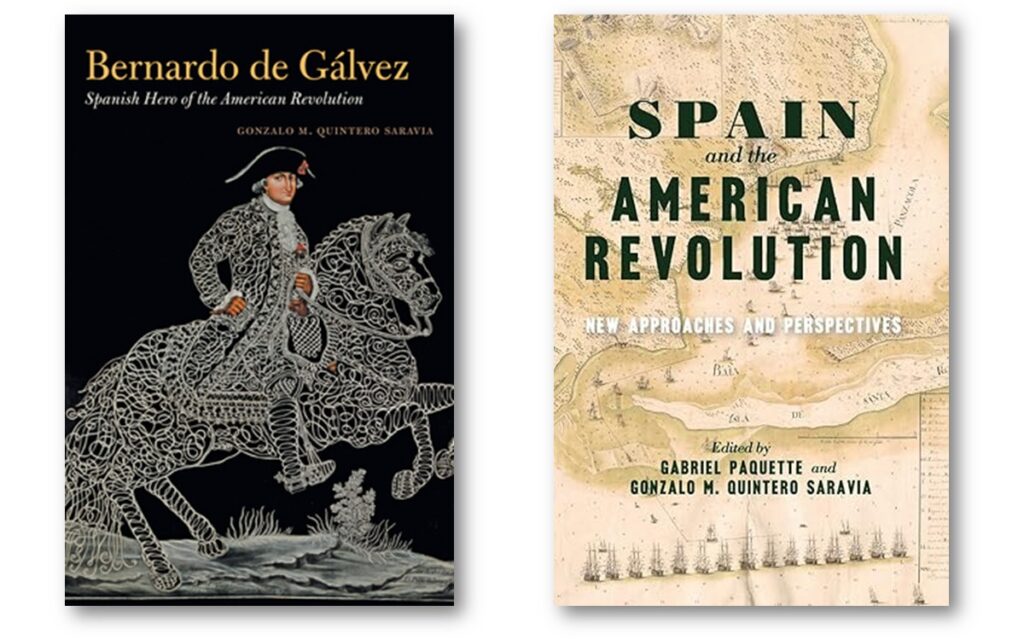 Two books by Dr. Quintero that form the backdrop to our conversation in this interview.
AAR Essential Insights
Although the full video and transcript of my conversation with Dr. Quintero are included in this post, I’ve selected and summarized several insights that I found particularly revealing and worth emphasizing. These moments — some surprising, others that challenge familiar assumptions — help us see the Spanish Empire and the American Revolution in a different light.
By the way, these insights are my own takes and interpretations from the interview. For Dr. Quintero’s perspective and exact framing, please watch the interview above and view the transcript below in the corresponding sections.
Spain’s Imperial Revival and the American Revolution
For many Americans, the story begins with a simple assumption: Britain was powerful, the colonies were rebellious, and Spain was a fading empire watching events from the sidelines. Yet that is not the picture that emerges here.
The Seven Years’ War was a shock to Spain, but it was not the beginning of a decline. It was a wake-up call. The loss of Florida, the British occupation of Havana and Manila, and the vulnerability of Spain’s defenses forced Madrid to rethink how an empire survived in a competitive world. What followed was not retreat, but reform. Military reform. Naval reform. Economic reform. Diplomatic reform.
I found it particularly striking that Spain’s leaders no longer viewed defense simply in terms of ships, fortresses, and soldiers. They began thinking in broader strategic terms. An empire could be strengthened through commerce, administration, diplomacy, and infrastructure as much as through military force. In many ways, this sounds surprisingly modern.
Perhaps the biggest surprise is that by the eve of the American Revolution, Spain was not an empire in freefall. It was an empire that believed it was recovering its strength and reclaiming its place among the great powers. That changes how we understand everything that follows. Spain did not enter this story as a bystander. It entered as a major imperial player with ambitions of its own.
Watch this segment in the video above (00:03:57)
Merit, Reform, and the Rise of the Gálvez Family
When Americans hear the word “empire,” we often imagine a rigid hierarchy where birth determines destiny. That certainly existed in eighteenth-century Spain. Yet one of the most surprising parts of this interview is the extent to which reformers were trying to loosen those barriers.
Before Bernardo de Gálvez became a military hero, his uncle José de Gálvez became a symbol of something larger.
He rose from extreme poverty in a small village in southern Spain to one of the most powerful positions in the Spanish government. That was not simply a remarkable personal story. It was evidence that Spain’s rulers were attempting to build a more capable state by rewarding talent, education, and service alongside privilege and aristocratic birth.
What struck me is that this story challenges two assumptions at once. First, that eighteenth-century Europe was completely closed to social mobility. Second, that Spain was merely drifting toward decline. The same reform movement that elevated the Gálvez family was also helping to reshape the Spanish military, bureaucracy, and empire. In that sense, the rise of Bernardo de Gálvez begins long before he ever set foot on a battlefield.
Watch this segment in the video above (00:12:40)
Spain Was Helping Before There Was a United States
One of the most revealing moments in this interview comes when we realize just how early Spain became involved. Not after the Declaration of Independence. Not after Saratoga. Not even after the shooting started in 1775.
According to this account, Spanish aid was already moving through commercial networks before Lexington and Concord. That should force us to rethink the way we tell this story.
We often imagine the Revolution beginning as a local colonial dispute that gradually attracted foreign powers. Yet Spain was already calculating its interests before independence was declared and before anyone knew whether a new nation would even emerge.
What makes this especially fascinating is the reasoning behind it. Spanish leaders were not supporting an American nation. They did not even expect one to exist. From Madrid’s perspective, thirteen weak former colonies looked far less threatening than the British Empire sitting on Spain’s doorstep. The goal was not to create the United States. The goal was to weaken Britain.
That distinction matters. It reminds us that great powers often support nations or movements not because they share the cause, but because the cause serves their own objectives. So yes. Spain was helping the American Revolution. But it was not fighting for the same reasons as the Revolutionaries themselves.
Watch this segment in the video above (00:29:36)
Why “American Revolution” Doesn’t Tell the Whole Story
One observation from this interview stayed with me because it forces us to reconsider the very name of the conflict. As Dr. Quintero puts it, “The American Revolution or the war for American independence, it’s called that way because of the result of the war.”
That is a remarkably important distinction. We call it the American Revolution because the United States emerged from it. But participants living through the conflict did not know that outcome in advance. What they experienced was a sprawling international struggle involving competing empires, rival dynasties, commercial interests, and military campaigns stretching across multiple continents.
Viewed from that perspective, some of the most important events of the war were not taking place in Boston, Philadelphia, or even Yorktown. Spain and France were discussing the recovery of Gibraltar and Florida. Military operations stretched into the Caribbean, Africa, and Asia. At one point, Spain and France even planned a joint invasion of Britain itself. One proposal called for troops to land near Portsmouth and advance toward London in hopes of creating panic in the financial markets and forcing the British government to seek peace. Another involved landing forces in Ireland to create yet another front against Britain.
That is not the story most Americans learn in school. Yet it helps explain why so many foreign powers became involved and why the outcome mattered far beyond the thirteen colonies. The American Revolution was undeniably an American story. But it was also part of a much larger global conflict whose participants often had very different objectives.
Watch this segment in the video above (00:38:37)
When Spanish Victories Became an American Problem
One of the most surprising insights from this interview is that Spanish success could create as much anxiety for Americans as British success.
At first glance, that sounds impossible. Spain was supplying money, weapons, uniforms and blankets for America’s War of Independence. And to boot, as discussed above, it was exerting military pressure against Britain. Yet Spanish and American interests only overlapped to a point. Beyond that point, they often diverged.
The turning point came when Spain began achieving its own objectives. Florida was recovered. Spain controlled both sides of the Mississippi River. British forces that might otherwise have fought the Continental Army were tied down elsewhere. From an American perspective, those developments were helpful. But they also raised an uncomfortable question: what would happen if Spain became too successful?
The quote that stayed with me from this interview was simple and revealing: “They needed Spain to continue to be harassing the Brits in North America… But they did not want a victory from Spain.” That single observation goes a long way toward explaining why Spain never formally allied with the American colonies. The Revolutionaries were fighting for American objectives. Those goals sometimes aligned, but they were never identical.
Perhaps that is the most valuable reminder of all. History is often taught through alliances, partnerships, and shared causes. Yet nations rarely act out of friendship. They cooperate when interests overlap and drift apart when those interests diverge. The American Revolution was no exception.
Watch this segment in the video above (00:51:11)
Americans Wanted Spain to Fight Britain—But Not Win
Continue watching at 51:11 in the video above
The Interview (S1E22): Adel Aali and Gonzalo Quintero
In our conversation, Dr. Quintero addresses key questions about the Spanish Empire and the American Revolution. The detailed outline and full transcript below supplement the video above.
Podcast
Watch the full interview on this page with the outline and transcript below, or take the conversation with you on the go through our Spotify podcast.
Outline
Watch the full interview on this page with the outline and transcript below, or take the conversation with you on the go through our Spotify podcast.
Click for Timestamped Outline
- Selected Highlights (00:00)
- Guest Introduction (01:38)
- Spain’s Imperial Crisis After the Seven Years’ War (03:47)
- The Loss of Florida and Strategic Vulnerability (05:44)
- Reforming the Spanish Empire After 1763 (08:01)
- British Colonies Through Spanish Eyes (10:05)
- Trade, Smuggling, and Imperial Competition (11:54)
- Why Spain Watched the Colonies Closely (14:27)
- Bernardo de Gálvez Before the Revolution (16:31)
- Frontier Warfare and Imperial Service (18:17)
- Louisiana and the Gulf Coast Frontier (20:44)
- Rebellion Becomes Opportunity (23:34)
- Spain’s View of the Colonial Crisis (25:49)
- Hurting Britain Without Supporting Revolution (28:03) – Turning Point (28:53)
- Secret Aid Before Independence (31:41)
- Gardoqui and Sons Before Lexington and Concord (32:15) – Key Moment (32:41)
- Arms, Supplies, and Covert Support (34:37)
- Why Spain Entered the War (36:13)
- Alliance with France, Not the United States (37:31)
- Imperial Interests and Strategic Goals (39:48)
- Bernardo de Gálvez Goes to War (41:02)
- Baton Rouge, Mobile, and Pensacola (43:26)
- Securing the Gulf Coast (46:18) – Key Moment (47:05)
- Spain, Yorktown, and American Victory (48:52)
- Spanish Silver and Revolutionary Finances (50:12)
- Why Americans Feared Spanish Success (51:11) – Turning Point (51:36)
- The Revolution as a Global War (54:08)
- Fighting Britain Across Multiple Continents (56:03)
- The Limits of American-Centered Narratives (58:24)
- Why Spain Was Forgotten (01:00:18)
- National Memory and Historical Erasure (01:01:47)
- Bernardo de Gálvez Returns to Public Memory (01:04:03) – Key Moment (01:05:12)
- Just One Point (01:06:20)
Transcript
Note: This transcript was generated automatically and may contain minor errors. It is provided for reference and accessibility only.
Click to View Transcript
Adel:
Dr. Quintero, it’s a pleasure to have you in our program’s special series. Thank you for taking the time for this conversation with me about the American Revolution. So, before we get too deep into the American Revolution and Spain’s role, please describe for us the state of the Spanish Empire in the years leading up to the American Revolution.
Dr. Quintero:
The crucible of everything is the Seven Years’ War or the French and Indian War that ended in 1763. That changed completely the map and the aspect of North America before that. It was crucial because for France it meant that it lost all its territories in North America, only remaining territories in the Caribbean which were very important, but for Spain also it meant a wake-up call that things were not working well in the empire.
The empire has been under several attempts to be reformed, but it was a wake-up call of 1763 that started everything. We must remember that in 1762 the British occupied Manila and Havana, and those were the two main outposts of Spain in the Caribbean and in Asia. The Philippines and Cuba.
Exactly. That meant that the threat was real, even though they both were returned to Spain after the signature of the peace in 1763, but it was clear that the defense of the empire was not in good shape, to say the least. Hence the wake-up call.
That’s the wake-up call. So a set of reforms were put into practice and a new concept of defense. The defense was not now think about in military terms only or in how many ships you have or how many fortresses or castles or whatever, but also the economic and the political and the diplomatic side.
So it meant that the Spanish empire went through a series of reforms from 1763 to 1783, and progressively it was put in a actually very good shape. The navy was not only restored but actually increased, not only in the number of ships at the disposal of it, but also in the quality of them, the cannons and everything. And also castles were reinforced, new ones were built, the system of the military was changed in order to have better troops, better trained, not only more, but also better equipped.
And so it wasn’t actually in 1775, it was actually in pretty good shape and it completely almost recovered. But as France had the feeling that they need revenge for what they had suffered in the Seven Years’ War, Spain has also that feeling too, that they want to regain its position as one of the major players in European politics. Because in 1763, Spain lost Florida.
And Florida was a key territory, not because it was richer than anything else, but because it controlled the trade and naval routes from Mexico, which is at the time the viceroyalty of New Spain, and Cuba to the Iberian Peninsula. So it was a threat. It was described as a dagger pointed at the heart of the Spanish empire in the Caribbean.
Adel:
A dagger pointed at the heart of the Caribbean. Oh wow, that’s almost poetic.
Dr. Quintero:
Yeah, because Cuba was the pearl of the crown of Spain in the Caribbean. And also it meant that France, quitting North America, they had previously Louisiana. Louisiana was never a profitable colony.
Adel:
Louisiana was never a profitable colony. Not like the sugar colonies, sugar islands in the Caribbean.
Dr. Quintero:
Okay, okay, I’m following. Never was a profitable colony. So when in 1763, through the treaties, they had to renounce Louisiana, they offered Louisiana to Spain in compensation from the loss of Florida.
Spain was reluctantly accepted this poisonous gift because it meant extending its own borders. But there was no choice because France threatened with ceding the territory of Louisiana to the British and it was not acceptable because it would bring the British closer to the rich possessions of Spain in New Spain, which is today Mexico and the South in the United States. So Spain actually grew in territory and became neighbors with the British for the first time in that part of the world.
Interesting.
Adel:
But just to recap what you just shared with us, Spain didn’t necessarily want this, didn’t necessarily want Louisiana, didn’t necessarily want to be neighbors. The increase in territory wasn’t a glorious thing for them. It was sort of a swap for a richer territory, i.e. Florida.
Dr. Quintero:
Exactly. In order to avoid the British having control over Louisiana, which meant that they would be too close to comfort for the Spanish in Mexico.
Adel:
So based on what you just shared with us, this, by 1775, going from 1763 to 1775, and this reform continues, as you said, till 1783. So by the eve of the American Revolution, we’re inching closer to the battles of Lexington and Concord in April 1775. The shot heard around the world.
The shot heard around the world, yeah. The Spanish Empire has sort of renewed imperial ambitions. This is an empire ascending, not in retreat.
Of course not. It was never in retreat during the second half of the 18th century. Did Spain have any interactions with the American colonies?
Dr. Quintero:
Very little. First, it was the language barrier. No Englishmen on both sides of the Atlantic spoke Spanish.
Very few of them. Very few. And very few Spaniards spoke English.
They actually, when they communicated, the Spanish and the British officers, they communicated in French. So there was very little cultural interaction. Commercial, there was a little, but very little, because Spain has a closed system of monopoly in its commerce, not allowing foreigners to enter into its possessions, in theory at least.
And most of the commerce that went with the 13 colonies was through Cuba, but it was not legal, to say the least. And also to certain points in the northern Spain, mainly Bilbao, where there was an important trade of cod, which was going to be one of the keys for the Spanish aid to the Americans. Using the cod the cod systems of exchange, and then sending arms, munition, and everything through that channels that were previously existed.
Adel:
So by cod, you mean the Atlantic cod?
Dr. Quintero:
The fish, yeah.
Adel:
Oh, wow. That’s amazing, because the French and all that were involved with it, also going on to Canada and the north. That’s really fascinating.
And you also said they were involved, to some extent, through Cuba. And was that sugar and rum for the colonies? Smuggling sugar and rum?
Dr. Quintero:
Yeah, sugar and rum for the colonies. And mainly tobacco importing from the 13 colonies. I see.
Adel:
So I want to talk about a very important person. And you’ve written about him. You’ve written several books about Spain in this period.
And the title of one of your books is Bernardo de Galvez, Spanish hero of the American Revolution. So before we get to his role in the American Revolution, which is a rich subject, who was Galvez?
Dr. Quintero:
The person, who was he? The history of his family is really interesting, because the rise of this family to the power, to the center of the power in the Spanish Empire during the second half of the 18th century, is the story of the successful social reforms that were done in Spain during the middle of the 18th century. These social reforms meant that a new class of civil servants, members of the military, officials, etc., came close to the monarchy, defending the monarchy, instead of the old aristocracy. The uncle of Bernardo de Galvez was José de Galvez. José de Galvez was born in a very miserable little village in the south of Spain, in Málaga, called with an almost impossible name to pronounce, Macharabiaya. Okay.
Very, very little place in south of Spain, near Málaga. He was the son of not even peasants, but laborers with no land of their own. And he attended a parochial school in a neighboring village.
He was the nerd of the class. So when the bishop of Málaga came on a visit, he was the one who was supposed to deliver a speech. And the bishop was so impressed by him that he sent him to the seminar in order to make him a priest.
He decided that that was not his goal. And he switched careers and he became a lawyer. He studied at the University of Alcalá de Hedades.
And then he settled his office in Madrid. He was so good that the French embassy, I’m talking about the uncle of José de Galvez.
Adel:
I know you’re talking about José de Galvez.
Dr. Quintero:
We haven’t even gone to Galvez himself. No, not yet. Okay.
So he was a good lawyer and he was so good in Madrid that the French embassy made him his own lawyer. Through these contacts, he started to ascend positions in the structure of the Spanish administration. And then later he became the minister for the Indies, the minister for the colonies, which was probably the most important posting anyone could have in the Spanish administration, the Spanish government.
Adel:
He comes from, he’s not even a peasant. He’s below a peasant. He has no possessions, no earthly properties.
Dr. Quintero:
No contacts, nothing. And he rises to become probably the second most important post in the Spanish government at the time.
Adel:
And for our American audience, we’re talking about Europe in the 18th century. This is not America where you go from rags to riches. This was not possible in the old Europe.
Dr. Quintero:
It was possible.
Adel:
It is possible, but it’s incredible, right? It’s an incredible story.
Dr. Quintero:
Not so incredible because during the 18th century, one of the main reforms that Charles III tried to achieve was reform the society, opening the ranks of the highest post to people with merit. He also created what is today the most important decoration of the Spanish monarchy, which is the Royal Order of Charles III, Carlos III. And the order has a motto, virtue and merit.
And that was the only two things that you needed to become a member of this order. And not only that, this order became the most important one in the Spanish rank of orders. It’s like the British have this, the one you put it on your knee, I don’t know what it’s called.
Or in France, you have the Legion of Honor. In Spain, we have the Order of Charles III, which is the most important one. And he made it especially in order to reward those people with no, they have to be Catholic, of course.
That’s normal in 18th century Spain. But besides that, and having no trace of impure blood, and you know what I’m, what do you mean by impure blood? Exactly.
But that was not a normal thing in Spain at the time.
Adel:
So you did mention just a few minutes ago that when I asked you about Galvez, his story, you started with successful social reforms. What I didn’t appreciate when you mentioned that is how far those reforms went. Hence, you’re saying it is, it was possible in the 18th century.
So these reforms were really pervasive in society. Yeah, José de Galvez is not the only example.
Dr. Quintero:
No, no, no. There were others too. There were two ways to achieve this, either in the administration, through the government, being an official, or through the military.
And so when José de Galvez was working with the French embassy, he bought a commission for his nephew, Bernardo, in the French army, because he had no contact in the Spanish army. So Bernardo de Galvez started his military career under French flag, fighting the Portuguese in the Seven Years’ War. Wow.
Then he switched to the Spanish army, when his uncle was already in a post that allowed him some contacts to do so. He was not minister yet, but he was a rising star. And then Bernardo de Galvez entered the military, the Spanish military.
He was selected for a very, for the school, like the San Jose, or West Point at the time.
Adel:
Kind of like an elite academy?
Dr. Quintero:
Exactly. The Real Escuela Militar de Ávila. Then there was an attempted attack, a failed attack on Algiers.
He volunteered for that. He participated in that. He was wounded there, and he was decorated because of his banner.
Then he was posted to New Spain, when he fought in what is today Texas and northern Mexico, against the Apache. But contrary to most of the officers from the Bayonne Peninsula, posted at that time, at that place, who regarded the Apaches as savages and all those things, and they all only wanted to have military solutions or campaigns against them, he wrote an extensive diary and a report about the life, the culture, the way of living of the Apache. And he thought that the best way to confront them was understanding them.
And since he thought that the Apache were attacking the settled populations because they were poor, and they did not have they didn’t have enough resources, they had to steal them, he said that the best way to settle this Apache population was, instead of fighting them, buying them through commerce, through trade, and through gifts, adopting a new Indian policy, which was called at the time. That meant regular gifts, exchanging, giving them weapons, giving them things to make them settle, and make them peaceful, and to being able to achieve what to get what they want through peaceful means. And that was his idea.
Then, but that doesn’t mean he didn’t fought the Apaches. He was twice also injured. Then he returned to Spain, and then he was appointed colonel of the Louisiana Infantry Fixed Regiment, and acting governor of Louisiana.
Because when he entered the French army, he learned French. And because of his experience with the Apache, the Alexander O’Reilly, who was at the time the chief of the Spanish army, from an Irishman in origin, there were lots of Irishmen in this story, lots of them.
Adel:
Lots of Irishmen.
Dr. Quintero:
The link between Spain and Ireland is very close through history. And in this period, it was especially important, that link between Ireland, Irishmen and Spain.
Adel:
Didn’t Spain once actually send troops to Ireland or something to that effect?
Dr. Quintero:
I think this has happened in history. Spain was always trying to create problems in Ireland from the British. I don’t want to digress, but- That’s an old tradition.
It’s a very old tradition. Yes. Okay, so back to New Spain.
Bernardo was appointed in Louisiana. The problem with Louisiana is that when Louisiana became Spanish, most of the population there was against that. Even there was a revolt against the Spanish new administration.
So when Bernardo went there, the situation was not very peaceful. And his orders, his first order was to make the local population not only happy, but loyal to Spain. And he did so in a very clever way, which is granting commercial privileges to the commercial elite and planters in Louisiana, so they could start making money, actually.
But not only that, he was so successful also because of his personality. He was, how can I say? He loved going to parties.
He loved dancing. He was very charming. He was young.
And at the end, everybody loved him. Also, he fell in love with a local, Felicitas San Marchant, the daughter of probably the richest merchant in Louisiana, Gilberto San Marchant. And he was so in love that he married her, but against the provisions of the Spanish law.
There were two provisions that Bernardo de Galvez was violating by marrying a local. First, as a military officer, he had to ask permission to the king for marrying anyone. He did not.
And second, as governor of a territory, he was expressly forbidden to marry a local. What he did, actually, is he used canon law, which has a figure of marrying in danger of death. When you’re extremely ill and you have already promised your bride that you’re going to marry her, you can marry her without all those previous provisions.
That becomes an exemption. He fell really ill. He married her.
But I don’t know if it was extremely that bad, the situation, because nine months after the marriage, the first daughter was born.
Adel:
So he wasn’t that sick. Was his wife also of a Spanish background? No, no, no, no, no, no, no.
French background. French background. French.
Okay. Yeah, the name sounded not Spanish.
Dr. Quintero:
Okay. No, no, no. Saint-Marchand.
French.
Adel:
French. Yeah. You started telling me about his military career, how his uncle bought a commission for him, not in the Spanish military, but in French, but he rose and he came back to Spain.
He went to the elite military academy and all of that. I’m curious now, because this is going to be relevant to our conversation that’s going to come up in a few moments about the American Revolution and that war, was he like a, because we call him the Spanish hero of the American Revolution, was he like a daring hero? Yes.
Or was he a methodical? No, no, no, no, no, no, no, no, no, no, no, no, no.
Dr. Quintero:
He was not a methodical. No, no, no, no, no, no, no. But he knew he wasn’t, so he had good friends that could do all the dirty work for him.
Yes. I see.
Adel:
So he had friends and consultants that did the military planning and strategy. He was the daring hero. Okay.
I see. So let’s go to the American Revolution. And this is what I want to know.
Initially, let’s talk about the shot heard around the world, right? What did the American Revolution initially mean for the Spanish Empire? Like it’s 1775.
I don’t know. Are they even interested in what’s happening? Is this something in their geopolitical interest of the world that interests them at this moment?
Dr. Quintero:
It was a great opportunity to poke the eye on the British. A great one. Spain was creating problems in the territories of the enemy from a long time ago, like the British did in the Spanish territories.
In the late 16th century and early 17th century, in Spain, there were created three colleges, a college St. Albans for Englishmen, a college of St. Patrick’s for the Irish, and the college of the noble Scotsman for the Scots. There were all young men coming from those three places. They came to Spain.
These colleges were settled in Madrid and Salamanca. They were giving Catholic instruction and they were after that either received the holy orders or not, and then re-sent to the respective places to be sources of information, let’s be clear, spies, and also to be used in creating problems for the British in England, Scotland, and specifically Ireland. There were lots of revolts, lots of rebellions in Ireland that were funded by Spanish money and also that were led by people that were educated in Spain.
So it’s an old tradition where your enemy has a problem inside, you foster that problem. You put more gasoline into the fire. So you must remember that Spain was a neighbor of the 13 colonies.
So you’re always interested in what is going to happen in the 13 colonies. And the shot that was heard around the world at the beginning was not a revolution. It was a revolt.
It became a revolution in 76 with the creation of independence. That became a revolution. It transformed them into an international war when France and Spain stepped in.
But at the time it was just a revolt. Nobody knew what was going to happen. But it was a good opportunity for Spain to create problems within the territories in North America of the British.
Adel:
Before Spain gets involved in the war, and we’re going to get to that in a moment, did it initially, similar to France, start covert support and operations?
Dr. Quintero:
Both France and Spain started covert operations at the same exactly time. There was a guy, Beaumarchais, who was very involved in freedom, liberty, and all those things. And he proposed a plan to the French government to create a cover company, what’s called Roderique and Hortales, through which they could channel secret aid to the rebels at the time.
Money, blankets, ammunition, cannons, muskets, you name it. And that company, Roderique and Hortales, was funded one million livres tornés by the French government and another million, exactly the same amount, by the Spanish embassy in Paris. So at the beginning, the aid was by the two, by France and Spain, in equal terms through this French cover.
Then Spain created the all cover operations through those guys who were already buying cod from the 13 colonies and selling whatever through Bilbao. And they later used another company that was Gardoqui and Sons from Bilbao doing the same thing, just sending military materiel, ammunitions, guns, whatever, to the rebels.
Adel:
Is this late 1776, early 1777? Yeah, yeah, yeah.
Dr. Quintero:
No, no, no. 76.
Adel:
76. Oh, okay. Sorry, I just take it early.
Dr. Quintero:
Before the Declaration of Independence.
Adel:
Even before the Declaration of Independence?
Dr. Quintero:
Before the Declaration of Independence. Yeah, yeah, yeah. And actually, the first shipment done by Gardoqui and Sons was before the shot heard around the world.
Adel:
Before April 1775. Wow. Yeah.
Okay.
Dr. Quintero:
You must remember that there was a choice for Spain. What would you prefer as a Spanish member of the government? To have as neighbor in North America, the British with the Royal Navy and the Army, or 13 colonies that you don’t know what they’re going to become?
The choice was clear. It’s better to have 13 colonies that are going to be weak than the British Empire there. So let’s help the 13 colonies.
Actually, nobody thought that there was going to be a United States. The Declaration of Independence, you say this United States, the state is in capitals, but United is not. It’s not a declaration of the beginning of a country.
It’s the Declaration of Independence of 13 different countries at the same time. And everybody thought that these 13 countries could not become a country at all, ever. Actually, it did not become a country until the Constitution and George Washington becoming the first president in 89.
But at the time, there’s a report in 75 by the Count of Bergen, the Minister of Foreign Affairs and Prime Minister of France at the time, expressly saying this. There’s no way these 13 colonies could pose a threat to anyone in the near future, because there will be either 13 different countries or fighting each other or just recuperating for the cost of the war.
Adel:
Oh, wow. Okay. So Spain gets involved really early on.
This is going to sound like too much detail, but I think it’s important. What does Spain provide to the American colonies at this point? Before entering the war.
Before entering the war, there’s already a structure. We have the Continental Congress starts in 1774 and 1775, the second Continental Congress. We have committees of safety, committees of correspondence, the secret committee.
So there’s a lot going on. Even though it’s not a country, the American revolutionaries already have a lot of administration going on. So what does Spain provide?
Guns, cannons, saltpeter, uniforms, what?
Dr. Quintero:
The Articles of Confederation. In the Articles of Confederation, it’s actually described what the Americans needed at the time. And there’s a mention of France and Spain.
What they needed at the time was the help from those countries supplying everything they could. And before entering the war, Spain supplied everything from cash through loans or grants, but mostly tents, clothing, most of the blankets that allowed the Continental Army survived the winter at…
Adel:
Valley Forge and Morristown later.
Dr. Quintero:
Valley Forge were Spanish ones.
Adel:
Wow.
Dr. Quintero:
So, but cannons, muskets, powder, but not only that. Also, Spain during that time opened the Spanish ports in the Caribbean and Central America to American vessels, but not only commercial vessels, commercial ships, but also to privateers that when they entered the Spanish ports, they were refitted by the Spanish treasury at no cost. Wow.
Wow.
Adel:
Okay. At what point and for what reason does Spain join the war, join the fighting? Was there an event?
What happens here?
Dr. Quintero:
France joined after Saratoga because Saratoga proved that the Continental Army was a serious contender that could face a battle in European style. The British could face a battle, could win a battle. There were doubts that they could alone win the war.
So France entered on their side. But Spain wanted several things to recover from the Brits. Gibraltar, Minorca in Spain, the Floridas, Mobile, secure the Mississippi, and also expel the British from Central America.
Wow. That’s a tall order.
Adel:
Okay.
Dr. Quintero:
That was the list that Spain forced France to sign as the objectives of the war, previously engaging to the war. And it was a list, six item list. And France says, yes, these are the things that we’re going to fight for.
And we’re not going to sign a peace separately, and we’re going to fight for these things. But Spain at the time adopted a policy to try to achieve these objectives through diplomatic means. There was a mediation of Spain between Britain and the colonies.
There was several movements in Russia, Prussia, Sweden, Netherlands, in order to pressure the Brits in order to make peace and grant Spain what she wanted. But at the end, when the government of Spain realized that there was no way that Spain could get those objectives without fighting, she decided to declare war to the Brits in June 79.
Adel:
June 79. So that’s about a year and a half. After France.
Yeah. June 79 declared war. Okay.
I’ve used the term war, and you’ve used the term war several times. So I want for our audience to appreciate what this means when we say war. Based on what you said, was Spain essentially fighting all over in the Americas, in Europe, in the Caribbean?
Dr. Quintero:
The American Revolution or the war for American independence, it’s called that way because of the result of the war. But actually, it was a global war. It was fought not only in European waters, in the Atlantic, in North America, in the Caribbean, but also was fought in Africa, and also was fought in Asia.
Not by Spain, but by France. France and Britain have fought a lot in India, both sides of India, and also in Senegal. So it was a global war.
It was the second global war. The first global war was the Seven Years’ War. This is a global war.
So the first action that was taken between France and Spain against the Brits was an attempt to invade England in 79. Wow. Yeah.
The idea was to, a joint force, they will attack Portsmouth, they will disembark, and they will march against London, not to conquer England. This attempt is called the Other Armada. The Other Armada of the Faithful Delegate.
Adel:
Yeah.
Dr. Quintero:
And the idea was to march some troops against London and to create a panic in the Stock Exchange that will force the British government to sue for peace. It never happened because of problems between the two armadas, the Spanish one and the French one. There were problems of communication.
There were several problems. An epidemic, how you say, an epidemic, escorbuto, I don’t remember how you say it now, within the French ships, so they didn’t attack Portsmouth. But that was actually the first thing.
It was the first thing that was attempted, but the first idea was to disembark in Ireland and create problems again.
Adel:
Okay, Ireland, that’s interesting. We talked about that earlier. So, let’s get to Galvez.
He’s very important for the American Revolutionary World. What does he do?
Dr. Quintero:
He was the governor of Louisiana and the colonel of the Louisiana Infantry Fixed Regiment. And he was in charge of observing what was going on in the 13 colonies. So, he deployed a network of spies that delivered very good results.
And before the war was declared, he received instructions from Madrid to start preparing it. And he decided that the first thing he should do is go up the Mississippi to expel the British from there to secure his duergard. So, he attacked Baton Rouge and Natchez.
He conquered those postings and then he returned to New Orleans in order to attack Mobile, which was his second objective. He succeeded in that and he tried to go directly against Pensacola, which was the capital of the Florentines at the time. But he wasn’t able to do it.
So, he had to return to New Orleans because he needed more troops. And then he gathered more troops, both in New Orleans and in Havana. The first try was not successful.
He was a little bit reckless, you may say. And there was a huge hurricane at the time. So, the ships were dispersed all along the Gulf Coast and also the Gulf of Mexico.
Very bad luck. And he spent several months reorganizing his troops, his forces. And then in 82, he successfully entered the Bay of Pensacola and conquered Pensacola.
Adel:
Wow. So, he takes Baton Rouge, Mobile, Alabama, well today Alabama, Pensacola, Florida.
Dr. Quintero:
At the time of Florida, yes.
Adel:
Yeah. So, what is the practical impact of all of this fighting to the east of the 13 colonies for the American Revolution?
Dr. Quintero:
It was great because the British troops that were fighting the Spanish over there were not able to fight the Continental Army in the north.
Adel:
Yeah. Essentially pinned them down to the east and south.
Dr. Quintero:
Exactly. Not only that, the Continental Army was a very special army. It was an army of citizens, not of soldiers, which was very different from the armies of France or Spain at the time.
So, they signed a special contract in order to say, I’m going to serve under the Continental Army for a certain period of time. And you’re going to pay me this amount of money. And there were huge economic problems for the Continental Congress to pay that money that was owed to the Continental Army troops.
And several times they were at the verge of mutiny. The last time they were at the verge of mutiny was when they were going south towards Yorktown. At the time, Rochambeau had joined Washington.
They were going down to Yorktown and they were going to meet a French fleet under Ambiante de Grasse at the bay of the Chesapeake. But the French had no money. So, the Spanish gave them the money for that and guaranteed the French that the Spanish Navy would protect their colonies in the Caribbean.
So, de Grasse was able to go to join Rochambeau and Washington at Yorktown, defeated the British at Chesapeake Bay. And when the Continental troops were at the verge of mutiny, they were paid by Spanish pesos that de Grasse had in his ships.
Adel:
Wait a second, wait a second. Okay, Yorktown, 1781, is a huge deal. It essentially brings major British operations in the colonies to an end.
There’s still things going on. Yeah, yeah, yeah. But the big, the last big thing is that one.
So, based on your telling of this history, Spain helps the Americans by essentially paying the, I don’t know, mutinous Continental Army soldiers who are saying, hey, we need to get paid. These are citizen soldiers. It provides the money for them and it tells France, don’t worry about your Caribbean possessions, islands, we’ll cover those, send your fleet over to Chesapeake Bay.
Exactly, yes. This is a lot. Spain comes in at a very important moment.
Dr. Quintero:
No, but not only that, actually, as we discussed previously, the richest possessions that the British had in the Americas were not the 13 colonies at all. The 13 colonies were a little bit rich, not as rich as, for example, the Viceroyalty of New Spain or Mexico, which was far richer than that. But they were certainly, they were doing very well, actually.
But the richest really thing were the Sugar Islands, and within the Sugar Islands was Jamaica. And after Yorktown, the fleet of de Grasse was supposed to join a Spanish fleet and Spanish and French troops that were concentrating in what is today Haiti, at the time it was Saint-Domingue, in a place called Guarico. They were going to concentrate several, almost 40,000 troops and an impressive number of ships to attack Jamaica.
It didn’t happen because the French were defeated in a naval battle by Rodney, the Battle of the Saints, that actually meant that that operation was not going to be happening in the next six months. But the threat against Jamaica was real. And that was the reason behind why the British government decided that this was the time to make peace, because we are risking losing Jamaica.
And we can certainly lose the 13 colonies, but we cannot lose Jamaica.
Adel:
That is huge. Oh, my gosh. So, in effect, France and Spain together force peace, in addition to what they do for Yorktown, is also they force peace on Britain by threatening their highly valuable possessions in the Caribbean.
Exactly. That is fascinating. Let’s take a break here.
In the next segment, I asked Dr. Quintero, let me do this again. Let’s take a break here. In the next segment, I asked Dr. Quintero about the legacy of Spain’s contributions to the American Revolution. We’ll be right back. Dr. Quintero, we discussed the war, the American Revolutionary War, and Spain’s contributions to it. So, given all that Spain did for the American Revolution, why didn’t the Spanish Empire formally ally with the American colonies?
Dr. Quintero:
It was not in the interest of the Spanish Empire at the time. It was not? No.
Why? Well, I mean, France did, right? Yeah, but France has no possessions in North America.
She was free to do so. But Spain had nothing to gain from allying with these 13 colonists that were fighting against the Brits. No.
The idea was to lure France into doing what Spain needed to be done. The contribution of the Continental Army made no contribution for the Spanish aims.
Adel:
But Spain was essentially an de facto ally. It was doing everything for the colonies. Money.
Dr. Quintero:
No, no, no, no, no, no. No? No.
Spain and France were doing, both of them, and the U.S. were doing, the three of them, what was good for them, not for others. For example, when Bernardo de Galvez conquered Pensacola and he granted the peace terms to the British garrison, the politicians in Philadelphia were really pissed because he granted freedom to those prisoners under the oath to not take arms against Spain or France for the rest of the war, not mentioning the Continental Army, not mentioning the United States. Also, they were pissed because Spain was recovering a huge chunk of land that the 13 colonies wanted for themselves.
Also, the politicians in Philadelphia did not like very much that Spain at that time controlled both sides of the Mississippi River, thus actually blocking the expansion to the west to the 13 colonies. And remember, the demarcation line of 63 was one of the reasons why the 13 colonies rebelled against Spain.
Adel:
Demarcation meaning that the British Empire limited the westward expansion. Exactly.
Dr. Quintero:
So the politicians, the U.S. politicians at the time, were not very happy when Spain was victorious. They needed Spain to continue to be harassing the Brits in North America in order that those troops were not concentrated against them. But they did not want a victory from Spain.
Adel:
This is fascinating. Okay. When Spain becomes victorious and gets what it wants, this is perhaps a moment of concern for the American colonies because Spain is going to stop fighting because it got what it wanted, perhaps.
Exactly.
Dr. Quintero:
Not only that, but he has recovered Florida and they are encapsulating us. Oh, wow. The reason why Florida did not become one of the 13 colonies that rebelled against Britain, it was not in the region of 13 colonies, was because Florida was very happy with the British troops there because they were a guarantee against the expansion of Spain.
So now, when the United States and Spain are neighbors now, there’s going to be problems. And both Spain and the U.S. know it. There’s going to be problems in the near future.
But Spain said, well, at the time, everyone believed that there’s going to be 13 little states that have no real navy, very little army, and the economic problems were humongous, incredibly big. The first currency of the United States was the Spanish peso. You mentioned peso before.
Are you also, I’ve heard of the Carlos dollars, are those different? Yeah, but the dollar is the way they call the peso, the Spanish peso. The first certificates that were issued by Virginia and the U.S. Congress were valued in Spanish pesos, not in dollars. They said that the value of the dollar was referenced to the value of the peso because nobody believed in the value of the dollar at the time, of the continental money. That was the reason the continental troops were about to mutiny because they refused to be paid in continental money. They actually wanted hard cash, and hard cash at the time meant Spanish pesos.
Oh, wow.
Adel:
So this is really fascinating because based on what you’re sharing with me, the things that Spain, through mainly the work of Bernardo de Galvez, accomplishes in south and west of the 13 colonies, these are not things that the colonists really like. In fact, they dislike it. So if Spain allied with the 13 colonies, it would have to fight for the colonies’ war aims as well as its own.
But this way, without allying with them, with the 13 colonies, Spain was free to do whatever furthered its own interests.
Dr. Quintero:
This is real politics. This is real politics, actually. But it’s real politics all around.
It’s real politics for France. It’s real politics for Britain. It’s real politics for the U.S. And nobody fights because there are good guys. They fight for their own interests. That’s the way things are. That’s the way things were, and this is going to be always.
How things work.
Adel:
Dr. Quintero, I had a question set up for you, but now it’s kind of a moot point because of real politics and everything you explained. I want to say the question because I think the dichotomy is interesting, but now I understand. I have an answer.
You already answered the question. My question was this. Was there a dichotomy in the following scenario, a Catholic Spanish monarch supporting essentially Protestant English-speaking anti-monarch rebels?
Is there a dichotomy there? And the answer is no, because it’s all real politics.
Dr. Quintero:
The religion played no role here. The monarch saying, yes, the prime minister at the beginning of 1975 was Grimaldi from Italian origin. And he said that he had misgivings on aiding too much the rebels because the sovereign rights of a sovereign in his people and his territories.
He was not comfortable with that, but he soon forgot about that and let’s make problems for the Brits and that’s it. No, no, it’s pure national interest. That is interesting.
And the Catholic is really important because the net of spies that Spain had in England was mainly through Catholic priests.
Adel:
And by net of spies, we’re going back again, if you permit me one moment again, the three colleges that you mentioned, the one for the English, then St. Patrick for Ireland and then noble Scots for the Scottish that would come to Madrid for an quote unquote education. Essentially, they became inculcated in the Spanish culture and they became spies. So interesting.
So ideological and religious foundations have no bearing in this global conflict. Let’s go to Galvez for a moment, the Spanish hero of the American Revolution. Something really, there’s a real rich story that I came across in 1783.
So this is two years after Yorktown. The confidence of Congress makes a promise or says something to the following effect, in appreciation of everything Galvez you’ve done for us, we’re going to display your portrait somewhere that we meet. Back then, obviously, we didn’t have the Capitol.
There was no Washington DC anyway back then, but that doesn’t happen for 231 years. Galvez’s portrait is finally hung in the US Capitol in 2014. Now, back then, correct me if I’m wrong, you were the counselor for the Spanish Embassy in the United States, right?
Were you present Washington DC? Tell us about this. How did this come about?
And what was it like to be there?
Dr. Quintero:
It was really touching because in 2014, I was finishing my PhD dissertation on Bernardo de Galvez. So it was really extremely touching. And also a little bit later on that came the recognition of Bernardo de Galvez as a US honorary citizen.
Adel:
Wow. That’s a big deal because there’s only like eight people. Winston Churchill and Lafayette is another one.
Dr. Quintero:
Yeah. Wow. So that was a big thing.
Adel:
How did this come about and why did it take so long? I mean, this is a 231 year old promise.
Dr. Quintero:
The expert in the image of Spain in the US is Professor Richard Kagan from Johns Hopkins University. He wrote a book about exactly that, the image of Spain throughout the history of the United States from the American Revolution to the 20th century. The Spanish craze is called.
Spanish craze. And he is now, we are very good friends. We’re actually having the lectures together.
Nice. And his latest one is called the Erasure of Spain from the US history. Erasure of Spain from US history.
Exactly. So he studies why and how that happened from the beginning. And since religion played no role in the decision during the American Revolution by France or Spain or whatever, it played a huge role for this erasure of the presence of Spain in the US.
But he’s the one who actually studied it. But now it has changed. Now the sociology, the social composition of the US is completely different.
Ignoring Hispanics is a little bit difficult now.
Adel:
Exactly. I just want to tell you something interesting when you said Dr. Kagan, Richard Kagan, and what he calls erasure of Spain from US history. I hadn’t thought about that until recently when I started preparing for my conversation with you.
And something funny happened as I was thinking about Spain. I sort of recognized, I’m not sure this is even a question. I’m just sharing something with you, Dr. Quintero. I had not learned about Spain’s involvement with the American Revolution in school. I shared this with several people who are in their 40s and 50s. And a couple of them even tried to correct me.
And they said, you mean France? I said, no, I mean Spain. And then I shared this also with younger people, my daughter, my niece, and their friends.
And they’re still not learning about Spain, which was a world power at that time. That’s really interesting. So when you say erasure of Spain from US history, that really resonates.
And it’s something to look into, to have another podcast about that.
Dr. Quintero:
But don’t feel so bad about it. I never learned about this thing in school, neither. Oh, you didn’t learn about this?
No, no, no. For Spain, it was not important. Remember, Spain has a long tradition of anti-US, which is based on the experience of the ending of the Spanish Empire in Cuba, Puerto Rico, the Philippines.
Oh, 1898. That’s the beginning of everything. Yeah.
And still, in a part of the Spanish society, still resonates that anti-Yankeesmo is called here. Anti-Yankeesmo?
Adel:
Yeah. It resonates a lot. Wasn’t that called the 1898 Spanish-American War or something like El Desastre or something?
Dr. Quintero:
Exactly. El Desastre. Yeah.
It was the end of the last colonies that Spain had, Puerto Rico, Cuba, and the Philippines. Yeah. Wow.
And that’s the origin of that part of the population in Spain having a bad feeling about the US, which, of course, I completely did not share. But it’s there. It’s there.
Anything related to the… Actually, the history of the United States is history of Spain are together for, let’s say, 350 years, because the territory in which is the United States today was Spanish until 1820, something like that. So the things that you study as American history and the thing we study as Spanish history actually are shared for a long time because they’re the same history.
In 1783, after the peace signed in Paris, the Treaties of Peace signed in Paris, there were made several maps about the new disposition of the territories in North America. And when you see that, more than three quarters of what is today the United States were under Spain. So if in 1783, two thirds of what is today United States was under Spain, it means that we have at least a lot of shared history.
Adel:
Yeah, yeah, yeah. And funny that we don’t learn about it much here in America and you don’t learn much about it in Spain. We decided to ignore each other.
Each other’s history, anyway. You have an upcoming book and the working title is Spain and the Global Struggle for US Independence. I’d love to hear a little bit about it.
Dr. Quintero:
The origin of the book was a seminar sponsored by the Mount Vernon Ladies’ Association, which I’ve worked with them for a long time now.
Adel:
Mount Vernon, huh?
Dr. Quintero:
Yeah, yeah. Washington’s house. Yeah, yeah, yeah.
And a beautiful museum, beautiful museum. And they do a lot. I work a lot with them and also with the Daughters of the American Revolution.
But this is what Mount Vernon Ladies’ Association. And we had that seminar in Spain in 22. We brought several historians from both sides of the Atlantic to discuss several topics.
And for the book, I’m writing the first chapter, the introduction, and a chapter with Professor Gabriel Paquette, which is another expert of empires in the 18th century. And Professor Kagan is also in that book, which we analyze certain aspects, but meant for the general public, by historians, but for the general public. And this is going to be published by University of Virginia Press.
It’s going to be published in the second half of this year.
Adel:
The UVA somewhere in the second half of this year. And you have collaborated, I know this for a fact, with Dr. Paquette and also Kagan in the past. Very nice.
Thank you for sharing that. If you wanted our audience to remember just one point about Spain and the American Revolution, what would that one point be?
Dr. Quintero:
It was a global struggle. It was another conflict between empires. The result was the independence of a new nation, which will have extremely important consequences several decades after that.
But at the time, it was just one of the several wars that were fought for imperial domination in the Americas. It’s important to take into account that nobody believed in what the U.S. became several decades after that. Everyone was sure that the United States would be at war within itself in a short period of time.
The divide between the north and the southern states was so clear, even at the beginning, that no one thought that no one can work it out. And what the second founding fathers, not the first one, but the second ones, actually the fathers of the Constitution did, was actually something that most of the observers thought impossible, to make one nation from 13 so different. And that was the beginning of a new nation that will expand first through North America, and then to gain the position they had in the 20th and 21st century.
But at the beginning, the United States was just a composition of 13 different things that nobody thought that they could actually live together in Global conflict happens.
Adel:
Perhaps, not perhaps, in reality, the American Revolution ignites that global conflict, becomes the reason for it. And one of the major outcomes, not major in the beginning, but in history now, one of the outcomes of that grand global conflict is the independence of 13 colonies that eventually, despite what everyone thinks, become a nation and then stay a nation. That’s fascinating.
Dr. Quintero, thank you so much for educating me and our audience about the American Revolution. And to our audience, if you know of any history that could provide more perspective about the American Revolution, please share it with us and tell us what’s your perspective. This was great.
Thank you so much, Dr. Quintero. It was great. I enjoyed it very much.
Thank you very much. Same here.
Related Interviews and Essays
Arming Americans
Why did Benjamin Franklin send a Connecticut shopkeeper who spoke no French and had hardly traveled outside of Connecticut to France? How and why was a playwright secretly smuggling weapons to the American colonies with the help of Spain?
Why were people in London gambling fortunes on whether a French war hero was a man or a woman? And how does this relate to the American Revolution?
►My interview with Prof. Joel Richard Paul: The Bizarre Plot That Armed the American Revolution
Prof. Paul’s major works including the following books:
- Without Precedent: Chief Justice John Marshall and His Times,
- Indivisible: Daniel Webster and the Birth of American Nationalism, a book we discussed in the History Behind News program, and
- Unlikely Allies: How a Merchant, a Playwright, and a Spy Saved the American Revolution, which is the subject of this interview.
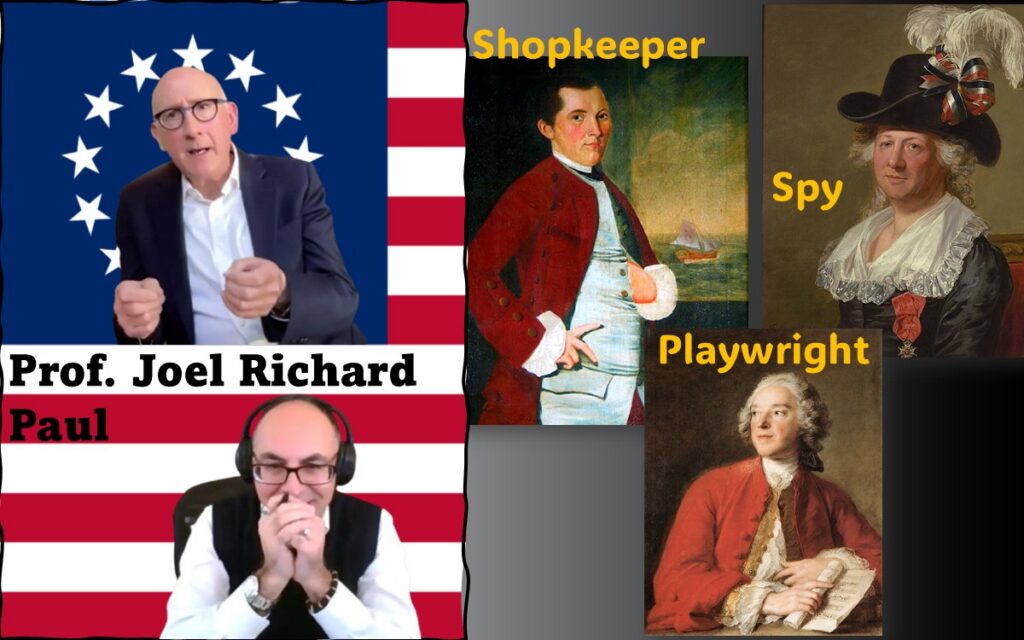 Extraordinary Men (and a Woman?) Behind a Ludicrous Scheme That Worked Against All Odds
Revenge! Revenge! Revenge!
►My interview with Dr. Rafe Blaufarb, author of The Revolutionary Atlantic: Republican Visions, 1760-1830, among other works
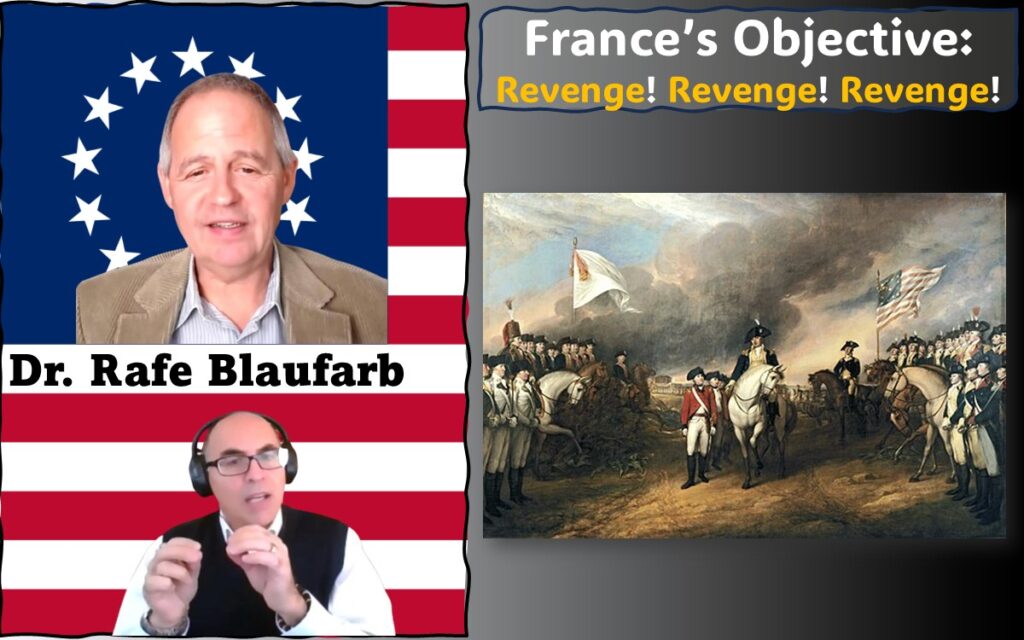 Why France Backed the American Revolution (And Got Nothing in Return)
About This Program
Analyzing American Revolution (AAR) is a special series podcast production of the History Behind News program. In this series, 33 professors (and counting) analyze the American Revolution from 33 different angles through in-depth interviews with host Adel Aali.
Meet Our Guest Scholars
A structured body of thought on the American Revolution—where leading scholars advancing distinct interpretations that give this program its depth.

Thematic Collection
Tap below for a closer look at the Revolutionary Era themes we examine—and to meet our guest scholars.

Library
- Interview Transcript Highlights
- Interview Image and Artist Highlights
- Quiz Answers and Backstories

Image Gallery
Explore the backstories and artist bios behind images of our Founding—before and after the American Revolution. These visuals shape how we remember—and reimagine—the Revolutionary Era.

Support AAR
AAR is an independent program built on sustained research, preparation, and production. Your support helps continue this series and expand our program.

Experienced Analysis of History
About HbN Program
The History Behind News program (HbN) is committed to making in-depth history researched and written by scholars enjoyable and accessible to everyone. Our motto is bridging scholarly works to everyday news.
The histories we’ve uncovered encompass an impressively wide range of subjects from ancient history to U.S. politics and economy to race, women’s rights, immigration, climate, science, military, war, China, Europe, Middle East, Russia & Ukraine, Africa and the Americas to many other issues in the news. We also receive advanced copies of scholarly books and discuss them in our program (in the context of current news).

Adel Aali, host. Snapshot from his introductory video to AAR podcast.
233 Scholars & Counting
Our guests are scholars at leading institutions. They are highly recognized, having received prestigious grants and fellowships as well as notable awards, including the Pulitzer Prize. They include celebrated documentary producers, former White House advisors and other high-ranking government officials, and current and former senior reporters of major national and international newspapers. Many have testified in Congressional hearings, and others frequently contribute to major media outlets and widely read publications.
Think You Know the American Revolution?