Updated: April 7, 2026
Intellectual Foundations of the American Revolution — Part IV
Common sense (not Common Sense by Thomas Paine), as AAR’s guest scholar, Dr. Sophia Rosenfeld explains, is a more basic, instinctive form of understanding—what we naturally perceive or experience—while reason builds on it to reach higher-level conclusions through logic and inference.
In the 18th century, common sense was increasingly valued as shared, everyday knowledge that everyone—from peasants to kings—could understand. Its appeal lay in accessibility: ordinary people could grasp truths about life, society, and politics without extensive formal education.
How Thomas Paine Used ‘common sense’
Thinkers like Thomas Paine used common sense as a foundation for democratic ideas, arguing that ordinary people could understand what is right, challenge authority, and govern themselves. Interestingly, common sense could be applied both conservatively and radically, but in Paine’s hands, it became a powerful tool for challenging monarchy and aristocracy, grounding revolutionary ideas in everyday wisdom.
How Governments Can Misuse ‘common sense’
At the same time, common sense could be co-opted by those in power.
Dr. Rosenfeld explains that governments or populist leaders can claim to embody common sense and dismiss any dissenting views as nonsense, turning a concept meant to be universal and apolitical into a political weapon. This manipulation can prop up authoritarian or exclusionary agendas, even within democracies, by making ordinary people feel that any alternative perspective is illegitimate.
Words like “common sense” or “nation,” originally seen as neutral or obvious, can thus become tools of persuasion—or control—depending on who wields them. The history of such misuse shows how ideas meant to empower people can also be inverted to constrain them.
How Thomas Paine Used His Common Sense to Inspire Revolutionary Thought
In his 50-page pamphlet, Common Sense, Thomas Paine transforms common sense into a radical political tool, showing that ordinary people are fully capable of understanding and participating in governance. Dr. Rosenfeld notes that Paine’s arguments rely on simple, everyday observations—like questioning why a small island should rule a continent—to challenge the authority of kings and aristocrats. By framing his revolutionary ideas as obvious truths, Paine both undermines the paternalistic logic of monarchy and empowers ordinary citizens to see themselves as capable of self-rule.
His approach turns common sense into a foundation for democratic politics: it’s accessible, relatable, and yet capable of supporting profound change. In this way, Paine uses a familiar concept to advance a revolutionary vision, making radical ideas feel natural and inevitable.
Here is the portion of my interview with Dr. Sophia Rosenfeld that speaks directly to this point:
About Featured Images
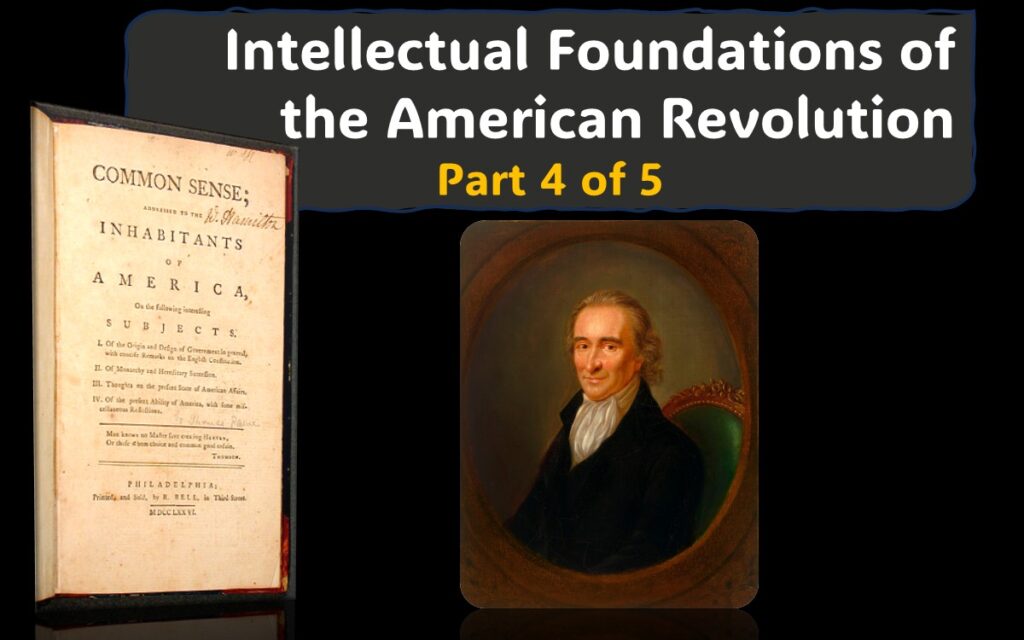
Thomas Pain and his famous pamphlet “Common Sense”.
Unless otherwise indicated, all images in AARevolution—including those in this post—are in the public domain.
Related Interviews and Essays
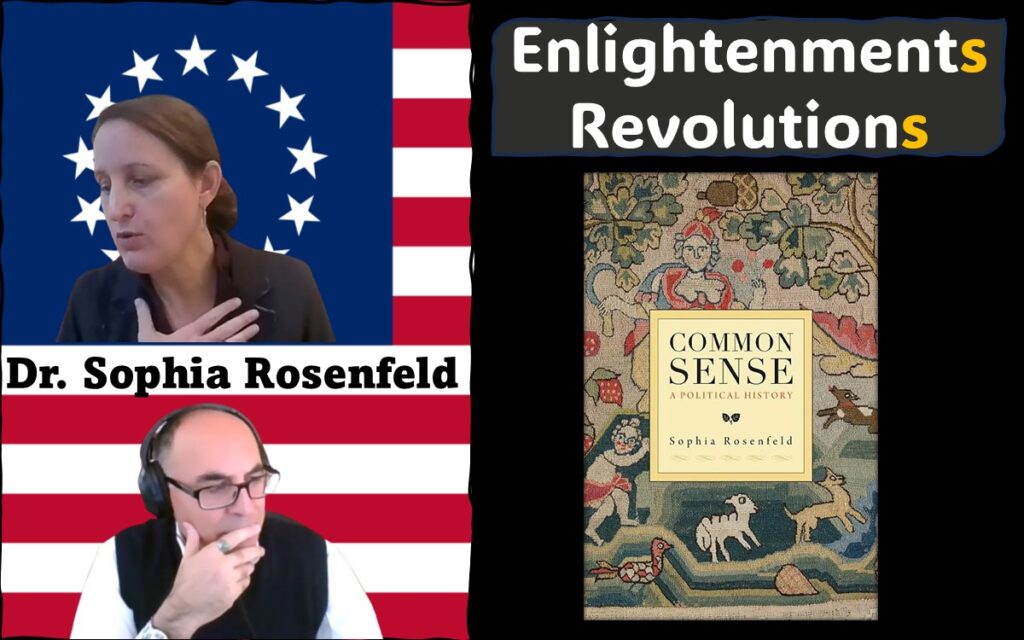
For more on the subject on the impact of the Age of Enlightenment on the American Revolution and our Founding Fathers, see my full conversation with Dr. Sophia Rosenfeld—including our interview’s video, timestamps for key sections, and my takeaways.
 The Enlightenment and Intellectual Foundations of the American Revolution
Dr. Rosenfeld’s major works include the following:
- The Age of Choice: A History of Freedom in the Modern World
- Common Sense: A Political History
- A Revolution in Language: The Problem of Signs in Late Eighteenth-Century France
- Democracy and Truth: A Short History”
This 5-Part Series
- Part I: The Enlightenment Is Hard to Define
- Part II: Age of Enlightenment, Reason, and Revolution
- Part III: The Enlightenment’s Impact on the American Revolution
- Part IV: Common Sense and Reason in the American Revolution (this essay)
- Part V: The Enlightenment and the Power of Reflection
About This Program
Analyzing American Revolution (AAR) is a special series podcast production of the History Behind News program. In this series, 33 professors (and counting) analyze the American Revolution from 33 different angles through in-depth interviews with host Adel Aali.
Thematic Collection
Tap below for a closer look at the Revolutionary Era themes we examine—and to meet our guest scholars.

Library
- Interview Transcript Highlights
- Interview Image and Artist Highlights
- Quiz Answers and Backstories

Image Gallery
Explore the backstories and artist bios behind images of our Founding—before and after the American Revolution. These visuals shape how we remember—and reimagine—the Revolutionary Era.

Experienced Analysis of History
About HbN Program
The History Behind News program (HbN) is committed to making in-depth history researched and written by scholars enjoyable and accessible to everyone. Our motto is bridging scholarly works to everyday news.
The histories we’ve uncovered encompass an impressively wide range of subjects from ancient history to U.S. politics and economy to race, women’s rights, immigration, climate, science, military, war, China, Europe, Middle East, Russia & Ukraine, Africa and the Americas to many other issues in the news. We also receive advanced copies of scholarly books and discuss them in our program (in the context of current news).

Adel Aali, host. Snapshot from his introductory video to AAR podcast.
207 Scholars & Counting
Our guests are scholars at leading institutions. They are highly recognized, having received prestigious grants and fellowships as well as notable awards, including the Pulitzer Prize. They include celebrated documentary producers, former White House advisors and other high-ranking government officials, and current and former senior reporters of major national and international newspapers. Many have testified in Congressional hearings, and others frequently contribute to major media outlets and widely read publications.
Think You Know the American Revolution?