Updated: August 6, 2026
Introduction
In this interview: “But really, what I came to realize is that the, you know, the things that we can know, are not necessarily the things that the parties at the time cared about hiding.”
Watch this section in the video below (00:25:24).
Was the Boston Massacre inevitable? For its time, was it truly a “massacre”?
And how much do we really know about that night—and how much comes from the stories people chose to share?
Five people died in the Boston Massacre (actually six). Deaths of a handful of people, while tragic, should not have started the permanent tear between the American colonies and their king and mother country. Yet that is exactly what happened. The “Massacre” ignited revolutionary passions, fueled as much by propaganda and politics as by the shooting itself. This is the story of how an event on March 5, 1770, began a chain of events that irreversibly changed American history—and how its memory has been shaped, amplified, and misunderstood over time.

How to Use This Post
Use this post as reference guide to the American Revolution through the lens of this interview and the broader Analyzing American Revolution program (AARevolution). Navigate using the interactive table of contents above and the timestamps below (in gray) to discover how this interview deepens the story of the Revolution—and to explore how the program unfolds: its key themes, insights, image gallery, scholars list, history quizzes, and related interviews across the series.
Video
Watch the full interview (timestamps below)
Propaganda and Politics: The Permanent Rupture with Britain
The story of what happened in Boston on March 5, 1770, is often told in a straightforward way—that British soldiers lined up and fired on American colonists.
But much of what we think we know about the Boston Massacre is shaped by propaganda and politics, rather than clear and incontrovertible fact. For example, was it truly a “massacre”? Did British soldiers actually line up against the crowd, as depicted in Paul Revere’s famous engraving? And what messages in that image would have been immediately apparent to 18th-century colonists, but are less visible to us today?
An often-overlooked aspect of this story is a deeper question: why were the people of Boston so angry at the British? Were the British truly the “big, bad bullies” of 1770 Boston that we’ve come to imagine over time? And how did the Boston Massacre—a relatively minor event in the broader context of the British Empire—come to alter the relationship between Britain and the American colonies so profoundly?
In this interview, Serena Zabin reexamines the Boston Massacre through the lens of human choices, social networks, political tension, and the family ties and imperial bonds between Britain and the American colonies.
She explores how both ordinary and elite colonists interpreted, responded to, and acted upon the developments that led to the event—and those that followed and reshaped colonial society. She also deepens our understanding of how British soldiers, officers, and imperial officials reacted to this moment of rupture.
Dr. Zabin further reassesses whether the road to revolution from this point was, in fact, inevitable.
By tracing the choices of both elite and everyday colonists, she shows how revolutionary sentiment took root well before the first shots were fired at Lexington and Concord.
In essence, the Boston Massacre was more than a moment of violence. It marked a turning point in how colonists understood their relationship with Britain—and how they began to act upon that understanding.
Central Question
This conversation raises a central question:
How did a street shooting become powerful and enduring revolutionary propaganda?
About My 200th Guest: Dr. Serena Zabin
Dr. Zabin is a professor of history and the Liberal Arts at Carleton College.
She is the Vice President of the Teaching Division of American Historical Association, a distinguished fellow in Early American History at the Huntington Library for 2024-25, and a former president of Society for Historians of the Early American Republic.
Her research focuses on Early America and Public History, subjects about which he has published extensively, including the following books:
- Dangerous Economies: Status and Commerce in Imperial New York,
- The New York Conspiracy Trials of 1741: Daniel Horsmanden’s “Journal of the Proceedings” with Related Documents, and
- The Boston Massacre: A Family History, which received the 2024 George Washington Book Prize and is the focus of this interview.
Dr. Zabin is the 199th guest scholar of the History Behind News Program, and Analyzing American Revolution is a special series of our program. To learn more about Dr. Zabin, you can visit her academic homepage.
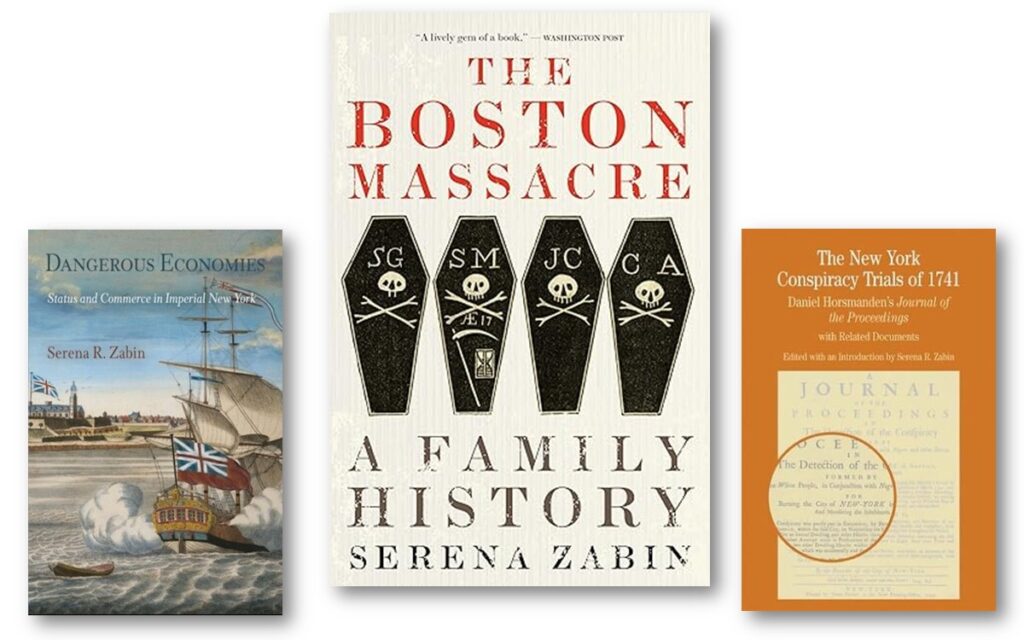 Books by Dr. Zabin. “The Boston Massacre: A Family History” is discussed in this interview.
About the Featured Image
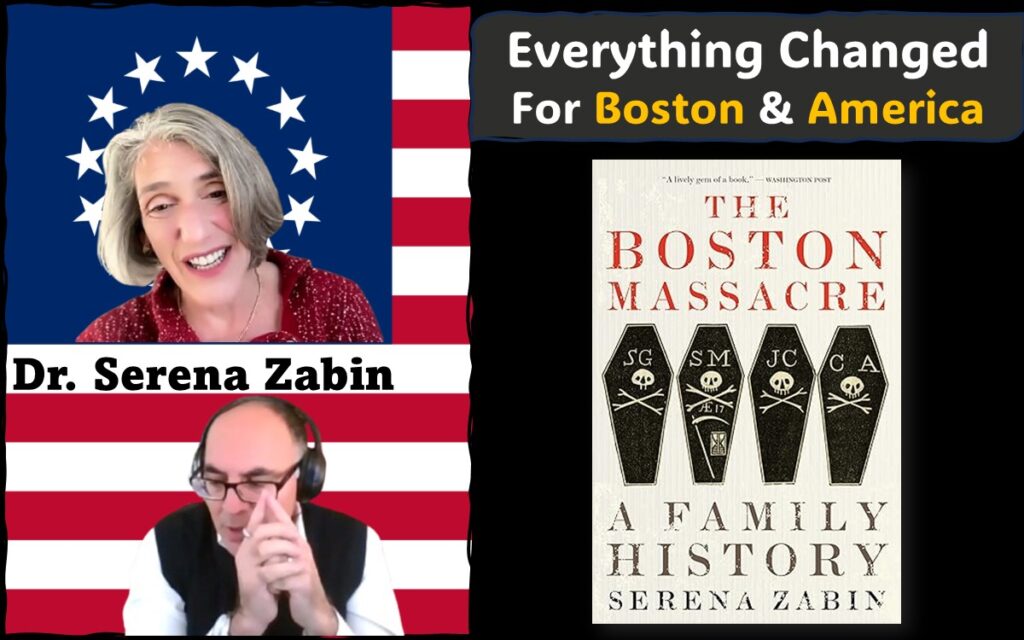
The featured image brings together images of Dr. Zabin and Adel Aali from the interview, superimposed on the Betsy Ross flag, alongside cover image of Dr. Zabin’s book The Boston Massacre: A Family History, with the following text banner: Everything Changed — For Boston and America.
Unless otherwise indicated, all images in AAR—including those in this post—are in the public domain.
AAR Essential Insights
Although the full video and transcript of my conversation with Dr. Zabin are included in this post, I’ve selected and summarized several insights that I found particularly revealing and worth emphasizing. These moments — some surprising, others that challenge familiar assumptions — help us see the Boston Massacre and the American Revolution in a different light.
By the way, these insights are my own takes and interpretations from the interview. For Zabin’s perspective and exact framing, please watch the interview above and view the transcript below in the corresponding sections.
Was the Boston Massacre Really a “Massacre”?
Although five people died, the event we call the Boston Massacre was not a “massacre” in the straightforward sense of the word. The term was chosen almost immediately by the Sons of Liberty as part of a political strategy to shape public perception.
In reality, the Boston Massacre was a shooting, and by contemporary standards—even then—it was relatively small. What matters is that the label “massacre” served as propaganda, framing the incident in a way that amplified anger and mobilized colonial opinion.
This reveals how much of what we think we know about the Boston Massacre is shaped by politics and narrative, rather than by the sheer facts of the event.
Watch this section in the video above (00:08:07).
 Boston Gazette, March 12, 1770—four days after the funeral of the Boston Massacre victims on March 8. (Public Domain). Initials on the coffins identify the four men buried that day: (1) Crispus Attucks, (2) Samuel Gray, (3) James Caldwell, and (4) Samuel Maverick. The fifth victim, Patrick Carr, was not included in this report because he died on March 17.
But there was also a sixth victim: Christopher Monk. He was gravely wounded in the Massacre (shot in the side/groin) and died in 1780 from his injuries, around age 27.
Did British Soldiers and Bostonians Know Each Other?
An important facet of the Boston Massacre—one that we never learned in school—is that despite the tension between colonists and soldiers, many Bostonians and British troops were actually familiar with one another.
Boston was a relatively small city of about 16,000 people, and soldiers had been stationed there for over a year, forming everyday interactions with residents. Some soldiers even recognized individuals in the crowd during the events leading up to the Boston Massacre, exchanging greetings or brief conversation as they marched.
This familiarity contrasts sharply with the usual story of anonymous, faceless soldiers clashing with an angry mob, revealing a much more personal and interconnected social world. Recognizing these relationships helps us see the complexity of the incident and challenges the assumption that it was purely an impersonal confrontation.
Watch this section in the video above (00:10:10).
Paul Revere’s Depiction of the Boston Massacre
Paul Revere’s engraving of the Boston Massacre is one of the most famous images in 18th-century America, but it is not an accurate depiction of the event.
Revere exaggerated and arranged the scene for political effect: soldiers and colonists were not lined up in neat columns across the street, and many of the participants knew each other personally. The chaos of that night—poor lighting, a crowded street, bells ringing, and unclear shouts—makes it nearly impossible to determine exactly what triggered the shooting or whether Captain Preston gave the order. Some details, like alleged shooting from a window in the Customs House (government’s main building in Boston), remain unproven, and eyewitness testimony often contradicts itself.
Revere’s goal was not to depict a precise street scene, but to shape public perception and highlight colonial fears about the presence of a standing army in peacetime, tapping into anxieties about liberty and the potential for abuse of power.
Watch this section in the video above (00:22:53).
 The Boston Massacre as depicted by Paul Revere in his 1770 engraving titled “The Bloody Massacre Perpetrated in King-Street Boston on March 5th 1770 by a Party of the 29th Regt.”
The Trial: Politics & Performance?
The trials following the Boston Massacre were deeply political, as both sides carefully managed public perception.
John Adams and Josiah Quincy represented the soldiers and their captain, navigating a delicate balance between defending their clients and appealing to colonial sentiment. Adams separated the captain’s trial from that of the soldiers, arguing that there was insufficient evidence that the officer gave the order to fire, and later framed the soldiers’ actions as self-defense. To do so, he emphasized that some of those involved were sailors, apprentices, or people of color—not “real Bostonians”—a strategy that would not be acceptable today.
Despite the controversies, the trials were largely seen as a victory for the rule of law, and Adams’ role enhanced his reputation rather than undermined it, showing how legal skill, public relations, and politics were tightly intertwined in this defining moment.
An important point to highlight is that such a trial would have been unimaginable in most contemporary nations and empires—not even in France. This underscores that Britain was a far more liberal empire than many of its contemporaries.
Watch this section in the video above (00:30:19).
The Permanent Rupture: Shattered Families and A Broken Imperial Family
The Boston Massacre can be seen as a “family history” both literally and metaphorically.
When British regiments arrived in 1768, they brought hundreds of women and over a thousand children, creating crowded households in private homes, sheds, and warehouses across Boston. Soldiers and civilians mingled in everyday life, forming marriages, baptisms, and “fictive families,” while some soldiers even engaged in minor criminal activity.
Metaphorically, the British Empire framed the King as the head of a family, with subjects owing loyalty like children, but the Boston Massacre exposed the fragility of these bonds.
Families were physically and emotionally broken apart through desertion, relocation, or marital separation, a rupture Dr. Zabin calls a “bad divorce.” When the troops eventually left, both the city’s economy and the sense of imperial order contracted, highlighting the complex social and political impact of military occupation.
Watch this section in the video above (00:46:53).
Who Yelled Fire?
Continue watching at 08:49 in the video above.
The Interview (S1E2): Adel Aali and Serena Zabin
In our conversation, Dr. Zabin addresses key questions about the Boston Massacre and its impact on the American Revolution. The detailed outline and transcript below supplement the video above.
Podcast
Watch the full interview on this page with the outline and transcript below, or take the conversation with you on the go through our Spotify podcast.

Outlline
Use the in-depth outline below to follow the discussion and navigate key moments in the interview.
Click for Timestamped Outline
- Selected Highlights (00:00)
- Guest Introduction (01:57)
- The Event On March 5, 1770
- Setting the Scene (03:53)
- What Do We Actually Know? Limited Facts and Confusion (04:21)
- Who Yelled “Fire”? Uncertainty and Chaos (07:00)
- Was It a “Massacre”? Language and Political Framing (08:49)
- Sons of Liberty and the Power of Naming (09:13)
- Soldiers and Civilians: A Small, Interconnected Town (10:10)
- Soldiers Knew People in the Crowd (10:32)
- The Immediate Aftermath
- Crisis Into the Night (11:37)
- Governor Thomas Hutchinson and Damage Control (13:19)
- Depositions and Competing Investigations (13:31)
- A Big Deal: Visual and Personal Impact (14:44)
- Riots vs. Shootings (15:25)
- Crisis Into the Night (11:37)
- The Paul Revere Effect
- Paul Revere’s Engraving: Image and Propaganda (16:46)
- Henry Pelham and the Origins of the Image (17:25)
- Visual Narrative: Order vs. Chaos (18:05)
- Crispus Attucks and Representation (20:02)
- Propaganda & Conspiracy in Revere’s Engraving (20:40)
- “Butcher’s Hall” and Mislabeling the Scene (20:37)
- The Window Shooting Question (21:20)
- Two Opposing Lines vs. Mixed Crowd Reality (26:21)
- Did Captain Thomas Preston Give the Order? (24:16)
- Contradictory Testimony and Limits of Evidence (24:57)
- Paul Revere’s Engraving: Image and Propaganda (16:46)
- Motivation and Meaning
- Not Yet Revolution (28:11)
- Fear of a Standing Army (28:19)
- John Locke and Ideas of Liberty (29:27)
- The Trials
- Law, Politics, and Strategy (30:15)
- John Adams and Josiah Quincy Jr. as Defense Counsel (31:19)
- Separating the Trials: Preston vs. Soldiers (32:29)
- Self-Defense Argument and “Not Real Bostonians” (33:44)
- Crispus Attucks and Racial Framing (34:51)
- John Adams’s Reputation and the Rule of Law (35:24)
- Law, Politics, and Strategy (30:15)
- A Family History
- The Boston Massacre as a “Family History” (38:16)
- Soldiers Living Among Civilians (38:46)
- Women, Children, and Everyday Interactions (39:03)
- Marriages, Baptisms, and Shared Lives (44:21)
- Quartering, Housing, and Tensions in Boston (40:30)
- The Quartering Act and Castle Island (41:02)
- Boston as “One Large Airbnb” (43:22)
- The Imperial “Family” and Its Breakdown (46:40)
- King as Father and Subjects as Children (46:52)
- The Massacre as a “Bad Divorce” (48:55)
- The Boston Massacre as a “Family History” (38:16)
- The British Soldiers
- Economic and Social Effects of Troop Withdrawal (49:40)
- Who Were the Soldiers in Boston? (51:37)
- PBS Documentary
- Dr. Zabin’s participation in Ken Burns’ “The American Revolution” (52:42)
- Just One Point (55:30)
Transcript
Note: This transcript was generated automatically and may contain minor errors. It is provided for reference and accessibility only.
Click to View Transcript
Adel:
Dr. Zabin, it’s a pleasure to have you in our program’s special series. Thank you for taking the time for this conversation with me about the American Revolution. The Boston Massacre is a story we all know or think we know, right? We learned it in middle school and high school, and you and I are going to dig deep into it and perhaps talk about some stories that people may not know. But before we go there, can you just set the scene for us? Just kind of remind us, what happened on the evening of March 5, 1770?
Dr. Zabin:
Yes. So great question. What we actually know for sure is actually a pretty limited set of facts.So we know that on March 5, 1770, around nine o’clock in the evening, there was a sentry in front of a British Army soldier in front of a customs house in the center of Boston, right in the heart of Boston. And he’s walking around trying to stay warm. It had just snowed.So it’s kind of a snowy, wet, mucky day. And a number of teenagers come by, and other people walk in the street too, but a number of teenagers come by. They sort of start hassling him.Maybe they start throwing a few snowballs. They’re sort of tussling. You can imagine what teenagers in the street are like.Other people start to show up.
Adel:
Teenagers are throwing snowballs at a soldier? That takes a lot of guts.
Dr. Zabin:
Well, they’re sort of tussling with each other. I mean, they certainly are taunting him. He’s sort of stuck in this little box area right in front of the customs house.He’s not really supposed to leave his space. So they are kind of teasing, right? Pushing.
Adel:
Mm-hmm.
Dr. Zabin:
And he yells back. I mean, he’s not just sort of taking it. But there are other people in the street, and more people start to come.And somewhere, and the sequence of timing here is a little unclear even, as more people come, the sentry decides he wants a little backup. And about the same time, people start to hear church bells ringing. So the bells start to ring, and the sentry blows his whistle, trying to get some attention from the guardhouse just a few hundred yards away, really.And the captain of the day and a handful of soldiers, probably eight soldiers, come marching out just about a block. And they come through the streets, which they are finding increasingly crowded. People are coming out to see what’s going on.
Some people think that the bells indicate that there’s a fire. They come out with their fire buckets, looking to be part of the fire brigade. And other people just come to see what’s happening.
More and more people start coming into the street. At some point, the officer yells at everybody just to go away. Nothing really happens.
They ignore him for the most part. And it gets louder. It’s dark.
There’s no street lights in Boston, by the way. So it’s hard to figure out exactly what’s going on at nine o’clock on a March night. And at some point, someone yells fire.
And it’s very unclear who yells fire. Because it could be that someone is saying, where is the fire? Here I am with my bucket.
It is possible that some people are yelling at the soldiers saying, you don’t dare fire at us. Because of course, they can’t fire without a command and really without reading the Riot Act. And some soldier believes that what he heard was a command to fire.
But all we know is that indeed, there are guns fire. And when the smoke clears, there are five people dead or dying, three immediately dead, one dies within a few hours, one a couple days later, on the snow in front of what is the seat of imperial power, the big statehouse, what we now call the statehouse, what they then call the townhouse in the center of Boston, another six people are injured. And nobody exactly knows why or how that word got shouted.
That’s about as much as we know.
Adel:
Wow. Let me let me key in on one thing that you said. I’ve often thought about this.
And this is not to sort of make light of what happened. Five people died. One person is significant.
You know, five is very significant. That’s not the point. But we know this event in Britain, I think it’s called the incident or something.
But in our country, we know this event as the Boston Massacre, quote unquote. So as massacres in those decades and centuries ago, was this a massacre?
Dr. Zabin:
I know it’s I mean, my colleagues who work on the 20th century say this is the morning’s work for a drone. You know, what is, you know, five people? Is that a massacre?
So I mean, certainly, it is that term massacre is a political term. It was chosen by the Sons of Liberty almost immediately thereafter, I mean, within a day. And there is a sort of PR war about how to describe what happened.
And obviously, this one, the Sons of Liberty one, because that’s what we know it as. I think we might more accurately call it a shooting. It absolutely is a shooting thing.
But yes, the word massacre is just really here meant to do political work, as opposed to descriptive.
Adel:
We’re going to get to the PR part in a second. And I think that’s just a story on its own that we really didn’t learn back in middle school and high school and even college for that matter. But there’s one thing that as I was preparing for this interview, intrigued me.
And it’s this and I was looking at some of your work. Did any of the soldiers, whether they shot or not, know people in the crowd?
Dr. Zabin:
Absolutely. Boston’s not a big town, 16,000 people. So, you know, and that’s one of the biggest towns in North America.
But soldiers had already been living there for 17 months. And yes, a couple of the soldiers who end up being prosecuted for the shooting, know and see people in the crowd, they talk to them, their neighbors come over and say, hey, what’s happening? And they chat as they’re marching out to support this century.
So yes, people really did know each other in the small world.
Adel:
That’s a different story than what we know, right?
Dr. Zabin:
Yes, it’s a really different, it’s a different story.
Adel:
Which would never pay attention to that. Now that now that you say that, so there’s a century in front of the customs house, which later, I think was called butcher’s house. And we’re going to get to that or something to that effect.
So these eight soldiers and their captain, I think it’s called Preston. Did I say that correctly? They’re going to help this century.
And as you said, they’re actually chatting with some people they know on neighbors. So it’s the next day, right? This, the Boston massacre happens.
Were like Bostonians and the British administrators surprised? Like, how did this happen? Or were they sitting and thinking, you know what, this was going to happen?
Dr. Zabin:
I think both of those things are true. They don’t wait till the next day. I mean, there’s an all night crisis, right?
The governor comes out that, you know, as soon as the shootings over, I mean, it happens essentially underneath the balcony of his office. He comes out, and he tells everyone to go home. And he promises that the law will have its course.
He says, we will investigate. If something illegal happened, you know, I promise, he says to the people of Boston, that we will do this through the courts. And so he, you know, starts rounding up all the people that he can, who will tell him what happened, some of the political people on both sides.
And about three o’clock in the morning, the officer in charge and the soldiers turn themselves in, they are in jail. So just a few hours later, really, once they’ve talked it through a little bit, by the next morning, certainly, the town meeting, which is the sort of political body that runs Boston, has organized themselves already, they start taking depositions from people who say that they have a story to tell about what happened that night. And the line is so long within an hour, like, okay, this is not going to work, we’re going to actually start coming around to you, we’ll have to figure out some other way of doing it.
But we can’t just have people standing in line, waiting to tell us what happened. They put together that little committee, and the town meeting themselves deputizes a number of the Sons of Liberty to go to the governor and say, you have got to get these soldiers out of Boston today, we are not waiting. And so there’s some negotiation, but absolutely, people are investigating, they’re trying to figure out what happened.
The army also is trying to collect depositions pretty fast. They don’t, they’re not quite as organized, they don’t get it together by nine o’clock the next morning, because they’re trying to figure out how to deal with this captain who’s in jail. But there is an investigation.
But the investigation is not really to find out what happened so much as it is to figure out who to blame.
Adel:
I see. This is an investigation with an angle. Absolutely.
Who to blame. What I got from what you just shared with me is the governor was it was it Hutchinson? Gage comes later.
This is Hutchinson. He immediately, this is like, you know, to 3am. This starts at 9pm.
So we’re talking dead of night. He immediately gets into damage control. And the town just rallies to deal with this.
How did this happen? Who knows? So the other thing, so one damage control, the other thing is, in Boston’s colonial history at this stage, from what I gather is that this is a big deal.
Dr. Zabin:
It is a big deal. I mean, it’s a big deal to see to see soldiers shoot civilians and watch them bleeding on the steps of the, you know, of the essentially the governor’s home and the governor’s office. That’s that’s not nothing.
I mean, soldiers are also horrified. You know, the officers are horrified. This is a big I mean, it’s a big deal.
It’s a big deal. Visually, it’s a big deal. Politically, it’s a big deal personally.
So yes, there has never really been something like this before. There have been other riots in Boston. Certainly, riots are not uncommon in the 18th century in a world in which most people can’t vote.
That’s the way in which lots of people express their political opinions, including back in England, including back in England, so many riots in England. I mean, that’s this is the big age of rioting. So that piece is not the surprising, scary part.
The you know, the hard part is the part where soldiers actually shoot people who die, which does not always happen with 18th century muskets. And, and then it happened right, right in the heart of town. Yeah, that part was pretty bad.
Adel:
Yeah. You talked about the visual impact of this, you know, people on the steps or doorsteps of a major government building, the major government building in Boston, and sort of the sight of people just bleeding and dying there. Earlier, I told you that we would come back and talk about PR, right?
So let’s talk about the visual PR that I even remember seeing this, you know, 40 years ago. And that’s Paul Revere’s engraving of this. Talk about that.
Dr. Zabin:
Like, well, yeah, I’ll just, yeah, it has to be one of if not the most famous 18th century American image. Yes, I think, you know, it is everywhere these days, I do not believe that there is a single textbook for middle school or high school that doesn’t have it in it.
Adel:
Yeah.
Dr. Zabin:
And, you know, and at the time, it had fairly wide distribution also. So to back up a moment, it’s based on a drawing that actually a different young man named Henry Pelham, sort of had started and Revere kind of gets hold of it. And he’s the one who puts out the actual engraving and engraving, of course, can be duplicated very quickly, as opposed to a drawing, which, you know, Henry Pelham feels, you know, like, like somebody scooped him, essentially.
But, you know, Revere creates this image in which he tells the story that the Sons of Liberty want to have told, and it’s very vivid, it’s very clear. And, you know, what you see, this is a good moment for me to sort of walk folks through what they would see in the engraving. So you see on the one side, this line of soldiers, right, all lined up, sort of standing together, you know, one foot forward, you see Captain Preston behind them, safely behind them, right, waving his sword.
So he’s obviously urging them on, it’s very clear he is not going to be in a line of fire.
Adel:
Right. The way I remember the engraving, he’s sort of pointing his sword forward.
Dr. Zabin:
Absolutely, right up in the air, sort of waving the mob, but yes. So and they’re sort of leaning into it happily. And on the other side, you see this kind of mass of Bostonians, all of them, you know, fairly well dressed, you’re certainly not seeing they’re the kind of apprentices and sailors and street people that you otherwise might have seen.
And there is in the middle of it, this one woman. And we think there’s probably were a few more women than that on the street, although not a lot. But this image has right in the middle, one woman dressed in black with her hands crossed against her breast, you know, looking terrified, or distressed.
But really, you know, what her image is doing there, what her presence is doing is telling the viewer that this group of men are, you know, respectable, they’re a place where a lone woman could feel safe for her own, her own physical safety, right? The people to be afraid of are not these guys, they’re the soldiers. So and then you see a couple of people already bleeding out, there’s a lot of gore, right?
And these engravings are all hand colored later. So some of them have like really red gore. And some of them have the most famous person who are the person who will become the most famous person to die as sailor named Crispus Attucks.
Some of them color him darker, he was a mixed African of African descent and indigenous descent. And sometimes those engravings have him as dark skinned, and sometimes they don’t, which is also interesting. And then right in the middle, dividing the soldiers and the townspeople is all of the smoke, right?
And we know the smoke is there, people talk about needing for it to clear. But the smoke is really just a line that divides the center of the picture, as Revere puts it together, right? And that nothing about this part is true.
I guess the other piece I should point out is that it does what the soldiers are in front of a building that’s labeled Customs Hall, but Revere himself wrote above it, Butcher’s Hall, right? Which was not on, it was not a sign that was on the Customs House.
Adel:
Speaking of Customs House, there’s also, I was looking at this last night, and there’s also in one of, there are three windows, I guess it’s on the second floor, on the furthest to the left, it seems like someone’s shooting out of the Customs House? Yes.
Dr. Zabin:
So that’s another one of the stories that has been very hard to pin down. And in fact, the courts themselves couldn’t figure out whether there was really an incident there or not. But certainly what the Sons of Liberty were claiming is that there were sympathizers for the army who are up there shooting out the window.
And they were in a world, you know, which is maybe unsurprising. There’s a kind of number of conspiracy theories floating around, right? There’s, I don’t know, 11 people are dead or injured.
It’s not quite clear how there could have been 11 bullets. Was there really time for somebody to reload? Or- You said there were only eight soldiers.
Right, exactly.
Adel:
So how could there be 11? Eight soldiers.
Dr. Zabin:
How could there be 11? Did some ricochet off the stone? That seems likely, at least one person claims that a bullet does ricochet.
So there’s never been, there certainly is evidence that there were people up there. There’s never been any evidence that’s been convincing, you know, or there wasn’t in the 18th century, any convincing argument that that’s where the other bullets came from. But you can see why that was tempting.
Adel:
So are there any, is there anything specific that you think Paul Revere exaggerated or even misrepresented? I can probably point to a couple of them. One is, well, let me not point, let me ask you, you’re the expert.
Was there like the woman being in the middle? This is really interesting. I’d never thought about it.
This is by design. This is something that it would have meant a lot to people in the 1770s, right?
Dr. Zabin:
Yes. This just says something. This is not a photograph of the street scene, right?
This is the story he’s telling.
Adel:
So yeah. I asked that question specifically because as I read this, about this event, this massacre in detail, the people there were, I forget all their occupations, but kind of like sailors, seamen, and these are not sort of thing that they’re, they’re clothes. I’m not saying they’re not respectable, but these are not class.
Dr. Zabin:
Yes. Yes.
Adel:
Yeah.
Dr. Zabin:
And that clothing is very middle class.
Adel:
Yeah. It could have been like ruffians out there in the streets. I see.
And you’re suggesting that there’s no evidence for that window shooting. The butcher house obviously was not there. And how about Captain Preston, whose sword, I said, I noticed that is sort of pointing forward.
Did he order people to shoot?
Dr. Zabin:
Well, that again, I think is that that’s a really unanswerable question. I think it’s unanswerable. So I do think that what happened that night is, you know, in many ways, opaque, sort of literally, as I said, there’s not much light, right?
The only light is really from, you know, little candles or other things in people’s windows. You know, a couple lanterns, there’s not much light, people couldn’t see much. But more than that, I do think that people tried very hard at the time to figure out what happened.
They actually take hundreds of depositions. Most of them are somewhat contradictory. And so what I came to understand as I worked on this book is that there was no way that 250 years later, I was going to be able to see something in this evidence that other people at the time did not when that was really the question they were asking, they really wanted to know, did Captain Preston give the order to fire?
Right? And nobody could quite totally figure that out. We can talk afterwards what the court said about that.
But really, what I came to realize is that the, you know, the things that we can know, are not necessarily the things that the parties at the time cared about hiding. Right? They, they didn’t repeat that last sentence again, please, the things that we the things that we can know now, right, turned out to be things that the people in the past, the parties who were involved, were not trying to hide, right?
They’re trying to hide all sorts of other things. They’re trying to shape a story, right? But it turns out that they’re not that concerned with questions about, you know, back to your first question, did the soldiers know the people on the street, right?
So one of the stories that Revere is telling in that engraving is that the soldiers are on one side of the street, and the civilians are on the other side. Well, all of the eyewitness testimony tells us that they’re all mixed up together. They’re pushing each other, they’re touching each other, they’re arguing, you know, not this clear, two columns, nothing like that.
But it’s definitely nothing like two columns. And that’s true. In fact, you know, that that’s actually true.
But it’s also metaphorically true. In fact, the soldiers and the civilians really knew each other pretty well. They were all mixed up together.
They’ve been living together, they’re neighbors, right? They’re not actually these enemies shooting at each other yet. That’s not the story, really.
That’s just the story Revere is trying to tell us. But it turns out that all kinds of evidence for how much these people knew each other, how involved they were in each other’s lives, that stuff’s just sitting around in plain sight, because nobody was trying to hide that story, right? But the story of what actually happened that night with that word fire, that one is almost impossible to say.
Adel:
So, impossible to say, yet Revere says a lot with his engraving, which leads me to ask this question. What was in his mind? Did he have revolution and independence in mind with this PR slash propaganda, or did he just want more rights?
Like, you know, get rid of British tariffs, get rid of this and that. And this is March 1770. So by then we already have a decade since 1763, end of the Indian-French war of British acts coming and going, right?
So Bostonians are ticked off. So what’s his motivation?
Dr. Zabin:
They are. They are right. But it is not, you’re quite right, it is not independence, it is not revolution, right?
I mean, it’s what is really most explicitly about is an objection to having troops in Boston, what the 18th century referred to as a standing army, right, as opposed to just a militia that organizes when needed and then disappears again. The idea that there should be a standing army in wartime was completely, I mean, excuse me, in peacetime, right, in peacetime, a standing army in wartime, of course, right? You need it.
The, you know, Massachusetts men were very willing to join the Seven Years’ War. But when it comes to actually peacetime, there should not be a standing army at all. They believe that that was a deep violation of their rights, that the likelihood that a king was going to turn a standing army on its citizens in order to claim their liberties was a deeply held idea that was developed by John Locke at the end of the 17th century.
It’s an idea that especially colonial thinkers really hold on to, right? So this fear of losing their liberty is tied closely to the idea of what is it that a king is going to do with troops? And when troops show up in Boston, you know, Sons of Liberty, who are, you know, identifying themselves by their British liberties, kind of freak out.
Adel:
So… Okay. Paul Revere is involved.
Many others are involved. We know that. And I forget the timing.
I think it’s October of that year, 1770, a trial starts. I think there’s actually two separate trials. One for the captain and one for the soldiers, if I remember correctly.
What happens in this trial? Does anything, is there anything on earth that, you know, people have revelations and they realize what the story is, or is it all politics? What happens here?
Dr. Zabin:
So it is a lot of politics, certainly. So the Sons of Liberty, we’re pretty sure, decide early on that the way to win this is going to be to take a kind of political high ground, to say that we are so sure that what the soldiers did was so out of bounds that we will get our best legal talent to represent them, right? And even so, right, we’re going to be able to show that they were, you know, that the soldiers overstepped.
But we’re going to do our best to perform, right, for the world how sure we are of this, right? So they go to John Adams, right, who is a Son of Liberty at this point, and Josiah Quincy, and they say, will you take this on, right? Not all the Sons of Liberty think that this is a great politics, and not all of them are convinced that having John Adams do his best job is going to actually help them, right?
So there’s some division there, but he does that. Adams is not thrilled about essentially feeling like he is the governor’s client, that doesn’t make him feel good. And meanwhile, the person who really is supporting the government, right, who would be the king’s attorney essentially, is the one prosecuting the soldiers, right?
So no one’s convinced that he’s going to work very hard.
Adel:
I noticed that’s kind of flipped. It’s kind of flipped. He feels flipped.
Yeah, yeah, yeah.
Dr. Zabin:
Okay. Exactly. So it’s flipped.
So then Adams does this move that I think lawyers nowadays would say is not considered ethical, right, in which he separates out the trial of the officer from the trial of the soldiers. And so his technique is to say that it’s going to be too impossible for anybody to convict the officer. Nobody’s going to be able to say that he gave the command to fire, right?
There’s just not beyond a reasonable doubt. And so he decides that that’s going to be what that case is going to turn on. The soldiers themselves, when they hear that Preston is going to be tried separately from them, are completely panicked.
They actually write Adams and some of the judges a note, and they say, you’re just throwing us under the bus. They say, we just followed the command we heard. And if you get rid of this defense, what will happen to us?
They’re very worried. They think this is wrong. But Adams goes ahead.
And indeed, he gets one jury of Massachusetts men to say that they cannot, beyond a reasonable doubt, say that Preston actually gave a command to fire, so he’s acquitted. And then a couple of weeks later, he starts this trial for the soldiers. And in that one, his argument is self-defense.
And that’s a very hard argument for a son of liberty to make, because he needs to say somehow that these soldiers fired in self-defense, but the people that they’re defending themselves against were not these out-of-hand Bostonians, right? He wants to say Bostonians look just like those people in the Revere print, right? These very respectable, middle-class people that no woman would be afraid of.
And so he’s like, how am I going to say that these soldiers are both defending themselves in this moment on Boston streets, and that Bostonians have not been a riotous people, right? That’s the fear.
Adel:
Those two don’t fit in the same box.
Dr. Zabin:
No, it’s a tiny little eye to thread in this needle. And so what he says is, oh, well, the people who are rioting, they weren’t real Bostonians. They were sailors.
They were apprentices that came from outside. And I will say, he plays a race card, and he says, Crispus Attucks, he’s a person of color. There’s guys like him.
There’s Irish people. These are not real Bostonians. And that’s how he gets them off.
Adel:
Wow. That would not fly in today’s course, obviously. Oh, wow.
That is wild. So this is something that I have thought about in the past before reaching out to you for this interview. I remember watching, this is now about 10, 15 years ago, the HBO series on John Adams.
And I’ve read the book, McCullough’s book. And I forget how this works out. John Adams represents the British government, soldiers essentially, right?
Right. Yet later, he has a future political life in Boston. Heck, he becomes the president.
So there must not have been this overwhelming Bostonian resentment towards him. Was there?
Dr. Zabin:
No. I mean, he says in his autobiography much later that it’s the most manly act he’s ever done. He’s very proud of himself.
And, you know, that’s Adams for you. But at the time, it’s not a huge risk to his political reputation. Some, as I said, some of the Sons of Liberty are not sure about this move.
And we know that Josiah Quincy’s father writes to him and says, what are you doing? Right. Why are you representing these beasts?
And Quincy Jr. writes back and he says, oh, I was asked to do this by people that you would approve of. And in the end, you know, everybody understood they won the PR war, right? They do come out looking like they took the high road.
And so it doesn’t actually ever hurt Adams. He’s very proud of it. It looks like a moment of, you know, later he places a moment of his kind of independence and his commitment to the rule of law, which is genuine, to be fair.
He’s genuinely committed to the rule of law. But so is Hutchinson. Right.
I mean, it was a deeply held belief of the 18th century, right? And it’s sort of one of the core principles that, you know, this moment of this, we won’t quite call it revolution, but of the imperial crisis is founded on.
Adel:
You know, one thing, and this is a digression, it’s not even a question, it’s just an observation. Dr. Seidman, the more I learn about the American Revolution, you know, we go back to our history, you realize how different it was, the British, the bad British that we think of in our early years in education, they were so much more progressive than, let’s say, the Russian Empire, the Ottoman Empire, perhaps even the Austrian Empire or the Spanish Empire. You see what I mean?
I’m not even sure if there would have been a trial, let’s say, had this happened in China and Russia or Ottoman. Yeah. Oh, my God.
Dr. Zabin:
Or probably even in France.
Adel:
Or probably even in France. Yeah. Let’s take a break here.
In the next segment, I’ll ask Dr. Seidman about the full story of the Boston Massacre, one important point that we’ll talk about, and we’ll also chat about Kim Byrne’s documentary. We’ll be right back. Dr. Seidman, as we were closing the last segment, I said, in this segment, I’m going to talk about the full story with you. And to do that, I want to start with the title of your book, and I’ll read it. The Boston Massacre, a Family History. How is the Boston Massacre a family history?
That’s a new one.
Dr. Zabin:
So it’s a family history in two ways, both, I’d say, actually and sort of metaphorically. So the actual part is connected to the part I was talking about in the first segment when I said those soldiers had been living in Boston for 17 months, and they knew many of the people on the street. So it turns out that when these four regiments show up, which is about 2,000 men come to Boston in 1768, they come with a number, we don’t exactly have a precise number, but somewhere like 750 maybe women, largely married to some of these soldiers, and even more children, probably over 1,000 children.
And so there are all these families that end up crammed into Boston, and Boston at this point, there’s no back bay yet, or the back bay actually is water, right? It’s just a one inch, excuse me, a one square mile peninsula. And so you’ve got 16,000 people, you’ve got another 2,000 guys, maybe another 1,000 women, 750 women crammed into this town.
They all have to find places to live. They end up living, which is another story that I can unfold if you want it. They end up all living on the peninsula, not really in barracks.
They live in a lot of people’s spare rooms, they live in their sheds, the army rents what warehouses they can find and other spaces like that.
Adel:
But overflowing- They don’t have separate quarters of their own. Is that what you’re saying?
Dr. Zabin:
Yeah. So the issue about the quarters is there were quarters, there were barracks, but they’re out in the harbor on what’s still called Castle Island, and they had been refurbished for the Seven Years’ War, as you said, which had only ended less than a decade before, with Massachusetts tax money. And the Massachusetts selectmen were very clear that they thought that’s where the soldiers should go.
If they’re going to come to Boston, they should stay in the barracks that were built for the British Army. And the Quartering Act, as it existed in 1768 and until indeed 1774, the Quartering Act said very clearly soldiers needed to be placed first in existing barracks, and then if there’s not enough room, then they’d go into pubs, into public houses, and only after that can they be put into private homes. And the selectmen told both the governor and the officers that they needed to follow the Quartering Act, and the governor and the officers wanted the soldiers in town.
They want them right in the middle to put down all these riots that are happening in front of the governor’s house.
Adel:
And confirm this for me, if you would, please. What we call Castle Island, I’m somewhat familiar with Boston, you can drive to it, it’s just part of Boston. It’s like connected.
But it was really an island back then, right?
Dr. Zabin:
Yes. I mean, you could, at low tide, indeed, there’s a seven mile hike that you can take through a lot of mud, and you can walk or you can row three miles if the tide is higher. So it’s there, but it’s not convenient for putting down a riot, right?
It’s a staking ground, right? For putting people who are then going to go somewhere else. But it’s not, if they’re going to go fight in Canada, it’s fine.
But it’s not really great if what you’re trying to do is urban policing with troops, right? So the selectmen tell the officers, if you try to requisition space in Boston, we will get you here, we’ll get you booted out of the army. It is a direct violation of the Quartering Act.
And the governor spends a lot of time grumbling about how everybody thinks that they’re a lawyer. But in fact, the army gives in and the compromise they come up with after a couple of months of having soldiers camping out in Boston Common and places like that is they end up renting spaces from Bostonians. It’s like turning Boston into one huge Airbnb, right?
So they rent, so Bostonians are renting every spare room they have, every shed, every cellar. And certainly every warehouse, anything they can. And so soldiers are living through, and their families, right?
And all of these women and children are living all over Boston. And Boston at this point actually is majority female in part because Massachusetts had sent so many men to fight in the Seven Years’ War. They actually lose a huge chunk of their young men.
So there are a lot of unmarried women, some of whom are from Boston, some of whom come to Boston. It’s one of the few places women can work for wages to look for husbands. And they see all these men and they’re like, oh, you know what?
There’s a lot more husband material here all of a sudden. So a lot of these single women, including some of the daughters of Sons of Liberty, right? Are really enthusiastic about this influx of young men, right?
And they, in fact, meet and have children and some get married, not always in that order. Who knows? They’re sometimes in that order.
But the church records show about 40 marriages between soldiers and civilians. And there certainly were more that were not done in churches. And then there’s at least 100 baptisms of children in local churches, often with godparents who include local civilians.
So they make these kind of fictive families, right? That’s what a godparent is. So soldiers and then when soldiers desert, certainly they often end up marrying the women they meet.
So they create families. They literally create families when they come. So that’s the actual, literal piece of the family history.
Adel:
Before we go to the second one, when I asked you about family history, you said there are two aspects to it. So one that you just shared with me, but before we go to the second one, this is such a mixed up and slash kind of messed up stories. Like these people, it’s like they go to Trader Joe’s together, you know what I mean?
Does that make sense? I know that sounds funny when I say it, but that’s literally what it is. These soldiers, before they’re put on the red uniform, they see all these people.
Heck, they may even invite them to dinner.
Dr. Zabin:
Exactly. There are certainly diaries full of people talking about all their dinner parties. They absolutely do invite them to dinner.
And then the less salubrious ones, we have court records that show that. They couple them, put together some little theft rings together, right? They’re doing burglaries and all sorts of things.
Things that would happen in a big town.
Adel:
Okay, wow. The second point, you said there are two aspects to this. What’s the second point?
Exactly.
Dr. Zabin:
The second one, which is less literal as a family, has to do really with an 18th century idea about the government as family. This is a longstanding belief that the king is like the head of the family, right? And that the people underneath are like the parents, the nobles are, and then the commoners and all the subjects are the king’s children, right?
And they owe loyalty to the king like they would to their father. And that language, we know that language of the mother country, all of those pieces, right? Which is all these family metaphors, which explain the relationships that people are supposed to, the political relationships that people are supposed to have with Britain.
And in fact, what happens with the shooting, right? And then what will become the massacre is those family bonds start to look a lot less pleasant than they were, right? People start to look around, they think, oh, this is what it means to be part of the empire.
This is what it feels like to be in this kind of family, in this imperial family. So when that shooting happens, and then the soldiers have to leave, families physically get broken apart, right, in different ways. Because of course, soldiers who have married, the person that they married may decide to stay in Boston.
And so they sort of self-divorce, that way the family splits up. Sometimes the wife decides to travel with the army and leave behind, right, her natal family, this little piece of Boston, right, embedded in the British army. Sometimes the men decide to stay, right, they sort of, which the army calls desertion, they call, you know, sort of keeping their family intact.
But, you know, so they physically break apart. But really, I think of the Boston Massacre actually is what I call a bad divorce, right? It feels like the beginning of the breakdown of the imperial family.
And people understand it in those terms, having seen what it means to make and break families in the British empire. Hmm.
Adel:
Now that you explain it this way, the title of your book completely makes sense, Dr. Zabit. Two small questions in the context of everything we’ve talked about. This may be a nothing, but when these four regiments leave, there goes the rental income for all the properties there?
Dr. Zabin:
Yeah.
Adel:
Yeah.
Dr. Zabin:
Yeah, I mean, that is mostly true. Two of them leave the summer before, actually.
Adel:
Two regiments.
Dr. Zabin:
Because it looks like two regiments. It looks like things are calming down. One of the, one of those regiments had never really made it into Boston anyway.
But it, you know, so there’s a little sense that it’s going to get, you know, for some people, there’s a little sense that things are going to contract, right, for them economically. They talk about that. Most Bostonians, having made some money out of the army, are happy to see it leave, right?
They think that, everybody thinks it’s a good idea for the army to leave, with the exception of the governor. He’s the one who’s, and especially the governor who is there before Hutchinson, who leaves in 1769, at the end of 1769, a guy named Francis Bernard. He’s still anxious.
He wants the troops to stay. But both the civilians and the officers absolutely want troops out of Boston. They are just waiting for a disaster.
And they think every day they’re there, you know, is another roll of the dice. And the sooner they can get people out, you know, the greater the likelihood that this is not going to ruin anyone’s career.
Adel:
The other question I had, I said, I had a couple of small questions. And this one could actually be a huge question. But I just want to sort of confirm, I don’t want to monopolize more of your time, too much of your time anyway, is this, were the troops in the Boston Massacre British, as in from Scotland, as in Great Britain, as in Scotland and England, sort of the union of Great Britain, or were they Irish?
When you said, John, as we’re talking about Irish, I sort of thought of that question.
Dr. Zabin:
Absolutely. Yes. So in fact, a lot of so they’re mixed, of course.
And the two regiments that are left in Boston in 1770, one of them is from the 14th is drawn largely from Britain, actually, you know, from, as you say, actually, a lot of it from England. But the 29th had been stationed in Ireland and had done a lot of recruiting in Ireland. So especially in Northern Ireland, because Catholics were not allowed to join the army.
Right. They were thought of as too traitorous. So, you know, so this is only the Protestant part of Ireland, right, Northern Ireland.
And but there are lots of Irish men and women who come as part of the 29th Regiment.
Adel:
I see. Um, let’s talk about something that you’ve done. And it’s going to be a huge event for us history nerds.
I’m raising my hand here. And I think a lot of people know, I shouldn’t say for us history nerds, I think a lot of people. And that’s the Ken Burns documentary.
What was your contribution to that series?
Dr. Zabin:
So it’s a 12 hour gorgeous film. It’s incredible. Um, yes.
So they reached out to me, the directors, a couple of, um, I should say a couple of years ago after they’ve been working on it for quite a while.
Adel:
I understand they’ve been working on it since 2015. That’s one of the things.
Dr. Zabin:
Exactly. Yeah. Yeah.
Yeah. Right. Or, you know, I don’t know how active all of that working on it was, but they certainly had done a lot of the work by the time they reached out to me, which was 22 or 23.
Um, but they read my book and they said, Oh, what we really love are stories of course. Right. And you know, your work is full of stories.
That’s how I approach the writing history. And so they, um, they asked if they could talk with me about, you know, whether I could give them some leads. They wanted, you know, people to try to follow through this long 12 hour, um, story, right.
They were like, Oh, there, you know, can you give us some names? But as we chatted, we actually just had a really great time. And so by the end of the zoom conversation, um, the two directors who are talking to, um, his two co-directors, um, so invited me to come and they said, well, why don’t you come and we’ll film you and we’ll see what happens.
Right. You know, we have a lot of cutting left to go. And, um, so they sent me this huge list of questions and said, these are some of the topics we’re thinking about that we’d love some detail to fill in, you know, various beats sort of through this 12 hours.
Adel:
Yeah.
Dr. Zabin:
And I was terrified. I thought it was like my exams or something. So I prepared, I stayed up too late.
I was super anxious. I wasn’t very good in front of a camera. It took them a while.
Adel:
You’re great in front of a camera. Yeah.
Dr. Zabin:
I’m going to say the first hour was pretty stiff and then, but they said we have all day, you know, and so as time went on, I got into it, we had more fun. And so, um, then last year when they started showing clips, I was at a conference and Ken Burns was showing some of the American historical association. Oh, there I am.
And so I learned I made it in.
Adel:
That is awesome. Well, I certainly look forward to watching you there and just seeing the whole series. If you wanted our audience to remember just one point about the Boston massacre after everything we’ve talked about, what would that one point be?
Dr. Zabin:
I think it’s that the stories that the sons of Liberty want us to hear are often very loud, right? They spent a lot of time yelling and that drowns out some of these other voices of people who really mattered. These women who traveled with the army, right?
These young men who decided to marry local women and that those stories about the ways in which people who are living in the colonies and people who would come to the colonies, right? Forced there really by the British administration that the connections that they made with each other and the connections that they broke were as much a part of the making of the American Revolution and sort of all of the big politics and big speeches that the sons of Liberty also made.
Adel:
Yeah, that’s fantastic. Dr. Zabin, thank you so much for educating me and our audience about the American Revolution and to our audience. If you know of any history that could provide more perspective about the American Revolution, please share it with us and tell us what’s your perspective.
Thank you so very much. This was wonderful.
Dr. Zabin:
Thank you for having me.
Related Interviews and Essays
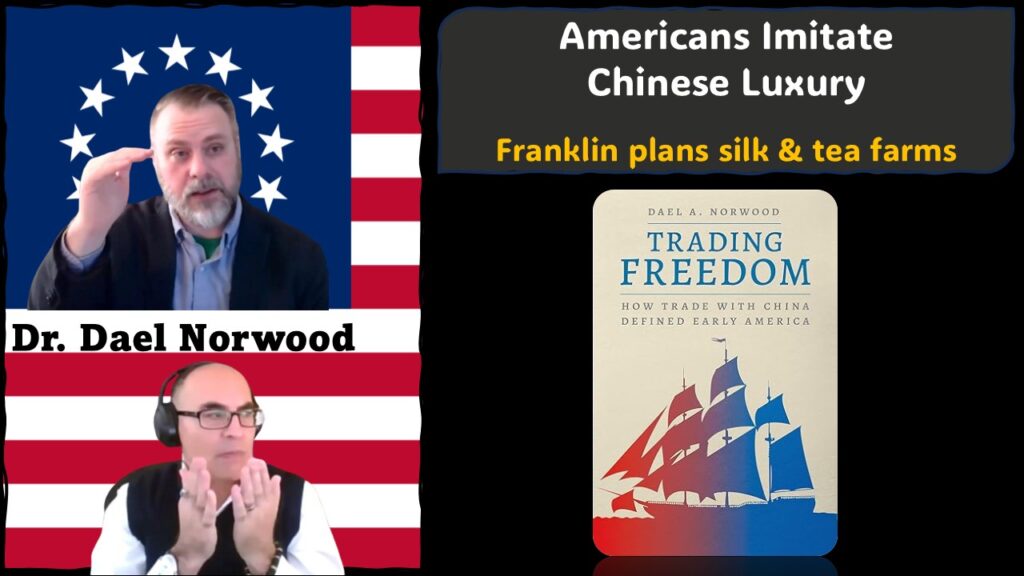
If you’re interested in how economic tensions increased in Boston and ultimately led to the Boston Massacre, see my interview with Dr. Dale Norwood: Why China Mattered to the American Revolution.
Boston Tea Party and the Consumer Revolution in the American Colonies
Dr. Norwood is a historian of nineteenth-century America specializing on the global dimensions of U.S. politics and economics. He is particularly interested in the political economy of commerce: how the ideas and practices of international exchange have affected Americans’ relations with other powers, as well as their dealings with each other.
He has published extensively on these subjects, including the following book, which we discuss in this interview: Trading in Freedom: How Trade with China Defined Early America
 Multiple Tea Parties in American Colonies
Tea, Porcelain, and Lacquerware From China
About This Program
Analyzing American Revolution (AAR) is a special series podcast production of the History Behind News program. In this series, 33 professors (and counting) analyze the American Revolution from 33 different angles through in-depth interviews with host Adel Aali.
Meet Our Guest Scholars
A structured body of thought on the American Revolution—where leading scholars advancing distinct interpretations that give this program its depth.

Thematic Collection
Tap below for a closer look at the Revolutionary Era themes we examine—and to meet our guest scholars.

Library
- Interview Transcript Highlights
- Interview Image and Artist Highlights
- Quiz Answers and Backstories

Image Gallery
Explore the backstories and artist bios behind images of our Founding—before and after the American Revolution. These visuals shape how we remember—and reimagine—the Revolutionary Era.

Support AAR
AAR is an independent program built on sustained research, preparation, and production. Your support helps continue this series and expand our program.

Experienced Analysis of History
About HbN Program
The History Behind News program (HbN) is committed to making in-depth history researched and written by scholars enjoyable and accessible to everyone. Our motto is bridging scholarly works to everyday news.
The histories we’ve uncovered encompass an impressively wide range of subjects from ancient history to U.S. politics and economy to race, women’s rights, immigration, climate, science, military, war, China, Europe, Middle East, Russia & Ukraine, Africa and the Americas to many other issues in the news. We also receive advanced copies of scholarly books and discuss them in our program (in the context of current news).

Adel Aali, host. Snapshot from his introductory video to AAR podcast.
232 Scholars & Counting
Our guests are scholars at leading institutions. They are highly recognized, having received prestigious grants and fellowships as well as notable awards, including the Pulitzer Prize. They include celebrated documentary producers, former White House advisors and other high-ranking government officials, and current and former senior reporters of major national and international newspapers. Many have testified in Congressional hearings, and others frequently contribute to major media outlets and widely read publications.
Think You Know the American Revolution?