Updated: May 30, 2026
Introduction
In this interview: “The story is wrong.”
Watch this segment in the video below (07:33)
Most Americans learned that the Quartering Act forced British soldiers into colonial homes.
Did it?
Were soldiers actually being forced into private houses? If not, why did colonists oppose the law?
Why did the issue become important enough to appear in the Bill of Rights? And if the traditional story is wrong, what was the real conflict about?
What does this reveal about how Americans were beginning to think about privacy, government power, and the place of the military in society?
In this interview, Dr. John G. McCurdy revisits one of the most familiar stories of the Revolutionary Era and shows why it deserves a second look. Rather than focusing on a simple dispute over housing soldiers, he examines how debates over quartering reflected deeper changes in colonial society, including new ideas about private space, public authority, and the proper relationship between citizens and the state. The result is a very different understanding of both the Quartering Act and its lasting legacy in American political culture.
Video
Watch the full interview with Dr. McCurdy (timestamped outline below)
Key Themes
- The Quartering Act and Historical Memory
- British Military Presence in Colonial Society
- Soldiers in Cities and Everyday Life
- Private Space vs. Public Authority
- The Third Amendment and Constitutional Meaning
Central Question
If the Quartering Act did not force British soldiers into private homes, how did the controversy help shape American ideas about private space, government authority, and the Third Amendment?

How to Use This Post
Use this post as reference guide to the American Revolution through the lens of this interview and the broader Analyzing American Revolution program (AARevolution). Navigate using the interactive table of contents above and the timestamps below (in gray) to discover how this interview deepens the story of the Revolution—and to explore how the program unfolds: its key themes, insights, image gallery, scholars list, history quizzes, and related interviews across the series.
The Quartering Act Did Not Force Soldiers Into Private Homes
One of the most persistent stories about the coming of the American Revolution is that the Quartering Act of 1765 forced British soldiers into the homes of unwilling colonists. According to Dr. McCurdy, however, that interpretation does not accurately reflect what the law actually said.
The Quartering Act directed that soldiers be housed first in barracks and, when necessary, in taverns, inns, and other public accommodations. If additional space was needed, unoccupied buildings could be rented for military use. Private homes were not the intended destination for quartered troops. In fact, when military officials initially proposed language that would have permitted soldiers to enter private residences as a last resort, King George III rejected the idea and the provision was removed.
Colonists still objected to aspects of the law, particularly its requirement that local governments provide supplies and support for stationed troops. Yet the central controversy was not simply a matter of soldiers occupying bedrooms. The debate was increasingly tied to questions about taxation, political authority, and the growing belief that certain spaces should remain beyond the reach of government power.
About My 217th Guest: Dr. John G. McCurdy
Dr. John G. McCurdy is a Professor and Graduate Coordinator at the Department of History and Philosophy of Eastern Michigan University. He specializes in colonial and Revolutionary America, gender, and LGBTQ+ history, and his research explores the cultural history of the eighteenth-century Anglo Atlantic.
Dr. McCurdy has published extensively on these subjects, including the following books:
- Vicious and Immoral: Homosexuality, the American Revolution, and the Trials of Robert Newburgh (discussed in Part I of this interview)
- Citizen Bachelors: Manhood and the Creation of the United States (Part I)
- Quarters: The Accommodation of the British Army and the Coming of the American Revolution (this interview)
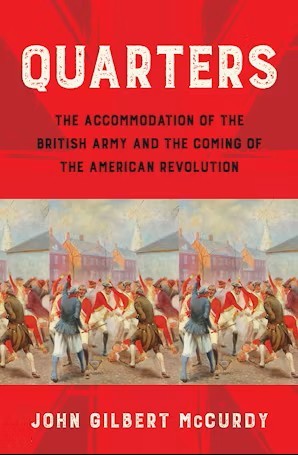 Dr. McCurdy’s book that we discuss in this interview
About Featured Image
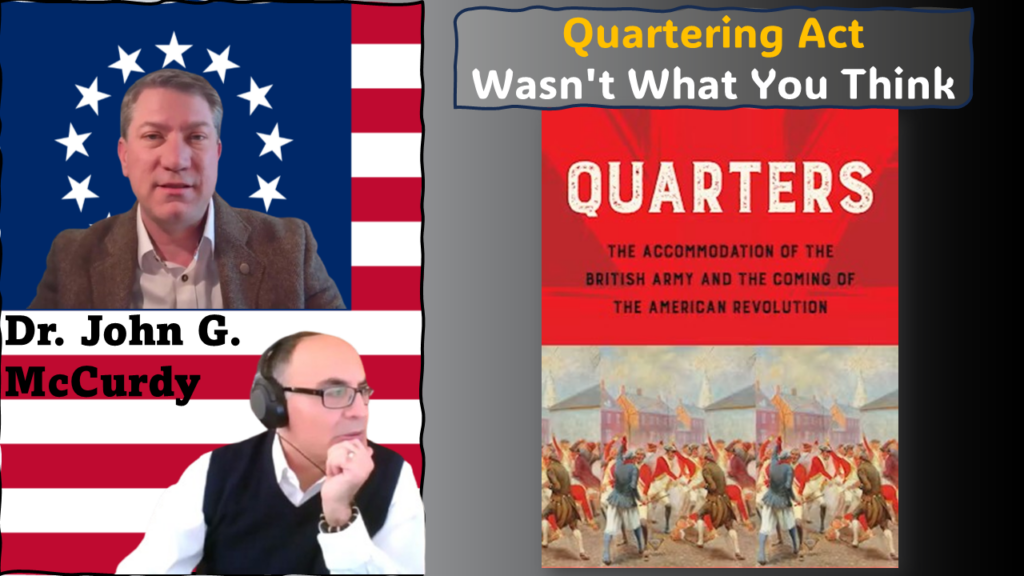
The featured image brings together images of Dr. John G. McCurdy and Adel Aali from the interview, superimposed on the Betsy Ross flag, alongside the cover image of Dr. McCurdy’s book, Quarters: The Accommodation of the British Army and the Coming of the American Revolution, which we discuss in this interview.
Unless otherwise indicated, all images in AAR—including those in this post—are in the public domain.
AAR Essential Insights
Although the full video and transcript of my conversation with Dr. McCurdy are included in this post, I’ve selected and summarized several insights that I found particularly revealing and worth emphasizing. These moments — some surprising, others that challenge familiar assumptions — help us see the Third Amendment and the American Revolution in a different light.
By the way, these insights are my own takes and interpretations from the interview. For Dr. McCurdy’s perspective and exact framing, please watch the interview above and view the transcript below in the corresponding sections.
The Third Amendment
The Third Amendment to the U.S. Constitution was ratified on December 15, 1791, as part of the Bill of Rights. It states:
No soldier shall, in time of peace be quartered in any house, without the consent of the owner, nor in time of war, but in a manner to be prescribed by law.
The Quartering Act Myth
The Third Amendment is one of the least discussed parts of the Constitution, perhaps because most of us think we already know the story behind it. British soldiers were forced into colonial homes. Colonists were outraged. The Revolution followed. End of story.
Except, as Dr. McCurdy explains, that story is wrong.
What makes this so striking is not merely that the Quartering Act has been misunderstood. It is that the misunderstanding has become part of America’s historical memory. The law specifically directed soldiers to barracks, taverns, public houses, and other accommodations. When military officials proposed language that would have allowed soldiers into private homes as a last resort, King George III himself rejected the idea and had it removed.
That does not mean colonists welcomed the law. They still objected to supporting a standing army in peacetime and to Parliament’s authority to impose such requirements. But once the familiar myth falls away, the real historical questions become far more interesting. If the Quartering Act was not primarily about soldiers occupying private homes, then what exactly were Americans resisting? And why did the issue leave such a lasting imprint that it eventually found its way into the Bill of Rights?
Watch this segment in the video above (06:49)
The Quartering Act History We Got Wrong
Continue watching at 7:26 in the video above
Private Space and Public Authority
The phrase “taxation without representation” looms so large in our understanding of the American Revolution that it can obscure other important developments taking place at the same time.
What struck me in this segment is that Americans were objecting to more than taxes. They were also beginning to draw sharper boundaries between public authority and private life. The Quartering Act became entangled with a larger question: where did the power of the state end?
The colonists did not necessarily like the law. New York resisted it so strongly that Parliament suspended the colony’s assembly until it complied. Yet many Americans approved of one important feature. The law recognized that private homes occupied a different category from barracks, taverns, warehouses, and other public spaces. Soldiers could not simply enter a residence because the government wanted them there.
Today, that distinction feels obvious. In the eighteenth century, it was becoming increasingly important. The debate over quartering was helping define a principle that many Americans now take for granted: there are places where government authority stops and private life begins.
Watch this segment in the video above (09:48)
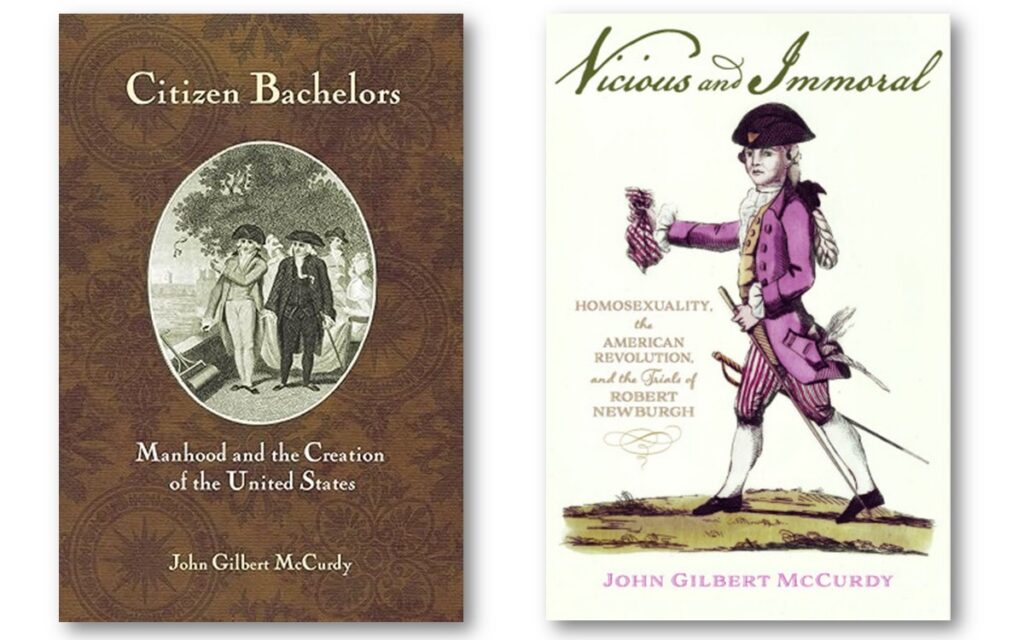 Dr. McCurdy’s books that we discuss in Part I of our interview
The Problem Wasn’t Quartering
The more I thought about this part of the interview, the more it seemed that the controversy was never really about quartering alone. The same law that many colonists accepted in the 1760s became far more controversial a few years later. What changed?
Not the text of the law. The soldiers changed.
A military presence is interpreted differently depending on why that military is there. Housing troops after a war is one thing. Stationing them in a city to monitor unrest, enforce unpopular policies, and remind colonists who holds power is something else entirely. The Quartering Act itself may have remained largely the same, but the political context surrounding it changed dramatically.
This strikes me as an important reminder that laws are rarely judged only by their wording. They are judged by how people experience them. Once British troops in Boston came to be viewed less as protectors and more as instruments of imperial control, many colonists understandably developed a very different opinion about supporting their presence.
Watch this segment in the video above (10:43)
Why Soldiers Left American Cities
This may be the most important insight in the entire interview because it moves the discussion far beyond the Quartering Act itself.
We often assume that the distinction between public and private space has always existed. Yet Dr. McCurdy reminds us that eighteenth-century Americans did not necessarily view their homes the way we do today. Many houses were small. Taverns often operated out of private residences. Travelers, neighbors, and even soldiers could move through spaces whose boundaries were far less defined than modern Americans would expect.
What changed was not merely a law. It was the way people thought about the world around them.
As homes became larger and towns developed more specialized buildings, Americans began drawing sharper lines between public and private life. Inns were for travelers. Barracks were for soldiers. Homes were for families. The debate over quartering emerged at precisely the moment these distinctions were becoming more important.
The implications extended far beyond the Revolutionary Era. One of the most fascinating observations in this interview is that the United States gradually diverged from Europe in its relationship with the military. While cities such as London continued to maintain large military barracks in their urban centers, Americans grew increasingly uncomfortable with a permanent military presence in everyday civic life. In that sense, the story of quartering is also a story about how Americans came to imagine their cities, their homes, and the proper boundaries of state power.
Watch this segment in the video above (11:57)
An Amendment With an Escape Clause
The Third Amendment is probably the least discussed amendment in the Bill of Rights. Most Americans rarely think about it, largely because quartering soldiers no longer feels like a pressing issue. Yet this conversation revealed something I had never considered.
Unlike many constitutional protections, the Third Amendment appears to contain its own exception. Soldiers cannot be quartered in peacetime without consent, but in wartime Congress can authorize quartering through legislation. That raises an intriguing question: is the amendment establishing an absolute right, or is it establishing a process through which the government may act under certain circumstances?
Equally interesting is the word “house.” Today we tend to imagine a private residence. But what did the framers mean by the term? Did they intend it to apply only to homes? Could it include other structures? Public buildings? Barracks? The amendment suddenly becomes much more complicated once we move beyond the familiar textbook explanation.
What I appreciate about this discussion is that it reminds us how much remains open to interpretation, even within constitutional provisions that receive relatively little public attention. Sometimes the most overlooked parts of the Constitution contain some of the most interesting questions.
Watch this segment in the video above (15:50)
The Interview (S1E21): Adel Aali and John G. McCurdy
In our conversation, Dr. McCurdy addressed important topics relating to the Quartering Act, the Third Amendment and the American Revolution. Below, is the outline of our conversation followed by the interview’s full transcript.
Podcast
Watch the full interview on this page with the outline and transcript below, or take the conversation with you on the go through our Spotify podcast.
Outline
Watch the full interview on this page with the outline and transcript below, or take the conversation with you on the go through our Spotify podcast.
Click for Timestamped Outline
- Selected Highlights (00:00)
- Guest Introduction (01:10 )
- The Third Amendment and Quartering Soldiers (02:45)
- What the Third Amendment Actually Says (02:54)
- “In a Manner to Be Prescribed by Law” (03:05)
- Billeting Soldiers in Colonial America (03:16)
- British Troops Before the Seven Years’ War (03:43)
- Why Colonists Built Barracks (04:08)
- Who Paid for Quartering? (04:55)
- The Medieval Origins of Billeting (05:09)
- Receipts, Compensation, and Colonial Complaints (05:37)
- Thomas Gage and the Quartering Act (05:47)
- Researching Quarters (05:58)
- Quartering and Changing Ideas of Space (06:36)
- The Quartering Act Myth (06:49)
- The Story Most Americans Learn (07:14) – Key Moment (07:31)
- What the Quartering Act Actually Required (08:00)
- King George III and Private Homes (08:21)
- Rejecting Forced Quartering in Houses (08:32) – Turning Point (08:32)
- Permission, Not Compulsion (08:46)
- Taxation Without Representation or Something More? (09:48)
- New York’s Resistance to the Quartering Act (10:06)
- Protecting Private Space from State Power (10:29) – Key Moment (10:29)
- Why Attitudes Changed in Boston (10:43)
- A Successful Law in the 1760s (11:08)
- Soldiers as Instruments of Imperial Control (11:15) – Turning Point (11:27)
- How Americans Rethought Public and Private Space (11:57)
- Homes, Taverns, and Everyday Life in Colonial America (12:20)
- The Rise of Distinct Public and Private Spaces (12:55)
- Why Soldiers Disappeared from American Cities (13:32)
- Barracks in New York, Philadelphia, and Charleston (13:37)
- Diverging from Britain and Europe (14:20) – Turning Point (14:39)
- Just One Point (actually, two points) (15:19)
- The Quartering Act Did Not Force Soldiers into Private Homes (15:30)
- The Third Amendment and the Meaning of a “House” (15:50)
Transcript
Note: This transcript was generated automatically and may contain minor errors. It is provided for reference and accessibility only.
Click to View Transcript
Adel:
Dr. McCurdy, please tell us what the Third Amendment to the U.S. Constitution says about quartering soldiers.
Dr. McCurdy:
Right. It states, no soldier shall in time of peace be quartered in any house without the consent of the owner, nor in time of war, but in a manner to be prescribed by law.
Adel:
Manner to be prescribed by law. Before the American Revolution, was there a lot of forced quartering of soldiers, British soldiers going on?
Dr. McCurdy:
So, a lot is a hard thing to quantify, right? I would say what I was able to discover in my research is that throughout the colonial era, probably up to the 1750s, 1760s, it’s not uncommon to have an army march into town and need a place to stay, and that these soldiers would go into your home. Most of these soldiers are actually going to be provincial soldiers or colonial soldiers.
The British army is pretty ancillary to the colonial existence until the Seven Years’ War in the 1750s, when suddenly thousands of British troops start arriving. And early in the war, these troops do go into people’s homes, in which response- You mean early in the war, by early in the war, you mean the Revolutionary War, as in 1757? Early in the Seven, I’m sorry, early in the Seven Years’ War, the French- Oh, Seven Years’ War, okay.
And, of course, the Americans are very unhappy about this, and so in the 1750s, there’s a huge infrastructure project where every major American city and several smaller cities start building barracks. So, if you know New York City today, where City Hall stands, at that point, there was a barracks in the 1750s that was capable of holding about 2,000 men.
Adel:
Oh, okay.
Dr. McCurdy:
In Philadelphia, throughout New Jersey, several New Jersey towns have barracks. Boston has barracks, but often an island in Boston- Castle Island, yeah. Yeah, exactly.
Castle Island, Charleston, they’re throughout the colonies because the Americans decide, we can put these soldiers in barracks. They don’t need to be in our homes.
Adel:
Did British soldiers pay anything towards their residents with people? Do they pay rent? Did they pay for food?
Did they share insurance? How did that work out?
Dr. McCurdy:
So, traditionally, and this goes back to medieval times, if not earlier, the process of quartering is called billeting. And billeting comes from the word billet, meaning ticket, which is the idea that if a soldier comes to your house, stays the night, eats your food, he has to give you a receipt, basically, that you can take to the sheriff or some colonial official or other official and receive money for it to receive compensation. So, soldiers aren’t supposed to be staying there for free.
Of course, the charge is that the soldiers will write these billets and the state will never pay them. I see. Yeah, that’s an old charge.
Adel:
So, let’s talk about your book, Quarters, The Accommodation of the British Army and the Coming of the American Revolution. Tell us about your book, please.
Dr. McCurdy:
So, I was interested in this sort of story. Yeah, I became interested in the Quartering Act. No one had written a book about it.
I was interested in what that would be. And I started going through the papers of Thomas Gage, who’s a commander-in-chief of the British forces in North America from 1763 to 1775. And he’s a meticulous bureaucrat and maintains a whole series of records about where soldiers are going and what’s going on.
So, it got me digging into the sort of larger issue of quartering as the issues.
Adel:
Does Thomas Gage later become, after Hutchinson, the governor of Massachusetts?
Dr. McCurdy:
Yeah, he spends a year as governor of Massachusetts.
Adel:
Same guy. Okay.
Dr. McCurdy:
So, I was interested in sort of how quartering emerges, what the Quartering Act says, but then also how this reflects how ideas of space are changing in the American colonies.
Adel:
Was quartering, by the eve of the Revolution, 1775, was it a huge deal or was it just sort of a residual element that people just resented and they just included that in the Bill of Rights? Right.
Dr. McCurdy:
Yeah. So, I mean, that’s a great way of thinking about this. So, I’ve been teaching, I don’t know, 20-some years at this point.
When I first started teaching the Revolution, I would talk about, you know, you had this thing called the Quartering Act, which forced soldiers into people’s homes and Americans were so upset about it, they wrote the Third Amendment, which that’s a very nice, easy story. Yeah.
Adel:
It’s wrong. And by Quartering Act, you mean the Quartering Act of 1765.
Dr. McCurdy:
Exactly. And it’s wrong.
Adel:
That story’s wrong.
Dr. McCurdy:
The story is wrong. So, the colonists don’t want troops in their homes. And so, again, in the 1750s, they build all these barracks.
Britain decides to leave 15 regiments or somewhere in the neighborhood of 7,000 soldiers in North America at the end of the Seven Years’ War. Most of them are in Canada or Florida or out in the West, but a number are in New York, Philadelphia and New Jersey. And so, the Quartering Act is written.
The Quartering Act will state pretty emphatically that soldiers are not to go into private homes. Soldiers are to go into barracks. And if there are no barracks, they go into taverns or public houses.
And if neither of those are available, then unoccupied buildings can be rented. Warehouses. Soldiers can be warehoused, basically.
And it’s interesting because when they first write the Quartering Act, because it’s Gage who wants this thing. When they first write the Quartering Act, Gage says, well, we need language that if all else fails, we can put soldiers into private homes. And actually, it’s King George III who will say, I’ve never heard of such a crazy thing.
You can’t put soldiers in people’s homes. And so, that part of the law is removed. And so, it’s an interesting thing in how the law is executed.
On the one hand, the British Army, at least before the war begins, is very good at making sure soldiers don’t go into private homes. They can go in there, but only with permission. You can accept soldiers, of course, or officers if you want in your home, but that you have to give permission.
They can’t be forced into your house. The other side is the Americans are very happy about this. And many colonies, including Massachusetts, will actually provide money under the Quartering Act.
The Quartering Act provides, what it states is that the colonists are supposed to pay for supplies. So, they’re to maintain the barracks for these soldiers. They’re to provide blankets, common utensils, liquor in some cases, vinegar, things like that, basic sort of amenities for living.
But the Quartering Act does not require the colonists to provide for the salaries. They don’t have to pay the salaries of the soldiers, nor do they have to pay for the food of the soldiers. It’s merely to make where they live a little more livable.
Adel:
Explain for me again, why are the colonies, you said, Americans are happy about this, happy about the fact that permission is required, or they’re happy about the Quartering Act?
Dr. McCurdy:
They’re happy. I don’t want to say they’re happy about the Quartering Act. They will protest it, right?
New York will become famous, will famously protest the Quartering Act to the point where they say, we will not provide any supplies for soldiers. And Parliament responds by saying, fine, we’re going to dissolve the New York Assembly. You cannot meet again to make any law unless that’s to comply with the Quartering Act.
So there are complaints about the law itself, because it’s seen as taxation without representation. But the Americans do like the fact that the law protects their private spaces. It designates the private home as being a place where soldiers and by extension, the state cannot go.
Adel:
Suddenly this, I mean, it’s still a menace to the colonists, but suddenly the Quartering Act of 1765 is not a big bad wolf that we grew up thinking. I mean, they weren’t forcing people necessarily into the homes. In fact, King George III didn’t want that.
Right.
Dr. McCurdy:
Yeah. Yeah. And it’s really, it’s a very successful law, I would say, in the 1760s.
And that turns, like opinions about the law begin to turn with the garrisoning of Boston in 1768, and then later with the military occupation of Boston in 1774. Because these soldiers are arriving sort of not just to be there, but they’re arriving to, of course, keep the Americans in line. And then they have a very different opinion about paying anything for that type of thing.
Adel:
Yeah. Yeah. And then for them to stay in Castle Island, which is not, doesn’t have immediate access to the city, they can’t quell any riots, they have to stay in the city.
So that complication starting in 1768, which leads to 1770, the Boston Massacre, and that all as well. Does the Quartering Act in any way reshape the meaning of geography in the colonies or in colonial towns?
Dr. McCurdy:
So I think ideas of quartering are really interesting, whether it’s the Quartering Act or not. I think ideas of quartering are really key to how Americans start rethinking space. And this was sort of my idea with the book, that again, if you go to the 17th century, even for most of the 18th century, again, soldiers show up and you put them in your home, because there’s not a great deal of distinction between private houses and public houses.
Most houses in colonial America are two rooms. There aren’t really inns in most towns. You might have a tavern, but a tavern might just be run out of somebody’s house, as opposed to being a separate building.
So the distinctions we have between public spaces and private spaces is very fuzzy. That changes in the middle of the 18th century. By the 1750s, 1760s, Americans are starting to build two-story houses.
They’re starting to have much larger places, much more stuff. And that’s helping them. They’re starting to think differently about space, about public buildings versus private buildings.
Now you have inns and taverns and places where people can stay. If there’s an inn, you can stay. You don’t need to be in my house.
You can go to the inn. So I think that’s key, is this law emerges and this practice of quartering is being debated at the moment when Americans are beginning to really distinguish between public spaces and private spaces. The other thing I would add onto that is I think sort of how we think about the city changes.
So as I mentioned, there were barracks in New York, where City Hall is now, in Philadelphia, Charleston. By 1800, almost all of these barracks are gone. They’re not the best built structures to begin with.
They’re built out of wood, so they don’t withstand the test of time, as it were. But I think this is key. Americans don’t really ever put massive barracks in the middles of their cities after the Revolutionary War.
Those go away. The Army doesn’t occupy New York or Washington. Americans are very uncomfortable about having a large army in their presence in times of peace, and that we’ve maintained for 250 years.
We see how dramatic this is because it’s at the same time that they are putting up barracks in London, massive barracks right in the center of London, which you can still see. I mean, they’ve been repurposed. But soldiers in the city is a very typical thing, a very ordinary thing in Europe in the 18th century.
But in the country that follows, in the United States, soldiers are really pushed out of cities.
Adel:
This is really interesting. So in that specific point, the American colonies diverge from Great Britain and let’s say France and Europe in general, where to your point, if we were to go to London, let’s say in 1792, you would see soldiers and military barracks smack dab in the middle of London. But this does not continue.
This is not the case had we gone to, let’s say, New York in 1792.
Dr. McCurdy:
Oh, wow.
Adel:
That is really fascinating. If you want our audience to remember just one point about quartering British soldiers in the American colonies, what would it be?
Dr. McCurdy:
So I would make two points if I could. One would be the earlier point I made, which is the quartering act did not force soldiers into private houses, which I think, again, we often think it does. The second point is going back to the Third Amendment.
So again, as I mentioned, the quartering gets into this whole discussion of private versus public. But the Third Amendment is very interesting. And then it says you can’t put soldiers in any house, which by my reading of that, and I’m not a constitutional lawyer, suggests that would be any building.
Anything that’s deemed a house is really off limits. The Third Amendment is also a curious amendment because it can be completely overridden if Congress passes a law, right? Because the ending part of the amendment says only if a law is passed that it’s allowable, which, you know, there’s nothing like that in the Second Amendment or the First Amendment, right?
That says if Congress passes a law, we can do whatever we want, but it doesn’t happen in the other amendments.
Adel:
That is really interesting. Yeah, no quartering. And then there’s the issue of what a house means.
Does that even include a public space or barracks? Unless Congress passes a law to that effect, that’s really fascinating. Dr. McCurdy, thank you so much for educating me and our audience about the American Revolution. And to our audience, if you know of any history that could provide more perspective about the American Revolution, please share it with us and tell us what’s your perspective. Thank you so very much. This was wonderful.
Dr. McCurdy:
Yeah, thank you for having me. This has been great fun for me.
Adel:
Same here.
Related Interviews and Essays
Part I of This Interview
►My interview with Dr. John G. McCurdy: “Homosexuality, Single Men and the American Revolution“
Dr. McCurdy has published extensively on these subjects, including the following books:
- Vicious and Immoral: Homosexuality, the American Revolution, and the Trials of Robert Newburgh
- Citizen Bachelors: Manhood and the Creation of the United States
- Quarters: The Accommodation of the British Army and the Coming of the American Revolution
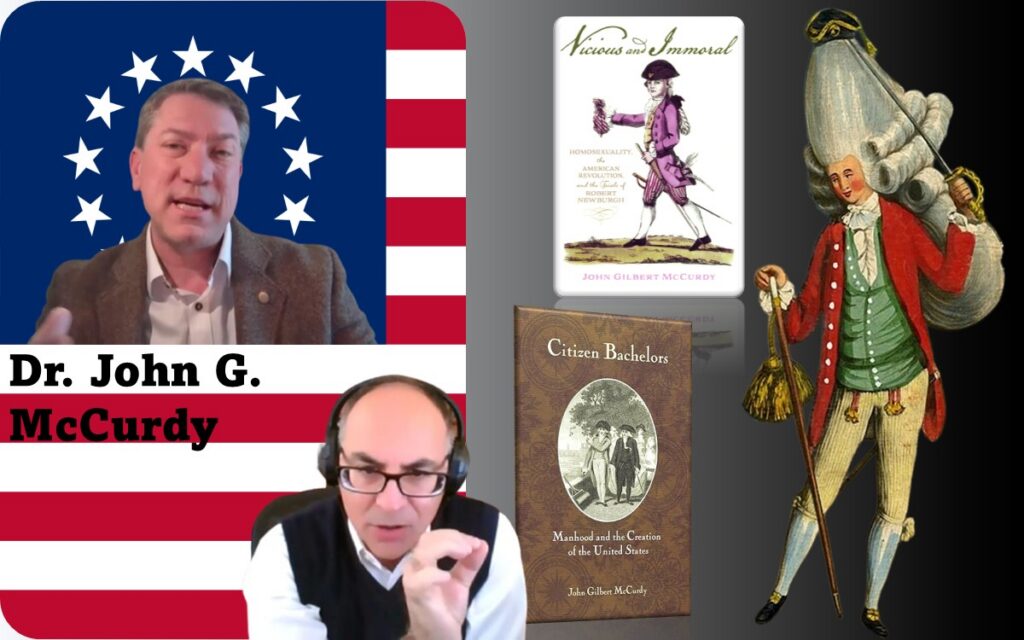 Homosexuality Was Illegal —
But Colonial America Did Not Always View It the Same Way as Britain
King George III
In this interview, Dr. McCurdy mentions King George III’s opposition to housing British soldiers in the homes of American colonists. Undoubtedly, this is a perspective on the King and British politics that many Americans rarely encounter. In our program, Dr. Richard Bell analyzes and sheds light on the King, the British Parliament, and British politics during the American Revolution.
►My interview with Dr. Bell: “Rethinking King George III: the American Revolution From the British Perspective“
Dr. Bell’s major works include:
- The American Revolution and the Fate of the World
- Stolen: Five Free Boys Kidnapped Into Slavery and Their Astonishing Odyssey Home
- We Shall Be No More: Suicide and Self-Government in the Newly United States
- Buried Lives: Incarcerated in Early America
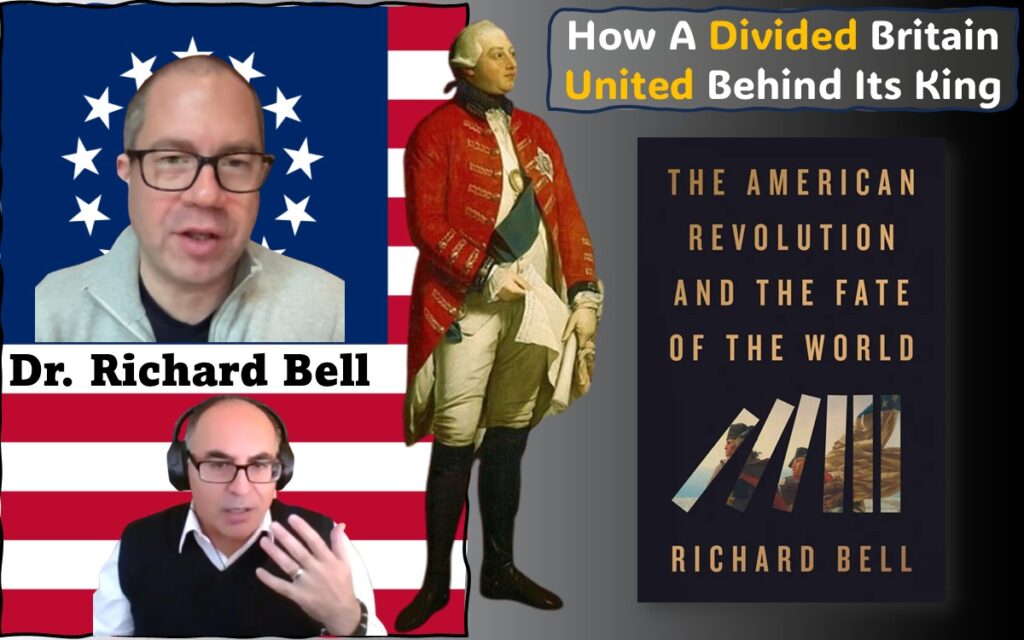 The Missing—and Misunderstood—British Side of the American Revolution
About This Program
Analyzing American Revolution (AAR) is a special series podcast production of the History Behind News program. In this series, 33 professors (and counting) analyze the American Revolution from 33 different angles through in-depth interviews with host Adel Aali.
Meet Our Guest Scholars
A structured body of thought on the American Revolution—where leading scholars advancing distinct interpretations that give this program its depth.

Thematic Collection
Tap below for a closer look at the Revolutionary Era themes we examine—and to meet our guest scholars.

Library
- Interview Transcript Highlights
- Interview Image and Artist Highlights
- Quiz Answers and Backstories

Image Gallery
Explore the backstories and artist bios behind images of our Founding—before and after the American Revolution. These visuals shape how we remember—and reimagine—the Revolutionary Era.

Support AAR
AAR is an independent program built on sustained research, preparation, and production. Your support helps continue this series and expand our program.

Experienced Analysis of History
About HbN Program
The History Behind News program (HbN) is committed to making in-depth history researched and written by scholars enjoyable and accessible to everyone. Our motto is bridging scholarly works to everyday news.
The histories we’ve uncovered encompass an impressively wide range of subjects from ancient history to U.S. politics and economy to race, women’s rights, immigration, climate, science, military, war, China, Europe, Middle East, Russia & Ukraine, Africa and the Americas to many other issues in the news. We also receive advanced copies of scholarly books and discuss them in our program (in the context of current news).

Adel Aali, host. Snapshot from his introductory video to AAR podcast.
217 Scholars & Counting
Our guests are scholars at leading institutions. They are highly recognized, having received prestigious grants and fellowships as well as notable awards, including the Pulitzer Prize. They include celebrated documentary producers, former White House advisors and other high-ranking government officials, and current and former senior reporters of major national and international newspapers. Many have testified in Congressional hearings, and others frequently contribute to major media outlets and widely read publications.
Think You Know the American Revolution?