Updated: August 16, 2026
Introduction
“That equated to roughly 20% of the male population. That’s the highest percentage in American history. World War II, 12%.”
Watch this segment in the video below (01:04:22).
Militias existed. Local defense existed. So why did the Continental Congress create the Continental Army—only to limit its power?
What was this army actually fighting for? Not in hindsight—but in 1775, before independence was declared, before a nation even existed.
Who chose to serve in Washington’s Army—and why? And what did that experience mean to them at the time?
And then there’s Washington himself: was he truly qualified for command? Or did the war—and the men under him—shape his leadership as much as he shaped them?
Did the turning points of the war change how soldiers understood not just the conflict—but their own identity within it?
In this interview, Dr. Ricardo Herrera takes these questions seriously—and in doing so, challenges the assumptions we often bring to the Revolutionary War. Rather than treating the Continental Army as a fully formed national force, he reveals it as something far more uncertain: an improvised institution, constrained by politics, shaped by circumstance, and evolving alongside the Revolution itself. What emerges is a clearer, more grounded understanding of how the War was fought—and how those who fought it began, gradually and unevenly, to redefine what they were fighting for.
Video
Watch the full interview with Dr. Herrera (timestamped outline below)
Key Themes
- Colonial Rivalries and Continental Unity
- Rights, Liberty, and the Continental Army
- Citizen Soldiers of the Continental Army
- Continental Army and American Nationhood
- George Washington’s Continental Army
Central Question
This conversation raises a central question:
If the Continental Army began as a conservative defense of English liberties, how did it become a “people’s army” that not only sustained the Revolution but helped transform provincial soldiers into Americans?

How to Use This Post
Use this post as reference guide to the American Revolution through the lens of this interview and the broader Analyzing American Revolution program (AARevolution). Navigate using the interactive table of contents above and the timestamps below (in gray) to discover how this interview deepens the story of the Revolution—and to explore how the program unfolds: its key themes, insights, image gallery, scholars list, history quizzes, and related interviews across the series.
Why the Continental Army Was Created—and What It Was Meant to Do
The Continental Army was established on June 14, 1775 (three days before the Battle of Bunker Hill), by the Second Continental Congress in response to an immediate military crisis, not a unified vision of independence.
Fighting had already broken out at the Battles of Lexington and Concord, and colonial militias—particularly from New England—were already engaged in sustained operations around Boston. However, Congress did not create a new army from scratch; it consolidated these existing forces, placing them under the command of George Washington while simultaneously imposing limits on their scope, authority and economic power.
As Dr. Herrera explains, this decision reflected deep political caution. The same delegates who recognized the need for coordinated military action were also wary of centralized power and standing armies. The result was a force that was national in name but constrained in practice: short enlistments, inconsistent supply systems, and a command structure shaped as much by colonial sensitivities as by military logic.
At its core, the Continental Army was not initially designed to wage a long war for independence—it was created to manage resistance under conditions of uncertainty. Understanding that distinction is essential, because it reframes the Army not as a starting point of national unity, but as one of the mechanisms through which that unity had to be built.
About My 209th Guest: Dr. Ricardo Herrera
Dr. Ricardo Herrera is a retired professor of Military History at the Department of National Security and Strategy in the US Army War College. Dr. Herrera has served as an Armor and Cavalry officer in the US Army. Dr. Herrera has published extensively on U.S. military history, including the following books that we discuss in this interview:
- Feeding Washington’s Army: Surviving the Valley Forge Winter of 1778, which was a Finalist in the Inaugural American Battlefield Trust Book Prize for History
- For Liberty and the Republic: The American Citizen as Soldier, 1775-1861
- His forthcoming book is tentatively titled Most Uncommon Soldier: The Life, Letters, and Journal of Edward Ashley Bowen Phelps, 1814-1893
About Featured Image
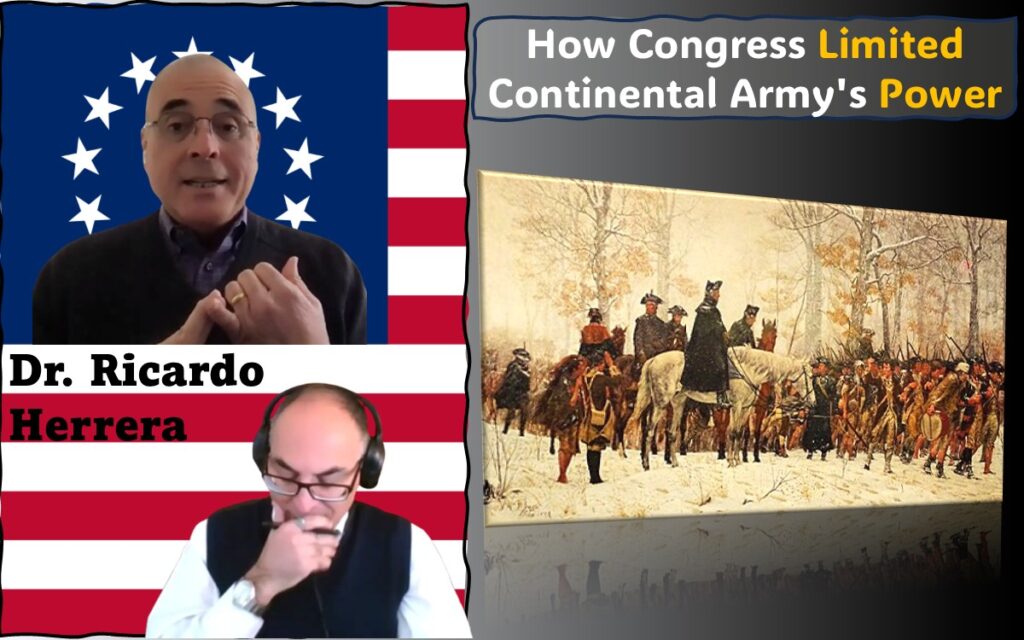
The featured image brings together images of Dr. Ricardo Herrera and Adel Aali from the interview, superimposed on the Betsy Ross flag, alongside painting “The March to Valley Forge, December 19, 1777”, by William B. T. Trego, Museum of the American Revolution.
Unless otherwise indicated, all images in AAR—including those in this post—are in the public domain.
AAR Essential Insights
Although the full video and transcript of my conversation with Dr. Herrea are included in this post, I’ve selected and summarized several insights that I found particularly revealing and worth emphasizing. These moments — some surprising, others that challenge familiar assumptions — help us see the Continental Army and the American Revolution in a different light.
By the way, these insights are my own takes and interpretations from the interview. For Dr. Herrera’s perspective and exact framing, please watch the interview above and view the transcript below in the corresponding sections.
A Strange Army—For Liberty, Not Yet Revolution
There’s a tendency to read the Continental Army backward—to assume it was always aimed at independence. It wasn’t. And that distinction matters more than we usually admit.
In 1775, this army comes into existence in a moment of urgency, tension, and contradiction. Congress doesn’t build it from scratch. It adopts an existing New England force already in the field… and then adds to it. A national army—before there is a nation. That matters because its purpose is not independence. Not yet.
What emerges instead is something more conservative—deliberately restrained. An army raised to defend rights as British subjects. To preserve what colonists believed was already theirs. That’s a very different political project than revolution.
Even the symbolism reflects this tension. An army fighting British troops—under a flag that still carries the Union Jack. That’s not confusion—it’s a signal. The struggle begins inside the imperial system, not outside of it.
And then there’s the composition and organization of this army. A mix of provincial regiments and newly formed continental units. New England men surrounding Boston… riflemen marching up from Pennsylvania, Maryland, and Virginia. It’s not cohesive. It’s an amalgamation—held together more by necessity than design. That tension is the point.
This “weird organization,” as Dr. Herrera calls it, captures the moment perfectly. A war has begun—but its meaning is still unsettled. The army exists, but the cause is still forming.
That tension—between loyalty and rupture, between rights and independence—is where the story begins.
Watch this segment in the video above (00:03:44)
Raising an Army—Local Men, Continental Cause
At first glance, the question seems straightforward: how do you recruit an army? Set quotas, fill the ranks.
That’s not what happens here.
In 1776, Congress authorizes one-year enlistments… short-term service for what is already becoming a long war. The quotas are based on rough population estimates—imprecise, almost improvised. On paper, it looks orderly. In practice, it isn’t.
Even the structure reflects this. Regiments are numbered—but the system quickly breaks down. Seniority, timing, local decisions… what should create order ends up creating confusion.
And then there’s the deeper issue. These are not truly national units. They’re local. Men from the same towns… serving together. That builds cohesion—but also concentrates risk. When a regiment takes losses, entire communities feel it at once.
Washington sees the problem. He wants to mix the regiments—to push men beyond provincial identity. But the states resist. They hold on to control… and to their own.
So what emerges is a contradiction. An army fighting for a collective cause… organized around local ties.
And why do men join?
Not for one reason. For many. Patriotism—but also pressure. Some volunteer. Others are pushed. Some are chosen because they have no ties.
This is not a clean system.
It’s a patchwork—held together just enough to sustain a war.
Colonial Rivalries
Continue watching at 15:42 in the video above
Soldiers, Citizenship, and a New Identity
Did the Continental Army make soldiers better citizens?
Not exactly. But that’s almost the wrong question.
What these men believed—based on their letters and journals—is that by serving, they were demonstrating citizenship. Not learning it in theory… but proving it in action. And the experience changed them.
Many entered as farmers, laborers—men tied to local worlds. In the army, they learned to read and write… to keep records… to organize. Skills that carried over after the war—into town offices, local government, everyday political life. But the deeper shift wasn’t just practical. It was conceptual.
Men who had lived and thought locally—Pennsylvanian, Virginian, Massachusetts—were now marching across colonies, serving alongside people they had never met. Different accents, different backgrounds but shared experience. That does something.
It forces a comparison. And eventually, a realization: they have more in common than not. That’s where something new begins to take shape—not just an army, but a sense of being American. Not fully formed. Not universal. But real.
And it doesn’t come from theory or documents alone. It comes from service… from movement… from shared hardship.
The Continental Army doesn’t just fight a war—it helps create the people who will later call themselves a nation.
Watch this segment in the video above (00:39:50)
Battles, Morale, and the Turning Point
Do pivotal battles reshape what soldiers believe… or just how they feel?
At first, not much changes ideologically. But morale? That’s a different story.
In 1776, the New York campaign is a shock. British warships filling the harbor… thousands of disciplined troops landing. For many Continentals, this looks overwhelming—professional soldiers against something far less certain. Some desert. Others lose confidence. The army shrinks… dramatically.
And then—Trenton.
A small victory on paper… but not in effect. Washington strikes, surprises, captures nearly an entire Hessian force. It’s not just a win—it’s proof. Proof that this army can fight… and win.
He then follows it up. Crosses again. Holds at Assunpink Creek… then moves on Princeton. Another blow. Another victory.
These aren’t massive battles. But they land at the right moment. Morale shifts. Confidence returns—not just in the army, but among the people watching it. And strategically, it matters.
The British pull back. Their lines contract. Control weakens across New Jersey. What looked like collapse weeks earlier now looks… survivable.
So no—the war isn’t won here. But something changes. Not ideology. Not yet.
Rather, in belief—the belief that this army—imperfect, improvised, under pressure—can endure.
And that may be the more important turning point.
Watch this segment in the video above (00:39:29)
Feeding the Army—and Restricting Its Power
At one level, the problem is simple: how do you feed an army?
The colonies don’t have the industrial base to sustain one. Weapons, uniforms, supplies—much of that comes from Europe. But food? That has to come from the land… from the colonies themselves. And that creates pressure.
Armies move… and they consume. Roads torn up. Fields disrupted. Livestock taken. Whether civilians support the cause or not, the army takes what it needs—so Congress builds a system. Not centralized. Not efficient. But deliberate.
Food is purchased—through agents, often using their own credit. They buy, submit receipts, wait to be repaid. Meanwhile, the currency itself is losing value. Inflation sets in. The system strains. And that strain isn’t accidental.
Congress is trying to solve two problems at once: feed the army… and limit its power.
A strong, well-funded army can sustain itself—but it can also dominate. That fear runs deep. So the system is designed to prevent the army from accumulating economic power. No easy access to money. No independent supply base. Dependence—on Congress, on the states, on civilians.
It works… and it doesn’t. The army survives—but barely, at times.
And that’s the tradeoff.
To preserve liberty, they accept weakness. To avoid a powerful army, they build one that is constantly under strain. And that tension—between necessity and fear—shapes how the war is fought.
Watch this segment in the video above (00:51:29)
The Largest People’s Army in U.S. History
This is a critical point from this interview.
We tend to underestimate the scale of the Continental Army… and misunderstand who was actually involved. Roughly 230,000 men served—perhaps more. That’s about 20% of the male population—the highest percentage in American history.
Let that sink in.
World War II—often seen as the nation’s greatest mobilization—reaches about 12%. So the Continental Army was something different.
This was not a small, committed minority fighting on behalf of others. This is a people’s war—and a people’s army. This forces a reassessment. The idea that only a small percentage of Americans took part… that the Revolution was carried by a narrow few—that doesn’t hold up. Not against these numbers. Not against this level of participation.
So if there’s one point to take from this—it’s this: The American Revolution was not fought on the margins. It was carried, sustained, and endured by a significant portion of the population itself.
Watch this segment in the video above (01:03:25)
The Interview (S1E14): Adel Aali and Ricardo Herrera
In our conversation, Dr. Herrera addresses key questions about the Continental Army, Continental soldiers, Valley Forge and the American Revolution. Below is a structured outline to help you navigate the discussion, followed by the full transcript.
Podcast
Watch the full interview on this page with the outline and transcript below, or take the conversation with you on the go through our Spotify podcast.

Outline
Use the in-depth outline below to follow the discussion and navigate key moments in the interview.
Click for Timestamped Outline
- Selected Highlights (00:00:00)
- Guest Introduction (00:01:35)
- Why Was the Continental Army Formed? (00:03:22)
- Rights, Liberties, or Independence? (00:03:44)
- Richard Henry Lee and the First Continental Congress (00:04:25)
- George Washington and the Birth of a Continental Army (00:06:08)
- Pennsylvania, Maryland, and Virginia Riflemen (00:06:08)
- Defending Traditional English Rights Rather Than Independence – Key Moment (00:07:37)
- Militias, Protest, and Colonial Rivalries (00:08:43)
- Rioting, Representation, and the Gordon Riots (00:09:29)
- Why Congress Wanted a Continental Army – Turning Point (00:12:15)
- John Adams, George Washington, and a National Cause (00:16:07)
- Choosing a Virginian Commander-in-Chief (00:16:43)
- George Washington’s Early National Vision (00:23:34)
- Recruiting the Continental Army (00:20:37)
- One-Year Enlistments and Congressional Quotas (00:20:37)
- Local Regiments, Community Pressure, and Military Service (00:25:53)
- Patriotism, Citizenship, and the American Soldier (00:30:12)
- For Liberty and the Republic: The American Citizen as Soldier, 1775–1861 (00:30:12)
- Veterans, Literacy, and Early American Nationalism – Turning Point (00:37:24)
- Trenton, Princeton, and the Crisis of 1776 (00:43:17)
- British Regulars, German Auxiliaries, and Desertion (00:44:32)
- Capturing Hessian Soldiers at Trenton – Key Moment (00:47:25)
- George Washington as Strategist (00:53:17)
- “Ends, Ways, and Means” and the Big Picture of War (00:54:20)
- The Strategic Importance of the “Ten Crucial Days” – Turning Point (00:54:52)
- Feeding the Continental Army and Valley Forge (00:58:08)
- Feeding Washington’s Army: Surviving the Valley Forge Winter of 1778 (00:58:08)
- French, Spanish, and Dutch Support for the American Cause (01:01:05)
- Congress, Inflation, and Fear of Standing Armies (01:06:14)
- Printing Money, Inflation, and Weak Central Government (01:07:55)
- Liberty, Economic Power, and Standing Armies (01:09:12)
- Just One Point (01:13:37)
- The American Revolution as a “People’s War” (01:13:50)
- Approximately Twenty Percent of the Male Population Served – Key Moment (01:14:42)
Transcript
Note: This transcript was generated automatically and may contain minor errors. It is provided for reference and accessibility only.
Click to View Transcript
Adel:
Dr. Herrera, it’s a pleasure to have you on our program special series. Thank you for taking the time for this conversation with me about the American Revolution. So let me start with a question that I think, I think it primarily pertains to 1775 and you can correct me, Dr. Herrera, if I’m wrong. And the question is this, why was the Continental Army formed? And let me, let me be more specific. It’s kind of like a dog question.
Well, there was a war that that’s why we formed the army. But my question is more specific and it’s this, in 1775 was the Continental Army formed to fight for more rights and secure those rights against the British Parliament, essential British subjects holding on to their rights, or was it formed for independence? You see, those are, those are two different things, right?
Dr. Herrera:
Absolutely. And thanks so much for having me on. It’s a pleasure to meet you.
The Continental Army, when it gets both, it’s a weird organization. It’s both created by the Continental Congress, but it’s also, it also adopts an existing force. But before I get into that, let me back up the clock to 1774 and the First Continental Congress.
Richard Henry Lee of Virginia had proposed that the colonies represented at the First Continental Congress create an intercontinental militia. And so you can see some of the ideas that were percolating. Now, Congress said, no, thanks.
Let’s go with, let’s go with protests, non-importation, and so on. But Lee has this idea. We fast forward then to the fights at Lexington and Concord in April of 1775.
The British army suffers an incredible defeat on this thing. They’re bottled up in Boston. You have New England militiamen laying siege to the British army.
The Massachusetts Provincial Congress then does something that is reminiscent of what it had done before, and that’s to create a provincial army. And this is something that they had experienced in the French and Indian War, better known as the Seven Years’ War in Europe.
Adel:
Like a decade, almost a decade, more than a decade earlier.
Dr. Herrera:
Absolutely. Yeah. Yes, absolutely.
Decade plus. And so what you’ve got now are provincial regiments, and they start to take on a very New England flavor. Largely Massachusetts, but all of New England’s represented in the siege.
June of 1775, the Second Continental Congress is meeting, and on the 14th of June, it decides to, one, adopt the New England Army of Observation, which is all of these provincial regiments surrounding Boston. But it also creates the first, what becomes the first continental regiment. And so it is a regiment of riflemen from Pennsylvania, Maryland, and Virginia.
And they will march northward to Boston. So you’ve got this strange amalgamation, if you will. The next day, George Washington gets appointed commander-in-chief of the Continental Army, and he’s the only choice, really.
He, you know, I’m not the first to say this, but he was British North America’s super action hero. He’s known to everyone. He’s got a reputation.
He’s got all of the qualifications that you’re looking for. The Army, to finally get to answering the question, the Army was raised and created for the defense of traditional English liberties, rights and liberties. So it’s very much a conservative force in terms of Congress’s intention behind it.
Adel:
Okay, so no independence at this point.
Dr. Herrera:
You’ve got some delegates who are thinking of independence. John Adams, of course, comes to mind very readily. But the Army itself was a conservative force, if you will, politically.
And you can say this, really, about the commanders as well. And even take a look at the Grand Union flag that will be adopted shortly thereafter. You’ve got the 13 red and white alternating stripes.
And in the canton, you have the British Union Jack. And this speaks, I think, to the nature of the struggle as it began. It, of course, evolves.
Adel:
Let’s go back to what you said about the First Continental Congress. Richard Henry Lee, I think he comes from a big family in Virginia. His brother, Arthur Lee, also goes to France and England.
A separate story. So Richard Henry Lee is proposing an inter-colonial militia. Yes.
Dr. Herrera:
And so he is thinking already of how do we defend our rights. We’ve got to be able to do more than simply agree to non-importation or to protest. We’ve got to be ready to defend our rights.
And this takes the English tradition, the English right of protest to a new level. This is even going beyond, and I’m really pushing it here, but it goes beyond the rioting that was very commonplace in early modern Britain, early modern even, and other parts of early modern Europe.
Adel:
And that’s because they didn’t have political representation. So rioting was a form of expressing their political opinions and sort of lobbying for themselves in that sense.
Dr. Herrera:
Yeah, that’s the way that the mobs did it in Britain. You would also see, for example, and to kind of fast forward, the Gordon riots. So you’ve got a Scottish nobleman who was incredibly annoyed by just the thought that George III would agree to any sort of Catholic emancipation.
So the Gordon will help instigate a daze. I don’t recall the exact length of them, but incredibly damaging riots in London. And he’s got representation himself.
Typical Londoners, well, some of them do, some of them don’t. It just depends on property, on who has been given the franchise, and English political history is just a whole nother bailiwick.
Adel:
Yeah. I’ve studied actually the history of Scotland, read a very lengthy book by Professor Devine about it, and also traveled there. So that itself is an interesting history.
And the reason I mentioned it here, Dr. Ferrer, is because many Scots end up coming to America, and there’s actually a lot of thoughts and cross-Atlantic ideas that are shared from Scottish past. I want to go back once more, if you indulge me, to intercolonial militia proposed by Richard Henry Lee. Why not that?
Why a continental army? Did they not think that sort of a coalition of militias at that point in 1775? I’m not talking about like 1777, after the Declaration, all of that.
In 1775, did they not think that we can send our militias and they can work together? Why form an army? Do they realize that they’re creating a different institution altogether?
Dr. Herrera:
They did. They did. What they’re looking at is typically the militia, and I’m generalizing.
So say for Suffolk County or whichever county, you might, and that’s in Massachusetts, you might have four regiments that are formed or four battalions, and they will serve for limited periods of time, primarily for local defense. Occasionally, the militia would venture outside of its colonial borders, but the militia was primarily short-term local defense. This kind of hybrid force that the British will raise during the imperial wars, the provincial regiments were intended to serve for a campaign season, so several months, perhaps even as long as a year, and they were designed to venture outside of colonial borders.
So these are longer-term soldiers. They’re not quite regulars, but they’re something more than the militia. They tended to be better trained, better drilled, and so their combat effectiveness, their abilities, while not always great, tended to be superior to the militia.
And so by raising the Continental Army, what the Continental Congress had intention, what it intended to do, was a longer service force, something that will serve even longer than the provincial regiments, something that will hold together for a longer period. And so this really demonstrates, in my mind, something of the seriousness about the Congress’s intentions to defend their rights and liberties as they understood them.
Adel:
And in addition to longer service, using the example you gave about the hybrid British model, longer service and also venture out of their immediate locality, right? For example, you gave the example of Pennsylvania, Maryland, and Virginia First Continental Regiment that went up north to New England. So you get out of IC.
Was there any pushback against this forming a Continental Army because of colonial rivalries at that time? From my just various readings, I know that as late as, I don’t know, 74, even perhaps early 75, different colonies had different border disputes and claims to territory, for example, Connecticut, Virginia, whatever, for the Ohio Valley. So was there some sort of reservation that all of a sudden we’re giving up the independent control of our men, our boys to, I don’t know, an extra colonial body?
Dr. Herrera:
You know, I’m glad you mentioned that. And those colonial rivalries, colonial suspicions, and even when the United States was declared, those continue. And one of the better known memoirs, Joseph Plum Martin, who serves in the Connecticut regiment, or serves in militia in the Connecticut Continental Line, he writes about Pennsylvanians referring to them as southerners.
And he even writes about how thick the accents were, that they had difficulty understanding one another. So these distinctions were incredibly pronounced all throughout the war. But to get to your question, there’s, since it’s primarily a New England army, and the army takes its character, takes its shape, and evolves as the war evolves.
So at first in 1775, it’s really a New England contest. And so these are New Englanders, they’ve got more of a tradition of working together, you know, and that will go back to the 17th century, when you look at things like King Philip’s War. So they’ve got, they’re used to this, and they’re comfortable with it.
When John Adams proposes that they put a Virginian, however, what he’s doing is signaling that this has got to go beyond New England.
Adel:
And Virginia is important, because it’s like the strongest, most populous state.
Dr. Herrera:
It’s the most populous colony. It’s the oldest. Colony, yes, yeah.
Yeah. And so it’s not the wealthiest, you have to look to South Carolina for that, but it is certainly one of the wealthiest. And as I said, Washington, he’s got experience.
You know, he commanded the 1st Virginia Regiment during the Seven Years’ War. He’s been, he’s well known for his exploits. And so he really was the obvious choice.
And Adams makes this incredibly savvy political calculation.
Adel:
And correct me if I’m wrong, Adams is also one of the people that pushes for people to appoint George Washington as the commander in chief.
Dr. Herrera:
Oh, absolutely. He’s the driving force. John Hancock thinks that he’s going to get it, but it’s like, no, thank you.
No, thank you. Just go ahead and take a seat, John. And so it’s really, it’s going to be Washington.
And Washington, when he shows up, you know, he’s doing a couple of things that I find really fascinating. He shows up in the blue and buff uniform of the Fairfax Associators, which was a privately instigated, if you will, militia outfit that he commanded. And he’s demonstrating his willingness to fight, to defend his rights, to defend their rights.
But he’s also sort of telling people, yeah, I’m here. I’m open for the job that I’m pretty sure is going to be created. He’s also, though, rather reticent about it.
So he’s straddling the fence when it comes to that position.
Adel:
And that continues later. He’s somewhat reticent about becoming president and then later reticent about going into a second term. He doesn’t want to be president.
Dr. Herrera:
He doesn’t want to be president at all.
Adel:
He’s like, please leave me alone.
Dr. Herrera:
I want to stay at home at Mount Vernon.
Adel:
So, OK, it’s 1775. We have a predominantly, well, we pretty much have a New England army and whatever fighting there is happening up north. This continues, this sort of northern theater continues until the Battle of Saratoga, if I’m correct.
And that’s where most of the things are happening. But also in 1775, we have one regiment, the First Continental Regiment, composed of Pennsylvania, Maryland, and Virginia that goes up north. OK, let’s fast forward now 1776, 1777, whatever year you wish to pick.
How is the Continental Army recruited? For example, is it like proportional? This colony has more population.
Give us more men. How does that work?
Dr. Herrera:
In 1776, Congress authorizes one-year enlistments.
Adel:
One-year enlistments?
Dr. Herrera:
OK. One-year enlistments.
Adel:
OK.
Dr. Herrera:
And the regiments were recruited from each of the colonies. And the way that Congress does it, it sets out quotas based upon the best guesstimates of the population. And the way it works out is roughly 0.025 percent of the total population. I did some quick figuring this morning to arrive at the number. It’s imprecise, but that’s about the closest that I can get within hand grenade range. And so, yeah, they do that.
The regiments in the Continental Army receive the designation of Continental Regiment, and it’s preceded by a number. So that kind of makes sense. You’ve got the first, the second, the third.
Now, here’s where it gets really messy. It depends upon the seniority. And I don’t have the list in front of me right now, but you’ve got various regiments that will take precedence and so you might have the first, which is this amalgamated regiment.
Rhode Island might have two senior regiments because they were raised earlier, followed by a handful of Massachusetts regiments, followed by another handful of other regiments. And the numbering will drive you batty.
Adel:
So it’s not regionally based. So you may have this first. The first is amalgamated, then you may have…
Dr. Herrera:
Don’t let the numbers impose any sort of order or clarity on this mess. In 77, that’s when you start to get, that’s when you get the state’s continental lines. And so then you’ve got the first through whatever regiment of the Massachusetts line, the first and second Maryland.
And so that makes it slightly easier. I see. I see.
And so Washington had wanted very early on to get rid of the colonial and later state designations and to mix these all up so that you’ve got men from different places. And I think he’s seeing a great value in getting people to stop thinking provincially and to start thinking continentally. But the states and Congress say, no, we’re too jealous of our autonomy.
We’re just going to stick with our affiliations. And you’ll see that continue into really up until the Spanish-American War in 1898. And even into World War I, you’ve got the National Guard divisions that were nationalized, and they still have early on very much a state flavor.
And you’ll see some, a little bit of that even in the World War II. Wow. But I won’t get into the 20th century.
Adel:
I want to make a comment and then ask you to confirm how I understand what you just shared with us. First is that my comment is that how farsighted of General Washington to think of this, to think of sort of the implications of mixing peoples from different places like New Hampshire and Georgia to create a model of a nation, that’s very farsighted of him. And also my, what I wanted to confirm with you is this.
So during the American Revolution, as you said, this sort of continues to the Spanish-American War in 1898 and also into the First World War. But sticking to the American Revolution, so you would have, let’s say, Virginians from, you know, Southern Virginia or whatever, all serving together. Except for that amalgamated regiment that you shared with us, rest of them were really just people from the same region serving in a group.
Dr. Herrera:
Well, the First Continental Regiment gets, really it’s disbanded in 1776. And so everything starts brand new. And so that goes by the wayside.
One of the better known members, Daniel Morgan, will take command, if I remember correctly, of the 11th Virginia. But you’re correct when you point to the incredible, the intense localism of the recruiting base for the regiments. And you’ll see that, you know, fast up until the, as I was mentioning earlier, the Spanish-American War.
And you’ll see these very localized units where they’re doing their recruiting within their particular county or counties. And so you’ve got a lot of familiarity. And that sounds great when it comes to say unit cohesion.
But if that regiment takes heavy casualties, think about what happens to the male population back in the home county. Women are going to be looking for husbands, children are looking for fathers, and so on. And so it can also have some pretty deleterious effects on the home recruiting base.
So then you’ve got, I’m sorry.
Adel:
No, go ahead, please. Go ahead.
Dr. Herrera:
Well, I was thinking, you’ve also got some, and I’m getting out of the War for Independence and fast forwarding to the American Civil War. And just before that, you had outfits like the 7th New York, which was known as the Kid Glove Regiment. It was very well off.
These were volunteers. When it went to war in 1861, the privates even had embroidered camp stools so that they would be comfortable on campaign. And so, you know, today, I think its armor is on 7th Avenue in New York, has Tiffany glass.
It’s a post-war armory, post-Civil War that it is. You also have ethnic regiments that are later formed. So the 69th New York, which still has a pronounced Irish flavor, even though it is no longer largely Irish, and it has its own distinctive armory in New York City.
Adel:
It’s interesting. You said that it’s good because there’s familiarity and essentially these men or these boys are not only fighting for a cause, but they’re also fighting for each other because of various kinships. What I hadn’t appreciated, and I’m so glad you shared it with us, is that if that regiment or battalion is picked out and attacked by enemy, then you have disproportionate damage to that area, to that ethnicity, disproportionately high number of deaths in that.
That’s really interesting. In talking about fighting for each other and fighting for a cause, those mesh together and also they’re distinct things. I want to go to your book, which is titled For Liberty and the Republic, The American Citizen as Soldiers, 1775 to 1861.
So let’s stick to the American Revolution portion of your book. Did the Continental soldiers know what they’re fighting for?
Dr. Herrera:
They had an idea. You’ve got soldiers’ motives varied, many of them fighting for patriotism, something that Charlie Royster referred or Charles Royster referred to as the Rage Militaire. That patriotic motivation for enlistment lasts until 1777, in some case 77.
Later on, motives change. You’ll have some soldiers signing up because, frankly, they’re bored. It’s primarily an agricultural society and your nearest neighbor may be miles away.
And so life on the farm just isn’t all that exciting. And so some of these guys are thinking, well, maybe there’s adventure. So it’s all sorts of motives.
And so you’ll see all of these things driving soldiers to enlist. Many of them really drank deeply from the well of defense of liberties and all of that. Others, later on as the war develops with enlistment bounties, with land warrants, they’re looking at a way to get ahead.
Oh, you mean compensation? Right. Well, I mean, they were getting paid.
But in order to attract soldiers to enlist, the states and Congress started offering bounties to motivate men to enlist. And so these men see these bounties. And this goes back to the French and Indian War with recruiting bounties.
And so they’re looking at these bounties as ways to get ahead in society. So if I have my land, I can then establish myself as a farmer. I establish my economic autonomy.
That means that I’m able to participate in political society and economic society. I’ve gained a rung on the ladder through my military service.
Adel:
I see. Was there any pressure for them? Kind of like peer pressure, community pressure, elderly or elite pressure for them to join?
Dr. Herrera:
You’ve got all sorts of pressure, societal. And it’s not necessarily at any one time or in any particular order. So you’ve got pressure in terms of expectations of demonstrating manhood.
I see my good friend, John, he’s decided to enlist. The other guys are mocking me, saying that I’m not brave. So I’ve got to go demonstrate my manhood, my ability.
And so I’m going to enlist because I want to show that I’m a man. And so service is a way of demonstrating manhood. Others, you’ll see pressure rather more direct.
And so if a community has got a quota, you need to provide X number of soldiers. Who do we pick? Well, we look at the local towns, ne’er-do-wells.
We look at the most recent arrivals. And so there’s a form of pressure. It’s actually a form of conscription.
Adel:
Do you mean by arrivals, you mean immigrants, let’s say from Scotland, Ireland or whatever?
Dr. Herrera:
It might be immigrants. It may be somebody who moved to that locale from a neighboring colony, a neighboring state or a few counties away. Someone who has no ties to the local community.
And so who better to force into service than somebody with no ties?
Adel:
Yeah, and no one to push back if there is pushback, for example. Yeah, no family.
Dr. Herrera:
And you’ve also got some men paying for substitutes, some of them, particularly in the South, sending enslaved men to do their service for them. In other cases, enslaved men striking bargains with their masters, free Blacks enlisting of their own volition, trying to get a step up in society, prove that they are worthy of being citizens. So really, it’s an incredible mix of motives and pressures that impel soldiers to enlist.
Adel:
I’m intrigued by the title of your book, and I want to, I’ll just repeat it again for the audience, For Liberty and the Republic, The American Citizen as Soldier, 1775-1861. I want to go to the subtitle of this book, The American Citizen as Soldier. Did the Continental Army make soldiers better citizens?
I know we were on a country yet, but you appreciate what I mean by citizen here. Yeah.
Dr. Herrera:
Yeah, I’m glad you asked that. I don’t know if it made them better citizens, but based upon my reading of their letters, their journals, diaries, and so on, these men believed that they were demonstrating their citizenship, that they were good citizens because they were soldiers. And after the war, one of the things that you, and this is something that is, you know, for all the historians out there, those who want to become historians, here’s something that you might want to pick up on.
What did these veterans do after the war? Many of them went on to become town clerks because they had learned, if they didn’t know how to read and write, they had learned to read and write in the army. They had learned about basic organizational skills, particularly if they had been non-commissioned officers, sergeants.
And so they had to keep the roll. They had to make sure that soldiers were present. And so they learned many of these basic organizational skills that were vital to everyday politics in running a town and running a county, in being, you know, a state bureaucrat, if you will.
Many of the junior officers pick up, they develop these same skills as well. And so these, while you might not think that being a soldier has directly translatable skills, there actually were byproducts of this. The officers, in fact, many of them, they’re serving as teachers to their soldiers, teaching them about, if you will, the cause in which they all served.
Adel:
So I think we can say, yes, in a way, enlistment in the army did teach citizenship skills, sort of things that they would not have learned. For example, let’s pick up your, on your example of a farm boy being bored. He is learning things that has to do with a much larger world of the 13 colonies that sort of, I don’t know, inculcate some sort of citizenship in his mind.
Dr. Herrera:
Right? It does. It does.
My reluctance really has to do with whether they become better citizens. Because in my mind, if you were raising crops that were sold to help feed the army, you were a wagoner, you were somehow working to help support the army to sustain it. Those are pretty good demonstrations of citizenship in my mind.
The delegates to Congress, at least the ones who were more participatory, those who were actually in Congress, their attendance records were not always the best. They’re being pretty good citizens, I think. So they’re learning.
They are learning these skills. One of the things that I think is important, and you see this particularly in the Constitution writing phase after the war, many of the officers who had marched north to south, south to north, east to west, they had seen that they had much more in common with their fellow Americans than not. And so they developed a sense of national identity, that they were Americans, not just Pennsylvanians, not just Virginians, and so on.
They began to understand that despite the accents, the different ethnicities, I mean, this was a diverse army, ethnically, even racially, despite that, that they had a lot more in common than not. And so this helps foster really the background for early American nationalism. And you see a lot of these men becoming what would later be known as Federalists.
Not all of them, but it really contributes toward the sense of a national identity, because you had to serve with men who were not from your state. You served outside of your home, and you get to see more of what becomes the United States.
Adel:
Let’s take a break here. In the next segment, I asked Dr. Herrera about feeding the Continental Army and also the pivotal battles of the Revolutionary War. We’ll be right back.
Dr. Herrera, were there any pivotal battles that changed the Continental soldiers’ opinions, morale, beliefs, or this sense of citizenship that we were just talking about in the last segment? There were many pivotal battles and dramatic battles, to be sure. We can talk about those for several podcasts.
But my question is very specific to their impact on the psychology of the soldiers.
Dr. Herrera:
Yeah, nothing comes to mind in terms of their motivation or the impact on ideology. So keeping that in mind, if we go to, say, the New York campaign, the battles around New York in the summer of 1776, a number of soldiers did become disillusioned. I mean, think about how frightening that must have been to see hundreds of warships, transports, and victualers, the ships carrying food, coming into New York Harbor.
It looks like a pine forest stripped of its needles coming in. And then to see tens of thousands of British regulars and German auxiliaries landing. And they look like real soldiers because they were.
Hmm. And so some soldiers saw this. Some of them deserted.
Some of them deserted after the battle because it seemed hopeless. As the army retreated across the Jerseys in 1776, being pursued by troops under the command of Charles Lord Cornwallis, other troops deserted. The Continental Army was shrinking.
Washington had something like, oh gosh, if I remember correctly, something like 20,000 soldiers or so at New York. He’s down to only a few thousand by the time the army crosses the Delaware. Wow.
When Washington launches the raid on Trenton in Christmas of 1776, that’s a tremendous shock, not just to the British, but most importantly to the American people. The American people badly need a victory, a clear cut victory. Washington’s army, small as it was, bags very nearly an entire brigade of Hessians, about 900 or more soldiers who were there manning the outpost at Trenton.
They fall back across the Delaware. And by the way, they’ve got all the boats. There’s no way the British are going to get across unless they can build boats really quickly or the Delaware freezes over.
Cornwallis will approach. He’s marching toward them. Washington thinks, got to strike again.
Re-crosses. They fight the second battle of Trenton along Assenpink Creek. The British launch several assaults and the Continentals hold.
Washington decides, we’re not going to stand here and fight because if Cornwallis turns my right flank, which is to the north because there were fords across the Assenpink, he’ll be able to pin the army against the Delaware and destroy it. I can’t cross over. That’ll take too long.
Let’s go north. And so Washington will order the fires to be stoked, a handful of soldiers to give the appearance of manned positions. The artillery and wagons will muffle their wheels and set off on back roads heading northward to Princeton.
Washington has learned that there’s a brigade of British regulars at Princeton. And he’s thinking, you know, we pulled it off once. I think we can do it a second time.
And so the Continentals will attack Princeton and maul the 4th Brigade under the command of Colonel Charles Mahud. By the time this is happening, Cornwallis realizes the old fox is gone. And so he has to make his way northward to try and catch up with Washington.
And so here, Washington’s army has scored yet another stunning, granted, these are small, but the implications for the American people were incredibly tremendous. They score a second victory at Princeton. And there are a couple of apocryphal stories that come out of this.
One observer records, we don’t know if it’s true, but you know, it’s too good a story to not want to believe it. Washington, while rallying Hugh Mercer’s brigade, Mercer has been mortally wounded, and they’re old friends. The brigade was unsteady with the loss of its commander.
Washington rallies it, leads it on a counterattack, and he’s purported to have said, it’s a fine day for a fox, not boys. And so that’s just a great story. And so they counterattack.
There’s another one at the College of New Jersey today, Princeton University. British soldiers were defending Nassau Hall, which still stands, and a company of New York artillery under the command of one Captain Alexander Hamilton opens fire on it. Again, this is the story, and it’s just too good not to tell.
One of the rounds from Hamilton’s company beheads the portrait of George II. So here’s the artistic decapitation of royal authority in New Jersey.
Adel:
That’s a great story.
Dr. Herrera:
After the war, the trustees of Princeton decide, we want a portrait of General Washington. They contribute money, Charles Wilson Peale. Oh, of course, the Peale family.
Oh, yes. And Wilson paints this portrait. The frame that’s used was the same one that had held George II’s portrait.
Oh, come on.
Adel:
Wow.
Dr. Herrera:
They saw off all the emblems of royal authority, regilled it. And what you get then, and I think that this is tremendous, you get the Republican George replacing the Royal George.
Adel:
Wow, that is a fascinating story. I would have never gotten that. But that’s hard.
Dr. Herrera:
Princeton has the portrait, and it’s really a great story. And even if Hamilton’s artillery didn’t behead George II, so what?
Adel:
I’m going with the story. This is great.
Dr. Herrera:
It is a great story. It’s kind of like the man who shot Liberty Valance. This is the West, sir.
We print the legend.
Adel:
So, I asked you about sort of battles that may have changed a soldier’s morale, their ideology. And these are two great examples, Trenton and Princeton. Did either of them have any strategic importance in the war?
Or they did. So, I asked that question, and I’m looking forward to your answer. I asked this question to figure out whether or not Washington did it only to boost morale, or did it really matter to the war effort from a sort of strategy perspective?
Dr. Herrera:
Sure, sure. Let me answer the last part of it first. Washington, in my mind, was an average tactician.
I think on the best of days, I’d give him a B minus. As a strategist, as somebody who understood the big picture, what it took to win a war, as we would often teach it at the Army War College, the ends, ways, and means, Washington got it. He gets an A plus.
He understood strategy far better than any of his British opponents did. They were tactically better than he was, but as a strategist, Washington gets it. And so, these strikes, these 10 decisive days, as they’re often called, they have tremendous strategic implications.
So, you’ve got the first battle of Trenton, the second battle of Trenton, the battle of Princeton, all American victories. Then, what does Washington do? He heads north.
He’s heading in the direction of New York, where he’d been kicked out of in the summer, sets up camp near Morristown in the Wachung Mountains, incredibly difficult terrain. This threatens the British. More importantly, these victories caused the British to collapse their lines of communication.
They fell back from their outposts along the Delaware and throughout New Jersey, nearly all the way back to New York City, where they’d started the previous summer. It also helps incite the forage wars in New Jersey. So, New Jersey militia, often backed up by Continentals, attack British foraging columns out in the countryside.
The British can’t go out in anything less than battalion or brigade strength. So, several hundred soldiers have got to go out, or else they’re going to be attacked by the New Jersey militia and Continentals. So, this really has an incredible effect on the British.
It also brings into question, in Europe, the ethical nature of the soldier trade, which was what these German auxiliaries, that we better know as Hessians, which brings it into question. Is this right? Is this proper?
You’ll begin to see the beginnings of Europeans questioning this and eventually putting an end to the soldier trade.
Adel:
So, the answer is a resounding yes. These 10 days, these three relatively small battles, Trenton, Second Trenton, and Princeton, have huge strategic, positive strategic implications.
Dr. Herrera:
Absolutely.
Adel:
Wow. That’s fascinating. Absolutely.
I want to talk about another book you’ve written. It’s titled, Feeding Washington’s Army, Surviving the Valley Forge Winter of 1778. During the break, I told you that I had had another podcast conversation with one of your colleagues, Dr. Lockhart, about specifically Valley Forge, and that’s a fascinating story, including Baron von Steuben. What I’m interested in, in your specific book, is feeding Washington’s army. My question is based on my understanding. I want, actually, your feedback on what I think was the state of manufacturing in America.
As I understand it, perhaps with the exception of Connecticut, which starts to manufacture cannons to some, a portion of cannons for the war effort, the colonies don’t have huge industries. The British make sure of that. So, they buy goods from Britain and like, you know, ship back raw materials, just very.
So, most of the supplies, like cannons, muskets, tents, and what have you, have to come from other places, such as France. But food, that has to come from the colonies. Is my assessment sort of here correct, relatively correct, at least?
Dr. Herrera:
Yeah, you’re absolutely correct. There was some manufacturing going on in the colonies, the states. In fact, here in Carlisle, where I live, it was known as, I believe, Washingtonburg, and there was a continental arsenal here.
So, there was some manufacturing going on. In Philadelphia, there was some casting of artillery. If you can cast bells, you can cast artillery.
Same processes. In fact, if you go to Anderson House, which is the headquarters of the Society of the Cincinnati in Washington, D.C., one of these American cast, I believe, six-pounder guns is inside the house and beautifully maintained. It’s got the U.S. stamped on it. It’s really a wonderful piece. There’s some manufacturing of muskets, some of uniforms, but you’re absolutely correct. The Americans don’t have the industrial base to really sustain the army.
And so, the supplies ranging from gunpowder to lead to muskets, uniforms, hat, shoes, much of that imported from Europe. So, you’ll see that from France. Spain, early on, was also supplying the rebellion under the table, much like France did under the table.
Also, the Dutch, places like St. Eustatius and the West Indies. So, you’ve got a number of European countries interested in helping the Americans, not because they want to see republics, but because they want to see Britain taken down a peg or two to restore the European balance of power. So, the Americans are doing that.
But as far as food’s concerned, absolutely, it’s coming from what’s grown locally. And the Americans, early on, began to establish magazines, which are essentially supply depots where you can have preserved food. So, say, dried beef, pickled fish, rum, beer, flour, grain, all sorts of things.
And they will do that in order to support the army. The British were doing the same thing. In fact, the British had hoped that they could live off of the land, as it were.
But it turned out that American farmers were rather difficult. That even despite the great temptations of gold and silver, a lot of American farmers were not always willing to sell their goods to the British army. And so, most of the British food supplies actually come from depots in England and Ireland.
The British army’s rule of thumb was to have six months of supply on hand at all times. That only occurs three times throughout the eight years of the war. So, the Americans and the British were both competing for food.
Food becomes an incredible part of the war effort.
Adel:
So, I take it that the American agricultural base, its production, is intact. It’s not… Well, it is disrupted to some extent, but it’s still going on.
It’s not like there’s nothing happening as far as food production and farms.
Dr. Herrera:
Yeah. If you’ve got armies marching through your area, that’s going to disrupt the growing food. Because armies of that age, and even today, are among the most tremendous engines of conspicuous destruction and consumption.
So, just think about the roads. They march along them. They destroy the road networks.
You’ve got thousands of feet. You’ve got hooves tearing up the roads. Your fence posts become firewood.
Your orchards get picked clean. You discover that your cattle, your poultry, your swine have all decided to enlist in the army. Yeah.
And it doesn’t matter if these soldiers, if you support what they’re there for, or if you’re opposed to it, they’re going to consume what’s in their way.
Adel:
So, did the Continental Army get its food supply by purchasing it, or were Americans helping out, voluntarily giving food? How did that work out?
Dr. Herrera:
It’s primarily a purchase system. And as the war goes on, Continental money devalues. And the only thing, and so, well, I’ll talk about that in a moment, but what purchasing agents do, and the commissary system and quartermaster system was a complex setup designed by Congress to prevent the growth of military power through economic power.
And what they did was go out and meet the purchasing agents. These were generally pre-war merchants who would then venture forth their own credit or their own capital to buy goods on behalf of the army. They would then have to send in their receipts to Congress.
Congress would examine them and then pay them. In the meantime, these purchasing agents are saying, hey, I need money so that I can buy and live. I can’t buy more things unless you pay me.
I really need this. They’re also, in many cases, doing great harm to their personal reputation, which means their personal credit to go out and purchase things on behalf of the army. And another thing that works against it is the fact that Congress had no authority to tax.
All it could do was requisition, ask the states nicely, hey, would you please send some money in? And the states were loathe to tax their people. Gosh, some things never change.
There’s a truism. You can’t fight war on the cheap. And so the states were loathe to tax their own people.
So what did Congress do? It put the presses into high speed. Let’s just print more money and further devalue it.
Adel:
Inflation. Absolutely. By the way, there’s a great story about Robert Morris, also known as the financier of the American Revolution.
He himself, at some point, ends up in debtor’s jail. He had lent so much money and helped so much. Aside from that, I’m really fascinated by what you just shared with us.
One of the motivations of the quartermaster system set up by the Continental Congress, let me say this again and tell me if I’m getting it right, was to prevent growth of military power through economic power. So they didn’t want this huge military industrial complex with not just for arms, but for everything else that it comes with, i.e. economic power. Back then, in the middle of the war, they feared this potential.
Dr. Herrera:
Yeah, and it goes back to 17th century English fears of a standing army, that the monarch would use soldiers to oppress the people’s liberty. They tended to see things in gender norms. So liberty was female.
It was delicate. It needed to be protected from power. What better instrument of power than a standing army, which was masculine and grasping?
Seizing power, depriving the people of their liberties through the power of force was a great threat. But Congress also understood that purchasing power was another way of corrupting the people and destroying liberty.
Adel:
Yeah.
Dr. Herrera:
Because if the army can purchase and make us wealthy, we’re willing to give away some of our freedom, some of our liberties. So the thought process went.
Adel:
That’s interesting. Is it true that sometime in late 1781 or perhaps 1782, Congress cut off funding for the Continental Army?
Dr. Herrera:
It’s not so much cut off funding. It’s that it couldn’t get the states to cough up any money. And so Congress is asking the states, please send in money.
We’re requisitioning it. We need to. And this is because of the nature of the Articles of Confederation.
Americans got the government they wanted, which meant a weak central government, strong state government, better insured, or I should say, better prepared to protect people’s liberties. So the war effort was in many ways hobbled by this, by the lack of an energetic government, one with authority.
Adel:
Okay. So it’s not the case that they cut off funding. It’s just there was no money.
Dr. Herrera:
There’s no money coming in.
Adel:
Got it. If you wanted our audience to remember just one point about the Continental Army after everything we’ve talked about, what would that one point be, Dr. Herrera?
Dr. Herrera:
There’s so many things, but I would urge people to remember that this was a people’s war, and the Continental Army was the people’s army. Based upon the rough numbers that we have for soldiers who served in the Continental Army, somewhere around 230,000. I’ve seen some estimates as high as 250.
Don’t hold me to that. That equated to roughly 20% of the male population. That’s the highest percentage in American history.
World War II, 12%. Wow. Wow.
Never before, or I should say never, well, never before, never since has the United States put forth such an effort than in this war. So when you see people talking about 3%, immediately recognize that the 3% stuff is nonsense.
Adel:
This is a wonderful point. I’m so glad you shared it with us. Thank you.
Dr. Herrera, thank you so much for educating me and our audience about the American Revolution, and to our audience, if you know of any history that could provide more perspective about the American Revolution, please share it with us and tell us what’s your perspective. Thank you so very much, Dr. Herrera. Thank you.
Related Interviews and Essays
If you’re interested in other perspectives on the American Revolution and the Revolutionary War, see interviews with the following guest scholars in the program:
Valley Forge & Baron “de” Steuben
►My interview with Dr. Paul Lockhart, author of The Drillmaster of Valley Forge: The Baron de Steuben and the Making of the American Army, among other works
 Steuben: How a Disgraced Prussian Volunteer Transformed America’s Struggling Army
France
►My interview with Dr. Rafe Blaufarb, author of The Revolutionary Atlantic: Republican Visions, 1760-1830, among other works
 Why France Backed the American Revolution (And Got Nothing in Return)
Spain
Why was Spain sending military aid to the American colonies even before Lexington and Concord?
►Interview with Dr. Gonzalo Quintero: Spain’s Forgotten Role in the American Revolution
Dr. Quintero’s major works include the following:
- Bernardo de Gálvez: Spanish Hero of the American Revolution, which received the Distinguished Book Award from the Society for Military History
- Spain and the American Revolution: New Approaches and Perspectives (The Revolutionary Age)
- His forthcoming book’s working title: Spain and the Global Struggle for U.S. Independence
 Spain and the American Revolution
The Netherlands
►Interview with Dr. Peter Van Cleave, author of “The Dutch Origins of the Quasi War: John Adams, the Netherlands, and Atlantic Politics in the 1790s”, among other works.
About This Program
Analyzing American Revolution (AAR) is a special series podcast production of the History Behind News program. In this series, 33 professors (and counting) analyze the American Revolution from 33 different angles through in-depth interviews with host Adel Aali.
Meet Our Guest Scholars
A structured body of thought on the American Revolution—where leading scholars advancing distinct interpretations that give this program its depth.

Thematic Collection
Tap below for a closer look at the Revolutionary Era themes we examine—and to meet our guest scholars.

Library
- Interview Transcript Highlights
- Interview Image and Artist Highlights
- Quiz Answers and Backstories

Image Gallery
Explore the backstories and artist bios behind images of our Founding—before and after the American Revolution. These visuals shape how we remember—and reimagine—the Revolutionary Era.

Support AAR
AAR is an independent program built on sustained research, preparation, and production. Your support helps continue this series and expand our program.

Experienced Analysis of History
About HbN Program
The History Behind News program (HbN) is committed to making in-depth history researched and written by scholars enjoyable and accessible to everyone. Our motto is bridging scholarly works to everyday news.
The histories we’ve uncovered encompass an impressively wide range of subjects from ancient history to U.S. politics and economy to race, women’s rights, immigration, climate, science, military, war, China, Europe, Middle East, Russia & Ukraine, Africa and the Americas to many other issues in the news. We also receive advanced copies of scholarly books and discuss them in our program (in the context of current news).

Adel Aali, host. Snapshot from his introductory video to AAR podcast.
233 Scholars & Counting
Our guests are scholars at leading institutions. They are highly recognized, having received prestigious grants and fellowships as well as notable awards, including the Pulitzer Prize. They include celebrated documentary producers, former White House advisors and other high-ranking government officials, and current and former senior reporters of major national and international newspapers. Many have testified in Congressional hearings, and others frequently contribute to major media outlets and widely read publications.
Think You Know the American Revolution?