Updated: November 6, 2026
Introduction
In this interview: “It was reckless. Yes, I think it was reckless. They needed him because he was running the government.”
Watch this segment in the video below (00:54:50)
Why take such unnecessary risk? Was is courage or recklessness? What happens when a political leader’s willingness to share the danger costs a revolutionary movement someone it needs?
And what counts as success? Can a general lose many battles yet advance the larger cause? Why do we remember some revolutionary leaders as Founding Fathers while Nathanael Greene and Joseph Warren remain outside the familiar list?
In this interview, Ms. Salina B. Baker examines what Nathanael Greene and Dr. Joseph Warren contributed to American independence—and whether those contributions warrant greater recognition as founders. Drawing on the research behind her historical novels, she considers how their choices, abilities, and limitations shaped a cause whose outcome remained uncertain.
Interview Video
Watch the full interview with Salina Beth Baker (timestamped outline below)
Key Themes
- Founding beyond constitutional achievements
- Strategic gains despite defeats
- Political leadership versus sacrifice
- Liberty and social happiness
- Historical evidence versus invention
Central Question
Why are Nathanael Greene and Joseph Warren peripheral to America’s founding story despite their contributions to making independence possible?

How to Use This Post
Use this post as reference guide to the American Revolution through the lens of this interview and the broader Analyzing American Revolution program (AARevolution). Navigate using the interactive table of contents above and the timestamps below (in gray) to discover how this interview deepens the story of the Revolution—and to explore how the program unfolds: its key themes, insights, image gallery, scholars list, history quizzes, and related interviews across the series.
Who Counts as a Founding Father?
Nathanael Greene and Dr. Joseph Warren helped make American independence possible, yet neither occupies the familiar place in public memory held by George Washington, John Adams, or Thomas Jefferson. Their careers raise a question about how we recognize founders: do we give sufficient weight to the political organizing and military leadership that made establishing a new nation possible? Ms. Baker argues for including both men, whose contributions came at different stages of the revolutionary struggle.
Dr. Warren helped turn opposition to British policies into organized resistance. As the principal author of the 1774 Suffolk Resolves, he articulated grievances alongside practical recommendations concerning taxation, political authority, and collective action. The First Continental Congress’s endorsement carried those arguments beyond Massachusetts. His subsequent leadership in the Massachusetts Provincial Congress placed him within an emerging alternative government. When he dispatched Paul Revere and William Dawes in April 1775, he was acting as an organizer with responsibility for translating warnings into coordinated action.
Greene confronted the challenge of keeping resistance militarily viable. Taking command of a depleted Southern Army in late 1780, he cultivated partisan leaders whose cooperation he needed despite his reservations about militia. His campaign also requires distinguishing possession of the battlefield from strategic advantage. For example, at Guilford Courthouse, Cornwallis won the engagement but suffered losses that constrained his next moves, while Greene preserved an army capable of continuing the struggle.
Dr. Warren died in 1775 and Greene in 1786. So neither participated in the Constitutional Convention. Recognizing their contributions broadens the discussion of founding to include the work that made independence achievable before the Constitution could be written.
About My 238th Guest: Salina B Baker
Salina B Baker is a multiple award-winning historical fiction author, presenter, and historian of the American Revolution. She has written extensively about the American Revolution, including the following books:
–“The Line of Splendor: A Novel of Nathanael Greene and the American Revolution” and
–“Act Worthy of Yourselves: A Novel of Dr. Joseph Warren and an American Rebellion”
You can learn more about Ms. Baker by visiting her website.
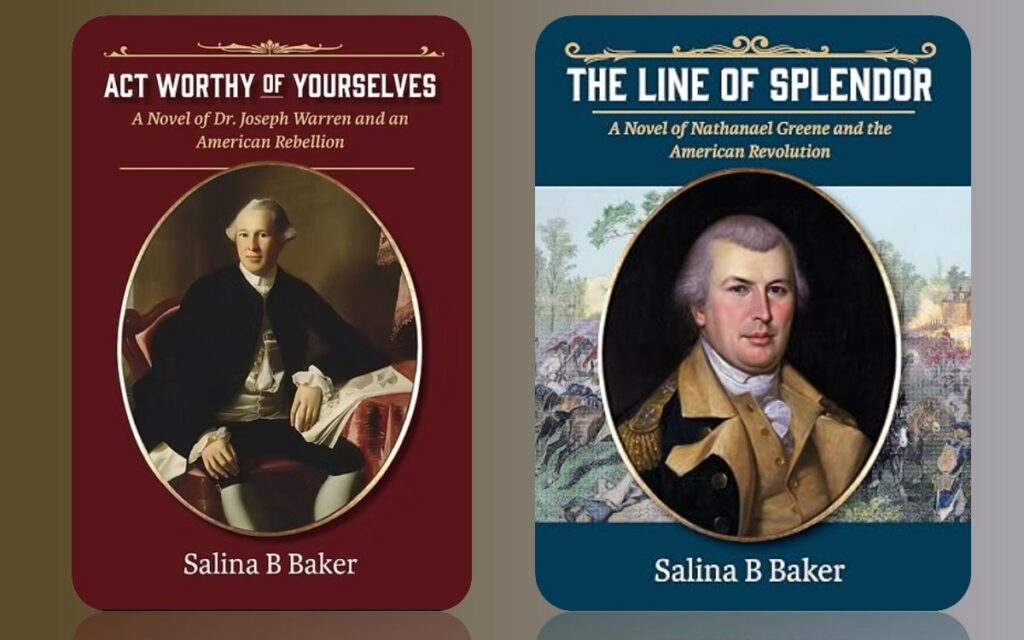 Books by Ms. Baker that we discuss in this interview
About This Post’s Featured Image
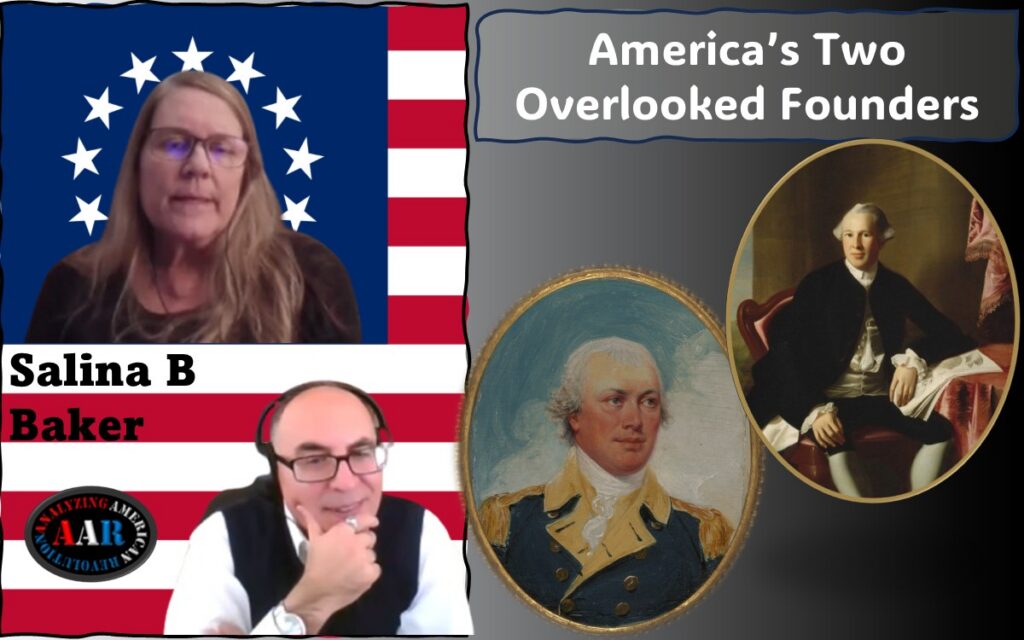
Image of Adel Aali (program host) and his guest, Salina B Baker, superimposed on the Betsy Ross flag, along with images of Nathanael Greene and Dr. Joseph Warren.
Unless otherwise indicated, all images in AAR—including those in this post—are in the public domain.
AAR Essential Insights
Although the full video and transcript of my conversation with Ms. Baker are included in this post, I’ve selected and summarized several insights that I found particularly revealing and worth emphasizing. These moments — some surprising, others that challenge familiar assumptions — help us see Nathanael Greene and Joseph Warren fit into the larger history of the American Revolution.
By the way, these insights are my own takes and interpretations from the interview. For Ms. Baker’s perspective and exact framing, please watch the interview above and view the transcript below in the corresponding sections.
The Evidence Behind a Founder’s Inner Life
Nathanael Greene died before the Constitutional Convention. That alone helps explain why he sits outside our familiar picture of the Founding Fathers. But it also exposes a limitation in that picture: we tend to recognize the men who designed the new government more readily than those who helped make its existence possible.
For me, restoring Greene to that discussion also means recovering the person behind his military reputation. Ms. Baker describes a man who joked, loved his family, felt insecure, and could write sharply when provoked. These characteristics matter because leadership emerges through a personality, with all its strengths and limitations.
Ms. Baker’s historical fiction offers a way into understanding Greene’s humanity, but it also creates an obligation to distinguish evidence from reconstruction. Letters can reveal affection, frustration, and uncertainty. They cannot supply every private conversation or establish precisely what someone felt. When I pressed Ms. Baker on how she identified Greene’s insecurity, our exchange brought that interpretive boundary into view.
Her acknowledgment that she had not unearthed a major new discovery is equally useful. An original contribution need not begin with an unknown document; it can come from approaching familiar evidence from a different angle. Regardless, the standard remains demanding: does the interpretation illuminate what the sources support, and can the reader recognize where creative license begins?
Watch this segment in the video above (04:29)
Greene’s Strategy: Preserving the Means to Keep Fighting
The shift from opposing British policies to seeking independence was hardly automatic. A grievance could justify resistance without making separation desirable. Greene’s family’s dispute over a confiscated ship gives that distinction substance: challenging British authority through a lawsuit was still operating within an existing order. Committing to independence meant pursuing a different one.
Ms. Baker places Greene’s commitment to independence at the outbreak of fighting in April 1775. What interests me is how this political transformation was followed by another adjustment: learning what effective military leadership required, especially when circumstances contradicted his preferences.
In the South, Greene could not build a campaign around the army he wished he had. He needed partisan commanders and militia whose limitations he recognized. His willingness to answer their letters, cultivate relationships, and enlist their support was part of his strategy. Before he could maneuver against the British, he had to assemble the cooperation that made maneuver possible.
That is also why a battlefield scorecard tells us too little. At Guilford Courthouse, Greene surrendered the field, but Cornwallis suffered losses that limited what he could accomplish afterward. Preserving an army capable of returning to the struggle could matter more than holding a particular position. The distinction is between winning an engagement and improving the prospects of winning independence.
For me, Greene’s perseverance becomes more revealing when understood this way. He endured, certainly, but he also adapted. His achievement lay in sustaining the military capacity and local relationships through which resistance could continue.
Watch this segment in the video above (14:49)
Joseph Warren and the Political Meaning of Happiness
Joseph Warren died before independence was declared. Yet asking whether he belongs among the Founding Fathers raises a question about what we mean by founding: does it begin with establishing a sovereign nation, or with developing the principles that make a break with an existing government conceivable?
Ms. Baker places “social happiness” near the center of Dr. Warren’s political outlook. The phrase deserves attention. In her account, Dr. Warren’s happiness encompassed liberty, property, trade, and the security of what communities had built across generations. These were concrete interests through which people could judge whether government protected them or threatened their well-being.
What particularly caught my attention was the scope of Dr. Warren’s language. In his 1775 oration commemorating the Boston Massacre, he spoke of America’s fortunes and the liberty of millions yet unborn. As I pointed out during our conversation, he was speaking about America—not simply Boston or Massachusetts. That wording alone cannot establish a settled national identity, but it reveals a political horizon extending beyond his colony and his own generation.
This gives Dr. Warren’s founding status a substantive basis for discussion. His importance rests partly in articulating what political authority owed the governed, and why resistance might become necessary when those obligations were violated. His early death makes those ideas no less consequential. It does, however, require us to distinguish the vision he expressed from the constitutional arrangements he never lived to help shape.
Watch this segment in the video above (32:58)
The Suffolk Resolves: Making Resistance Governable
Declaring that British policy violated colonial rights was one task. Deciding how a community should respond—and whose authority it should follow—was another. That is what makes the Suffolk Resolves particularly important to me. They gave resistance an organized political form.
As Ms. Baker explains, the resolves addressed practical choices: withholding taxes from the existing government, supporting an alternative provincial authority, and coordinating resistance under the Continental Congress. These recommendations reached into the machinery of government. If British authority had violated the charter, who could legitimately collect revenue, direct collective action, and command obedience?
Here we can see a deeper transformation taking shape before independence. Resistance was creating institutions capable of exercising authority. The Continental Congress’s endorsement of the Resolves also carried a Massachusetts dispute into an intercolonial forum. Local grievances were becoming a shared political responsibility.
Dr. Warren’s role complicates the distinction between influential leadership and widespread fame. Ms. Baker describes a rising figure whose committee work connected Boston with other colonies, even though he lacked the standing of some older contemporaries. His later decision to dispatch Paul Revere and William Dawes offers another example: we remember the riders more readily than the organizer who sent them.
For me, this is a substantial part of Dr. Warren’s claim to founding status. He helped turn opposition into coordinated action—and helped give that action a structure through which it could endure.
Watch this segment in the video above (44:34)
Dr. Warren at Bunker Hill: Courage and the Obligations of Leadership
Dr. Warren’s decision to fight at Bunker Hill presents a difficult tension: the conduct that made him admirable may also have deprived the Revolution of someone it could scarcely afford to lose. He wanted to share the danger faced by his fellow citizens. But did his responsibilities require him to serve elsewhere?
That was the distinction behind my question about recklessness. Dr. Warren was president of the Massachusetts Provincial Congress, with responsibilities extending well beyond the battlefield. His recent appointment as major general added another role, but his political importance was already established. His death cost the movement a leader helping sustain its alternative government.
Ms. Baker describes Dr. Warren as unwilling to let others shed their blood without joining them. We can appreciate the moral force of that position while questioning its consequences. Personal solidarity and public responsibility do not always point toward the same decision. A leader’s willingness to sacrifice himself cannot, by itself, settle whether the sacrifice serves the people who depend on him.
Our conversation eventually turned to whether Dr. Warren might have become president. That is necessarily speculation, and his promise cannot establish what he would have accomplished. The firmer historical loss is the work he was already doing—and could no longer continue.
For me, this makes Dr. Warren’s death more consequential than a familiar story of heroic sacrifice. Remembering his courage should also mean recognizing the political capacity lost with him.
Watch this segment in the video above (51:10)
The Interview (S1E38): Adel Aali and Salina B Baker
In our conversation, Ms. Baker addresses key questions and reveals untold stories about the lives of Nathanael Greene and Joseph Warren and their contributions to the American Revolution. The detailed outline and full transcript below supplement the video above.
Podcast
Watch the full interview on this page with the outline and transcript below, or take the conversation with you on the go through our Spotify podcast.
Outline
Use the in-depth outline below, with its key moments and turning points, to follow the discussion and navigate the interview.
Click for Timestamped Outline
- Selected Highlights (00:00)
- Guest Introduction (01:24)
- Nathanael Greene’s Place Among the Founding Fathers (04:29)
- Military Leadership and Influence on the Continental Congress (04:54)
- The Meaning of The Line of Splendor (05:44)
- Historical Fiction: Evidence and Creative License (06:32)
- Reconstructing Conversations from Historical Sources (06:47)
- How Far Can a Novelist Go? (09:21) – Key Moment (09:48)
- The Person Behind Nathanael Greene’s Military Reputation (10:11)
- Why Salina B. Baker Chose Nathanael Greene (10:42)
- Humor, Insecurity, and Family Relationships (11:38)
- Nathanael Greene’s Path from Grievance to Revolution (14:49)
- The Seizure of the Greene Family’s Ship (15:24)
- When Resistance Became a Commitment to Independence (16:47) – Turning Point (17:30)
- Nathanael Greene’s Rise and Southern Strategy (19:29)
- Self-Education and George Washington’s Confidence (20:13)
- Turning Battlefield Defeats into Strategic Gains (22:09) – Turning Point (27:47)
- Nathanael Greene’s Reluctant Service and Lasting Contribution (28:55)
- Why He Resented Becoming Quartermaster General (29:15)
- Just One Point About Nathanael Greene: Perseverance (31:40)
- Joseph Warren’s Founding Status and Political Vision (32:58)
- Social Happiness, Liberty, and Property (34:31)
- Act Worthy of Yourselves: A Call Beyond Massachusetts (36:21) – Key Moment (37:06)
- Reconstructing Joseph Warren’s Life Before Independence (37:48)
- Rebellion Versus Revolution in the Book Subtitles (38:25)
- Historical Evidence and Elizabeth Warren’s Missing Voice (39:57)
- The Suffolk Resolves and Joseph Warren’s Political Leadership (44:34)
- Resistance, Taxation, and Alternative Government (45:39)
- Joseph Warren’s Reputation Across the Colonies (49:18)
- Joseph Warren at Bunker Hill: Courage and Political Loss (51:10)
- Why He Chose to Fight Despite His Responsibilities (52:41) – Key Moment (54:50)
- Could Joseph Warren Have Become President? (55:43)
- Just One Point (58:00)
- Joseph Warren’s Commitment to Social Happiness (58:11)
- The People and Country Behind His Political Choices (58:28)
Transcript
Note: This transcript was generated automatically and may contain minor errors. It is provided for reference and accessibility only.
Click to View Transcript
Adel:
(4:39) Ms. Baker, it’s a pleasure to have you on our program’s special series. (4:42) Thank you for taking the time for this conversation with me about the American Revolution. (4:48) I want to speak with you about Nathaniel Greenee, and I’ll start with this question.
(4:54) Do you think he should be included in the pantheon of our founding fathers?
Ms. Baker
(5:03) Yeah. (5:04) General Greenee died early on in 1786, before the Constitutional Convention and those types of things, but I think he should be included. (5:16) He was a major general, and he had a lot of dealings with Congress and how things operated there.
(5:26) And I think that was the influence that he had before we got into the Constitution and the presidency was influencing what was happening with the war and what would happen later on.
Adel:
(5:41) So by Congress, you mean the Second Continental Congress that continued, and then we had the period of sort of Articles of Confederation, and during that time, he was still active.
Ms. Baker
(5:53) Right.
Adel:
(5:54) Let’s talk about your book, which is titled The Line of Splendor, a novel of Nathaniel Greenee and the American Revolution. (6:03) In this title, what does the line of splendor refer to?
Ms. Baker
(6:10) When he was made quartermaster general, which we’ll probably talk about that more later, he was not a happy person at all. (6:18) And he wrote to Joseph Reed, who was a Pennsylvania politician and a one-time to George Washington. (6:26) And he wrote to Reed grumping about it and said, they have removed me from the line of splendor, meaning field command.
(6:36) Right. (6:37) So if you’re not out there in the field, you can’t be on the line. (6:41) So that was where that came from.
Adel:
(6:42) Oh, that’s great. (6:44) I’m glad I asked that. (6:45) Now, your book is a novel, right?
(6:49) Right. (6:49) So how much history is incorporated into your book?
Ms. Baker
(6:57) All of it is historical. (7:00) There are things like his children talking to one another, which is not historical. (7:10) It would be some situation where the kids were together talking, maybe with Katie, his wife, or maybe with him when he came home from the war.
(7:20) I did take letters and situations and make conversations out of them, which is what makes a novel, is giving people a picture of who he was as a man and who the people around him were as people and not just these historical figures or statues here and we know from distant letters and things like that. (7:44) So that’s where it became a novel is taking these things that really happen, still writing about them, but adding the conversation and the emotions they might have had during that time. (7:58) So and there is about bibliography in the back of it with my resources, primary and secondary, not all of them because there are a lot of them.
(8:08) So the book is history, but it’s like they say, history tells us what happened, historical fiction tells us how it felt. (8:18) So that kind of sums it up into a little package. (8:22) So I don’t know if that answered your question.
Adel:
(8:25) No, no, it does. (8:26) And it provides even more than what I asked for. (8:29) As far as historical fiction telling us how it felt, then you must have lived and breathed this history, the figure of Nathaniel Greenee for you to appreciate how it may have or it must have felt.
Ms. Baker
(8:48) Yes, I spent years and years researching him and Katie and like I said, the other people who knew him, whether they hated him or they didn’t hate him. (8:59) And you start to hear when you start reading Nathaniel’s letters over and over again, you start to hear his voice and his emotion in there. (9:09) And you can start picking up on it and you can make assumptions that aren’t too far off left field.
(9:17) When you hear these people talking to one another via letters or you know, what mostly all letters is what like nonfiction has.
Adel:
(9:27) And the letters are actually primary sources.
Ms. Baker
(9:30) Right, right.
Adel:
(9:31) So when you said not too far off in the left field, did at any point did you feel like you’re taking too much license here? (9:43) Did you think you’re deviating and you sort of rein yourself back in? (9:47) Or did anyone, editor or friend say you’re sort of starting to leave the ballpark?
(9:53) Or is that okay in a historic? (9:54) Oh, the answer is no.
Ms. Baker
(9:55) The answer is no. (9:57) Right. (9:57) I didn’t.
(9:58) I was really careful about that. (10:00) That’s a question I appreciate a lot. (10:03) I was really careful with that.
(10:04) Henry Knox was a really close friend of his and their conversations were friendly because they were buddies.
Adel:
(10:11) Yeah.
Ms. Baker
(10:11) And you can read this yourself. (10:13) You know, if you read a biography of Henry Knox or letters or whatnot to Nathaniel Greene and how they talk to one another in their letters.
Adel:
(10:21) So you didn’t do this in a university setting. (10:26) You’re not an academic, a professor teaching the subject, correct?
Ms. Baker
(10:30) No, I have a degree in computer science.
Adel:
(10:32) So you said just a few minutes ago, you spent years and years writing this, researching it. (10:42) Why? (10:43) What compelled you, one, to do this?
(10:46) And second, why Nathaniel Greene?
Ms. Baker
(10:52) So I wrote a four book historical fantasy series about the American Revolution, which took years of research because you don’t make up the American Revolution. (11:05) You can kind of add that supernatural element to the rest of it. (11:09) You can’t just make it up.
(11:11) It was four books. (11:12) Nathaniel Greene was in three of them. (11:15) And when I got done and published that series, I was like, I am not done with this man.
(11:20) And so I went back and researched him in a proper way, a proper novel, traveling everywhere. (11:29) And so I gave him a lot of my blood, sweat, and tears and he deserves it.
Adel:
(11:34) Good for you. (11:35) What about him interested you? (11:38) In this case, I’d say you’re like infatuated by him, fascinated by him.
Ms. Baker
(11:42) Usually authors are pretty infatuated by their subjects.
Adel:
(11:46) Exactly, exactly.
Ms. Baker
(11:48) He seemed like a real guy. (11:50) He liked to joke. (11:51) He liked to tell jokes.
(11:53) He was really insecure. (11:56) It may have been because he had a limp and asthma and a smallpox scar on his right eyeball, or he was not formally educated. (12:04) We’re not sure exactly why he was insecure.
(12:07) And he could, when he lost his temper or got annoyed, he could write some pretty sharp letters to people. (12:18) And he loved his wife and his family dearly. (12:22) And those things together, I just saw him as this great guy with faults and strengths and he could love people and they loved him.
Adel:
(12:31) How do you determine someone is secure by reading primary and secondary sources 200 years later?
Ms. Baker
(12:40) Well, he helped form a militia company called the Kentish Guards in 1774.
Adel:
(12:47) Is this in Rhode Island?
Ms. Baker
(12:49) This is in Rhode Island and it was for East Greenewich, Coventry and Warwick. (12:53) He was born in Warwick and he helped form the militia company. (12:59) But when he applied for lieutenant, they told him, no way, you have a limp.
(13:03) And that’s not officer material.
Adel:
(13:07) Oh, wow.
Ms. Baker
(13:07) Yeah. (13:08) And he would often write about his limp or write about how sick he was with asthma, or he would write letters to Continental Congress and say, you know, trying to think of something in particular that I could say where he was being insecure. (13:30) But I think it’s just something you have to read.
Adel:
(13:35) Yeah.
Ms. Baker
(13:36) To understand where you’re starting to see where he’s talking about. (13:39) Well, I know I have a limp or I know this or that. (13:43) And, you know, so.
Adel:
(13:46) You sort of deduce that, deduce that from the body of the work that you’re working on. (13:50) So in your research, did you find anything about him that was new that other authors you think hadn’t unearthed?
Ms. Baker
(14:04) I don’t, I don’t think so.
Adel:
(14:07) Yeah.
Ms. Baker
(14:08) I don’t think I unearthed anything new because he has papers out there. (14:12) There’s 12 volumes of them. (14:14) His grandson, George Washington Greene, wrote a three volume series on his life.
(14:21) And those things pretty much are been written a long time ago. (14:25) So there’s pretty static. (14:28) Yeah.
(14:29) There were some things I found out later. (14:32) One of the colonels that fought for him, Whitehorse Harry Lee, chose to die on Cumberland Island. (14:38) This is something I discovered, but it was already written because he idolized Nathaniel Greene.
(14:45) So there were things that I learned along the way.
Adel:
(14:50) Which is important discovery for yourself that I’m sure in turn impacted what you ended up writing in the book.
Ms. Baker
(14:57) Yes.
Adel:
(14:57) Yes. (14:59) Did anything in Greene’s life. (15:03) I’m not talking about the American Revolution.
(15:05) I’m talking about his life earlier. (15:09) Predict that he would become a revolutionary. (15:13) He was from a well-to-do family, right?
Ms. Baker
(15:16) They were fairly well-to-do. (15:19) They ran a farm. (15:21) They had a farm and they had iron forges, but these are all family owned and mills and whatnot.
(15:27) So Greene’s had a big family unit that owned a lot of things. (15:34) So at one point they had a ship called Fortune. (15:38) It was Sloop.
(15:39) In 1772, it was confiscated by a British Royal Navy officer for smuggling. (15:47) And this was owned by the Greenes and the Greene family. (15:52) And they brought lawsuit against this Royal Navy officer.
(15:58) This led to the burning of the Gatsby. (16:00) It was one of those things that led to this.
Adel:
(16:03) Oh, wow.
Ms. Baker
(16:03) Yeah. (16:04) The burning of the Gatsby was in June 1772. (16:09) And I think the Fortune was confiscated in February.
(16:14) So the Greenes sued the British Navy officer for taking their Sloop.
Adel:
(16:21) Nathaniel Greene or his family or his father?
Ms. Baker
(16:23) Nathaniel and his family. (16:25) His father was dead by then. (16:28) So they sued them and won.
(16:31) Now, no one’s really sure if they received the money that they won in the lawsuit. (16:38) But this would be one of the things that Nathaniel would have been unhappy with the British, obviously, for taking their Sloop. (16:46) So that’s one of the earliest documented things about him turning him toward, you know, British, against British policies.
Adel:
(16:57) Now, that’s a really important phrase that you just used, turning him against British policies. (17:07) You can be against the policies of a president in the United States, but you don’t necessarily are for total revolution or secession or anything crazy like that. (17:22) So at what point do you think, based on your writing and, before that, your research, do you see that Greene transforms from being against it, being ticked off, being sort of rebellious to saying, you know what, this is outright revolution.
(17:38) We want independence.
Ms. Baker
(17:40) I think as soon as the first shots fired in Massachusetts.
Adel:
(17:44) Oh, wow. (17:45) So April 75.
Ms. Baker
(17:47) He was in the Kentish Guards then. (17:49) And they, when the shots were fired, they found out the next day and the guards set out for Massachusetts because they had the British under siege in Boston, the provincial army in Massachusetts did. (18:02) So they’re calling for regiments to come from the New England colonies to help them with the siege.
(18:09) So Greene’s guards set out for Boston and they were called back at the border, but they had a loyalist governor who called them back. (18:18) But the Rhode Island General Assembly was like, no, we’re going to form an army of observation. (18:24) And they made Greene their general.
(18:29) And so it was right off the bat where he was, had joined the revolution, the actual war.
Adel:
(18:39) When you say actual war, Greene and his family, they were Quakers. (18:48) How common was it for Quakers then to go to war?
Ms. Baker
(18:55) Well, I know I’m not going to be able to give you a lot of examples, but I do know there was a man named Thomas Mifflin who became quartermaster general of the Continental Army. (19:07) He was from Pennsylvania and he was a Quaker. (19:10) I know that some of the men, the Pennsylvania men that helped with Washington’s crossing were Quakers.
(19:17) Some of the local Pennsylvania Navy people, some of the local militia guys, and I can’t think of all their names off the top of my head, but they were also Quakers. (19:26) So there were some Quakers fighting in the revolution, in the war.
Adel:
(19:32) He wasn’t the only one, the single Quaker doing this. (19:36) Yeah. (19:39) Here’s an interesting thing, and I think you may have sort of answered it.
(19:44) We touched on this. (19:46) So I’ll ask a question. (19:49) Greene comes out of the Revolutionary War with a reputation of being one of Washington’s most talented and dependable officers.
(20:01) This is due in no small measure to his successes in the Southern Theater. (20:10) So did he have military training before? (20:15) I know we talked about the Rhode Island militia, but was that, like, did he have formal military training, war battle experience?
Ms. Baker
(20:23) No, he had none. (20:24) No, for instance, Indian War, like a lot of the guys.
Adel:
(20:27) Yeah, yeah, yeah.
Ms. Baker
(20:28) None of that stuff. (20:29) He did study military strategies.
Adel:
(20:34) On his own?
Ms. Baker:
(20:35) On his own. (20:38) That was one of the things that he did. (20:40) And he was like the rest of the guys all reading John Locke and, you know, all those philosophers of the time, and military law and strategy.
(20:49) So he was a self-educated guy in the military world when the war began.
Adel:
(20:57) So, okay, self-educated. (21:00) How does he rise so fast? (21:03) How does he succeed?
Ms. Baker
(21:06) Yeah, that’s a good question because I don’t think anybody really can answer that question. (21:12) But somehow he got Washington’s ear. (21:17) And there’s guesses, you know, both of them were not formally educated.
(21:21) Both of them were raised on a farm and were expected to work the farm. (21:25) You can kind of give a guess on why Washington saw what he saw in Nathaniel Greenee. (21:32) But I think that Washington also learned quickly that whatever he assigned to General Greene, he did to the best of his ability.
(21:40) You know, kind of like, yes, sir, I got it. (21:42) Don’t worry. (21:43) I can handle it.
(21:44) Except for a few things that went wrong.
Adel:
(21:49) And Washington, who himself had ample experience with war going back more than a decade ago in the French and Indian War. (22:02) He didn’t see, obviously didn’t, Greene’s lack of fighting experience as a handicap. (22:11) He sort of still gave him opportunities.
Ms. Baker
(22:15) Yes, that’s true.
Adel:
(22:19) You know, I’ve read this about him, Ms. Baker, and just many different writings, that he had a knack for turning sort of battlefield defeats, and he had many of them in the South, into major strategic…
Ms. Baker
(22:37) All of them.
Adel:
(22:37) Yeah, all of them, actually, yeah. (22:39) But he turned them into strategic successes. (22:44) And, you know, by 1781, I think it’s late September or October, we have Yorktown and Corwin Wallace is holed up there and it’s over with, right?
(22:54) How does he do that? (22:56) Tell us about that a little bit. (22:57) Is that like guerrilla warfare or how does he accomplish this?
Ms. Baker
(23:02) It was a combination of things. (23:03) One of them was partisan warfare. (23:06) He got down to the South.
(23:08) He was kind of anti-militia because Washington’s had that same attitude. (23:14) But when General Greene…
Adel:
(23:15) I’m sorry, you said anti-militia.
Ms. Baker
(23:17) He was, yes, sort of anti-militia.
Adel:
(23:19) So he’s favored regular army more.
Ms. Baker
(23:22) Yes. (23:23) He felt like militia would come and fight and go home, which is what they did. (23:29) But when he got down there, things were so bad.
(23:33) His army was tiny. (23:35) It was 2,400 men and only 800 of them were clothed and equipped properly. (23:41) He took command from Horatio Gates, who lost an army at Camden.
(23:49) So this is what Greene went and picked up was this mess of an army. (23:56) Charleston had fallen, Gates had lost, and this all had happened in 1780. (24:01) So there was very little army down there when he picked it up.
(24:05) And he realized that he was going to have to reach out to partisans, Francis Marion, Thomas Sumpner, Andrew Pickens, all these guys operating in South Carolina. (24:19) And he immediately started writing to them. (24:22) Francis Marion had unanswered letters that Horatio Gates had.
(24:26) He hadn’t even bothered to answer them. (24:29) And so the first thing Greenee did was start answering these letters and saying, I’m here, and kind of buttering them up and saying, I know you’re a great guy, and I need you and whatnot. (24:42) I think I just lost track of what I was going to say.
Adel:
(24:44) So no, this is actually really interesting. (24:48) Maybe you lost track. (24:50) I didn’t, because I’m totally focused on something very important.
(24:53) So here are major fighting personalities, local commanders like Francis Marion. (25:00) And I’ve been to Charleston, and you see his square and all of that. (25:05) They’re sort of being dissed by Horatio Gates.
(25:10) And here comes Greene, who himself is not too fond of militias, but he sees the reality on the ground and reaches out and starts sort of spreading love to all these people to create some sort of fighting force.
Ms. Baker
(25:28) Yes, exactly. (25:32) He’s got some good guys down there. (25:36) Daniel Morgan is down there.
(25:39) Oklahoma Williams is down there. (25:41) A bunch of Marylanders are down there. (25:43) There’s some Delaware guys.
(25:46) So he’s got some good guys down there. (25:49) Light Horse Harry Lee joins him like a month later. (25:52) But it’s still bigger than just that little bit of an army that he ends up taking over.
(26:00) And so the militia, but they come and go. (26:03) So they’re pretty much a pain, just like he thought they would be. (26:08) But he needed them, and they were useful.
(26:12) And he managed to lose every battle that he fought. (26:16) But what he did was he wore the British down to a nub. (26:21) He divided his army right off the bat, sent Daniel Morgan to Northwest South Carolina.
(26:28) And then he moved his wing of the army down to Shura, South Carolina. (26:34) And then Cowpens happened out of that. (26:38) Cornwallis sent Bannister Tarleton to fight Daniel Morgan, and they ended up fighting at Cowpens.
(26:45) Greene moved his wing of the army again, or ordered his wing of the army again to march to Salisbury, North Carolina, sorry. (26:56) And he went in to support Morgan, because Morgan, when he won Cowpens, Cornwallis went after him. (27:03) So Greene took a small contingent of guard and went himself to support Daniel Morgan on his retreat.
(27:13) They retreated across North Carolina and wore Cornwallis’ army down. (27:20) Cornwallis burned his baggage train so that he could pursue Greene and Morgan and the flying army faster. (27:28) So Cornwallis makes his decision to do this.
(27:32) Well, his army is starving. (27:34) They’re exhausted. (27:35) They’re chasing Greene and Morgan across North Carolina.
(27:40) And then Greene turns around and goes into Virginia, which was called the Race to the Dan, so that his army could rest. (27:49) They converged at Guilford Courthouse, the flying army, the rest of the army, and said, we need to run. (27:55) And they did.
(27:57) And it was the best thing that Greene did was cross the Dan River into Halifax, Virginia, and rest his army. (28:08) And while he’s resting his army, Cornwallis’ army is pretty tired. (28:14) So yeah, he wears Cornwallis down to the point that he’s had it.
(28:19) And after the Battle of Guilford Courthouse, which Greene lost, Cornwallis lost 500 more men. (28:26) And so he goes and retreats to Wilmington, North Carolina, 200 miles away. (28:32) And Greene’s got South Carolina open all before him and the British outpost there.
(28:40) So now he’s got another job to do. (28:42) And that’s bringing the British outpost down.
Adel:
(28:46) Yeah. (28:48) Great strategy. (28:49) I mean, he lost every battle, but he managed to really, I don’t want to say outfox, because many times he was confronted, but he really outmaneuvered the grand strategy against Cornwallis.
(29:03) And we get to Yorktown. (29:05) Now, let’s go to the line of splendor. (29:11) I take it that being quartermaster, the quartermaster of Valley Forge was not anything like splendor for him, right?
Ms. Baker
(29:25) Did he resent that? (29:27) The line of splendor was being on the field. (29:30) He resented it a lot.
(29:32) A committee from Congress arrived in Valley Forge in February or March. (29:40) And the committee and George Washington pressed him to take the job because Washington knew he was going to do the best job he could. (29:48) He was the best guy for the job.
(29:51) And Greene took it. (29:52) He said, quote, that he was afraid that he would be confined to a series of drudgery, meaning, you know, a chain to the desk. (30:01) Yeah.
(30:01) And that they would take him from field command. (30:05) And they promised him that he could stay a major general. (30:09) And he actually did get field command twice while he was quartermaster twice or three times.
(30:19) Monmouth Courthouse, the Battle of Rhode Island and the Battle of Springfield. (30:24) I think he was still quartermaster during the Battle of Springfield in New Jersey. (30:28) So he did get field command.
(30:30) Washington let him have it while he was quartermaster, which made him happy that he could do that. (30:36) But he despised the job. (30:38) It was and he got into lots of fights with Congress over it.
Adel:
(30:43) Seems like a lot of people disliked it. (30:45) Even Baron von Steuben. (30:47) He also didn’t like it.
(30:49) He wanted the glory of being in the battlefield. (30:51) But together, I guess.
Ms. Baker
(30:53) That’s interesting you brought him up because he was actually Greene’s second in command when he took over the Southern Army. (31:00) Baron von Steuben was. (31:02) Oh, OK.
(31:04) So he and Steuben traveled from Philadelphia. (31:08) But along the way, they had to gather troops and supplies for the Army. (31:11) Well, they mostly failed.
(31:14) And they got to Virginia and Thomas Jefferson won’t help them either. (31:18) He’s like, I can give you 100 wagons. (31:20) They’re like, no, we need you got men down in the South.
(31:23) The Virginia line is down there. (31:25) And we’re the only Continental Army here. (31:28) There were no British in Virginia at the time.
(31:32) But Greene’s saying we’re going to keep the British out of Virginia. (31:36) Jefferson won’t help him. (31:38) So he left Steuben in Virginia to continue recruiting efforts with Thomas Jefferson.
(31:45) And most people don’t know that. (31:46) Yeah.
Adel:
(31:46) Yeah. (31:47) I didn’t know that either. (31:48) Wow.
Ms. Baker
(31:48) Yeah.
Adel:
(31:50) If you want our audience to remember just one point about Nathaniel Greene, what would it be?
Ms. Baker
(31:57) One point I think would be he could persevere and hang on like no one else. (32:06) And this is how he managed to oust the British out of the Carolinas and into Virginia, where they surrendered Yorktown, like we said earlier. (32:17) And I think people should know this, that it was it was actually his perseverance that did this.
(32:24) If he hadn’t chased Cornwallis out of the Carolinas, there might have been a surrender. (32:30) But when and where?
Adel:
(32:32) It may have been like three years later or something like that.
Ms. Baker
(32:34) It could have been or it could have been somewhere else. (32:37) But he went down. (32:39) He was not even down there a year when the surrender happened.
(32:43) So he went down there and cleaned up pretty good.
Adel:
(32:45) Do you think he gets enough credit for it?
Ms. Baker
(32:47) No, I don’t. (32:49) But that’s just me.
Adel:
(32:51) That’s just you.
Ms. Baker
(32:52) Yeah.
Adel:
(32:53) But your book makes a difference. (32:56) Let’s take a break here. (32:57) In the next segment, Ms. Baker and I will talk about another favorite revolutionary of mine, and that’s Dr. Joseph Warren. (33:07) We’ll be right back. (33:08) Ms. Baker, do you think Dr. Joseph Warren should be included in the pantheon of our Founding Fathers? (33:19) And before you answer that question, let me tell you why I’m particularly interested in this.
(33:26) My answer is yes. (33:28) But here’s the thing that I want to pick on, Ms. Baker. (33:33) He died so early on.
(33:35) Bunker Hill. (33:39) Early months of revolution. (33:41) Some people may even argue that it was a rebellion then.
(33:45) It was not yet even a revolution, arguably. (33:49) So let’s go back to my question. (33:52) Given that his early death, do you think he should be included in the pantheon of our Founding Fathers?
Ms. Baker
(33:59) I do. (34:00) I think that actually he could be kind of like a Founding Grandfather, maybe, you know, pre-war, but he was building a platform for rebellion along with his close fellow peers, which was Samuel Adams and John Hancock and James Otis Jr. and Josiah Quincy Jr., people that were lawyers, doctors. (34:34) Of course, Sam Adams was educated at Harvard, but he didn’t really make any money.
(34:41) But these are educated men, and they’re laying a foundation for liberty, and they’re very worried about social happiness and property, and they’re also worried about their own charter. (34:54) And when they talk about my country, a lot of times back then, during the rebellion, people were referring to their own colony, like Massachusetts or Virginia or whatnot. (35:06) But Joseph Warren saw it as a bigger thing than just Massachusetts.
(35:15) And that was like this. (35:18) I don’t want to keep repeating myself on that one, but it was the right that people had to happiness and their own business and trade and what their ancestors had built upon. (35:28) And they felt like Britain was taking these things away from them.
Adel:
(35:32) So his vision was much wider than just Massachusetts.
Ms. Baker
(35:38) It was more nationalist, I think. (35:39) Maybe not in the very, very beginning, but it started to evolve into that as things got more and more complicated.
Adel:
(35:51) And you used an interesting phrase. (35:54) You said social happiness, and later you, like a minute after that, you again used the word happiness. (36:00) Is that social happiness sort of the predecessor, the foundation of pursuit of happiness that we have later?
Ms. Baker
(36:09) Yeah, it absolutely is.
Adel:
(36:14) And that is fascinating. (36:18) Okay. (36:20) I have many questions to ask about just that, Ms. Baker, but I’m going to not do that because we’ll be on that point for another hour. (36:30) Let me do this. (36:31) Go to your book, which is titled Act Worthy of Yourselves, a novel of Joseph Warren and An American Rebellion. (36:45) I have a couple of questions on this, the title of the book itself.
(36:49) First of all, what does act worthy of yourselves mean? (36:54) It sounds like something that my mom would tell me and my brothers.
Ms. Baker
(36:59) Behave yourself? (37:01) Yeah. (37:01) Well, this actually loops back to the social happiness because this is a line from his 1775 Boston Massacre oration that he gave at Old South Meeting House in Boston.
(37:16) And some of the lines from that is, on you to pin the fortunes of America, you are to decide the question on which rest the happiness and liberty of millions yet unborn. (37:28) Act worthy of yourselves.
Adel:
(37:31) Oh, that’s beautiful.
Ms. Baker:
(37:32) Yeah, it’s a beautiful line. (37:35) There’s more to it before that, but I’ll keep that brief because I probably won’t be able to quote it all right off the top of my head.
Adel:
(37:42) And he said fortunes of America, not Massachusetts or Boston.
Ms. Baker
(37:48) Yes, he did. (37:49) Exactly. (37:49) And this is later, like I said, more nationalism going on here in the way he’s thinking.
Adel:
(37:58) That’s significant. (38:01) Going back to the title, I told you I have two questions about it. (38:05) The subtitle of your book on Dr. Warren ends with an American Rebellion, which is different than the subtitle of your book on Greene, which we discussed in the last segment, which ends with the American Revolution. (38:26) So one is rebellion. (38:28) The other one is revolution. (38:33) Why the difference?
Ms. Baker
(38:35) Well, first of all, I didn’t want to be redundant with the American Revolution on both books because that just seems silly. (38:44) But it was more of a rebellion and it was a revolution, but it was a rebellion. (38:49) There wasn’t any war happening in the beginning of that.
(38:54) And these were the formative years when, I guess you could call them formative years, when the revolution or the rebellion was heating up, leading to war. (39:05) So Greene was more involved in the war for the whole eight years, where Joseph Warren was more involved in the laying the foundation of the rebellion itself and the revolution itself. (39:20) So I just kind of wanted to keep the two, because there’s two different time periods, sort of, but they overlap.
(39:26) But with Warren, it starts out earlier. (39:31) So I guess that’s the only reason I really did the subtitles more like that.
Adel:
(39:38) Now, it makes sense. (39:39) One really, the story sort of ends in 1775. (39:43) The other one goes on throughout the revolution, through the course of the revolution.
(39:48) Now, I’ll ask you a question that I asked in the previous segment, and it’s this. (39:55) Like your book on Nathaniel Greene, your book on Dr. Warren is a novel. (40:02) So how much of it is history?
Ms. Baker
(40:07) All of it, except his wife, Elizabeth. (40:11) I put it in the preface of my novel. (40:14) We know hardly anything about his wife, Elizabeth.
(40:18) We know how old she was when she was, that her father died. (40:23) She was an orphan. (40:24) She was 17 and an orphan when he married her.
(40:27) We know that she inherited most of her father’s estate, how old she was, when she died, and what she looked like, because there’s a painting of her. (40:36) That’s it, pretty much. (40:37) And that they had four children.
(40:39) So we don’t really know much else about Elizabeth herself, aside from like things that she inherited that her and Joseph owned together. (40:50) But we don’t have her voice. (40:52) There’s no voice for her, not like Katie Greene, where there’s biographies of her.
(40:58) So I brought Elizabeth to life in that novel with his four children. (41:06) So everything else has all been historically researched, just like General Greene. (41:13) But it’s still a novel with the way people felt, and people that hated him, and people that loved him.
(41:21) And so I kind of brought his family to life more than General Greene, because we know a lot more about General Greene, even General Greene’s brothers. (41:30) We do know that Dr. Warren’s youngest brother, John Warren, was a doctor. (41:35) We know a lot about John.
(41:38) There’s a primary resource about John and his letters. (41:43) He was a doctor. (41:44) He founded Harvard Medical School.
(41:47) So John was the only- Not too shabby. (41:49) Yeah, they come from a dynasty of doctors, the Warrens do. (41:54) So it was basically his close family that I made conversations with that weren’t historically recorded.
Adel:
(42:05) Why Warren? (42:07) Why did you decide to research him and write about him? (42:12) And I’m sure you spend a great deal of time doing this.
(42:16) This is not easy stuff.
Ms. Baker
(42:18) It’s not. (42:20) I mentioned that historical fantasy series I wrote.
Adel:
(42:23) Yeah.
Ms. Baker
(42:24) It’s in the first book. (42:27) And I, like Greene, I was really attracted to him for some reason. (42:32) I can’t even tell you why I was attracted to Warren.
Adel:
(42:35) Except for what?
Ms. Baker
(42:38) Yeah. (42:39) Yeah. (42:42) So I went back after I finished my novel.
(42:44) Well, I kind of research. (42:46) They overlap. (42:47) My research does.
(42:48) But I went back and did three and a half years of research on Joseph Warren. (42:53) And I am on the Dr. Joseph Warren Foundation Board of Directors. (42:58) I’m the secretary.
(43:00) So I take Joseph Warren very seriously.
Adel:
(43:06) Did you find anything new about him or maybe new to you?
Ms. Baker
(43:15) A lot. (43:16) I learned a lot more from the book about Warren than I did about Greene, because I had read tons about the war itself. (43:24) But it was the pre-war that I learned a lot about the Massachusetts government structure was actually kind of difficult for me to grasp, like where everybody fit.
(43:36) I learned a lot about not just Warren, but James Otis Jr. or John Hancock. (43:43) Things I didn’t know about them. (43:45) Personal things I didn’t know about them.
(43:47) Things I did. (43:49) But with Warren, we’re talking about a lot of political stuff. (43:54) It was really heavy at the time.
(43:56) You know, the committees of correspondence, committee safety, the Massachusetts Provincial Congress. (44:02) These political things were very different for me.
Adel:
(44:09) Well, if I may just add my own assessment of Warren. (44:16) Much of what he did was sort of heavy intellectually. (44:21) The thinking and the writing.
(44:22) It kind of makes me think like he was in the thick of the Enlightenment era and the sort of things, you know, quarry as to what would have happened had he lived into his 60s and 70s and written more and we would have had his books. (44:37) So that’s one of the things that really fascinates me about Warren is his sort of intellectual weight. (44:44) And I want to go to something that I think it’s really big, although you don’t learn this in high school.
(44:50) This is not something we go away with. (44:52) And that’s the Suffolk Resolves. (44:54) Can you tell us about that and Warren’s role in that?
Ms. Baker
(45:00) Sure. (45:01) The First Continental Congress convened on September 5th, 1774 in Philadelphia. (45:11) And Sam Adams and Warren’s contemporaries left to go to the Continental Congress.
(45:17) John Adams and Robert Treat Payne and Thomas Cushing. (45:21) And these are all guys that Warren knew really well.
Adel:
(45:23) Mm hmm.
Ms. Baker
(45:24) And while they were gone, there was a they were trying to find a way. (45:30) This I’m going to try to stay focused with this, not jump around. (45:34) They were trying to find a way to.
(45:41) Establish. (45:43) OK, I’m going to I know it’s going to veer off of this. (45:47) Oh, OK, let me just start easy.
(45:49) The Suffolk’s Resolves was a meeting of men to establish resolutions on how to meet the problems with the British occupying Boston, as well as their political rights and recommendations on things they should do if a full on rebellion revolution happened, a war happened. (46:19) So Joseph was the primary author of the Suffolk’s Resolves. (46:24) It was 19 resolutions.
(46:27) It was stated colonial defiance. (46:30) It also laid the philosophical groundwork for the Declaration of Independence. (46:36) And this was we have a right to our own government because Parliament has annihilated our charter by taking away our voting rights for our counselors, for our.
(46:52) Our own government in Massachusetts, so they also recommended don’t pay taxes. (47:00) To the government, you pay taxes to this new provincial Congress. (47:07) But there was a but and that was it will be any of these resolutions are under the auspices of the Continental Congress.
(47:19) So Joseph authored those primarily, and they were approved by the Suffolk County Committee. (47:30) Paul Revere took the resolves to the Continental Congress in Philadelphia. (47:37) They adopted the resolves and those resolutions as their first official act.
(47:46) And so is their first official act. (47:49) This made Joseph Warren’s words kind of the voice of a nation. (47:53) They hadn’t been born yet.
(47:56) And so they were using these as guidelines to what are they going to do in Massachusetts? (48:04) And that’s basically what the Suffolk resolves were. (48:07) They were extremely important.
(48:10) To the beginning of the government that we were trying to form.
Adel:
(48:18) I know that the Suffolk resolves was extremely important, and that’s why I asked you about it. (48:25) And I have an observation and then a question on that. (48:29) One observation is that it’s hardly something that rolls off your tongue when you talk about.
(48:39) No one, no one talks about the Suffolk resolves, and I think it’s such an instrumental work early on in the revolution. (48:52) Maybe I’m just a nerd. (48:53) I don’t know.
(48:53) I just think it’s super important. (48:57) And the second, and I told you that was the observation. (48:59) I told you I have a question.
(49:01) And this is the question. (49:05) Yes, we got it. (49:06) You and I agree that it was an important document.
(49:09) Was Warren himself at that time? (49:13) Let’s forget where we are now. (49:15) At that time in 1775, early 1775, in this case, was he deemed to be an important person in the 13 colonies?
Ms. Baker
(49:28) Actually, the Suffolk resolves were in 1774.
Adel:
(49:33) Oh, OK, OK. (49:34) That’s even makes it better. (49:35) OK.
Ms. Baker
(49:36) Yeah, because it’s a little bit before, you know, 1775 when all the things started happening. (49:43) I think he was known throughout the colonies, but he didn’t have the clout that he was much younger than his contemporaries as well. (49:52) And he didn’t have the clout that they had to like go to the Continental Congress and whatnot.
(49:58) So I don’t think that his name was extremely well known at that point. (50:03) I would say it was well, was known, for instance, when the Boston Poor Act was passed and they closed Boston Harbor. (50:12) He was on a committee of ways and means to ask the other colonies to donate things to the citizens of Boston, because with the port closed, they couldn’t get.
(50:23) All the food and supplies they needed into the town, and so he wrote to other colonies as well, being a part of that committee, he was on all these crazy, crazy committees, committee of correspondence. (50:37) And so his name was known, but he wasn’t the superstar, you know.
Adel:
(50:43) But he was a rising star.
Ms. Baker
(50:45) He was a rising star. (50:46) Right, right.
Adel:
(50:48) And just this is this is for people that are interested in facts and for kids, he was the one that was responsible. (50:59) Help me with this. (51:00) Was he responsible for getting Paul Revere to ride out?
(51:03) Right.
Ms. Baker
(51:04) Yes.
Adel:
(51:05) Yeah, yeah. (51:06) That’s something that many people remember.
Ms. Baker
(51:09) He was the lone person that made that decision to get Paul Revere and William Dawes to ride.
Adel:
(51:15) On April 18th, the night before. (51:20) OK, I’ve been eager to ask you this question. (51:24) I actually researched it.
(51:26) I just want to make sure this question doesn’t come across silly, because sometimes we ask questions about history that really we’re thinking we’re asking in the context of our time, not what the practice was. (51:38) So I know that at that time in 1775, in the late 18th century, as a major general, which Warren was a major general at that time.
Ms. Baker
(51:53) He was for three days.
Adel:
(51:55) For three days, yeah. (51:56) You didn’t need to be, you know, being in the front lines of a battle, be shooting it out. (52:04) You could be in the back.
(52:05) In fact, you should be in the back. (52:08) So that’s sort of that’s that’s my research to make sure that this question is not going to be silly, that it was it was. (52:17) It was customary for a major general to be commanding, not to be doing the actual fighting.
(52:22) So given this, what compelled Warren to personally go there, fight in Bunker Hill like a soldier? (52:37) And was this reckless? (52:39) Was this thought of to be reckless?
(52:41) Did people say, what the heck are you doing?
Ms. Baker
(52:44) Yes, sort of.
Adel:
(52:47) This is not a criticism. (52:48) I’m trying to appreciate what he was thinking.
Ms. Baker
(52:51) Yeah, he was he. (52:55) He was president of the Massachusetts Provincial Congress when they made him a major general. (53:01) And I think this was something that he wanted.
(53:04) And they said, OK, because he’s the president and he’s running the show at this point, literally running the show. (53:11) Yeah. (53:12) So he gets this major generalship, but.
(53:17) He knows that he shouldn’t be out on the field yet, but he can’t let that the Battle of Bunker Hill is happening. (53:27) He can hear it. (53:28) He’s in Cambridge.
(53:30) He can hear it. (53:32) He was told not to go to battle. (53:35) Some of his contemporaries told him, don’t go.
(53:37) They’re going to know who you are and they’re going to kill you. (53:39) And he said, I can’t let my fellow citizens fight out there without me being there shedding my blood with them. (53:48) Basically, is what he.
(53:50) No, I’m not sending a bunch of guys out there to fight and may not be with them. (53:55) He felt like a hypocrite. (53:56) I think maybe that’s kind of a strong word.
(53:58) But yeah. (54:00) But he did go out there, relinquished his command to Colonel Israel Putnam and Colonel Prescott, who were the two guys are kind of in command there where they were in command and said, no, I’m not ready to command as a major general. (54:15) And he knew it.
(54:16) He knew that he had no business out there commanding. (54:22) But I think once he got there and he got killed, the criticism got killed with it because people were just, you know, heartbroken and horrified that he and I got there. (54:34) Letters, you know, Abigail Adams writes to John Adams and says, you know, today is the decisive day and that General Warren had died on the field.
(54:43) And all of these letters, they’re in the book, in the afterward, all these letters of people that he knew and writing about him dying at Bunker Hill and how horribly sad it was and how that he’d been brought down and they needed him. (55:00) It was reckless. (55:01) Yes, I think it was reckless.
(55:03) They needed him because he was running the government, albeit it was an illegal government in Britain’s eyes, but he was still running the show. (55:13) And so I think it was reckless. (55:15) And he had four orphaned children, too.
Adel:
(55:17) Yeah, and he was with respect to the government, you’re saying it was an illegal government in the eyes of Britain at that time, even though it was an illegal government, it was sort of running Massachusetts. (55:31) It was a major administration. (55:33) So my question about being reckless, it was not just that he was a major general, is that he was the brains.
(55:38) He was the intellectual weight before all behind all of this. (55:43) It’s really sad. (55:46) I might say this 200 some years later, but it is really sad.
(55:49) You kind of think what would have happened to him? (55:52) Do you? (55:53) I wasn’t planning to ask you this, Ms. Baker, but I’ll ask it anyway, because it’s fun. (55:57) Had he lived? (55:59) Do you think he could have been a future president?
Ms. Baker
(56:04) You know, that’s one of the greatest questions of the American Revolution. (56:07) What if Joseph Warren had survived the Battle of Bunker Hill? (56:12) And I did, I’ve written a lot about Warren, fictionally and non-fictionally.
(56:18) And I actually did, it’s kind of a roundabout way to answer you, but I’ll make it quick. (56:23) I did a anthology with seven other writers called Alternate Endings. (56:30) And it was about what if history, this particular thing in history ended a different way.
(56:37) So say, what if, you know, Abraham Lincoln hadn’t ever been shot or, you know, Henry VIII was a woman or, you know, whatever, you know, they weren’t.
Adel:
(56:46) The what ifs of the world. (56:47) I actually have a book here in the back, Ms. Baker. (56:51) It says, what if, I really enjoy it.
Ms. Baker
(56:55) It’s like that. (56:57) So I did Joseph Warren. (56:59) And what if he had survived Bunker Hill?
(57:01) And I personally got him all the way through the war as a surgeon to the presidency and his relationship with Washington. (57:11) So my, obviously my opinion was, I think he could have risen to be a president, maybe not the first president, maybe not even the second, but I think he could have.
Adel:
(57:21) He was young enough that he would have lived into the 1800s. (57:26) Now he never, correct me if I’m wrong. (57:28) You just mentioned Washington, but he never met Washington, right?
(57:32) No, he never met Washington.
Ms. Baker
(57:33) But in my what if, my alternate endings, yes, he and Washington were very close.
Adel:
(57:40) Washington comes to Boston after Bunker Hill. (57:43) So yeah, that makes sense. (57:45) And I, by the way, I asked that one because it was a fun question and also because he was an intellectual heavyweight who was also young and who was also a man of action.
(58:04) That’s why I thought he really, this guy would have had a future in the country. (58:10) If you wanted our audience to remember just one point after everything we’ve talked about, about Dr. Warren, what would it be? (58:21) Just one.
Ms. Baker
(58:21) Gosh, one point would be that, I guess back to what I said in the very beginning was that he believed in social happiness and that’s why he did the things that he did. (58:38) He did it for the people. (58:40) He did it for his country.
(58:46) It’s harder with him, I think, than Nathaniel Greene for me to say one point. (58:51) Because he did the same things Greene did, gave it his all.
Adel:
(58:58) But I love what you said, the social happiness. (59:00) I think that’s really, that becomes a predicate for everything else that happens later, including the famous words, pursuit of happiness. (59:09) Ms. Baker, thank you so much for educating me and our audience about the American Revolution. (59:13) And to our audience, if you know of any history that could provide more perspective about the American Revolution, please share it with us and tell us what’s your perspective. (59:23) Thanks very much. (59:24) This was great.
Ms. Baker
(59:25) Thank you so much for having me. (59:26) It was really fun.
About This Program
Analyzing American Revolution (AAR) is a special series podcast production of the History Behind News program. In this series, 33 professors (and counting) analyze the American Revolution from 33 different angles through in-depth interviews with host Adel Aali.
Meet Our Guest Scholars
A structured body of thought on the American Revolution—where leading scholars advancing distinct interpretations that give this program its depth.

Thematic Collection
Tap below for a closer look at the Revolutionary Era themes we examine—and to meet our guest scholars.

Library
- Interview Transcript Highlights
- Interview Image and Artist Highlights
- Quiz Answers and Backstories

Image Gallery
Explore the backstories and artist bios behind images of our Founding—before and after the American Revolution. These visuals shape how we remember—and reimagine—the Revolutionary Era.

Support AAR
AAR is an independent program built on sustained research, preparation, and production. Your support helps continue this series and expand our program.

Experienced Analysis of History
About HbN Program
The History Behind News program (HbN) is committed to making in-depth history researched and written by scholars enjoyable and accessible to everyone. Our motto is bridging scholarly works to everyday news.
The histories we’ve uncovered encompass an impressively wide range of subjects from ancient history to U.S. politics and economy to race, women’s rights, immigration, climate, science, military, war, China, Europe, Middle East, Russia & Ukraine, Africa and the Americas to many other issues in the news. We also receive advanced copies of scholarly books and discuss them in our program (in the context of current news).

Adel Aali, host. Snapshot from his introductory video to AAR podcast.
239 Scholars & Counting
Our guests are scholars at leading institutions. They are highly recognized, having received prestigious grants and fellowships as well as notable awards, including the Pulitzer Prize. They include celebrated documentary producers, former White House advisors and other high-ranking government officials, and current and former senior reporters of major national and international newspapers. Many have testified in Congressional hearings, and others frequently contribute to major media outlets and widely read publications.
Think You Know the American Revolution?